
Reviewed · COOKING CLASSES
Tokyo: Japanese Knife Skills and Sashimi & Tempura Cooking Class
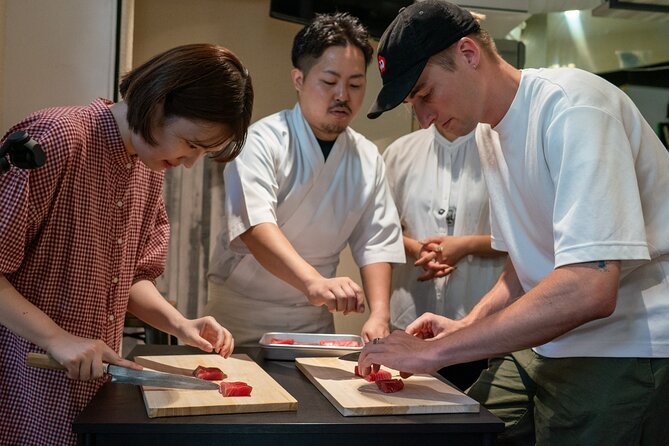
Japanese knife work is the real star here. In a small class near Nishi-Koyama, you learn how to sharpen and care for a Japanese knife, slice sashimi cleanly, and make decorative vegetable cuts before eating the meal you prepared. Amy and her team bring a warm, patient teaching style that makes this more than a standard cooking demonstration.
I like the personal instruction for a small group, especially if you own a Japanese knife and want useful skills to take home. I also like the balance of technique and lunch: you spend serious time on sharpening, then put the lesson to work with sashimi and tempura. The main consideration is the narrow focus. If you want a broad tour of Japanese cooking, two hours centered on knife work may feel specialized, and the listed schedule leaves little spare time.
In This Review
- Key points at a glance
- Why Japanese knife skills make a good Tokyo activity
- Meeting at Nishi-Koyama Station
- The 50-minute knife care and sharpening lesson
- Sashimi slicing and decorative vegetable cuts
- Preparing tempura alongside the sashimi
- Eating the handmade lunch
- What $123.79 represents
- Who will get the most from this class
- Should you book it?
- FAQ
- Where does the Japanese knife and cooking class meet?
- What time does the activity start?
- How long does the experience last?
- What food will I prepare?
- Will I learn how to sharpen a Japanese knife?
- Can I bring my own Japanese knife?
- How many people can join?
- Is transportation from my hotel included?
- What is the cancellation policy?
Key points at a glance
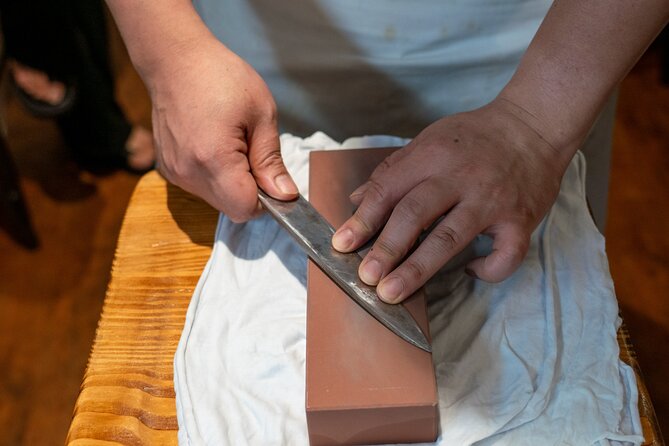
- Sharpening gets 50 minutes: This is not a quick safety talk. You spend most of the lesson learning knife care and sharpening.
- Sashimi and tempura become your lunch: You prepare both parts of the meal, then eat what you made.
- Decorative cuts are part of the challenge: You practice vegetable designs that may take patience and a steady hand.
- Amy is named as a guide: Her warm, funny manner comes through in the feedback, while the chef provides patient instruction.
- The class begins at noon: Meet at the ground-level exit of Nishi-Koyama Station, then walk about 10 minutes to the venue.
- Bring a knife if you have bought one in Japan: Provided knives are available, so you do not need to shop for one before coming.
Why Japanese knife skills make a good Tokyo activity
Many cooking classes teach you a recipe and send you home with a full stomach. This one puts the tool itself first. That matters because Japanese knives reward careful handling, and the cutting method affects the look and texture of ingredients, especially raw fish.
You learn how to hold and care for the knife before preparing food. That order makes sense. A sharp, properly maintained knife is safer and more useful than a costly blade treated like an ordinary kitchen tool. The class also gives you a practical answer to a common souvenir problem: you may buy a Japanese knife in Tokyo, then return home unsure how to sharpen it.
I like that the lesson is built around skills you can repeat. Sashimi slicing, vegetable decoration, and knife care are not facts you simply hear once. You practice them under a chef’s eye, then use the results in your own lunch.
The focus is not aimed only at expert cooks. The available feedback describes instruction that is patient and approachable, including for someone who had never learned these techniques before. Still, decorative cutting can be difficult. You should expect to work at it, not produce restaurant-perfect garnishes on your first attempt.
Other cooking classes in Tokyo

Meeting at Nishi-Koyama Station
The meeting point is at 6-chōme-3-10 Koyama, Shinagawa City, with the activity beginning at noon. More specifically, you meet at the ground-level exit of Nishi-Koyama Station. That is useful in a city where large stations can have a maze of exits, but you should still allow time to find the correct one.
From the station, your guide walks with you for about 10 minutes to the venue. This short walk is part of the experience rather than private transportation. Hotel pickup and transportation are not included, so you need to reach Nishi-Koyama on your own.
The station is near public transportation, which makes the meeting point practical for a Tokyo itinerary. I would avoid scheduling a major attraction immediately before this class. A noon start gives you room for a calm morning, and arriving early is wiser than trying to race across Tokyo with a new knife lesson ahead.
The activity ends back at the venue after lunch. You are not returned to your hotel or the station as part of the listed service, so leave yourself a few minutes to get your bearings and plan your next train trip.
The 50-minute knife care and sharpening lesson
The longest part of the class is the knife lesson, lasting about 50 minutes. That tells you where the value lies. The food is important, but the main product is the ability to treat a Japanese knife properly.
The chef explains sharpening and general care, then shows you how to handle the knife. You get to practice rather than simply watch. If you already own a Japanese knife, this is the point at which the class can become especially useful. Bring it along if you purchased it during your trip. If you did not buy one, use one of the knives supplied at the venue.
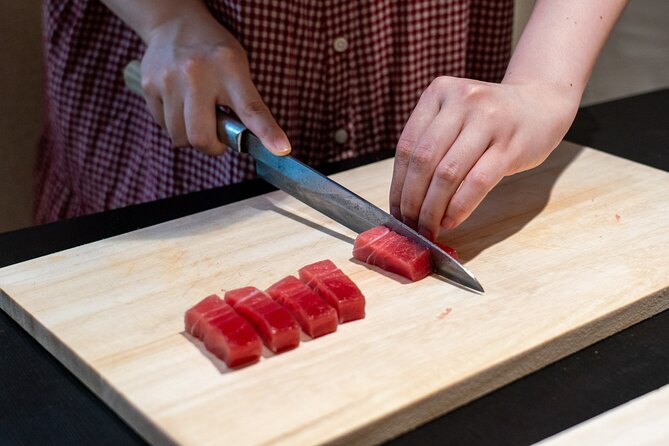
The instruction also covers how cutting brings out an ingredient’s best qualities. With sashimi, a clean slice matters to both appearance and texture. The point is not just to chop quickly. You learn controlled movement and precision, with the chef correcting your handling as you work.
This section may feel long to anyone who wants an immediate cooking activity. I see that as a fair trade if you are interested in Japanese blades. A short class that spends only five minutes on sharpening would be easier to fit into a busy day, but far less useful once you get home.
The class is described as private for two, with personalized attention, while the maximum group size is six and the minimum is two. That means you should confirm the exact group arrangement when booking if exclusivity matters to you. In every case, the small maximum supports close instruction better than a large demonstration class.
Sashimi slicing and decorative vegetable cuts
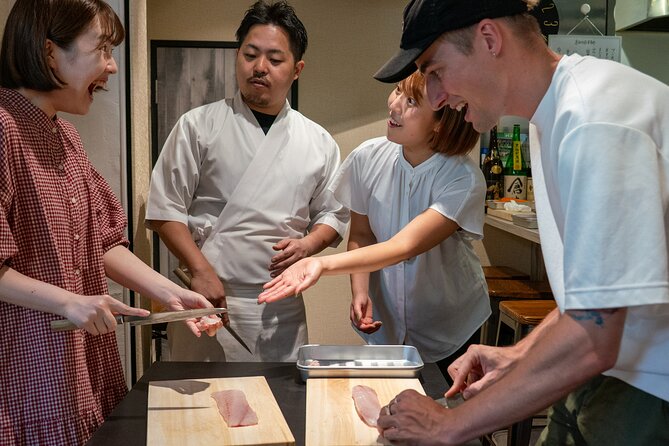
After the knife lesson, you move into food preparation. The class teaches sashimi slicing and decorative vegetable cutting, two skills that look simple when a chef performs them and become much harder when you try them yourself.
Sashimi is a good test of control. The cuts need to be neat, and the knife should move with purpose rather than force. You prepare your own sashimi portion, using the technique introduced earlier. This gives the sharpening lesson a clear purpose: you immediately see how a well-maintained knife behaves during delicate work.
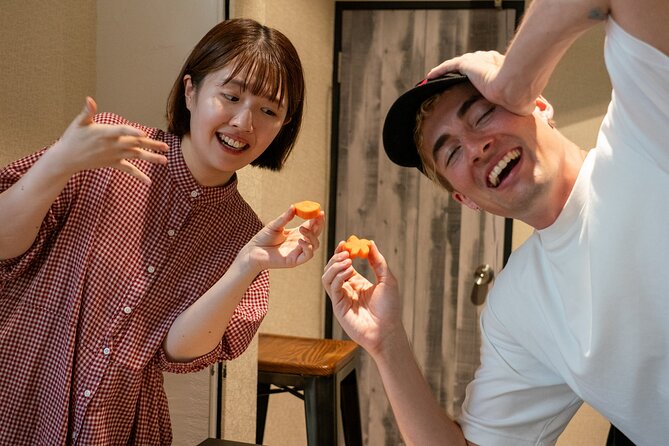
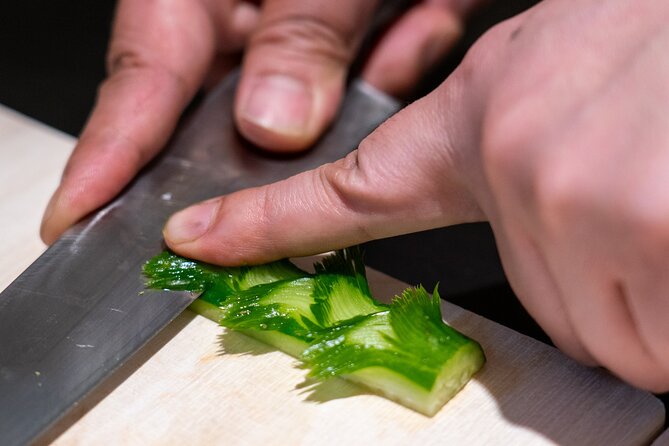
Decorative vegetable cutting adds a playful element. You may shape vegetables into attractive designs for the plate. One useful expectation is that this can be tricky. The difficulty is part of the lesson because it shows how much practice sits behind the precise food presentation you see in Japan.
Amy is identified as one of the guides, and the available feedback describes her as funny and welcoming. An English-fluent Japanese guide accompanies the class, which is important when the subject includes small hand movements and technical care instructions. You want to understand exactly how pressure, angle, and motion should work, not rely on broad gestures.
This is also where the class differs from a simple lunch activity. You are not just assembling food prepared in advance. The meal gives you a reason to practice, make mistakes, and improve before sitting down.
Preparing tempura alongside the sashimi
The cooking portion lasts about 30 minutes and includes both sashimi and tempura. The combination gives you two different knife and cooking experiences. Sashimi requires careful raw preparation, while tempura brings a cooked dish and a platter format to the meal.
The class does not present knife skills in isolation. You see how the same preparation habits support several kinds of Japanese food. Cutting vegetables for tempura is more practical than decorative cutting, while the sashimi work demands finer control.
Because the cooking period is listed as only 30 minutes, the pace may be fairly focused. You should not expect a long menu with many separate dishes. Instead, the class concentrates on producing a sashimi meal and a tempura platter within the available time.
That limited menu is a strength if you want one clear lesson and a manageable lunch. It may disappoint you if you are hoping to learn a full range of sauces, soups, or regional dishes. The description supports a specific knife-centered class, not a general survey of Japanese cuisine.
Other cooking classes in Tokyo




Eating the handmade lunch
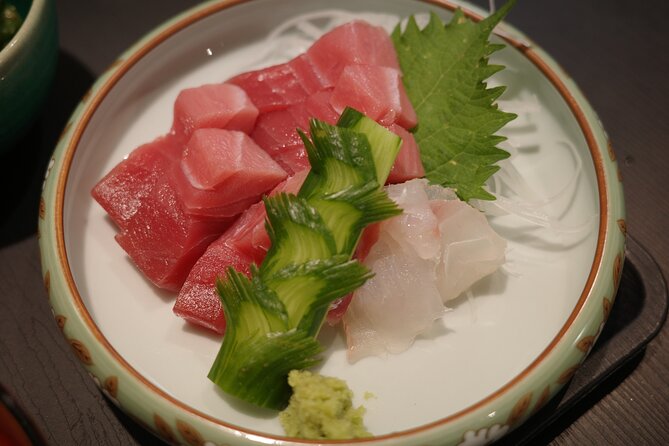
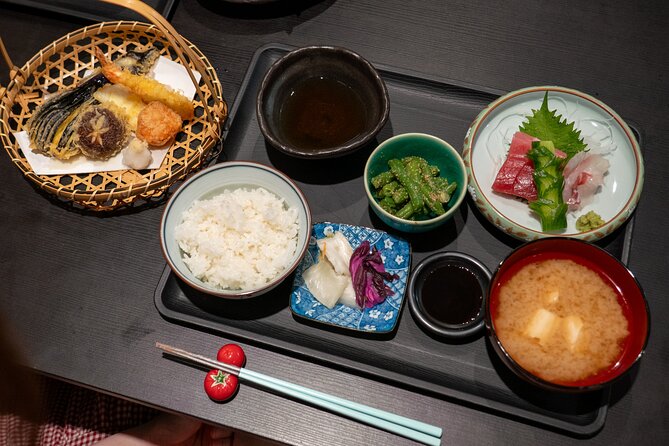
The final 30 minutes are set aside to enjoy the meal you prepared. You eat the sashimi and tempura lunch at the venue, with the satisfaction of seeing the earlier instruction on your plate.
I like this finish because it avoids the feeling of a class that ends the moment the work is done. You have time to appreciate the result and reflect on which techniques were hardest. The meal also gives you a clear measure of the class: the knife skills are tied to food you can see and taste immediately.
Lunch is included in the price, along with the knife lesson. Drinks and extras are not listed, so you should not assume anything beyond the prepared meal. The class is suitable for lunch planning because it starts at noon and ends after the meal, but the total experience is still only about two hours.
The detailed schedule adds up to 50 minutes for the knife lesson, 30 minutes for cooking, and 30 minutes for eating, plus the walk from the station. That is slightly longer than two hours if every segment runs fully. Treat the duration as approximate and avoid booking a tight appointment afterward.
What $123.79 represents
At $123.79 per person, this is not a bargain lunch. You are paying for a small-group lesson, chef instruction, sharpening practice, cooking, and the meal. The value depends on how much you care about the knife skills.
For someone who has bought, or plans to buy, a Japanese knife, the price can make sense. The class addresses a real need: learning to sharpen and care for the blade instead of taking home an expensive tool without guidance. You also get practice with sashimi and decorative cuts, which are difficult to learn from a written guide alone.
If your main goal is simply to eat sashimi and tempura, cheaper meals are easy to find in Tokyo. This class earns its price through personal attention and hands-on practice, not through the quantity of food. You should book it for the lesson first and the lunch second.
The experience is booked, on average, 24 days ahead. That suggests you should plan early, particularly if you need a specific date during a busy Tokyo visit. Confirmation is received at booking, and free cancellation is available up to 24 hours before the start time. Changes or cancellations made inside that window are not refunded, and the minimum group requirement applies.
Who will get the most from this class
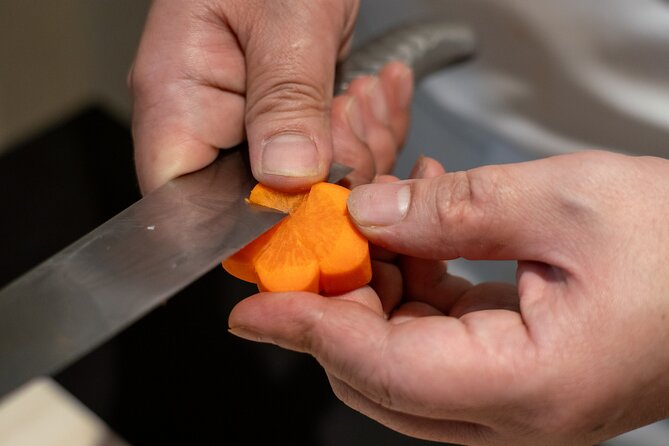
This is a strong choice for home cooks, food lovers, and anyone shopping for Japanese kitchen tools. It is also a good fit for couples because the class is presented as a private hands-on experience for two, with close chef attention.
You do not need to bring a knife. Provided knives are available, and the activity says all you need to bring is yourself. Still, bringing a Japanese knife bought during your trip could make the care lesson more personal and practical.
The class also suits a food-focused Tokyo schedule. Nishi-Koyama offers a change from the city’s best-known sightseeing areas, and the activity asks you to spend time learning rather than rushing from one landmark to another.
I would be more cautious if you want a broad Japanese cooking course, a large social group, or a long meal. The class is narrow, technical, and fairly short. Decorative cutting may test your patience, and the schedule does not leave room for a leisurely cooking workshop with many dishes.
Should you book it?
Book this class if you want to understand Japanese knives, learn sharpening from a Japanese chef, and use those skills to make sashimi and tempura. The strongest reasons are the small-group format, the 50-minute knife lesson, and the chance to take home a skill rather than only a food memory.
Skip it if you are mainly looking for a cheap lunch or a wide-ranging introduction to Japanese cooking. At $123.79, the price is justified by instruction and personal attention. Check the group arrangement if you specifically require a class limited to two people, then reserve well ahead of time and keep your afternoon schedule flexible.
FAQ
Where does the Japanese knife and cooking class meet?
You meet at the ground-level exit of Nishi-Koyama Station in Tokyo. The listed address is 6-chōme-3-10 Koyama, Shinagawa City, Tokyo 142-0062, Japan.
What time does the activity start?
The class starts at 12:00 pm.
How long does the experience last?
The experience lasts approximately two hours. The schedule includes a 50-minute knife lesson, a 30-minute cooking session, and 30 minutes to eat the meal.
What food will I prepare?
You prepare sashimi and a tempura platter, then enjoy the handmade lunch at the venue.
Will I learn how to sharpen a Japanese knife?
Yes. The knife lesson includes sharpening, knife care, and proper handling.
Can I bring my own Japanese knife?
Yes. You may bring a Japanese knife purchased during your travels. Knives are also provided if you do not have one.
How many people can join?
The activity requires at least two participants and has a maximum of six travelers. It is presented as a private hands-on class for two.
Is transportation from my hotel included?
No. Hotel travel and private transportation are not included. You meet at Nishi-Koyama Station and walk about 10 minutes to the venue with the guide.
What is the cancellation policy?
You can cancel up to 24 hours before the start time for a full refund. Cancellations or changes made less than 24 hours before the start time are not accepted for a refund.
More Workshops & Classes in Tokyo


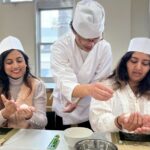
More Cooking Classes in Tokyo
More Cooking Classes in Tokyo
More tours in Tokyo we've reviewed









Cooking Classes, compared.
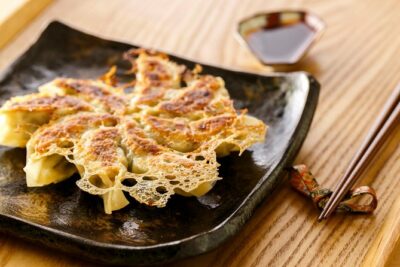 ★ 5.0Ramen & Gyoza Cooking Class in Tokyo with Local Supermarket VisitFrom $122
 ★ 5.0Ramen and Sushi Cooking Class with Sake Pairing Set in TokyoFrom $79
 ★ 4.9Tokyo: Wagyu and 7 Japanese Dishes Cooking ClassFrom $673 hours
 ★ 5.0Tokyo Washoku 4-hour Cooking Class: From Market to TableFrom $79
 ★ 5.0Professional Ramen & Gyoza with Ramen Chef in a restaurant!From $159
 ★ 5.0Small-Group Wagyu Beef and 7 Japanese Dishes Tokyo Cooking ClassFrom $72