
The first time I tried to photograph Tokyo Skytree I was standing on Azuma Bridge in Asakusa at about 4pm with a camera I didn’t really understand, and I could not fit the whole thing in the frame. Six hundred and thirty-four metres of lattice steel goes up a long way. You tilt the camera, you step back, you tilt some more, and eventually you realise the reason everyone photographs it from the far side of the Sumida River is because that’s the only place you can actually see it properly. I eventually got the shot by crouching on the pavement with my back pressed against the railing of the bridge, which is not a dignified photography technique but it worked.
Skytree is the tallest tower in Japan and the second-tallest freestanding structure on earth (the Burj Khalifa in Dubai holds first place, if you were wondering). It opened in May 2012, and it was built partly because digital television broadcasts needed a taller antenna than the old Tokyo Tower could offer, and partly because Tokyo had watched Shanghai and Dubai go vertical and wanted a statement of its own. It is a statement. It is also, if you time it right, one of the most useful observation experiences in the city — the one that shows you the bit of Tokyo that Shibuya Sky and the Tokyo Metropolitan Government Building observation floors cannot.
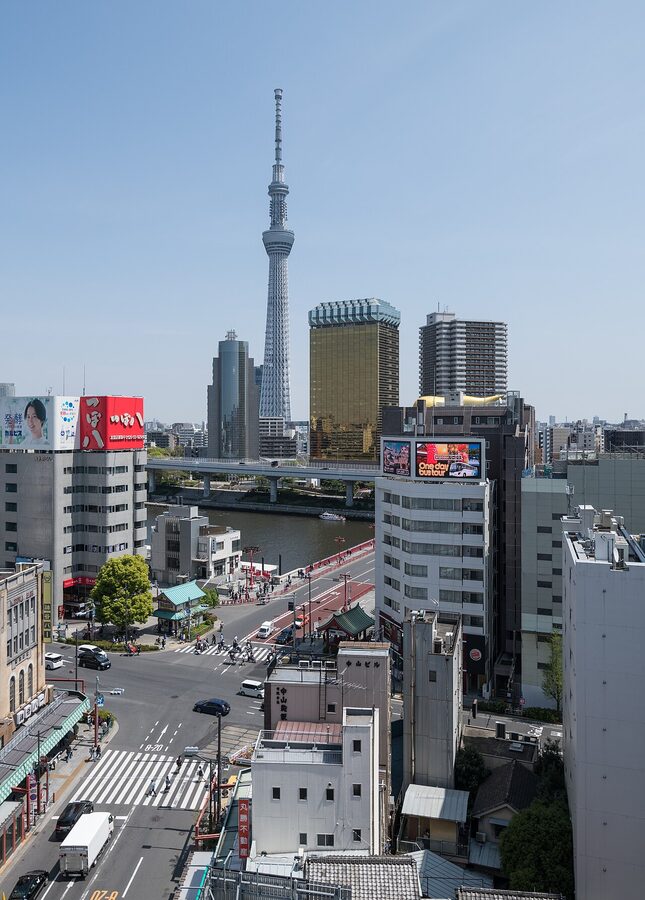
If you are trying to decide whether to go up the tower or just photograph it from below, the honest answer is that it depends on the weather, the day of the week, and what else you are doing in Tokyo. I’ll walk you through all of that. You’ll come out of this with a solid idea of when to book, which ticket to buy, which deck is worth the extra yen, and how to build Skytree into a half-day or full-day plan that includes Asakusa next door.
In This Article
- The short version, if you are in a hurry
- Two observation decks, one tower
- Tembo Deck at 350 metres
- Tembo Galleria at 450 metres
- Pricing, in more detail than you probably want
- How to actually book (and save some money)
- When is actually the best time to go up?
- What you actually see from the top
- Getting there
- Skytree Town: the mall you didn’t plan for
- What to actually do in Solamachi
- Photographing the tower from outside
- Combine it with Asakusa for a full day
- So is Skytree actually worth it?
- A bit of history, since the tower has more of it than you’d think
- Practical FAQ
- How long does the whole Skytree visit take?
- Is it good for kids?
- Do I need to book in advance?
- How does Skytree compare with Shibuya Sky and the Tokyo Metropolitan Government Building?
- Is there a cafe or bar at the top?
- Can I actually see Mt Fuji from up there?
- What happens if my timed slot is cloudy?
- Is the tower open during earthquakes or bad weather?
- Short version, once more
The short version, if you are in a hurry
Skytree has two paid observation decks (the main one at 350 metres called Tembo Deck, and the upper one at 450 metres called Tembo Galleria), and underneath the tower is a 312-shop shopping and dining complex called Tokyo Solamachi. Tickets cost roughly ¥2,100 to ¥2,700 for the main deck and around ¥3,100 to ¥3,800 for the combined ticket, depending on the day and time slot. Book online in advance to save around fifteen percent and to skip the queue. Best visibility is December to February; avoid summer afternoons. And yes, on a clear winter day you can see Mt Fuji from the top.
That is the gist. The rest of this guide is the detail that matters if you actually want to do it well.
Two observation decks, one tower
Skytree is not a single deck you ride up to. It is two separate paid observation levels, stacked on top of each other, and you can buy them individually or bundled. They are genuinely different experiences and the upper one is not always worth the money.
Tembo Deck at 350 metres
This is the main observation deck and the one most people visit. It spans three floors (340, 345, and 350 metres), is entirely glass-walled with reinforced windows, and has seated areas, a small cafe, a gift shop, and a handful of sections where the floor itself is glass — you stand on it and look straight down at the street 340 metres below. I am not usually squeamish about heights, but I will admit I took a second before I walked across those panels. The first time you do it your brain insists on a small, polite pause.
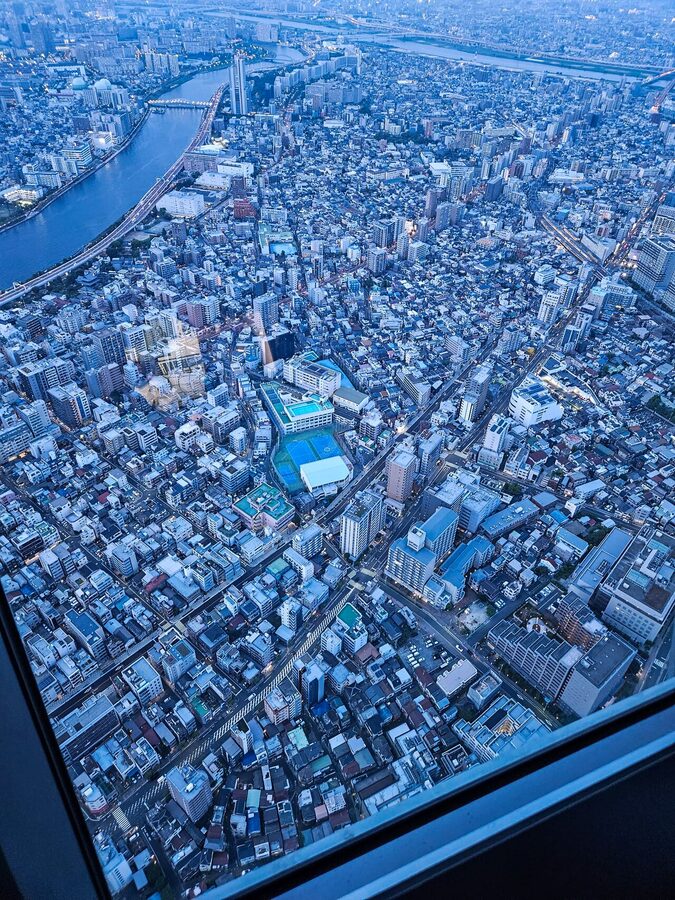
Tickets for Tembo Deck alone are ¥2,100 booked online in advance and ¥2,400 at the door. The elevator ride to the top takes fifty seconds, which feels quick until you realise it is climbing 350 metres in that time (that is roughly 420 metres per minute, and your ears pop). Allow forty-five to seventy-five minutes for the deck visit itself. The rotation around all three floors is a slow wander — you are not rushed.
Tembo Galleria at 450 metres
The upper deck is connected to Tembo Deck by a separate, internal elevator. You can only reach it if you have already paid for Tembo Deck entry. It is a spiral ramp that climbs from 445 metres to 450 metres, and the walk itself is the point — you circle the inside of the tower, gaining height slowly, until you reach a small glass-floor section at the top which is officially the highest public viewing point in Japan.
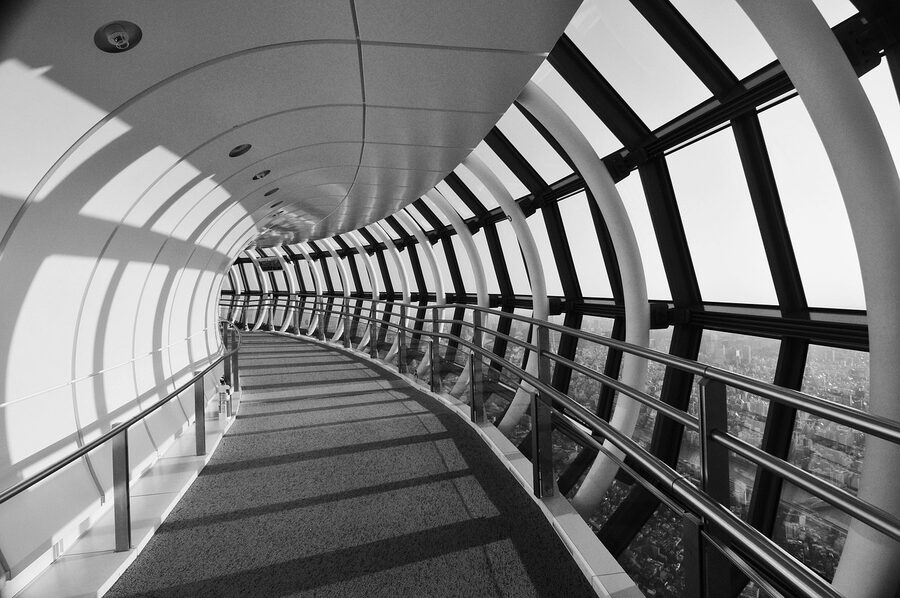
The Galleria add-on costs ¥1,000 on top of Tembo Deck entry. A combined ticket is ¥3,100 online or ¥3,400 at the door. Here is my honest rule: buy the combined ticket only if the weather forecast shows good visibility on the day you are going. If it is hazy or low-cloud, skip the Galleria upgrade — you will literally see less than you would from Tembo Deck, because the extra hundred metres of altitude puts you into the cloud layer rather than above it.
That said, if the sky is clear and you are already up there, the Galleria is worth the extra ¥1,000. The spiral ramp is genuinely atmospheric, the glass-floor section at 450 metres is fun, and the view over Chiba and the bay is meaningfully different from 350 metres.
Pricing, in more detail than you probably want
Skytree’s ticketing changed in 2023 to a time-based variable rate system. Peak slots (Saturday and Sunday, plus Japanese public holidays, and the cherry blossom and autumn seasons) cost more than quiet weekday mornings. Here is how the numbers shake out:
- Tembo Deck only: ¥2,100 to ¥2,700 depending on the day and time slot. Online booking is roughly fifteen percent cheaper than walking up.
- Tembo Deck and Galleria combined: ¥3,100 to ¥3,800 total. The Galleria add-on is effectively a thirty percent uplift.
- Fast-track “Skytree Enjoy Pack”: ¥500 to ¥1,000 extra for priority elevator access. Worth it on a busy Saturday afternoon if you hate queues; ignore it on a Tuesday morning.
- Children: half-price under 12, free under 6. There is a family discount for two adults and two children.
If you are comparing observation decks in Tokyo, Shibuya Sky is ¥2,500 for a single rooftop experience with no upper-deck upgrade available, fewer floors overall, but more dramatic open-air exposure. The free Tokyo Metropolitan Government Building observation deck in Shinjuku costs nothing but gets you about 202 metres up with a different (west-facing) view. Skytree is the tallest of the three and the most expensive, and the money buys you altitude and the east-side view that the others cannot offer.
How to actually book (and save some money)
The official booking site is en.tokyo-skytree.jp. Timed-entry slots release thirty days in advance. Weekend slots in early April (cherry blossom) and mid-November (autumn colour) tend to fill up two to three days ahead, so book early if you are visiting in those seasons. Weekday winter slots are usually available same-day without much fuss.
Third-party resellers like Klook and GetYourGuide resell the same timed-entry bundles at similar or occasionally slightly lower prices, sometimes including Solamachi meal vouchers or Sumida Aquarium combo tickets. Read the specific slot rules before buying — some resellers lock you to a narrow entry window and others give you a two-hour flexible range.
Walk-up tickets are possible but weekend queues at the Tembo Deck ticket counter can hit sixty to ninety minutes. If you are already in the area and the day is clear, you can chance it — but I would always book online when you know your plan.
When is actually the best time to go up?
Visibility is everything. I learned this the hard way on a July afternoon when I paid full price for the combined ticket and got up to Tembo Deck to see a wall of grey haze in every direction. You could not see Tokyo Tower, let alone Fuji. Three factors matter:
Time of year. December through February gives you the clearest air. Mt Fuji is visible on roughly fifty to seventy percent of winter days, which is by far the highest hit rate. Summer visibility drops to ten to thirty percent because of heat haze and humidity. Spring and autumn are in between. If you are choosing when to visit and Fuji-from-Skytree is on your list, go in winter.
Time of day. Sunset is the dramatic slot — you get the colour changes in the sky, the city lights coming on, and the blue hour afterwards when there is still light in the sky but the city is already glowing. Mid-morning (around 10 to 11am) is typically the clearest, and the crowds are thinnest. Afternoon is usually the haziest slot. If you want Fuji, aim for morning.
Weather. Check the live webcam on the official site before you leave your hotel. If the top of the tower is in cloud, save the trip for another day. Tickets are non-refundable for no-shows, but timed entry slots can usually be rescheduled if you contact customer service in advance.
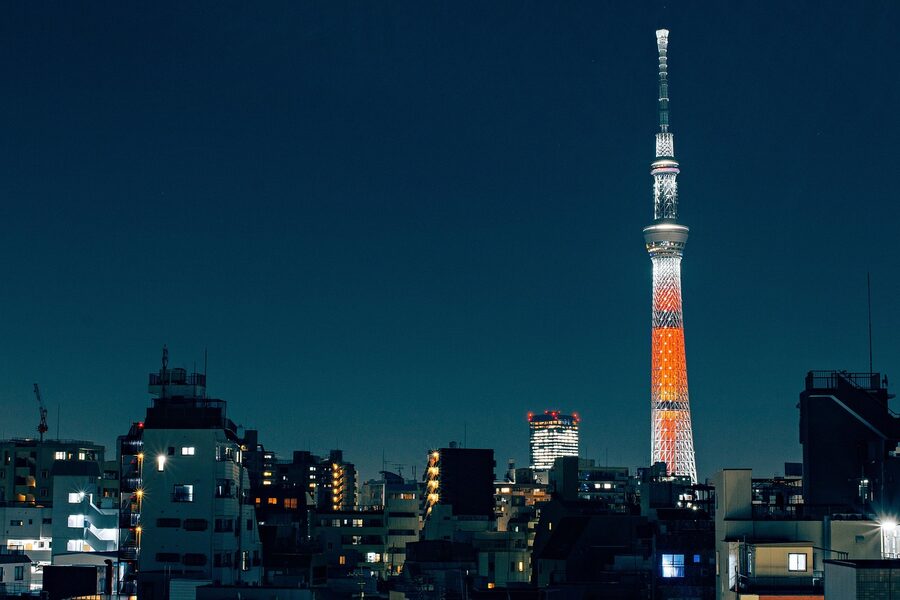
What you actually see from the top
Standing on Tembo Deck, here is what a clockwise scan of the horizon gives you:
West — central Tokyo. You can see Tokyo Tower in the mid-distance about ten kilometres away (it looks surprisingly small from up here — Tokyo Tower is 333 metres tall, and you are looking at it from 350 metres up a structure that is 634 metres tall). Beyond that, the Shinjuku cluster of skyscrapers. On a clear winter day, Mt Fuji rises behind all of it, a hundred kilometres further west.
South — Tokyo Bay. You can pick out the Rainbow Bridge, the Odaiba waterfront, and sometimes Haneda Airport’s runways on the horizon. At night the bay is a dark gap in the middle of the city lights, which is quite striking from above.
East — the river flats and Chiba prefecture. This is the view that no other observation deck in Tokyo offers you, and it is arguably the most interesting. You see the residential and industrial east side of the city, the way it sprawls out into the countryside, the bends of the rivers. It is less dramatic than the west-facing skyline view but it is a real slice of Tokyo that most tourists never notice from street level.
North — Saitama prefecture and the mountains beyond. On a very clear winter day you can see the Japan Alps in the distance. Mt Tsukuba, a locally famous peak, sits to the north-east and rises cleanly above the flat Kanto plain.
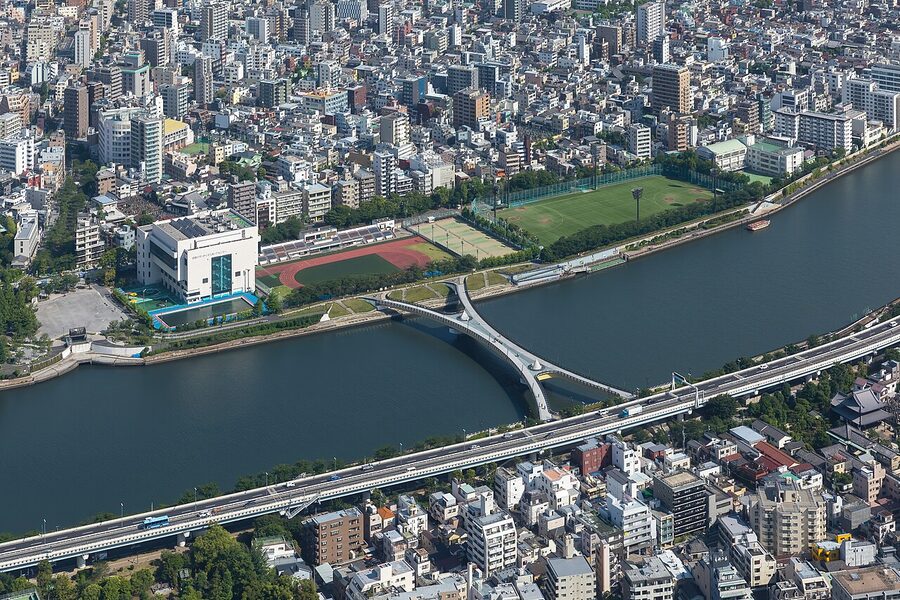
Directly below — the Sumida River, the roofs of Asakusa (you can spot Senso-ji by its five-storied pagoda), and the Asahi Flame on top of the Asahi Beer Hall. Looking straight down through the glass floor sections at the base of the tower is the moment that most people take photos of their feet to send home.
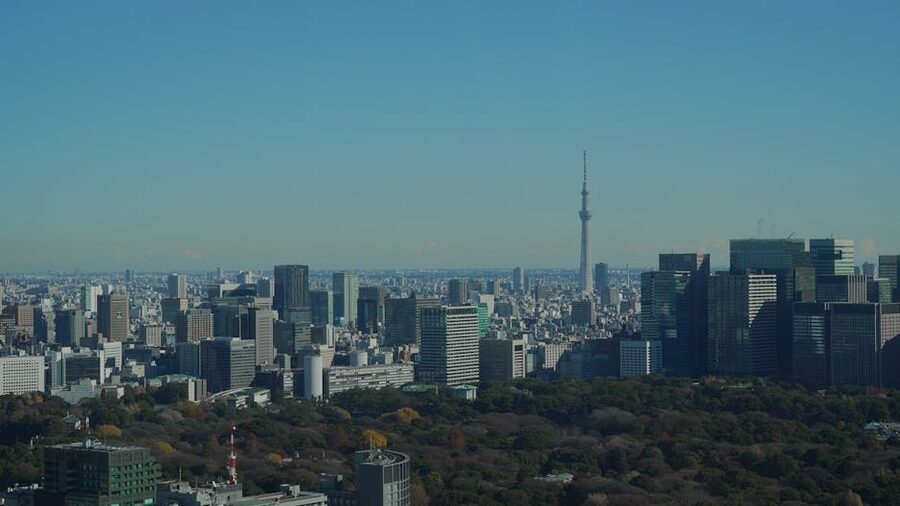
Getting there
Skytree has its own train station, which is genuinely useful. The tower is linked directly to two stations:
Tokyo Skytree Station (とうきょうスカイツリー駅) is on the Tobu Skytree Line, and it is literally at the base of the tower. From Asakusa Station it is one stop (¥150, three minutes). If you are walking from the centre of Asakusa, you can skip the train entirely — it is fifteen to twenty minutes across Azuma Bridge and along the Sumida riverfront, which is a pleasant walk in good weather.
Oshiage Station is on multiple lines (Tokyo Metro Hanzomon, Toei Asakusa, Keisei Oshiage, and Tobu Skytree) and is directly connected to Skytree Town through the underground passageways. From Shibuya, you take the Hanzomon line directly to Oshiage — thirty-five minutes, ¥280. From Tokyo Station, change at Mitsukoshimae to the Hanzomon line. Either way, follow the signs for “Skytree” once you arrive and you cannot miss it.
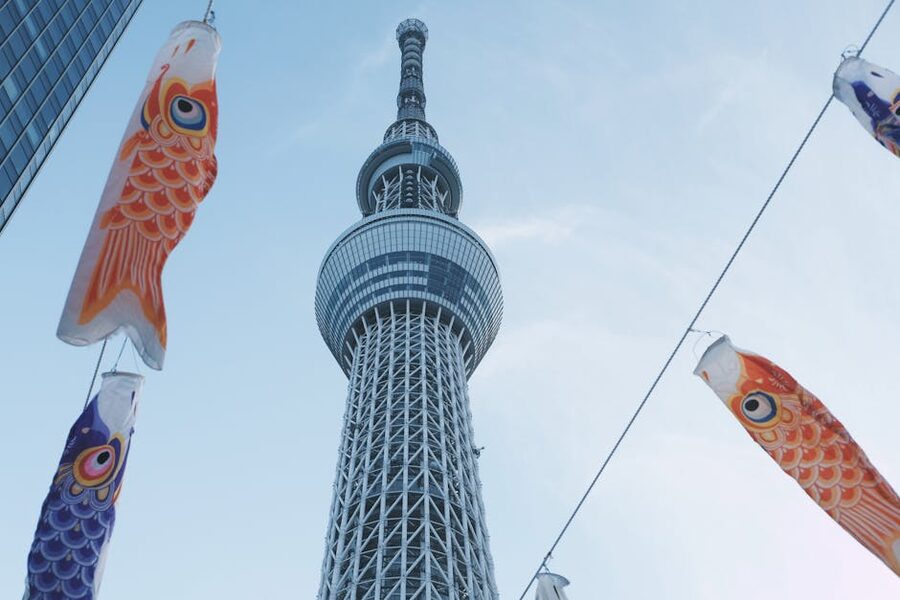
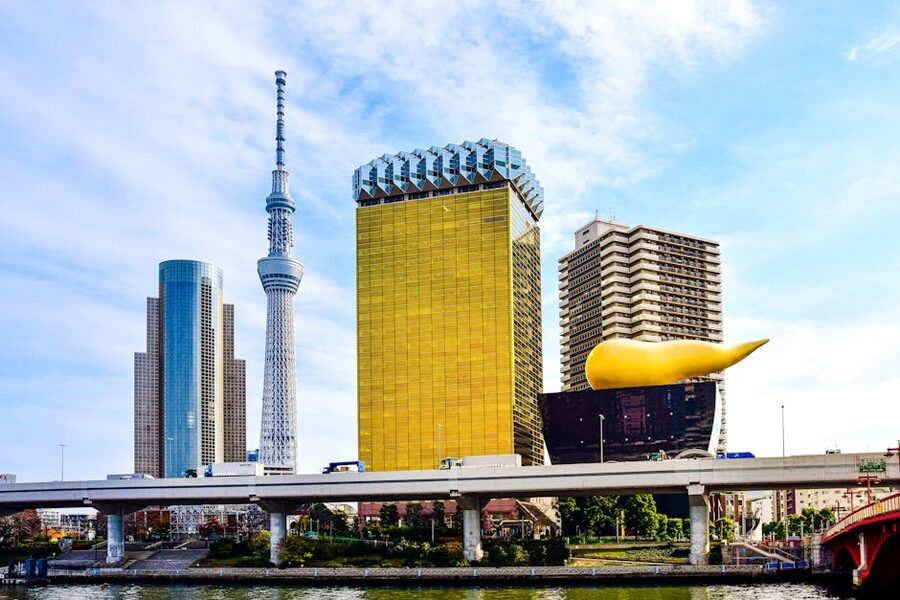
I find the walk from Asakusa the best option if the weather is reasonable. You get to cross Azuma Bridge (good photo angle of the tower over the river), pass the Asahi Beer Hall with the giant gold flame sculpture on top (which is, to be clear, the weirdest piece of architecture in Tokyo and absolutely worth seeing up close), and then you follow the riverside walkway for about ten minutes until you arrive at the base of the tower. In cherry blossom season this walk is particularly lovely because you pass through the south end of Sumida Park, which is lined with sakura trees.
Skytree Town: the mall you didn’t plan for
This is the bit most first-time visitors don’t realise. Skytree sits on top of a 312-shop shopping and dining complex called Tokyo Solamachi (東京ソラマチ). Four main floors of retail, two dedicated restaurant floors, a planetarium on the seventh floor, an aquarium on the fifth and sixth floors, and a postal museum in the east tower. You can genuinely spend a full day here without going up the tower at all, and on a rainy day it is an excellent place to stash yourself indoors.
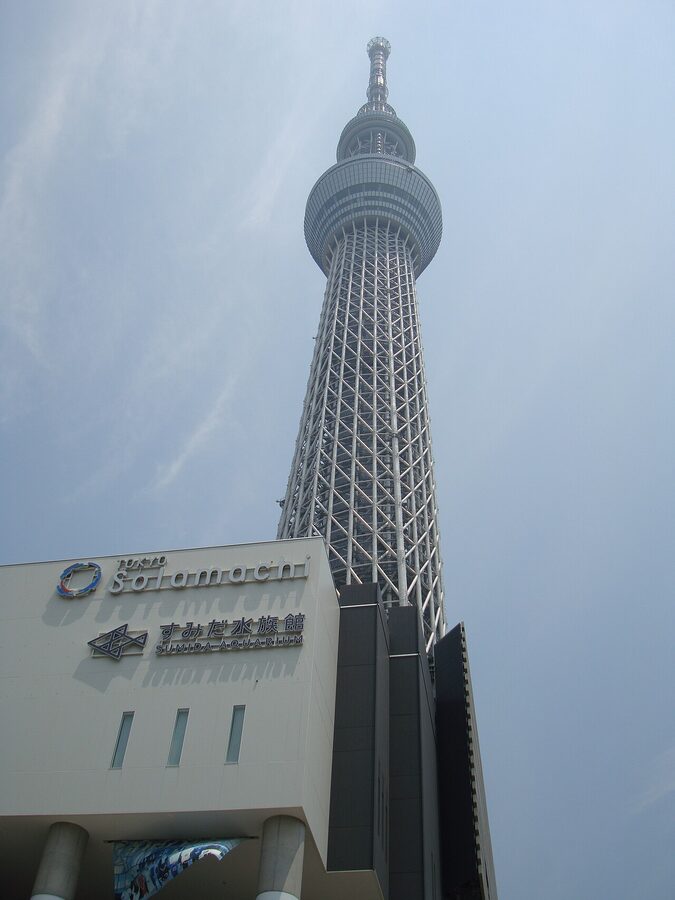
What to actually do in Solamachi
If I am being honest, Solamachi is a better-curated mall than most Tokyo shopping complexes. The mix skews toward Japanese brands and speciality stores rather than global chains, which makes it more interesting for a visitor. Here are the bits worth prioritising:
Sumida Aquarium on the fifth and sixth floors is a modern, small-footprint aquarium with a much-loved penguin pool (the path wraps around the tank so you can watch them from about seven different angles) and a famously well-lit jellyfish tank. ¥2,500 for adults, roughly half that for children. It is not the Osaka Kaiyukan or the Enoshima Aquarium in scale, but it is well-designed and it fits neatly into a Skytree visit.
Konica Minolta Planetarium on the seventh floor runs programmes in Japanese but with a visual-heavy approach that works fine for non-speakers. ¥1,500 adult, and the reclining seats are comfortable enough that a tired afternoon visitor might genuinely nod off during the show. I have.
Tokyo Banana has its flagship shop here — the ubiquitous banana-shaped sponge cake is genuinely a decent souvenir, and the Solamachi store has flavours you will not find at the airport. The shelf life is short (about a week) so buy it near the end of your trip.
Ukiyo-e gallery on the fourth floor is free and has rotating exhibitions of Edo-period woodblock prints. It is a small space but a good palate cleanser between shopping sessions.
Postal Museum Japan on the ninth floor of the east tower is ¥300 and is weirdly fascinating — it covers the history of Japanese mail from the Meiji era to the present, with a collection of stamps and postal uniforms. Worth an hour if you are interested in twentieth-century Japanese social history.
For food, the sixth and seventh-floor restaurant levels are reliable mid-range at ¥1,200 to ¥3,500 per person. The specifically-themed tourist restaurants (the ones with English-heavy signage and photo menus) are skippable; aim for the local izakaya chains and ramen counters instead. There are also grab-and-go food stalls on the lower floors if you want to eat cheaply and then go sit by the river.
Photographing the tower from outside
Some of the best Skytree photos are not taken from the top. They are taken from specific street-level angles around the base, and here are the ones that I keep coming back to:
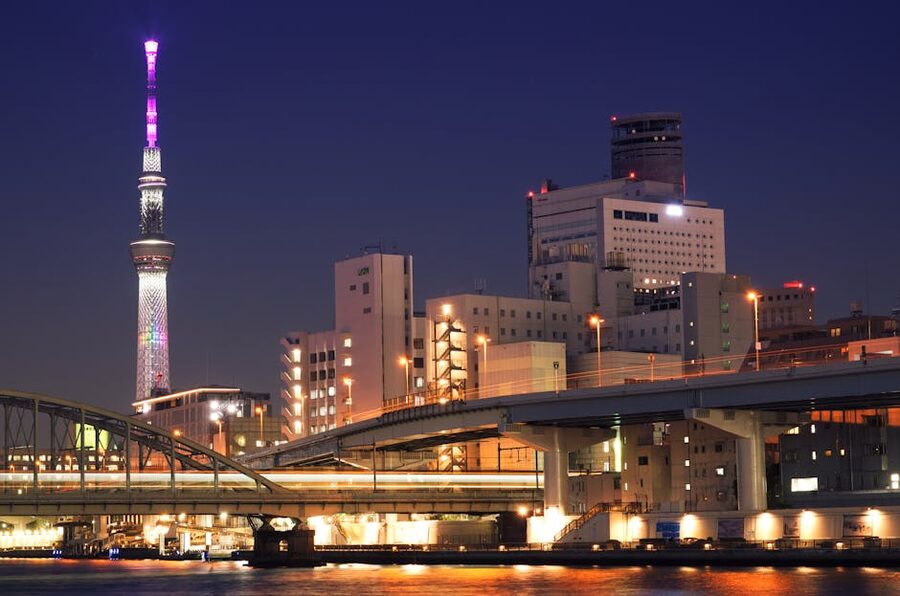
Azuma Bridge from the Asakusa side. This is the classic. Tower plus the Asahi Flame plus the Sumida River in one frame. Best at blue hour (roughly thirty minutes after sunset) when the sky is still holding some colour and the tower lights are on. Arrive fifteen minutes before sunset to claim a spot on the railing — the bridge gets crowded.
Sumida Park north end. In early April the cherry trees here are at peak bloom and they frame the tower beautifully. In late November you get autumn colour doing the same job. Less dramatic than Azuma Bridge but softer, and quieter because it is further from the main tourist drag.
Jikken Bridge. North of Skytree, looking back down. This one is a wide-angle vertical shot with the tower looming above. Almost nobody goes here for photos, which is exactly why it is worth the walk.
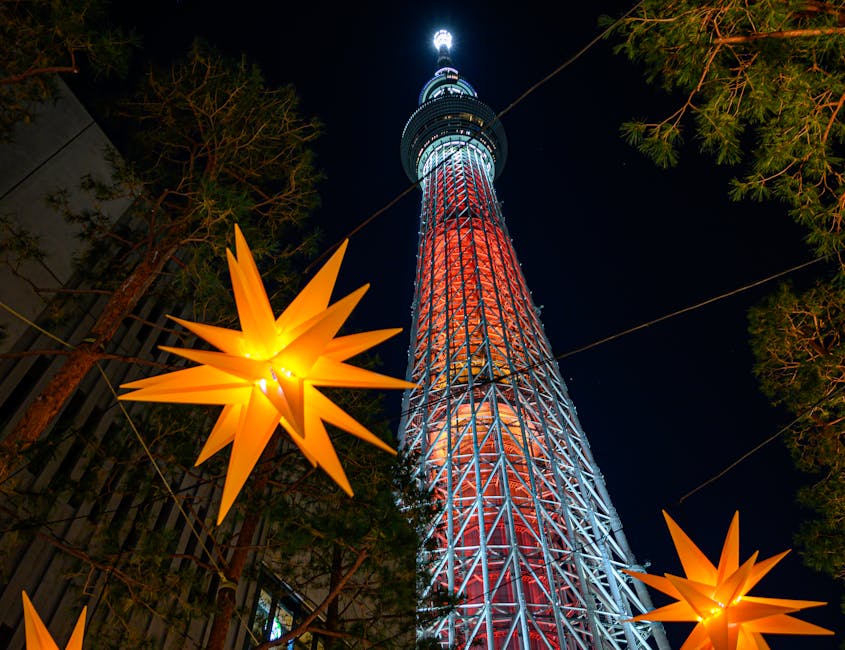
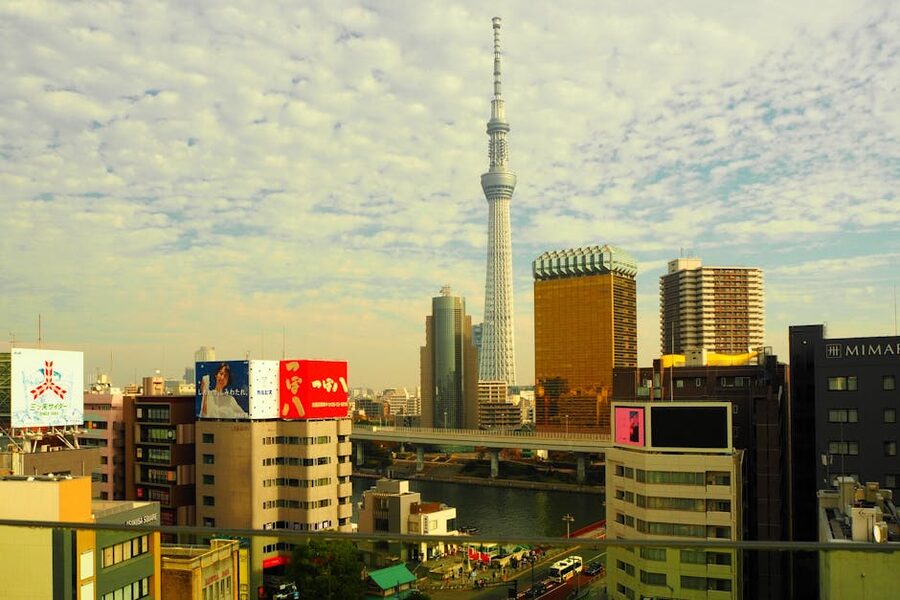
Worm’s-eye view from directly below. Stand at the Skytree base entrance, look up, phone vertical. You get the classic tapering-to-a-point composition that works on any camera. This is the Instagram shot.
Reflection shots. After rain, the paving around the Solamachi base pools up in a way that reflects the tower cleanly. You can also get reflections in the river from the Kototoi Bridge area. Low light is best for these.
Combine it with Asakusa for a full day
Skytree is right next to Asakusa, and the two are made to be visited together. Here is a plan I have used and recommended several times:
Morning (9:30am to 12pm). Skytree visit. Aim for a 10:30am timed slot — the air is clearest mid-morning and the crowds are still manageable. Forty-five minutes on Tembo Deck, thirty more on Galleria if the weather is clear, then a quick spin through Solamachi on your way out.
Lunch (12pm to 1pm). Eat in Solamachi — sixth-floor restaurants, ¥1,500 to ¥2,500. Or grab a bento from the basement food hall and walk across to Sumida Park to eat by the river in good weather.
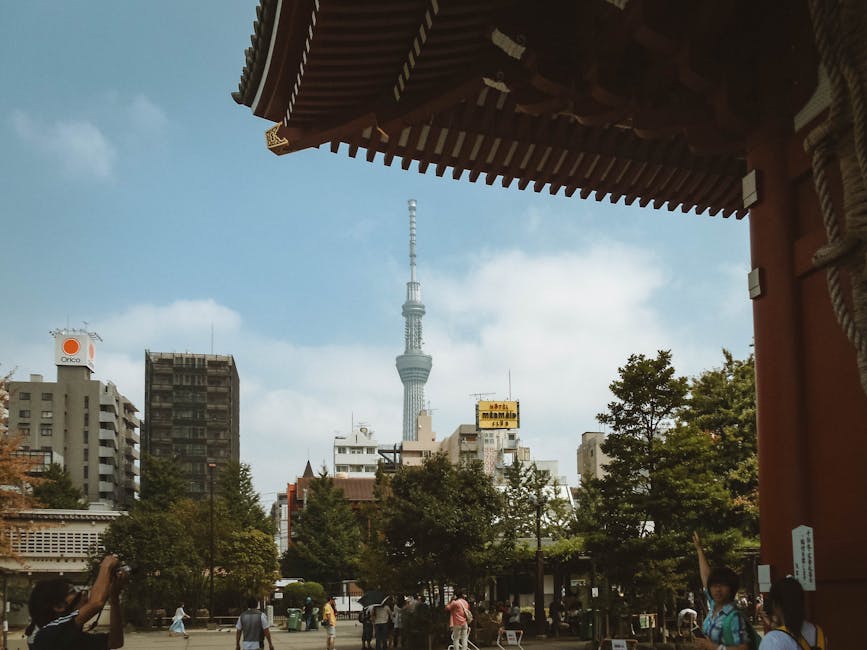
Afternoon (1pm to 4pm). Walk across Azuma Bridge to Asakusa. Visit Senso-ji, wander Nakamise shopping street, get a rickshaw ride if you fancy it, eat a melon pan from the bakery near Kaminarimon. This is the old-Tokyo half of the day.
Late afternoon (4pm to 5:30pm). Back toward the river. Walk along the Sumida promenade watching Skytree as the light changes. Stop for coffee at one of the small cafes on Hoppy Street.
Blue hour (5:30pm to 6:30pm depending on season). Back to Azuma Bridge for the blue-hour shot of Skytree with the Asahi Flame and the river. This is the picture you came to Tokyo to take.
Dinner (7pm onwards). Either back to Asakusa for izakayas, or back across to Solamachi for one of the higher-end restaurants on the upper floors. If you planned it right, you are now tired, full, and holding a phone full of photos.
Full context on the temple side in my Asakusa guide, and if you are figuring out where to stay, the budget Tokyo accommodation guide has a breakdown of which neighbourhoods give you the easiest access to this east-Tokyo area.
So is Skytree actually worth it?
Honestly? Yes, but not always. Here is when I think it earns the ticket price:
It is worth it if: it is your first trip to Tokyo and you have not done any other observation deck; you are visiting in winter when Fuji visibility is high; you specifically want the east-side river-and-bay view that Shibuya Sky and the Metropolitan Government Building cannot show you; you are already spending the afternoon in Asakusa and want to round out the day; you have children who will enjoy the glass floor sections and the Sumida Aquarium.
Skip it if: the forecast shows cloud or haze at the top; you have already done Shibuya Sky and cannot decide whether to add a second observation deck (in that case, skip or use the free one in Shinjuku); you dislike queues and do not have a pre-booked ticket; it is a humid summer afternoon.
My honest view, after several visits: Skytree does exactly one thing better than any other Tokyo observation deck, which is the view east over the river flats, the bay, and residential Tokyo. For the classic Tokyo postcard view (Fuji plus skyscrapers), Shibuya Sky is more dramatic and the free Tokyo Metropolitan Government Building deck gives you a perfectly good west-side view for no money. Pick Skytree when you want the specific thing it offers, not simply because it is the tallest.
A bit of history, since the tower has more of it than you’d think
The case for building Skytree started quietly in the early 2000s. Tokyo Tower, the red-and-white Eiffel-Tower-lookalike in Minato from 1958, had been the broadcasting hub for decades. But when Japan began its transition to digital terrestrial television in 2003, broadcasters started lobbying for a taller antenna. The problem was that the skyline around Tokyo Tower had grown up — new skyscrapers were interfering with the signal. Something taller was needed.
A consortium of six Japanese broadcasters (NHK plus the five major commercial networks) joined forces with Tobu Railway, which owned a suitable piece of land in the Oshiage-Narihirabashi area next to Asakusa. Site selection was decided in 2006, design work ran through 2007 and 2008, and construction began in July 2008. The tower topped out at 634 metres in March 2011, just four days before the Tohoku earthquake struck.
That detail is important. The 2011 earthquake tested the tower during construction — not a full load, but a serious seismic event at high altitude. The building used a central concrete column called the “shimbashira” that mimics the seismic-absorbing design of the five-storied pagodas of traditional Japanese temples. In simple terms, the central column moves slightly out of sync with the outer steel frame during an earthquake, and the two sections damp each other’s movement. It is old engineering, borrowed from 1,400-year-old temples, updated with modern materials.
The final height of 634 metres was chosen partly because “634” in Japanese can be read as “musashi” — Musashi being the old name for the region that includes modern Tokyo. So the tallest tower in Tokyo literally spells out the old name of the place it is standing in. That is the sort of detail I find charming.
Skytree opened to the public on 22 May 2012. In its first week it had more than a million visitors. By 2013 it was already averaging around 16,000 daily visitors, and that rough number has held more or less steady ever since. It became, almost immediately, the visual anchor of east Tokyo — the thing you use to orient yourself when you are lost on the streets of Oshiage or Mukojima.
Practical FAQ
How long does the whole Skytree visit take?
Allow two to three hours minimum, not counting travel. Thirty to forty-five minutes on Tembo Deck, another thirty to forty-five on Galleria if you bought the combined ticket, and then sixty-plus minutes wandering Solamachi on the way out. Add the Sumida Aquarium and you are at four hours. Add a meal in Solamachi and you are at five.
Is it good for kids?
Yes. The Sumida Aquarium in the base is a genuine kid-magnet (the penguin pool is the reason — children can spend an hour there alone). The glass-floor sections on Tembo Deck produce a predictable giggle. The Galleria spiral ramp is less interesting for small children, so skip the upgrade unless they specifically want the highest-point experience.
Do I need to book in advance?
Recommended but not always required. Weekend slots in early April (cherry blossom) and mid-November (autumn colour) can sell out two to three days ahead. Weekday winter slots are usually available same-day at the door. If you are travelling on a tight schedule, book — missing the tower because you could not get in would be frustrating.
How does Skytree compare with Shibuya Sky and the Tokyo Metropolitan Government Building?
Skytree: tallest (450m public), paid, best east-facing view, most crowded. Shibuya Sky: mid-height (229m), paid, most dramatic open-air rooftop deck, best central-Tokyo view. Tokyo Metropolitan Government Building: 202m, free, solid city-wide view with Mt Fuji visible on clear days from the north observatory. If you want just one, pick based on what view you care about most.
Is there a cafe or bar at the top?
Tembo Deck has Skytree Cafe with drinks at ¥600 to ¥1,500 and simple snacks. No alcohol is served at the top. If you want a rooftop-bar experience with a view, Shibuya Sky’s rooftop has standing beer, and the Park Hyatt New York Bar in Shinjuku still runs for a more classic option.
Can I actually see Mt Fuji from up there?
On clear winter days, yes. December to February gives you roughly fifty to seventy percent visibility. Summer visibility drops to ten to thirty percent because of heat haze. The official site has a live webcam that tells you the current visibility at the top — check it before leaving your hotel. If Fuji is your main reason for going up, aim for a cold, clear morning in January or February.
What happens if my timed slot is cloudy?
Tickets are non-refundable for no-shows, but you can usually reschedule a timed-entry slot if you contact customer service in advance. There is no rain-check policy for just-showing-up-and-it’s-cloudy. Plan for the weather.
Is the tower open during earthquakes or bad weather?
The tower closes in strong winds (sustained gusts over certain thresholds) and during significant earthquakes for safety inspection. Operational closures are rare but they happen; check the official site on the morning of your visit. In mild weather it is open from 10am to 10pm daily, with last elevator entry at 9pm.
Short version, once more
Tokyo Skytree is 634 metres of broadcasting tower with two paid observation decks and a 312-shop mall at its base. Book online in advance, aim for a clear winter morning if you can, and pair it with a walk across the Sumida to Asakusa for the best half-day plan in east Tokyo. The view east is what it does better than any other observation deck in the city. Do not go up in haze or cloud. Do go up at sunset for the colour changes if the sky is clear. And if you only care about Fuji, come in January or February and check the webcam before you leave your hotel.
For the rest of Tokyo, my other guides cover the neighbouring district in detail — Asakusa, Senso-ji Temple, and if you are working out where to stay while you see all this, the budget-conscious accommodation breakdown has the neighbourhood-by-neighbourhood rundown.