
Reviewed · ASAKUSA TOURS
Asakusa Night Evening Walking Tour with English-Speaking Guide
Asakusa changes character after sunset. The red Kaminarimon Gate glows against the evening sky, Senso-ji feels calmer once daytime crowds thin out, and the lanes near Hoppy Street begin to fill with the warm light of small pubs. This one-hour walk gives you a useful introduction before dinner, with stories about local customs, temple traditions, and Asakusa legends.
I like two things in particular: the short route covers several important sights without eating up your evening, and the guide adds the context that is easy to miss on your own. Guides such as Takumi and Mio have been praised for making the walk clear, fun, and easy to follow. The main consideration is timing: the main hall at Senso-ji closes at 6 PM, so this is an evening sightseeing walk rather than a chance to enter every temple building.
In This Review
- Key points to know before booking
- Why Asakusa works so well at night
- Starting beneath the Kaminarimon lantern
- Walking Nakamise toward Senso-ji
- Seeing Senso-ji when the crowds have gone
- A short pause at Asakusa Shrine
- Hanayashikidori and Asakusa’s old entertainment side
- Ending with izakayas on Hoppy Street
- What the $34.29 price really buys you
- Guides, pace, and the kind of experience to expect
- Who should book this evening walk
- Should you book the Asakusa night walk?
- FAQ
- How long does the Asakusa night walking tour last?
- What language is the tour conducted in?
- Where does the tour start?
- Where does the tour end?
- Is food or drink included?
- Can I enter the main hall at Senso-ji during the tour?
- How many people can join the tour?
- Is the tour near public transportation?
- Can I cancel for a full refund?
Key points to know before booking
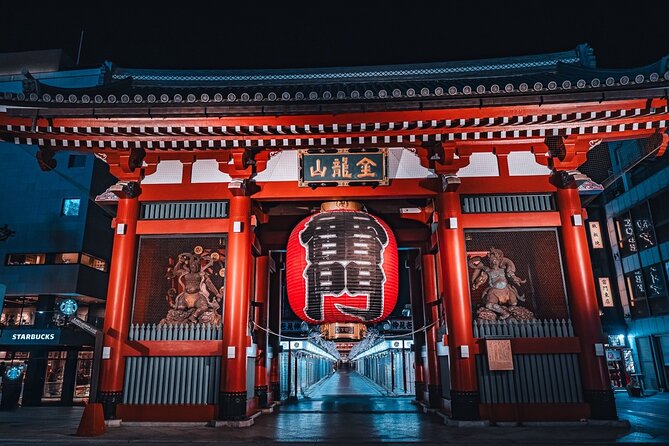
- Kaminarimon after dark: Begin beneath Asakusa’s huge red lantern, with time to see the gate and its wind and thunder deities.
- A quieter Senso-ji: See the temple grounds after the busiest daytime hours, though the main hall may already be closed.
- Six compact stops: The route allows about 10 minutes at each location, keeping the pace brisk and focused.
- Local stories from an English-speaking guide: Takumi, Mio, and other GuideMe Japan guides explain the sights in plain English.
- Dinner-ready finish: End on Hoppy Street, where you can continue with izakaya food and drinks at your own expense.
- Small group format: A maximum of eight people makes it easier to hear the guide and ask questions.
Why Asakusa works so well at night
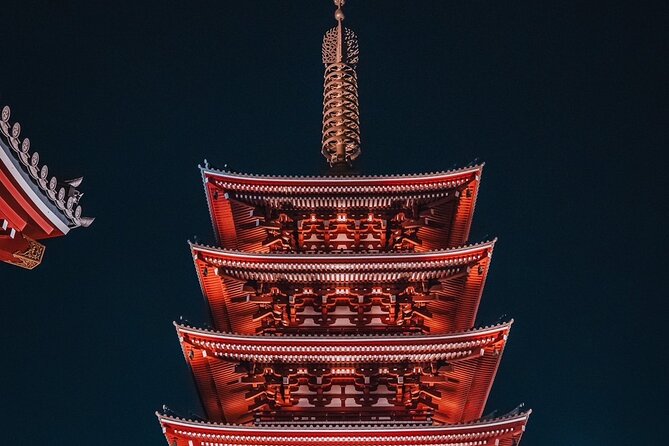
Many first visits to Asakusa happen in daylight, when Nakamise Shopping Street is full of shoppers and Senso-ji draws a steady stream of worshippers and sightseers. That daytime energy has its place, but evening brings a different view of the district. The temple grounds are more peaceful, shopfronts take on a softer glow, and the restaurant lanes feel more local and less like a photo stop.
This tour is designed as a gentle start to the night. You are not spending several hours on a large historical tour or rushing across Tokyo to check off distant attractions. Instead, you move through one compact neighborhood and finish where you can make your own dinner plans.
The route lasts about an hour, with roughly 10 minutes at each of six stops. That makes it a practical choice if you have dinner booked afterward, are meeting friends later, or want a short activity after a long day of sightseeing. It also means the guide needs to keep the commentary focused. You will get useful background and local stories, but not an exhaustive study of every building.
A few more Tokyo tours and experiences worth a look


Starting beneath the Kaminarimon lantern
The meeting point is Burger King Asakusa Azumabashi, near Kaminarimon in Taito City. This is a practical place to begin because it is close to public transportation and puts you near the district’s best-known entrance.
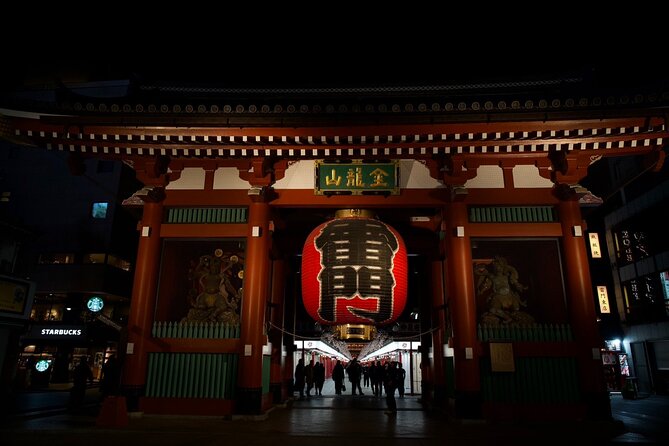
Your first stop is Kaminarimon, the Thunder Gate. Its oversized red lantern is the visual symbol of Asakusa, and the gate is flanked by statues of Fujin, the god of wind, and Raijin, the god of thunder. At night, lighting gives the gate a more dramatic appearance than it has in bright midday sun.
You have about 10 minutes here. That is enough for photographs and a clear explanation of what you are looking at, especially if you have walked through the gate before without knowing the meaning of the statues. The guide can also help orient you to the route ahead, which is useful in an area with many lanes and shops.
The short stop has a tradeoff. You will not have much time to linger or photograph the gate from every angle. Still, as an opening scene, Kaminarimon does the job well: it places you immediately in the old heart of Asakusa.
Walking Nakamise toward Senso-ji
From Kaminarimon, the route continues along Nakamise Shopping Street. This pedestrian shopping street leads toward Senso-ji and is lined with stalls selling traditional snacks, souvenirs, and handmade goods.
In daylight, Nakamise can feel crowded and highly commercial. At night, the mood is less about shopping and more about seeing the row of traditional façades and understanding how the street connects the gate to the temple. The guide’s explanation gives you a framework for the shops, rather than leaving you to see only a long line of souvenir stalls.
You have another 10 minutes here. That is enough for a walk-through and a few questions, but you should not expect a dedicated shopping session. Food and drinks are not included, so any snack you buy is your own expense. If you want to return for browsing, this tour gives you a quick orientation and lets you decide where to spend more time later.
I especially like this part for first-time visitors. Nakamise is easy to photograph, but its purpose makes more sense when you understand that it serves as the approach to one of Tokyo’s best-known temples. The guide helps connect the street, the gate, and the temple into one place rather than three separate sights.
Seeing Senso-ji when the crowds have gone
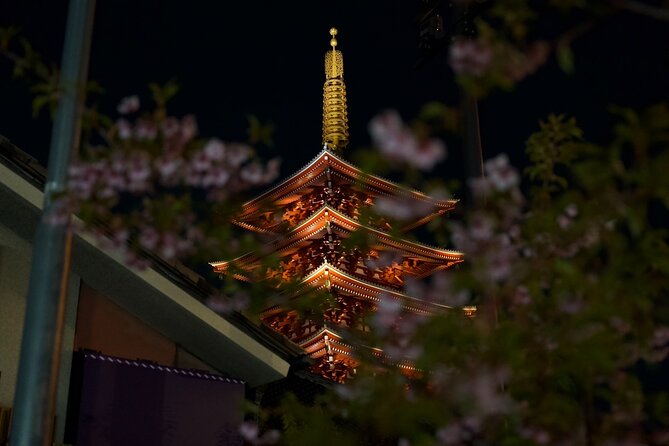
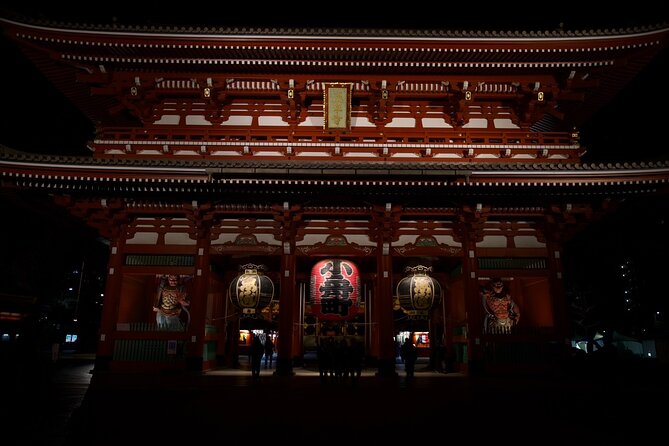
Senso-ji is one of Tokyo’s oldest and most famous Buddhist temples, dedicated to Kannon, the goddess of mercy. Its grounds include the well-known Kaminarimon entrance, the broad approach from Nakamise, and the main hall that draws visitors throughout the day.
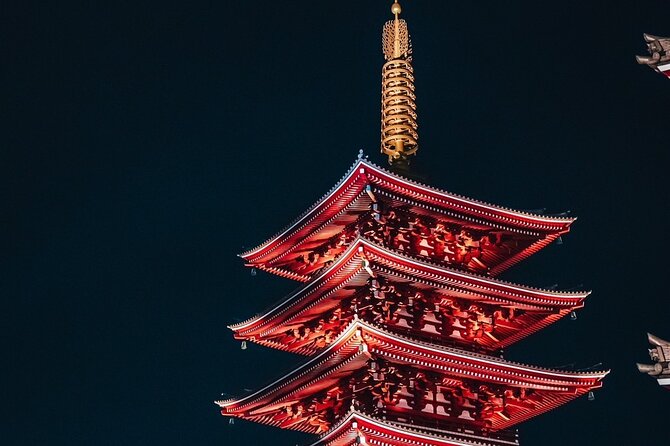
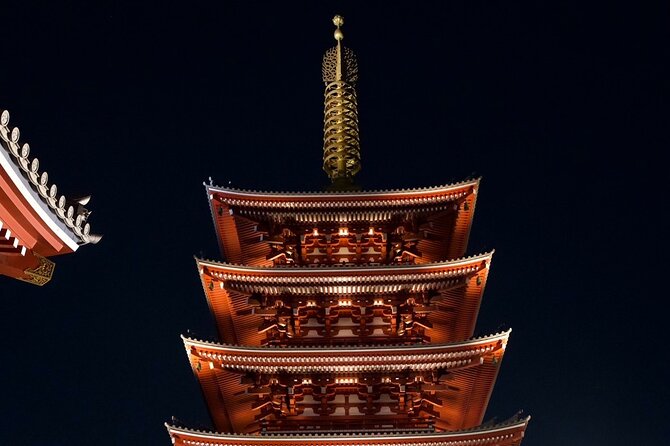
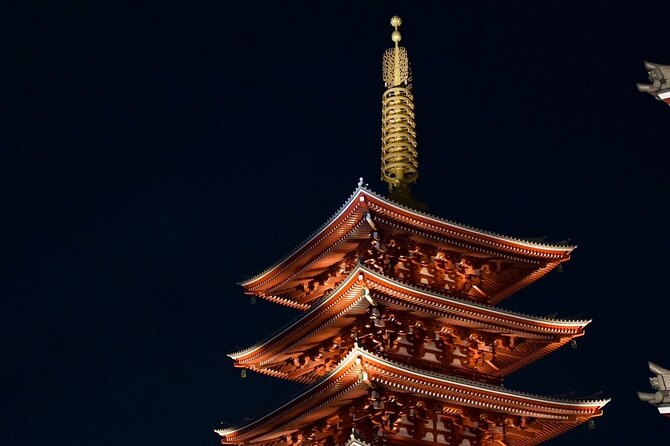
The evening setting is the reason to take this tour instead of simply visiting during daylight. The temple complex can feel more still after the main daytime rush, and the illuminated structures give you a chance to appreciate details without the same level of movement around you.
There is an important limit. The main hall closes at 6 PM, so you may not be able to enter it during the evening walk. The tour is better understood as an introduction to the temple grounds, visual details, and religious setting. If going inside the main hall is a priority, plan a separate daytime visit.
The guide’s role matters here. A temple can be beautiful yet confusing if you do not know what each gate or building represents. The tour gives you background on Senso-ji and helps explain why the site matters, which was particularly useful for people who had already visited during the day but felt they had missed the meaning behind what they saw.
A short pause at Asakusa Shrine
Next door to Senso-ji is Asakusa Shrine, a Shinto shrine built in the 17th century. It honors the three men connected with the founding of Senso-ji and survived World War II.
The close relationship between the Buddhist temple and the Shinto shrine is one of the most interesting features of this part of Asakusa. You can see two religious traditions side by side, each with its own setting and story. The guide helps you notice that difference without turning the walk into a lecture.
The stop lasts about 10 minutes. That keeps the visit easy for anyone who wants cultural context but does not want a long formal tour. You will have time to look around and ask questions, though the brief schedule means the explanation will remain selective.
For me, this is one of the more worthwhile stops because it adds meaning to the district’s layout. You are not only seeing a major Buddhist temple and then moving on. You are also seeing how a nearby Shinto shrine fits into the same historic center.
A few more Tokyo tours and experiences worth a look



Hanayashikidori and Asakusa’s old entertainment side
The route then reaches Hanayashikidori, a street near Senso-ji named after Hanayashiki, Japan’s oldest amusement park. Shops, cafés, and restaurants line the area, giving it a different feel from the temple approach.
This stop shows another side of Asakusa. The neighborhood is not only about worship and traditional architecture. It also has a long connection with entertainment, casual food, and everyday city life. The guide can point out how the streets around the temple shift from formal religious spaces to more relaxed commercial lanes.
You have about 10 minutes here. It is enough to take in the atmosphere and hear the background, but not enough to visit the amusement park or settle in at a café. No admission tickets are included, and the tour does not list any attraction entry beyond the walk itself.
That focus keeps the price and schedule manageable. If you want a quick sense of the district’s character, Hanayashikidori adds variety. If your main goal is rides, shopping, or a long meal, you will need extra time after the tour.
Ending with izakayas on Hoppy Street
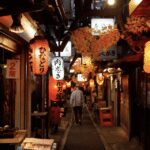
The final stop is Hoppy Street, a lively alley known for its izakayas and the local drink called Hoppy. The street is lined with traditional Japanese pubs, making it a natural place to end an evening walk.
The finish is one of the tour’s smartest practical details. You do not have to work out where to go for dinner after being dropped far from the sights. You end in an area where you can look at menus, choose a pub, or continue exploring Asakusa on your own.
Food and drinks are not included, so you should budget separately for dinner. That is not a weakness for this kind of tour. It gives you freedom to choose the restaurant and spend as much or as little as you like. The guide can introduce you to the area, but the evening after the official walk is yours.
Hoppy Street may be lively, and some visitors will prefer a quiet restaurant elsewhere in Asakusa. Still, it is a fitting end if you want a casual Japanese pub atmosphere. The route lets you move from temples and shrines to the neighborhood’s evening food culture in a single hour.
What the $34.29 price really buys you
At $34.29 per person, this is not an attraction ticket package. The main value is the English-speaking guide and the interpretation provided at six free-admission locations.
You are paying for structure, local explanation, and a small-group experience rather than entry to a paid site. For a first evening in Tokyo, that can be worthwhile. Asakusa’s major sights are easy to find, but their stories and religious meanings are not always obvious. A guide helps turn a pleasant walk into a more informed one.
The maximum group size is eight. That is small enough to make questions practical and to keep the guide’s voice within reach. It also avoids the feel of a large procession moving through narrow streets. Since the tour is only about an hour, a small group helps the route stay on schedule.
The value is weaker if you already know Asakusa well or only want independent photography. You can visit the temple district without a ticket, and you will still need to pay for your own meal. I see the price as reasonable for a compact introduction, especially early in a Tokyo visit, but less necessary for repeat visitors who already understand the area.
Guides, pace, and the kind of experience to expect
GuideMe Japan runs the experience, with English-speaking guides including Takumi and Mio. Takumi has been described as making the evening informative and enjoyable, while Mio is noted for being lively, friendly, and fun. Those details suggest a tour style built around conversation and explanation rather than a formal, scripted presentation.
You should still treat named guides as examples, not a guarantee of who will lead your departure. The important point is that the experience is conducted in English and designed to explain the temples, streets, and local culture in a short format.
The pace is brisk but not strenuous. Six stops in one hour gives you about 10 minutes in each place, plus the walking time between them. Most people can participate, and the tour is near public transportation. You should wear comfortable shoes simply because it is a walking activity, though no special fitness requirement is stated.
A mobile ticket keeps the start simple. Confirmation is provided when you book, and free cancellation is available if you cancel at least 24 hours before the local start time. Changes or cancellations inside that window are not accepted for a refund.
Who should book this evening walk
I would choose this tour for a first-time Tokyo visitor who wants a clear introduction to Asakusa without giving up an entire evening. It also suits anyone who visited the area during the day but left without understanding the temple and shrine stories.
It works well for:
- Solo visitors who want a guide and a small group
- Couples looking for a short pre-dinner activity
- Families who prefer a compact tour
- People interested in Japanese religious sites and local legends
- Anyone who wants to finish near casual restaurants and izakayas
You may want to skip it if your schedule allows a long independent visit to Asakusa and you prefer to set your own pace. It is also not the right choice if entering Senso-ji’s main hall at night is essential, since that hall closes at 6 PM.
Should you book the Asakusa night walk?
Book it if you want context with your evening meal. The route covers Kaminarimon, Nakamise, Senso-ji, Asakusa Shrine, Hanayashikidori, and Hoppy Street in one compact hour, then leaves you in a useful place for dinner.
The strongest reason to go is not simply seeing famous sights. It is hearing the stories that make those sights easier to understand, especially if Takumi, Mio, or another engaging GuideMe Japan guide leads your walk. At $34.29, the tour offers fair value for a small group and an English explanation, while keeping food and the rest of the night flexible.
FAQ
How long does the Asakusa night walking tour last?
The tour lasts approximately one hour.
What language is the tour conducted in?
The tour includes an English-speaking guide.
Where does the tour start?
It starts at Burger King Asakusa Azumabashi, near Kaminarimon, in Taito City, Tokyo.
Where does the tour end?
The tour ends at Hoppy Street in Asakusa.
Is food or drink included?
No. Food and drinks are not included in the tour price.
Can I enter the main hall at Senso-ji during the tour?
The main hall closes at 6 PM, so evening entry may not be available.
How many people can join the tour?
The maximum group size is eight travelers.
Is the tour near public transportation?
Yes. The experience is described as being near public transportation.
Can I cancel for a full refund?
Yes, if you cancel at least 24 hours before the experience start time. Cancellations or changes made less than 24 hours before the start time are not accepted for a refund.
More Walking Tours in Tokyo



More Night Tours in Tokyo
More Asakusa Tours in Tokyo

More tours in Tokyo we've reviewed




Asakusa Tours, compared.
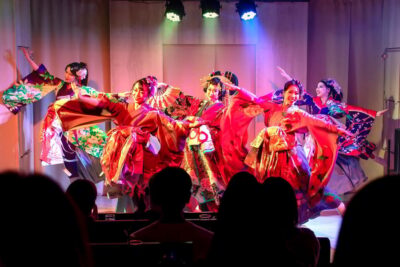 ★ 4.8Tokyo: Japanese Dance Cabaret Theater Asakusa-Kaguwa TicketFrom $492 hours
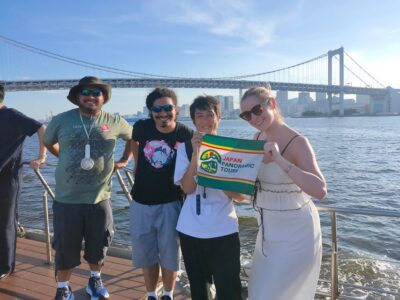 ★ 4.7Tokyo: Meiji Shrine, Asakusa, Skytree Bus Tour and CruiseFrom $12210 hours
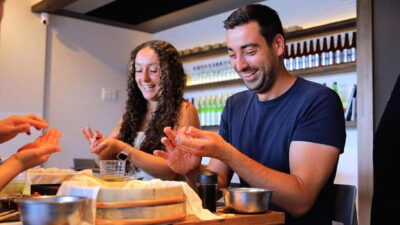 ★ 4.9Tokyo: Roll and Authentic Sushi Making Class in AsakusaFrom $581h 40m
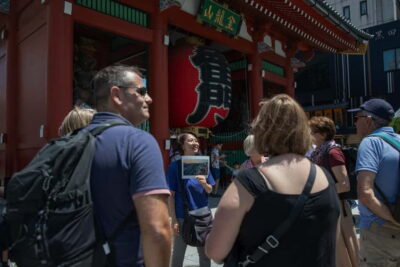 ★ 4.8Tokyo: Asakusa Walking Tour with Sensoji Temple VisitFrom $222 hours
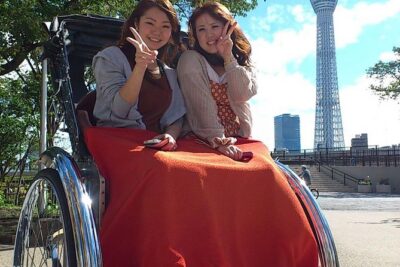 ★ 5.0Tokyo Asakusa Rickshaw TourFrom $42
 ★ 4.5Tokyo Panoramic 1 Day: Meiji Shrine, Asakusa, Odaiba and SKYTREE®From $85