
Reviewed · ASAKUSA TOURS
Tokyo: Meiji Shrine, Asakusa, Skytree Bus Tour and Cruise
Tokyo is a huge city, and this 10-hour coach tour tackles it from end to end. In one long day, you move from the forested Meiji Shrine and Imperial Palace to Asakusa’s old streets, the 350-meter Tokyo Skytree deck, and a short ride beneath Rainbow Bridge.
I like the comfortable air-conditioned bus, which saves you from piecing together several train routes, and I like the blend of big sights and small cultural touches, especially the Uji matcha tasting and Asakusa pub-style meal. The catch is the pace: expect more than 11,000 steps, and do not count on the cruise, since high tide or maintenance can replace it with Hamarikyu Garden or the Fukagawa Edo Museum without a refund.
In This Review
- Key points to know before booking
- A full day that gives you Tokyo’s broad outline
- Meiji Shrine: Tokyo’s quiet opening act
- The Imperial Palace and a glimpse of old Edo
- Asakusa combines food, shopping, and old Tokyo
- What lunch includes
- Tokyo Skytree delivers the big view
- Odaiba and the short Tokyo Bay cruise
- Is $122 good value for a 10-hour Tokyo tour?
- Walking, weather, and the daily pace
- Who should book this Tokyo coach tour?
- Final verdict: book it for coverage, not leisure
- FAQ
- How long does the Tokyo bus tour last?
- Where does the tour begin?
- Is lunch included?
- Can I request a vegetarian or gluten-free meal?
- Is Tokyo Skytree admission included?
- Does the tour always include the Tokyo Bay cruise?
- What languages are available?
Key points to know before booking
- One bus, eighteen Tokyo sights and activities: Cover Meiji Shrine, the Imperial Palace area, Asakusa, Skytree, Odaiba, and more without changing trains all day.
- Matcha is part of the Asakusa stop: Try Uji green tea, matcha gelato, or matcha beer, depending on the option available.
- Lunch is optional: The standard set meal includes Japanese fried chicken, tofu, rice, and a soft drink, with vegetarian and gluten-free choices available if requested in advance.
- Skytree entry is included: Go to the Tembo Deck at 350 meters with skip-the-line admission.
- The cruise is not guaranteed: It normally runs except on Tuesdays, but weather, high tide, or technical work can change the final stop.
- Walking shoes matter: This is not a sit-back-and-watch-the-city tour. You walk through shrine grounds, shopping streets, temple areas, and observation facilities.
A full day that gives you Tokyo’s broad outline
This experience works best as a first look at Tokyo. You do not get long, quiet visits at every stop, but you do get a useful sense of how the city fits together. The bus links districts that would take time to connect on your own, while a live English-speaking guide fills in the cultural details.
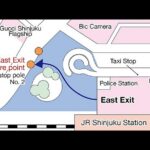
The route begins at a central meeting point, with options listed around the Love statue in Shinjuku or Matsuya Ginza, depending on the booking choice. The precise meeting point matters, so check it carefully before setting out. The day finishes near Tokyo Mode Gakuen, rather than returning to your hotel.
The coach has air conditioning and Wi-Fi, giving your feet a break between stops. That is especially valuable in Tokyo’s hot, humid months. The driver handles the city traffic while you watch districts change outside the windows, from Kabukicho’s neon pub district to Harajuku, Akihabara, Ueno, and Odaiba.
The tour is led in English. Audio headsets are also available in Spanish, French, Italian, German, Portuguese, and Ukrainian. Guides who have led this route include Aya, Sora, Yui, Hiro, Levin, Lovely, Lisa, and Tsubasa. Their style can shape the day, but the strongest descriptions of the experience consistently point to friendly, lively guides who explain both practical details and Japanese customs.
A few more Tokyo tours and experiences worth a look
Meiji Shrine: Tokyo’s quiet opening act
The first major stop is Meiji Jingu, dedicated to Emperor Meiji and Empress Shoken. Its forested setting is the surprise. You are still in central Tokyo, but broad paths and tall trees make the city feel far away.
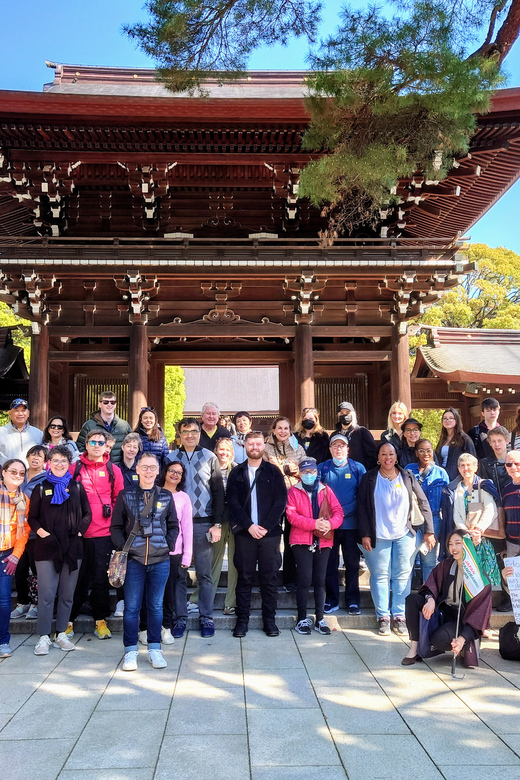
You have about an hour here, enough to walk through the shrine grounds and learn the basic etiquette of a Shinto visit. Your guide can explain how to approach the shrine, bow, purify your hands, and pray. These small instructions are useful because the rituals are easy to miss if you simply arrive, take a photo, and leave.
The shrine itself was rebuilt after wartime destruction, but the setting remains one of Tokyo’s most peaceful. Watch for sake barrels and wine barrels offered to the shrine, and take a moment to notice how carefully the grounds are maintained.
One practical point: the walk begins early, and the paths are not a place for flimsy shoes. Bring water in warm weather. Some people would prefer more time here, especially if they enjoy gardens and religious sites, but the schedule must keep moving.
The coach passes Harajuku and Omotesando next. You will not have a dedicated shopping stop, but the drive gives you a quick look at two very different sides of Tokyo: youth fashion around Harajuku and polished storefronts along Omotesando.
The Imperial Palace and a glimpse of old Edo
The route continues past the National Diet Building, Japan’s parliament, with its symmetrical 1936 architecture. This is a drive-by view, so keep your camera ready if you want a quick photograph.
At the Imperial Palace, you get about 30 minutes. Depending on conditions and the operating plan for the day, the group visits either the East Garden or the Niju-bashi Bridge in the Outer Garden.
The East Garden offers traditional Japanese planting, stonework, and traces of Edo Castle. Niju-bashi gives you the classic palace-area view across the moat and bridge. Neither option is a full palace visit, and you should set your expectations accordingly. This is a compact historical stop, not a long garden walk.
Still, it gives the day useful context. Tokyo is not only a city of towers and shopping streets. Underneath the modern capital is Edo, the old castle town that shaped Japan’s political history.
Asakusa combines food, shopping, and old Tokyo
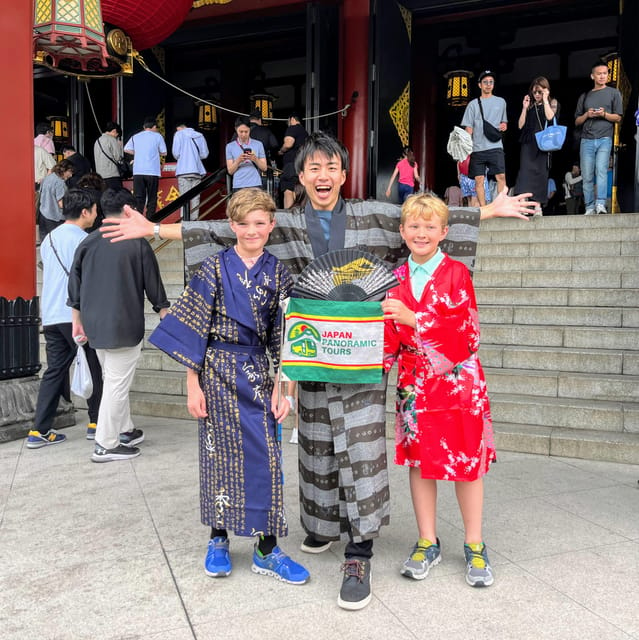
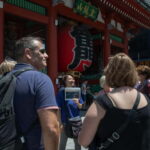
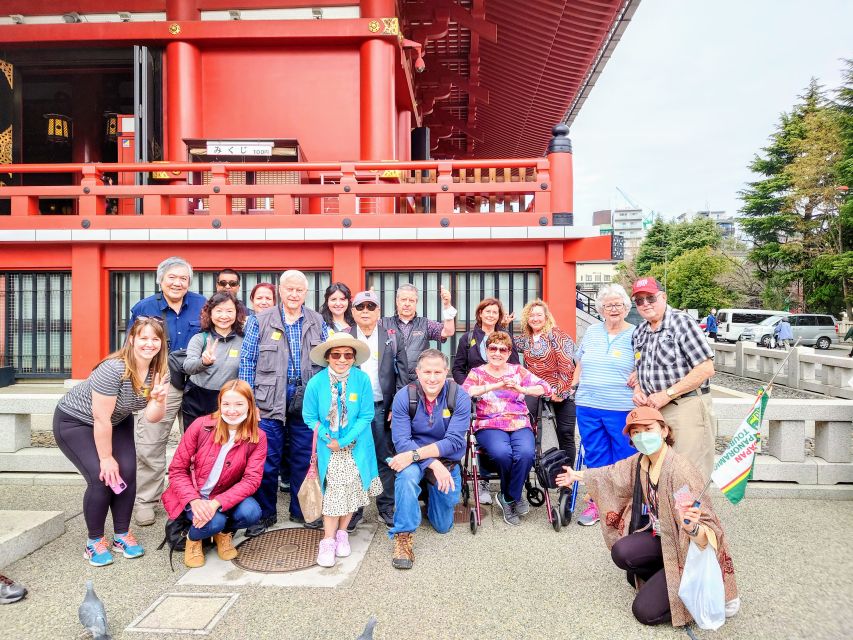
Asakusa is the day’s main cultural block, with matcha, lunch if selected, shopping, and free time. The famous Kaminarimon Gate, with its giant red lantern, is the natural photo stop. From there, Nakamise Avenue leads toward Senso-ji, lined with snacks, souvenirs, crafts, and traditional-style goods.
You get roughly 30 minutes for the matcha experience, 50 minutes for lunch if you add it, and about an hour of free time. That sounds generous, but Asakusa is easy to fill. You may want to photograph the gate, look inside Senso-ji, browse Nakamise, and eat without feeling rushed.
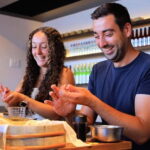
The matcha tasting uses first-flush Uji tea from Kyoto. The experience is presented as a smoother, less bitter style of matcha, which makes it a gentle introduction if you normally find green tea too sharp. Depending on the available choice, you can have matcha tea, matcha gelato, or matcha beer.
This is one of the tour’s best details because it is small and specific. You are not just being driven past a famous district. You get a taste of a Japanese ingredient with a clear regional connection.
What lunch includes
The optional Izakaya-style lunch is a set meal built around karaage, or Japanese fried chicken, and tofu. It also includes rice and a soft drink. The tofu is made daily at the shop from locally produced soybeans.
The food will suit you if you want a straightforward Japanese meal rather than a long restaurant experience. Portions and quality can vary, so I would not book the tour solely for lunch. Still, several people have found it satisfying, and the meal makes the day easier by removing the need to hunt for food in a crowded district.
Vegetarian and gluten-free meals are available if you state the number of people needing them when booking. The gluten-free choice includes grilled chicken, rice, and tofu. The standard food contains no pork, seafood, nuts, or crustaceans, but the dashi stock contains fish broth. Serious allergies, Muslim-friendly meals, lactose-free meals, and some other special diets are not supported, so book without lunch if the meal is a concern.
During free time, you can shop along Nakamise Avenue or explore around the temple precinct. Keep an eye on the meeting time. Asakusa is one of the easiest places on the route to wander too far.
A few more Tokyo tours and experiences worth a look
Tokyo Skytree delivers the big view
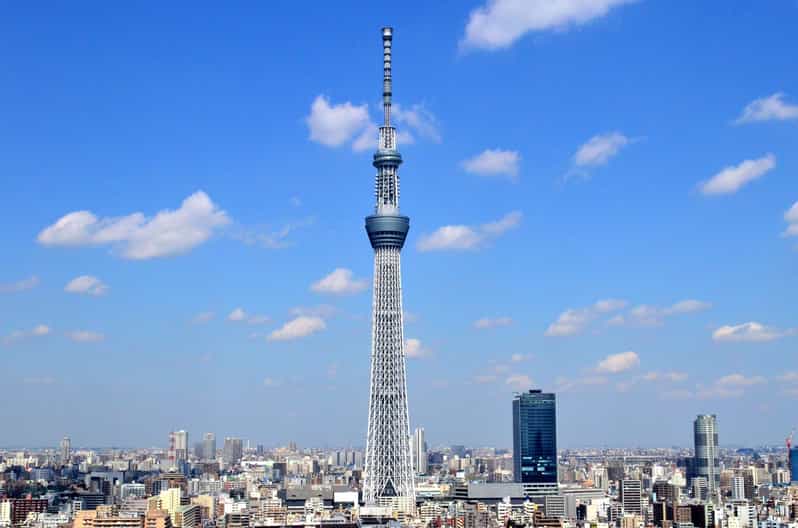
After Asakusa, the bus takes you to Tokyo Skytree and the Sora-machi shopping complex. Admission to the 350-meter Tembo Deck is included, and skip-the-line access saves useful time on a tightly scheduled day.
The view is the payoff. Tokyo spreads in every direction, and the scale of the city becomes clear from above. On a clear day, you can pick out the dense blocks, broad river corridors, and distant edges of the metropolitan area. On a hazy day, the view is less dramatic, but the height still gives you a strong sense of Tokyo’s size.
You have about 90 minutes here. That includes the elevator process, observation deck, and time to look around Sora-machi if the schedule allows. Some people would trade part of this stop for more time at Meiji Shrine, but the Skytree is one of the few places on the route where you can understand Tokyo as a whole.
The observation deck is indoors, which makes this a useful weather-proof stop. It also gives you another break from walking, though the shopping complex can add plenty of extra steps if you browse every floor.
Odaiba and the short Tokyo Bay cruise
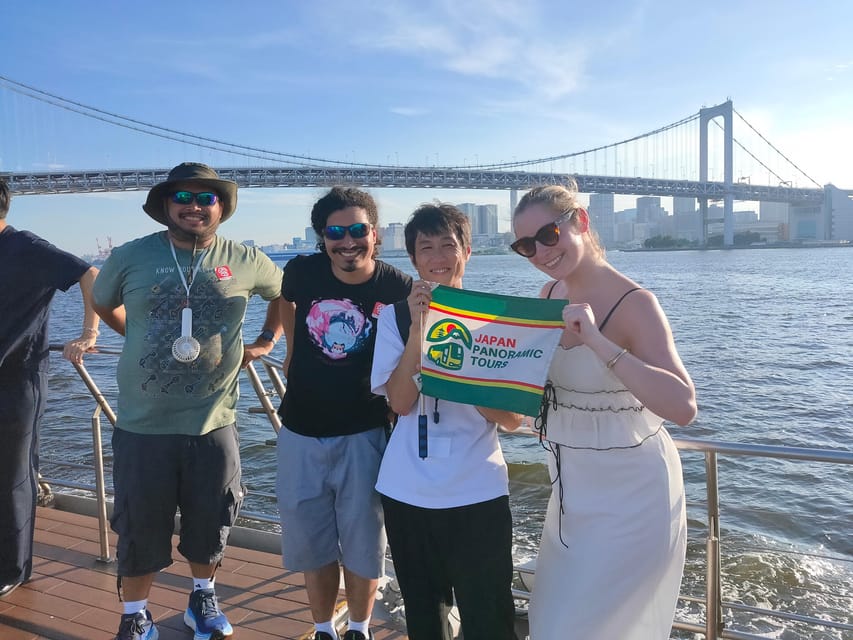
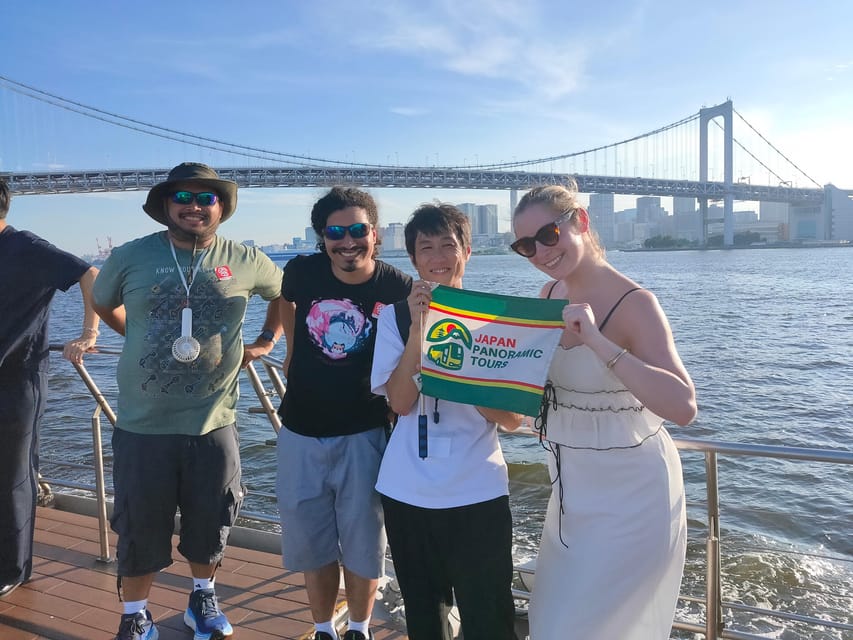
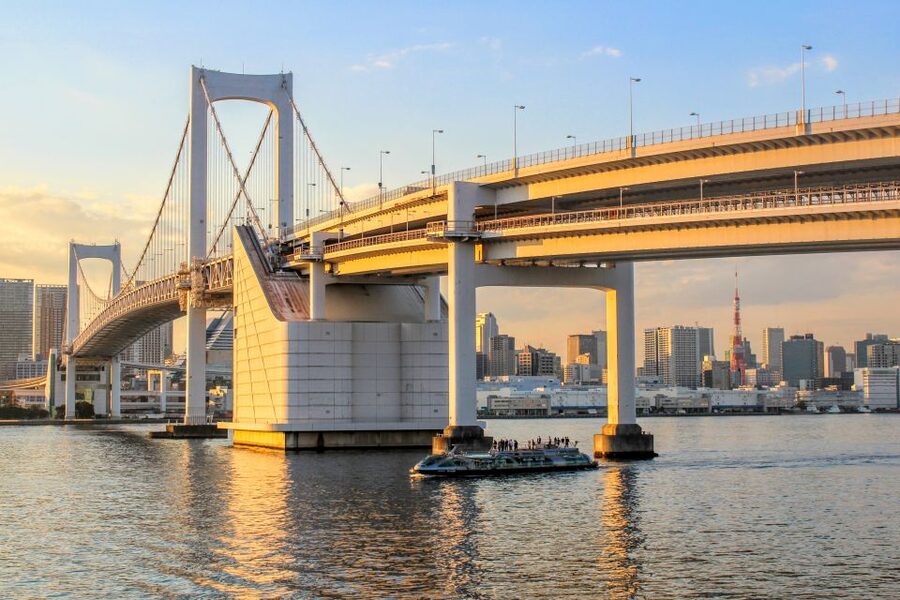
The final activity is usually a Tokyo Bay cruise from the Odaiba area. The boat ride lasts around 20 minutes and passes beneath Rainbow Bridge, with views toward Tokyo’s waterfront towers.
This is a pleasant way to end a long day. The change of pace helps, and a late-afternoon or sunset departure can make the waterfront especially attractive. Do not expect a full sightseeing cruise with extensive narration. Think of it as a brief scenic ride and a chance to rest while seeing Tokyo from the water.
The cruise normally operates except on Tuesdays. It can also be replaced by Hamarikyu Gardens or the Fukagawa Edo Museum because of high tide or technical maintenance. The substitute sites give you more history or garden scenery, but there is no refund when the cruise is canceled.
That rule is worth taking seriously. If the boat is the main reason you are booking, this may not be the right tour. If your main goal is seeing Tokyo’s major districts in one day, the replacement still leaves you with a full program.
Is $122 good value for a 10-hour Tokyo tour?
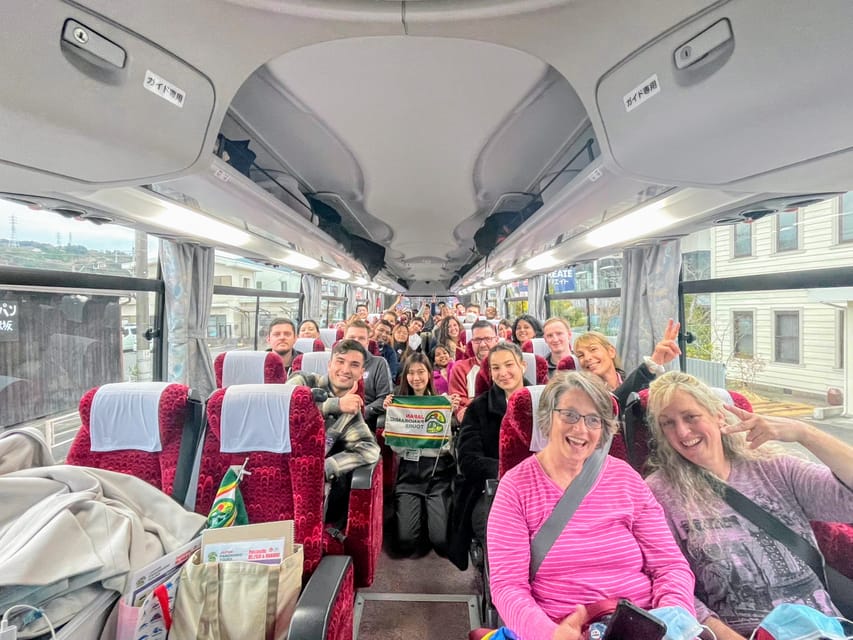
At $122 per person, this is not a bargain-basement bus ride. But the price includes a full day of coach transport, a professional English-speaking guide, Wi-Fi, the Skytree Tembo Deck admission, matcha, and the cruise when it operates. Lunch is included only if you select that option.
The value comes from time saved. Tokyo’s rail network is excellent, but getting from Meiji Shrine to the Imperial Palace, Asakusa, Skytree, and Odaiba in one day takes planning, transfers, and steady attention to station signs. Here, you can sit down between districts and let the guide manage the route.
The tradeoff is independence. You cannot stay longer at Meiji Shrine because you love the trees, or leave Asakusa early because you have seen enough. You follow the group’s clock.
For a short first visit, I think the price is reasonable if you value structure and want the Skytree admission included. If you have several days in Tokyo and enjoy exploring slowly, you can see many of these areas on your own for less and spend more time in each place.
Walking, weather, and the daily pace

The bus reduces the amount of long-distance walking, but it does not make this a low-effort day. You walk through shrine grounds, palace areas, Asakusa streets, shopping arcades, observation facilities, and the waterfront. A step count above 11,000 is realistic based on the route, so wear supportive shoes.
The coach is especially helpful in summer. One person described the air-conditioned transfers as a major comfort during hot, humid weather, while another found the walking heavier than expected. Both points can be true. The bus gives you rest between districts, but each stop still asks you to keep moving.
Traffic, weather, and operating conditions can change the order of stops. If a place closes, an alternative may be used. This flexibility is normal for a Tokyo day tour, but it means you should treat the schedule as a plan rather than a guarantee.
The activity is not suitable for people with mobility impairments. You must also load and unload your own luggage, wheelchairs, or strollers. Hotel pickup and drop-off are not included.
Who should book this Tokyo coach tour?
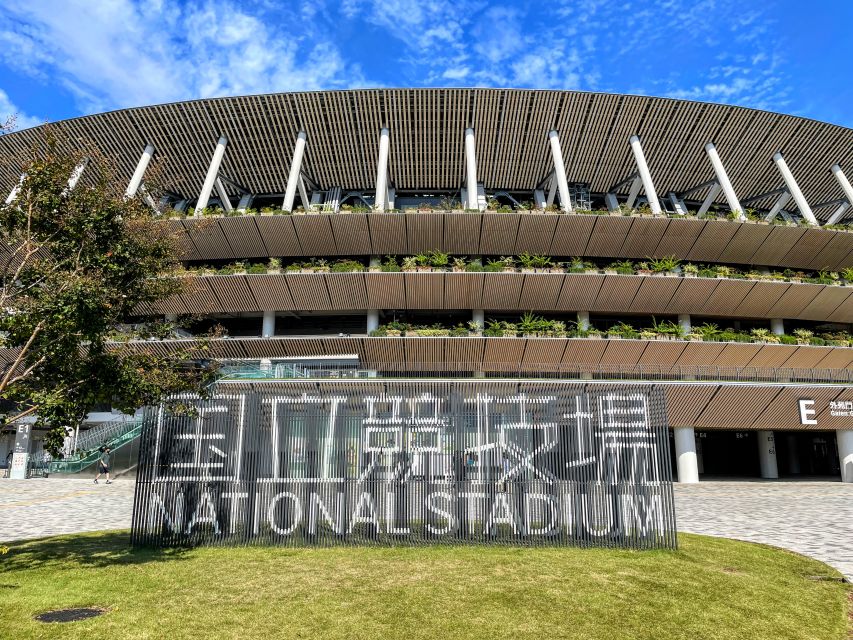
I would choose this for a first-time visitor with one or two free days in Tokyo, especially if you want a guide to explain shrine etiquette, palace history, local food, and city geography. It also suits families and older visitors who prefer a coach between districts rather than a full day of train transfers.
The multilingual audio option helps if you prefer to hear explanations in Spanish, French, Italian, German, Portuguese, or Ukrainian. The live guiding itself is in English.
I would not choose it if your priority is a slow morning at Meiji Shrine, serious shopping in Harajuku, a long temple visit, or a guaranteed boat ride. The route is broad by design. You see many important places, but you sample each one.
Final verdict: book it for coverage, not leisure
This is a strong orientation tour with unusually wide coverage. You get traditional Japan at Meiji Shrine and Asakusa, political history at the Imperial Palace, modern Tokyo at Skytree, and waterfront views around Odaiba.
I especially like the combination of organized transport and real cultural details, rather than a simple drive-by city circuit. The matcha tasting, temple etiquette, optional local-style meal, and guide advice on restaurants and shopping give the day more substance.
Book it if you want to get your bearings quickly and make your remaining Tokyo days easier to plan. Skip it if you dislike fixed schedules, long walking days, or substitutions for the cruise. For most short stays, the route offers a practical and lively first chapter in Tokyo, provided you arrive in good shoes and accept that one day cannot tell the whole story.
FAQ
How long does the Tokyo bus tour last?
The tour lasts about 10 hours, including sightseeing stops, food experiences, free time, Skytree, and the final waterfront activity.
Where does the tour begin?
There are three listed starting options around the Love statue in Shinjuku and Matsuya Ginza. Your exact meeting point depends on the option you book.
Is lunch included?
Lunch is included only when you select the lunch option. The standard meal includes Japanese fried chicken, tofu, rice, and a soft drink.
Can I request a vegetarian or gluten-free meal?
Yes. You must state the number of vegetarian or gluten-free meals when booking. The gluten-free meal includes grilled chicken, rice, and tofu.
Is Tokyo Skytree admission included?
Yes. Admission to the Tokyo Skytree Tembo Deck at 350 meters is included, with skip-the-line entry.
Does the tour always include the Tokyo Bay cruise?
No. The cruise normally operates except on Tuesdays, but high tide or technical maintenance can cancel it. Hamarikyu Garden or the Fukagawa Edo Museum may be visited instead, and no refund is given for the change.
What languages are available?
The live guide speaks English. Audio headsets are available in Spanish, French, Italian, German, Portuguese, and Ukrainian.
More Tickets & Passes in Tokyo


More Bay & River Cruises in Tokyo
More Asakusa Tours in Tokyo

More tours in Tokyo we've reviewed



Asakusa Tours, compared.
 ★ 4.8Tokyo: Japanese Dance Cabaret Theater Asakusa-Kaguwa TicketFrom $492 hours
 ★ 4.9Tokyo: Roll and Authentic Sushi Making Class in AsakusaFrom $581h 40m
 ★ 4.8Tokyo: Asakusa Walking Tour with Sensoji Temple VisitFrom $222 hours
 ★ 5.0Tokyo Asakusa Rickshaw TourFrom $42
 ★ 4.5Tokyo Panoramic 1 Day: Meiji Shrine, Asakusa, Odaiba and SKYTREE®From $85
 ★ 5.0Tokyo Go Kart: Asakusa, Skytree, and Akihabara **IDP MUST**From $99