
Reviewed · TSUKIJI MARKET TOURS
Tsukiji Fish Market Small-Group Food Walking Tour
Tsukiji is no longer Tokyo’s main wholesale fish market, but its Outer Market remains one of the best places in the city to eat your way through Japanese food culture. This three-hour walk takes you through narrow lanes lined with seafood stalls, specialty shops, kitchenware sellers, shrines, and small restaurants.
I like the included seafood lunch, which turns this from a simple market walk into a proper morning meal. I also like the small group size, capped at seven, since a guide can explain unfamiliar foods and steer you through crowded lanes. The main catch is important: the inner wholesale market moved to Toyosu in 2018, so this tour is about Tsukiji’s active retail market, not the old tuna auction floor.
In This Review
- Key things to know
- Tsukiji today: know what you are booking
- Meeting at Tsukiji Station Exit 1
- Walking through Tsukiji’s food lanes
- Seafood tastings, from tamagoyaki to tuna
- The included seafood lunch
- A Buddhist temple and Shinto shrine
- Tokyo views and the walk toward Shiodome
- What the small group adds
- Is $87.37 a fair price?
- Heat, crowds, and practical comfort
- Who should book this Tsukiji food tour?
- FAQ
- How long does the Tsukiji Fish Market tour last?
- Where does the tour begin?
- Where does the tour end?
- Is lunch included?
- What kinds of food might I try?
- Does the tour visit the old wholesale fish market?
- Are vegan options available?
- Can the tour accommodate food allergies or dietary restrictions?
- How many people can join the tour?
Key things to know
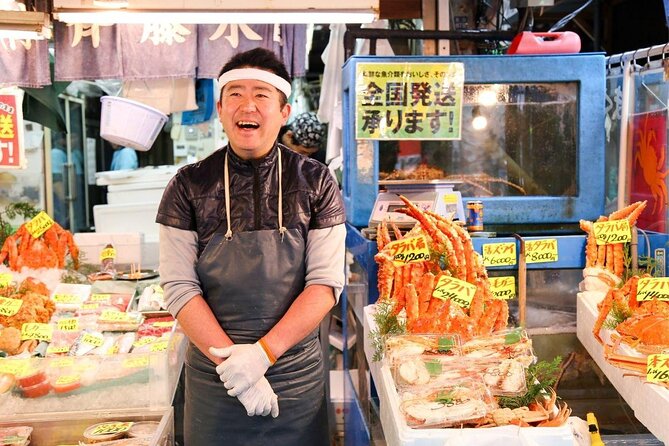
- The fresh seafood lunch is included, with several tastings along the way.
- Expect classic bites such as sushi, tamagoyaki, grilled eel, scallops, crab, and local snacks, though exact stops can vary.
- The old wholesale market is gone from Tsukiji, but the Outer Market still has hundreds of food and kitchen shops.
- A Buddhist temple and Shinto shrine add useful cultural context beyond eating.
- Groups are limited to seven people, making it easier to hear the guide and keep moving.
- Vegan options are not available, and allergy-free meals cannot be guaranteed.
Tsukiji today: know what you are booking
The name Tsukiji still carries the image of Tokyo’s great fish market, with forklifts, tuna auctions, and wholesale seafood trading. That inner market moved to Toyosu in 2018. If your main goal is to see the modern wholesale operation, this is not the right experience.
What remains at Tsukiji is the Outer Market, called Tsukiji Jogai Market. It is a busy collection of roughly 460 shops selling fish, fruit, vegetables, meat, dried goods, seasonings, cooking tools, tableware, and prepared food. Some businesses serve professional buyers, while others welcome shoppers and curious eaters.
That distinction matters, but it does not make Tsukiji a poor choice. The Outer Market is more approachable than a working wholesale floor. You can stop for a snack, examine Japanese cooking tools, watch food being prepared, and sit down for lunch without needing to understand the rules of a commercial auction site.
The best way to think about this tour is as a guided food walk through the living retail district that grew around the old market.
A few more Tokyo tours and experiences worth a look

Meeting at Tsukiji Station Exit 1
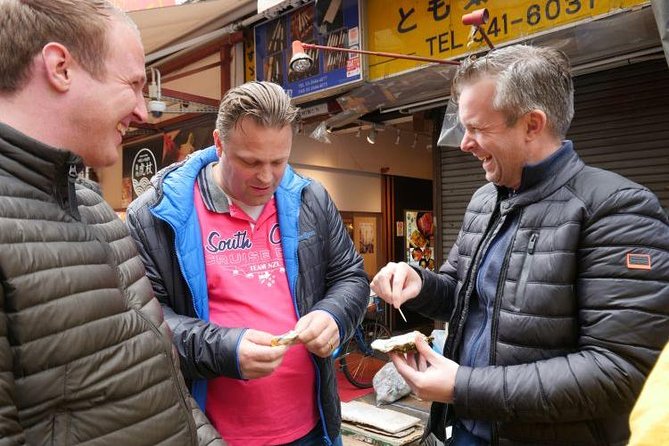
The tour begins at Tsukiji Station, Exit 1, at 3 Chome-9 Tsukiji. Your guide waits there, and the tour provider sends confirmation at booking. The meeting point is close to public transportation, but give yourself a few extra minutes to find the correct exit and get oriented.
One useful tip is to arrive early and look for other people who appear to be waiting for a food tour. The market area has many signs, entrances, and nearby businesses, so a little spare time reduces morning stress.
The walk ends near Shiodome Tower at 1-6-3 Higashishimbashi, Minato City. That makes the tour convenient if you plan to continue toward Shiodome or nearby Tokyo sights. It does mean you finish in a different part of the city, so check your next destination before you start.
Walking through Tsukiji’s food lanes
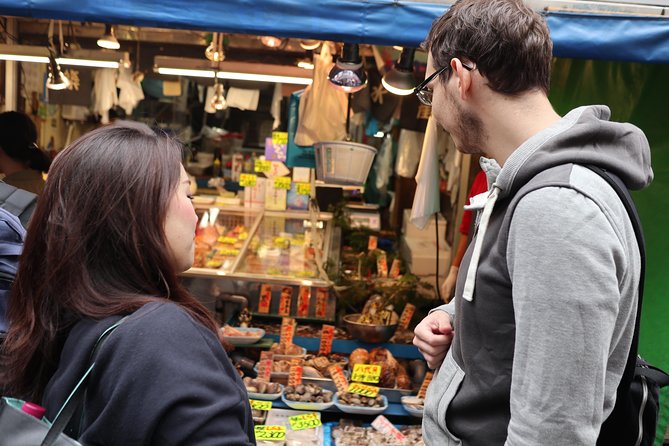
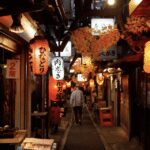
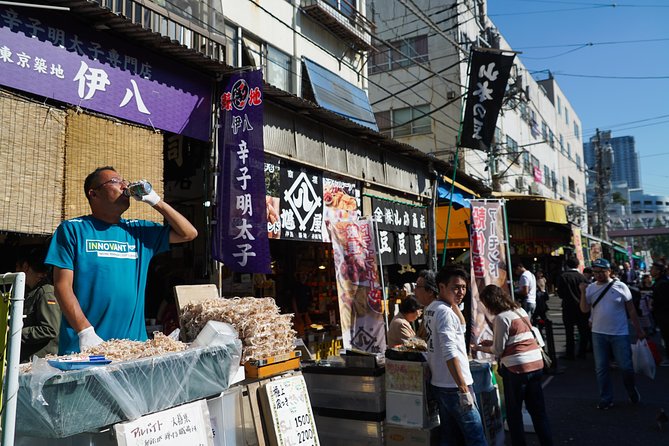
The market portion is the heart of the experience. You move through tight lanes where shops sell seafood, dried fish, seasonings, sweets, utensils, and tableware. It is not a single enclosed hall. It is a patchwork of small businesses, food counters, and side streets.
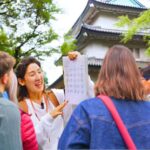
A guide is useful here because the choices can feel random at first. You may see ingredients you cannot identify, cooking tools with no English explanation, and food counters where people eat quickly or take their purchases away. Guides such as Kazu, Yuki, Hitomi, Mark, Tiger, and others have been praised for explaining food, suggesting good stops, and helping with the flow of the walk.
The exact food lineup can change. That is normal in a market tour, since shops may have lines, limited stock, or different opening conditions. One scheduled takoyaki stop, for example, may be skipped if the queue is too long. You might receive more substantial bites at another stop instead.
The market is tightly packed, and some signs ask customers not to stop and eat in the lane. You need to stay close to the group, keep your bag tucked in, and avoid blocking shop entrances. This is a working market, not a staged food court.
Seafood tastings, from tamagoyaki to tuna
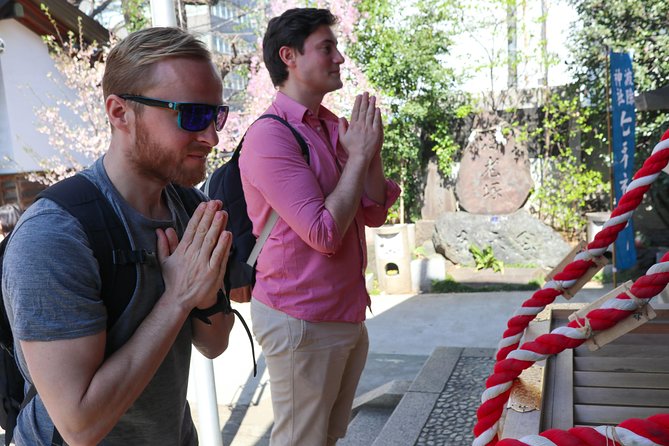
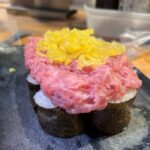
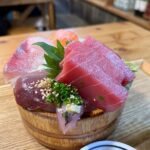
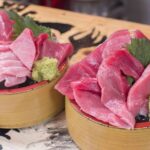
The food is the reason to book this walk, and the range can be impressive. Past tastings have included tuna nigiri sushi, grilled eel, tamagoyaki, scallops on a stick, crab legs, dried stingray, yakitori-style snacks, and other small market foods.
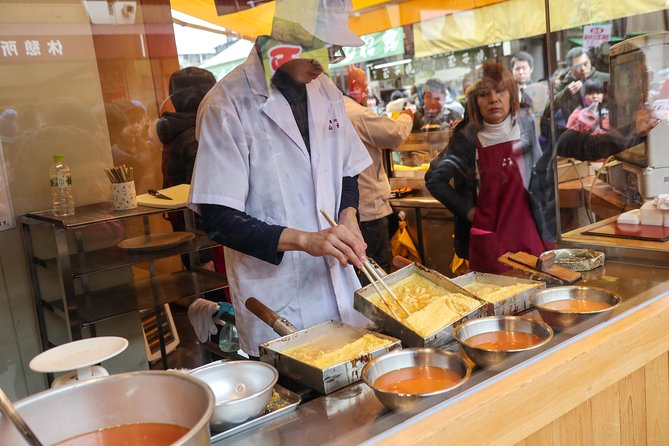
Tamagoyaki is a Japanese rolled omelet with a gentle sweetness. It is a useful first taste because it shows that Tsukiji is not only about raw fish. Grilled eel brings a smoky, savory flavor, while sushi gives you the clean taste of fresh seafood in a simple form.
The best part of having a guide is not just getting fed. It is learning what you are eating and why a particular stall matters. Some guides give background on seafood types and Japanese food customs before the tastings. Others focus more on recommendations and keeping the group moving. The quality of explanation can vary, so if food knowledge is your top priority, ask questions as you go.
You should also arrive hungry. Even when the formal tasting count is described as two or three snacks, the actual food may include several smaller samples plus larger items. Eating a full breakfast beforehand could leave you too full for the lunch that follows.
The included seafood lunch
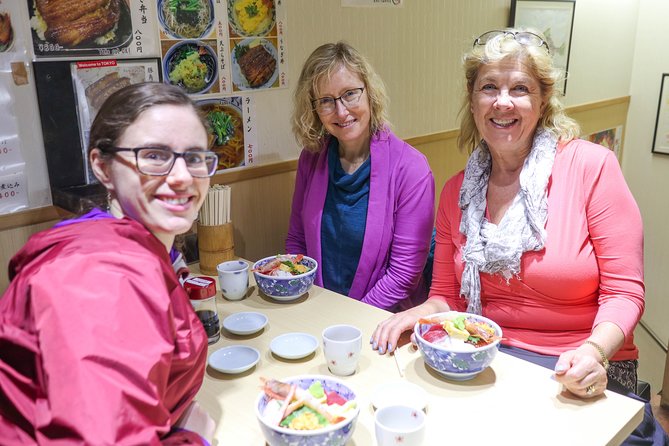
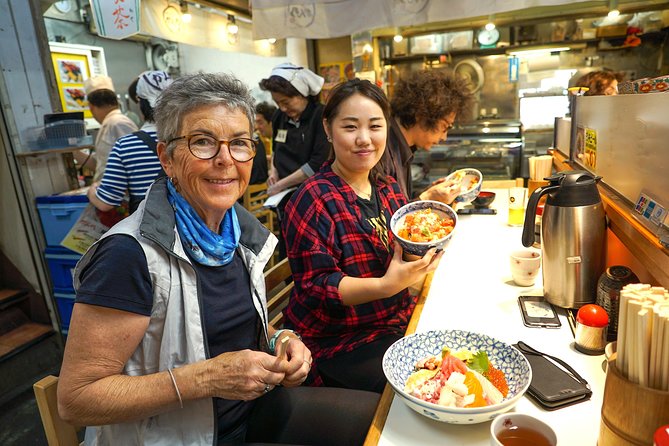
The tour includes a sit-down seafood lunch at a local restaurant or small market eatery. This is a valuable part of the price because it gives you a proper meal after the grazing stops.
Past menus have included sushi and other fresh fish dishes. At some restaurants, you can choose what you want for the main meal, which is helpful if you have already sampled several bold flavors. One especially appealing detail is the chance to eat in a small booth, a setting that feels more personal than grabbing another bite while standing in the lane.
Do not treat the lunch as a fixed restaurant reservation with a published menu. The specific place and choices may vary. The experience is built around local market food, so flexibility is part of the deal.
Food restrictions need careful attention. Vegan options are not available. The operator cannot guarantee allergy-free food because the meals are prepared in kitchens it does not control, and substitutions may not be possible at every stop.
One guide made an effort to help a person with celiac disease by arranging suitable alternatives where possible. That is encouraging, but it should not be treated as a guarantee. If you have a serious allergy or strict dietary requirement, contact the operator before booking and understand that the tour may not be a safe fit.
Other walking tours we've reviewed in Tokyo
A Buddhist temple and Shinto shrine
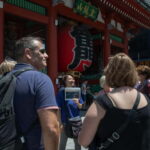
This is more than a seafood crawl. The route includes a Japanese Buddhist temple and a Shinto shrine, giving you a look at two major parts of Japanese religious life.
The temple adds a quiet contrast to the market streets. You can learn about the building and the role of Buddhism in Japan before returning to the food stalls. The Shinto shrine provides another cultural stop, with its own traditions and visual details.
The religious visits are relatively short, but they improve the shape of the tour. Without them, the morning could feel like a string of snacks. With them, you get a little context about the district and the ways food, commerce, ritual, and neighborhood life overlap in Tokyo.
Dress and behave respectfully. Keep your voice down at religious sites, follow the guide’s instructions, and remember that these are functioning places of worship rather than photo props.
Tokyo views and the walk toward Shiodome
The route also includes a point where you can see the Tokyo city view, with the walk finishing near Shiodome Tower. The view gives you a break from the narrow market lanes and helps place Tsukiji within the larger city.
This part is not the main reason to book the tour, but it adds variety. You begin among low storefronts and food counters, then end near a modern business district. That change shows Tokyo’s habit of layering old commercial neighborhoods beside tall, modern buildings.
Because the published route describes several short stops of around 20 minutes, expect a moving tour rather than a long visit at each site. The guide will likely adjust the pace around food queues, market conditions, and the group’s interests.
What the small group adds
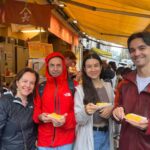
The maximum group size is seven people. That is small enough for a guide to keep everyone together in narrow lanes and answer questions without shouting.
A smaller group also helps at food stalls. You can hear an explanation, see what the guide is pointing toward, and move through busy areas with less confusion. Some bookings may have only a few people, while others may fill the available spaces.
This is not necessarily a private tour. A couple once found themselves sharing the walk with another couple, which made the meal more social. If you want a fully private experience, do not assume the seven-person limit means private service.
The guide often makes or breaks the morning. Strong guides such as Kazu, Yuki, Hitomi, Mark, and Tiger have been praised for humor, food advice, kindness, and clear explanations. There have also been less satisfying experiences where the guide gave little information and the food stops felt thin. That variation is worth keeping in mind when you compare this with a private guide or a self-guided food plan.
Is $87.37 a fair price?
At $87.37 per person, this is not the cheapest way to walk through Tsukiji. You could browse the market yourself and buy individual snacks for less.
The value comes from the combination of a guide, several tastings, a seafood lunch, cultural stops, and a three-hour route. If you are new to Japanese food, the guide can save you from wandering past good stalls or ordering something you do not understand. The included meal also makes the price easier to justify.
The value is weaker if you already know Tsukiji well, speak Japanese, or mainly want to shop independently. You also need to accept that the food selection can change and that the tour does not visit the former inner wholesale market.
I see this as a good first-market experience, especially early in a Tokyo visit. It gives you a map of the area and enough food ideas to return on your own.
Heat, crowds, and practical comfort
Summer in Japan can be extremely hot and humid. Bring water and wear a hat. You will spend much of the three hours walking outdoors, often in close quarters, so light clothing and comfortable shoes make sense.
The market lanes can be crowded, with little room to pause. Keep valuables secure and follow the guide’s pace. If you dislike tight spaces, standing while eating, or changing plans around queues, this may feel hectic.
The tour is near public transportation, and most people can participate. A mobile ticket is provided, so keep your booking confirmation easy to access at the meeting point.
Free cancellation is available if you cancel at least 24 hours before the start time. Changes or cancellations made inside that window are not accepted for a refund.
Who should book this Tsukiji food tour?
I would choose this tour if you want to try several Japanese foods without planning every stop yourself. It suits first-time visitors, seafood fans, couples, small groups of friends, and anyone who enjoys learning through eating.
It is also a good choice if you want more than a market photograph. The temple, shrine, history, and city view give the morning a wider purpose.
I would hesitate if your main goal is the tuna auction or the working wholesale market. You should also think twice if you need vegan food, have severe allergies, or prefer a quiet, unhurried meal.
For everyone else, the strongest reason to book is the mix: fresh seafood, a real market setting, a meal, and a guide who can help you make sense of it all. Book it when you want a lively introduction to Tsukiji, but arrive knowing you are visiting the Outer Market of today, not the wholesale market of the past.
FAQ
How long does the Tsukiji Fish Market tour last?
The tour lasts approximately three hours.
Where does the tour begin?
The meeting point is Tsukiji Station, Exit 1, at 3 Chome-9 Tsukiji, Chuo City, Tokyo.
Where does the tour end?
The tour ends at Shiodome Tower, 1-6-3 Higashishimbashi, Minato City, Tokyo.
Is lunch included?
Yes. A fresh seafood lunch at the market is included in the tour.
What kinds of food might I try?
Possible tastings include sushi, tamagoyaki, grilled eel, scallops, crab, dried seafood, and local market snacks. The exact selection can change.
Does the tour visit the old wholesale fish market?
No. The inner wholesale market moved to Toyosu in 2018. This experience visits Tsukiji’s Outer Market and nearby food areas.
Are vegan options available?
No. Vegan options are not available on this tour.
Can the tour accommodate food allergies or dietary restrictions?
Allergy-free food cannot be guaranteed, and substitutions may not be possible at every stop. The operator will try to provide alternatives at other stops when possible.
How many people can join the tour?
The maximum group size is seven people. It is a small-group tour, not automatically a private tour.
More Food Experiences in Tokyo

More Walking Tours in Tokyo
More Tsukiji Market Tours in Tokyo
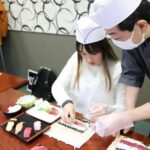
More tours in Tokyo we've reviewed











Tsukiji Market Tours, compared.
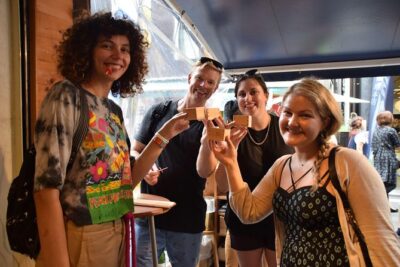 ★ 5.0Tokyo Tsukiji Fish Market Food and Culture Walking TourFrom $99
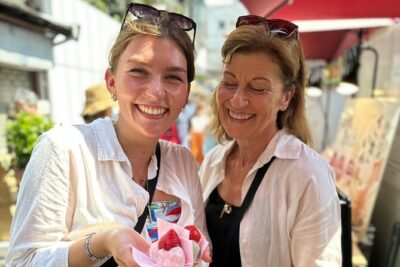 ★ 5.0Tokyo: Tsukiji Fish Market Food and Walking tourFrom $30
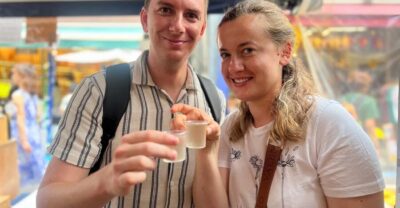 ★ 4.9Tokyo: Tsukiji Fish Market Guided Walking TourFrom $222 hours
 ★ 5.0Tokyo Sushi Making Class in Tsukiji with Professional ChefFrom $49
 ★ 5.0Tsukiji Fish Market Guided Tour and Sushi Making with Pro ChefFrom $104
★ 4.7Tokyo: Tsukiji Fish Market Food and Culture Walking TourFrom $963 hours
★ 5.0Tsukiji Fish Market Guided Tour and Sushi Making with Pro ChefFrom $104
★ 4.7Tokyo: Tsukiji Fish Market Food and Culture Walking TourFrom $963 hours