
Reviewed · SUMO EXPERIENCES
Tokyo Ryogoku Sumo Morning Practice + Photo Shoot with Wrestlers
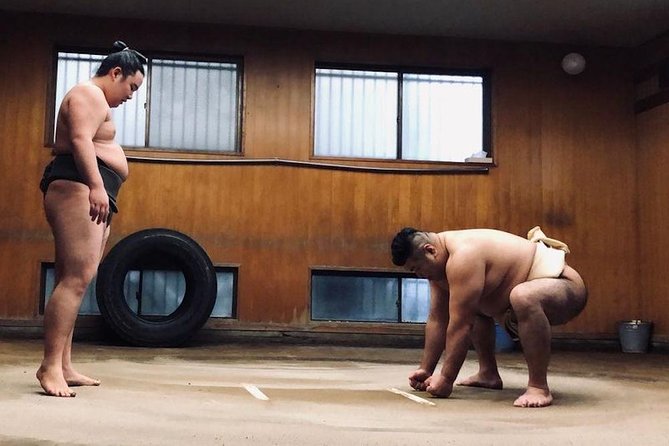
A few feet from the wrestlers, you watch sumo as work, not theater. The morning begins with stretching, warm-ups, drills, and serious bouts between athletes preparing for competition. There is no staged show, no cheering section, and often no talking. You are seeing a private training routine that most visitors could not arrange alone.
I like the close-up view of real practice and the chance to understand the sport through a local guide before entering the stable. I also like that the small group, capped at seven people, keeps the visit personal. The main drawback is practical: you may sit on a tatami floor for more than an hour, sometimes without permission to use the toilet or take photographs during practice.
In This Review
- Key points to know before you book
- Why a sumo stable is more revealing than a tournament
- Meeting at JR Ryogoku Station at 8 a.m.
- The five to 30 minute walk to the stable
- Sitting quietly inside an active stable
- What you may see during the practice
- Photos with wrestlers after training
- A short look around sumo town
- Is $98.16 a fair price?
- Who should book this morning visit?
- How to prepare for a respectful visit
- Should you book the Ryogoku sumo practice?
- FAQ
- Where does the tour meet?
- Is the meeting point at the Ryogoku Oedo Line station?
- What time does the activity start?
- How old must participants be?
- How long does the experience last?
- Do I have to sit on the floor?
- Can I take photographs during practice?
- Is food included?
- Can I cancel for a full refund?
Key points to know before you book
- Meet at the correct Ryogoku station: Use the JR Ryogoku Station East Exit, not the Ryogoku Oedo Line Station.
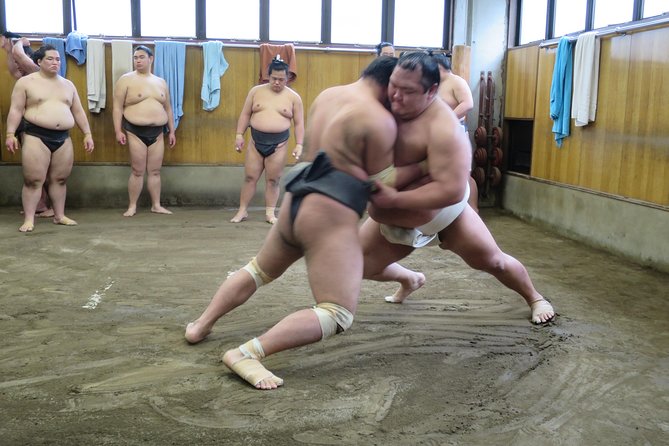
- Watch genuine morning training: The session can include exercises, technique work, and full-force practice bouts.
- Guides add essential context: Guides such as Mayu, Masao, Ayaka, and Yumiko have explained sumo rules, stable life, rank, and customs.
- Photos depend on the stable: Tour photographs are included, but the stable decides if practice photos or posed wrestler photos are allowed.
- Prepare to sit quietly on the floor: Chairs are uncommon, and talking during practice is not permitted.
- Allow extra time: The visit is advertised at about two hours, but practice can run longer than expected.
Why a sumo stable is more revealing than a tournament
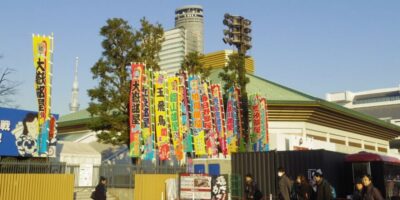
A tournament gives you the grand ceremony, the crowd, the colorful banners, and the drama of a formal match. A stable shows you the daily labor behind it. You see bodies being prepared, techniques repeated, and wrestlers working under a strict routine.
That difference matters. The practice is not performed for the group. It can feel quiet and even severe, but that is part of its value. You are watching athletes train for upcoming tournaments, not actors reenacting sumo for an audience.
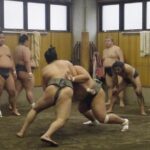
The morning may include basic exercises and warm-ups before the wrestlers begin bouts. Depending on the day, you might see strong clashes and repeated technique practice. One of the most striking parts is the physical effort at close range. Sumo is often presented as a simple contest of size, but training makes the balance, footwork, timing, and endurance easier to appreciate.
This visit works best if you accept the rules. You are not entering a sports bar or a public performance hall. You may need to sit in a prescribed way, remain silent, avoid photography, and stay within the tatami areas. Those restrictions can feel strict, especially if other people nearby appear to have different permissions, but they reflect the stable’s own conditions for allowing an audience inside.
A few more Tokyo tours and experiences worth a look


Meeting at JR Ryogoku Station at 8 a.m.
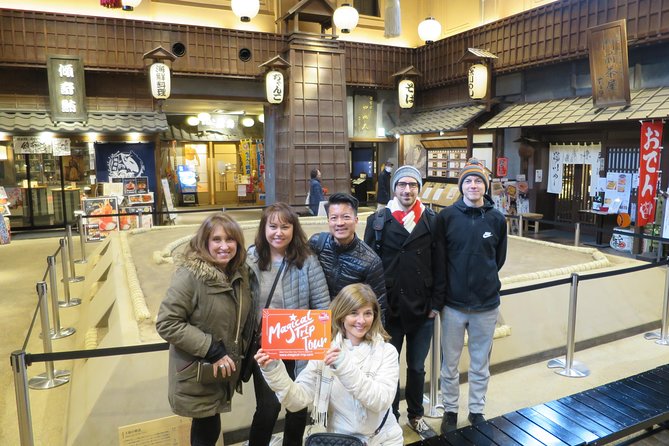
Your guide meets you beneath the elevated tracks near Re.Ra.Ku Ryogoku Ekimae, at the JR station’s East Exit. Look for the red or orange MagicalTrip board. This detail is important because Ryogoku has two stations, and going to the Oedo Line station can put you in the wrong place.
The meeting time is 8 a.m., though you should arrive at least 10 minutes early. The group cannot simply wait for late arrivals outside the stable. If you are more than 15 minutes late, you may be refused entry without a refund or a new appointment.
I recommend treating this as an early-morning commitment, not a casual start to the day. Check the route to JR Ryogoku Station the night before, allow time for a wrong turn, and have the meeting location ready on your phone. One person had trouble reaching the guide by phone after going to the wrong meeting point, so careful planning matters.
Before the walk, the guide normally explains what you are about to see. The quality of this introduction can shape the whole visit. Strong guides have explained the rules of sumo, how stables are organized and ranked, and the way wrestlers live and train. Guides named in past sessions include Mayu, Masao, Ayaka, Yumiko, Tommy, and Kate, though your guide will depend on the date.
Some visitors have wanted more explanation of the sport’s origins, hierarchy, daily life, and business side. If those subjects interest you, ask questions before entering. The street outside the station can be noisy, so it may be easier to hear the guide once the group has moved away from traffic.
The five to 30 minute walk to the stable
From the station, you walk with the guide through Ryogoku, Tokyo’s sumo district. The walk can take about five to 30 minutes, depending on which stable is available that day.
That range tells you something about the arrangement. You are not visiting one fixed museum or arena. The available stable can change with the training calendar, tournament schedule, and the wrestlers’ condition. In a larger group, people may also be divided into smaller groups and sent to different stables.
The walk is short enough to be easy for most people, but it is still worth wearing comfortable shoes. This is not a sightseeing walk with a long list of planned stops. The main purpose is to get you into the stable on time.
You may pass through the Ryogoku area again after practice, with the guide pointing out local sumo landmarks. The route can include a look at Ryogoku Kokugikan, the district’s major sumo venue. The listed exploration there lasts about 10 minutes, so think of it as a brief orientation to sumo town rather than a full venue tour.
One extra stop has included Ekōin temple, a place connected with memorial observances. This is not guaranteed as part of every visit, so you should not book the activity expecting a temple tour. The stable practice is the central event.
Sitting quietly inside an active stable
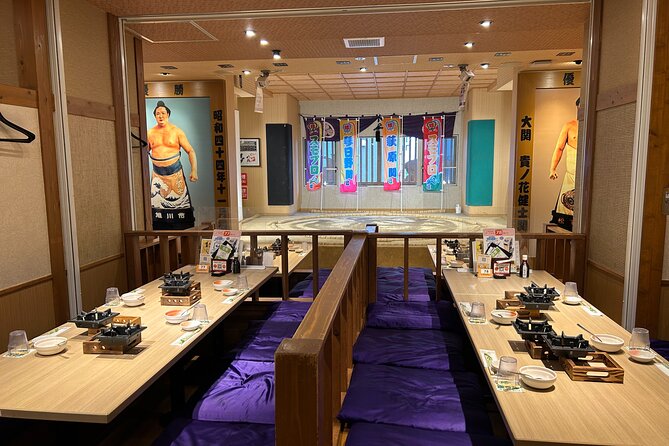
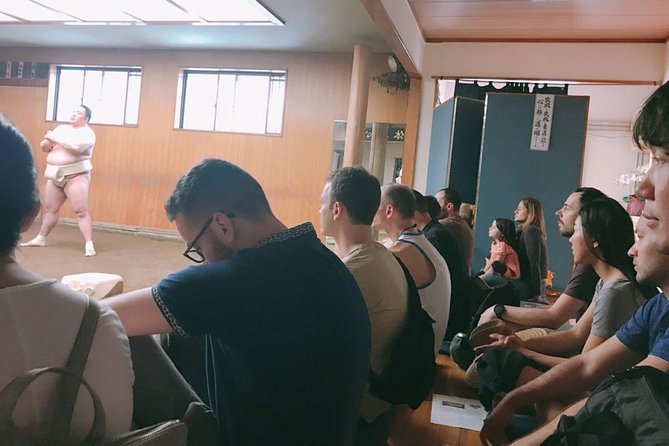
Once inside, you move to the tatami area. Stable rules are firm: areas beyond the designated straw flooring are off-limits, and you may not be able to leave for the toilet during practice.
Most stables do not provide chairs. Expect to sit on the floor for roughly an hour and 20 minutes, though the exact length varies. If you have trouble sitting cross-legged or on your knees, this is the most important physical issue to consider. There is no promise of a chair or a chance to shift to a comfortable seat.
The first visitors to arrive usually have the best chance of sitting near the front. Seating is first come, first served, and late arrivals may be placed two or three rows back. You will still see the wrestlers, but the difference is meaningful when the action is taking place only a few feet away.
The stable may set rules about masks, posture, silence, and cameras. During practice, you should assume that photography is not permitted unless the guide clearly says otherwise. The wrestlers are completing their daily training, and speaking can disturb the session.
This is where the experience asks for some maturity. The quiet may feel unusual at first. You cannot clap after a hard bout or whisper constant questions to your companion. But that restraint lets you observe the room as a working place rather than turning it into a show.
What you may see during the practice
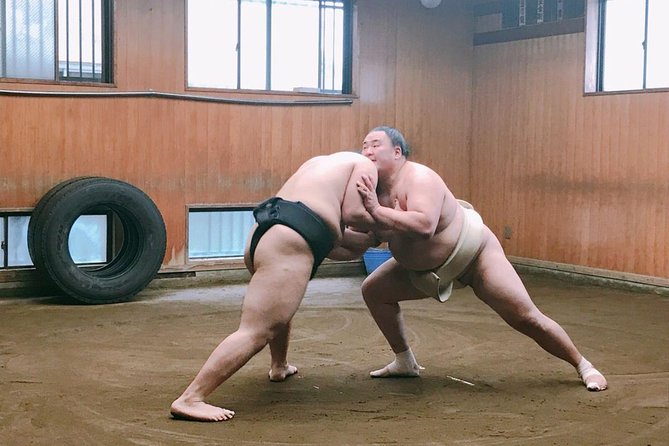
The session can begin with general exercises and stretching. As the wrestlers warm up, the work may become more intense, with drills and practice matches. You might see bouts between wrestlers testing balance and technique, sometimes with enough force to make the floor and room feel very close indeed.
The pace is not arranged for your convenience. You may arrive partway through a practice that began earlier, and the session may end sooner or run for two hours. A sudden injury or a change in the stable’s schedule can alter the morning.
That uncertainty is worth understanding before you pay. You are buying access to a real activity, not a guaranteed sequence of set pieces. If you want a fixed schedule, commentary, and a predictable finish, a formal tournament may suit you better.
The best part is the chance to notice small details. A good guide can point out what the wrestlers are doing, explain the purpose of an exercise, and describe the hierarchy within sumo. Several guides have also discussed the discipline, hygiene, living arrangements, and business structure that shape a wrestler’s life.
The guide’s role varies in quality. Some sessions have included helpful explanations before and during the practice, sometimes with written notes to help the group follow along. Other sessions have had a brief introduction and little explanation afterward. If learning is your main reason for booking, tell the guide early that you would like context, and save questions for the allowed discussion period.
A few more Tokyo tours and experiences worth a look

Photos with wrestlers after training
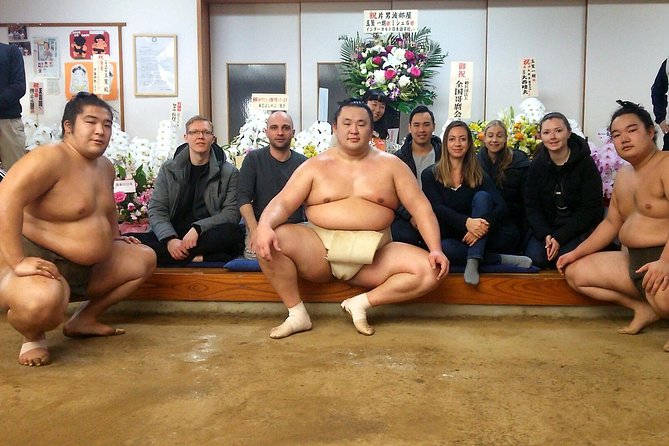
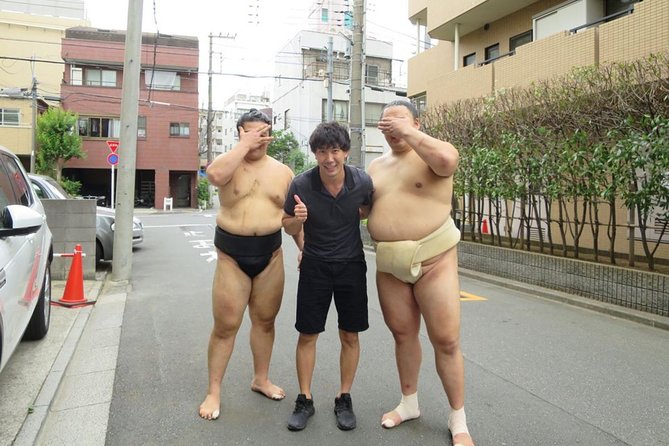
The photo opportunity is a pleasant possibility, not a guarantee. The stable decides if you can photograph the practice and if the wrestlers will pose with the group afterward.
The experience includes tour photographs, but that does not mean you can freely use your own camera throughout the session. You may be asked to wait until practice ends. Some groups have been allowed to photograph both the training and posed shots, while others have faced stricter rules.
After practice, wrestlers may answer questions or pose for photographs. This can be the most personal part of the morning, but you should follow the guide’s instructions and avoid treating the wrestlers like performers who are always available.
If a photo with a wrestler is essential to your booking decision, you need to accept the risk that it may not happen. The stable can refuse photographs for any reason, and there is no refund simply because the photo permission was not granted.
A short look around sumo town
After leaving the stable, the guide walks the group through Ryogoku and then back toward the station. The neighborhood is closely tied to sumo, and even a short walk helps place the practice in its local setting.
Ryogoku Kokugikan is the obvious landmark. The stop is brief, but it gives you a sense of how morning training connects with the formal world of tournaments. You will not be attending a match, touring every part of the hall, or receiving lunch as part of the standard plan.
The activity ends back at the original meeting point. The advertised duration is about two hours, but the practice can last longer, so avoid booking a tight lunch reservation or an early afternoon train immediately afterward.
Is $98.16 a fair price?
At $98.16 per person, this is not a cheap way to watch sport. You are paying for access arranged through a local company, a guide who can help you enter a stable, an explanation of what you are seeing, and included tour photographs.
The value depends on how difficult this access would be for you to arrange independently. A stable is not a normal public attraction, and the schedule can change without notice. The local connection is the main product.
I think the price is easier to justify if you are genuinely interested in sumo, Japanese customs, or the daily work behind a famous sport. It is less convincing if you want a polished entertainment package, a long guided walk, a meal, or guaranteed front-row seating.
The price also carries some risk because the stable controls the experience. Practice may be shortened, photography may be refused, or the group may be seated toward the back. If the stable cancels because its schedule changes or practice is called off, you are due a full refund. That protection does not apply to arriving late or breaking stable rules.
Who should book this morning visit?
I would choose this for a sumo fan who cannot attend one of Japan’s six official tournaments. It offers a close look at training and can reveal more about the sport’s discipline than a seat in the audience.
It also suits a first-time visitor who wants a direct cultural experience and is comfortable with quiet observation. Solo participants can fit in well because the central rule is to sit quietly, not to make constant conversation.
The activity is only for people aged 12 and older. Children under 12 will be refused entry without a refund. Summer visitors should bring water and wear a hat before and after the indoor practice, since Tokyo can be hot and humid.
I would hesitate to recommend it to anyone who cannot sit on the floor for a long period, needs guaranteed toilet access, or dislikes schedules that can change at short notice. It is also not ideal for a visitor who expects the guide to provide a long lecture from start to finish.
How to prepare for a respectful visit
Wear clothing that lets you sit comfortably. Use the toilet before the tour begins, since leaving during practice may not be allowed. Bring water, especially during Tokyo’s humid summer, but keep your movements quiet and follow any instructions from the stable.
Arrive early at the JR Ryogoku East Exit. Do not confuse it with the Oedo Line station. Keep your phone on hand for the meeting details, but do not assume you can call the guide at the last minute if you are lost.
Do not take photographs until permission is clear. Do not enter areas beyond the tatami space. Do not speak during practice, even if you have an urgent question about a move. Write it down and ask afterward.
Free cancellation is available if you cancel at least 24 hours before the local start time. Changes or cancellations made later are not accepted, and late arrival does not qualify for a refund. If poor weather causes the activity to be canceled, you should be offered another date or a full refund.
Should you book the Ryogoku sumo practice?
Book it if you want to see sumo as a demanding daily craft rather than a tourist performance. The close distance, real training, and chance to hear about stable life can make this one of Tokyo’s more memorable cultural activities.
Skip it if you need a fixed timetable, a chair, open photography, or a guaranteed posed picture. The strongest sessions seem to depend on both the stable’s mood and the guide’s ability to explain what is happening.
For the right person, the restrictions are part of the lesson. You sit quietly, watch the work, and leave with a clearer sense of how much discipline sits behind the brief spectacle of a tournament bout.
FAQ
Where does the tour meet?
Meet your guide at the JR Ryogoku Station East Exit, near Re.Ra.Ku Ryogoku Ekimae beneath the elevated tracks. Look for a red or orange MagicalTrip board.
Is the meeting point at the Ryogoku Oedo Line station?
No. You must go to JR Ryogoku Station’s East Exit. There are two Ryogoku stations, so check your route carefully.
What time does the activity start?
The activity starts at 8 a.m. You should arrive at least 10 minutes early because the group cannot wait for late arrivals.
How old must participants be?
Participants must be at least 12 years old. Children under 12 are not allowed inside the sumo morning practice and will be denied entry without a refund.
How long does the experience last?
The estimated duration is about two hours. The practice itself can sometimes run longer than expected, so the final end time is not fixed.
Do I have to sit on the floor?
Yes, you should be prepared to sit on tatami flooring. Most sumo stables do not usually provide chairs, and you may sit for more than an hour.
Can I take photographs during practice?
Photography depends on the rules set by the sumo stable. You may be asked not to photograph the training, and photographs with wrestlers are also not guaranteed.
Is food included?
No standard lunch or other meal is included in the activity. The main experience is the stable visit, with a short walk around Ryogoku afterward.
Can I cancel for a full refund?
Yes, if you cancel at least 24 hours before the local start time. Late cancellations, late changes, and missed departures are not refundable. If the stable cancels the practice or poor weather causes the activity to be canceled, you should be offered another date or a full refund.
More Morning in Tokyo
More Sumo Experiences in Tokyo

More tours in Tokyo we've reviewed











Sumo Experiences, compared.
 ★ 4.8Tokyo: Sumo Show Experience with Chicken Hot Pot and a PhotoFrom $1032 hours
 ★ 4.8Tokyo: Sumo Show and Dining ExperienceFrom $7990 minutes - 2 hours
 ★ 5.0the SUMO showFrom $89
 ★ 5.0Tokyo Shinjuku Sumo Show & Experience with PhotoFrom $79
 ★ 4.8Tokyo: Sumo Show and Experience in ShinjukuFrom $691h 30m
 ★ 4.6Tokyo: Sumo Tournament Tour with Chair Seat TicketsFrom $141