
Reviewed · GO-KARTS
Tokyo: Akihabara/Asakusa Go-Karting Tour (including guide)
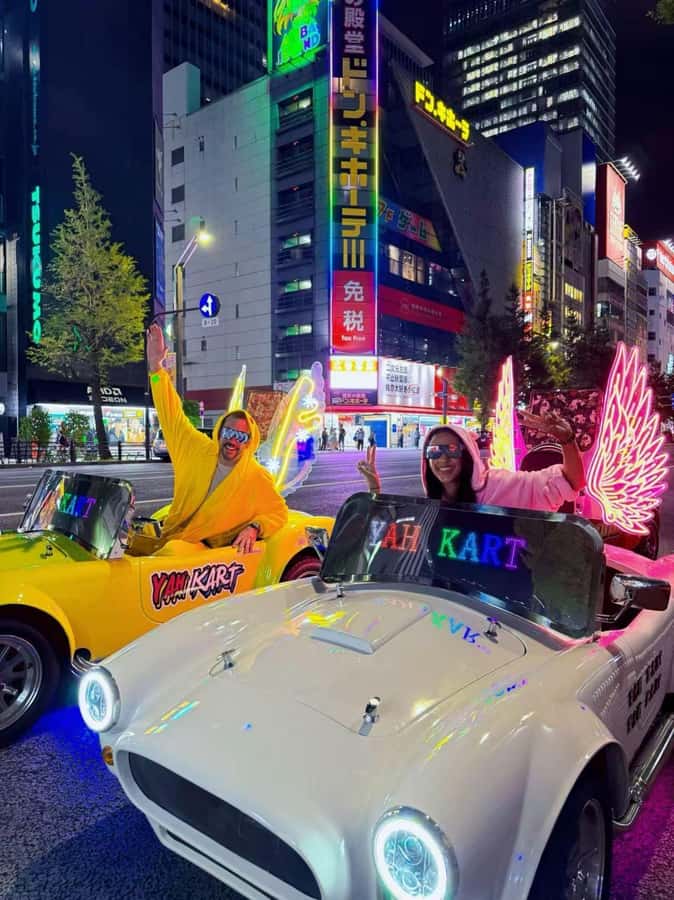
Tokyo looks very different from the seat of a mini go-kart. This tour takes you from neon-lit Akihabara to the traditional Kaminarimon gate at Senso-ji, giving you a moving view of the city instead of another walk along the pavement. I like the unusual mix of modern streets and old Tokyo, and I like that a guide leads the group and helps keep the ride orderly. The catch is simple: you are driving on real roads, so this is not a quiet amusement-park circuit.
I also like the small extras at the finish: a mysterious souvenir, a photo, and a magnetic frame with a custom Japanese stamp. The main thing to settle before booking is your license. Without the correct physical permit or Japanese translation, you cannot drive and a refund is not available.
In This Review
- Key points before you book
- Why this route gives you a different Tokyo view
- Starting at the YAH KART meeting point
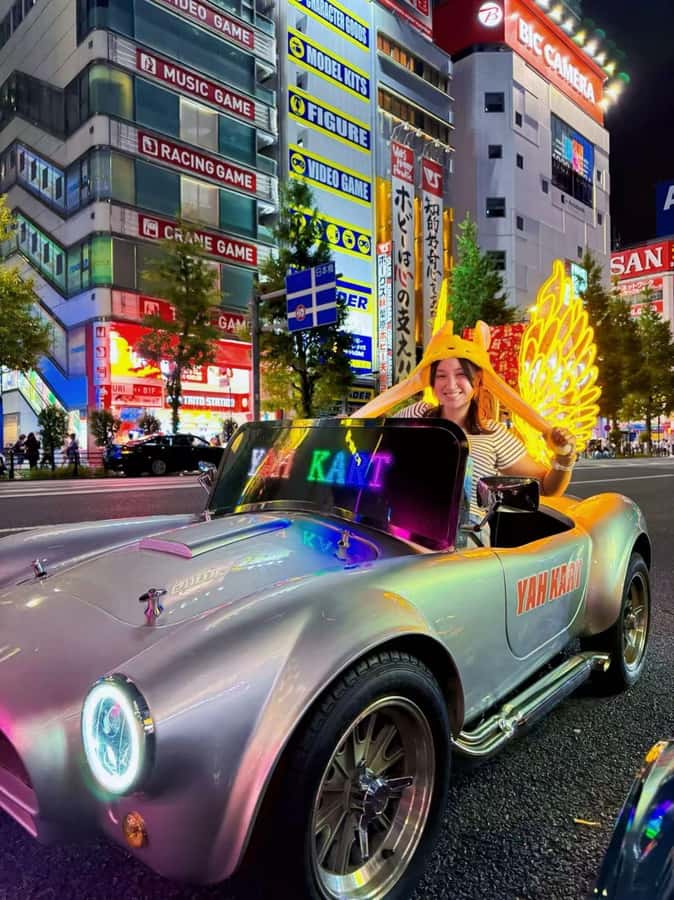
- Akihabara: Tokyo’s electric welcome
- Ueno: a central link between two sides of Tokyo
- Asakusa and Kaminarimon: a traditional finish
- How the guide affects the experience
- What you receive after the ride
- Is $71 a fair price?
- Who will enjoy this most?
- License rules you cannot ignore
- Booking, cancellation, and practical planning
- Should you book the Akihabara and Asakusa kart tour?
- FAQ
- Do I need an International Driving Permit to join?
- Which participants need a Japanese license translation?
- Can children join the go-kart tour?
- What is included in the price?
- Are glowing accessories and a 360-degree camera included?
- Where does the tour start and finish?
Key points before you book
- Neon Akihabara to historic Asakusa: The route links Tokyo’s electric-pop district, Ueno, and the Kaminarimon area near Senso-ji Temple.
- You drive on public roads: This is a street-driving experience, not a closed course, so traffic rules and attention matter.
- An approved license is essential: Most participants need a physical 1949 Geneva Convention International Driving Permit, plus a physical passport.
- Three keepsakes are included: Expect a mysterious souvenir, a tour photo, and a magnetic photo frame carrying a Japanese stamp.
- Night rides suit Tokyo’s neon: The light-up streets can make an evening departure especially appealing, though you still need to drive carefully.
- The activity is for adults: Participants must be at least 18, and group members should book together under one reservation.
Why this route gives you a different Tokyo view
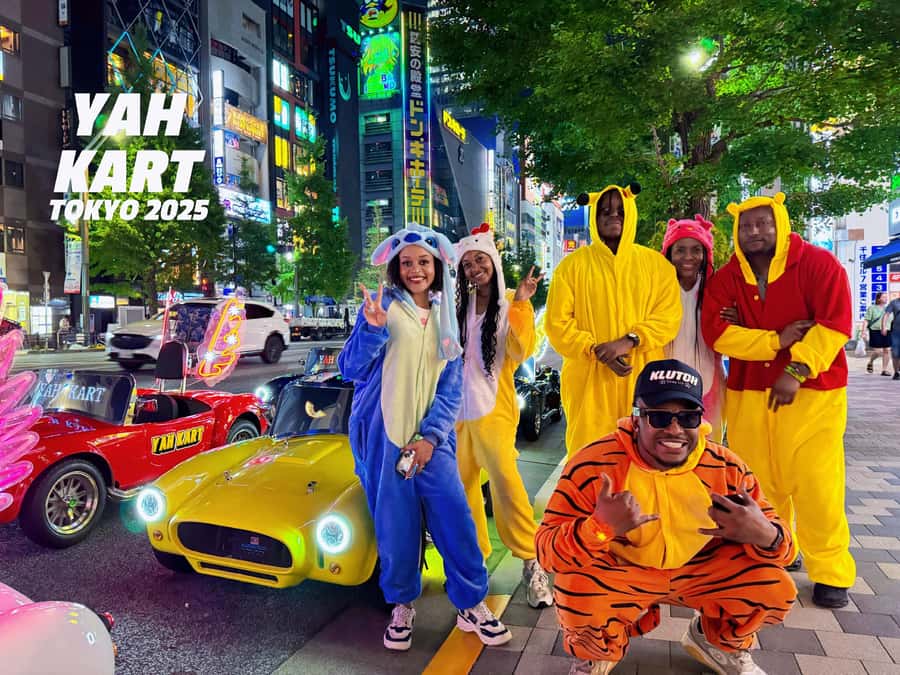
Most Tokyo sightseeing happens at walking speed, from train platforms, or through a taxi window. Here, you sit low in a small kart and pass through the city as part of a guided line. That changes the feel of familiar places. Akihabara’s signs and shopfronts rise around you, while Asakusa brings a very different mood near Kaminarimon and Senso-ji Temple.
The route is designed around contrast. Akihabara represents Tokyo’s electronic and pop-culture side. Ueno adds another central-city district. Asakusa brings a more traditional setting, with the large Kaminarimon gate and the Senso-ji area. You do not simply visit one attraction and leave. You connect several parts of Tokyo by road.
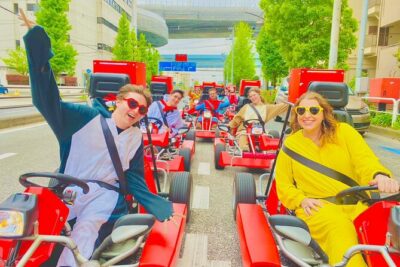
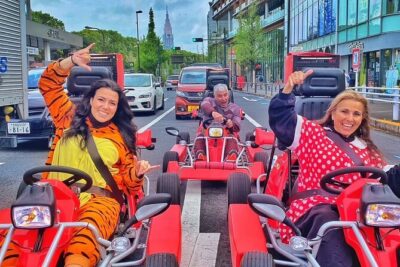
The go-kart itself is part of the show. People around you may look over, wave, or take notice as the small vehicles pass. That attention is fun for some people and uncomfortable for others. I would book this for someone who enjoys being visible in public, not for anyone hoping to blend into the crowd.
A few more Tokyo tours and experiences worth a look


Starting at the YAH KART meeting point
The tour begins on the first floor of a red building. Look for the YAH KART sign on the door. This is the place to complete the required checks, receive instructions, and prepare for the ride. Since the supplied information does not give a street address, check the exact meeting details carefully before leaving your hotel.
Bring your physical passport and the correct driving documents. A phone image or photocopy is not enough for the stated requirements. You must carry your physical International Driving Permit, or, for the listed exceptions, your physical domestic license along with the official Japanese translation.
Wear comfortable clothes. You cannot bring drinks in the vehicle, and you should avoid alcohol before driving. The company also lists vehicle insurance as an extra rather than an inclusion, so read the booking terms carefully if you want to understand your coverage.
Before the engines start, the guide should explain the basic kart controls and the road rules. The karts are described as easy to use, but simple controls do not remove the need to watch traffic. You are responsible for driving safely and following Japanese road laws.
Akihabara: Tokyo’s electric welcome
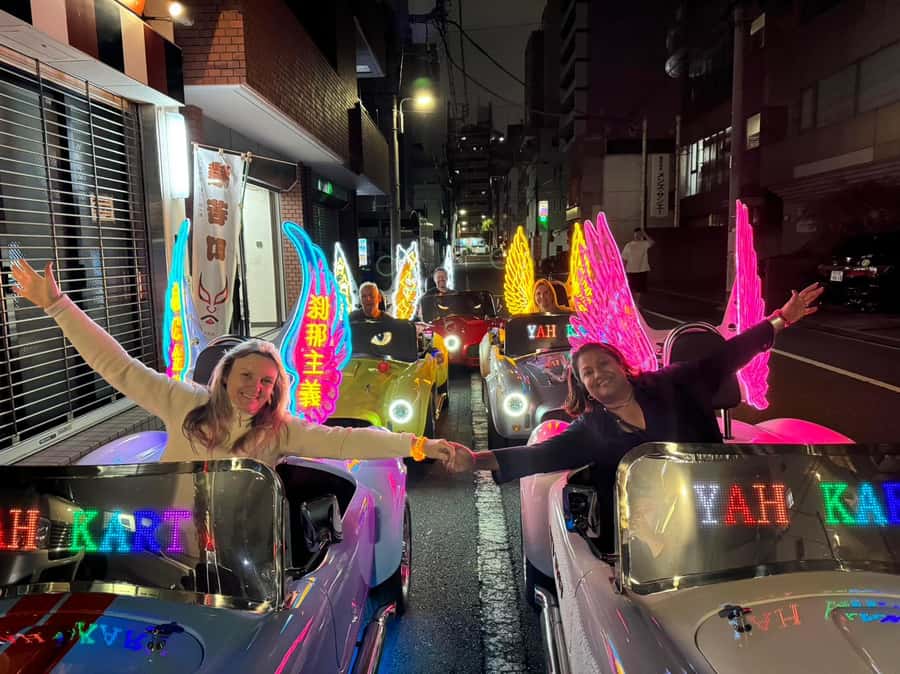
Akihabara is the natural place to begin a modern Tokyo route. The district is known for electronics, anime, games, and bright signs, making it one of the city’s most instantly recognizable areas. From a go-kart, you get a quick-moving view of those signs and streets rather than a slow shop-by-shop visit.
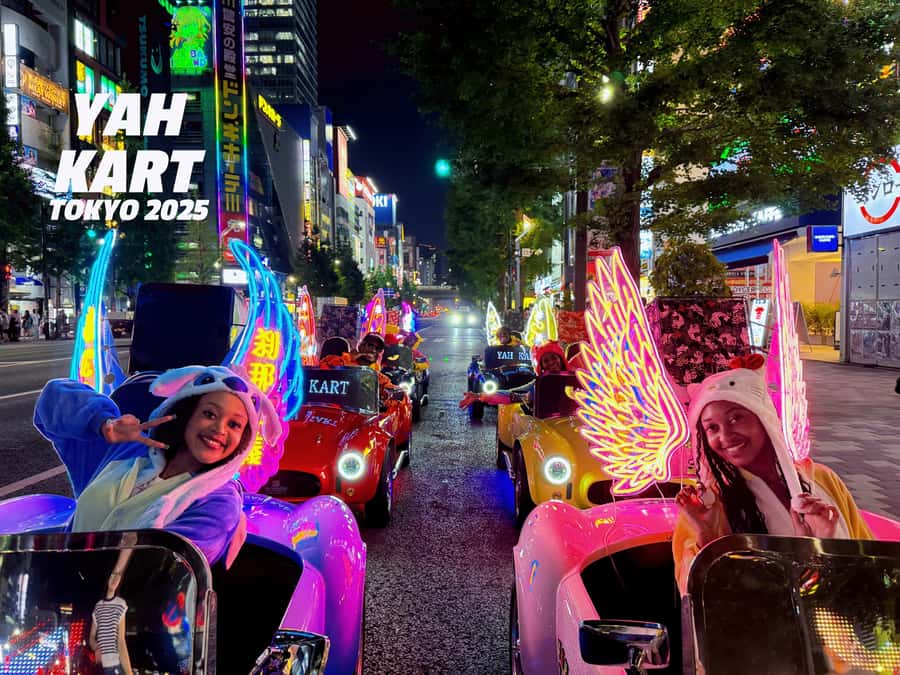
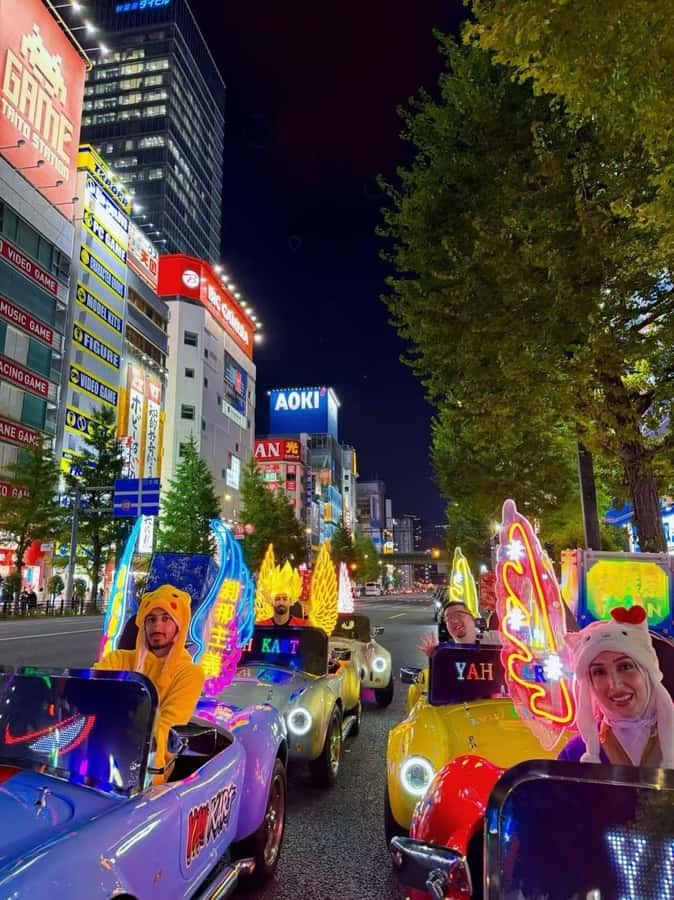
The strongest part of this section is the sense of occasion. A small convoy of colorful karts is hard to miss, and you may feel like the city has become a stage for a few minutes. That is also the point at which you may notice the difference between this activity and ordinary sightseeing: you must divide your attention between the view, the guide, and the road.
Do not expect long stops for shopping or museum visits. The value here is the ride through the district, not a detailed tour of Akihabara’s stores. If you want time inside arcades or electronics shops, plan that separately before or after the activity.
An evening ride may work especially well in Akihabara. The artificial light gives the district its strongest visual character, and one participant specifically recommended going at night for the neon. Still, low light asks more of you as a driver. Keep your focus on the road, even when the signs are tempting to photograph.
Ueno: a central link between two sides of Tokyo
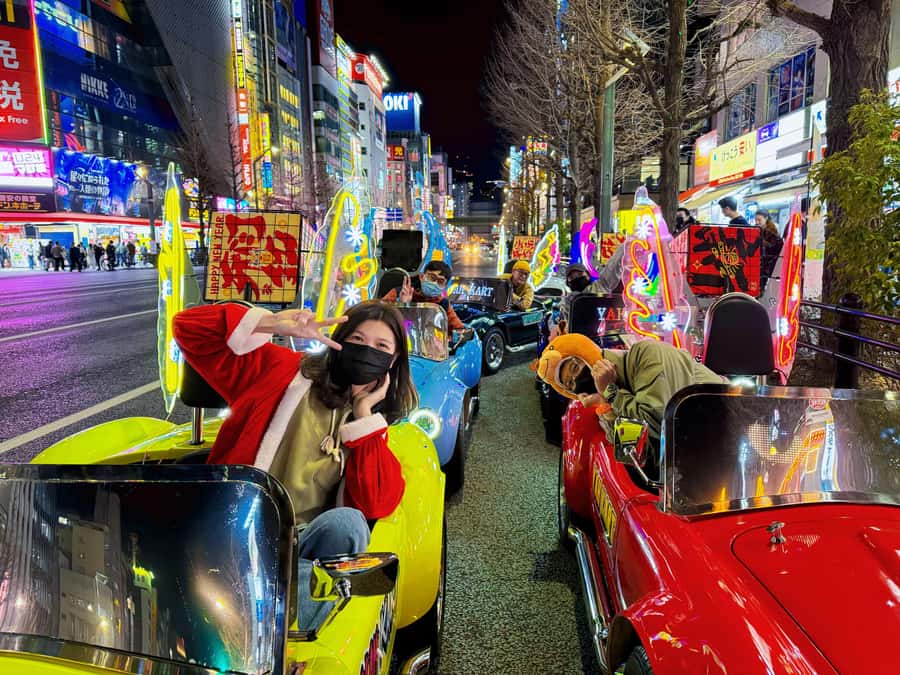
Ueno acts as a connecting part of the route. It helps tie Akihabara to Asakusa and gives you another view of central Tokyo from the kart. The information for this tour does not promise a stop at a particular Ueno attraction, so treat this section as a street-level passage rather than a full Ueno sightseeing visit.
That distinction matters when you set expectations. You can see the city changing around you, but you may not have time to explore a park, museum, market, or temple on foot. If Ueno is high on your list, reserve a separate visit.
For me, this kind of connecting stretch is useful because it makes the tour feel like a city journey instead of a single photo stop. You get the pleasure of moving between districts under your own control, with a guide at the front. The tradeoff is that traffic and signals can interrupt the flow. The ride is not a race, and the schedule must follow normal road conditions.
Asakusa and Kaminarimon: a traditional finish
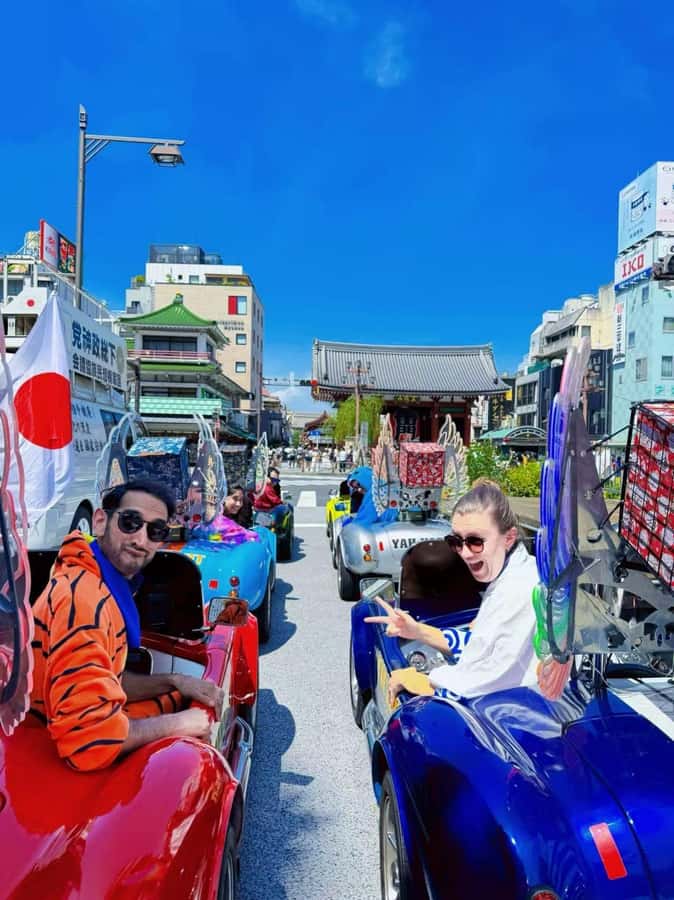
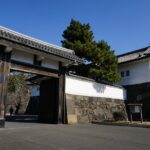
Asakusa changes the visual tone of the tour. The Kaminarimon gate at Senso-ji is one of Tokyo’s best-known traditional sights, with a strong presence that contrasts sharply with Akihabara’s electronic signs. Seeing it from the road gives you a memorable finish to the modern-to-traditional route.
The tour information identifies Kaminarimon and Senso-ji as route highlights. It does not promise entry into the temple or a long guided visit inside the grounds. You should think of this as a drive past or near a major sight, with opportunities shaped by traffic and the group’s movement.
That limitation is not a flaw if you understand the format. You are paying for a guided go-kart ride through Tokyo, not a temple tour. If you want incense, temple buildings, shopping streets, and careful photography around Senso-ji, return on foot at another time.
The contrast is the real payoff. You begin among Tokyo’s most playful modern streets and finish near one of its most traditional temple districts. Few ordinary city tours create that particular shift while letting you operate the vehicle yourself.
A few more Tokyo tours and experiences worth a look


How the guide affects the experience
The guide is not just there to point out sights. The lead driver controls the pace and helps the group move safely through the streets. English, Chinese, and Japanese are listed as available languages, which makes the pre-ride briefing and road instructions easier for many participants.
One guide named Ryu is praised for keeping the ride safe while leaving room for photos and sightseeing. If Ryu leads your departure, you can expect a guide who pays close attention to the group. The company also emphasizes helpful staff and careful support, which is important because street driving can feel more demanding than the kart controls suggest.
You should stay close to the group and follow instructions rather than trying to speed ahead. The supplied comments describe the cars as fast, but the exact pace depends on city traffic, signals, and the guide. This is a guided city ride, not a driving competition.
The best guide will help you enjoy the attention without letting it distract you. Since you may want to wave or pose, it is smart to keep your hands and eyes ready for driving until the guide indicates a safe opportunity.
What you receive after the ride
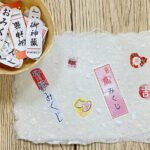
The included extras give you something tangible to take home. You receive a mysterious souvenir, a photo, and a magnetic photo frame with a custom Japanese stamp. The photo frame is a particularly nice touch because it turns a digital memory into a small physical memento.
The tour also allows optional light-up accessories and a 360-degree camera. These are not included in the $71 price, so treat them as add-ons rather than part of the standard package. Glowing accessories may add to the playful look of an evening ride, while a panoramic camera could record more of the route than a single photograph.
Ask about the optional costs before you agree to them. The included photo and frame may already be enough for you, especially if you want to keep the total price under control.
Is $71 a fair price?
At $71 per person, this is not the cheapest way to see Akihabara or Asakusa. You can walk through both districts for little more than the cost of transport, and public trains will take you between them efficiently.
The value comes from the activity itself. You are hiring the kart, the guide, the route planning, and the chance to drive on Tokyo streets. The photo, souvenir, and stamped magnetic frame add a little more value. For someone who wants a distinctive experience rather than the lowest-cost sightseeing route, the price is reasonable.
The price makes less sense if you mainly want detailed information about Senso-ji, shopping time in Akihabara, or a relaxed ride with no traffic. This tour does not replace those activities. It adds a playful driving experience to your Tokyo plans.
You should also budget for anything not included. Meals and drinks, hotel pickup, glowing accessories, the 360-degree camera, and vehicle insurance are outside the stated package. The meeting point is also your return point, so you must make your own way there and back.
Who will enjoy this most?
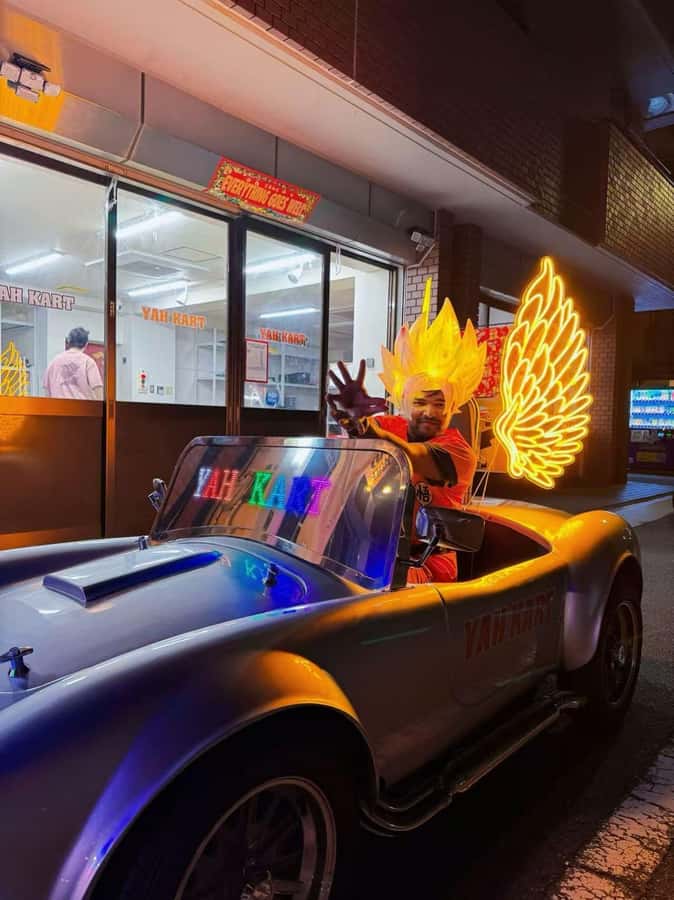
This tour suits adults who enjoy novelty, city lights, and a little public attention. It works especially well for couples, friends, and small groups who want a shared memory that is different from a standard walking tour. The age minimum is 18, so families with younger children cannot join as drivers.
It is also a good fit for confident drivers who can stay calm in a busy urban setting. You do not need to treat the experience as a test of speed. The better approach is to follow the guide, keep a safe distance, and enjoy the route when traffic allows.
I would hesitate to recommend it to anyone uncomfortable with driving on public roads. One participant described the experience as exciting but not for the faint-hearted because the karts travel through busy streets. That is a useful warning, not a reason to avoid the activity entirely.
Groups should book together rather than making separate reservations. Individual bookings may not be placed together, and that could spoil the point of sharing the ride.
License rules you cannot ignore
The license requirement is the most important practical detail. Most participants need an International Driving Permit issued in the 1949 Geneva Convention format by a government-authorized association. You must carry the physical permit and your physical passport.
People with licenses issued in Switzerland, Germany, France, Taiwan, Belgium, or Monaco need a Japanese translation from the Japan Automobile Federation, known as JAF. They must carry the physical domestic license and the official translation.
Licenses from countries not covered by the 1949 Geneva Convention are not accepted under the stated rules. The examples given include China, Indonesia, Mexico, Qatar, and Saudi Arabia. Confirm your eligibility before paying.
The company requires advance confirmation that you hold an approved license. If you cannot provide the required document, you cannot join and no refund will be available. This is the one detail I would settle before thinking about costumes, cameras, or the best time of day.
Booking, cancellation, and practical planning
You can reserve now and pay later, which helps if your Tokyo schedule is still shifting. Cancellation is allowed up to 24 hours before the activity for a full refund. Keep the meeting point and return point in mind when planning dinner or another booking afterward.
The activity ends back at the red YAH KART building. Since no hotel pickup or drop-off is included, allow time to reach the start independently. Comfortable clothing is recommended, and drinks are not allowed in the vehicle.
If you want neon views, choose an evening departure when available. If you prefer maximum visibility while learning the route, daytime may feel easier. The supplied details do not state the tour duration, so do not build a tightly timed reservation immediately afterward.
Should you book the Akihabara and Asakusa kart tour?
Book it if you want Tokyo sightseeing with a steering wheel, enjoy being noticed, and already hold the correct driving documents. The route offers a memorable contrast between Akihabara’s modern energy and Asakusa’s traditional setting, while the guide, photo, souvenir, and magnetic frame add useful value to the $71 cost.
Skip it if you want a quiet temple visit, a detailed cultural tour, or a completely controlled driving environment. Also skip it until your license is confirmed if there is any doubt. For the right adult driver, this is a lively, unusual way to connect several Tokyo districts, with enough practical support to make the experience feel exciting rather than reckless.
FAQ
Do I need an International Driving Permit to join?
Yes. Most participants need a physical International Driving Permit issued in the 1949 Geneva Convention format by a government-authorized association. You must also carry your physical passport.
Which participants need a Japanese license translation?
Participants with licenses from Switzerland, Germany, France, Taiwan, Belgium, or Monaco need an official Japanese translation from the Japan Automobile Federation, or JAF. They must carry their physical domestic license and the translation.
Can children join the go-kart tour?
No. The activity is not suitable for children under 18.
What is included in the price?
The package includes the go-kart driving experience, a guide, a mysterious souvenir, photos, and a magnetic photo frame with a custom Japanese stamp.
Are glowing accessories and a 360-degree camera included?
No. Glowing accessories and the 360-degree camera are optional extras and are not included in the listed price.
Where does the tour start and finish?
The tour starts on the first floor of the red building marked by a YAH KART sign on the door. It finishes back at the same meeting point.
More Guided Tours in Tokyo


More Akihabara & Anime Tours in Tokyo
More Asakusa Tours in Tokyo
More tours in Tokyo we've reviewed





Go-Karts, compared.
 ★ 5.0Flagship 2-Hours Official Street Go-Kart Tour – Tokyo Bay ShopFrom $642 hours to 2 hours 30 minutes (approx.)
 ★ 5.0Official Street Go-Kart in ShibuyaFrom $76
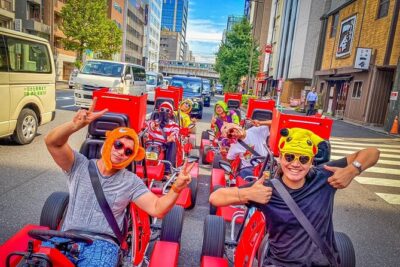 ★ 5.0Official Street Go-Kart Tour – AkihabaraFrom $61
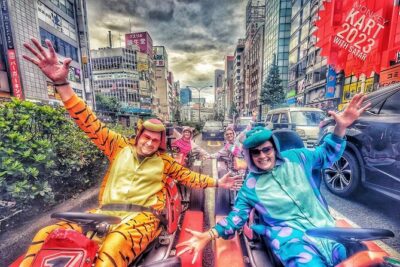 ★ 5.0Tokyo Go Kart: Asakusa, Skytree, and Akihabara **IDP MUST**From $99
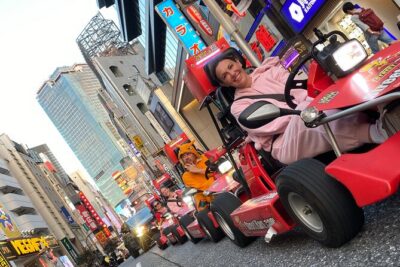 ★ 5.0Shibuya Official Street Go-Kart in Shibuya AnnexFrom $69
 ★ 4.7Tokyo: Asakusa, Skytree & Akhihabara Go-Kart City ExperienceFrom $961h 10m