
Reviewed · SHOW
Traditional Japanese Comedy, Juggling & Magic Live Show in Tokyo
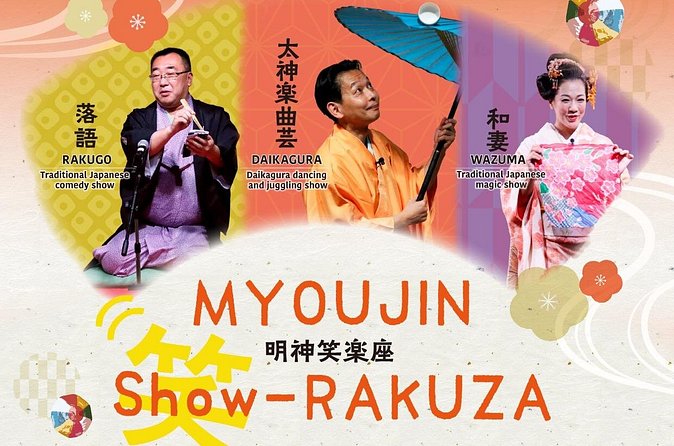
Tokyo has plenty of polished stage shows, but this one gives you three old Japanese arts in one sitting: Rakugo comedy, Daikagura juggling, and Wazuma magic. The acts are presented for an international audience, with interpretation and hands-on moments that make the traditions easier to grasp.
I like the small theater setting inside Kanda Myoujin Shrine, only a few minutes from Akihabara. I also like that you do not just sit and watch: you may step onto the Rakugo stage, try a simple trick, and take home small traditional props. The main consideration is timing, since this is a single scheduled performance rather than a flexible all-day attraction.
In This Review
- Key points at a glance
- Three old Japanese arts, one compact Tokyo show
- Finding EDOCCO STUDIO at Kanda Myoujin Shrine
- What the Rakugo section teaches you
- The umbrella act and the hands-on demonstrations
- Why the Wazuma magic act earns its place
- The interpreter and the welcome matter
- The take-home gift and its real value
- Is $36.24 good value?
- Timing, cancellation, and practical details
- Who should book this experience?
- Should you book the Kanda Myoujin comedy and magic show?
- FAQ
- Where does the performance take place?
- How long does the show last?
- What time does the performance begin?
- What types of entertainment are included?
- Do I need to speak Japanese?
- Can I participate in the activities?
- Is a gift included?
- How much does the experience cost?
- How many people can join the activity?
- Can I cancel for a refund?
Key points at a glance
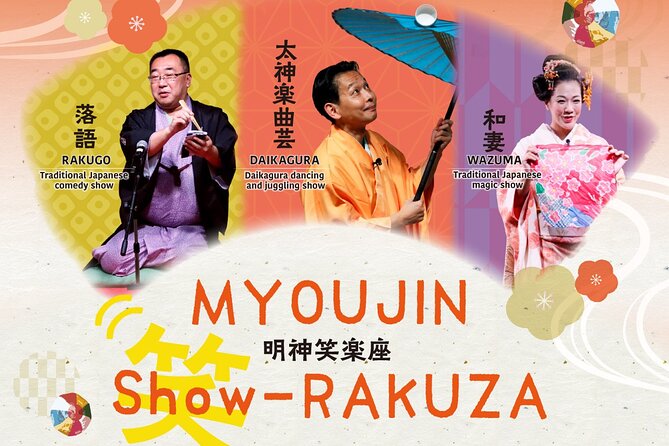
- Three traditional arts in 90 minutes: Rakugo comedy, Daikagura acrobatics, and Wazuma magic share one compact show.
- English-friendly presentation: An interpreter helps explain the jokes, tricks, and cultural points, so Japanese language skills are not required.
- Hands-on participation: You may learn basic Rakugo expressions and try simple Daikagura or Wazuma techniques.
- A shrine setting near Akihabara: EDOCCO STUDIO sits within the grounds of historic Kanda Myoujin Shrine.
- Useful cultural souvenirs: The included mini gift may feature items such as a tenugui hand towel, folding fan, or paper balloon.
- A practical rainy-day plan, with one caveat: The theater is indoors, but the activity can still be canceled for poor weather under its stated policy.
Three old Japanese arts, one compact Tokyo show
The appeal here is variety. In about an hour and a half, you get a quick introduction to three performance forms that are rarely bundled together for international audiences.
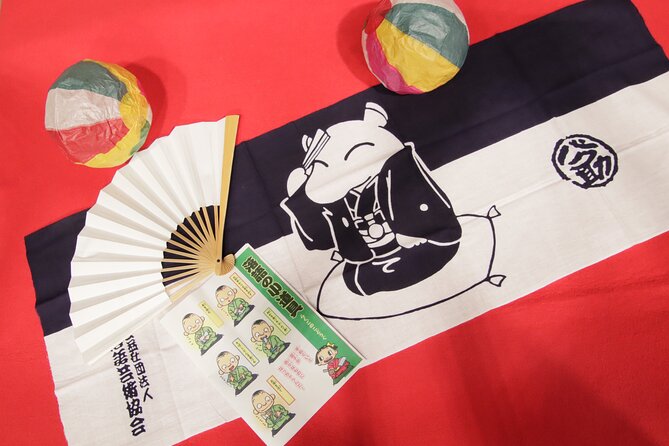
Rakugo is a comic storytelling art. The performer sits on a stage and uses little more than a folding fan and a tenugui hand towel as props. With changes in voice, expression, and body position, one person creates a small cast of characters and lets a story unfold.
That simplicity can surprise you. Rakugo is not a large visual spectacle, so the humor depends on timing and the audience understanding what is being said. The interpreter is important here. The show is designed so you can follow the basic situation and comic rhythm even without Japanese.
The Rakugo portion also has a teaching element. The Rakugo master introduces basic expressions, and you may get a chance to perform on the stage yourself. I see this as more valuable than a standard translated lecture. You learn how the performer uses a fan, posture, and voice to suggest a scene, then get a small taste of the skill required.
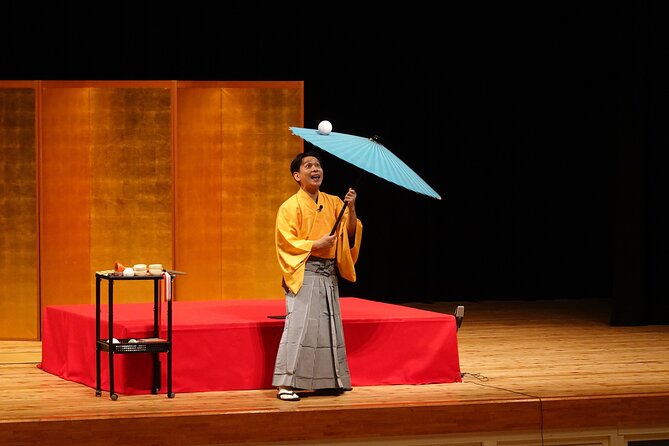
Daikagura supplies the visual punch. This traditional form includes balancing and juggling, with an umbrella-spinning act singled out as one of the memorable parts of the performance. The umbrella is not just a decorative prop. It becomes part of a carefully controlled display of balance and movement.
You may also be invited to try a simple Daikagura activity. That does not turn you into a professional performer, of course, but it helps you notice the control behind what looks effortless from the audience. The interactive part is handled in a light way, so you can take part without feeling pushed into the spotlight.
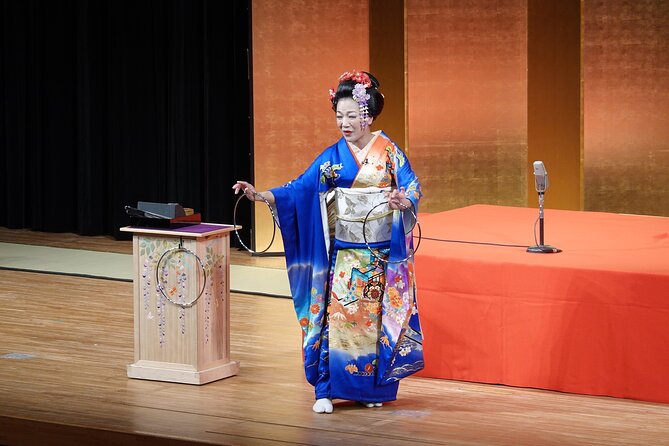
Wazuma, the Japanese magic segment, adds a different kind of fun. The magician teaches basic tricks that you can repeat for friends later. This is one reason the show works well for families and groups, since the experience continues after you leave the theater.
The three sections give the hour and a half a good shape. Rakugo asks you to listen, Daikagura gives you movement and visual skill, and Wazuma lets you play with a trick of your own. It is less like a formal museum lesson and more like a friendly introduction through live performance.
A few more Tokyo tours and experiences worth a look

Finding EDOCCO STUDIO at Kanda Myoujin Shrine
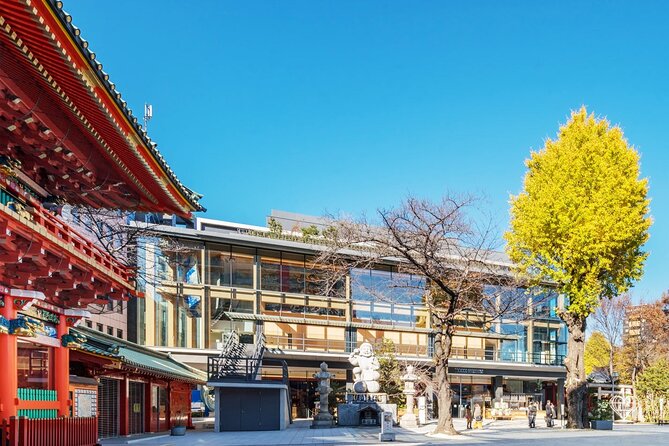
The meeting point is EDOCCO STUDIO, at 2-chome-16-2 Sotokanda, Chiyoda City. The studio is located within Kanda Myoujin Shrine, a central Tokyo site a few minutes from Akihabara.
That setting adds useful context before the show starts. You are not being sent to an isolated theater on the edge of town. You can pair the performance with time around Kanda Myoujin and Akihabara, though the activity itself begins and ends at EDOCCO STUDIO.
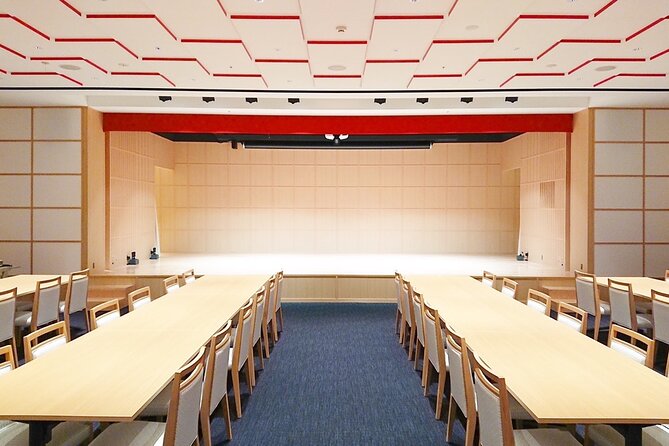
The venue is modern and indoors, while the shrine grounds provide the traditional setting outside. That contrast fits the show well. You get old performance forms presented in a space suited to modern international sightseeing.
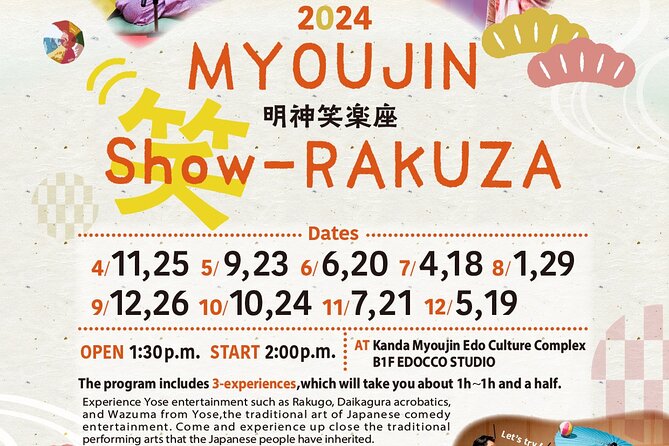
Doors open at 1:30 p.m., with the show starting at 2 p.m. The performance lasts about 90 minutes. Plan to arrive with enough time to find the studio and settle in before the start, since this is a timed show rather than an attraction you can enter whenever you like.
The group can include up to 100 people. That is not a tiny private demonstration, but the theater format and audience participation give it a more personal feel than a large commercial stage production. If you prefer a completely private experience, this is not the right fit. If you like a shared show with chances to join in, the size should be manageable.
What the Rakugo section teaches you
Rakugo can be hard to judge from a short description because its main tool is language. The performance uses a single seated storyteller, and the jokes often depend on character changes, wordplay, or social situations.
The interpretation solves the biggest problem for international audiences. You are not expected to understand Japanese. The interpreter helps carry the story and explains enough of the form for you to follow the act.
I especially like the practical teaching angle. You can learn a few Rakugo expressions and see how the performer creates different people with limited movement. A folding fan and hand towel become stand-ins for objects, while a turn of the head or change in voice signals a new character.
You may also be able to take a turn on the Rakugo stage. That moment is useful because it shifts your view from the joke to the craft. Even a basic attempt shows why timing and posture matter. It also gives children and adults a memorable point of contact with the art.
The drawback is that comedy is personal. If you prefer fast visual action, the seated storytelling may feel slower than the juggling or magic. The interpreter makes the material accessible, but no translation can reproduce every layer of a Japanese comic tradition. Treat Rakugo as a cultural sample, not a full course in the art.
The umbrella act and the hands-on demonstrations
Daikagura is likely to be the most visually immediate part of the show. The umbrella performance is easy to understand across language barriers, and the balance work gives the audience a clear sense of timing and control.
The show also lets you try elements of the tradition firsthand. This matters because juggling and balance acts can look simple until you hold the prop yourself. The lesson is not about mastering a professional routine. It is about giving you a brief connection to the performer’s tools and methods.
The interactive style is a strong point for families. Children can see that traditional culture is not only something displayed behind glass. Adults who might normally skip a formal cultural program also get a reason to stay engaged.
Still, participation varies by the flow of the performance and the audience. You should not book this expecting guaranteed individual stage time. The experience promises opportunities to try Daikagura and Wazuma, while the Rakugo section may also let you perform on stage. Think of participation as part of the design, not a private lesson.
Why the Wazuma magic act earns its place
The Japanese magic portion gives the show its easiest afterlife. The magician does not only perform tricks, but also teaches simple effects that you can use later with friends.
That teaching makes the $36.24 price easier to assess. You are paying for a live performance, an interpreter, a cultural setting, and a small take-home gift. The magic lesson adds something you can remember and repeat, rather than leaving you with only photographs or a program.
The magic also helps balance the Rakugo segment. If your children or companions are less interested in traditional storytelling, the visual tricks provide a change of pace. The performance has been described as interactive without making people feel forced, which is the right balance for a public show.
Do not expect a large illusion production with elaborate scenery. Wazuma is presented as traditional Japanese magic, with the charm coming from technique, surprise, and direct contact with the audience. That is a different kind of show from a theater spectacular, and the price should be judged on that basis.
A few more Tokyo tours and experiences worth a look


The interpreter and the welcome matter
For a culture-focused performance, clear explanation can make or break the experience. Here, interpretation is built into the presentation, and the staff are described as kind, welcoming, and easy to work with.
That support helps in several ways. It explains the Rakugo story, gives context for the juggling acts, and makes the magic lesson possible for people who do not speak Japanese. It also reduces the worry of being singled out without understanding what is happening.
The tone appears friendly rather than formal. You can go alone, with friends, or with children. Going alone should not prevent you from enjoying the performance, while a group can share the tricks and props afterward.
The show is family-friendly, but keep in mind that the exact balance of comedy, instruction, and performance may suit older children better than very young ones who need constant movement. The 90-minute length is reasonable, though it is still a full sitting for a child.
The take-home gift and its real value
A small traditional gift is included with admission. Possible items include a tenugui hand towel, folding fan, and paper balloon, all connected to the props or performance style.
This is not a major souvenir purchase, but it is a pleasant touch. The objects help you remember the show and give you something tangible to show friends at home. A fan or towel also has more cultural meaning than a generic Tokyo souvenir because you have seen similar items used in the performance.
The gift should not be the main reason to book. Its value is modest, and the exact item may vary. Think of it as an extra that strengthens the cultural theme, not as compensation for a short show.
Is $36.24 good value?
At $36.24 per person, this sits in the moderate range for a Tokyo cultural activity. The best value comes if you want a guided introduction rather than a simple stage ticket.
You receive three performance styles, an interpreter, interactive instruction, admission to the 90-minute show, and a small gift. The location near Akihabara also makes it easier to fit into a day of sightseeing without a long trip across the city.
The price may feel less attractive if you only want a polished comedy or magic show. The point is not one world-class act. It is the combination, along with the chance to try basic techniques and understand how the props work.
I would compare it with the cost of filling an evening with several separate cultural attractions. Here, the program gives you a clear start and end time, a controlled indoor setting, and a broad taste of Japanese performing arts. For a first visit to Japan, that mix can be more useful than spending the same money on a show you may not understand.
Timing, cancellation, and practical details
The experience uses a mobile ticket, and confirmation is normally sent at booking. If you book within two hours of the start, confirmation comes as soon as possible and depends on availability.
Free cancellation is available if you cancel at least 24 hours before the 2 p.m. start time. Changes or cancellations inside that 24-hour window are not accepted for a refund.
Although the performance takes place indoors, the stated policy says the activity requires good weather. If poor weather causes a cancellation, you can receive a different date or a full refund. The same applies if the minimum number of people is not reached. Check the final confirmation for any current instructions before setting out.
Service animals are allowed, and the venue is near public transportation. Most people can participate. The maximum group size is 100.
Because the show has one fixed start, I would avoid scheduling a tightly timed meal, train, or ticketed attraction immediately afterward. The advertised duration is about 1.5 hours, but a little breathing room makes the afternoon easier.
Who should book this experience?
I would recommend it most strongly to first-time visitors who want a cultural activity that does not require Japanese language skills. It is also a good pick for families, solo visitors, and couples looking for something different from temples, shopping, and city views.
Book it if you like:
- Short cultural programs with several types of entertainment
- Friendly audience participation
- Traditional arts explained in English through interpretation
- Experiences near Akihabara
- Small souvenirs and simple tricks you can share later
Think twice if you want a purely passive show, a private performance, or a long, detailed study of one Japanese art. The program offers a broad introduction, not a specialist demonstration of only Rakugo, Daikagura, or Wazuma.
Should you book the Kanda Myoujin comedy and magic show?
Yes, if you want an accessible cultural stop with real variety. The strongest reasons are the interpreter, the gentle participation, the umbrella act, the basic magic lesson, and the chance to see Rakugo from close range.
The show works because it treats tradition as something you can watch, hear, and try. At $36.24, it is a fair choice for an hour and a half near Akihabara, especially when you value the included gift and the hands-on element.
Book at least a day ahead if your schedule is firm, since the performance has a fixed afternoon start and limited capacity. If you want a relaxed introduction to Japanese stage arts without needing Japanese language skills, this is a smart addition to a Tokyo itinerary.
FAQ
Where does the performance take place?
It takes place at EDOCCO STUDIO, located within Kanda Myoujin Shrine at 2-chome-16-2 Sotokanda, Chiyoda City, Tokyo.
How long does the show last?
The show lasts approximately 1 hour and 30 minutes.
What time does the performance begin?
The listed start time is 2 p.m. Doors open at 1:30 p.m.
What types of entertainment are included?
The program includes Rakugo comedy, Daikagura acrobatics and juggling, and Wazuma Japanese magic.
Do I need to speak Japanese?
No. The show is designed for international visitors, and an interpreter helps make the performance understandable.
Can I participate in the activities?
Yes. The experience includes opportunities to try Daikagura and Wazuma firsthand. The Rakugo portion also teaches basic expressions and may include a chance to perform on the Rakugo stage.
Is a gift included?
Yes. A special mini gift is included. Examples listed include traditional props such as tenugui hand towels, folding fans, and paper balloons.
How much does the experience cost?
The listed price is $36.24 per person.
How many people can join the activity?
The maximum group size is 100 people.
Can I cancel for a refund?
Yes. You can cancel up to 24 hours before the start time for a full refund. Cancellations or changes made less than 24 hours before the start are not refunded.
More Shows & Entertainment in Tokyo
More Shows & Performances in Tokyo
More tours in Tokyo we've reviewed




Show, compared.
 ★ 4.0Mt Fuji & Hakone Cruise, Drum Show Bullet Train 1 Day from TokyoFrom $149
 ★ 4.8Tokyo: Sumo Show Experience with Chicken Hot Pot and a PhotoFrom $1032 hours
 ★ 4.8Tokyo: Sumo Show and Dining ExperienceFrom $7990 minutes - 2 hours
 ★ 5.0the SUMO showFrom $89
 ★ 5.0Tokyo Shinjuku Sumo Show & Experience with PhotoFrom $79
 ★ 4.5Tokyo: Samurai Restaurant Show Ticket with 2 DrinksFrom $551h 30m