
Reviewed · UENO & YANAKA WALKS
Private Workshop to Create Paper Last for 1,000 years in Ueno
Japanese paper begins with a tree, not a craft-store sheet. In this private Ueno workshop, you peel bark, beat plant fibers, and form wet pulp into four handmade paper pieces of your own design. The work gives you a clear feel for why washi has mattered in Japan for more than 1,000 years.
I like the patient, hands-on teaching and the unusual refreshment: tea made from kozo leaves, the same plant used as the paper material. I also like that this is a private activity, so your group can work at its own pace rather than share a crowded class.
The main drawback is the price, $143.35 per person for about two and a half hours. A cat named Kami lives at the workshop, so this is not a good choice if anyone in your group has a cat allergy.
In This Review
- Key points to know before booking
- Why this Ueno workshop feels different
- Starting with bark, trees, and washi tradition
- Beating fibers by hand with Dakai
- Forming two postcards and two larger sheets
- Making the most of the drying pause
- Meeting Kami, the workshop cat
- What $143.35 buys you in Ueno
- Getting to the Taito City meeting point
- Who will enjoy this class most
- The tradeoffs to consider before booking
- Should you book the Ueno washi workshop?
- FAQ
- Where does the paper workshop take place?
- How long does the activity last?
- What paper products will I make?
- Is the activity private?
- What does the workshop teach?
- Are food and drinks included?
- Is there a cat at the workshop?
- How does cancellation work?
Key points to know before booking
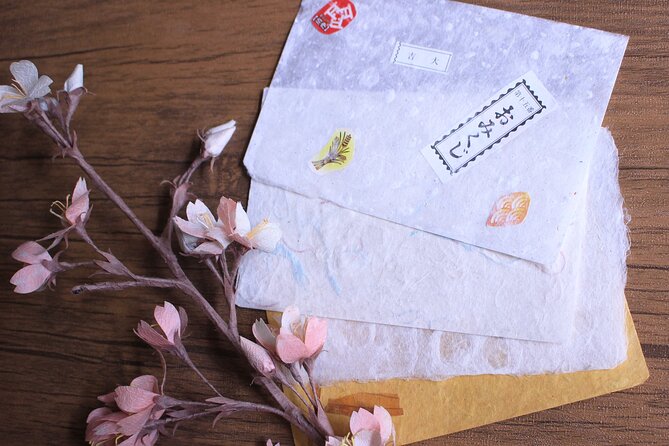
- You make four finished products: two designed postcards, one Rakusui paper, and one A5 sheet.
- You handle the full washi process: bark peeling, fiber beating, pulp preparation, and sheet formation.
- The class is private: only your group takes part, which allows for direct help from the instructor.
- The drying time includes a special treat: kozo-leaf tea and Japanese sweets from a local shop.
- The workshop is in Ueno: the meeting point is at 3-chome 30-2 in Taito City, near public transportation.
- Kami the cat is part of the setting: tell the provider about allergies before you attend.
Why this Ueno workshop feels different
Many craft activities give you a finished object after a short demonstration. This one asks you to handle the less glamorous parts first. You work with plant fibers, prepare them, and learn how a loose mixture becomes a flat sheet you can use.
That matters because washi can seem mysterious when you only see the final product. Here, you get the physical explanation. The fibers must be prepared, spread evenly, and drained with care. The process is simple to describe but surprisingly sensitive to how you move the mold and deckle.
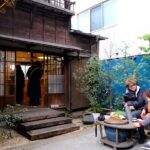
The setting is also personal. This is not a large production class with several groups at different stations. It is a private workshop for your party, held at the provider’s space in Ueno. You can ask questions as they come up, and the instructor can watch your technique closely.
The experience is presented as a way to connect with more than 1,000 years of Japanese papermaking tradition. You are not just decorating pre-cut paper. You are taking part in the stages that turn a tree-based material into a useful sheet.
A few more Tokyo tours and experiences worth a look
Starting with bark, trees, and washi tradition
The session begins with a general explanation of Japanese papermaking. You learn that the raw material comes from kozo, a plant traditionally used for washi. The workshop makes this connection especially memorable by serving tea made from kozo leaves later in the class.
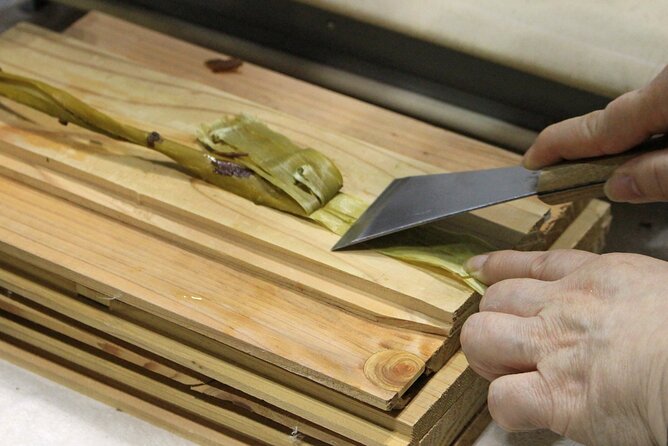
The first practical stage includes Hyouhitor, the peeling of the outer bark. This is a small but important detail. It shows that papermaking starts with preparation long before the pulp reaches the mold.
You should expect this part to be guided closely. The workshop promises the entire process, but it does not provide a detailed minute-by-minute schedule, so the time spent at each stage can vary. That is a good reason to arrive ready to listen and work rather than treat the class as a quick photo stop.
The value here is context. You see the material before it becomes paper, then follow it through several changes. By the time you begin forming sheets, you have a better idea of what is in the mixture and why the fibers need careful handling.
Beating fibers by hand with Dakai
Next comes Dakai, the beating of tree fibers. This is the part that gives the workshop a real sense of labor. You are not simply pouring a prepared liquid into a frame. You help break down the plant fibers so they can spread through water and form paper.
The work may look basic, but it is central to the finished sheet. Fiber preparation affects how evenly the pulp distributes and how the paper feels once dry. The instructor’s role is important here, especially if you are new to traditional papermaking.
One benefit of a private class is direct correction. If your technique is too light, too uneven, or simply unfamiliar, you can receive help without waiting behind a larger group. The available information does not name the instructor, but the teaching is described as patient and kind, with particular praise for the clear guidance and friendly manner.
This portion may be less polished than the final craft. Your hands may get involved with wet material, and the process requires some repetition. That is part of the point. The workshop gives you a physical understanding of washi instead of turning it into a quick decorative activity.
Forming two postcards and two larger sheets
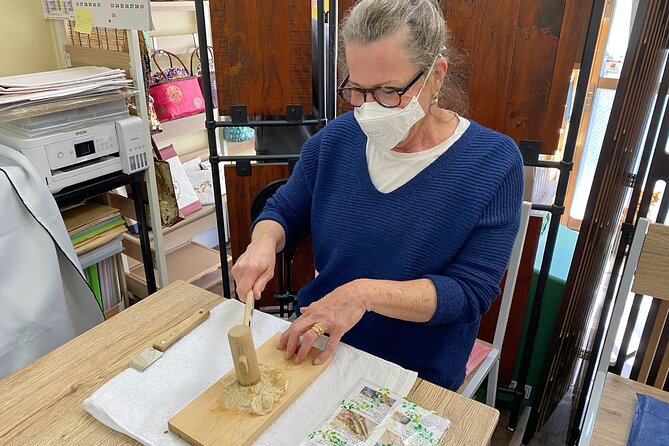
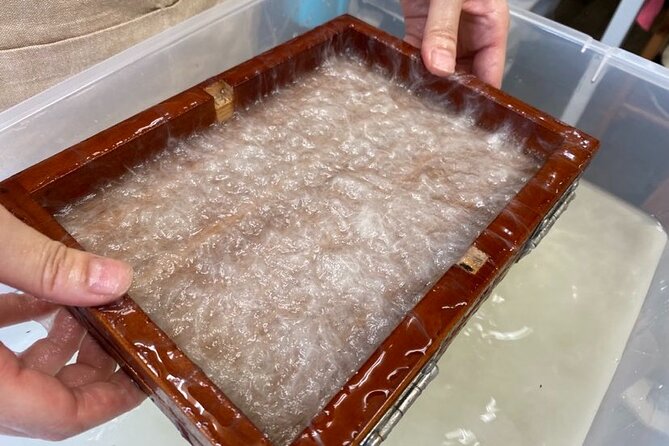
Once the raw material is ready, you pour it into a papermaking mold and deckle. You then sift the solution so it forms an even, flat sheet. This is where your movements begin to shape the final result.
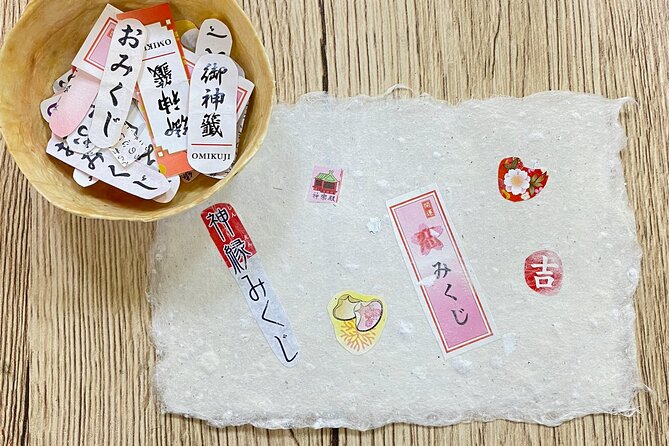
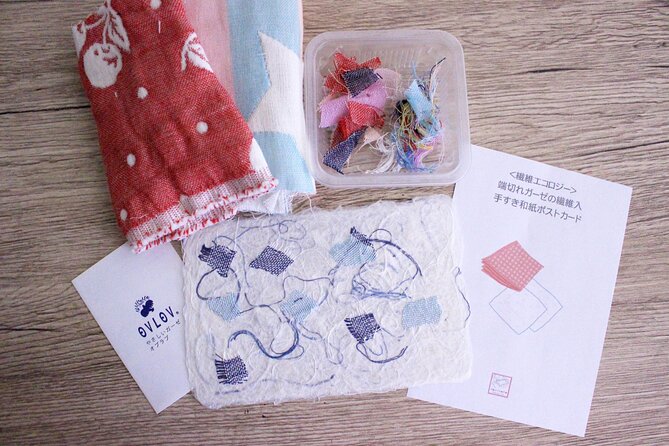
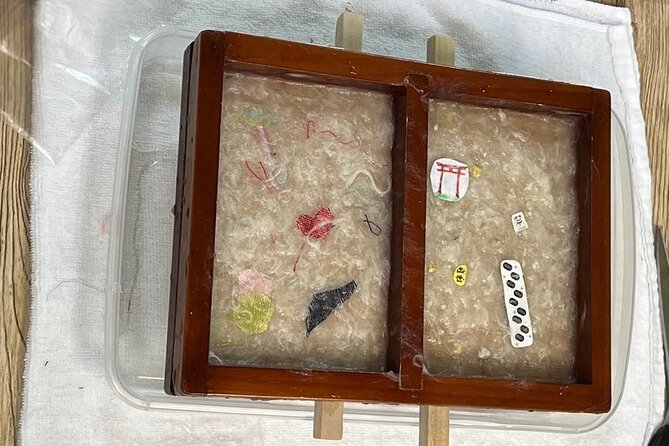
You create two postcard designs, a Rakusui paper, and an A5 paper. The postcards give you a chance to make smaller pieces with a personal design, while the larger formats let you see how the same material behaves across a broader surface.
The exact decorative options are not specified, so you should not book this expecting a set list of motifs or a particular style. The important promise is that your group creates original paper products rather than receiving identical souvenirs.
The process also leaves room for small differences between pieces. Each sheet is handmade, so variations in texture and appearance are part of the result. That can be a strength if you want a gift with visible human character. It can be a drawback if you expect perfectly uniform stationery.
The workshop provider describes the washi as unique to the experience. That makes the four pieces useful as gifts, cards, or personal keepsakes. Pack them carefully when you leave, since handmade paper can be more meaningful than durable.
Making the most of the drying pause
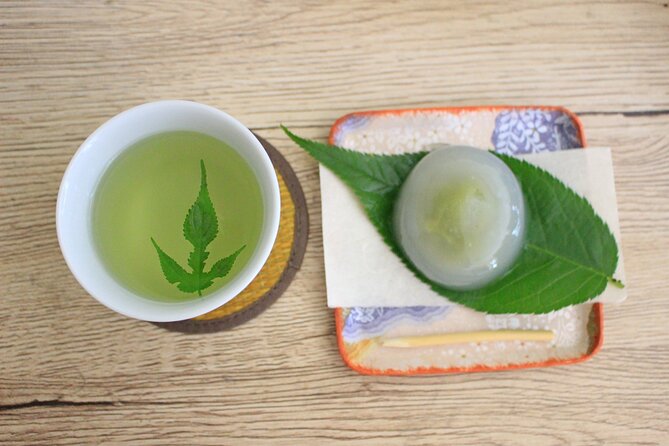
While your paper dries, the workshop serves its original Japanese paper tea and local Japanese sweets. The tea is made from kozo leaves, which ties the refreshment directly to the material you have been working with.
This is one of the most unusual parts of the class. It is not a standard coffee break added to fill time. The tea gives you another way to think about kozo, this time as a plant with more than one use in the workshop’s story.
The sweets come from a beloved local shop, although the shop is not named in the available details. You can expect a small Japanese treat rather than a full meal, so eat beforehand if you need lunch or a substantial snack.
The pause also changes the rhythm of the session. Papermaking involves wet sheets and careful handling, so waiting for them to dry is unavoidable. Turning that wait into a tea break makes the timing feel purposeful instead of wasted.
Other private tours in Tokyo





Meeting Kami, the workshop cat
The workshop’s mascot is a cat named Kami. The provider says Kami welcomes visitors, and the cat is part of the atmosphere rather than a separate paid feature.
For many people, this will add warmth to a small private class. For anyone with cat allergies, it is a serious practical concern. Tell the provider about allergies before attending, and do not assume that a private booking removes the issue.
The name Kami has a fitting connection to the workshop, since it can refer to paper in Japanese depending on the character used. The supplied details do not explain the naming, so it is best to enjoy the connection without treating it as a formal language lesson.
What $143.35 buys you in Ueno
At $143.35 per person, this is not a budget souvenir activity. The value comes from the amount of instruction, the private format, the four finished products, and the full process from plant material to paper.
You are paying for more than a short demonstration. The class includes bark peeling, fiber beating, sheet formation, design work, drying time, tea, and sweets. You also leave with four handmade pieces rather than one small object.
The price makes the most sense for a couple, family, or small group that wants a shared activity with a strong local focus. It is less convincing if you only want inexpensive stationery or a fast introduction to Japanese crafts.
A private class can also be useful for people who prefer questions answered as they work. The provider does not state the maximum group size, but only your own party participates. That gives the session a more personal feel than a standard public class.
The activity is commonly reserved about 31 days ahead. That figure suggests planning early, especially if you have limited time in Tokyo or need a particular date. The booking includes a mobile ticket, and confirmation is provided at the time of booking.
Getting to the Taito City meeting point
The meeting point is Japan, 110-0016 Tokyo, Taito City, Taito 3-chome 30-2, Ichikawa Building. The workshop is near public transportation, but no station name or walking time is provided.
Use the full address when planning your route, and allow time to find the building. Ueno has many streets and busy crossings, so arriving early is wiser than trying to reach the door at the exact start time.
The activity begins and ends at the same meeting point. That makes it easy to combine with other time in Ueno, but the class lasts about two hours and 30 minutes, so avoid booking another fixed appointment too close afterward.
The experience requires good weather under its cancellation terms. If poor weather causes the provider to cancel, you are offered another date or a full refund. You can cancel for a full refund up to 24 hours before the start time, but changes or cancellations inside that period are not accepted.
Who will enjoy this class most
I would recommend this workshop to anyone who likes making things with their hands and wants a souvenir connected to Japanese culture. It is especially well suited to couples, families, and small private groups who enjoy learning by doing.
It also suits people who want a calmer Ueno activity. You are not rushing from one sight to another. The class asks you to slow down, repeat a process, and pay attention to texture and balance.
The four products make it a practical choice for gift-givers. Two postcards, Rakusui paper, and A5 paper provide several ways to use the results. You can keep one piece and share the others, though the workshop does not specify whether postage, envelopes, or protective packaging are included.
Children may enjoy the process, but the available information does not state an age requirement or special child program. If you are booking with young children, confirm suitability with the provider first. The same applies to anyone with mobility, sensory, or other access needs, since no detailed accessibility information is provided.
The tradeoffs to consider before booking
The strongest reason to book is the complete process. You do not only decorate paper. You learn where the material begins and how it changes through several hands-on steps.
The strongest reason to hesitate is the cost. At more than $140 per person, this needs to be a main activity, not a filler between major sights. You should also be comfortable with a workshop environment that may involve wet fibers, repeated movements, and a resident cat.
The format will not suit someone looking for a large cultural show or a polished performance. The appeal is small scale and participation. You get more personal attention, but less spectacle.
The tea and sweets are another plus, though they should be viewed as a thoughtful part of the class rather than a meal. Plan food separately if you need something filling.
Should you book the Ueno washi workshop?
Book it if you want a personal Tokyo activity that leaves you with useful handmade objects and a better understanding of how washi is made. The patient instruction, private setting, four finished products, and kozo-leaf tea give the class a clear identity.
Skip it if the price is too high for a two-and-a-half-hour activity, if you need a fully detailed schedule before booking, or if anyone in your group has a cat allergy. For the right person, this is a quiet, tactile way to connect with Japanese tradition, and the finished paper gives you something better than a mass-produced souvenir.
FAQ
Where does the paper workshop take place?
The meeting point is at Japan, 110-0016 Tokyo, Taito City, Taito 3-chome 30-2, Ichikawa Building. It is near public transportation.
How long does the activity last?
The workshop lasts approximately two hours and 30 minutes.
What paper products will I make?
You will make two postcard designs, one Rakusui paper, and one A5 paper, for four finished products in total.
Is the activity private?
Yes. Only your group participates in the workshop.
What does the workshop teach?
You experience the full papermaking process, including Hyouhitor, peeling the outer bark, Dakai, beating tree fibers, and forming sheets with a mold and deckle.
Are food and drinks included?
Yes. While your paper dries, the workshop serves original Japanese paper tea made from kozo leaves and Japanese sweets sourced from a local shop.
Is there a cat at the workshop?
Yes. The workshop has a mascot cat named Kami. You should inform the provider if anyone in your group has allergies.
How does cancellation work?
You can cancel up to 24 hours before the start time for a full refund. If poor weather causes the activity to be canceled, you are offered a different date or a full refund.
More Workshops & Classes in Tokyo


More Private Tours in Tokyo
More Ueno & Yanaka Walks in Tokyo

More tours in Tokyo we've reviewed






Ueno & Yanaka Walks, compared.
 ★ 5.0Eat and Drink Like a Local: Tokyo Ueno Food Tour-Taverns&RamenFrom $95
 ★ 4.5The Old Quarter of Tokyo – Yanaka Walking TourFrom $40
 ★ 5.0Yanaka Walking Tour: Historic and Traditional District of TokyoFrom $72
 ★ 4.8Tokyo: Old Quarter Yanaka Walking TourFrom $323 hours
 ★ 5.0Tokyo: Food Tour in Ueno with 10+ Tastings of Japanese ClassicsFrom $142
 ★ 4.9Tokyo:Stroll in Old traditional culture towns~Yanaka & NezuFrom $293h 30m