
Reviewed · CYCLING TOURS
Tokyo Guided Small-Group Biking Tour
Tokyo reveals itself best between the famous sights. This 20-mile guided bike route moves from Shinjuku skyscrapers to quiet shrines, parks, shopping streets, Tokyo Bay, Ginza, and the Imperial Palace. You get a useful sense of how the city’s neighborhoods fit together, rather than seeing Tokyo one station at a time.
I especially like the small group of no more than five people and the chance to stop at a local supermarket for a bento lunch. Guide Gaku is often praised for his friendly manner, careful route guidance, and ability to point out places most first-time visitors would miss. The drawback is clear: this is a long ride on busy city roads, using a standard cross-city bike rather than an e-bike.
In This Review
- Key points to know before booking
- Why this bike tour makes Tokyo easier to understand
- Starting beneath the Shinjuku towers
- Meiji Jingu and the calm of Yoyogi Park
- Omotesando, Roppongi Hills, and a century-old-feeling cemetery
- Buying bento and eating beside Tokyo Bay
- Zojo-ji Temple with Tokyo Tower behind it
- Ginza and the outer grounds of the Imperial Palace
- Finishing above Shinjuku
- How hard is the 20-mile ride?
- Is $106.12 a fair price?
- Who should book this experience?
- My recommendation
- FAQ
- How long does the Tokyo biking tour last?
- How far do you ride?
- What is included in the price?
- Is lunch included?
- Where does the tour start?
- Where does the tour finish?
- Is this an e-bike tour?
- How fit do I need to be?
- What ages can join?
- What height range is required?
- What happens if the weather is bad?
Key points to know before booking
- A full-city route: Expect about 20 miles of riding over roughly six and a half hours.
- Small-group attention: The maximum group size is five, with a guide, bike, and helmet included.
- Major sights and side streets: The route includes Meiji Jingu, Yoyogi Park, Roppongi Hills, Zojo-ji, Tokyo Bay, Ginza, the Imperial Palace, and Shinjuku.
- A local-style lunch: You buy a bento box at a grocery store, carry it in your backpack, and eat beside the waterfront.
- A fitness test, but not a mountain ride: Tokyo is mostly flat, though you need to handle traffic and steer around pedestrians.
- A strong final view: The tour ends with a 360-degree outlook from the Tokyo Metropolitan Government Building.
Why this bike tour makes Tokyo easier to understand
Tokyo is too large for a single walking tour. Its districts spread across a vast rail network, and even a well-planned day on trains can leave you with a blurred collection of stations and attractions. A bicycle gives you the missing links.
You ride from one district into the next and see the changes happen at street level. Shinjuku’s towers give way to residential lanes. A quiet neighborhood shrine appears behind ordinary homes. Then the route opens into Yoyogi Park and the grounds of Meiji Jingu.
That movement is the real value here. You are not simply ticking off sights. You are seeing the contrast between Tokyo’s modern commercial core and its older religious and residential corners.
The small group matters, too. With five people at most, the guide can keep the pace together and answer questions without the feel of a large procession. Several participants have ended up with an almost private outing when others canceled, though you should book for the advertised small-group format rather than count on that.
Guide Gaku receives repeated praise for making the route feel safe and easy to follow. He explains how long each riding section will take, shows the route on a map, and helps the group through busier streets. That support is important in Tokyo, where the challenge is less about hills than about traffic, intersections, pedestrians, and constant visual distraction.
Other cycling tours in Tokyo
Starting beneath the Shinjuku towers
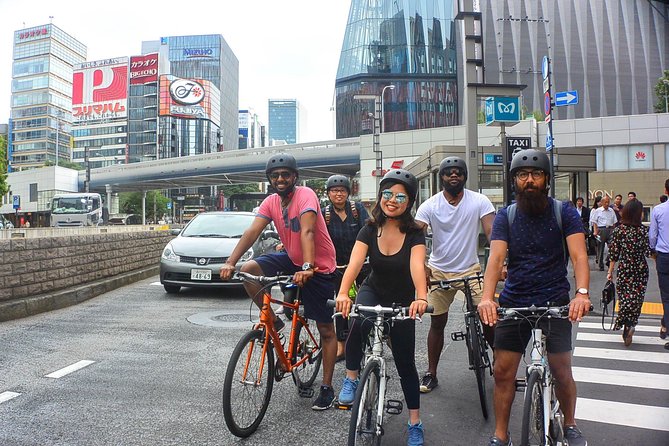
The meeting point is at 3-chōme-20-2 Nishishinjuku, in Shinjuku. You meet in the morning, receive your bicycle and helmet, and begin near one of Tokyo’s most recognizable concentrations of skyscrapers.
The first section quickly sets up the theme of the day. Rather than staying among the towers, you turn into backstreets and ride toward a small local shrine in a residential area. This is a smart opening because it shows two sides of Tokyo within a short distance: high-rise offices and a modest place of worship serving its neighborhood.
The pace is described as relaxed, but do not confuse that with an easy sightseeing stroll. The route covers a lot of ground, and the total riding distance is about 20 miles, or 32 kilometers. You will stop often, but you remain on the bike for a substantial part of the day.
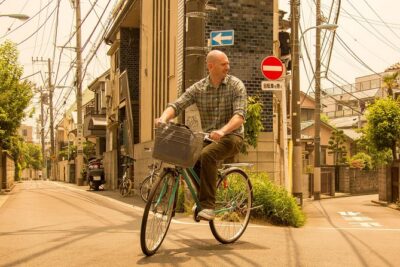
The bikes are cross-city bikes with flat handlebars. They are not cruiser bikes, and they are not electric bikes. You should already be comfortable riding a multi-speed bicycle and controlling it on busy roads. The route has little elevation gain, which makes it more manageable, but traffic awareness is essential.
Meiji Jingu and the calm of Yoyogi Park
From the residential shrine, you ride through Yoyogi Park toward Meiji Jingu, Tokyo’s best-known Shinto shrine. The park offers a welcome change from concrete streets, with broad paths and room to slow down.
Spring brings cherry blossoms to Yoyogi Park, although the exact display depends on the season. The route is not built around blossom viewing alone, so the park remains part of the experience at other times of year.
At Meiji Jingu, you leave the bicycles for a walk through the peaceful grounds around the shrine. This is one of the day’s more important pauses. A bike tour can sometimes become a race between photo stops, but walking through the shrine grounds gives you time to absorb the setting.
The shrine also helps explain Tokyo’s relationship with tradition. It is a major religious site in a capital city known for fashion, finance, gaming, and technology. You get the strongest contrast of the entire route here: a quiet Shinto space surrounded by one of the world’s largest urban areas.
Omotesando, Roppongi Hills, and a century-old-feeling cemetery
After Meiji Jingu, you continue toward Roppongi Hills along Omotesando. This is one of Tokyo’s most polished shopping avenues, lined with sophisticated stores and modern architecture.
The route then turns away from the main street and into a back road leading to Aoyama Cemetery. That change is one of the tour’s best details. Omotesando presents Tokyo as a sleek international shopping center. Aoyama offers a much quieter atmosphere and a sense of an older city.
You should not expect a lengthy cemetery visit or a formal historical lecture at every stop. This is primarily a city ride, not a specialist history tour. Its strength is the way Gaku connects places through lived knowledge of Tokyo, local observations, and practical route choices.
Roppongi Hills adds another angle. It is an entertainment and commercial complex, so you see the city’s modern social life rather than only temples and imperial buildings. The route keeps shifting between these different parts of Tokyo, which helps prevent the day from feeling repetitive.
Buying bento and eating beside Tokyo Bay
Lunch is part of the experience, but it is not included in the $106.12 price. You stop at a local supermarket and choose a bento box at your own expense. You then place it in your backpack and continue riding for about 25 minutes to the waterfront.
I like this arrangement because it is practical and local in a simple way. Instead of being directed to a fixed restaurant, you choose a ready-made meal from a grocery store, just as many residents do. It also keeps the group moving and avoids spending a large portion of the day at a sit-down meal.
The catch is that you need to carry your lunch. Bring a backpack or messenger bag, as the instructions recommend. You also need to budget separately for the food and drinks.
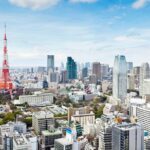
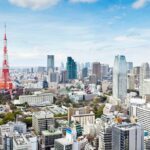
The waterfront stop is beside Rainbow Bridge, with views toward the Tokyo skyline and the Aqua City Odaiba complex. After several hours among buildings and traffic, sitting near the bay gives the day a useful pause. The view also shows how Tokyo extends beyond the central districts you may know from guidebooks.
Other guided tours in Tokyo

Zojo-ji Temple with Tokyo Tower behind it
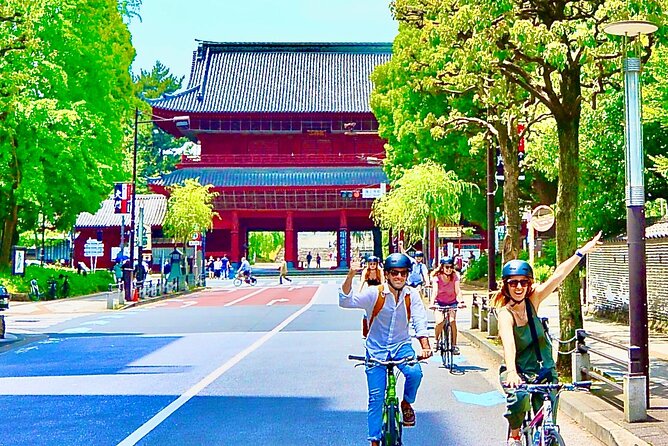
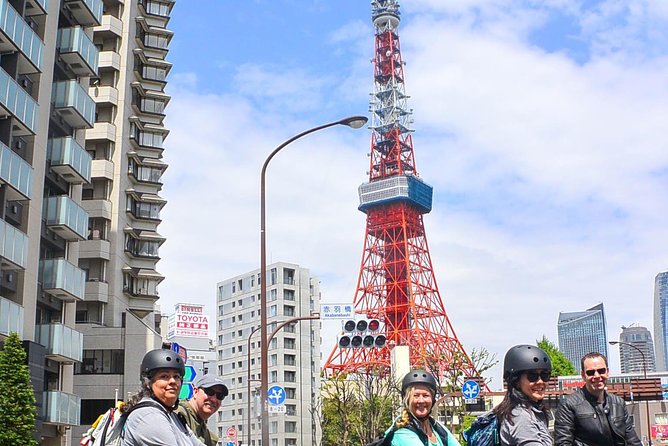
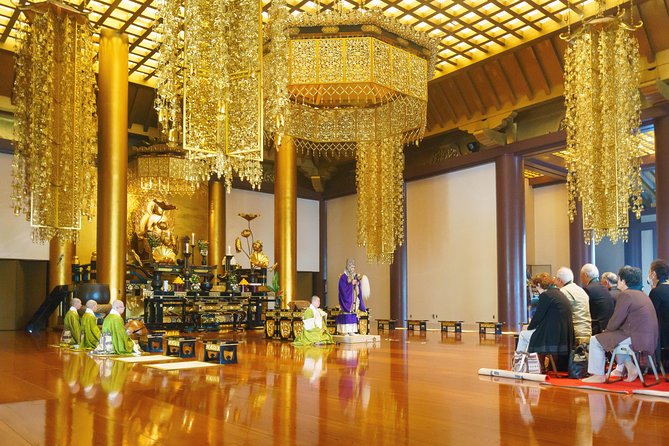
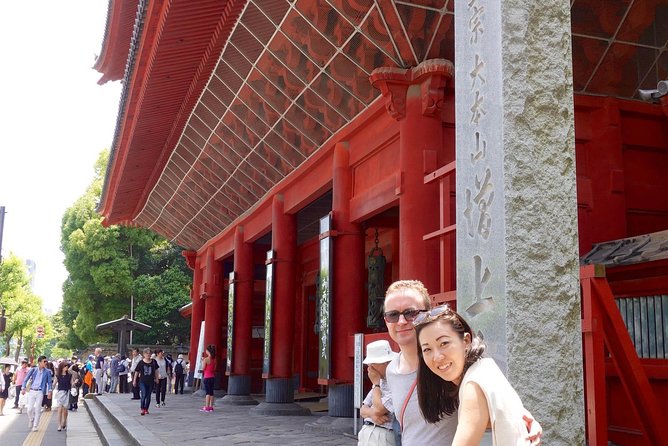
The route includes Zojo-ji Temple, where Tokyo Tower rises behind the temple grounds. This is one of the clearest visual pairings on the itinerary: an older Buddhist temple in the foreground and a bright modern tower in the background.
It is the sort of view that explains Tokyo without much narration. The city does not separate old and new into neat zones. They often share the same frame.
You do not spend the whole day inside religious sites. Instead, the guide uses them as anchors while the bicycle connects them to ordinary streets and commercial neighborhoods. That balance will suit you if you want cultural context but also want to see how people move through the city today.
Ginza and the outer grounds of the Imperial Palace
After lunch, you ride through Ginza, Tokyo’s famous luxury shopping district. The route uses both main roads and back streets, giving you a look at Ginza beyond its grand storefronts.
Ginza is a good cycling district for seeing scale and density. Wide streets, major retail buildings, and polished facades make it feel very different from the residential lanes near Shinjuku. You may find this section more traffic-heavy, so listen closely to the guide and keep your attention on the road.
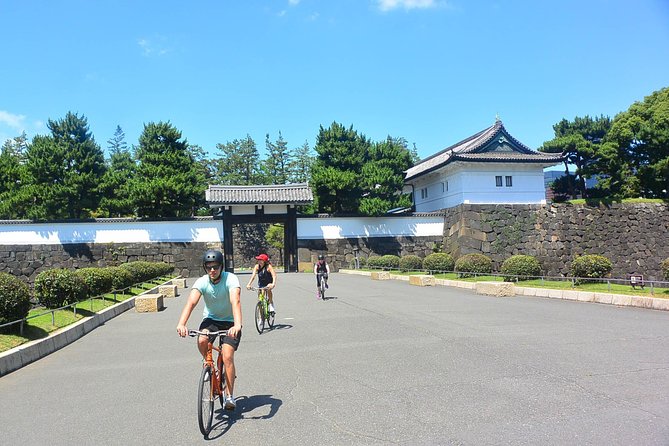
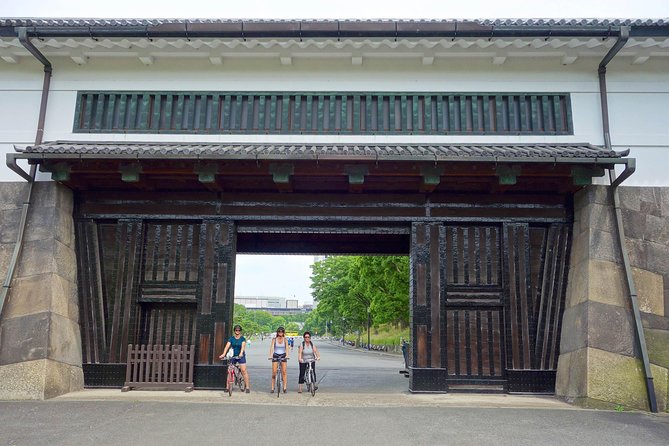
The tour then heads toward the Imperial Palace. You ride through two outer castle gates and along parts of the large moat. The palace itself is not presented as a full interior visit, and access to specific areas can change.
The outer grounds still provide a strong sense of the site. You see traditional garden elements, a tea pavilion, stone walls, and water-filled moats within central Tokyo. This is another place where the bicycle is useful. You can cover the surrounding area without spending the time and energy required to walk there from one entrance to another.
At this point, the day has taken you through shrines, a cemetery, shopping districts, a temple, a bayfront, and palace grounds. The variety is the main attraction. You gain a broad first look at Tokyo rather than a deep visit to only one neighborhood.
Finishing above Shinjuku
The route returns to Shinjuku and ends at the Tokyo Metropolitan Government Building. A high-speed elevator takes you to the top of the 48-story building, where you can look across Tokyo in all directions.
This final viewpoint gives the day a satisfying shape. From above, the districts you crossed by bicycle become easier to place. You may see Tokyo Skytree, and on a clear day, Mount Fuji may be visible.
The view is included in the tour, and the final ride back to the starting point takes about five minutes. Ending at the Government Building also avoids making you navigate back across the city after a long day in the saddle.
I would treat Mount Fuji as a bonus, not a promise. Weather and visibility control what you see. The Tokyo skyline and Skytree are the more dependable parts of the outlook.
How hard is the 20-mile ride?
The physical demand is moderate. The route is largely flat, and riders who exercise regularly have described the distance as manageable. You get breaks at shrines, parks, the supermarket, the waterfront, and the city viewpoint.
Still, this is not the right choice if you want a gentle spin with little traffic. You need to be comfortable cycling on busy roads and steering around pedestrians. The bike has multiple gears, and you should know how to use them.
The age range is 12 to 69, with a required height between 125 and 190 centimeters, or about 4 feet 1 inch to 6 feet 3 inches. Check every rider’s height carefully when booking. An incorrect height can mean the bicycle cannot be provided, with no refund available for that problem.
Wear comfortable clothing and prepare for a full outdoor day. The tour can be canceled for rain, extreme heat, or other poor weather, with a full refund offered when the operator cancels. You receive notice by 7 a.m. on the morning of the tour if weather causes a cancellation.
Is $106.12 a fair price?
At $106.12 per person, this is not the cheapest way to see Tokyo. You still pay for your own bento and drinks, and hotel pickup is not included. You must reach the Shinjuku meeting point yourself.
The price makes more sense when you consider what is bundled together: a six-and-a-half-hour route, bicycle, helmet, local guide, small group, multiple districts, and the Government Building observation stop. Reaching all of these places independently would involve several train rides, station transfers, walks, and a good deal of map work.
You are also paying for route management. Gaku’s role is not only to point out sights. He keeps the group together, handles the transitions between busy streets and quieter lanes, and helps you understand where you are.
I consider it good value for a first or second day in Tokyo, especially if you have limited time. It is less attractive if you already know the city well, dislike urban cycling, or prefer to spend an hour or more at each major sight.
Who should book this experience?
I would recommend it to active first-time visitors who want a broad introduction to Tokyo. It suits couples, families with older children, and solo riders who like meeting a small group while still receiving personal attention.
It is also useful if you have only a few days in the city. The route helps you identify districts you may want to revisit by train later, such as Ginza, Shinjuku, or the area around Meiji Jingu.
You should skip it if you are not comfortable on a multi-speed bike, if 20 miles feels excessive, or if you want a slow temple-focused tour. The pace includes stops, but the itinerary is ambitious by design.
Free cancellation is available up to 24 hours before the start time. Confirmation is subject to availability and is sent within 48 hours of booking. The operator allows a maximum of five people per booking, and dates of birth may be requested for age checks.
My recommendation
Book this tour if you want Tokyo to make sense as a city of connected neighborhoods, not just a list of famous landmarks. The strongest features are the small group, Gaku’s attentive guiding, the mix of well-known sights and quiet streets, and the simple bento lunch beside the bay.
Go in with the right expectations. You will ride a long distance, share roads with city traffic, pay separately for lunch, and use a regular bicycle rather than an e-bike. For a reasonably fit rider, those tradeoffs are worthwhile. This is one of the most efficient ways to get a first look at Tokyo while still seeing pieces of everyday life between the headline sights.
FAQ
How long does the Tokyo biking tour last?
The tour lasts approximately six hours and 30 minutes, including riding, sightseeing stops, lunch, and the final viewpoint.
How far do you ride?
The total route is approximately 20 miles, or 32 kilometers.
What is included in the price?
A professional guide, bicycle rental, and helmet rental are included.
Is lunch included?
No. You buy a bento box and any drinks at a local supermarket at your own expense, then carry the food in your backpack.
Where does the tour start?
The meeting point is 3-chōme-20-2 Nishishinjuku, Shinjuku City, Tokyo 163-1407, Japan.
Where does the tour finish?
The activity ends back at the original meeting point after the short ride from the Tokyo Metropolitan Government Building.
Is this an e-bike tour?
No. The bicycle is a cross-city bike with a flat handlebar, not an e-bike or a cruiser bike.
How fit do I need to be?
You need a moderate level of fitness and must be comfortable cycling on busy city roads. The route has minimal elevation gain, but the distance and traffic require stamina and control.
What ages can join?
The minimum age is 12 and the maximum age is 69. You may be asked to provide identification for age verification.
What height range is required?
Riders must be between 125 and 190 centimeters tall, or approximately 4 feet 1 inch to 6 feet 3 inches, so the bicycle can be fitted properly.
What happens if the weather is bad?
Cycling may be canceled because of rain, a heatwave, or other poor weather. If the operator cancels, you will be offered another date or a full refund, with notification sent by 7 a.m. that morning.
More Guided Tours in Tokyo
More Cycling Tours in Tokyo
More tours in Tokyo we've reviewed











Cycling Tours, compared.
 ★ 5.0Tokyo Great Cycling TourFrom $99
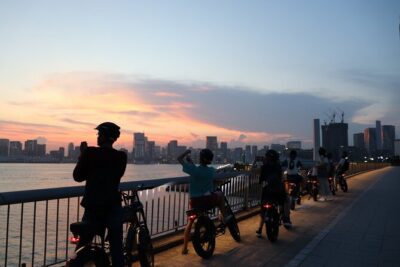 ★ 5.0Tokyo Top Highlights 3h Guided E-bike TourFrom $63
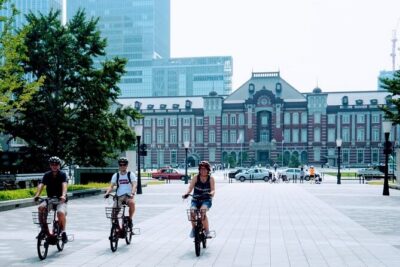 ★ 5.03h Tokyo E-Bike Tour: Hidden Gems, and Local Life with guideFrom $63
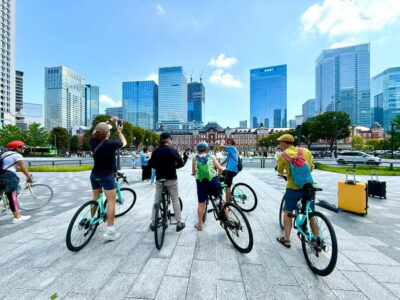 ★ 4.8Tokyo: 3-Hour Bike or E-Bike City Highlights TourFrom $453 hours
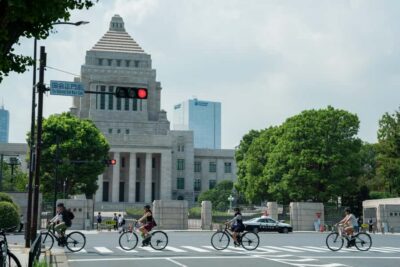 ★ 4.8Tokyo: 3-hour Guided E-Bike Tour of the City’s Hidden GemsFrom $65
 ★ 5.0Tokyo West-Side Cycling & Food TourFrom $99