
Reviewed · ASAKUSA TOURS
Asakusa Calligraphy Workshop Craft Your Own Art in Tokyo
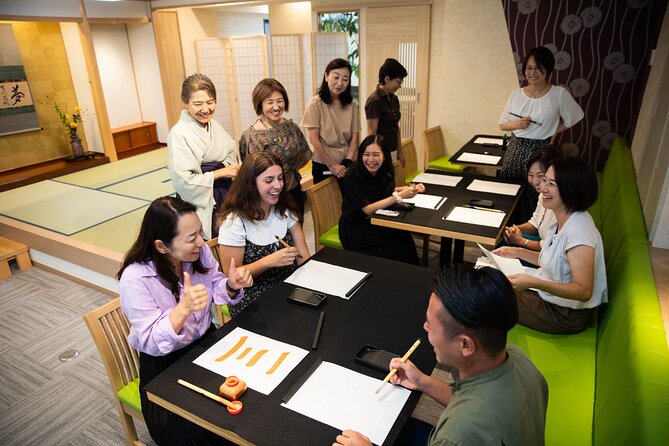
Japanese calligraphy becomes much more meaningful when you hold the brush yourself. In this 90-minute Asakusa workshop, you learn brush grip, stroke order, and control from an instructor rather than trying to copy a video at home. I like the hands-on format, and I like that you can use both a traditional brush and a modern fude pen.
The group is capped at 10 people, so you should have a fair chance to see the teacher and ask for help. Mei has also shown patience with late arrivals, even waiting for one delayed participant and offering a shortened session. The main drawback is time: 90 minutes goes quickly, especially if you want to practice several characters.
In This Review
- Key points to know before booking
- Why this Asakusa class works for first-time calligraphy students
- What happens during the 90-minute lesson
- The value of choosing your own characters
- Why the small group size matters
- The special value of Mei’s patient approach
- Is $40 a fair price?
- What to bring and how to prepare
- Who will enjoy this more than a standard sightseeing stop
- Meeting point, timing, and cancellation details
- Should you book the Asakusa calligraphy workshop?
- FAQ
- Where does the calligraphy workshop begin?
- Where does the workshop end?
- How long does the calligraphy class last?
- How much does the experience cost?
- How many people can join the class?
- Do I need previous calligraphy experience?
- What tools will I use?
- Can I take my calligraphy home?
- Is cancellation free?
Key points to know before booking
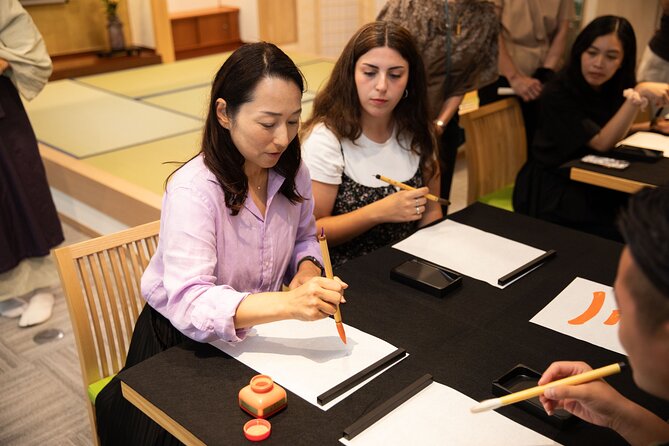
- Practice both classic and modern tools: You use a traditional calligraphy brush and a fude pen, giving you two different ways to form Japanese characters.
- Small group, maximum 10 people: The limited size should make it easier to watch demonstrations and receive corrections.
- Choose characters to write: You are not limited to one fixed sample, so your finished piece can have personal meaning.
- Take home your own work: Your calligraphy and special souvenirs give you a practical keepsake from Tokyo.
- Central Asakusa meeting point: The class starts and ends at the Tokyo Tourist Lounge near Kaminarimon.
- Good for beginners: The lesson focuses on basic skills, so you do not need previous calligraphy experience.
Why this Asakusa class works for first-time calligraphy students
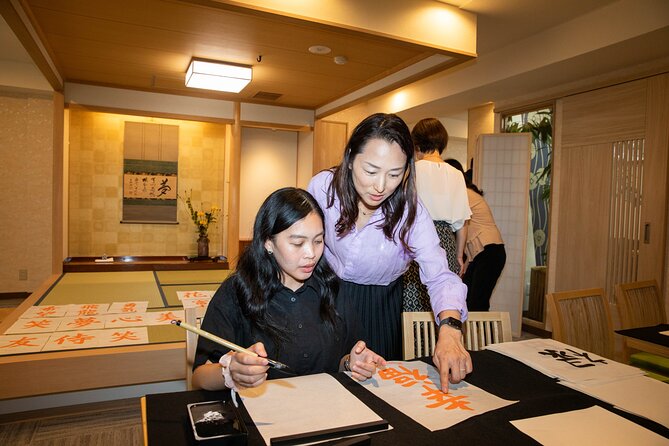
I like this class because it gives you a real physical skill to practice, not just a cultural demonstration to watch. Japanese calligraphy depends on details that are hard to catch from a book: how you hold the brush, how much pressure you use, and how one stroke should lead into the next.
The instructor begins with the fundamentals. You work on brush control and stroke order, two areas that shape the look of every character. A brush can create thick and thin lines depending on pressure, angle, and movement, so the lesson helps you understand why a character looks balanced rather than simply asking you to copy its outline.
That matters for beginners. If you start by copying a finished character without learning the movement behind it, your work may feel stiff. Here, you get a chance to repeat the basic actions and make small adjustments while the instructor guides you.
The class also leaves room for personal choice. You can select from different characters and create a piece that means something to you. The supplied information does not list the exact character options, so you should think about a simple word or symbol you might want to write, then ask the teacher what choices fit your level.
A few more Tokyo tours and experiences worth a look


What happens during the 90-minute lesson
The experience begins at the Tokyo Tourist Lounge Asakusa, located at 5F, 2-18-15 Kaminarimon, Taito City, Tokyo 111-0034. The meeting point is near public transportation, and the activity returns to this same location when the class ends.
The setting in Asakusa makes practical sense. You can pair the workshop with time in one of Tokyo’s best-known historic districts, though the class itself takes place at the stated meeting point rather than moving around the neighborhood. Give yourself enough time to reach the lounge before the start. One participant was caught in traffic and arrived late, and Mei waited and adjusted the session, but you should not count on receiving the full lesson after a delay.
Once the session begins, expect an introduction to the basic tools and techniques. You practice holding the brush correctly and controlling its movement. The instructor then works through stroke order, which is important because Japanese characters are built from a set sequence rather than random lines.
The early practice is likely to feel more technical than artistic. That is a good thing. You are learning the structure that lets the later writing look deliberate. Pay attention to how the teacher starts and finishes each stroke, since those small movements often give calligraphy its shape.
You then work with traditional brushes and a modern fude pen, or brush pen. The brush offers a more classic experience, with greater variation in line width and pressure. The pen gives you more control and may feel easier when you are trying to refine a character.
Using both tools is one of the class’s best features. You can compare the broad, expressive feel of a brush with the cleaner handling of a pen. It also gives you a better chance to continue practicing at home, since a brush pen may be easier to store and use than a full calligraphy setup.
The final part focuses on writing characters of your choice. You create your own finished calligraphy artwork and take it with you. The session also includes souvenirs, although the exact items are not specified, so the artwork is the most personal part of the takeaway.
The value of choosing your own characters
A fixed craft project can be easy, but it does not always feel connected to your trip. Here, choosing your character gives you a little control over the result. You might select an idea connected to your visit, a personal value, or a word you simply like the appearance of.
You should ask the instructor about the meaning and correct form of your preferred choice before writing it. The class is designed for beginners, and the instructor can help you work within the available time and your current skill level.
The choice also changes the feel of the finished piece. A character selected for its meaning becomes a travel memory. A character selected mainly for its shape becomes a small piece of art. Either approach works, but deciding in advance can save precious practice time.
I would not book this class expecting to produce museum-quality calligraphy in one session. The value is in learning the basic movements and leaving with a piece you made yourself. Your final work may show the unevenness of a first attempt, and that is part of its charm.
Why the small group size matters
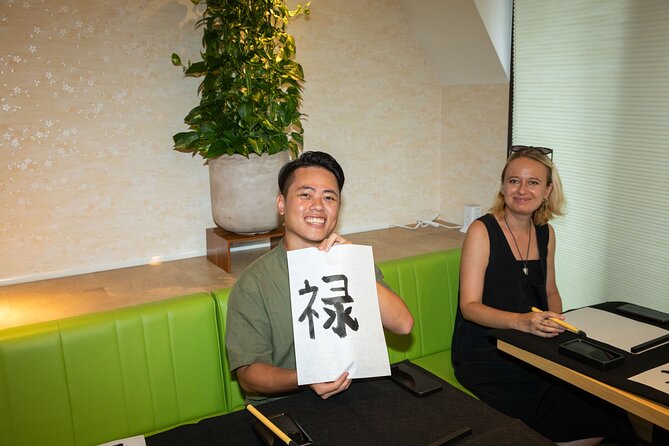
The maximum group size is 10 people. That is small enough to make personal instruction possible, though it is not a private class. Your experience will depend on how many people book that day and how much time each person needs.
A larger class could turn the lesson into a demonstration where you copy from a distance. A 10-person limit gives the instructor a better chance to notice your grip, posture, and stroke movement. You should still speak up if you want correction, especially during the brush-control practice.
Small-group teaching is particularly useful for calligraphy because the result depends on physical technique. Two students can copy the same example but hold the brush at different angles or apply different pressure. A teacher can spot those problems much faster in person than an online video can.
The group limit also keeps the activity social without making it feel like a large tour. You share the room with other beginners, but the workshop remains focused on making your own work.
The special value of Mei’s patient approach
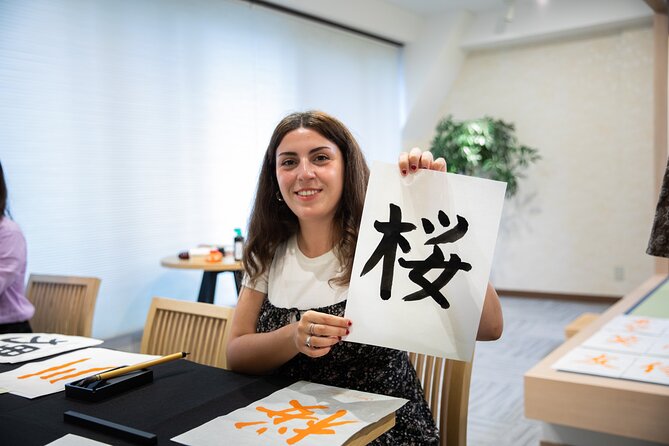
The instructor named in the available experience feedback is Mei. Her response to a late arrival is worth noting because traffic can complicate any Tokyo booking. She waited for the participant and provided a shortened version of the class rather than turning the person away.
You should still plan to arrive on time. A shortened session cannot offer the same practice as the full 90 minutes, and calligraphy rewards repetition. If something delays you, contact the provider as soon as possible and do not assume the instructor can extend the lesson.
Mei’s patience also suggests that the class can accommodate someone who needs a little extra explanation. That does not mean every request can be handled at the same pace, but the teaching approach appears attentive rather than rigid.
The class is provided by Localized Walking & Food Tours. The supplied details identify Mei as an instructor but do not provide a full teaching biography, so book this for the practical lesson and personal guidance rather than for a formal lecture on Japanese art.
A few more Tokyo tours and experiences worth a look


Is $40 a fair price?
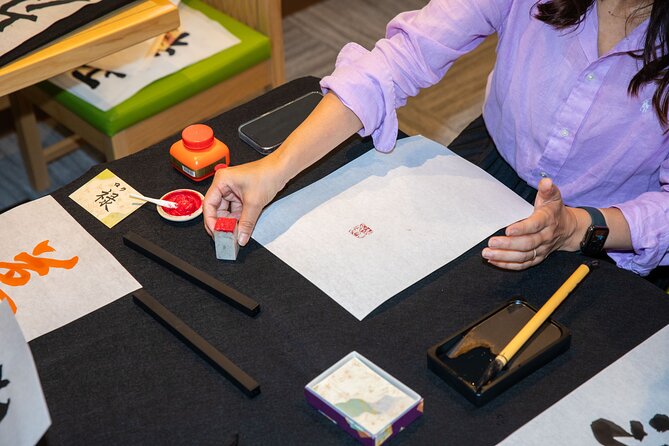
At $40 per person, this is priced as a short cultural activity rather than an all-day class. The fee includes the entrance cost, the calligraphy session, special souvenirs, and use of the Tokyo Tourist Lounge service at no charge.
I find the price reasonable if you want an activity that gives you something to do and something to take home. You are paying for instruction, materials, access to traditional tools, use of a modern brush pen, and a finished piece made during the class. It is not simply an admission ticket.
The value is strongest for visitors who want a personal souvenir. Tokyo offers plenty of ready-made gifts, but your own calligraphy carries a different memory. You remember the pressure of the brush, the order of the strokes, and the effort behind the finished character.
The price may feel less appealing if you only want to see calligraphy performed or if you have no interest in practicing at home. The class is built around participation. You should expect to hold the tools, repeat the techniques, and spend much of the time making your own work.
Bottled water is not included. That is a minor point for a 90-minute indoor activity, but bring water if you need it, especially after walking around Asakusa.
What to bring and how to prepare
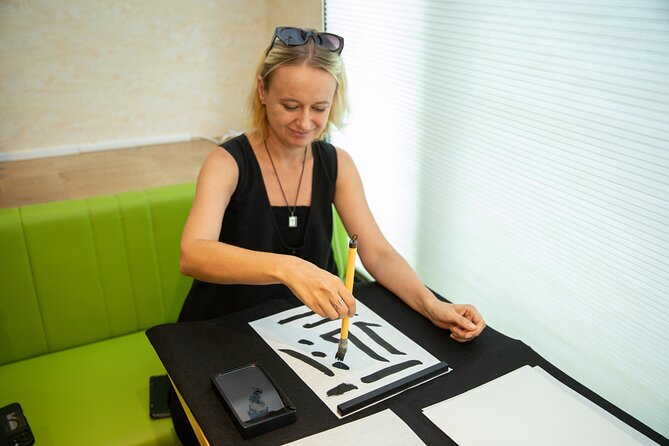
You do not need previous calligraphy training. The activity is described as suitable for most people, and the instruction begins with basic techniques.
Before arriving, consider these simple preparations:
- Choose one or two ideas for characters you may want to write.
- Allow extra time to reach the Tokyo Tourist Lounge.
- Keep your schedule flexible after the class since the activity ends at the same meeting point.
- Plan how you will carry your artwork home without folding or bending it.
- Bring water if you want it, since bottled water is not provided.
The last point about carrying your artwork matters. The experience includes a finished piece and souvenirs, but the supplied details do not explain the exact size or packaging. A firm folder or protective sleeve may help if you already have one in your luggage.
Because the class lasts about one to one and a half hours, it fits neatly into a day of sightseeing. You could schedule it before or after time in Asakusa, but leave enough room for the meeting point and any transport delays.
Who will enjoy this more than a standard sightseeing stop
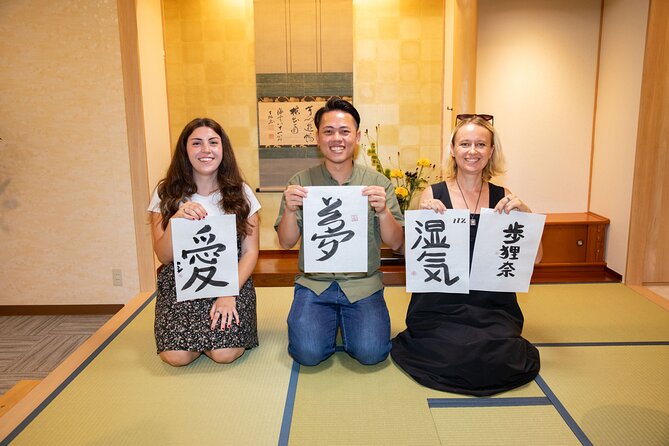
I would recommend this activity to you if you want a hands-on Japanese cultural experience and prefer making something over taking another set of photographs. It suits first-time visitors, returning visitors, couples, families with interested older children, and solo visitors who enjoy learning in a small group.
It is also a good fit if you want a souvenir with a personal story. The artwork is not mass-produced, and the choice of character gives you some ownership of the final result.
You may want to skip it if your Tokyo schedule is packed tightly or if you dislike guided instruction. Ninety minutes is short, but it still requires concentration. You will spend the session practicing rather than casually dropping in and leaving at any moment.
People with a strong interest in professional calligraphy should set realistic expectations. This is an introductory workshop, not a multi-day course. You will learn useful techniques and get a first taste of the art, but mastery takes much longer.
Meeting point, timing, and cancellation details
The class starts and ends at Tokyo Tourist Lounge Asakusa, at 5F, 2-18-15 Kaminarimon, Taito City, Tokyo 111-0034. It is near public transportation, and the mobile ticket makes it convenient to keep your booking details on your phone.
The experience lasts approximately 1 hour and 30 minutes. The class has a maximum of 10 participants, and confirmation is received at the time of booking.
Free cancellation is available if you cancel at least 24 hours before the start time. Cancellations made less than 24 hours before the start are not refunded, and changes inside that same 24-hour period are not accepted. The cut-off uses local Tokyo time, so check the clock carefully if you are booking from another time zone.
Should you book the Asakusa calligraphy workshop?
Book it if you want a short, affordable activity that lets you practice a real Japanese art and carry home something you made. The combination of traditional brushwork, fude pen practice, personal character choice, small-group teaching, and souvenirs gives the $40 fee solid value.
I would be especially likely to choose it during a first Tokyo visit when I wanted a break from temples, shopping, and city streets. The only real caution is the limited time. Arrive early, decide what you may want to write, and treat the finished piece as a first effort rather than a perfect work of art.
FAQ
Where does the calligraphy workshop begin?
The activity begins at Tokyo Tourist Lounge Asakusa, located at 5F, 2-18-15 Kaminarimon, Taito City, Tokyo 111-0034, Japan.
Where does the workshop end?
The activity ends back at the same meeting point, Tokyo Tourist Lounge Asakusa.
How long does the calligraphy class last?
The workshop lasts approximately 1 hour and 30 minutes. The experience description also refers to a one to one and a half hour duration.
How much does the experience cost?
The listed price is $40 per person.
How many people can join the class?
The group has a maximum of 10 travelers.
Do I need previous calligraphy experience?
No. The workshop is designed for beginners and teaches basic brush grip, brush control, stroke order, and other essential techniques.
What tools will I use?
You will practice with traditional calligraphy brushes and a modern fude pen, also called a brush pen.
Can I take my calligraphy home?
Yes. You can take your finished calligraphy artwork home, along with special souvenirs included in the experience.
Is cancellation free?
Yes, you can cancel for a full refund at least 24 hours before the experience start time. Cancellations or changes made less than 24 hours before the start are not accepted for a refund.
More Workshops & Classes in Tokyo


More Craft Workshops in Tokyo
More Asakusa Tours in Tokyo

More tours in Tokyo we've reviewed




Asakusa Tours, compared.
 ★ 4.8Tokyo: Japanese Dance Cabaret Theater Asakusa-Kaguwa TicketFrom $492 hours
 ★ 4.7Tokyo: Meiji Shrine, Asakusa, Skytree Bus Tour and CruiseFrom $12210 hours
 ★ 4.9Tokyo: Roll and Authentic Sushi Making Class in AsakusaFrom $581h 40m
 ★ 4.8Tokyo: Asakusa Walking Tour with Sensoji Temple VisitFrom $222 hours
 ★ 5.0Tokyo Asakusa Rickshaw TourFrom $42
 ★ 4.5Tokyo Panoramic 1 Day: Meiji Shrine, Asakusa, Odaiba and SKYTREE®From $85