
Reviewed · SAMURAI & NINJA EXPERIENCES
Samurai Experience – Learn Bushido through Kendo, in Tokyo
Kendo is not a sword photo opportunity dressed up as a class. You begin with Rei, the bow, then learn how spirit, body, and sword must work together before facing an instructor in a short match. That steady build gives this two-hour session more meaning than a quick costume fitting.
I like the small groups, limited to eight, and the careful teaching from Daichi and Makoto. I also like that the session includes the parts many visitors miss: footwork, etiquette, fighting spirit, and the final demonstration between instructors. The main consideration is physical effort. The armor and warm dojo can make this a proper workout, so wear light, comfortable clothes and expect to sweat.
In This Review
- Key points to know before booking
- Kendo near Tokyo Station, without the tourist trap
- Starting with Rei, respect before the sword
- Learning footwork before trying to strike
- Handling the shinai and learning the basic attacks
- Putting on the armor and facing an instructor
- Watching the instructors show real kendo
- What Daichi and Makoto add to the experience
- Photos, drinks, and the small extras
- Who will get the most from this two-hour class
- Booking details that affect your decision
- Is this kendo experience worth $103?
- Should you book Kendo Spirit?
- FAQ
- Is prior kendo experience required?
- Is the experience conducted in English?
- How far is the dojo from Tokyo Station?
- What equipment is provided?
- Are photos and videos included?
- Can I book a private session?
Key points to know before booking
- About 15 minutes from Tokyo Station: You can reach the dojo without giving up a full day of sightseeing.
- A real introduction to kendo: Learn etiquette, footwork, sword handling, attack points, and the meaning of Ki-Ken-Tai-Itchi.
- Small groups of up to eight: The pace allows beginners to ask questions and receive individual attention.
- You may wear full protective gear: The session builds toward a friendly match with an instructor.
- English instruction: Daichi and Makoto explain the movements and cultural background in English and Japanese.
- Photos, drinks, and souvenirs included: Equipment is supplied, and photos and videos are sent by email afterward.
Kendo near Tokyo Station, without the tourist trap
At $103 per person, this is not the cheapest activity in Tokyo. It is also not a quick stage show. You receive two hours of instruction, kendo clothing, a bamboo sword called a shinai, drinks, souvenirs, and access to a small-group lesson led in English.
I see the price as fair if you want to do something rather than simply look at something. A temple visit or museum can explain Japan’s past, but this session puts you inside a living practice. You learn the rules by moving, bowing, stepping, and striking. The value comes from the quality of that guided time, not from the equipment alone.
The location helps. The dojo is within approximately 15 minutes of Tokyo Station, making it easy to fit into a day around Marunouchi, Nihonbashi, Ginza, or the Imperial Palace area. You do not need to spend hours crossing Tokyo to reach it.
The small-group limit matters, too. With no more than eight people, you are less likely to stand around waiting for your turn. The instructors can correct your stance and keep the beginners moving at a comfortable pace.
A few more Tokyo tours and experiences worth a look
Starting with Rei, respect before the sword
The session does not begin with a dramatic sword swing. You first learn how to enter the practice with the right attitude.
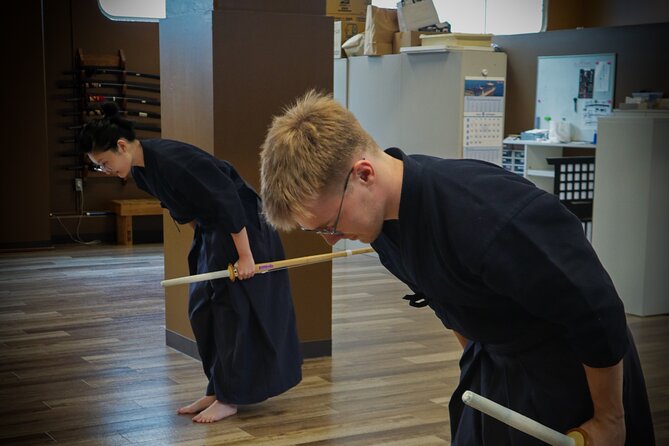
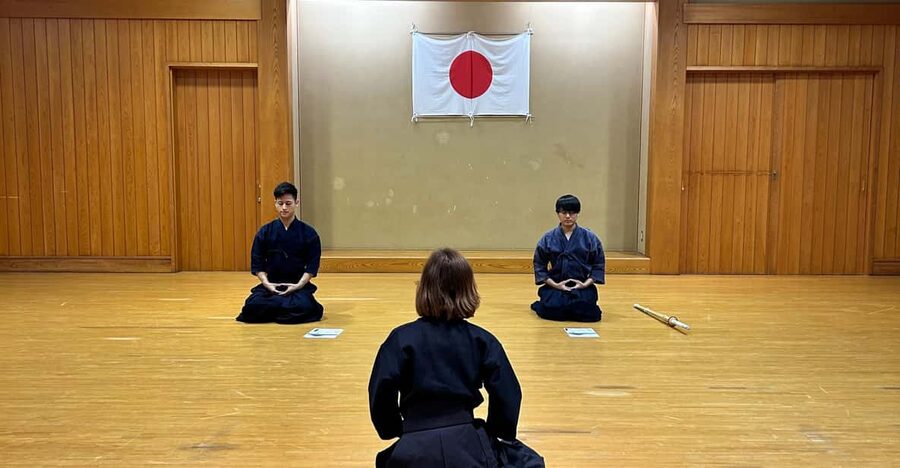
Etiquette is central to kendo. You calm yourself, bow to the dojo, bow to the people training with you, and learn that the gesture is not empty ceremony. It signals respect and helps you shift your attention away from sightseeing and toward the practice.
That opening can feel unfamiliar if you expect an action-heavy class. Give it time. Bushido is presented here as discipline and self-control, not as movie-style aggression. The point is not to act like a warrior for a few minutes. The point is to understand why every movement begins and ends with awareness.
The instructors introduce the language and ideas of kendo as they go. You learn that Ki means spirit or focused energy, Tai means body, and Ken means sword. Together they form Ki-Ken-Tai-Itchi, the idea that spirit, body, and sword must arrive as one action.
For a beginner, this explanation is useful because it gives structure to every later exercise. You are not simply told to swing harder. You are asked to bring your attention, posture, footwork, and strike together.
Learning footwork before trying to strike
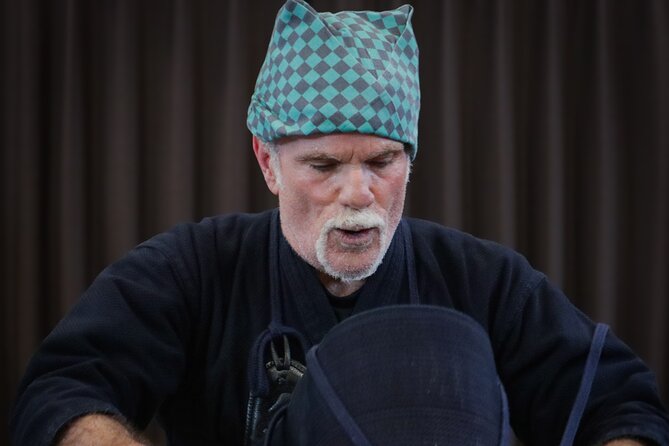
The early physical work centers on movement. You practice traditional kendo footwork, keeping the body balanced, grounded, and ready to move forward.
This is one of the most valuable parts of the session, even though it may be less exciting than the final match. Beginners often want to focus on the sword. Kendo makes you earn the sword by learning how to stand and move first.
You add new pieces gradually. The basic steps come before the attack technique. Then you practice combining movement and sword action. The progress is carefully paced, which helps if you have never studied martial arts.
The footwork can be harder than it looks. One participant described practicing the steps alone as a challenge, and that is a useful warning. You do not need to be athletic, but you do need to pay attention and follow instructions. The work asks for coordination more than raw strength.
I like this approach because it stops the class from becoming a shallow samurai fantasy. You feel how much control is required to make a simple movement look clean. That small lesson says a lot about Japanese martial arts.
Handling the shinai and learning the basic attacks
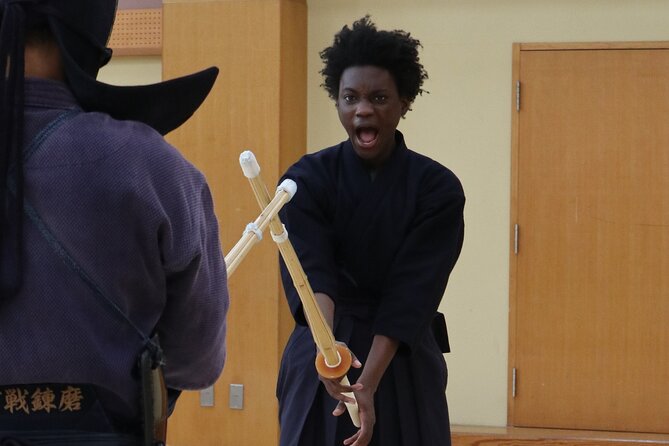
Once your body is moving correctly, you receive the bamboo sword, or shinai. All equipment is provided, so you do not need to bring a sword, protective clothing, or martial arts gear.
You learn how to hold and use the shinai, how to draw it, and how to fold the kendo equipment properly. The training covers basic attack techniques and the four main points of attack. The exact pace depends on the group, but the lesson builds from simple handling toward combined movement and strikes.
This is where the session becomes especially practical. You are not watching someone explain kendo from across the room. You are trying to keep your feet, hands, posture, and focus working together.
The instructors demonstrate each stage before asking you to repeat it. Daichi’s English is described as clear, and the class is conducted in English and Japanese. You can ask questions during the session, which is important because unfamiliar footwork and Japanese terms can be confusing at first.
Do not expect to master kendo in two hours. The purpose is a solid first look at its principles. You will leave understanding why precision matters, but not ready for a formal competition.
Putting on the armor and facing an instructor
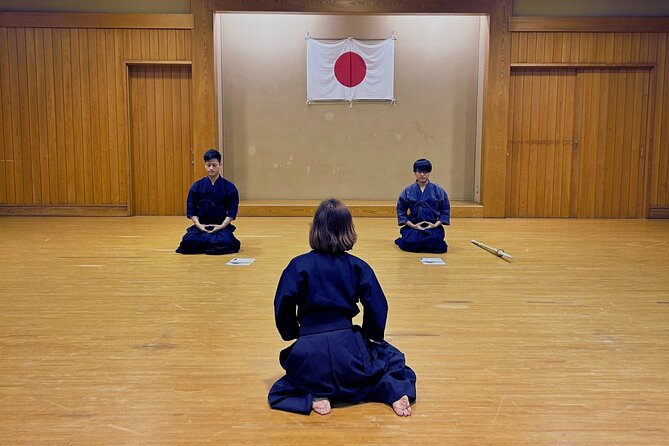
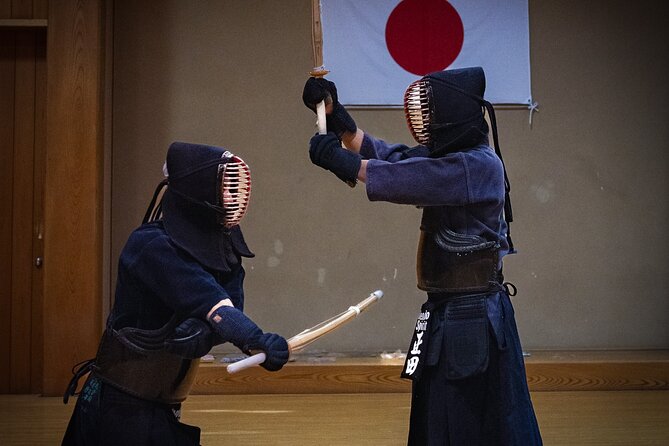
The class builds toward protective gear and a short sparring match. Wearing the kendo armor changes the feel of the experience. The clothing and helmet are not just props for a photograph. They make the movements more demanding and give you a stronger sense of the discipline involved.
You practice against a protected instructor before taking part in a friendly bout. The instructors adjust the challenge for beginners, so you are not thrown into an uncontrolled fight. The point is to apply the basics, not to prove that you can defeat a trained kendo practitioner.
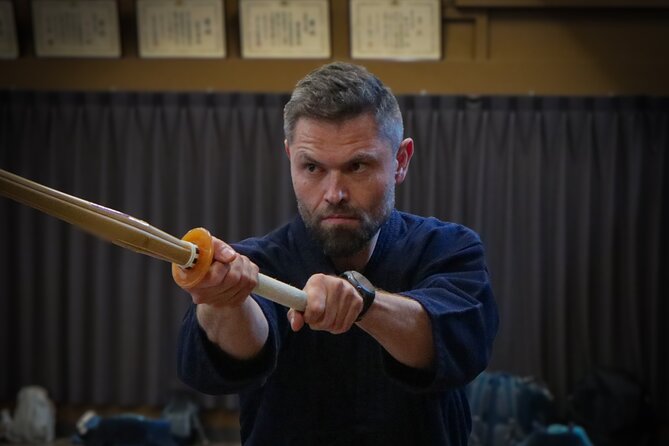
Still, the match can feel intense. One participant described freezing for a moment when the sword was pointed toward them. That reaction makes sense. Even with a bamboo sword and a controlled format, an instructor’s focused stance creates real pressure.
You may find the sparring is your favorite part, especially if you enjoy hands-on activities. It is also the warmest part of the class. Protective equipment can become uncomfortable, and one participant specifically noted the heat. Cold water and rest periods are available, but dress as if you are preparing for a light run rather than a quiet cultural lecture.
Wear comfortable clothing underneath the provided attire. Avoid alcohol and drugs, which are not allowed. The experience is not suitable for pregnant women, babies under one year, or people over 95 years old.



Watching the instructors show real kendo
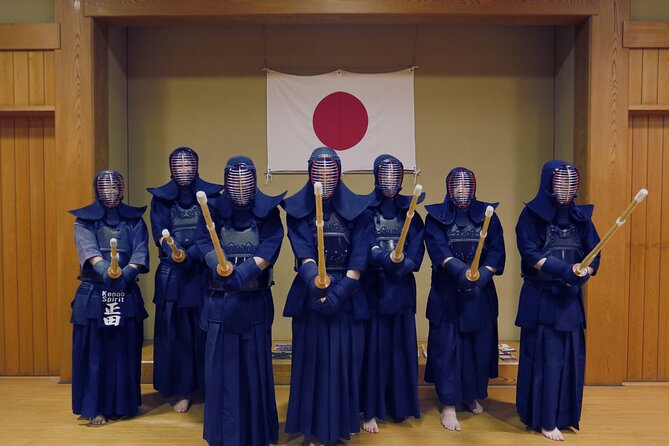
After you have practiced, the instructors demonstrate kendo for you. The final match between instructors is a strong close to the session because you can now recognize some of what you are seeing.
Before the class, a demonstration could look like fast movement and loud impact. After learning the basic steps and attack points, you notice the distance, timing, posture, and control. The speed has more meaning because you have tried to perform even a small part of it yourself.
This is also where the session gives you a useful distinction between martial arts and stage combat. The instructors are not simply performing sword tricks. Their demonstration shows the concentration and discipline that the class has spent two hours building toward.
The session finishes with another bow. That return to etiquette gives the experience a complete shape. You begin by setting aside casual sightseeing behavior, and you finish by showing respect to the people who trained with you.
What Daichi and Makoto add to the experience
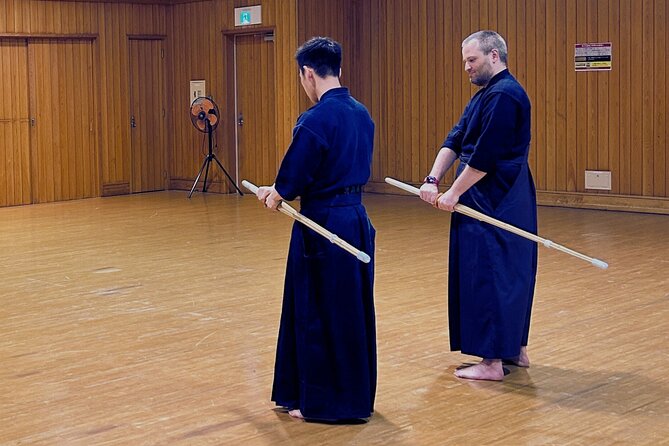
The instructors are a major part of the value. Daichi and Makoto are repeatedly praised for making the class clear, friendly, and well paced. They explain the cultural background without letting the talk overwhelm the physical practice.
That balance is important. Too much history would turn the class into a lecture. Too little would reduce it to sword swinging. Here, the background explains why the bow, footwork, and controlled strikes matter.
You can expect encouragement if you are a complete beginner. The class is designed for people with no prior kendo or martial arts experience, and instruction is adjusted so everyone can take part comfortably.
At the same time, this is not a pretend-samurai lesson with no standards. You are expected to be respectful and punctual. The instructors take the practice seriously, even while keeping the tone welcoming.
The English instruction is another practical advantage. You do not need to speak Japanese, and you can ask questions throughout the lesson. That makes the cultural side easier to understand, especially when Japanese terms are introduced alongside the movements.
Photos, drinks, and the small extras
A team member takes photos and videos during the experience with your agreement. The files are sent by email afterward, giving you a record of the class without requiring you to hold a phone while wearing armor.
That is a useful touch. You can concentrate on the instructions instead of trying to photograph your own match. The photos also capture an activity that is difficult to explain with a standard snapshot of a temple gate.
Drinks are included, which matters because the class can be physically warm. Souvenirs are included as well. Some participants have also received a certificate with a photo, but I would treat that as a possible extra rather than the main reason to book, since the listed inclusions specifically promise souvenirs, photos, and videos.
Lockers are available at the sports center, according to the activity details provided by one participant. The dojo has a large training room, giving the group space to practice without feeling cramped.
Who will get the most from this two-hour class
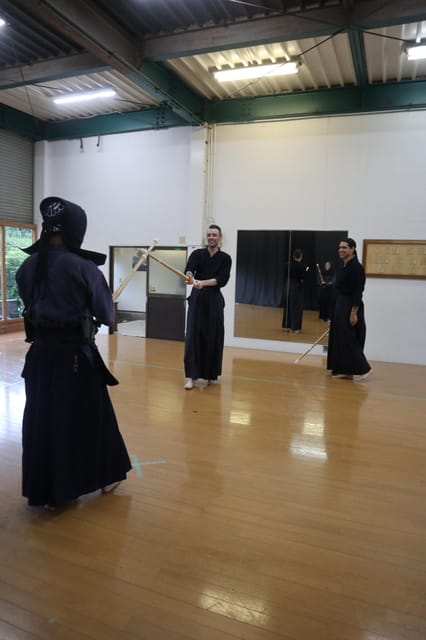
I would recommend this experience to you if you want a physical introduction to Japanese culture and have some interest in martial arts, samurai, swords, or Bushido.
It works especially well for:
- First-time kendo participants
- Couples or families with older children
- People who prefer doing an activity to watching a performance
- Visitors who want a meaningful experience close to central Tokyo
- Martial arts fans curious about the roots and discipline of kendo
- Anyone who wants an activity that combines culture, exercise, and instruction
A parent and 15-year-old child have taken the class together, showing that it can work for different ages within the stated limits. You do not need to be fit, but you should be ready for movement, protective equipment, and a workout.
I would not choose it if you want a relaxed, seated cultural activity. It is also not ideal if you dislike rules, physical repetition, or being put under mild pressure in front of an instructor. The match is friendly, but it is still the most demanding part of the session.
Booking details that affect your decision
The standard session lasts two hours, with starting times based on availability. The group is limited to eight people. You can cancel up to 24 hours in advance for a full refund, and reserve now while paying later, which helps if your Tokyo schedule is still shifting.
A private session is available as an add-on before payment, with one private-session add-on per group. Private sessions are only available on dates that still show eight open places. If your dates do not fit the published schedule, you can contact the provider to ask about another time.
Large groups can also be arranged in advance. That may suit school groups, company outings, or extended families, though a large group will naturally feel different from the small class that makes individual instruction possible.
The closest practical landmark is Tokyo Station, not a far-flung training hall. Still, confirm the exact meeting instructions after booking and allow enough time to arrive, change, and settle your mind before the bow.
Is this kendo experience worth $103?
For a quick costume photo, no. For a guided two-hour introduction that includes equipment, instruction, a controlled match, an instructor demonstration, drinks, souvenirs, and emailed photos and videos, I think the price is reasonable.
The strongest value comes from the teaching. You learn the purpose behind the actions, then test those ideas with your body. That makes the session more memorable than simply wearing armor and posing with a sword.
The main tradeoff is that two hours can only cover the fundamentals. You will not leave as a skilled kendoka, and some of the time is spent repeating footwork that may feel slow at first. That repetition is part of the point, but it may not suit someone looking for nonstop action.
The five-star rating from 68 bookings fits the experience’s clear strengths: friendly instructors, strong explanations, a small class, and a rare chance to try kendo rather than just observe it. The only consistent caution in the available comments is the heat and effort of wearing the equipment.
Should you book Kendo Spirit?
Book this if you want to understand Bushido through movement, not just hear about it. Daichi and Makoto guide you from the first bow through footwork, sword handling, armor, a friendly match, and a powerful instructor demonstration.
Skip it if you want an easygoing indoor attraction with little physical effort. If you can accept some sweat, repetition, and disciplined etiquette, this is one of the better ways to add something active and distinctly Japanese to a Tokyo visit. The close-in location and beginner-friendly pace make the decision easier, while the small group keeps the lesson personal.
FAQ
Is prior kendo experience required?
No. Most participants are beginners with no previous martial arts experience. The instructors introduce the movements step by step and keep the pace comfortable.
Is the experience conducted in English?
Yes. Instruction is available in English and Japanese, and you can ask questions during the session.
How far is the dojo from Tokyo Station?
The dojo is located approximately 15 minutes from Tokyo Station.
What equipment is provided?
Kendo attire and a bamboo sword called a shinai are provided. The experience also includes drinks and souvenirs.
Are photos and videos included?
Yes. Photos and videos are taken during the experience with your agreement and sent to you by email afterward.
Can I book a private session?
Yes. Add Exclusive Private Session before payment, with one add-on per group. Private sessions are available only on dates that still show eight open spots.
More Samurai & Ninja Experiences in Tokyo
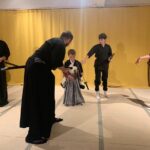
More tours in Tokyo we've reviewed




Samurai & Ninja Experiences, compared.
 ★ 4.5Tokyo: Samurai Restaurant Show Ticket with 2 DrinksFrom $551h 30m
 ★ 4.6Tokyo: Samurai Ninja Museum Guided tour and ExperienceFrom $27
 ★ 5.0Tokyo: Samurai Sword & Archery Class from Samurai DescendantFrom $1933 hours
 ★ 5.0Best Samurai Experience in TokyoFrom $65
 ★ 5.0Ninja Experience (Family Friendly) at Samurai Ninja Museum TOKYOFrom $47
 ★ 4.6Tokyo: Samurai Entertainment Night Show in Kanda ShrineFrom $412 - 3 hours