
Reviewed · SAMURAI & NINJA EXPERIENCES
Samurai Experience Mugai Ryu Iaido in Tokyo
Tokyo has many polished cultural attractions, but this 60-minute Mugai Ryu Iaido lesson offers something more direct: you put on samurai clothing, handle a mock katana, and learn the formal movements of a 340-year-old sword tradition. Master Takeda Hougyoku, head of the International Iaido Organization Hougyoku-kai, may personally guide the session, with an English-speaking instructor helping explain each step.
I like the small maximum group of eight, which gives you a better chance to receive corrections instead of simply watching from the back. I also like the balance between participation and demonstration: you learn the basics, then see genuine Iaido kata performed by an experienced master. The main drawback is time. One hour passes quickly, and the $151.92 price is high for a short activity, especially if you are seeking a full martial arts class rather than a focused cultural introduction.
In This Review
- Key points before you book
- What this Iaido experience really offers
- Changing into hakama sets the tone
- The opening explanation makes the movements easier to follow
- Learning to draw and sheath a mock katana
- Tameshigiri introduces the cutting tradition
- The final Iaido kata is the strongest part for many people
- Why the small group and master’s presence matter
- Is $151.92 reasonable for one hour?
- Getting to Kuramae and planning your hour
- Who will enjoy this most?
- My booking recommendation
- FAQ
- Where does the Samurai Experience Mugai Ryu Iaido take place?
- How long does the Iaido experience last?
- What is included in the price?
- Are real katanas used?
- Can beginners participate?
- Is the instructor English-speaking?
- How many people can join the activity?
- Will Master Takeda Hougyoku be present?
- Is transportation included?
- Can I cancel for a full refund?
Key points before you book
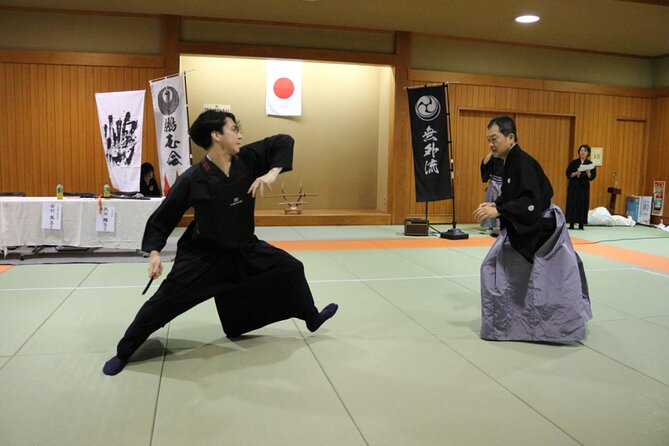
- Master Takeda Hougyoku leads the tradition: He is described as the heir to ancient Mugai Ryu scrolls and head of the International Iaido Organization Hougyoku-kai.
- You wear rented hakama: The traditional samurai clothing adds ceremony and makes photographs more memorable.
- The swords are imitations: You learn basic handling without using a real katana.
- The group is capped at eight people: This matters because the lesson includes hands-on instruction.
- Tameshigiri is part of the lesson: You are introduced to the samurai sword-cutting practice, alongside drawing, sheathing, gripping, and basic patterns.
- The activity begins and ends in Kuramae: There is no hotel or attraction pickup, so you must make your own way to 4-chōme-20-10 Kuramae.
What this Iaido experience really offers
This is not a stage fight, costume photo session, or broad tour of samurai history. It is a short introduction to Mugai Ryu Iaido, a martial art built around controlled sword movements and set forms.
That distinction matters. Iaido is less about swinging a sword wildly and more about precision, posture, timing, and the formal actions of drawing and sheathing. You are given an overview of how to hold the sword, how to move it safely, and how the basic patterns fit together.
The experience is designed for both first-time visitors and people who have already seen Tokyo’s better-known sights. If you have visited temples, shrines, observation decks, and food markets, this gives you a different way to meet Japanese culture. You are not simply looking at an object behind glass. You are learning a few of the physical rules surrounding it.
The lesson also has a clear safety advantage. Only mock katanas are used, so you can focus on the movement without handling a sharp blade. That makes the activity suitable for many first-time participants, although you should still be comfortable following instructions and taking part in a physical lesson.
A few more Tokyo tours and experiences worth a look

Changing into hakama sets the tone
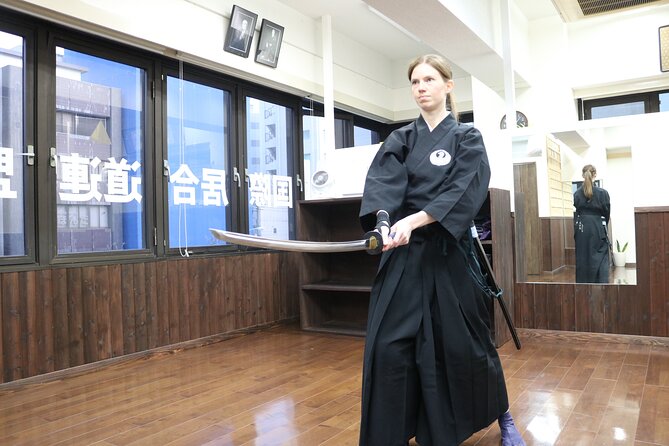
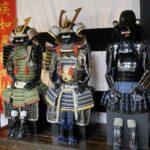
The session begins with a change of clothes. Rental hakama are included, so you do not need to bring samurai clothing or arrange a costume rental separately.
This is more than a photo opportunity. The clothing helps mark a change from ordinary sightseeing to formal practice. It also gives you a useful visual record of the experience, since photographs are permitted and there are plenty of chances to take them.
You should keep your expectations sensible. The activity lasts about an hour, and changing clothes takes part of that time. The hakama adds atmosphere, but this is not a long costume program with several themed sets or a staged performance.
Still, I think the clothing is an important part of the value. Without it, the session could feel like a brief sword-handling demonstration. Wearing hakama gives the lesson a stronger sense of place and ceremony.
The opening explanation makes the movements easier to follow
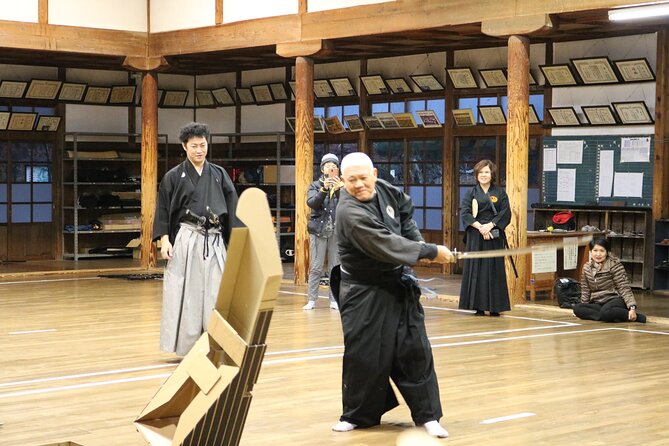
After changing, Master Takeda and the instructor explain what Iaido is and outline the flow of the lesson. This introduction is useful because the movements can look simple until you try to coordinate them yourself.
You receive basic instruction on how to handle the imitation sword safely, how to hold it, and how to draw and sheath it. You also learn some basic patterns. These details are not filler. They explain why Iaido depends on careful sequence and control rather than speed alone.
The English-speaking instructor is an important practical feature. You do not need to know Japanese to follow the lesson, and the explanations should help you understand what you are doing before you attempt it. The supplied information identifies an English-speaking instructor, while Master Takeda is the central martial arts teacher.
Because the group is limited to eight people, you should have a better view of the demonstrations and more room to receive individual attention. The lesson is not private, but it is much more personal than a large cultural show.
Learning to draw and sheath a mock katana
The most hands-on portion centers on the basic sword actions. You learn how to grip the imitation katana, draw it, move through simple patterns, and return it to the sheath.
These actions may sound straightforward, but the point is their order and form. Iaido is known as a practical martial art, and the lesson presents the sword as a tool that must be controlled carefully. You are not being trained for combat in one hour. You are learning the outline of a disciplined practice.
This is where the small group helps most. A teacher can watch your hands, stance, and timing more easily with eight people than with thirty. You should expect instruction at an introductory level, not a complete technical course. If you already practice martial arts, you may find the hour too brief for much progress, but the chance to see Mugai Ryu taught within its own tradition adds value.
The use of mock swords also keeps the focus on learning. You can pay attention to the motion rather than worry about the risk of a live blade. Safety instructions still matter, and you should follow the teacher’s directions closely.
Tameshigiri introduces the cutting tradition
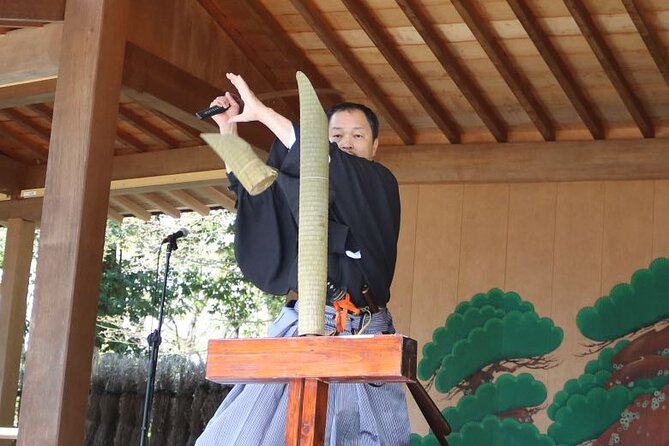
The schedule includes an introduction to tameshigiri, the practice of using a sword to cut a target. This is one of the more distinctive parts of the activity because it connects the formal movements of Iaido with the practical purpose of sword technique.
The description says you will try tameshigiri, while also specifying that the swords used in the experience are imitations of katanas. For that reason, you should treat this as a guided introduction to the practice rather than expect a full live-blade cutting session.
That distinction is worth keeping clear when comparing this activity with other samurai programs in Tokyo. The attraction here is the connection to Mugai Ryu and the instruction from Master Takeda, not a dramatic stunt with a sharp sword.
If you are interested in Japanese martial arts, tameshigiri gives the lesson a useful point of focus. It shows that the sword forms are linked to practical technique, even though your own session is carefully controlled and uses imitation weapons.





The final Iaido kata is the strongest part for many people
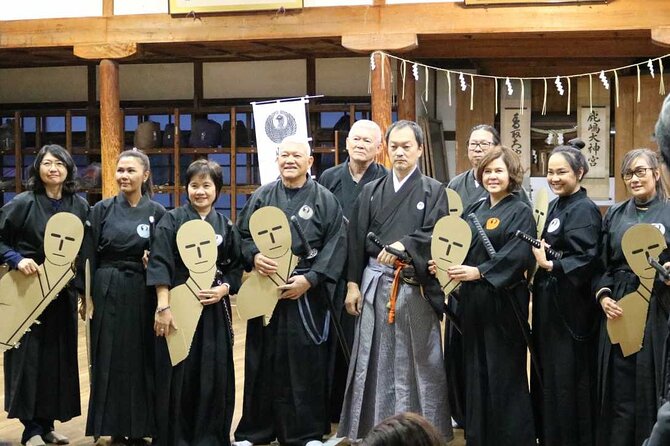
At the end, you watch a demonstration of Iaido kata. Kata are predetermined patterns of attack, and the demonstration shows the movements as a complete form rather than as separate instructions.
This is likely to be the most striking part of the hour. During your own practice, you are thinking about grip, position, and sequence. When Master Takeda performs, you can watch how those individual actions come together in a smooth, formal pattern.
The demonstration also gives the experience its strongest connection to the older Mugai Ryu tradition. Master Takeda is described as carrying on a 340-year-old style and as being entrusted with ancient scrolls from the masters of Mugai Ryu. You are not simply learning generic sword motions. You are being introduced to a named school with a long lineage.
The precise length of the demonstration is not specified, so you should not book this expecting a lengthy performance. It is the closing part of a lesson, not a separate theatrical show. Even so, seeing real kata after trying the basics yourself makes the forms easier to understand.
Why the small group and master’s presence matter
A major strength is access. With a maximum of eight participants, the class has an intimate feel without the cost of a private lesson.
The presence of Master Takeda Hougyoku adds another layer. He is identified as the head of the International Iaido Organization Hougyoku-kai and as a senior figure in the Mugai Ryu tradition. One of the strongest comments about the experience specifically praised the welcoming, professional instructors and the chance to have Master Takeda present.
That praise points to something important for you as a buyer. The value is not only the clothing or the sword handling. It is the chance to learn under a teacher connected to the school’s lineage, with instructors who want to pass on the art rather than simply stage a tourist photo stop.
Of course, the listing does not guarantee that Master Takeda will personally spend every minute with each participant. The group includes an instructor, and the schedule is short. Still, the stated format gives you a much better chance of personal attention than a large demonstration.
Is $151.92 reasonable for one hour?
At $151.92 per person, this is an expensive hour by ordinary Tokyo activity standards. You are paying roughly $2.53 per minute, before transport to the meeting point. The price includes hakama rental, an English-speaking instructor, and Japanese sword rental, but it does not include pickup or drop-off.
The cost makes more sense if you value specialist instruction and direct participation. You are not only watching a samurai show. You are wearing traditional clothing, learning basic sword movements, receiving small-group guidance, trying an introduction to tameshigiri, and watching kata connected to a long Mugai Ryu tradition.
It makes less sense if you want a longer class, a full museum-style explanation, or a broad introduction to samurai history. The activity does not promise extended practice, a meal, transportation, or a full-day program.
I would compare it with the cost of other premium cultural workshops in Tokyo rather than with a standard sightseeing stop. For a once-only cultural experience, the limited group and master’s involvement may justify the price. If you are on a tight budget, the short duration is the first thing to question.
Getting to Kuramae and planning your hour
The meeting point is 4-chōme-20-10 Kuramae, Taito City, Tokyo 111-0051. The location is near public transportation, but there is no hotel pickup or drop-off at a tourist attraction.
Plan extra time to find the exact starting point. A one-hour activity leaves little room for arriving late, especially because changing clothes and safety instructions are built into the schedule. Use the mobile ticket and keep the meeting details easy to access on your phone.
The activity ends back at the meeting point. That makes it easy to continue exploring the Kuramae area afterward, but the supplied information does not specify nearby sights, restaurants, or a route to another attraction. You should arrange your next stop independently.
Confirmation is sent within 48 hours of booking, subject to availability. Since the activity is often booked about nine days ahead, reserving more than a day or two before your preferred date is sensible, especially if you want a particular time.
Free cancellation is available if you cancel at least 24 hours before the start time. Changes or cancellations inside that window are not accepted for a refund.
Who will enjoy this most?
I would recommend this for you if you want an activity that is:
- Focused on one Japanese martial art rather than a broad cultural overview
- Small and hands-on
- Suitable for a first visit or a return visit to Tokyo
- Conducted with English-language assistance
- Photogenic without being only a costume session
- Led by an instructor connected to the Mugai Ryu tradition
It should also suit people who enjoy careful physical instruction. You do not need previous Iaido experience, since the lesson covers the basics. The activity says most people can participate, but anyone unsure about physical participation should consider that this is a practical lesson, not a seated talk.
I would be more cautious if you have only a short layover, dislike changing clothes, or expect to use a real katana. The swords are imitation weapons, and the session is brief. You also need to make your own way to Kuramae.
My booking recommendation
Book this if you want a focused, personal introduction to Japanese sword practice and are comfortable paying a premium for a short lesson. The strongest reasons are the maximum group of eight, the English-speaking instruction, the chance to wear hakama, and the possibility of learning directly with Master Takeda Hougyoku.
Skip it if you are looking for a longer martial arts course or a cheaper cultural activity. For most people, the best way to judge the price is to ask whether the master-led setting and hands-on format matter more to you than duration. If they do, this is one of Tokyo’s more distinctive cultural appointments.
FAQ
Where does the Samurai Experience Mugai Ryu Iaido take place?
It begins and ends at 4-chōme-20-10 Kuramae, Taito City, Tokyo 111-0051, Japan.
How long does the Iaido experience last?
The experience lasts approximately 60 minutes.
What is included in the price?
The price includes rental hakama, an English-speaking instructor, and Japanese sword rental.
Are real katanas used?
No. The activity uses imitation katanas for the lesson.
Can beginners participate?
Yes. The experience is designed for first-time visitors as well as people who have visited Tokyo before, and most people can participate.
Is the instructor English-speaking?
Yes. An English-speaking instructor is included.
How many people can join the activity?
The maximum group size is eight participants.
Will Master Takeda Hougyoku be present?
Master Takeda Hougyoku is identified as the master leading the Mugai Ryu instruction. The experience also includes an instructor.
Is transportation included?
No. Pickup and drop-off from hotels or tourist attractions are not included. You must reach the Kuramae meeting point yourself.
Can I cancel for a full refund?
Yes, if you cancel at least 24 hours before the experience start time. Cancellations or changes made less than 24 hours before the start time are not refunded or accepted.
More Samurai & Ninja Experiences in Tokyo
More tours in Tokyo we've reviewed










Samurai & Ninja Experiences, compared.
 ★ 4.5Tokyo: Samurai Restaurant Show Ticket with 2 DrinksFrom $551h 30m
 ★ 4.6Tokyo: Samurai Ninja Museum Guided tour and ExperienceFrom $27
 ★ 5.0Tokyo: Samurai Sword & Archery Class from Samurai DescendantFrom $1933 hours
 ★ 5.0Best Samurai Experience in TokyoFrom $65
 ★ 5.0Ninja Experience (Family Friendly) at Samurai Ninja Museum TOKYOFrom $47
 ★ 4.6Tokyo: Samurai Entertainment Night Show in Kanda ShrineFrom $412 - 3 hours