
Reviewed · HALF-DAY
Half-Day Local Tokyo Tour in Adachi Market and Shibamata
Tokyo’s Adachi Fish Market is the star here. You get an early look at the city’s only specialized marine-products market, where enormous tuna, sashimi, sushi, and other seafood take center stage. It feels like a working Tokyo market rather than a sightseeing machine. I like the small group of eight or fewer and the easy shift from food to old-town culture in Shibamata.
I also like that the tour uses the train to connect two very different parts of northeastern Tokyo. Guides such as Kaori, Mutsuko, Megumi, Mana, Masayo, and Yumi have been praised for clear explanations and a friendly manner. The main drawback is the early 8 a.m. start, plus the fact that food and drinks are not included, so this is more of a guided introduction than a full market breakfast.
In This Review
- Key points to know before booking
- Why Adachi Fish Market makes a better starting point than Tsukiji
- Shibamata brings back old Tokyo in a short walk
- Taishakuten-Sando is the most pleasant part of the walk
- Shibamata Taishakuten rewards close attention
- Yamamototei adds an unusual Japanese and Western blend
- What the four and a half hours really covers
- Group size, guides, and the feel of the experience
- Is $91.96 a fair price?
- Who should book this Tokyo tour
- Should you book it?
- FAQ
- How long does the Adachi Market and Shibamata tour last?
- What time does the tour start?
- Where does the tour begin?
- Where does the tour end?
- Is transportation included?
- Is food included in the price?
- How many people can join the tour?
- Are entrance fees included?
- Can private transportation be arranged?
- What is the cancellation policy?
Key points to know before booking
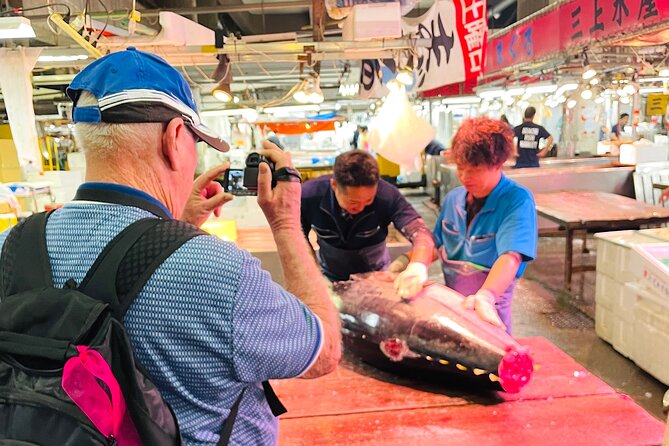
- Adachi Fish Market is the morning highlight: See a less tourist-focused seafood market, including large tuna and a wide range of marine products.
- Shibamata adds old Tokyo character: Walk a traditional shopping street, visit Taishakuten Temple, and see Japanese and Western design at Yamamototei.
- The group stays small: A maximum of eight people makes it easier to ask questions and hear the guide.
- The train ride is part of the plan: One-way rail fare from Senjuohashi Station to Shibamata Station is included.
- The tour ends in Shibamata: You finish at Shibamata Station, well placed to continue exploring on your own.
- The schedule is compact: In about four and a half hours, you see a market, temple, shopping street, garden, movie character statue, and historic house.
Why Adachi Fish Market makes a better starting point than Tsukiji
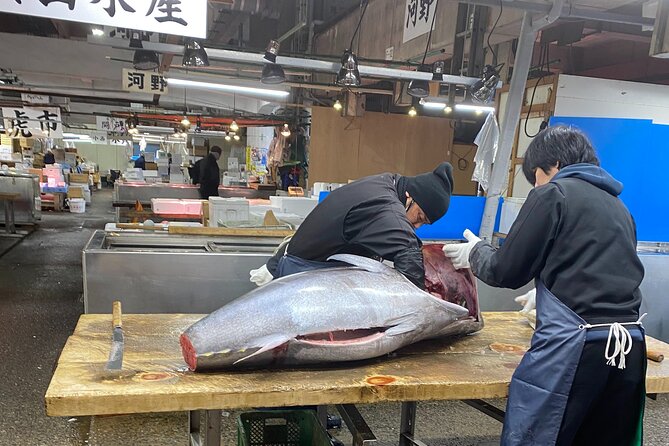
Many first-time Tokyo visitors head for Tsukiji, but Adachi Fish Market offers a different morning. It is described as Tokyo’s only specialized marine-products market, and its appeal comes from seeing seafood in a place that serves a practical local purpose rather than a famous sightseeing district.
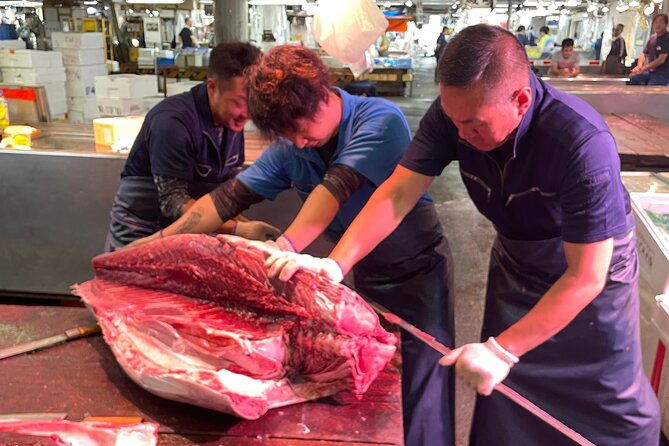
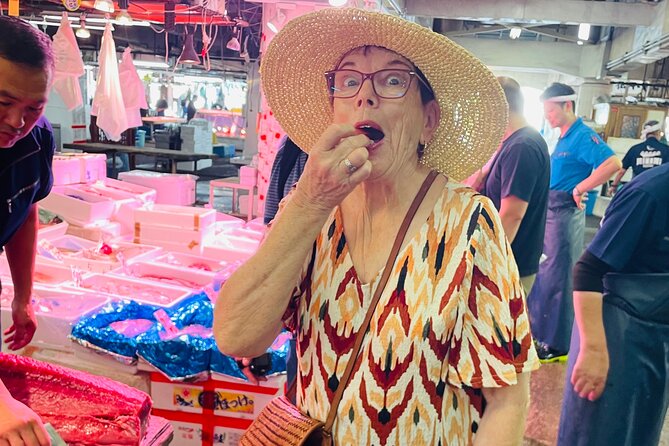
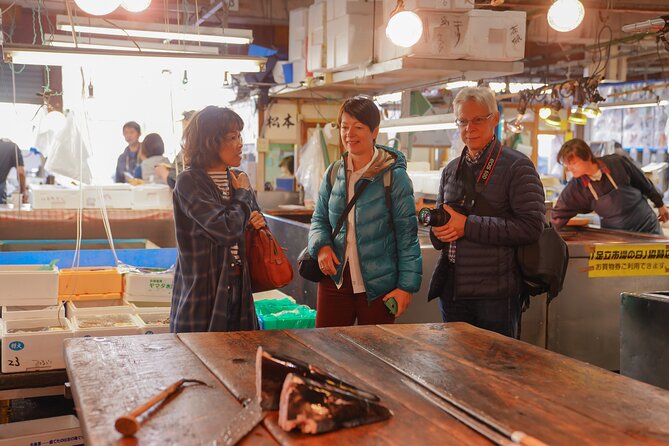
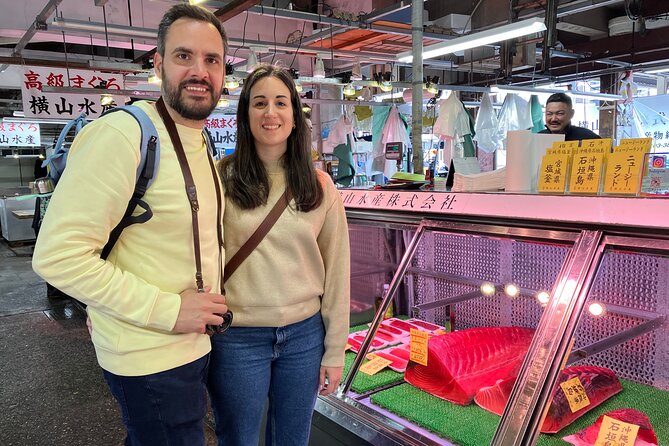
Your visit lasts about an hour. The guide helps you make sense of the stalls and explains what you are seeing, which matters in a market where labels and products may not be familiar. You might see enormous tuna, fresh sashimi, sushi, and a broad selection of seafood. The market is less about a formal tasting menu and more about watching the trade, asking questions, and getting a feel for Tokyo’s food culture.
I especially like this stop for people who have already seen the city’s major districts. The market gives you a reason to visit Adachi, an area many short visits miss. The setting also gives the tour a useful rhythm: begin with food and daily life, then move to the quieter streets and religious sites of Shibamata.
Keep your expectations practical. Food and drinks are not included, and the supplied details do not promise a meal or a seafood tasting. The market visit is best understood as a guided walk with opportunities to look closely at the stalls. If eating is your main goal, you should ask the operator what is available on your date rather than assume lunch is part of the price.
Other shopping tours in Tokyo



Shibamata brings back old Tokyo in a short walk
After the market, the tour heads by train toward Shibamata. The one-way rail fare from Senjuohashi Station to Shibamata Station is included, which removes one small task from the morning and makes the transition between neighborhoods simple.
Shibamata sits beside the Edogawa River in northeastern Tokyo. The tour gives you about 30 minutes to get a first impression of the town before moving through its main sights. This is not a large museum district or a grand central neighborhood. Its appeal is the slower pace, old-style streets, and sense of a traditional town within the Tokyo metropolis.
The tour also passes the bronze statue of Futen No Tora outside Shibamata Station. Tora is the fictional character from the Otoko wa Tsuraiyo film series, and Shibamata is presented as his home. The statue stop takes only about five minutes, but it gives the neighborhood a local cultural reference that your guide can explain better than a quick photograph can.
If you do not know the films, do not worry. The statue still serves as a clear welcome to Shibamata. If you do know them, this small stop has added meaning. Either way, it is brief and does not take time away from the temple and street.
Taishakuten-Sando is the most pleasant part of the walk
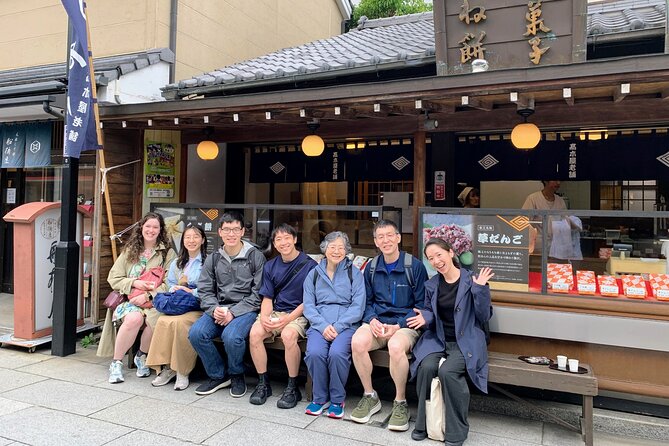
From the station, you follow Taishakuten-Sando for roughly 200 meters. This old-fashioned shopping street leads toward Shibamata Taishakuten and is lined with Japanese sweets shops, buckwheat noodle shops, and other traditional storefronts.
The short distance is one of the tour’s strengths. You get a compact introduction to local food and shopping culture without spending the morning on a long transfer between scattered sights. The guide can point out the kinds of sweets and shops that give the street its character, while you decide what deserves a closer look later.
The 20-minute stop is enough for orientation, but it is not enough for an unhurried shopping expedition. If a particular shop catches your eye, you may need to return after the tour. That is not a flaw so much as a limit of a half-day schedule. The tour’s job is to show you the street and explain why it matters, not to provide unlimited free time at every storefront.
I would pay attention to the contrast with Adachi Market. The market shows Tokyo’s food trade in action. Taishakuten-Sando presents food as part of a long-standing town street, with sweets and noodles tied to the atmosphere of the neighborhood. Together, the stops make the morning feel more varied than a standard city tour.
Shibamata Taishakuten rewards close attention
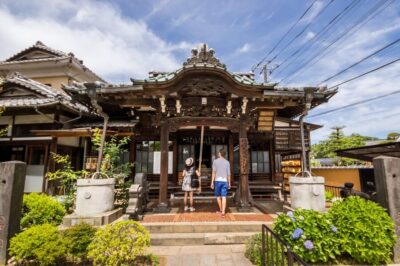
The temple visit lasts about 40 minutes, giving you time to look beyond the entrance and main hall. Shibamata Taishakuten, also called Taishakuten Daikyoji Temple, is noted for elaborate wood carvings arranged around the main hall. The carvings illustrate the Lotus Sutra story, and their precise detail is the main reason to slow down here.
This is where a good guide earns the tour fee. Religious art can be easy to pass without context, especially if you cannot read the signs. Guides including Kaori, Mutsuko, Megumi, Mana, Masayo, and Yumi have been praised for explaining Japanese customs and culture in clear English. The exact guide depends on the date, but the small group makes it easier to stop, listen, and ask about what you are seeing.
The temple also includes a garden associated with ikebana, the Japanese art of flower arranging. The supplied information calls it a stunning garden, but you should think of this as a visual pause after the detailed carvings. The attraction is not simply a single grand building. It is the combination of woodwork, religious storytelling, and garden design.
Entrance fees are included in the tour information, so you do not need to budget separately for the stated visits. Still, the amount of time is fixed. If temple art is your main interest, 40 minutes may feel quick, especially if you want photographs or a quiet look at every carved panel.
Yamamototei adds an unusual Japanese and Western blend
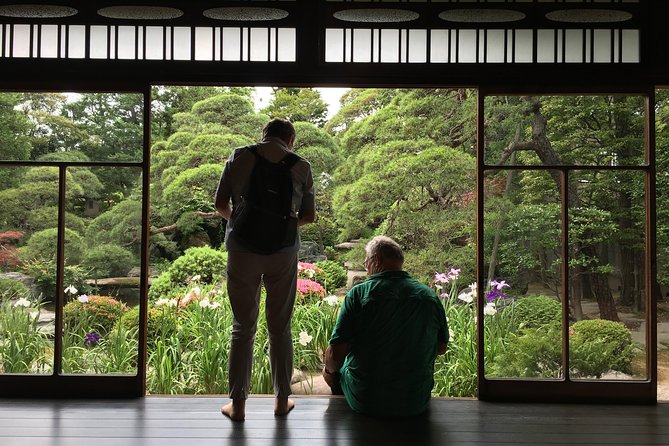
The final major stop is Yamamototei, where you spend about 30 minutes. This two-story building combines Japanese and Western architectural elements. Its Nagayamon, or long gatehouse, is singled out for its unusual Western features.
Yamamototei gives the tour a useful change of subject. After the market, shopping street, statue, and temple, you see how another period of Japanese design incorporated outside influences without losing a Japanese sense of proportion and presentation. The building is not treated as a standard shrine, and that distinction is worth noting. It is a designed residence and cultural site with a mixed architectural style.
The admission ticket for Yamamototei is included. Since this is the last listed stop, the visit also provides a calm finish before you make your own plans in Shibamata. The tour ends at Shibamata Station, so you can leave by rail or remain in the district if you want more time.
A few more Tokyo tours and experiences worth a look




What the four and a half hours really covers
The advertised duration is about 4 hours and 30 minutes. The listed stops account for roughly three hours and five minutes: one hour at the market, 30 minutes in Shibamata, five minutes at the statue, 20 minutes on Taishakuten-Sando, 40 minutes at the temple, and 30 minutes at Yamamototei.
The remaining time allows for walking, explanations, and the train transfer. That is a sensible format for Tokyo, where a tour can lose time simply moving from one neighborhood to another. You are not rushed from one distant attraction to the next without context, but you also should not expect long, open-ended breaks.
The tour begins at 8 a.m. at Senjuohashi Station in Adachi City. There is no hotel pickup or drop-off. You need to reach the meeting point yourself, and you finish at Shibamata Station rather than returning to the start. For me, the one-way route is a plus because it avoids backtracking. It works best if you plan your next activity in eastern or northeastern Tokyo.
Group size, guides, and the feel of the experience
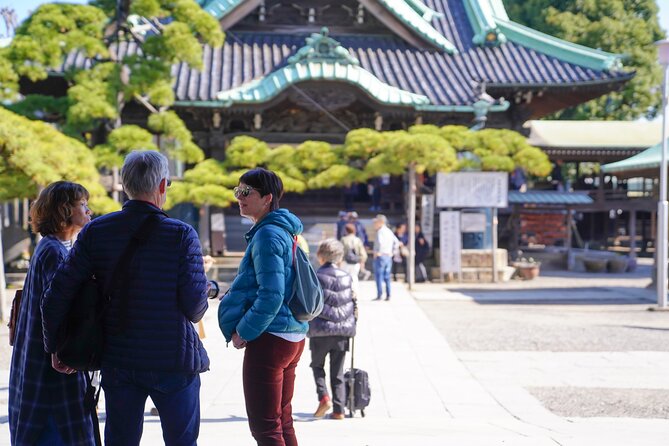
The maximum group size is eight, and at least two people are required per booking. This is a good middle ground for a guided walk. You get the social ease of a group without the crowding of a large coach excursion.
The strongest pattern in the available comments concerns the guides. Kaori was praised for clear language, professional conduct, and personal warmth. Mutsuko was appreciated for local charm, especially at the market. Megumi handled questions well for a family group of six, while Masayo was noted for explaining local customs. Yumi was singled out for making an unfamiliar part of Tokyo easy to enjoy, and Mana guided a private version that included the market and temple.
Those names do not guarantee who will lead your departure. They do show what this tour depends on: the guide’s ability to explain seafood, neighborhood customs, temple details, and the film connection at Shibamata. A guide who simply leads you from point to point would leave much of the value behind. The comments indicate that the operator has used guides who make explanation a central part of the outing.
The small group also helps families and first-time visitors. You can ask about unfamiliar foods without holding up a large crowd, and the guide can adjust explanations to the people present. The tour is described as suitable for most people, but it is still a walking experience with station transfers and time on your feet.
Is $91.96 a fair price?
At $91.96 per person, this is not the cheapest way to see Shibamata. You could visit the neighborhood independently for less, especially if you already understand Tokyo trains and are comfortable exploring a market, temple, and shopping street without help.
The price becomes easier to defend if you value interpretation. It covers a professional guide, a small-group walking tour, local taxes, the stated entrance fees, and one-way rail fare from Senjuohashi to Shibamata. You are paying to connect two outlying areas efficiently and to understand what you are looking at.
The tour is also a better value for a short Tokyo visit than it may first appear. In one morning, you see a specialized seafood market, an old shopping street, a film-related statue, a temple with detailed carvings, a garden, and a mixed-style historic building. Trying to arrange all of that alone would take some planning, and you would not automatically get the cultural explanations.
Group discounts are available, though the supplied details do not state the discount amount. Food and drinks cost extra, and private transportation by taxi, private car, or bus can be arranged for an additional fee. The standard tour itself uses the train and does not include hotel transport.
Who should book this Tokyo tour
I would choose this experience if you have already seen, or want to avoid, the most familiar Tokyo stops. It suits you if seafood markets, traditional streets, Buddhist temple art, and local stories interest you more than department stores and major photo locations.
It is also a strong choice for people who want a guide but do not want a large group. Families can benefit from the question-friendly format, and the comments include a group of six that enjoyed the market together. Couples and solo visitors should note the two-person minimum for each booking.
You may want another tour if your priority is a long market meal, free time for shopping, or a private car. The schedule is structured, the start is early, and meals are not included. The focus is learning and seeing several connected sights, not lingering at one restaurant or temple for half a day.
The tour is booked an average of 64 days ahead, so advance planning is sensible. Confirmation is received within 48 hours, subject to availability. Free cancellation is available up to 24 hours before the local start time. Changes or cancellations inside that window are not accepted for a refund.
Should you book it?
Book this tour if you want a compact, guided look at a less familiar side of Tokyo and you value clear cultural context. The best combination is the Adachi seafood market followed by Shibamata’s temple carvings and old shopping street. The route feels purposeful, and the small group keeps it personal.
Skip it if you need hotel pickup, a private vehicle, a late start, or a guaranteed food tasting. For everyone else, $91.96 is a reasonable price for a four-and-a-half-hour route that links two distinctive districts, includes the train fare and stated admissions, and leaves you at Shibamata Station with more of Tokyo still to explore.
FAQ
How long does the Adachi Market and Shibamata tour last?
The tour lasts approximately 4 hours and 30 minutes.
What time does the tour start?
The tour starts at 8 a.m.
Where does the tour begin?
It begins at Senjuohashi Station, at Senjuhashidocho in Adachi City, Tokyo.
Where does the tour end?
The tour ends at Shibamata Station in Katsushika City, Tokyo.
Is transportation included?
One-way train fare from Senjuohashi Station to Shibamata Station is included. Hotel pickup and drop-off are not included.
Is food included in the price?
No. Food and drinks are not included.
How many people can join the tour?
The tour has a maximum of eight participants. A minimum of two people per booking is required.
Are entrance fees included?
The tour information states that entrance fees are included. The admission ticket for Yamamototei is specifically listed as included.
Can private transportation be arranged?
Taxi, private car, or bus transportation is available for an extra fee.
What is the cancellation policy?
You can cancel up to 24 hours before the local start time for a full refund. Cancellations or changes made less than 24 hours before the start are not accepted for a refund.
More Half-Day in Tokyo


More Markets in Tokyo
More Shopping Tours in Tokyo
More tours in Tokyo we've reviewed






Half-Day, compared.
 ★ 4.0Half-day Tokyo Afternoon Tour by Hato BusFrom $41
 ★ 4.6Tokyo: A Half-Day Trip Bus Tour in the MorningFrom $404 hours - 270 minutes
 ★ 4.0Half-day Tokyo Morning Tour by Hato BusFrom $41
 ★ 5.0Tokyo Private Half-Day Tour with a Local – Secrets & HighlightsFrom $143
 ★ 5.0Private Hakone Half-day Car Tour with Hotel Pickup – Local GuideFrom $277
 ★ 4.9Old and Nostalgic Tokyo: Half-Day Yanaka Walking TourFrom $833h 30m