
Reviewed · CRAFT WORKSHOPS
Authentic Japanese calligraphy class in Tokyo! Kanji your name
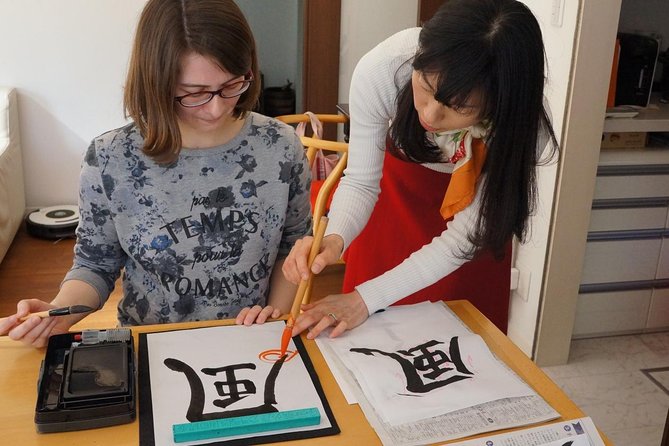
Japanese calligraphy becomes much easier to understand when you stop watching from the sidelines and pick up the brush yourself. In Maki’s home near Yoga Station, you learn the tools, posture, brush grip, and basic strokes before creating your own kanji on traditional Japanese paper.
I like the private format and the patient, step-by-step teaching. I also like that you can choose a word or character and take home a finished piece on colored paper or a fan. The main consideration is location: Yoga is outside the usual central Tokyo sightseeing circuit, so you need to allow time for the train ride.
In This Review
- Key points to know before booking
- What makes this Tokyo calligraphy class different
- Meeting Maki near Yoga Station
- Starting with Japanese writing systems
- Learning posture and brush control
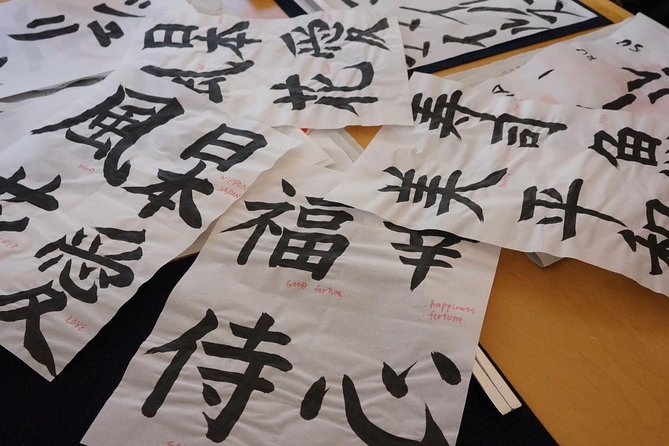
- Creating your own kanji on traditional paper
- A personal class with room for questions
- Small touches that make the visit memorable
- Is $56 good value?
- Who should book this experience
- Practical details before you go
- Should you book Maki’s calligraphy class?
- FAQ
- Where does the Japanese calligraphy class take place?
- How long does the experience last?
- Is this a private activity?
- What will I learn during the lesson?
- What materials are included?
- Can I take my calligraphy home?
- What is the cancellation policy?
Key points to know before booking
- Private lesson in a local home: Your group receives one-to-one instruction in Maki’s living room rather than joining a large studio class.
- Maki teaches each stage carefully: You learn about writing systems, tools, posture, brush handling, and technique before making your final work.
- A useful cultural activity for beginners: You do not need previous calligraphy experience, and the class is designed to make shodo approachable.
- A finished piece goes home with you: Practice paper and supplies are provided, along with colored paper or a fan for your final character or word.
- Near Yoga Station in Setagaya: The meeting point is at Yōga Sta., 2 Chome-39 Yoga, Setagaya City.
- About 90 minutes for $56: That price includes the lesson, tools, materials, consumable supplies, and consumption tax.
What makes this Tokyo calligraphy class different
Many Tokyo cultural activities give you a quick demonstration, a few minutes of practice, and a souvenir. This class gives you time to understand what you are doing. Maki begins with the foundations of Japanese writing and then shows you how those ideas affect the brush in your hand.
That matters because shodo, the Japanese word commonly used for calligraphy, is not simply neat handwriting. The movement, pressure, balance, and spacing all shape the final character. A brush stroke can look simple on the page, but the way you begin and finish it changes its weight and character.
You receive private guidance throughout the lesson. If your wrist is too stiff, your posture needs adjusting, or you are repeating a stroke incorrectly, Maki can address it directly. This is more useful than trying to copy a video, where you cannot ask a question or receive a correction.
The setting also gives the activity a personal feel. You visit Maki’s home and work in her living room, an ordinary local setting that feels different from a polished visitor center. That home-based format is one of the strongest reasons to choose this class if you want a cultural exchange rather than a quick craft stop.
A few more Tokyo tours and experiences worth a look

Meeting Maki near Yoga Station
The class begins near Yōga Station in Setagaya City. The exact meeting address is 2 Chome-39 Yoga, and the activity ends back at the same meeting point.
Yoga is not one of Tokyo’s best-known sightseeing districts, so check the route before you leave your hotel. The meeting point is near public transportation, but private transport is not included. You should treat the journey as part of the planning, especially if your day already includes Asakusa, Shibuya, Tokyo Station, or another distant part of the city.
The location can be a plus if you want to see a quieter residential side of Tokyo. It is also practical for anyone already staying or spending time in Setagaya. The tradeoff is simple: this is not a class you can casually fit between major sights in central Tokyo without allowing extra travel time.
Once you arrive, the private format means you are not competing with a large group for attention. You can attend alone, with friends, or with family, since only your own group participates.
Starting with Japanese writing systems
The lesson begins with an introduction to Japanese writing systems. This gives you useful context before you start painting characters.
Japanese uses several writing systems, and calligraphy can involve different kinds of characters. You learn enough to understand what you are writing and why the forms look different, rather than treating kanji as a collection of mysterious symbols.
The class is especially helpful if you want to write your name or a meaningful word. The experience is described as Kanji your name, but the lesson also allows you to write a word or character on traditional paper. That gives you room to choose something personal instead of receiving a completely fixed project.
Maki also explains the calligraphy tools. You learn what the brush and other supplies are for, how they work together, and why control matters. Since all the needed equipment is supplied, you do not have to buy materials before the class or carry special tools through Tokyo.
Learning posture and brush control
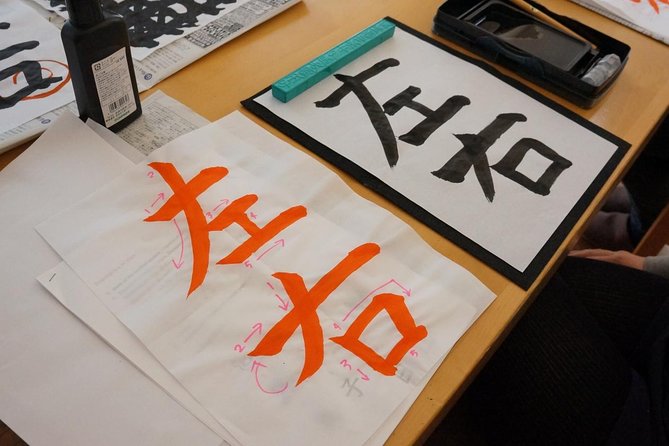
The physical basics are a major part of the experience. Maki teaches the correct posture and how to hold the brush, then guides you through the strokes.
This may sound minor, but it is where many beginners struggle. Holding a brush like a pen can make your lines tight and uneven. The correct grip and posture give your hand more freedom, while controlled pressure lets you create both heavier and lighter marks.
The class has a patient teaching style. Maki is described as explaining each technique carefully and repeating instructions when needed. That is useful for beginners who want to understand the process instead of rushing toward a souvenir.
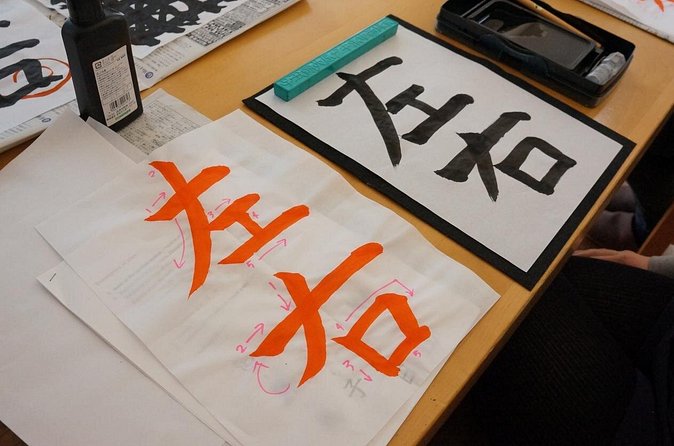
You also get time to practice on ordinary paper before working on the final piece. This is important. Traditional paper leaves little room for correction, so practice lets you become familiar with the brush and build confidence before making the character you plan to keep.
I like this structure because it separates learning from performance. You are not expected to produce something perfect on the first try. You can test the movement, receive advice, and try again.
Creating your own kanji on traditional paper
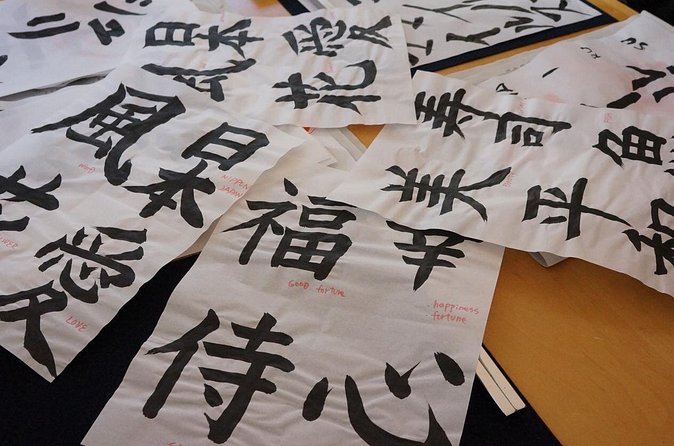
After practicing, you write a word or character on Japanese traditional paper. Depending on the materials provided, your final work can be presented on colored paper or a fan.
This is where the lesson becomes more than an explanation of calligraphy. You make a physical piece that records your effort and the character you chose. It is small enough to take home, but personal enough to remind you of the class long after your Tokyo visit.
The final work may not look like a professional calligrapher’s piece, and that is part of the point. The value comes from understanding the strokes and making the character yourself. Maki’s role is to help you produce something you feel comfortable keeping, while also showing you the discipline behind the art.
The materials include practice paper, calligraphy tools, colored paper or a fan, and other consumable supplies. These are included in the $56 price, along with consumption tax. You should not need to pay extra for the basic class materials.
A few more Tokyo tours and experiences worth a look





A personal class with room for questions
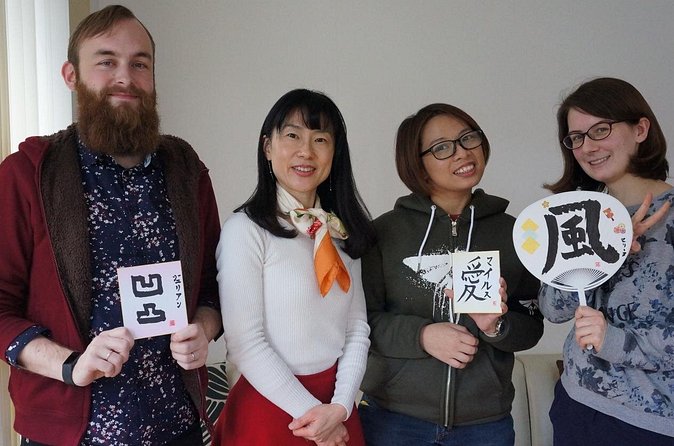
The one-to-one format changes the pace. In a group workshop, you may have to wait while the instructor helps other people. Here, Maki can spend the lesson responding to your pace and questions.
That works well for different types of participants. A complete beginner can ask basic questions without feeling rushed. Someone already familiar with Japanese culture can spend more time on brush movement or composition. A family or group of friends can learn together while still receiving direct help.
Maki also talks about Japanese culture beyond the mechanics of writing. The class gives you a chance to ask about traditions and the meaning behind calligraphy. It is not presented as a formal lecture, so the cultural information comes naturally through the activity.
English is also an important practical point. Maki is described as speaking English very well and explaining techniques clearly. That makes the class suitable for visitors who cannot read Japanese or communicate comfortably in Japanese.
The tone is friendly and participatory. You are not simply watching an expert work. You practice, ask questions, make corrections, and take part in each stage.
Small touches that make the visit memorable
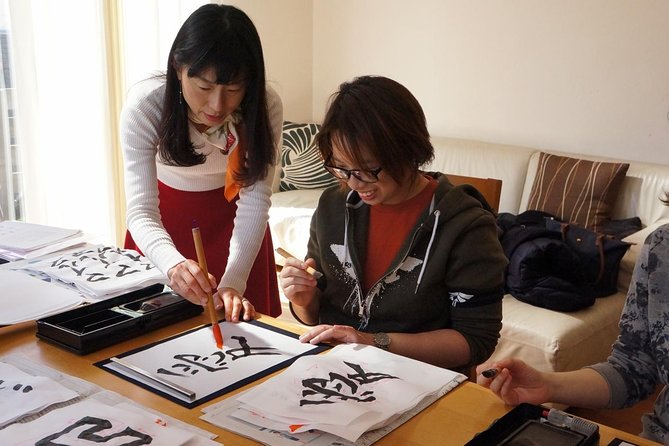
The class can include drinks for you to try, adding a little hospitality to the visit. That detail fits the home setting and gives the lesson a more relaxed rhythm.
Maki has also prepared something special for a birthday visit, so the activity can work as a thoughtful gift for a partner, friend, or family member. You should not assume a special arrangement is automatically included, but the experience can suit a celebration if you discuss your plans when booking.
The private setup is also useful for mixed-age groups. Most people can participate, and the activity does not require a high level of fitness. You sit, listen, practice, and work with the brush. The main challenge is patience and concentration, not physical exertion.
The class lasts about 90 minutes. That is long enough to cover the basics and make a final piece, yet short enough to fit into a day of sightseeing. I would avoid scheduling a major timed attraction immediately afterward, since Tokyo journeys can take longer than expected and the class is best enjoyed without watching the clock.
Is $56 good value?
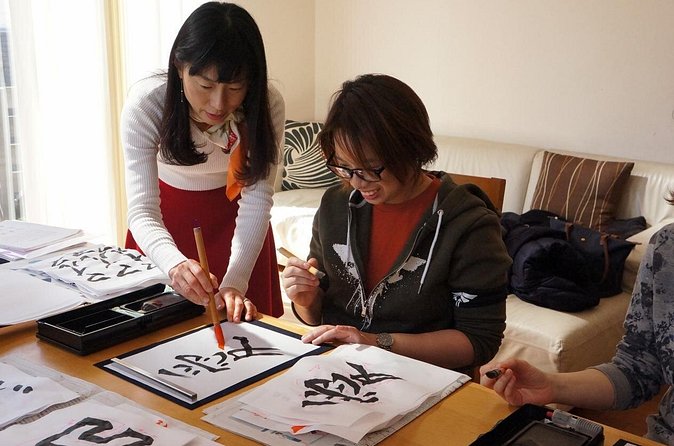
At $56, this is not the cheapest souvenir-making activity in Tokyo. It is also not simply a souvenir purchase. The fee covers a private lesson, instruction from Maki, use of calligraphy tools, practice paper, colored paper or a fan, other consumable supplies, and tax.
The private teaching is the main value. You are paying for personal correction and a cultural lesson in a local home, not just access to a table of materials. If you want to learn why the brush is held a certain way and how a character is built, the price is reasonable.
The value is less clear if you only want a quick photograph or a finished name written by someone else. In that case, a short demonstration may be enough. This class makes more sense for you if you want to understand the craft and create your own work.
It can also be good value for a small private group. Friends or family can share the experience while keeping the lesson focused on their own group. A birthday visit adds another possible use, especially if you want a cultural activity rather than a restaurant meal or shopping gift.
Who should book this experience
I would recommend the class to first-time visitors who want a calm cultural activity away from the most crowded tourist zones. It is a good match for people interested in Japanese language, traditional arts, handmade souvenirs, or photography with a personal story behind it.
It also suits solo visitors. You do not need to bring a group to make the private lesson worthwhile. Maki’s careful explanations and friendly approach give a solo participant enough interaction throughout the session.
Families can benefit from the clear structure. Children and adults can practice at their own level, though the supplied information does not specify a minimum age. If you are booking for young children, confirm suitability before reserving.
I would be more cautious about recommending it to someone with only a few hours in Tokyo or a packed itinerary. Yoga is near public transportation, but it is not positioned as a central sightseeing stop. The class rewards you for making time to reach it.
Practical details before you go
Your booking confirmation is provided at the time of reservation. The activity is private, and only your group participates.
The experience starts and finishes at the meeting point near Yōga Station. Private transportation is not included, so you will need to make your own way there and back.
Free cancellation is available if you cancel at least 24 hours before the local start time. Cancellations made less than 24 hours in advance are not refunded, and changes inside that period are not accepted.
Wear something you can sit comfortably in and take care around the ink and tools. The supplies are provided, but the final work is yours to carry home, so bring a folder or a flat way to protect it if you plan to continue sightseeing afterward.
Should you book Maki’s calligraphy class?
Book it if you want a private, hands-on introduction to shodo rather than a fast cultural demonstration. Maki’s patient explanations, strong English, home setting, and careful attention make this a particularly good choice for beginners.
The class is also a smart pick for a personal souvenir. You learn the technique, select a word or character, and leave with your own work on traditional paper or a fan.
Skip it if your Tokyo schedule is too tight to reach Yoga or if you want only a quick activity in the city center. For everyone else, $56 buys a thoughtful 90-minute lesson, a local welcome, and a keepsake with your own brush marks on it.
FAQ
Where does the Japanese calligraphy class take place?
The class starts near Yōga Station at 2 Chome-39 Yoga, Setagaya City, Tokyo 158-0097, Japan. The lesson takes place in Maki’s home.
How long does the experience last?
The calligraphy class lasts approximately 1 hour and 30 minutes.
Is this a private activity?
Yes. This is a private tour or activity, and only your group participates.
What will I learn during the lesson?
You learn about Japanese writing systems and calligraphy tools, along with correct posture, brush handling, and the techniques needed to create a character or word.
What materials are included?
The price includes calligraphy tools, colored paper or a fan, practice paper, consumable supplies, the experience fee, and consumption tax.
Can I take my calligraphy home?
Yes. You can write a word or character on traditional Japanese paper and take your calligraphy creation home.
What is the cancellation policy?
You can cancel for a full refund up to 24 hours before the experience start time. Cancellations or changes made less than 24 hours before the start time are not accepted for a refund.
More Workshops & Classes in Tokyo
More Craft Workshops in Tokyo

More tours in Tokyo we've reviewed







Craft Workshops, compared.
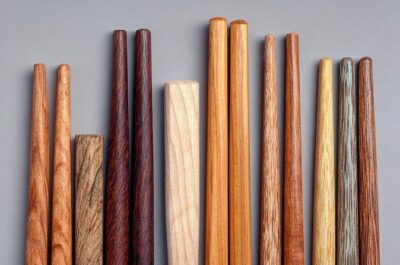 ★ 5.0Tokyo Shinjuku Chopsticks Making ClassFrom $20
 ★ 4.8Chopstick Making Workshop in GinzaFrom $251 hour
 ★ 5.0Kintsugi Experience: Art of Golden Joinery in TokyoFrom $59
 ★ 5.0Tokyo Chopstick Making Workshop with ArtisanFrom $26
Tokyo: Shinjuku Chopstick Making ClassFrom $121 hour
Tokyo: Chopstick-Making WorkshopFrom $61 hour
★ 5.0Tokyo Chopstick Making Workshop with ArtisanFrom $26
Tokyo: Shinjuku Chopstick Making ClassFrom $121 hour
Tokyo: Chopstick-Making WorkshopFrom $61 hour