
Reviewed · SUSHI MAKING CLASSES
Taisho Sushi Making Class in Tokyo
Tokyo’s Taisho Sushi Making class gets you past the restaurant counter and into the basic craft of sushi. You practice each hand movement with models first, then make nigiri, maki, and gunkan with real rice and seasonal ingredients.
I like the careful practice stage, which gives beginners a fair chance to learn the grip instead of fumbling with raw fish right away. I also like that the class includes plenty of sushi to eat and explains proper sushi etiquette. The main point to check is the timing: the booking information says about one hour, while the class description presents it as a 90-minute experience.
In This Review
- Key points at a glance
- Learning sushi in Kōjimachi
- Why the model practice matters
- Making nigiri with fish and rice
- Rolling maki and shaping gunkan
- Plenty to eat after the lesson
- Vegan and vegetarian choices
- Who will enjoy this Tokyo food class
- Timing, booking, and practical planning
- Is Taisho Sushi Making worth booking?
- FAQ
- Where does the Taisho Sushi Making class begin?
- Where does the activity end?
- How long does the sushi class last?
- How much does the class cost?
- Are equipment and ingredients provided?
- Can vegan and vegetarian participants join?
- What types of sushi will I learn to make?
- Can I cancel for a full refund?
Key points at a glance

- Practice before real ingredients: You repeat the sushi grip with models before handling fish and rice.
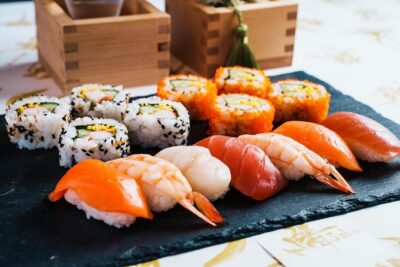
- Three sushi styles: The lesson covers nigiri, rolled maki, and gunkan, the seaweed-wrapped style used for toppings such as salmon roe.
- Eat what you make: The session ends with time to enjoy your sushi, with guidance on correct sushi-eating etiquette.
- Good for non-fish eaters: Vegan and vegetarian options are available when arranged through the experience.
- Central Tokyo meeting point: The class begins and ends at 1-chōme-4-4 Kōjimachi in Chiyoda City.
- A social, short-format class: It suits families, larger groups, and anyone fitting a food activity into a busy Tokyo day.
Learning sushi in Kōjimachi
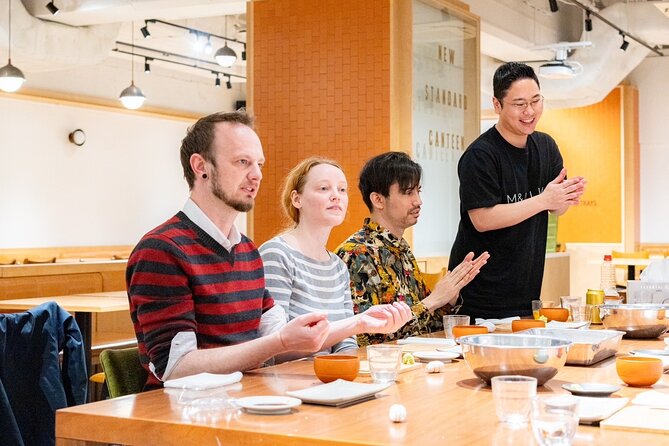
Taisho Sushi Making takes place at 1-chōme-4-4 Kōjimachi, Chiyoda City, Tokyo. The activity returns you to the same point, so you do not need to arrange a second meeting location after the class.
That simple plan matters in Tokyo. You can arrive with your hands free, since the equipment and materials are supplied. You also avoid spending time shopping for rice, seaweed, fish, or tools before the lesson. Your job is to arrive on time, listen closely, and bring an appetite.
The class is designed as a compact introduction rather than a full professional cooking course. The booking details describe it as about one hour, while the teaching outline calls it a 90-minute sushi-making experience. I would allow at least 90 minutes in your schedule and confirm the exact length after booking.
The class can include up to 50 people. That is a useful detail for families, school groups, and larger parties, though the experience may feel less personal at the upper end of that limit. If you want quiet, individual coaching, a smaller class would usually be preferable, but no smaller group size is promised here.
A few more Tokyo tours and experiences worth a look

Why the model practice matters
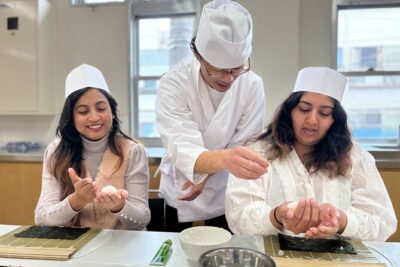
The most useful part of the lesson comes before the fish appears. You first practice the hand position and grip using models. That may sound basic, but sushi rice is delicate, sticky, and easy to compress too firmly.
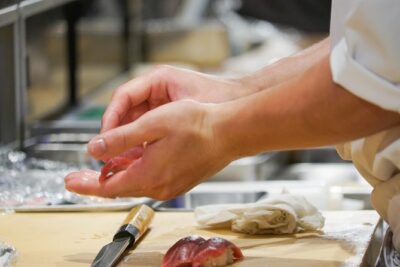
Nigiri looks simple on a plate. It is not quite so simple in your hands. You need to shape the rice without crushing it, place the topping correctly, and keep the piece together without turning it into a dense block. Starting with a model lets you repeat the movement several times without wasting food or worrying about making a perfect piece on your first attempt.
I like this approach because it treats sushi as a skill rather than a quick photo opportunity. You get a chance to understand the mechanics before working with real ingredients. For a first-time sushi maker, that practice can make the rest of the class less intimidating.
The model stage also gives the instructor a natural point to correct your grip. The supplied details do not name the instructors, so you should not expect a particular guide by name. The teaching method itself is clear: repeat the movement, receive instruction, and then move on to the real sushi.
Making nigiri with fish and rice
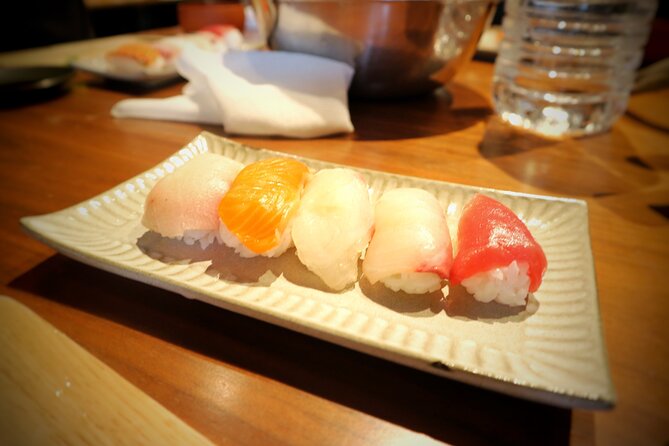
After practicing, you make nigirizushi with real fish and rice. Nigiri is the compact piece most people picture when they think of traditional sushi: shaped rice with a topping placed over it.
The fish changes with the season. That means the exact selection is not fixed in advance, but you are told to expect a broad variety and enough sushi to eat until you are full. This is one of the strongest reasons to consider the class. You are not only assembling one or two sample pieces for a demonstration. You get repeated practice and a meal from your work.
There is also value in learning the difference between assembling sushi and eating it. The class includes guidance on sushi etiquette, so you can ask practical questions about how to handle and eat the finished pieces. That makes the session useful beyond the hour or so spent in the classroom. You leave with a better idea of how the food is built and how it is traditionally approached at the table.
The seasonal menu is also a small advantage. You cannot select the exact fish from the information provided, but a changing selection keeps the class tied to the ingredients available at the time of your visit. If you have allergies or strict dietary needs, contact the provider before booking rather than relying on the seasonal menu to suit you.
Rolling maki and shaping gunkan
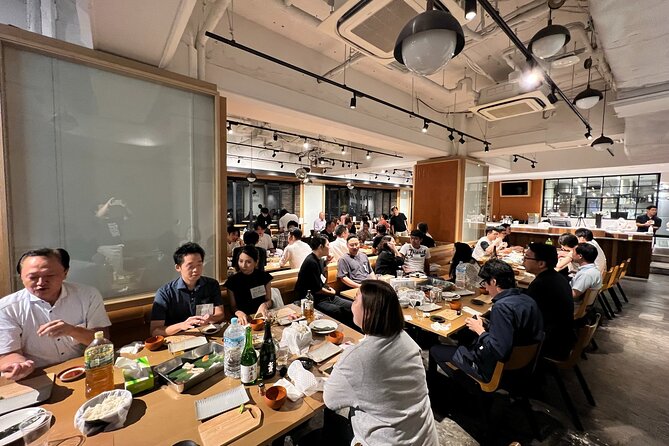
The lesson does not stop with nigiri. You also learn maki, the rolled sushi style, and gunkan. Gunkan means warship, a name that refers to the strip of nori wrapped around the rice to hold loose toppings.
The gunkan section covers items such as salmon roe and negitoro, described as crushed tuna, along with other toppings. You learn how the seaweed should be handled and why its front and back sides matter. That is the kind of small technical point that can be hard to notice when you only eat sushi in a restaurant.
Maki gives you a different problem from nigiri. Instead of shaping rice and topping as one piece, you must work with nori and roll the ingredients into a stable form. The class gives you a chance to see how the seaweed, rice, and fillings work together.
Learning three styles in one short session gives the class a good range. Nigiri teaches hand shaping. Maki teaches rolling. Gunkan teaches how to build a firm seaweed wall around loose ingredients. You get a quick tour of sushi construction rather than one narrow exercise.
The tradeoff is pace. A class covering several styles in roughly 60 to 90 minutes cannot provide the depth of a chef-training program. You will learn the foundations and practice the main movements, but you should not expect professional-level knife skills or a complete course in sushi preparation. Those looking for a first step will get more from this format than someone hoping to qualify as a sushi chef.
Plenty to eat after the lesson
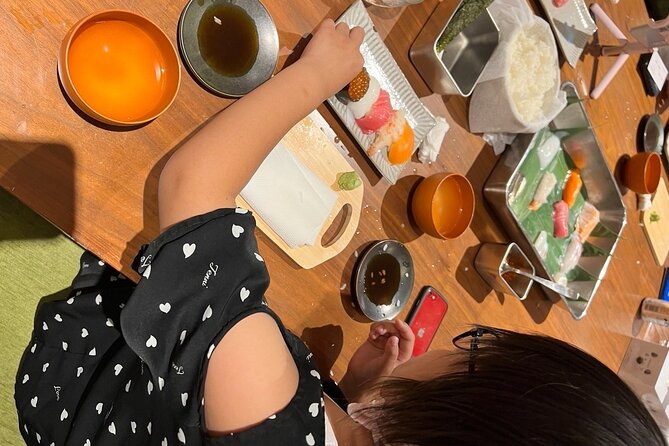
Food quantity matters in a cooking class. Some sessions offer one small sample, then send you elsewhere for lunch. This one is set up so you can eat the sushi you prepare, with the description promising a generous variety and amount.
That makes the $109.01 price easier to assess. You are paying for instruction, ingredients, equipment, a meal, and a Tokyo activity that fits into a short block of time. It is not cheap compared with buying sushi at a casual restaurant, but the value is different. You are paying to make the food and understand the work behind it, not just to consume it.
I would consider the price reasonable for someone who already plans to spend money on a food activity in Tokyo and wants hands-on participation. It is less compelling if your only goal is to eat excellent sushi at the lowest possible cost. A sushi counter or conveyor-belt restaurant will usually be the simpler choice for that purpose, though this class gives you a skill and a memory that a regular meal does not.
The chance to eat until full also helps larger groups. A family or group of friends can share the activity and the meal without arranging a separate restaurant booking immediately afterward. One published comment specifically praised the amount of fish and the time provided, and described the class as a good fit for larger groups and families. That matches the structure of the experience.
A few more Tokyo tours and experiences worth a look


Vegan and vegetarian choices
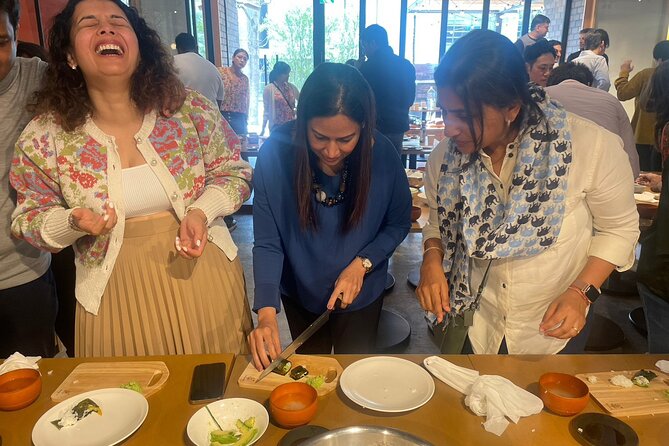
You do not need to be a fish eater to consider this class. Vegan and vegetarian options are available for people who do not eat fish.
The supplied information does not list the exact substitute ingredients, so you should ask what will be served before your visit. That is especially important for a vegan diet, since sushi rice seasoning, sauces, and other ingredients can vary.
For a vegetarian or vegan participant in a mixed group, the option is useful because everyone can take the same class together. Fish eaters can work with the seasonal selection while non-fish eaters receive suitable alternatives. The key is to communicate your needs clearly ahead of time.
Who will enjoy this Tokyo food class
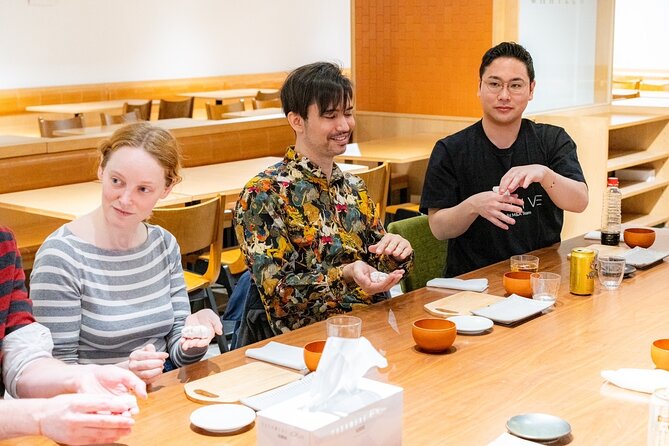
I would put this class high on the list for several kinds of visitors:
- First-time sushi makers: The model practice gives you a gentle start.
- Food-focused visitors with limited time: The compact format fits neatly into a Tokyo itinerary.
- Families and larger groups: The class can accept up to 50 people and includes enough food to make the shared activity worthwhile.
- Vegetarian and vegan participants: Alternatives are available, so a mixed group does not need to split up.
- People curious about sushi etiquette: You learn how to eat the finished pieces properly, not just how to assemble them.
- Visitors who want a social activity: You can meet other people interested in sushi during the session.
I would be more cautious if you need a very intimate class, a guaranteed list of fish, or advanced chef training. The group limit is fairly high, and the menu changes with the season. The lesson is aimed at learning the basics, not mastering every part of sushi production.
Timing, booking, and practical planning
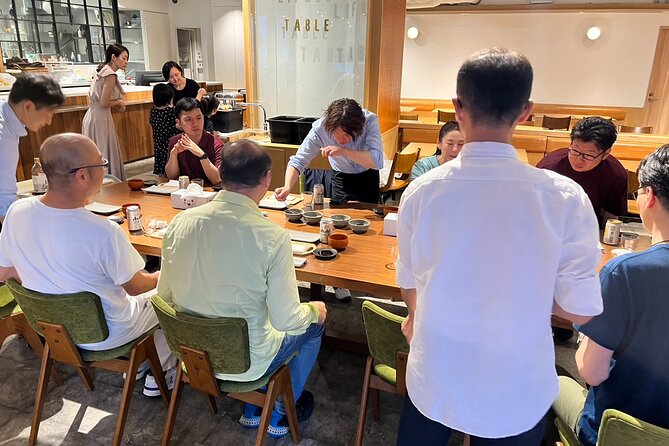
The experience is booked an average of 23 days ahead, so I would not leave it until the final day of your Tokyo planning. Confirmation arrives within 48 hours, subject to availability. That is worth remembering if your schedule is tight.
The class includes a mobile ticket, which keeps the arrival process simple. You do not need to bring cooking equipment or materials. The activity begins and ends at the Kōjimachi meeting point, making it easy to pair with other plans in Chiyoda City.
Service animals are allowed, and the location is near public transportation. The supplied details do not specify a particular station, walking time, or route, so check your map before setting out. Tokyo rewards leaving extra time for transfers and finding the correct building.
You can cancel for a full refund up to 24 hours before the start time. Changes or cancellations inside that 24-hour window are not accepted for a refund. The cutoff uses Tokyo local time. The class also requires a minimum number of participants. If the provider cancels because that minimum is not reached, you are offered another date or experience, or a full refund.
Is Taisho Sushi Making worth booking?
I would book this class if you want more than a sushi meal and have about 60 to 90 minutes to spare. The model practice, three sushi styles, etiquette instruction, and meal at the end give you a solid introduction without requiring previous cooking experience.
The best value comes from the hands-on structure. You are not simply watching a chef shape sushi. You practice the grip, work with real rice and fish, learn how nori behaves, and eat the result. Families and larger groups should find the format especially practical.
Think twice if you want a small, quiet class or a fixed menu of specific fish. The group limit can reach 50, the seasonal selection is not guaranteed, and the stated duration needs clarification. For most food-focused visitors, though, Taisho Sushi Making offers a useful and enjoyable way to understand one of Tokyo’s signature foods, even after you return home.
FAQ
Where does the Taisho Sushi Making class begin?
The class begins at 1-chōme-4-4 Kōjimachi, Chiyoda City, Tokyo 102-0083, Japan.
Where does the activity end?
The activity ends back at the meeting point in Kōjimachi.
How long does the sushi class last?
The booking details describe the activity as approximately one hour. The class description calls it a 90-minute experience, so you should allow up to 90 minutes.
How much does the class cost?
The listed price is $109.01 per person.
Are equipment and ingredients provided?
Yes. You can come empty-handed because all equipment and materials are provided.
Can vegan and vegetarian participants join?
Yes. Vegan and vegetarian options are available for people who do not eat fish.
What types of sushi will I learn to make?
The class covers nigiri, maki, and gunkan. You also learn about sushi grip, nori handling, and sushi-eating etiquette.
Can I cancel for a full refund?
Yes. You can cancel at least 24 hours before the experience start time for a full refund. Cancellations or changes made less than 24 hours before the start time are not refunded.
More Workshops & Classes in Tokyo
More Sushi Making Classes in Tokyo
More tours in Tokyo we've reviewed











Sushi Making Classes, compared.
 ★ 5.0Sushi Making Tokyo Roll and Authentic Japanese Sushi ClassFrom $59
 ★ 4.9Tokyo: Roll and Authentic Sushi Making Class in AsakusaFrom $581h 40m
 ★ 5.0Make Sushi and Create Unforgettable Memories in TokyoFrom $79
 ★ 4.9Tokyo: Sushi Making Class in a Happi Coat near a Famous SpotFrom $421h 30m
 ★ 5.0Tokyo Sushi Making Class in Tsukiji with Professional ChefFrom $49
 ★ 5.0Tokyo Night Foodie Tour in Shinjuku – Seasonal Sushi, Wagyu BeefFrom $111