
Reviewed · GO-KARTS
Official Japan Go-Kart Through Shibuya / Shinjuku (IDP Required)
The most unusual thing about this Tokyo tour is simple: you drive through the city instead of merely looking at it. From a low-slung go-kart, Shibuya Crossing feels closer, the traffic feels louder, and people on the sidewalks suddenly notice you. This is sightseeing with a steering wheel, a helmet, and a healthy respect for Tokyo traffic.
I like the route because it links several famous districts in one outing, and I like having a guide handle the navigation. The small group, limited to 10 riders, also makes the convoy easier to manage. The main drawback is that you are driving on public roads, not around a private kart track. If traffic makes you nervous, the first few minutes may feel tense.
In This Review
- Key points to know before booking
- What the two-hour Tokyo ride is really like
- Starting in Shinjuku at the JAPANKART branch
- Shinjuku Gyoen: a green opening to the route
- Omotesando and Harajuku from street level
- Shibuya Crossing is the headline moment
- Yoyogi Park and Meiji Jingu’s neighborhood
- Shinjuku’s skyline and Kabukicho
- Safety, support vehicles, and the first ten minutes
- Photos, videos, and the value of the experience
- Who should book this experience?
- Booking, weather, and cancellation details
- Should you book JAPANKART?
- FAQ
- How long does the Tokyo go-kart experience last?
- Where does the tour begin and end?
- What documents do I need?
- Are 1968 Vienna Convention permits accepted?
- Are there exceptions to the standard IDP requirement?
- What should I wear?
- What happens if bad weather cancels the tour?
Key points to know before booking
- You need the right driving papers: Bring your home-country driving license, passport, and a booklet-form International Driving Permit issued under the 1949 Geneva Convention.
- You cross Shibuya Scramble: The route passes through the famous crossing, potentially more than once, giving you a memorable view from street level.
- The guide leads the way: A lead vehicle, tail support, and in some outings a motorcycle escort help the group stay together and change lanes safely.
- You get more than a quick spin: The activity lasts about two hours, with some of the driving time reported as more than an hour on the road.
- The route covers Tokyo’s pop-culture districts: You pass Harajuku, Omotesando, Yoyogi Park, Shinjuku Gyoen, Kabukicho, and the Tokyo Metropolitan Government Building.
- Night departures add extra drama: Tokyo’s illuminated streets make an evening ride especially striking, though traffic and visibility require extra attention.
What the two-hour Tokyo ride is really like
This is not a sightseeing bus with a guide pointing out buildings. You are seated in your own go-kart and following a planned route through ordinary Tokyo traffic. That distinction matters.
The route is designed to give you quick visual hits of several districts rather than long stops at each attraction. You will pass parks, shopping streets, major intersections, and entertainment zones. The focus is the experience of moving through Tokyo, not getting out to tour every site.
The group limit is 10 people. That is large enough to feel social but small enough for the staff to keep track of the convoy. The strongest operational detail is the support system described by riders: a lead car in front, a vehicle behind, and sometimes a motorcycle helping the group remain together. Staff also make safe stops to check on the group and take photographs and videos.
You should still think of this as real-road driving. The karts share streets with cars, buses, taxis, and other traffic. Several riders describe feeling uneasy for the first 5 to 10 minutes, then settling into the rhythm once they understood the controls and spacing. That is a fair expectation. You need to follow instructions, maintain position, and pay attention to the guide.
The company provides a safety briefing before departure, and an instructional video is included with the booking confirmation. Watch it before arriving. It will save time and help you understand what to expect before you are sitting at street level in Tokyo traffic.
A few more Tokyo tours and experiences worth a look

Starting in Shinjuku at the JAPANKART branch
The meeting point is JAPANKART Shinjuku Branch at 5-chome Shinjuku, Shinjuku City, Tokyo 160-0022, on the third floor. The location is near public transportation, but the address can be difficult for taxi or rideshare drivers to find.
Arrive 15 minutes before your scheduled time. This is not a tour where arriving at the last second is wise. You need time for document checks, preparation, and the safety instructions. At least one ride-share driver reportedly struggled to locate the branch, while a taxi driver found it more easily, so allow extra time if you are not familiar with the area.
You will need to present your passport, your driving license from home, and your International Driving Permit. The permit must be in booklet form. A paper or A4 printout is not accepted.
Japan accepts an IDP issued under the 1949 Geneva Convention, not one issued under the 1968 Vienna Convention. The permit must also come from an approved organization in your country. Examples include AAA or AATA in the United States, AAA in Australia, AA or RAC in the United Kingdom, and CAA in Canada.
There are special rules for licenses from Switzerland, Germany, France, Taiwan, Belgium, and Monaco. If your license comes from one of those places, you need your original license plus a Japanese translation from the Japan Automobile Federation, also known as JAF. You do not use the standard IDP route in that case.
This is the most important booking warning. If your papers are wrong, expired, or in an unacceptable format, you can be refused at the shop and may not receive a refund. Check the requirements before leaving your home country. If you are unsure, contact JAPANKART before booking or traveling to Tokyo.
Shinjuku Gyoen: a green opening to the route
One of the first notable areas is Shinjuku Gyoen National Garden. This is one of Tokyo’s best-known parks, especially during cherry blossom season. From a go-kart, you will pass its grounds rather than enter them, so consider this a preview, not a park visit.
The contrast is part of the appeal. Shinjuku is known for tall buildings, bright signs, and constant movement, while Shinjuku Gyoen offers a broad green break in the middle of the city. The ride gives you that contrast in a few minutes, but you should not book this tour if your main goal is to stroll through the gardens.
Omotesando and Harajuku from street level
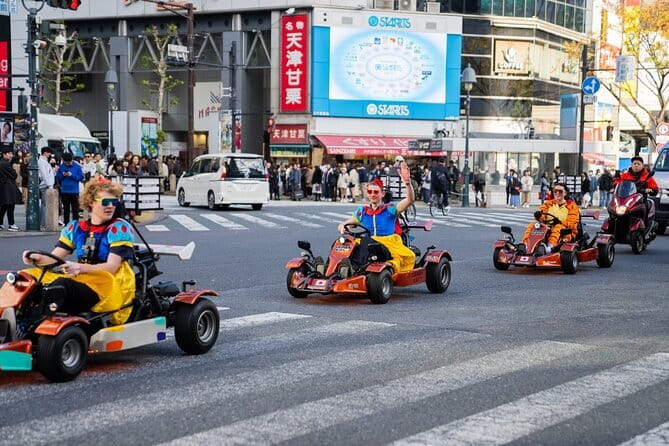
The route continues toward Omotesando, a polished shopping district lined with upscale stores and notable architecture. You may see expensive cars passing as you cruise along. This is a place where the go-kart itself becomes part of the scene. You are not blending in with normal traffic, and people may look over, wave, or take photographs.
Harajuku brings a different mood. It is associated with youth fashion, unusual clothing, and Tokyo’s playful side. You will pass through rather than stop for shopping or street food, but the street-level view lets you take in the storefronts and fashion quickly.
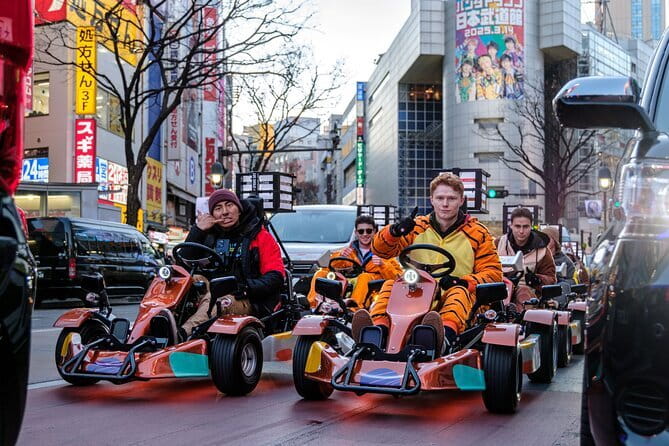
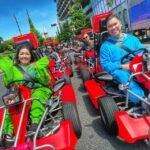
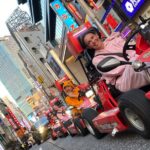
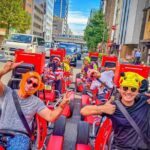
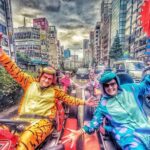
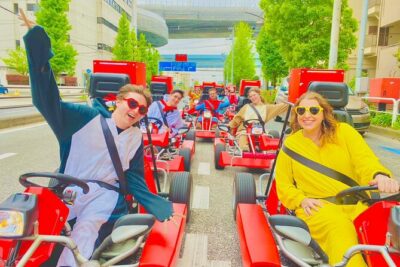
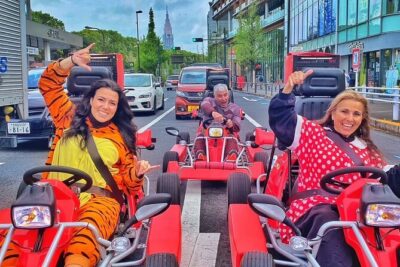
The ride can feel a little theatrical here. Some riders choose to wear costumes or onesies, and the company’s karts and clothing help create a playful look. Costumes are not the reason to book the experience, but they add to the public reaction and make the photos more memorable.
Shibuya Crossing is the headline moment
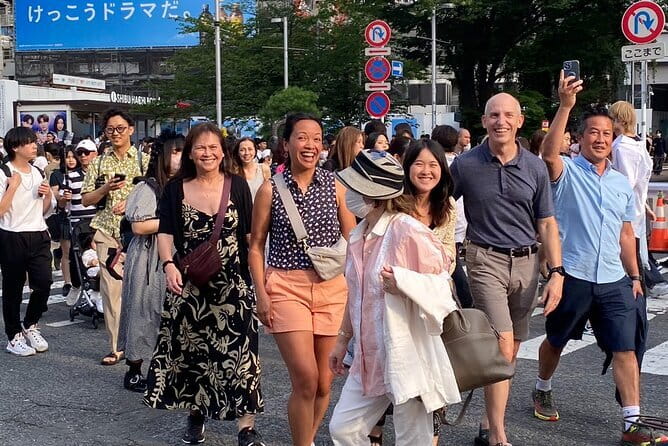
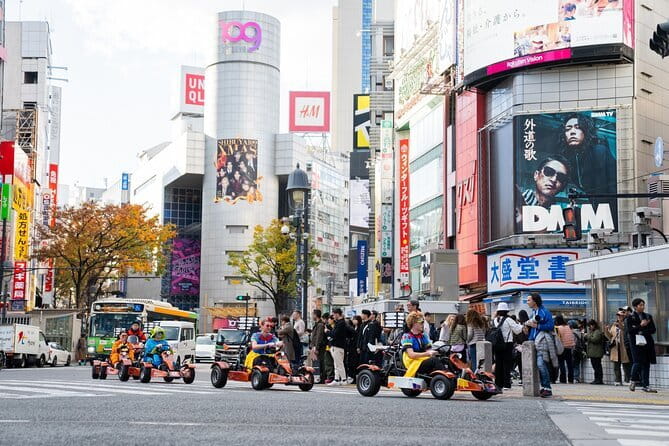
Shibuya Scramble Crossing is the part most people picture when they consider this tour. At the traffic lights, you wait with the other vehicles, then move through the crossing as thousands of pedestrians cross in every direction.
Driving across it gives you a very different view from the usual one on the pavement or from an elevated observation point. You see the traffic signals, the buildings, the crowds, and the famous intersection at eye level. Several outings have crossed the scramble twice, although the exact route and traffic conditions can vary.
Do not expect to stop in the middle of the crossing for photographs. The value is in passing through with the convoy while the city carries on around you. It is exciting, but you need to keep your attention on the road and the guide.
This is also where the experience can feel most exposed. You are low to the ground, surrounded by traffic, and highly visible to pedestrians. If you dislike attention, this may be uncomfortable. If you enjoy a little public spectacle, it can be the tour’s best moment.
A few more Tokyo tours and experiences worth a look

Yoyogi Park and Meiji Jingu’s neighborhood
Yoyogi Park is another green stretch along the route. It has lawns, ponds, and wooded areas, and it sits beside the famous Meiji Jingu shrine. Again, you pass by rather than tour the park or shrine.
That limitation is worth keeping clear. The go-kart is a moving viewpoint, not a substitute for a walking tour of Meiji Jingu. Still, seeing Yoyogi Park after Harajuku and Shibuya helps you understand how quickly Tokyo shifts from dense commercial streets to open public spaces.
Shinjuku’s skyline and Kabukicho
The Tokyo Metropolitan Government Building is another landmark you pass in Shinjuku. Its free observation decks are known for wide city views, but this activity does not include time to go inside or ride up to the decks.
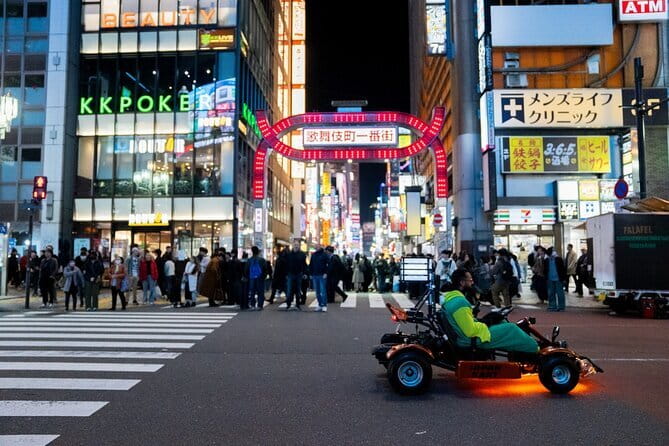
You will also pass Kabukicho, Shinjuku’s famous entertainment district. Its streets are packed with restaurants, nightclubs, shops, host and hostess clubs, and love hotels. In the evening, the signs and storefronts create a dramatic urban scene, though the go-kart route gives you only a moving glimpse.
Kabukicho is best understood as a district to observe, not a place this tour explores on foot. If you want a detailed look at its bars, restaurants, or nightlife, plan a separate visit. The kart ride gives you the quick, colorful version.
Safety, support vehicles, and the first ten minutes
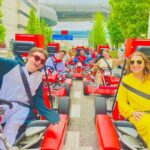
The staff’s road management is one of the strongest reasons to choose a guided operation rather than trying to navigate alone. The lead vehicle sets the pace, the rear vehicle helps protect the group from following traffic, and a motorcycle may assist with lane changes and keeping the convoy together.
That support does not remove all risk. You are still operating a motorized kart on public streets. You need to obey the guide, avoid sudden moves, and stay alert around intersections. The staff give instructions before departure, and riders have described the explanations as clear, patient, and thorough.
Expect a short adjustment period. The kart feels different from a normal car, and the low seating position makes surrounding traffic seem larger. After 5 to 10 minutes, many people find the controls easier to manage. The tour is best for someone comfortable following directions and handling a vehicle in city traffic.
The karts are open and close to the road. One practical tip is to consider wearing a mask, since you may notice exhaust fumes more than you would inside a car. This is especially relevant during slow traffic or at crowded intersections.
Wear practical clothing. Long skirts, high heels, and sandals are not permitted. Alcohol consumption before the tour is prohibited. These rules are basic, but they matter when you are climbing into a small open kart and driving for a substantial portion of two hours.
Photos, videos, and the value of the experience
Staff take photographs and videos at points along the route, including individual shots and group images. The files may be shared through Google Drive within about 12 hours. This adds real value because stopping to photograph yourself while driving is not practical.
The photos also capture something that ordinary Tokyo sightseeing does not: you in the middle of the city scene. Bystanders may wave or stare, and the novelty of the karts often makes riders feel briefly famous. That reaction is part of the fun, though it also means you should be ready for attention.
At $125.53 per person, this is not cheap transportation. You could cover the same districts by train for a fraction of the cost. The price makes more sense if you value the driving itself, the guide support, the photo package, and the chance to experience Shibuya and Shinjuku from the road.
The roughly two-hour duration helps the price feel more reasonable. You are not paying for a five-minute amusement ride. Some riders report more than an hour of actual driving, with the rest used for preparation, instructions, regrouping, and safe stops. Still, the route is not a full-day tour, and you will not receive extended visits inside the parks or at the city landmarks.
With a 97 percent recommendation rate and a 4.9 rating from 92 reviews, the experience has performed strongly overall. The low ratings point to a serious issue rather than a minor complaint: document misunderstandings and difficulty finding the branch can result in a wasted booking. Read the driving requirements carefully before paying.
Who should book this experience?
You are a good match if you want a playful, unusual way to see Tokyo and are comfortable driving in traffic. It suits couples, friends, solo visitors, and families with eligible adult drivers. Solo riders can join the group, and the small convoy provides structure without requiring you to organize the route yourself.
It is especially appealing if you have already seen Tokyo’s major sights from trains and sidewalks and want something more active. An evening departure may suit you if you want illuminated streets and a stronger sense of Tokyo after dark.
You should think twice if you are anxious behind the wheel, dislike crowds watching you, or want a quiet sightseeing experience. You should also skip it if you cannot obtain the exact driving documents required by Japan.
The tour is not a replacement for visiting Shinjuku Gyoen, Meiji Jingu, the Tokyo Metropolitan Government Building observation decks, or Shibuya on foot. Think of it as a fast-moving sampler with a strong entertainment angle.
Booking, weather, and cancellation details
The experience runs only in suitable weather. If bad weather causes a cancellation, you can receive a full refund or reschedule, depending on availability.
You can cancel for a full refund up to 24 hours before the start time. Cancellations or changes made within 24 hours are not accepted for a refund. Because the karts are mechanical vehicles, the operator may need to adjust bookings when the maximum number of reservations is reached and kart availability changes.
The tour ends back at the Shinjuku meeting point. That makes it easy to continue into Shinjuku afterward, though you should allow time to collect your belongings and receive any shared photo files later.
Should you book JAPANKART?
Book it if you want an active Tokyo memory rather than a standard sightseeing route. The combination of Shibuya Crossing, the guide-led convoy, photo support, and districts such as Harajuku and Kabukicho gives you a memorable two hours.
I would not book it casually without checking the paperwork first. The IDP rules are strict, and the wrong permit can end the experience before it starts. Arrive early, wear sensible shoes and clothing, watch the safety video, and expect a few nervous minutes at the beginning.
For the right person, $125.53 buys more than a ride. It buys a fast, funny, highly visible way to experience Tokyo from the road. Just remember that the city is the setting, and driving safely is the main activity.
FAQ
How long does the Tokyo go-kart experience last?
The activity lasts approximately two hours. The actual driving portion may last more than an hour, with additional time used for preparation, instructions, regrouping, and stops.
Where does the tour begin and end?
It begins at the JAPANKART Shinjuku Branch in Shinjuku City, Tokyo, at 5-chome Shinjuku, on the third floor. The activity ends back at the same meeting point.
What documents do I need?
You must bring your passport, your driving license from your home country, and an International Driving Permit issued under the 1949 Geneva Convention. The IDP must be an official booklet, not a paper or A4 version.
Are 1968 Vienna Convention permits accepted?
No. International Driving Permits issued under the 1968 Vienna Convention are not accepted in Japan for this activity.
Are there exceptions to the standard IDP requirement?
Yes. Participants with licenses issued in Switzerland, Germany, France, Taiwan, Belgium, or Monaco need their original driving license and a Japanese translation issued by the Japan Automobile Federation, or JAF.
What should I wear?
Do not wear long skirts, high heels, or sandals. Alcohol consumption before the tour is prohibited. Practical clothing and secure footwear are the sensible choice.
What happens if bad weather cancels the tour?
You can receive a full refund or request a different date, depending on availability. For personal cancellations, you must cancel at least 24 hours before the start time to receive a full refund.
More Go-Kart Tours in Tokyo
More Shibuya Tours in Tokyo
More Shinjuku Tours in Tokyo

More tours in Tokyo we've reviewed

Go-Karts, compared.
 ★ 5.0Flagship 2-Hours Official Street Go-Kart Tour – Tokyo Bay ShopFrom $642 hours to 2 hours 30 minutes (approx.)
 ★ 5.0Official Street Go-Kart in ShibuyaFrom $76
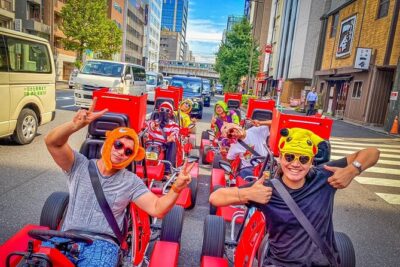 ★ 5.0Official Street Go-Kart Tour – AkihabaraFrom $61
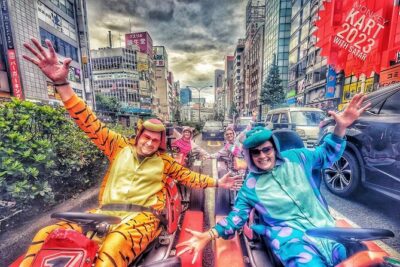 ★ 5.0Tokyo Go Kart: Asakusa, Skytree, and Akihabara **IDP MUST**From $99
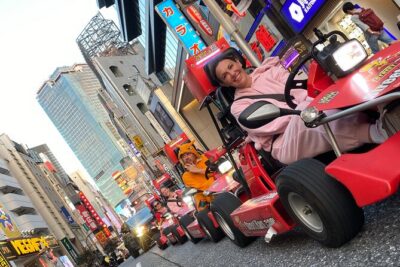 ★ 5.0Shibuya Official Street Go-Kart in Shibuya AnnexFrom $69
 ★ 4.7Tokyo: Asakusa, Skytree & Akhihabara Go-Kart City ExperienceFrom $961h 10m