
Reviewed · SAMURAI & NINJA EXPERIENCES
Samurai sword cutting experience
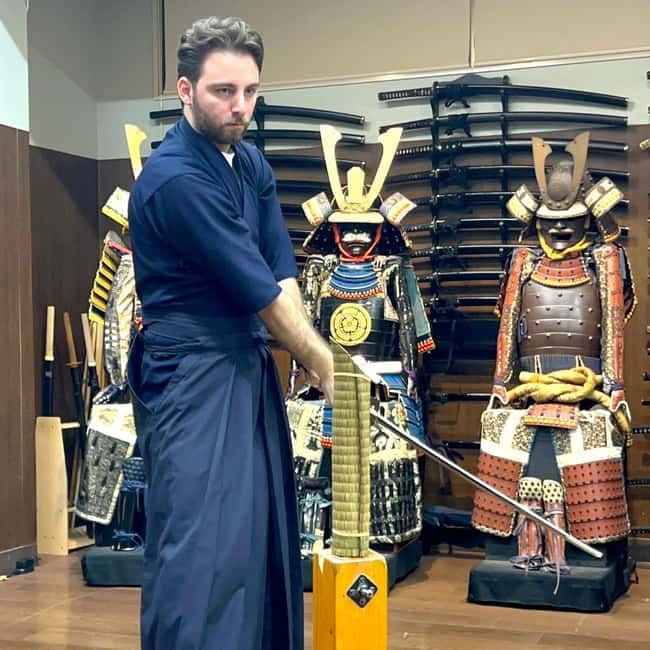
A real Japanese sword, some more than 100 years old, is the star here. You change into traditional iaido clothing, learn the basics from a Battoushi Do teacher, and make two cuts through rolled tatami under close instruction.
I like the clear progression from greeting and meditation to sword practice and cutting. I also like the chance to see old armor and record photos or video of your own turn. The main limitation is that this is a focused, physical activity for ages 14 and up, not a casual museum visit.
In This Review
- Key points to know before you book
- Starting at Samurai Theater Tokyo
- The first step is changing into iaido clothing
- Greetings and meditation set the tone
- Understanding the Japanese sword before using it
- Practice the swing before the tatami
- Watch the Battoushi Do teacher cut first
- Your two cuts through rolled tatami
- Armor, old swords, and the visual setting
- Photos and video of your own cutting turn
- A formal close after the action
- Is $93 a fair price?
- Who should book this sword session?
- Should you book the Samurai sword cutting experience?
- FAQ
- Where does the samurai sword cutting experience start and end?
- What languages are available?
- Can I use a real Japanese sword?
- How many times do I cut the tatami?
- Is photography or video included?
- Who cannot take part?
Key points to know before you book
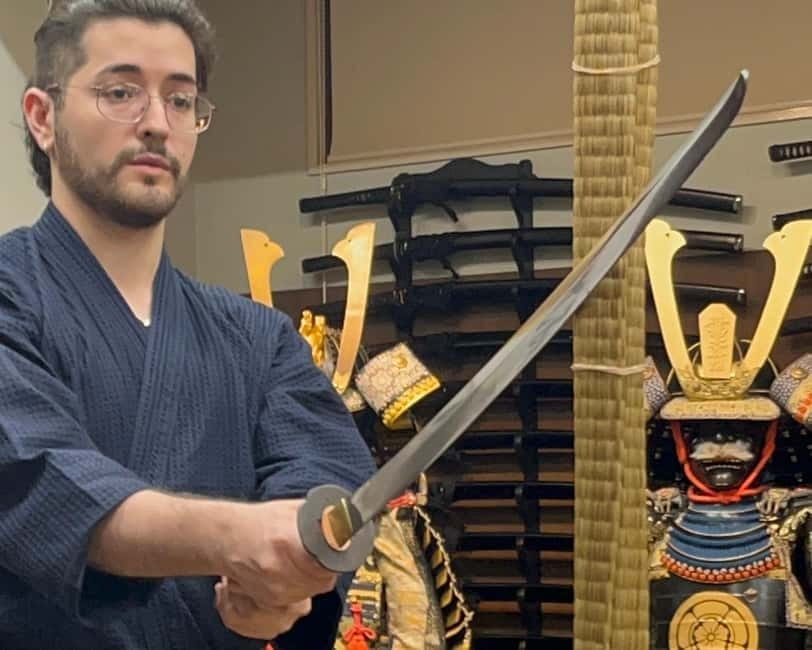
- Cut rolled tatami twice with a real Japanese sword, after practicing with an imitation blade and following the teacher’s instructions.
- Begin in traditional iaido clothing, which helps make the session feel like a formal martial arts lesson rather than a quick photo stop.
- Start with greetings and mental preparation, including meditation and a moment of unity before handling the sword.
- Learn from a Battoushi Do teacher, who explains the sword, demonstrates the cutting method, and watches your turn.
- See Japanese armor and old swords, adding useful visual context to the hands-on lesson.
- Record the moment, since photography and video are included if you wish.
Starting at Samurai Theater Tokyo
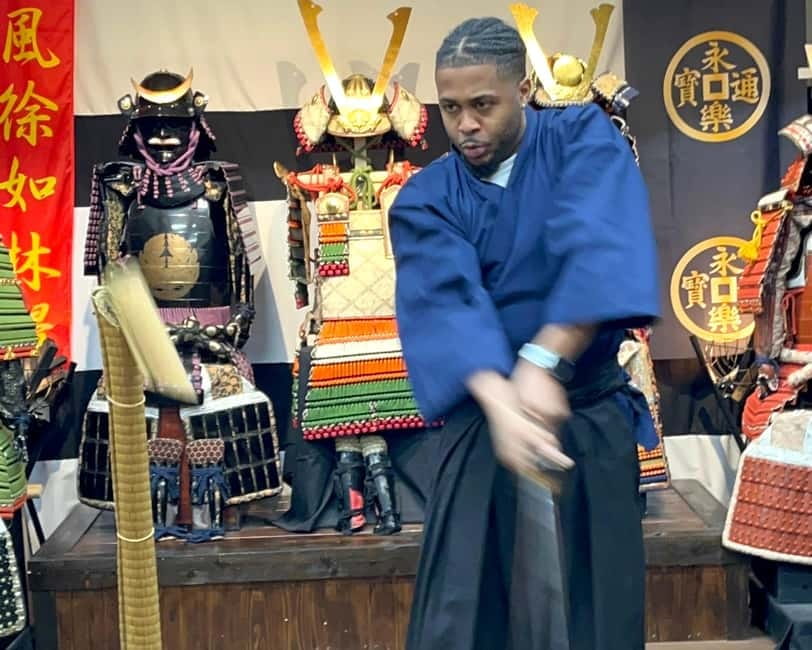
You meet at Samurai Theater Tokyo in Tokyo, on Honshu. The directions ask you to search for Samurai Theater Tokyo on Google Maps, so I would do that before leaving your hotel and save the location. The activity ends back at the same meeting point.
The setting matters because the session is built around a formal martial arts atmosphere. You are not simply handed a sword and told to swing. You change into traditional iai clothing, greet the teacher, and prepare your mind before the practical work begins.
English and Japanese are available. That is useful during a lesson where timing, grip, stance, and safety all matter. If you do not speak Japanese, English instruction gives you a clear way to follow the sequence, while the Japanese setting still gives the session its local character.
No duration or group size is provided, so I would not plan another tightly timed activity immediately afterward. Allow yourself breathing room before and after the appointment.
A few more Tokyo tours and experiences worth a look


The first step is changing into iaido clothing
The session begins with a change into traditional iaido clothing. This is more than a costume photograph, though you can certainly take pictures during the activity if you wish. The clothing signals that you are entering a formal practice, with attention paid to posture, greetings, and controlled movement.
I like this start because it gives the activity a sense of purpose. You are not rushing straight to the cutting target. Instead, the clothing and opening rituals help you shift from sightseeing mode into training mode.
The outfit may also affect comfort and movement. You should expect to stand, bend, and swing your arms, so wear something that works well beneath practice clothing. The activity does not provide a duration, but the structure clearly includes several stages before the final cut.
Greetings and meditation set the tone
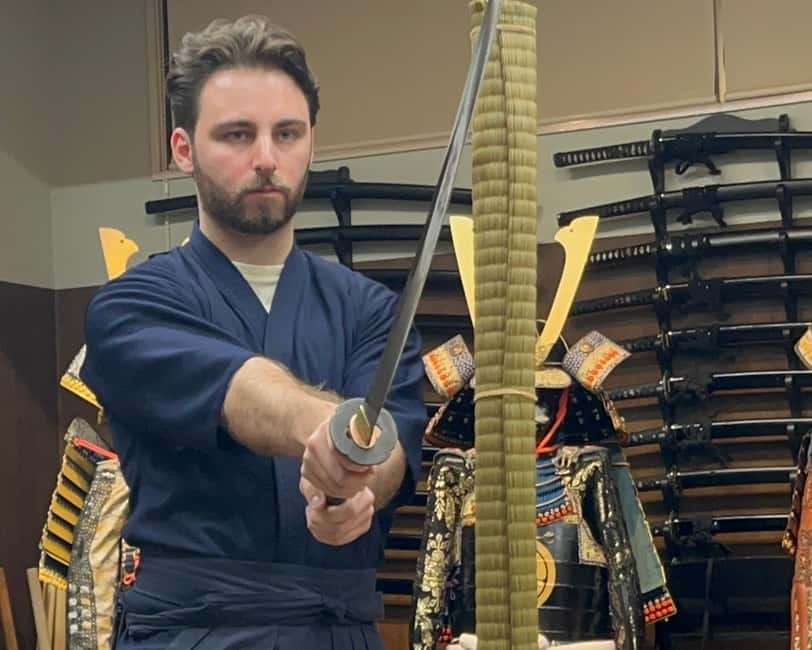
After changing, you take part in greetings and mental unification. Meditation is included as part of this opening and appears again later, before the final closing greetings.
For a first-time participant, this may be one of the more valuable parts of the session. Iaido is not presented as a simple strength test. The emphasis is on composure, attention, and acting at the right time. That short pause before handling a blade helps explain why the activity includes formal greetings rather than treating the sword as a prop.
Some people will enjoy this serious tone. Others may find it more ceremonial than expected. If you want a quick action photo and nothing else, the meditation and formal opening may feel slow. If you want a better sense of the discipline behind samurai sword practice, it gives the cutting a useful frame.
Understanding the Japanese sword before using it
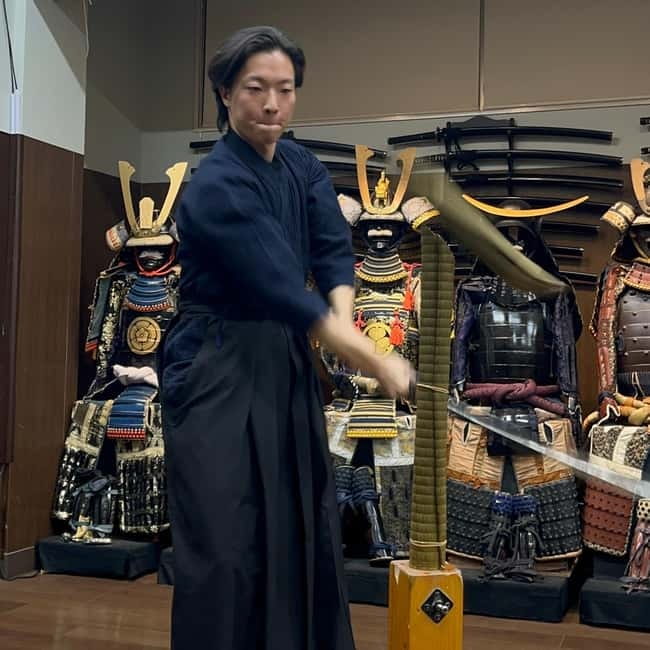
The teacher explains the Japanese sword before you begin practical work. This is important because the sword is not treated as an ordinary training object. Some of the real Japanese swords available during the session are more than 100 years old.
The explanation gives you a chance to understand what you are handling before you attempt a cut. I would pay close attention here, even if your main goal is the photograph. A sword’s age and craftsmanship are part of the value of this activity, and careless handling would undermine the whole point of the lesson.
You also use an imitation sword as part of the included equipment. That creates a sensible distinction between learning movement and handling a real blade. The practical sequence lets you begin with instruction and practice before moving on to the actual tatami cut.
Practice the swing before the tatami
You first practice swinging the sword. The activity includes both a practice sword and an imitation sword, allowing the teacher to show you the basic movement before you cut anything.
This stage is where the teacher’s guidance matters most. A novice may focus only on force, but the session is designed around following instructions and controlling the motion. You will want to listen carefully to the teacher’s advice on how to stand, how to swing, and when to act.
The instructions do not describe a long martial arts course, so you should not expect to leave with mastery of iaido. Think of it as a compact introduction with one clear practical goal: making a controlled cut through rolled tatami.
The practice also helps reduce nerves. Real swords can feel intimidating, especially when you know some are over a century old. Working first with a training blade gives you a safer point of entry.





Watch the Battoushi Do teacher cut first
Before your turn, the teacher demonstrates the cutting technique. This demonstration is one of the strongest parts of the format because you get to see the movement before trying to copy it.
The teacher is described as a real Battoushi Do instructor. That gives the lesson a more formal basis than a themed photo session led only by an actor. You can watch the timing, the direction of the cut, and the way the sword is handled, then apply those instructions to your own attempt.
You should not expect to improvise. The activity specifically directs you to follow the teacher’s instructions when cutting the tatami. That is good news for beginners, since you do not need previous sword experience to take part, though the supplied information does not claim any particular level of prior training.
The demonstration also provides a useful comparison. Your cut does not need to look like the teacher’s performance. The point is to make a safe, guided attempt and understand the discipline behind the motion.
Your two cuts through rolled tatami
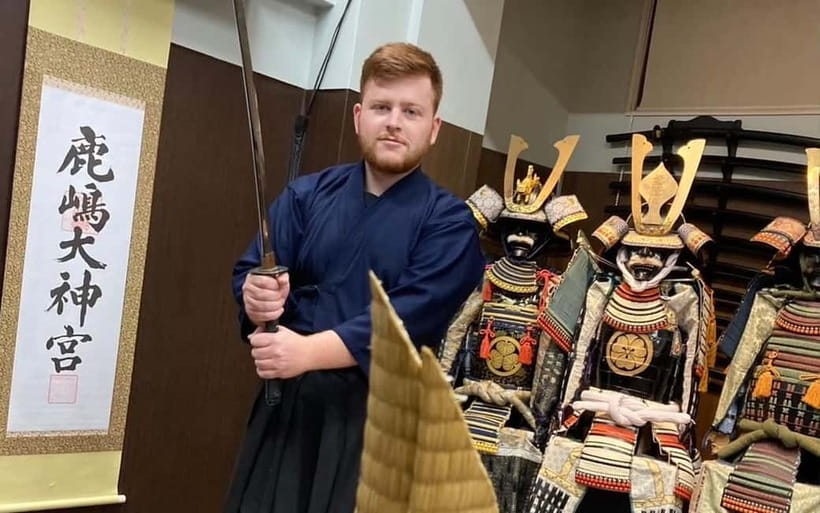
The central task is cutting rolled tatami twice. You follow the teacher’s instructions for the first cut, then cut the tatami a second time at the timing you choose.
That change in timing gives you a small measure of control. The first attempt is closely directed, while the second lets you act when you feel ready. It is a simple structure, but it helps you move from imitation to participation.
You should approach the cut with concentration rather than brute force. The activity builds toward this moment through clothing, greetings, meditation, explanation, practice, and demonstration. Each step prepares you to make the most of two attempts.
The number of cuts is also worth considering when judging the $93 price. You are not paying for repeated target practice over a long afternoon. You are paying for a structured cultural activity that includes instruction, traditional clothing, sword explanation, practice equipment, a teacher demonstration, real sword access, tatami targets, and the formal setting around the cut.
That makes the price easier to justify for someone who values instruction and atmosphere. If you only want to swing a sword many times, the two-cut limit may feel modest.
Armor, old swords, and the visual setting
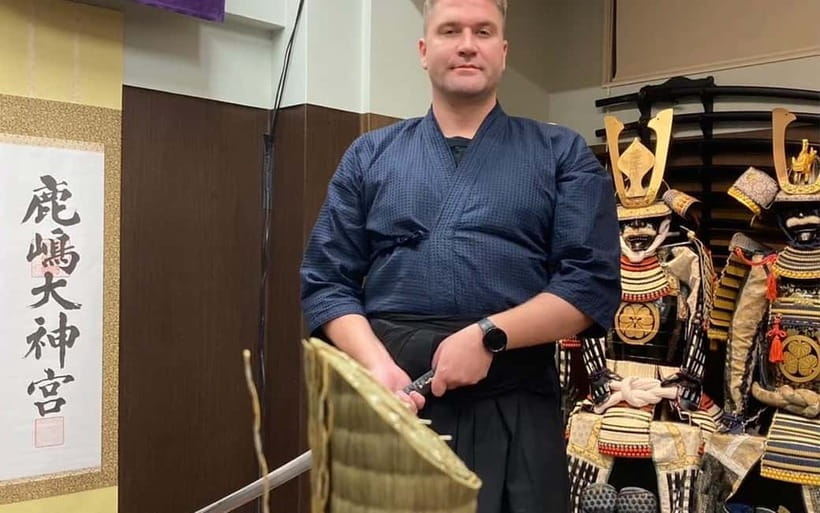
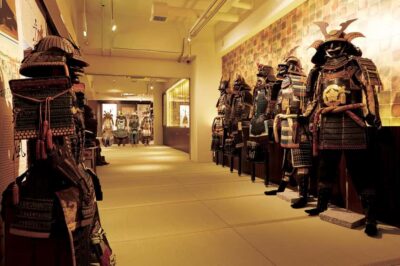
Armor is displayed during the activity, giving you more to look at than the cutting target alone. The display helps you connect the practice to the wider samurai world without turning the session into a full museum tour.
I would take time to examine the armor between the practical stages. The old equipment gives scale and texture to what you are learning. You are seeing objects associated with the age of the samurai while being taught how to handle a Japanese sword in a formal setting.
The supplied details do not identify individual pieces of armor or provide a full collection history, so I would not book this expecting an extensive historical exhibition. Still, the display adds useful context and makes the photographs more interesting than a plain studio backdrop.
Photos and video of your own cutting turn
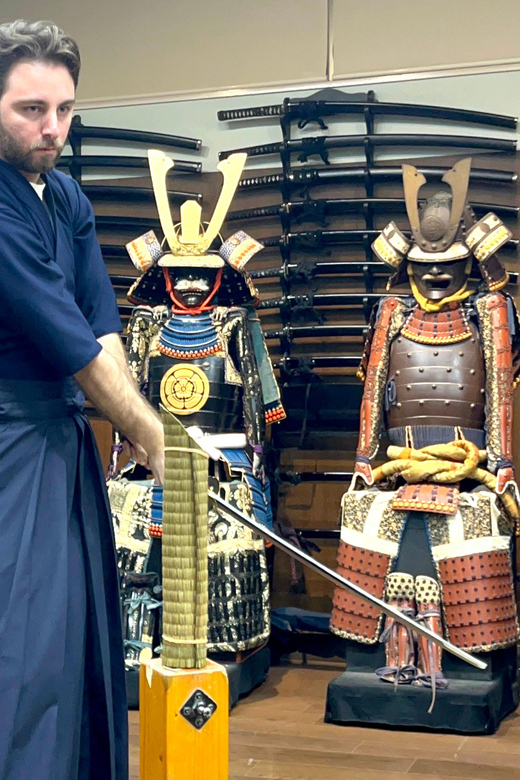
Photography and video recording are included if you wish. That is a practical benefit, since it can be hard to capture a sword cut while also concentrating on the teacher’s directions.
You can take pictures and videos of yourself cutting the tatami, then watch the teacher’s performance as part of the later program. The chance to keep a record makes the session more useful as a special-occasion activity, especially if you are visiting Tokyo with family or friends who want a memorable visual souvenir.
The activity also ends with a commemorative photo. I would treat this as a bonus rather than the main reason to book. The better value comes from having a guided turn with the sword, then being able to document it afterward.
Ask the teacher questions if you have them. The schedule includes time for questions, so you can use that opportunity to clarify the sword, the cutting method, or the practice you have just completed. The available information does not promise a long lecture, but the question period gives the session a more personal finish.
A formal close after the action
The activity returns to greetings and mental unification after the cutting and performance. That closing ritual gives the session a neat shape. You begin by preparing your mind, complete the practical work, and finish with another formal pause.
I like this balance. The sword cutting is the part most people will remember, but the opening and closing keep it connected to iaido practice rather than reducing it to a staged stunt.
You then take a commemorative photo and can ask final questions. Since the activity ends back at the meeting point, you do not need to arrange a separate return transfer.
Is $93 a fair price?
At $93 per person, this is not the cheapest Tokyo photo activity. The value depends on what you want from the outing.
The fee includes the instructor, sword explanation, practice, practice clothing, practice sword, imitation sword, teacher demonstration, rolled tatami, real sword access, and photography and video recording. You also get the formal greetings and meditation, the armor display, the two cutting attempts, and a commemorative photo.
I see the price as fair for a one-time cultural activity with specialist instruction and real equipment. The swords are not simply plastic props, and the session is not built around a single photo. You receive a step-by-step lesson before handling the real blade.
The value is weaker if you want a long class or a large number of cuts. No duration is given, and the format specifically centers on two tatami cuts. I would compare it with other Tokyo activities based on what matters most to you: authentic-feeling instruction, the age of the swords, a formal atmosphere, and a keepsake video, rather than minutes of activity.
Three existing ratings give the activity a perfect five-star average, with praise focused on clear explanation and the unusual nature of the session. One short French comment calls it a highly recommended, unique activity, while another describes it as a treat worth doing. Those reactions fit the strongest practical point here: the session is easy to understand, unusual, and tightly organized around a moment you cannot recreate at home.
Who should book this sword session?
I would recommend it to adults and teenagers aged 14 or older who are interested in Japanese martial arts, samurai culture, historic weapons, or unusual Tokyo activities. It also suits you if you want something more hands-on than looking at armor behind glass.
It is a good match for a visitor who enjoys formal rituals and careful instruction. The meditation, greetings, and mental preparation are not filler. They are part of what gives the sword cutting meaning.
I would be cautious if you want a relaxed, seated activity. Pregnant women should not book, and the activity is not suitable for wheelchair users or people with visual impairments. Children under 14 are not allowed.
The available information does not list a duration, group size, or transportation service. I would confirm any timing questions before booking and leave enough time around the appointment.
Should you book the Samurai sword cutting experience?
Book it if you want a compact, guided introduction to iaido with real Japanese swords, traditional clothing, and two chances to cut rolled tatami. The Battoushi Do teacher, formal opening and closing, armor display, and included photos give it more substance than a quick sword-themed photo opportunity.
Skip it if you want an extended martial arts course, many practice cuts, or a museum visit with detailed historical interpretation. At $93, the activity makes the most sense when you value the full ritual and instruction, not just the final swing.
You can reserve now and pay later, and cancellation is free up to 24 hours in advance. That gives you some flexibility while planning your Tokyo schedule.
FAQ
Where does the samurai sword cutting experience start and end?
It starts at Samurai Theater Tokyo in Tokyo and ends back at the same meeting point. Search for Samurai Theater Tokyo on Google Maps to find the meeting location.
What languages are available?
Instruction is available in English and Japanese.
Can I use a real Japanese sword?
Yes. The activity includes access to a real Japanese sword, and some of the swords are more than 100 years old. You first practice with training equipment before making the tatami cuts.
How many times do I cut the tatami?
You cut the rolled tatami twice. The first cut follows the teacher’s instructions, and the second is made at the timing you choose.
Is photography or video included?
Yes. You may take photos and videos of yourself cutting the tatami, and a commemorative photo is also included.
Who cannot take part?
The activity is not suitable for children under 14, pregnant women, wheelchair users, or people with visual impairments.
More Samurai & Ninja Experiences in Tokyo
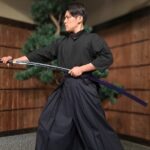
More tours in Tokyo we've reviewed








Samurai & Ninja Experiences, compared.
 ★ 4.5Tokyo: Samurai Restaurant Show Ticket with 2 DrinksFrom $551h 30m
 ★ 4.6Tokyo: Samurai Ninja Museum Guided tour and ExperienceFrom $27
 ★ 5.0Tokyo: Samurai Sword & Archery Class from Samurai DescendantFrom $1933 hours
 ★ 5.0Best Samurai Experience in TokyoFrom $65
 ★ 5.0Ninja Experience (Family Friendly) at Samurai Ninja Museum TOKYOFrom $47
 ★ 4.6Tokyo: Samurai Entertainment Night Show in Kanda ShrineFrom $412 - 3 hours