
Reviewed · ASAKUSA TOURS
Explore Asakusa’s historic landmarks
Asakusa’s best sights are packed into a walkable pocket of old Tokyo, and this tour connects the famous stops with the local streets that give the district its character. You’ll pass beneath Kaminarimon Gate, learn how to behave at Senso-ji, and finish around Hoppy Street, where post-war Tokyo still feels close at hand.
I like the small group limit of eight and the way guides such as Sachi, Andy, Kayoko, Sunny, and Yoshiko have helped visitors with prayers, fortunes, photos, food ideas, and souvenir shopping. I also like the optional sushi class, which adds a hands-on hour to the basic 1.5-hour walk. The main consideration is pace: the tour covers several stops in a short time, and Hoppy Street is seen rather than experienced as a full food crawl.
In This Review
- Key points at a glance
- Why this Asakusa walk works well
- Kaminarimon Gate: Tokyo’s great red welcome
- Nakamise-dori: snacks, souvenirs, and useful shopping advice
- Senso-ji: learn the customs, not just the photo angle
- Hanayashikidori: old Tokyo near Japan’s oldest amusement park
- Hoppy Street: a taste of local pub culture
- What the small group adds
- The sushi-making option: worth adding?
- Is $35 good value in Tokyo?
- Who should book this walk?
- Practical details before you reserve
- Should you book Explore Asakusa’s historic landmarks?
- FAQ
- How long does the Asakusa tour last?
- Where does the tour begin and end?
- What places are included in the walking tour?
- Is the sushi-making class included?
- How many people can join the tour?
- Can I cancel for a full refund?
Key points at a glance
- Kaminarimon and Senso-ji in one efficient walk: See Asakusa’s essential landmarks without spending half a day finding your way around.
- A small group capped at eight: You get a better chance to ask questions and request help with photos, prayers, or shopping.
- Practical temple guidance: Your guide explains how to worship at Senso-ji and how to get a fortune.
- A look beyond the postcard sights: Hanayashikidori and Hoppy Street add old neighborhood flavor to the major temple visit.
- Optional sushi-making class: Add one hour at either 12:30 to 13:30 or 15:30 to 16:30.
- Good first-day orientation: The walk can help you choose where to eat, shop, and return later on your own.
Why this Asakusa walk works well
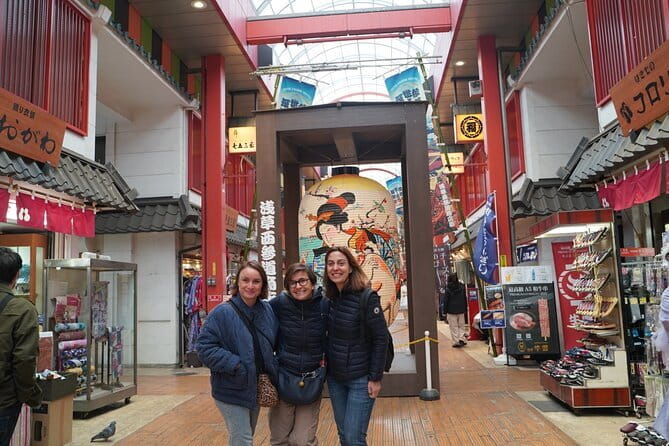
Asakusa can feel confusing on a first visit. The district mixes a major Buddhist temple, souvenir stalls, snack shops, old-style pubs, amusement-park nostalgia, and busy streets around the station. A guide gives those pieces an order and explains what you are looking at instead of leaving you with a quick photo and a name.
The basic walk lasts about 1.5 hours, though the full experience can run from 1.5 to 3.5 hours depending on the option you choose. That makes it easy to fit into a Tokyo schedule. You can take the walking tour alone, or add the one-hour sushi lesson if you want a more active finish.
I see this as an orientation tour rather than a grand historical lecture. You will not spend a long time inside every site. Instead, you move from one important point to the next while your guide fills in the meaning, customs, and small local details that are hard to pick up on your own.
The meeting point is the Asakusa Culture Tourist Information Center at 2-chōme-18-9 Kaminarimon. The activity returns there at the end, which is useful if you need to continue by train or want to retrace the route independently.
A few more Tokyo tours and experiences worth a look


Kaminarimon Gate: Tokyo’s great red welcome
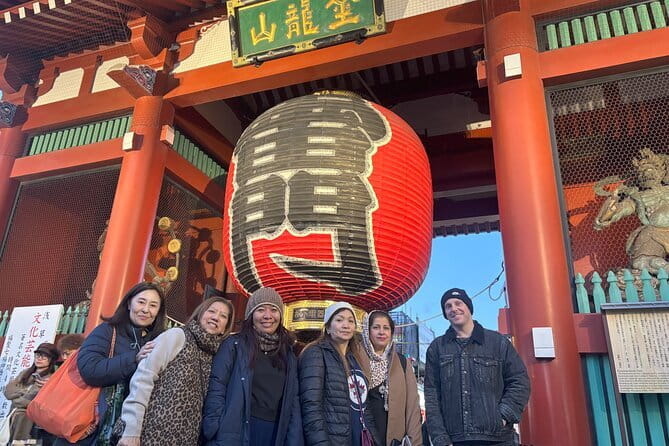
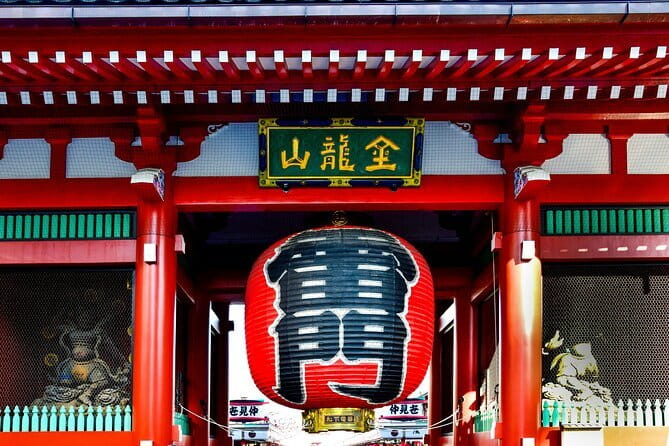
The tour begins at Kaminarimon, or Thunder Gate, the instantly recognizable entrance to Senso-ji. Its huge red lantern makes it one of the easiest photo stops in Tokyo, but the gate has more going on than its dramatic appearance.
Look to either side for the statues of Fujin and Raijin, the gods of wind and thunder. A guide can give you the basic story and explain why the gate carries such weight as an entrance to the temple grounds. That context matters, since the gate is not simply a decorative arch placed in front of a shopping street.
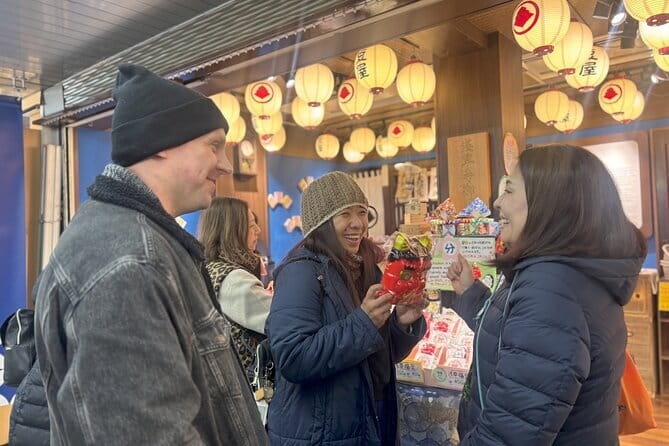
You should expect other people around the lantern, especially at popular times. The guide’s help with photos is a practical benefit here. One of the strongest themes in the guide feedback is personal attention, including help taking pictures and answering questions without rushing through the stop.
The gate itself is free to visit. You do not need a separate admission ticket for the walking route.
Nakamise-dori: snacks, souvenirs, and useful shopping advice
From Kaminarimon, you continue along Nakamise-dori, the straight shopping street leading toward Senso-ji. This is where the tour shifts from grand entrance to everyday browsing, with shops selling Japanese snacks, crafts, gifts, and traditional souvenirs.
The street is designed for browsing, but it can be easy to spend too much time looking at every display. A guide helps you understand what you are seeing and can point out the purpose or meaning of certain souvenir items. Yoshiko, for example, was praised for explaining the background and use of Japanese souvenirs, not simply naming them.
Andy also helped direct a visitor toward specific shopping areas and recommended shops after the formal walk. That is a useful feature if you are hunting for gifts rather than just taking pictures. You may want to tell your guide early if shopping matters to you, since a short tour cannot cover every store.
Food is part of the appeal here. You will see traditional snacks and local treats, though the supplied details do not promise tastings or food purchases as part of the price. Plan to pay separately for anything you want to eat or take home.
Senso-ji: learn the customs, not just the photo angle
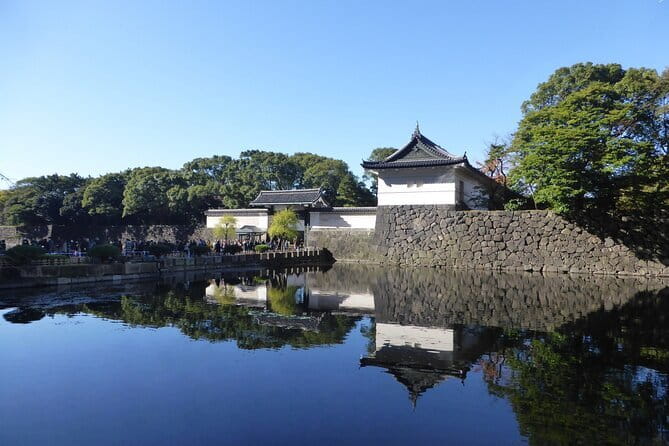
Senso-ji is Tokyo’s oldest temple and the central stop on the walk. It is dedicated to Kannon, the goddess of mercy, and draws people for both worship and sightseeing.
The useful part of visiting with a guide is the explanation of what to do. You can learn the proper way to pray and how to get a fortune, rather than copying the nearest person and hoping for the best. Kayoko was especially praised for showing visitors and a parent how to pray and receive fortunes correctly.
That guidance gives the temple visit more meaning. You can pause at the site with an idea of what the rituals represent, while still having time for photos and questions. Sachi was praised for answering questions about the shrine and temple and for being attentive throughout the experience.
The stop is scheduled for about 30 minutes. That is enough for an introduction, basic worship etiquette, and photographs. It is not enough for a quiet, detailed study of every building or religious object, so anyone seeking a long temple-focused visit should return later on their own.
The temple is free to enter. Keep in mind that this remains an active place of worship. Speak quietly around religious areas, follow your guide’s instructions, and treat the rituals as more than a performance for a camera.
Hanayashikidori: old Tokyo near Japan’s oldest amusement park
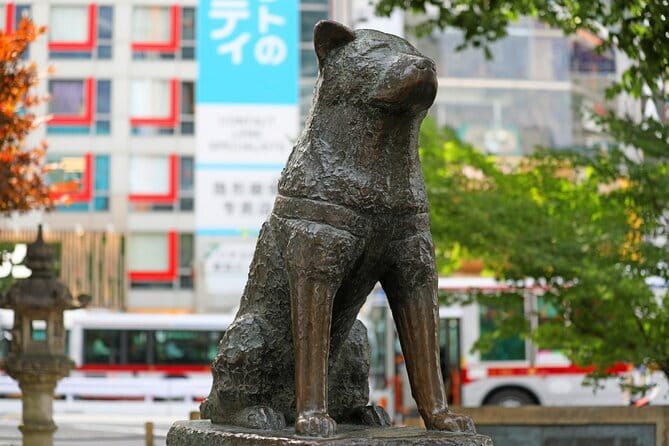
After Senso-ji, the route heads toward Hanayashikidori. The street takes its name from Hanayashiki, Japan’s oldest amusement park, which sits nearby. The area offers a different mood from the formal temple approach, with restaurants, cafés, shops, and traditional snacks.
This section is valuable because it shows Asakusa as a neighborhood rather than a single famous temple. You get a sense of how sightseeing, eating, shopping, and local entertainment overlap here. The street’s appeal is its nostalgic feel, though the tour does not include an amusement-park visit.
The scheduled time is about 20 minutes. Think of this as a guided look at the district and a chance to note places to return to later, not a full shopping or dining stop. If you spot a café or shop you like, remember its location, since the group will keep moving.
Other historical tours in Tokyo
Hoppy Street: a taste of local pub culture
Hoppy Street is the final major stop and one of the more distinctive parts of the route. It is lined with izakayas, or Japanese pubs, serving Hoppy, a local drink, along with foods such as yakitori and oden.
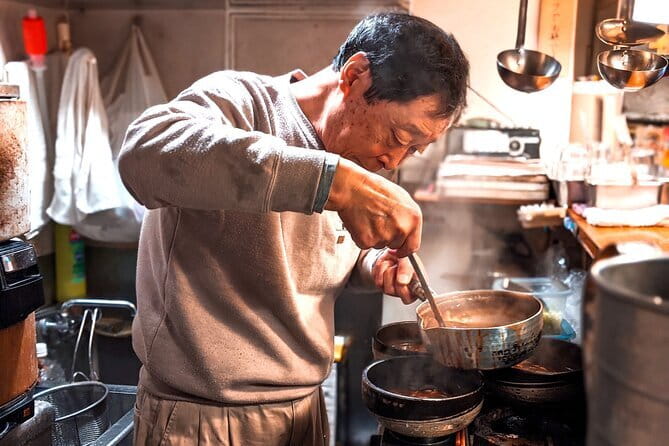
The street retains a post-war atmosphere that contrasts with the polished image many first-time visitors have of Tokyo. Your guide explains why local people have long enjoyed the area and gives you a little social context for the pubs and food. That makes Hoppy Street more interesting than a simple walk past restaurant signs.
The tour allocates about 20 minutes here. Food and drinks are not stated as included, so do not assume you will sit down for a full meal. You might find a place you want to return to after the tour, especially if you are curious about izakaya dining but would prefer to scout the area first.
This is also where the limits of the tour are clearest. Twenty minutes lets you see the street and hear its story, but it does not offer a long evening of ordering several dishes. I would treat it as an introduction and plan a separate meal if this is the part that interests you most.
What the small group adds
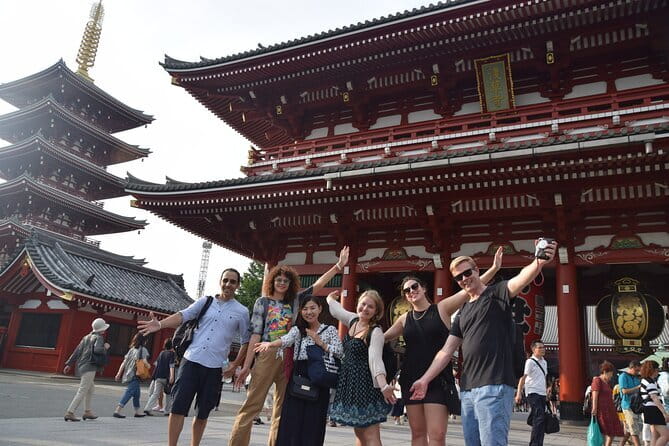
The maximum group size is eight people, a useful limit in narrow shopping streets and around busy temple gates. You are less likely to lose the guide in the crowd, and questions are easier to ask than they would be on a large coach-style walk.
The personal side of the guiding is one of the strongest reasons to book. Sachi helped with questions and made a special gift at the end of one experience. Andy offered shopping direction after the walk. Kayoko explained prayers and fortunes. Sunny was praised for combining temple information with suggestions for lunch, dinner, and dessert. Yoshiko helped with photos and souvenir explanations.
Those details show what you can reasonably hope to get from the format: not only a memorized route, but also help shaped around your interests. The exact guide is not guaranteed in the supplied information, so book this for the small-group format and local guidance rather than for one particular person.
The walk requires a moderate level of physical fitness. You will be on your feet and moving between several stops. Comfortable shoes will make the experience easier, especially if you plan to continue exploring afterward.
The sushi-making option: worth adding?
The sushi option adds a one-hour class after the 1.5-hour Asakusa walking tour. Available class times are 12:30 to 13:30 and 15:30 to 16:30.
This changes the experience from a sightseeing walk into a more hands-on half-day activity. If you want an activity that gives you something to do, not just something to see, the class is the natural add-on. It also gives your schedule a clear structure around lunch or midafternoon.
The basic tour may last about 1.5 hours, while the sushi choice can bring the total closer to 2.5 hours, depending on timing. The broader duration range listed for the activity reaches 3.5 hours, so check the exact option and start time when booking.
The available details do not explain the class menu, class size, dietary arrangements, or whether you eat what you make. I would choose it for the practical experience of making sushi, but confirm any food-related needs before paying for the add-on.
Is $35 good value in Tokyo?
At $35 per person, the walking tour is reasonably priced for a small-group introduction to one of Tokyo’s major districts. The temple, gate, shopping street, and neighborhood stops do not require admission fees, so you are paying for the guide’s time, explanations, route planning, and local help.
That value is strongest if Asakusa is new to you. A guide can show you how to pray, explain the fortune process, identify the main historical points, help with photos, and direct you toward useful shopping and food areas. Those small services save time and reduce the uncertainty that comes with a first visit.
The value is weaker if you already know Senso-ji and feel comfortable exploring independently. You can walk through the area without paying admission, and the route is not difficult to follow once you understand the layout. In that case, the tour earns its price only if you want cultural explanations or personal recommendations.
The sushi option should be judged separately. The supplied price is $35 per person for the experience, but it does not state the extra cost of the sushi choice. Check the total before booking so you can compare it with other cooking classes in Tokyo.
Who should book this walk?
I would recommend it most strongly to first-time Asakusa visitors who want the key sights explained in plain terms. Families and small groups may also appreciate the limited group size, photo help, and simple introduction to temple customs.
It suits you if you want a short activity at the start of a Tokyo stay. Afterward, you will know where Senso-ji, Nakamise-dori, Hanayashikidori, and Hoppy Street are located, making it easier to return for shopping or dinner.
It also fits people who enjoy asking questions. Guides including Sachi, Andy, Kayoko, Sunny, and Yoshiko have been praised for answering questions, explaining local culture, and adapting the experience to shopping or food interests.
I would be more cautious if you want a slow, scholarly temple tour, a long food tasting, or extensive free time in the shops. The route is compact and purposeful. Its job is to orient you, not to cover every corner of Asakusa.
Practical details before you reserve
Your mobile ticket is confirmed at booking, and the meeting point is the Asakusa Culture Tourist Information Center near Kaminarimon. The activity ends at the same point, so you can plan your next stop from there.
Public transportation is nearby. The tour requires moderate physical fitness, and you should expect to walk and stand for the duration. Admissions to the listed stops are free, while snacks, souvenirs, food, and drinks are not identified as included.
Free cancellation is available when you cancel at least 24 hours before the local start time. Changes or cancellations made within 24 hours are not accepted for a refund.
The experience receives a perfect rating from the seven ratings supplied, with repeated praise for guide friendliness, temple explanations, prayer instruction, photo help, and shopping advice. I would put the greatest weight on those practical strengths, since they are exactly what make a short Asakusa walk useful.
Should you book Explore Asakusa’s historic landmarks?
Book it if you want a friendly first look at Asakusa, clear help with Senso-ji customs, and a small group rather than a large guided crowd. The route covers the district’s essential landmarks and adds Hanayashikidori and Hoppy Street, giving you more than a quick temple photo stop.
Choose the sushi option if you want a hands-on activity and have room for an extra hour in your schedule. Skip the tour if you already know Asakusa well or prefer to spend your time eating and shopping at your own pace.
For most first-time visitors, $35 is a fair price for getting oriented, learning what you are seeing, and leaving with a short list of places to revisit. The tour is short, focused, and practical, which is exactly why it works.
FAQ
How long does the Asakusa tour last?
The experience lasts approximately 1 hour 30 minutes to 3 hours 30 minutes. The standard Asakusa walking tour lasts about 1.5 hours, while the optional sushi-making class adds one hour.
Where does the tour begin and end?
It begins at the Asakusa Culture Tourist Information Center, 2-chōme-18-9 Kaminarimon, Taito City, Tokyo. The activity ends back at the meeting point.
What places are included in the walking tour?
The route includes Kaminarimon Gate, Nakamise Shopping Street, Senso-ji Temple, Hanayashikidori, and Hoppy Street.
Is the sushi-making class included?
The sushi class is an optional add-on. It lasts one hour and is offered from 12:30 to 13:30 or from 15:30 to 16:30.
How many people can join the tour?
The group can include a maximum of eight people.
Can I cancel for a full refund?
Yes. You can cancel for a full refund up to 24 hours before the experience start time. Cancellations or changes made less than 24 hours before the start time are not accepted for a refund.
More Historical Tours in Tokyo
More Asakusa Tours in Tokyo

More tours in Tokyo we've reviewed











Asakusa Tours, compared.
 ★ 4.8Tokyo: Japanese Dance Cabaret Theater Asakusa-Kaguwa TicketFrom $492 hours
 ★ 4.7Tokyo: Meiji Shrine, Asakusa, Skytree Bus Tour and CruiseFrom $12210 hours
 ★ 4.9Tokyo: Roll and Authentic Sushi Making Class in AsakusaFrom $581h 40m
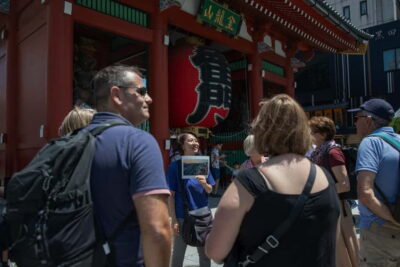 ★ 4.8Tokyo: Asakusa Walking Tour with Sensoji Temple VisitFrom $222 hours
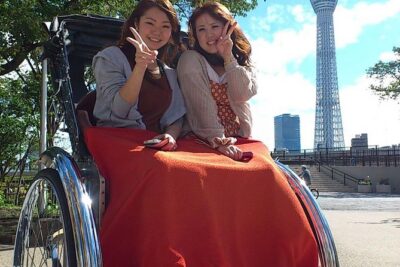 ★ 5.0Tokyo Asakusa Rickshaw TourFrom $42
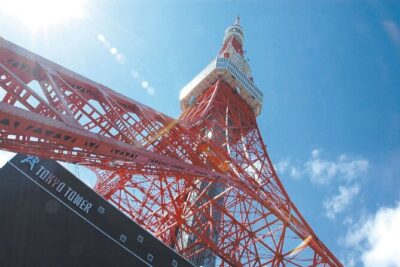 ★ 4.5Tokyo Panoramic 1 Day: Meiji Shrine, Asakusa, Odaiba and SKYTREE®From $85