
Reviewed · SAMURAI & NINJA EXPERIENCES
Tokyo: Samurai Experience with Lunch and Guided Tour
Tokyo’s samurai experience is not just a sword lesson. It combines a walk through Kagurazaka, once home to Edo-era samurai and geisha, with a live performance, beginner training, and lunch in a 70-year-old Japanese house. You get culture, movement, food, and old Tokyo streets in four well-filled hours.
I like the small group size, limited to nine people, and the way the tour connects samurai ideals with Shinto, Buddhism, and Zen. I also like the setting: a former teahouse linked to geisha life, rather than a modern restaurant built only for visitors. The main drawback is the food policy. Vegan, gluten-free, and shellfish-free meals cannot be guaranteed, and a vegetarian meal must be requested by the day before.
In This Review
- Key points at a glance
- Why Kagurazaka makes a fine samurai setting
- The walking tour: temples, lanes, and old Tokyo
- The one-hour samurai lesson in kimono
- Lunch in a former Kagurazaka teahouse
- What the four-hour schedule feels like
- Is $162 a fair price?
- Who should book this experience
- Booking details worth knowing
- Should you book the Kagurazaka samurai experience?
- FAQ
- Where does the tour meet?
- How long does the experience last?
- Is the tour conducted in English?
- How many people can join?
- Is a samurai costume included?
- Is lunch included?
- Can I request a vegetarian meal?
- Are vegan or gluten-free meals available?
- Is the tour suitable for children and wheelchair users?
Key points at a glance
- Kagurazaka’s back streets: Walk an old Tokyo district with samurai homes, shrines, geisha connections, and local sweets.
- One hour in kimono: Learn basic samurai movements and fighting techniques from professional samurai actors.
- Lunch in a former teahouse: Eat in a traditional Japanese house more than 70 years old.
- A guide-led cultural walk: Connect samurai life with Shinto shrines, Buddhism, and Zen.
- A compact small group: The tour accepts no more than nine participants and operates in English.
- A practical food warning: Vegetarian meals are possible with advance notice, but vegan and gluten-free options are not available.
Why Kagurazaka makes a fine samurai setting
Kagurazaka gives this tour a stronger sense of place than a stand-alone martial arts show. The district developed around an Edo-era slope and retains narrow lanes, old buildings, shrines, restaurants, and traces of its former geisha quarter. Samurai families once lived in the area, so the walking portion gives the lesson a local setting instead of treating samurai culture as a stage prop.
You begin in front of Aoyama Flower Market at the Ecute Edition Iidabashi store, beside the West Exit of JR Iidabashi Station. This meeting point is useful because the station exit is clearly specified, but you should still arrive early. The group leaves on time, and arriving more than 15 minutes late means you cannot join, reschedule, or receive a refund.
The first short walk leads to Zenkokuji, a Buddhist temple that helps set up the tour’s broader cultural story. Your guide explains how samurai life related to Shinto beliefs, Buddhism, and Zen practice. That context matters because samurai culture was not only about weapons. It also involved discipline, loyalty, spiritual practice, social rank, and a particular idea of self-control.
A few more Tokyo tours and experiences worth a look


The walking tour: temples, lanes, and old Tokyo
The tour includes several guided walks through Kagurazaka, with stops at temples, shrines, traditional streets, and local shopping areas. One visit lasts about 15 minutes, followed by a longer Kagurazaka segment of roughly two hours and twenty minutes that includes the class and lunch.
Do not expect a museum-style lecture with every date and name. The appeal is the connection between the streets under your feet and the ideas your guide explains. A strong guide can point out how Kagurazaka changed over time while keeping the conversation tied to samurai customs, religion, food, and daily life.
The district is also a pleasant break from Tokyo’s large crossings and tall buildings. Its narrow lanes can feel surprisingly quiet, though some streets are still active local roads. You will walk, so comfortable shoes are sensible. The tour is not suitable for wheelchair users, and the mixed surfaces and tight streets are part of the reason.
The English-speaking guide is an important part of the day. Guides named in the tour’s feedback include Mark, Taka, and Naoki. Mark is specifically praised for making the walk fun and informative, while Taka and Naoki are associated with a strong introduction to Tokyo’s historic, cultural, and food traditions. Your assigned guide may differ, but the experience depends heavily on how well that person brings the district to life.
The one-hour samurai lesson in kimono
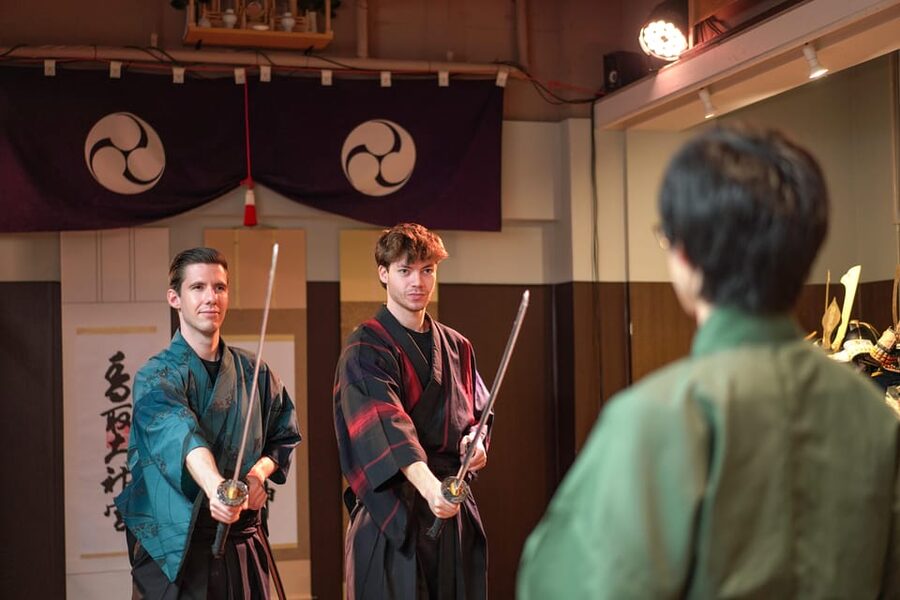
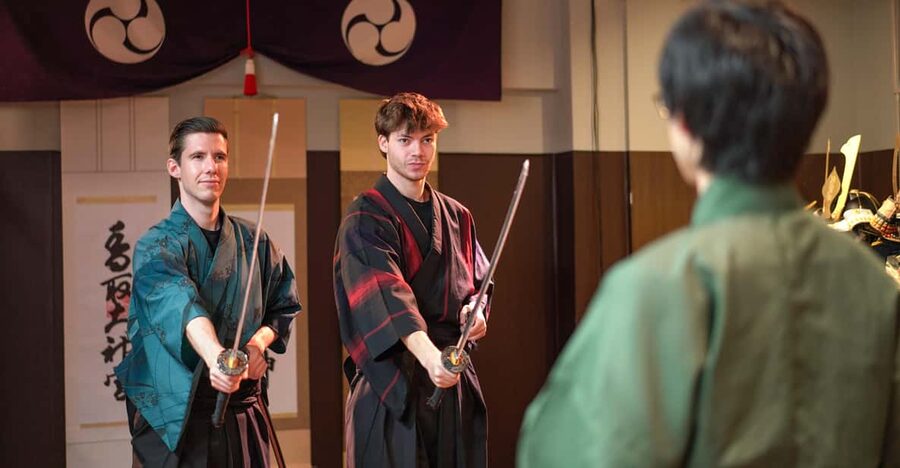
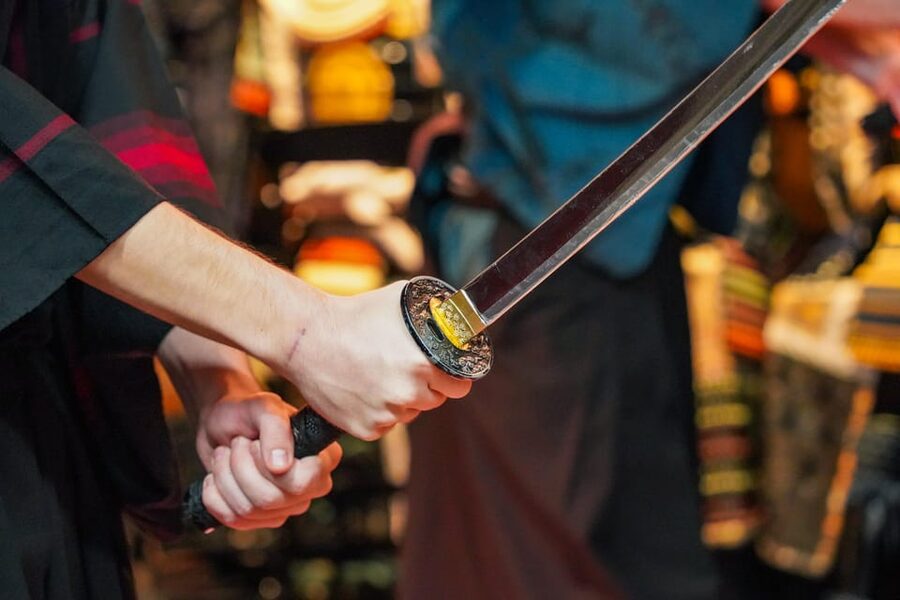
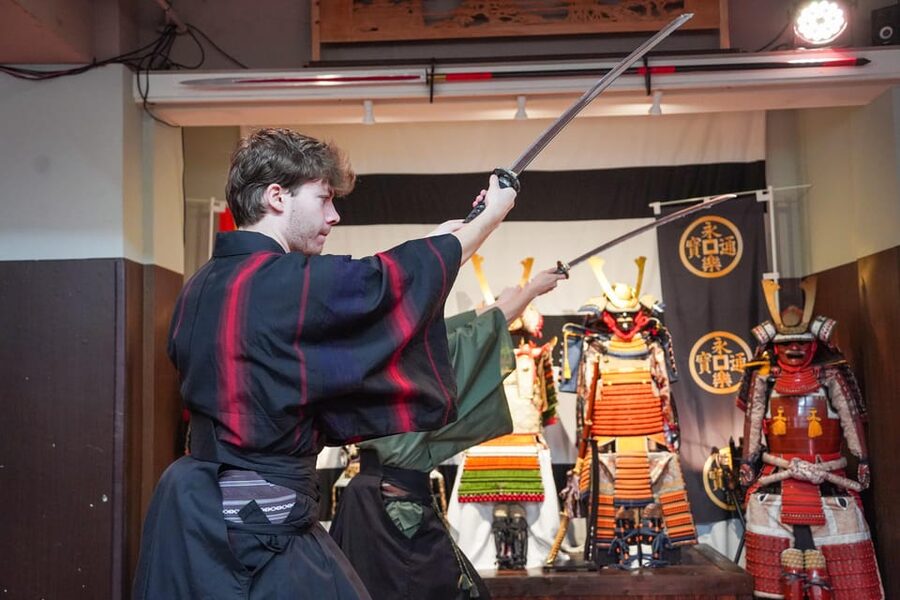
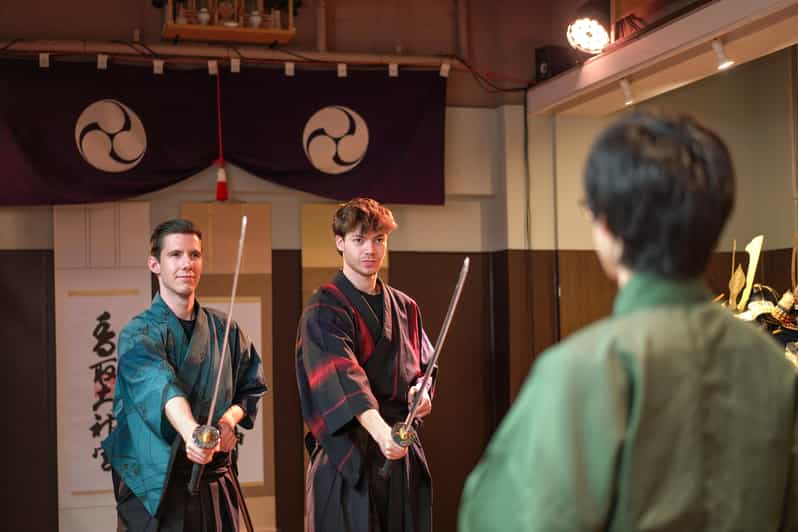
The central activity is a one-hour samurai experience with kimono rental. Professional samurai actors first give a performance, then show you the basic movements and fighting techniques. After watching, you practice the movements yourself under instruction.
This format works well for beginners. You do not need martial arts experience, and the guide helps break each movement into manageable steps. The goal is not to turn you into a swordsman in an hour. It is to give you a physical sense of posture, timing, focus, and controlled movement.
The kimono rental adds to the fun and makes the photo opportunity better. Families with children aged four and older are welcome, and the activity can be a good choice for children who learn more from doing than from listening to a long talk. The samurai performance also gives the session some theater, so even people who do not want to train intensely can enjoy watching.
You should keep your expectations realistic. This is a guided introduction, not a formal martial arts course. You will learn basic movements and authentic fighting techniques in a beginner-friendly format, but the session is designed as a cultural activity rather than serious combat instruction.
The live performance is one of the strongest reasons to choose this tour over a standard neighborhood walk. It gives you a clear visual example before you try the movements yourself. The combination of demonstration and practice also makes the history easier to remember. You are not only hearing about samurai discipline. You are asked to use your body carefully and follow the same controlled rhythm.
Lunch in a former Kagurazaka teahouse
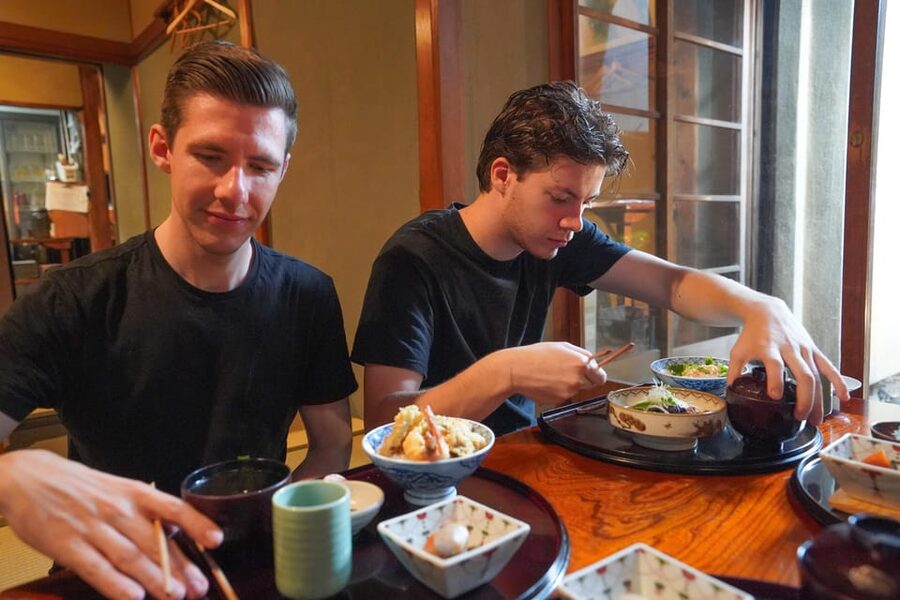
After training, you walk through Kagurazaka and eat lunch in a traditional Japanese house more than 70 years old. The building was once a teahouse and a place connected with geisha life, which gives the meal a sense of local character that a regular restaurant would not provide.
This is one of my favorite parts of the program because the setting extends the cultural lesson. You can pause, eat, and think over the morning while sitting in a building tied to the district’s entertainment past. The food is Japanese, and a vegetarian course is available if you request it by the day before.
The food restrictions require careful planning. Vegan and gluten-free meals are not available, and shellfish allergy requests cannot be guaranteed. The meal is prepared in kitchens outside MagicalTrip, so the operator cannot promise an allergy-free dish. If you have strict dietary needs, this may not be the right tour.
You also receive one traditional food or sweet during the walk. Depending on the stop, this may be chimaki, a steamed bun, or a modern Japanese sweet. It is a small feature, but it helps you taste Kagurazaka rather than simply look at it. You can choose one food or sweet during the tour.
A vegetarian request must be made no later than the day before. Same-day changes are not possible, so do not wait until you meet the guide. If substitutions cannot be made, the operator says it will try to compensate at other stops, but this should not be treated as a guarantee for special diets.
What the four-hour schedule feels like
The advertised duration is four hours, with about three and a half hours of guide time. The day is divided between walking, the samurai activity, lunch, and local snack stops. That keeps the pace varied.
You begin at Iidabashi, walk to Zenkokuji, continue through Kagurazaka, take part in the class, eat lunch, and visit additional points in the area. Later, you have time for shopping and a local snack before returning to the starting point near JR Iidabashi Station.
The schedule is full, but it is not built around long museum visits or extended free time. You should choose this tour if you like a guided day with a clear sequence. If you prefer to wander alone, stop for coffee whenever you wish, or spend hours browsing shops, the fixed pace may feel restrictive.
The walking sections are short enough to break up the activity, but you will still be on your feet for much of the four hours. Children aged four and up can participate, though parents should consider each child’s attention span and comfort with a kimono and a structured lesson.
Other guided tours in Tokyo






Is $162 a fair price?
At $162 per person, this is not a cheap neighborhood walk. The value comes from the number of elements packed into one booking: an English-speaking guide for most of the day, a kimono rental, a one-hour samurai lesson, a professional performance, a Japanese lunch, a traditional snack, and a small group capped at nine.
The price makes more sense if you would otherwise book separate activities for a cultural walk, martial arts demonstration, and Japanese meal. It also saves you the work of finding the old lanes, arranging the samurai class, and choosing a restaurant in a district where some of the best places are easy to miss.
I would not choose it for the lunch alone, and I would not book it if your main goal is advanced sword training. The best value is for someone who wants a concentrated introduction to samurai culture with a real neighborhood setting.
The small group helps. With up to nine people, the guide has a better chance to answer questions and help with practice and photographs. It also keeps the class from feeling like a large performance for a crowd. The exact group size can vary, but it will not exceed nine participants.
Who should book this experience
This tour suits first-time Tokyo visitors who want a cultural activity outside the city’s most famous central sights. It is also a good match for anyone interested in samurai, Japanese religion, martial arts, theater, traditional food, or old neighborhoods.
Families can book for children aged four and older. The kimono, practice movements, and photos give children something active to do, while the guide’s explanations give adults more context. Very young children may not enjoy the walking and instruction, so think about your child’s energy level before booking.
I also recommend it for couples and small groups who want a shared activity with a clear story. The day moves from street history to performance, from performance to practice, and from practice to lunch. That progression gives the experience a pleasant rhythm.
You may want to skip it if you use a wheelchair, need vegan or gluten-free food, have a serious shellfish allergy, or dislike scheduled group activities. Smoking, alcohol, and drugs are not allowed during the tour.
Booking details worth knowing
The meeting point is in front of Aoyama Flower Market at the Ecute Edition Iidabashi store, in front of the West Exit of JR Iidabashi Station. After leaving the station through the West Exit, the shop should be on your right.
The tour is offered in English and lasts four hours. Hotel pickup and drop-off are not included, so you must reach Iidabashi on your own and return from there after the final snack and shopping stop.
You can reserve now and pay later, which helps if your Tokyo plans are still changing. Free cancellation is available up to 24 hours before the start time for a full refund. The strict late-arrival rule matters more than usual here: arriving over 15 minutes late means losing your place without a refund or new date.
The activity has a rating of 5 from three verified bookings. The strongest praise focuses on the guides, the easy-to-find meeting point, the restaurant meal, the out-of-the-way streets such as the geisha alley, and the lively samurai lesson. Those are exactly the areas I would weigh most heavily when deciding if this tour fits your day.
Should you book the Kagurazaka samurai experience?
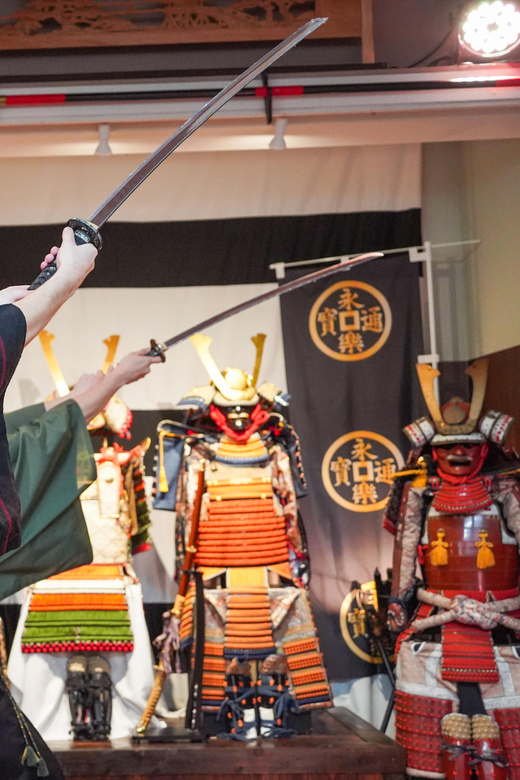
Book it if you want more than a staged sword show. You will walk through a district with real connections to samurai and geisha life, learn how religion shaped samurai ideals, watch professional performers, practice basic movements in kimono, and eat lunch in an old teahouse.
The best reason to choose it is the mix. No single part lasts long enough to become tiring, and each part gives the next one more meaning. The biggest caution is food: strict dietary needs may rule it out, and vegetarian diners must plan ahead.
For most visitors interested in Japanese culture, this is a well-balanced four-hour introduction with strong value at $162. Arrive early, wear comfortable shoes, request vegetarian food in advance if needed, and expect a lively beginner lesson rather than a serious martial arts course.
FAQ
Where does the tour meet?
Meet in front of Aoyama Flower Market at the Ecute Edition Iidabashi store, in front of the West Exit of JR Iidabashi Station. The shop is on your right after you leave through the West Exit.
How long does the experience last?
The tour lasts four hours. The local guide is included for about three and a half hours.
Is the tour conducted in English?
Yes. The tour includes a live English-speaking guide.
How many people can join?
It is a small-group tour limited to nine participants.
Is a samurai costume included?
Yes. The package includes a kimono rental and one hour of samurai experience.
Is lunch included?
Yes. A Japanese lunch is included, along with one traditional food or sweet during the tour.
Can I request a vegetarian meal?
Yes, but you must request the vegetarian course by the day before the tour. Same-day vegetarian requests cannot be accommodated.
Are vegan or gluten-free meals available?
No. Vegan and gluten-free options are not available, and shellfish allergy requests cannot be guaranteed.
Is the tour suitable for children and wheelchair users?
The tour is open to participants aged four and older. It is not suitable for wheelchair users.
More Lunch Experiences in Tokyo





More Guided Tours in Tokyo
More Samurai & Ninja Experiences in Tokyo

More tours in Tokyo we've reviewed










Samurai & Ninja Experiences, compared.
 ★ 4.5Tokyo: Samurai Restaurant Show Ticket with 2 DrinksFrom $551h 30m
 ★ 4.6Tokyo: Samurai Ninja Museum Guided tour and ExperienceFrom $27
 ★ 5.0Tokyo: Samurai Sword & Archery Class from Samurai DescendantFrom $1933 hours
 ★ 5.0Best Samurai Experience in TokyoFrom $65
 ★ 5.0Ninja Experience (Family Friendly) at Samurai Ninja Museum TOKYOFrom $47
 ★ 4.6Tokyo: Samurai Entertainment Night Show in Kanda ShrineFrom $412 - 3 hours