
Reviewed · UENO & YANAKA WALKS
Mini Origami Lamp and Mizuhiki knot Belt Workshop in Ueno
The best part of this Ueno workshop is that you do not simply watch a craft demonstration. You make two useful, attractive souvenirs yourself: a folding washi paper lamp and a decorative Mizuhiki knot belt ornament. The finished lamp closes like a book, which makes it far easier to pack than most handmade decor.
I like the private format, since Kaho Shinoda can give you patient, personal help with the small folds, gluing, and paper-cord work. I also like the gentle pace, with Japanese sweets and special paper tea served at the end. The main caution is that this is detailed handwork, not a quick children’s craft, and a cat lives in the workshop.
In This Review
- Key points at a glance
- Making a washi lamp that folds flat
- Learning the language of Mizuhiki knots
- What the 2.5-hour visit feels like
- Why the private setting matters
- Tea, sweets, and a small paper lesson
- Is $107.50 a fair price?
- Planning your Ueno craft break
- Who will enjoy this workshop most?
- Should you book the Ueno origami lamp class?
- FAQ
- Where does the workshop take place?
- How long does the activity last?
- What will I make?
- Are materials included?
- Is this a private class?
- Are tea and sweets included?
- Is the workshop suitable for young children?
- What is the cancellation policy?
Key points at a glance
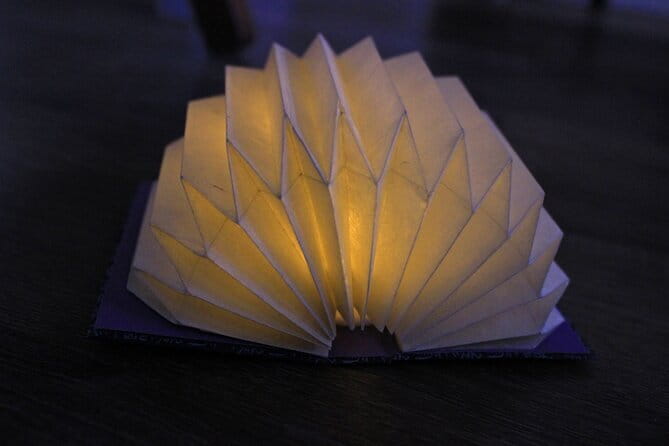
- A portable lamp made from handmade washi: Fold and glue several sheets into a bellows shape that glows with warm light when a small lamp is placed inside.
- Mizuhiki with meaning: Learn how traditional paper cords are tied and why different knots can carry messages suitable for gifts.
- Private instruction in Ueno: Your group receives direct guidance rather than working in a large class.
- Tea and sweets finish the session: The workshop serves Japanese sweets with its own paper tea, made from kozo, the fiber used in washi.
- A practical Tokyo souvenir: The lamp folds flat like a closed book, making it easier to carry home.
- Best for patient makers: Fine work makes this a better fit for older children, teens, and adults than for young children.
Making a washi lamp that folds flat
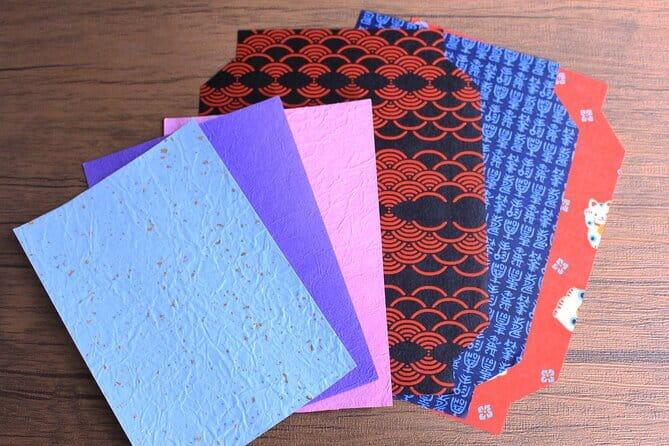
The workshop begins with an introduction to washi paper and a guide document covering the basic ideas behind the craft. Washi is light but durable, so it works well for an object that is both decorative and useful.
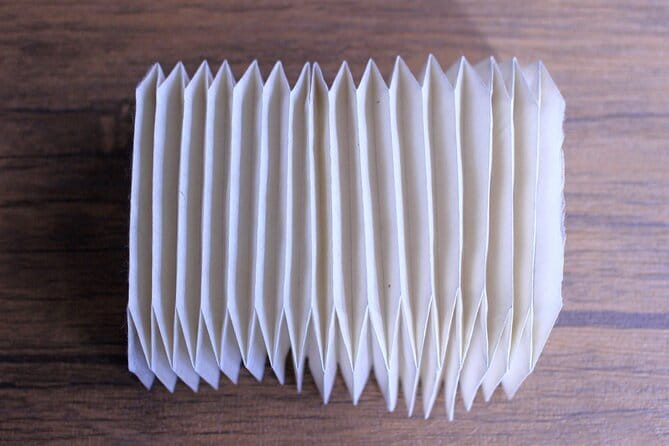
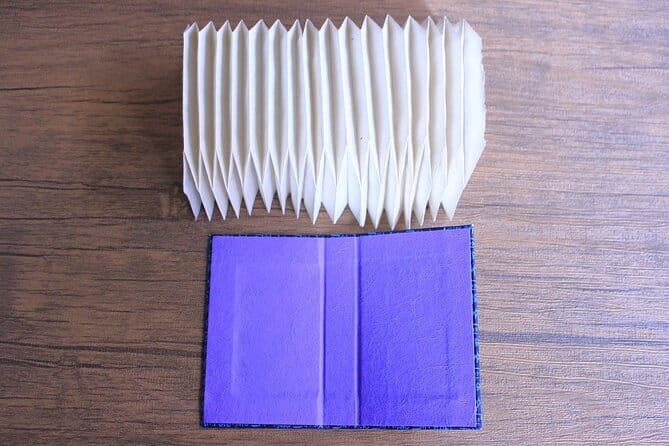
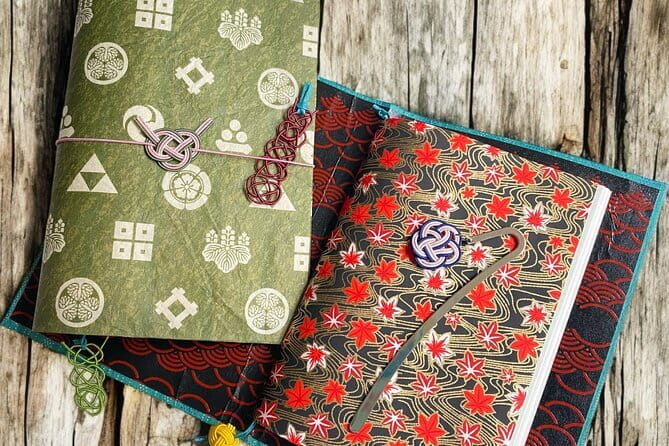
Your main project is a small lamp made by folding and gluing several pieces of handmade washi paper. The folds create a bellows-like form. Open it, place a small lamp inside, and the paper gives off a soft, warm glow. Close it, and the lamp looks much like a slim book.
That folding design is one of the smartest parts of the class. You are not making a fragile paper ball that needs a large box for the journey home. You leave with an object that can be folded down for packing and opened again at home.
The work does require care. You need to keep the folds even, apply glue neatly, and hold the paper in place as the shape takes form. This is why the private format matters. If you are unsure about a step, you can ask right away instead of trying to copy someone across a crowded table.
The goal is not factory-perfect symmetry. Your lamp is handmade by you, with the small variations that make it personal. That gives the finished piece more meaning than a paper souvenir bought from a shop, especially if you light it in the evening after returning home.
A few more Tokyo tours and experiences worth a look


Learning the language of Mizuhiki knots
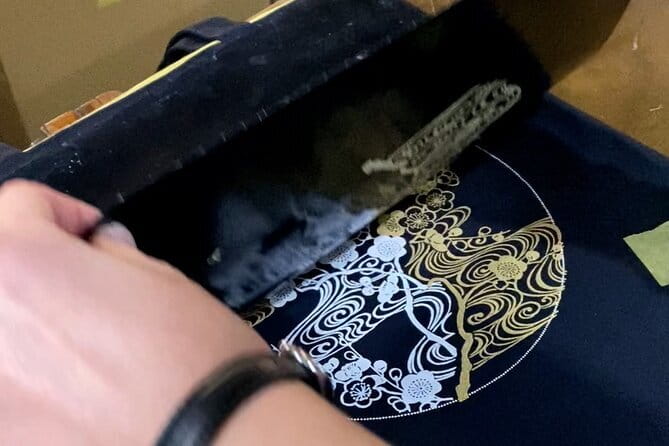
The second project introduces Mizuhiki, a traditional Japanese decorative cord made with a twisted washi-paper core covered by nylon or film. The cords are firm, colorful, and suited to ornaments, gift decoration, and accessories.
Here you create a Mizuhiki knot ornament for a belt. The knot is not just a pretty shape. Different knots have different meanings, which is one reason Mizuhiki is often used when presenting gifts. The class gives you a small window into the thought behind Japanese wrapping and presentation.
This part may appeal to you if you enjoy pattern and repetition. Mizuhiki work can look simple when finished, but the cord has to be guided in the right order. A private instructor can show you how to keep the strands in place and correct a knot before it becomes difficult to undo.
The belt ornament also gives you a second souvenir with a different character from the lamp. The lamp is about paper, light, and interior decoration. The Mizuhiki piece is smaller and more intricate, with a connection to Japanese gift customs.
What the 2.5-hour visit feels like
The full session lasts about two hours and 30 minutes and takes place at 和紙ラボTOKYO in Ueno. You stay at the same location for the activity, and the session ends there as well.
The time is long enough to work carefully without turning the class into an all-day commitment. You can fit it into a Ueno or Asakusa day, perhaps before or after visiting nearby sights. It also offers a welcome change from walking through busy streets, especially during Tokyo’s hot weather.
Expect the session to focus on making rather than sightseeing. There is no series of stops around Tokyo. Instead, the value comes from direct instruction, the materials, and the chance to finish two crafts during one sitting.
The class is private, so only your group participates. That makes it a good choice for a couple, a family with older children, or friends who want to work at their own speed. It also means the tone can be more personal than a standard group workshop.
The provider says the activity is near public transportation, and the meeting point is at 和紙ラボTOKYO in Taito City, Ueno. The exact directions should be checked when you book, since the address is listed in Japanese as 110-0016 Tokyo, Taito City, Taitō, 3-chōme 30-2, Ichikawa Building, 1F.
Why the private setting matters
Paper crafts can be frustrating when an instructor has to divide attention among a large room. One fold out of place can affect the shape several steps later. Here, you can ask questions as soon as something feels unclear.
Kaho Shinoda is named as the instructor associated with the workshop, and the session is built around guided practice. The available feedback points to clear instructions, prepared materials, and a calm pace that works well for beginners. That is important because you do not need to arrive with prior origami or Mizuhiki skills.
You should still expect to concentrate. The class is not suitable for young children because the work involves detailed folds and knotting. Older children may manage it, but the supplied information does not set a specific minimum age, so ask the provider before booking for a child.
I would choose this class for someone who likes hands-on activities and wants a souvenir with a story. If you prefer simply watching an artisan work, or if you dislike careful repetitive tasks, the price may feel high for the time spent at the table.
Tea, sweets, and a small paper lesson
At the end, the workshop serves Japanese sweets with Japanese paper tea. The tea is described as kozo tea, made from the fiber associated with washi paper, and it is not presented as a standard cafe drink.
This closing refreshment adds context rather than just filling time. You have been handling washi, learning how paper can be folded into a lamp, and seeing how paper fibers can become cord for Mizuhiki. The tea connects that material to something you can taste.
The sweets also give you a quiet pause after the detailed work. Based on the available comments, the paper tea and snacks are a well-liked part of the session. Do not book this as a full meal, though. It is a light finish to the class, not lunch or dinner.
There is a cat in the workshop. The mascot is called KAMI, and the provider specifically asks people with allergies to mention them in advance. If you are sensitive to cats, this detail should affect your booking decision, even if you are otherwise a good fit for the craft.
A few more Tokyo tours and experiences worth a look




Is $107.50 a fair price?
The cost is $107.50 per person. That is not a bargain basement craft class, but the price includes a private 2.5-hour session, all paper and craft materials, two finished projects, Japanese sweets, and tea.
The private instruction is the main value. You are paying for help through two projects, not just access to supplies. The lamp alone is a substantial souvenir because it involves several sheets of handmade washi and leaves you with a working decorative object. The Mizuhiki ornament adds a second skill and keeps the session from feeling like a single-project lesson.
Value depends on what you want from Tokyo. If you are looking for cheap souvenirs, you can spend far less in a shop. If you want a personal activity, direct guidance, and objects you made yourself, the price is easier to justify.
The compact lamp also saves you possible shipping or packing trouble. Since it closes like a book, it is designed with visitors in mind. You should still protect the paper carefully in your luggage, but it is more practical than taking home a large rigid lantern.
The activity averages booking about 29 days ahead, which suggests you should not leave it until the last minute if your dates are fixed. That is especially useful to know for a private class, where there are fewer spaces than in a large group workshop.
Planning your Ueno craft break
The meeting point is 和紙ラボTOKYO, and the activity stays there from start to finish. A mobile ticket is provided, which helps when you are moving around Tokyo with your phone rather than carrying printed paperwork.
The class is near public transportation, but the information supplied does not give a precise station exit or walking time. Give yourself enough time to find the building, and check the final meeting instructions before setting out.
Ueno makes a sensible base for this type of activity. You can pair the workshop with a day in the Ueno or Asakusa area, but plan your sightseeing around the fixed two-and-a-half-hour class. You will want enough time before the start to arrive calmly, since detailed paper work is not much fun when you are rushing in from another part of the city.
The activity requires good weather under its cancellation terms. That is worth noting even though the craft itself takes place indoors. If poor weather causes the session to be canceled, you are offered another date or a full refund.
You can cancel for a full refund up to 24 hours before the start time. Changes or cancellations inside that window are not accepted for a refund, and all cut-off times use Tokyo local time.
Who will enjoy this workshop most?
I would recommend it to adults and older children who enjoy making things with their hands. It suits people who want a quieter Tokyo activity, couples looking for a shared project, and anyone who prefers a handmade keepsake to another mass-produced souvenir.
It also works for a visitor who wants a little cultural context without signing up for a long lecture. You learn what washi is, how it behaves, how Mizuhiki cords are made, and why knots can carry meaning. The teaching is tied to the objects you are making, so the information has a clear purpose.
The workshop may not suit very young children, impatient makers, or anyone with a cat allergy. It is also not the right choice if you want a broad tour of Ueno. You spend the time in one workshop, and the main attraction is the making itself.
Bring patience more than artistic talent. The instructions and prepared materials help beginners, but the work still needs attention. Your finished pieces are meant to be personal creations, not identical products made by a machine.
Should you book the Ueno origami lamp class?
Book it if you want a private, creative break and like the idea of taking home a lamp you can actually use. The folding design is practical, the Mizuhiki project adds a second Japanese craft, and the tea and sweets give the session a pleasant finish.
I would be most likely to book this for a couple or small private group with a free afternoon in Ueno. The $107.50 price is reasonable when you value instruction, materials, and two finished keepsakes. Skip it if you want a low-cost activity, need a child-focused class, or have a cat allergy.
FAQ
Where does the workshop take place?
It takes place at 和紙ラボTOKYO, 110-0016 Tokyo, Taito City, Taitō, 3-chōme 30-2, Ichikawa Building, 1F, in the Ueno area.
How long does the activity last?
The workshop lasts approximately two hours and 30 minutes.
What will I make?
You will make an origami-style lamp from handmade washi paper and a Mizuhiki knot ornament for a belt.
Are materials included?
Yes. Materials for making both crafts are included in the activity price.
Is this a private class?
Yes. Only your group participates in the private workshop.
Are tea and sweets included?
Yes. Japanese sweets and Japanese paper tea are served at the end of the session. The tea is described as kozo tea.
Is the workshop suitable for young children?
No. The detailed folding and knotting work makes it unsuitable for young children.
What is the cancellation policy?
You can cancel up to 24 hours before the start time for a full refund. Cancellations or changes made less than 24 hours before the start time are not accepted for a refund. If poor weather causes the activity to be canceled, you are offered another date or a full refund.
More Workshops & Classes in Tokyo
More Ueno & Yanaka Walks in Tokyo


More tours in Tokyo we've reviewed









Ueno & Yanaka Walks, compared.
 ★ 5.0Eat and Drink Like a Local: Tokyo Ueno Food Tour-Taverns&RamenFrom $95
 ★ 4.5The Old Quarter of Tokyo – Yanaka Walking TourFrom $40
 ★ 5.0Yanaka Walking Tour: Historic and Traditional District of TokyoFrom $72
 ★ 4.8Tokyo: Old Quarter Yanaka Walking TourFrom $323 hours
 ★ 5.0Tokyo: Food Tour in Ueno with 10+ Tastings of Japanese ClassicsFrom $142
 ★ 4.9Tokyo:Stroll in Old traditional culture towns~Yanaka & NezuFrom $293h 30m