
Reviewed · TSUKIJI MARKET TOURS
Tokyo Tsukiji Market Small Group Tasting Tour
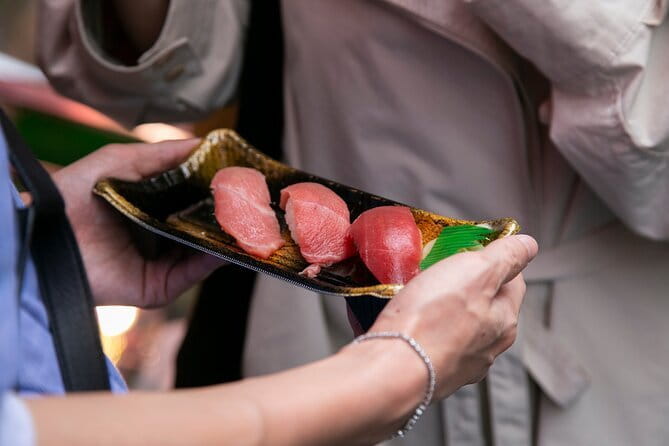
Tsukiji is more than a place to grab sushi. This 2.5-hour morning tour links the Outer Market with two important religious sites, beginning at the striking Tsukiji Hongwan-ji Temple and ending at Namiyoke Shrine, where merchants have long sought protection. Along the way, you taste seafood, savory meat, and other traditional foods.
I like the mix of food and local customs, and I like the small maximum of 10 people, which makes it easier to ask questions and keep up in crowded market lanes. The main catch is dietary: vegan and vegetarian requests cannot be accommodated, and other requests, including gluten-free, are not guaranteed.
In This Review
- Key points at a glance
- Why this Tsukiji morning works well
- Meeting at Tsukiji Station at 8:30 am
- Tsukiji Hongwan-ji Temple: a calm start before the food
- The Outer Tsukiji Market: four to five chances to taste
- Namiyoke Shrine: finishing with Tsukiji’s working side
- The guides are a major part of the value
- What the $89 price really covers
- Who should book this Tsukiji experience
- Practical ways to get more from the morning
- Should you book the Tokyo Tsukiji Market Small Group Tasting Tour?
- FAQ
- Where does the tour begin?
- What time does the tour start?
- How long does the experience last?
- Where does the tour end?
- How many people can join the group?
- How many food tastings are included?
- What types of food might be included?
- Are extra foods and drinks included?
- Can the tour accommodate vegan or vegetarian diets?
- Can I cancel for a full refund?
Key points at a glance
- Starts at 8:30 am: You meet at Tsukiji Station, giving you an early look at the market before the rest of your day gets busy.
- Three distinct stops: The route combines Tsukiji Hongwan-ji Temple, the Outer Market, and Namiyoke Shrine.
- Four to five tastings included: Expect a selection of traditional foods, including seafood and savory meat.
- Small group of up to 10: The size supports questions, steady pacing, and closer contact with your guide.
- Guides who add personal care: Daniel, Aki, and Elena have been singled out for clear explanations, patience, and help with water and bathroom breaks.
- Additional food costs extra: The included tastings are an introduction, not a full market feast.
Why this Tsukiji morning works well
The best feature here is the order of the experience. You do not simply arrive at the market, eat a few samples, and leave. You first see a major Buddhist temple, then walk through the food stalls, and finish at a shrine tied to Tsukiji’s working life.
That sequence gives the market more meaning. Food in Japan is closely connected with ceremony, trade, seasonal customs, and respect for ingredients. The temple and shrine visits help you notice those links instead of treating Tsukiji as only a shopping stop.
I also like the timing. Starting at 8:30 am gives you a useful first activity for the day, and the tour ends after about two and a half hours. You still have plenty of time to return to the market, explore on your own, or move on to Ginza and other central Tokyo sights.
The pace is best for someone who wants an introduction rather than an all-day food crawl. You receive four or five tastings, but any extra food and drinks come at your own cost. That is a good setup if you want guidance without committing to a long, expensive meal.
A few more Tokyo tours and experiences worth a look



Meeting at Tsukiji Station at 8:30 am
The tour begins at Tsukiji Station, at 3 Chome-9 Tsukiji, Chuo City. Since the meeting point is near public transportation, it is practical for visitors staying in different parts of Tokyo, though you should allow enough time to reach the station before the 8:30 am start.
The meeting location matters because Tsukiji’s lanes can feel confusing at first. A guide gives you a clear starting point and keeps the group together as the route moves from the temple toward the market.
You receive a mobile ticket, and booking confirmation arrives at the time of booking. The group can include no more than 10 people. That is small enough for a personal feel without the price of a private tour.
Wear comfortable shoes. The tour lasts two and a half hours and includes walking between the three stops and moving through market areas. The schedule includes water and bathroom breaks when needed, a detail that Daniel in particular made a point of handling during tours.
Tsukiji Hongwan-ji Temple: a calm start before the food
The first 30 minutes take place at Tsukiji Hongwan-ji Temple. You observe a purification ritual and have time to look at the building’s architecture before entering the market zone.
This is a smart beginning. The temple creates a quiet pause before the noise and movement of Tsukiji. It also introduces an important part of Japanese culture that many food-focused outings skip.
Your guide can explain what you are seeing and how to behave respectfully. You do not need to be a Buddhist practitioner to appreciate the visit. The point is to understand the setting and take part as an observer.
The temple stop is not an admission-heavy attraction. Admission is free, so the value comes from the guide’s context and from seeing how the sacred and commercial sides of Tsukiji sit close together.
Plan for observation rather than a long formal ceremony. The scheduled visit lasts about 30 minutes, so you get an introduction to the site without spending most of the morning there.
The Outer Tsukiji Market: four to five chances to taste
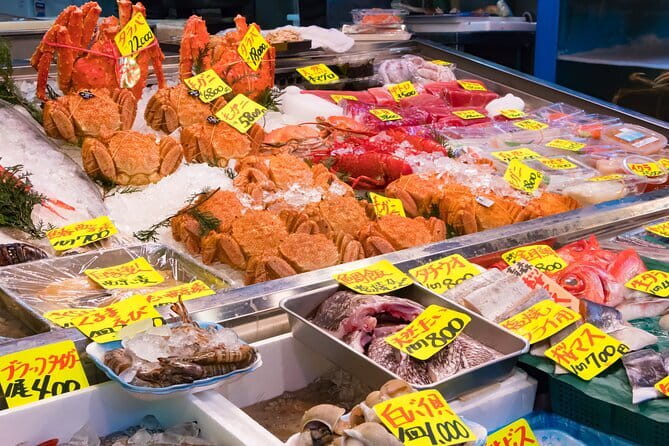
The central part of the experience lasts about 90 minutes in the Outer Tsukiji Market. This is where you visit different vendors and sample several traditional foods.
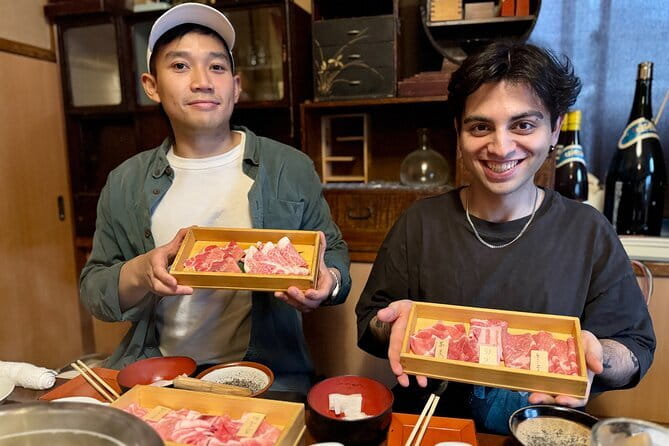
The exact selection is not fixed in the information provided, but the tour specifies seafood and savory meat among the tastings. That variety gives you a better sense of the market than a single snack would. You might try something familiar, or you might meet a food that needs explanation before the first bite.
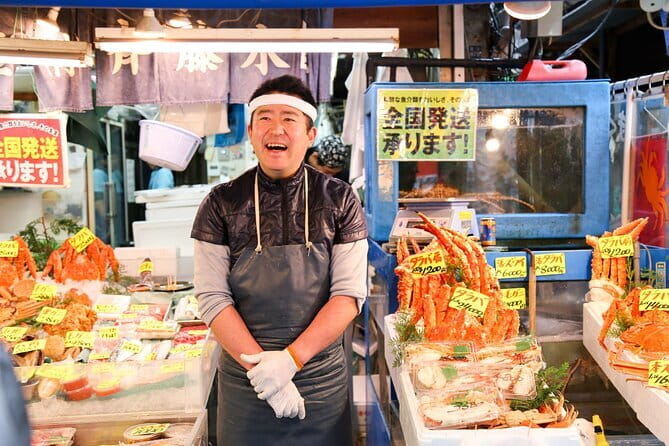
A guide is especially useful here. Market stalls can be easy to pass without understanding what they sell, how an item is prepared, or why it matters. The guide can point out choices and explain what you are eating as the group moves along.
Daniel has been praised for answering many questions, explaining what was happening, and adjusting samples to suit the group when possible. Aki has also taken groups to a couple of extra places beyond the planned route. Those details suggest the experience can feel responsive rather than rigid, though you should not count on extra stops or a particular food.
The included tasting allowance is four to five traditional foods. I see that as a sampler, not breakfast. If you arrive hungry, you may want to budget for more food and drinks. Those purchases are not included, and the market gives you plenty of temptation.
This is also the part of the tour where food restrictions matter most. Vegan and vegetarian diets cannot be accommodated. The operator will try to help with gluten-free and pescatarian needs, but no request is guaranteed. If food allergies or other restrictions affect your plans, contact the operator before booking and be ready for limited choices.
Namiyoke Shrine: finishing with Tsukiji’s working side
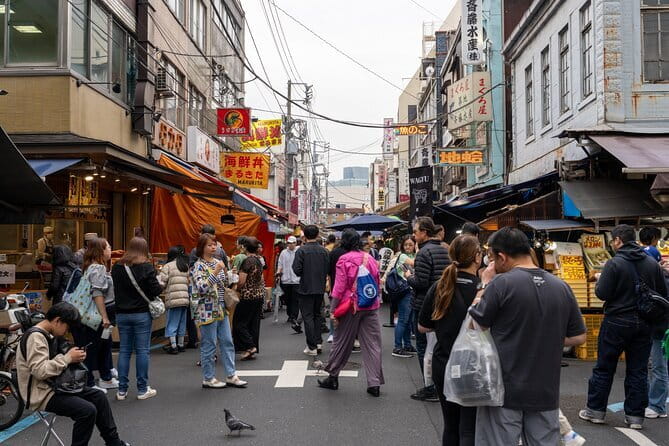
The final 30 minutes are at Namiyoke Shrine. It is described as a guardian site for Tsukiji’s merchants, so the stop brings the tour back to the people who work in and depend on the market.
That makes the shrine a fitting finish. You have just seen food as a product and tasted it as a meal. Here, you get a sense of the hopes and beliefs connected with the market’s daily work.
The visit also keeps the tour from becoming a simple list of samples. You leave with a little context about merchants, protection, and the role of shrines in ordinary city life.
The activity ends back at the meeting point. That makes onward planning simple, especially if you want to continue exploring the Outer Market after the guided portion. One useful strategy is to treat the tour as your orientation, then return to stalls that caught your eye once you know the layout better.
Other shopping tours in Tokyo


The guides are a major part of the value
The food is the obvious draw, but the guide determines how useful the morning feels. Daniel has received especially strong praise for his explanations, patience, and willingness to answer questions. He also kept water and bathroom breaks in mind, which can make a real difference during a walking tour.
Aki has been noted for adding a couple of places not listed in the planned route. Elena has been described as friendly and clear, waiting for anyone who fell behind and checking that the full group was comfortable.
Those details point to a guide style that is attentive and flexible. You can ask about the temple, food, customs, or market activity rather than simply following from stall to stall. A smaller group helps here because questions are less likely to disappear into a crowd.
Guide assignments can vary, so Daniel, Aki, or Elena may not be the person leading your departure. Still, the repeated focus on clear explanations and care for the group is a good sign for anyone who values interpretation over a quick snack stop.
What the $89 price really covers

At $89 per person, this is not the cheapest way to visit Tsukiji. You can enter the Outer Market without paying an admission fee, and you could buy individual snacks on your own.
The price pays for more than entry. It covers a hand-picked guide, the planning of a route through three different sites, and four to five tastings. You are also paying for help understanding what you see, choosing foods, and moving through the area without having to research every stop in advance.
For a first visit to Tokyo, that can be worthwhile. The tour combines a cultural introduction with food, and it uses only one morning. It may be less appealing if you already know Tsukiji well, speak Japanese comfortably, or prefer to choose every dish yourself.
The small group improves the value. With a maximum of 10 people, you are not paying for a large crowd experience. You may still spend extra at the market, but that gives you control over your final food bill.
The tour is also booked around 31 days ahead on average. That suggests you should not leave it until the last minute if the 8:30 am departure fits your plans.
Who should book this Tsukiji experience
I would recommend it most strongly to first-time visitors who want a clear introduction to Tsukiji. You get food, a temple, a shrine, and explanations in one compact morning.
It also suits people who like asking questions. The guides have been valued for explaining details, responding to individual interests, and making sure no one falls behind.
Families and mixed-age groups may appreciate the short duration and the scheduled breaks. Most people can participate, and service animals are allowed. Still, you should be ready for walking and for standing or moving through market spaces.
Food lovers who want a broad first taste will also find a good fit. Four or five samples give you a starting point, and you can continue eating afterward. If your main goal is a long, high-volume food tour, this may feel too short.
Vegetarians and vegans should skip it because those dietary needs cannot be accommodated. Pescatarians and people needing gluten-free options can ask in advance, but the operator does not promise that every request can be met.
Practical ways to get more from the morning
Arrive ready for an early start. The tour begins at 8:30 am, and arriving at Tsukiji Station with time to spare is better than trying to find the meeting point at the last second.
Keep your mobile ticket easy to access. You will receive confirmation when you book, and the activity uses a mobile ticket.
Bring room in your appetite and your budget. The four or five included tastings are useful samples, but extra food and drinks are separate. You may want to buy something else after the tour, especially if one of the foods becomes a new favorite.
Ask questions as you go. The strongest part of the experience is not only the tasting count. It is the chance to understand the temple ritual, the food, the market, and the shrine in one connected route.
Stay close to the group. Elena’s careful pacing and Daniel’s attention to breaks are helpful, but market lanes can still be busy. A small group is easier to manage when everyone keeps the guide in sight.
You can cancel for a full refund if you do so at least 24 hours before the local start time. Changes or cancellations inside that window are not accepted, and the payment is not refunded.
Should you book the Tokyo Tsukiji Market Small Group Tasting Tour?
Book it if you want a guided first look at Tsukiji that combines four to five tastings with cultural sites. The compact route, small group, and attentive guide style make it a good choice for a first Tokyo morning.
Think twice if you are vegan or vegetarian, since the tour cannot meet those needs. Also consider the price if you are happy exploring independently and buying only the foods you choose.
For most first-time visitors who want more than a snack crawl, I think the temple-to-market-to-shrine format earns its place in a Tokyo itinerary. Use the tour to get your bearings, then keep the rest of the morning free for a second look at the market.
FAQ
Where does the tour begin?
It begins at Tsukiji Station, at 3 Chome-9 Tsukiji, Chuo City, Tokyo 104-0045, Japan.
What time does the tour start?
The start time is 8:30 am.
How long does the experience last?
The tour lasts approximately 2 hours and 30 minutes.
Where does the tour end?
The activity ends back at the meeting point.
How many people can join the group?
The maximum group size is 10 travelers.
How many food tastings are included?
The tour includes four to five traditional food tastings.
What types of food might be included?
The tastings include traditional foods such as seafood and savory meat. The exact selection is not specified.
Are extra foods and drinks included?
No. Additional foods and drinks are not included in the tour price.
Can the tour accommodate vegan or vegetarian diets?
No. The tour cannot accommodate vegan or vegetarian dietary restrictions. Gluten-free and pescatarian requests may be considered, but they cannot be guaranteed.
Can I cancel for a full refund?
Yes. You can receive a full refund if you cancel at least 24 hours before the local start time. Cancellations within 24 hours are not refunded.
More Markets in Tokyo
More Shopping Tours in Tokyo
More Tsukiji Market Tours in Tokyo

More tours in Tokyo we've reviewed








Tsukiji Market Tours, compared.
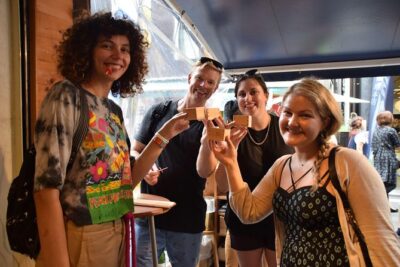 ★ 5.0Tokyo Tsukiji Fish Market Food and Culture Walking TourFrom $99
 ★ 5.0Tokyo: Tsukiji Fish Market Food and Walking tourFrom $30
 ★ 4.9Tokyo: Tsukiji Fish Market Guided Walking TourFrom $222 hours
 ★ 5.0Tokyo Sushi Making Class in Tsukiji with Professional ChefFrom $49
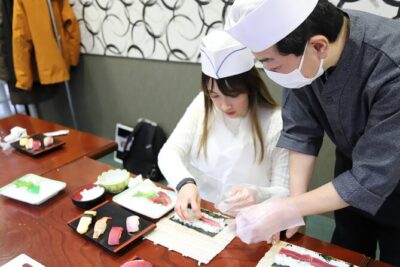 ★ 5.0Tsukiji Fish Market Guided Tour and Sushi Making with Pro ChefFrom $104
★ 4.7Tokyo: Tsukiji Fish Market Food and Culture Walking TourFrom $963 hours
★ 5.0Tsukiji Fish Market Guided Tour and Sushi Making with Pro ChefFrom $104
★ 4.7Tokyo: Tsukiji Fish Market Food and Culture Walking TourFrom $963 hours