
Reviewed · CRAFT WORKSHOPS
Tokyo: Calligraphy on Kanji Fan & Scroll with Drink
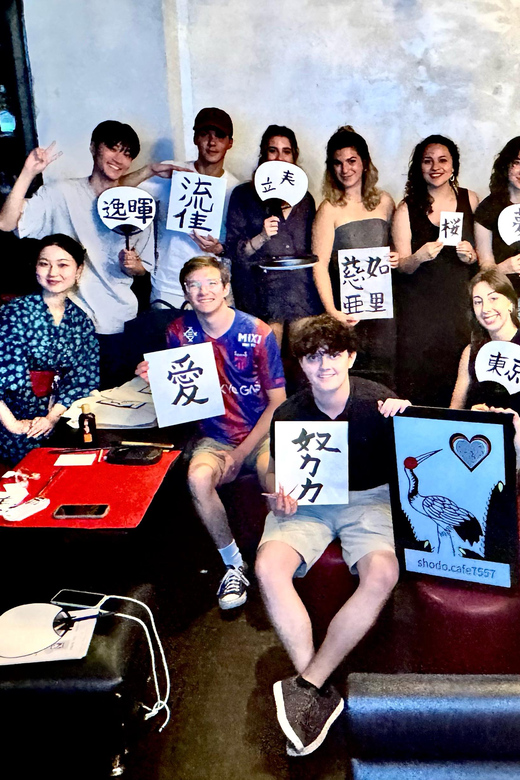
Japanese calligraphy here is not a rushed craft class. You sit down, slow your hand, and learn why each brush stroke matters. At Shodo Cafe 7557, guides including Kana and Kanako help you turn a name or favorite word into kanji artwork, then place it on a traditional fan and hanging scroll. I like the calm pace and the chance to practice several times before committing ink to the final pieces.
I also like the personal touches: your name can be prepared in kanji with its meaning, and you make a hiragana hanko stamp to take home. The main consideration is time. The advertised session is 80 minutes, but the activity may run from 60 minutes to two hours, so do not schedule it tightly against a train or dinner reservation.
In This Review
- Key points to know before booking
- Why this Roppongi calligraphy class feels different
- From Roppongi Station to Shodo Cafe 7557
- Starting with matcha and the calligraphy tools
- Practicing strokes before choosing your kanji
- Making the uchiwa fan and kakejiku scroll
- The personalized hanko and take-home gifts
- Is $53 a fair price?
- Who will enjoy this workshop most
- Practical booking advice for Roppongi
- Should you book the Roppongi calligraphy experience?
- FAQ
- Where is the calligraphy workshop held?
- How do I reach Shodo Cafe 7557 by train?
- How long does the activity last?
- Is the class taught in English?
- What can I write during the workshop?
- What artwork will I make?
- What drinks are included?
- What souvenirs can I take home?
- Is the activity wheelchair accessible?
Key points to know before booking
- Three minutes from Roppongi Station: Use Toei Oedo Line Exit 7 and look for the large crane sign near the National Art Center.
- Your final artwork has meaning: Choose your name or a favorite kanji character for a paper fan and hanging scroll.
- Patient English instruction: Kana, Kanako, and the other instructors guide beginners through brush order and pressure.
- More than a drink break: Matcha latte, green tea, coffee, soda, or beer is included while you work.
- A generous take-home package: Your hanko stamp, keychain, coaster, pouch, tote bag, fan, and scroll are included.
- Best for a flexible schedule: The listed duration is 80 minutes, though some sessions last longer.
Why this Roppongi calligraphy class feels different
Many Tokyo craft activities give you a quick demonstration, then leave you to produce one souvenir. This workshop gives you time to understand the writing before you make the final piece. That matters because Japanese calligraphy is built around controlled brush movement, not simply copying a symbol until it looks close enough.
You begin with the basics. The instructor explains the tools, how to hold and move the brush, and the order of the strokes. You practice on paper first. The early attempts can feel awkward, especially if you are used to writing with a pen, but the instructors are patient and keep the mood light.
The process has a quiet, almost meditative quality. You have to watch the tip of the brush, control the amount of ink, and finish each line with care. Even a simple character asks you to slow down. That is the cultural value of the class: you are not only producing a souvenir, you are getting a small lesson in attention and discipline.
The class is conducted in English, which makes it suitable for first-time visitors who cannot read Japanese. You do not need to arrive with a favorite character already chosen. You can write your name, select a word, or ask for help understanding the options.
A few more Tokyo tours and experiences worth a look

From Roppongi Station to Shodo Cafe 7557
The studio is at 7-9-3 Roppongi, in the Crest Roppongi Building on the second floor. From the Toei Oedo Line, leave through Exit 7, cross toward FamilyMart, and turn right toward the National Art Center, Tokyo.
Walk along the museum street, called Bijutsukan Dori. The large crane sign on the left is the useful landmark. The studio is not presented as a street-level shop, so keeping an eye out for the building name and crane sign will save you from wandering around Roppongi.
This central location works well if you are already visiting the National Art Center or the wider Roppongi area. You can also show a taxi driver the instruction to go to Shodocafe7557 in the Crest Roppongi Building near the National Art Center Tokyo.
Allow a few extra minutes to find the second-floor entrance. The route itself is short, but Roppongi streets can be confusing when you are trying to match a building sign with a map pin. Searching for Shodocafe7557 on Google Maps is another practical option.
Starting with matcha and the calligraphy tools
Once settled in, you choose a drink. Matcha latte and green tea fit the setting, but coffee, soda, and beer are also included. This is a useful detail for families or mixed groups, since not everyone wants matcha.
The drink gives the class a relaxed beginning rather than making you start with a brush the moment you sit down. The atmosphere is described as warm and peaceful, and that suits the activity. Calligraphy needs concentration, but it should not feel like a formal exam.
The instructor introduces the basic tools and explains how the brush behaves. You learn that pressure, angle, and stroke order affect the final shape. Even if you have no art background, the lesson breaks the task into manageable steps.
The class welcomes all ages and skill levels, though the activity is not suitable for people over 95. It is also wheelchair accessible. The information provided does not specify the exact group size, so you should not assume that every session is private.
Practicing strokes before choosing your kanji
The practice portion is one of the strongest parts of the class. You are not pushed straight toward the fan or scroll. Instead, you repeat individual brush strokes and try full characters under close guidance.
That practice is important for two reasons. First, it takes away some of the pressure of making a permanent piece. Second, it lets you feel the difference between a heavy stroke and a light one. Several people found the technique challenging at first, but the instructors gave them repeated attempts and encouragement.
You may also ask to work with a different word or character. If you already have something specific in mind, provide that information when booking or in a follow-up message. If you are using your name, the studio asks for every participant’s name in English ahead of time.
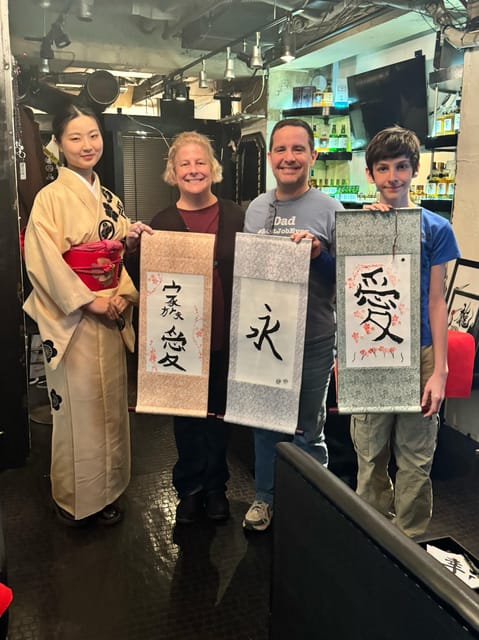
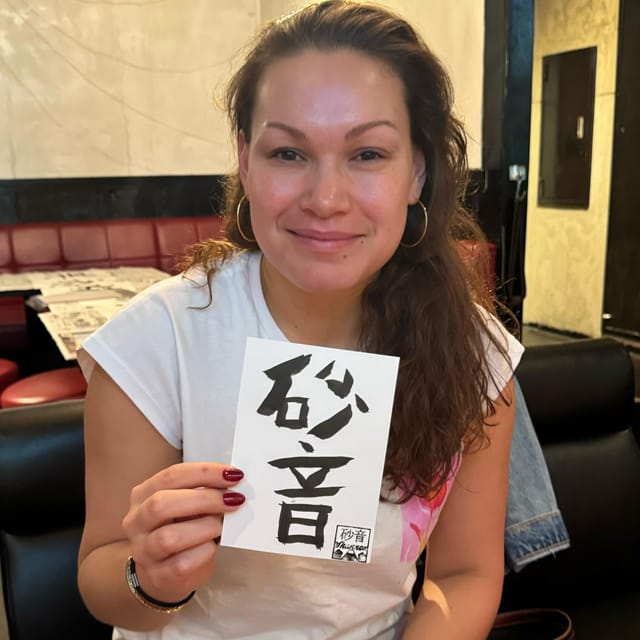
The staff can prepare a special explanation of your name in kanji. In some cases, this includes an animated video showing the name and its meaning. This is a particularly nice touch for children and for anyone curious about how a Western name can be represented through Japanese characters.
Do keep expectations realistic. A translated name is not necessarily a direct Japanese equivalent in the way a dictionary translates an ordinary word. The point is the sound, character choice, and meaning selected for your souvenir. The instructor can explain the interpretation used for your name.
Making the uchiwa fan and kakejiku scroll
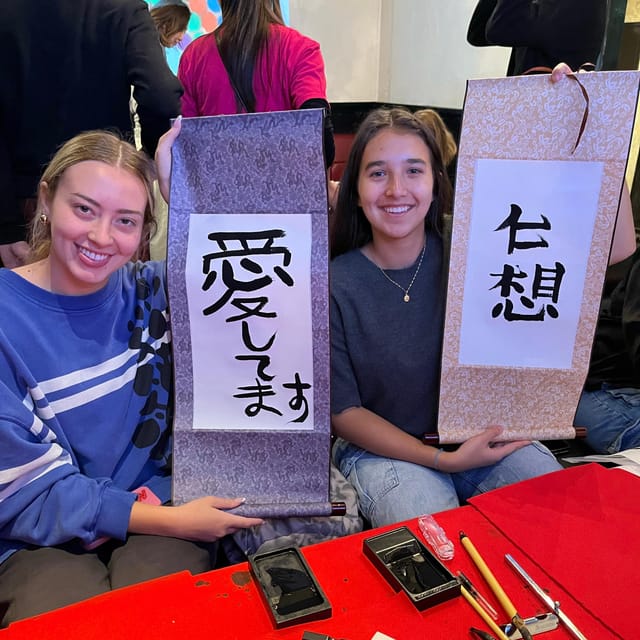
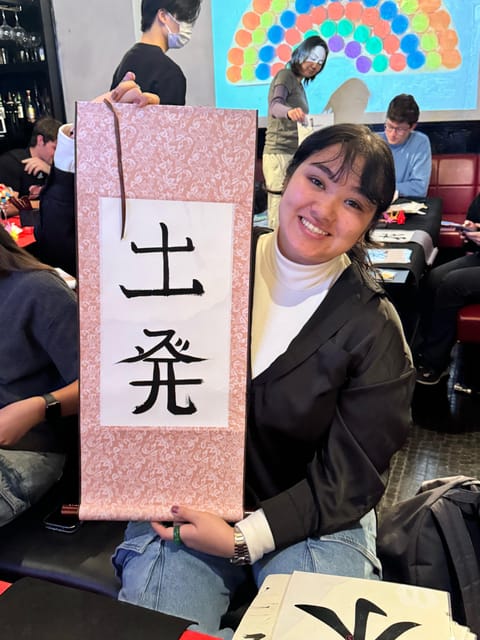
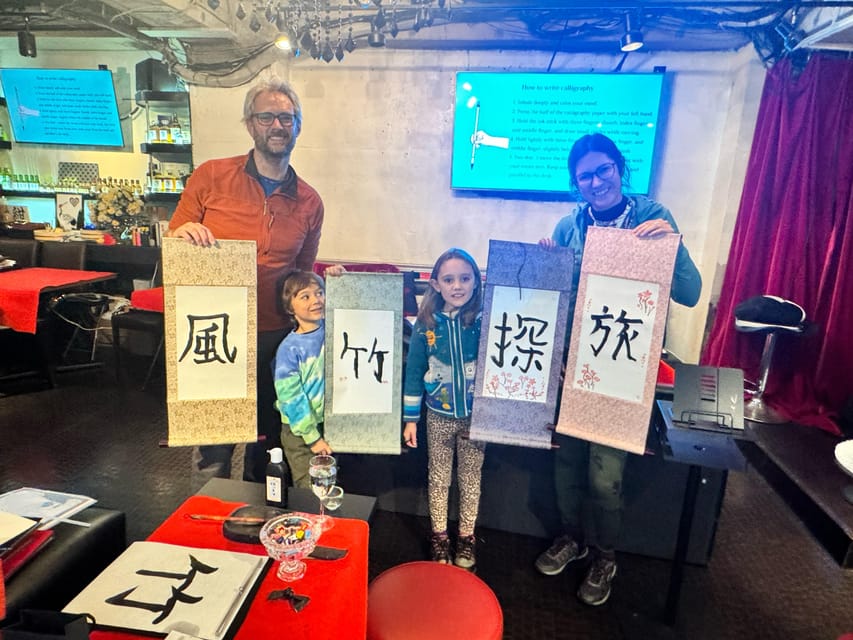
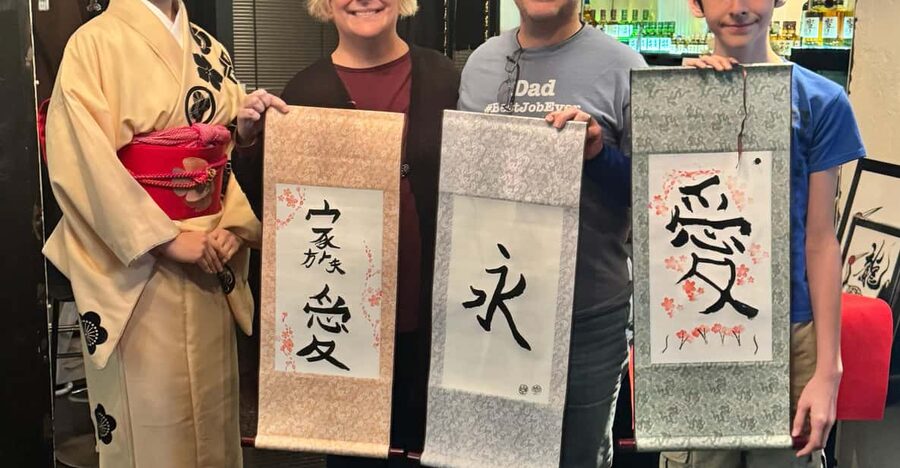
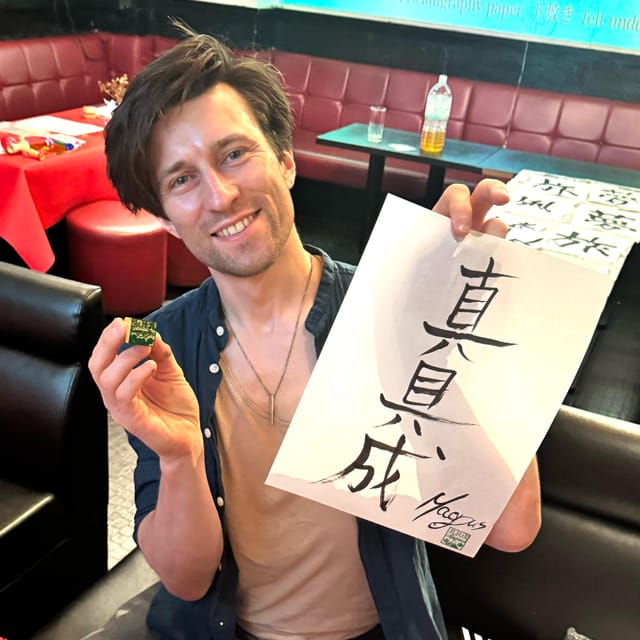
The final artwork gives the workshop its lasting appeal. You create an uchiwa, the traditional Japanese paper fan, and a kakejiku, or hanging scroll. Depending on the arrangement of the class, the included materials are described as a calligraphy board and folding fan, or a hanging scroll, but the activity information specifically promises both a fan and scroll as part of the work.
The fan is the more casual piece. It is easy to picture displaying it at home or using it as a reminder of Tokyo. The hanging scroll feels more formal and gives your chosen character a proper place on the wall.
You can write your own name, a favorite kanji, or a word selected with help from the instructor. The guides first help you practice the shape, then support you as you apply it to the final material. Do not worry if your first few attempts are uneven. The teaching style is patient, and you can practice until you feel ready.
I would think about your choice before arriving, but not obsess over it. A single character with a clear meaning often works better than a complicated phrase. The class is about learning the movement and understanding the symbol, not producing professional-level shodō.



The personalized hanko and take-home gifts
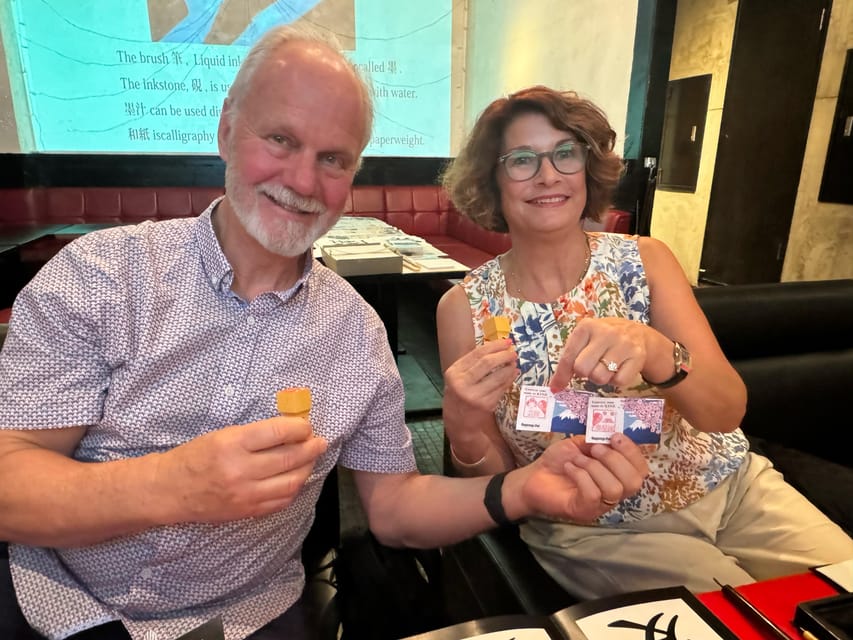
The hanko stamp adds another layer to the workshop. You receive a Japanese hiragana hanko with your name, giving you a small personal seal to keep. It is not the same as making a traditional carved seal from raw stone, but it is a meaningful souvenir connected to your own name.
The included take-home items are unusually generous for a short cultural activity. Along with the original fan and scroll, the package includes:
- A hiragana hanko stamp with your name
- A kanji keychain
- A kanji coaster
- A kanji pouch
- A kanji tote bag
The exact presentation may vary, but the practical point is clear: you leave with several small gifts as well as the art you created. The tote bag and pouch are useful during the rest of your trip, while the keychain and coaster are easy to pack.
Some of the accessories include calligraphy or kanji connected with the workshop. This helps the experience feel less like a single photo opportunity and more like a small set of keepsakes. If you are buying this for a child, the number of items can make the $53 price easier to justify.
Is $53 a fair price?
At $53 per person, this is not the cheapest way to spend 80 minutes in Tokyo. You are paying for an English-language lesson, guided practice, materials, a drink, two finished artworks, a hanko stamp, and several additional souvenirs.
That package makes the price reasonable for someone who wants a hands-on cultural activity rather than a demonstration. A museum visit may cost less, but it will not give you a personal item made with your own name. A souvenir shop may sell a fan or tote, but it cannot give you the process behind the character.
The value is strongest for families, couples, and people who enjoy making things. It is also a good option during a holiday period when many other businesses may be closed. One session took place on New Year’s Day, making this a useful choice for a day when Tokyo options can be limited.
The value is less convincing if you only want a quick introduction to Japanese writing and do not care about taking home several items. You may also find the pace longer than expected if you have a packed sightseeing plan. Because the activity can last up to two hours, leave room afterward.
Who will enjoy this workshop most
I would recommend it to first-time visitors who want a cultural activity with a clear result. You do not need artistic ability, Japanese language skills, or previous calligraphy experience.
It suits:
- Families with children who can follow a guided brush lesson
- Couples looking for matching or complementary souvenirs
- Solo visitors who enjoy quiet, creative activities
- Anyone studying kanji or curious about Japanese writing
- People seeking an indoor activity near Roppongi
- Visitors who want a personal alternative to mass-produced souvenirs
It may be less suitable for someone who dislikes slow, careful work or wants a fast-paced sightseeing stop. The practice is part of the point. You may produce several imperfect attempts before making the final fan and scroll.
The workshop also has a personal, small-studio feel rather than the polished scale of a major attraction. That is a benefit if you value direct help, but visitors who prefer a large group and a fixed, tightly timed presentation may find the format less predictable.
Practical booking advice for Roppongi
Give the studio all participants’ names in English when you book. This allows the staff to prepare the name meaning and possible kanji presentation in advance. If there is another word you want to write, mention it as early as possible instead of waiting until the class begins.
Plan to arrive at Shodo Cafe 7557, not simply at Roppongi Station. The meeting point is the studio itself, on the second floor of the Crest Roppongi Building. Hotel pickup and drop-off are not included, so you handle the short journey independently.
The listed duration is 80 minutes, with starting times based on availability. The actual activity may run between one and two hours. I would avoid placing it immediately before a timed ticket, airport transfer, or restaurant booking.
Free cancellation is available up to 24 hours before the activity for a full refund. You can also reserve and pay later, which is handy when your Tokyo schedule is still changing.
Should you book the Roppongi calligraphy experience?
Book it if you want to slow down for an hour or two and make something personal. The strongest reasons are the patient English guidance, repeated brush practice, name-based kanji explanation, and the unusually full set of souvenirs.
I especially like that you do not simply paint one character and leave. You learn the basic strokes, make a fan and scroll, receive a name stamp, and take home useful small items. The matcha latte or other included drink makes the price easier to accept.
Skip it if your Tokyo schedule is extremely tight, if you prefer passive sightseeing, or if a $53 craft class is outside your budget. For most people who enjoy culture, creativity, and meaningful souvenirs, this is a well-rounded Roppongi activity with enough substance to justify the time.
FAQ
Where is the calligraphy workshop held?
It is held at Shodo Cafe 7557, on the second floor of the Crest Roppongi Building at 7-9-3 Roppongi, Minato-ku, Tokyo.
How do I reach Shodo Cafe 7557 by train?
Take the Toei Oedo Line to Roppongi Station and use Exit 7. Cross toward Family Mart, turn right, and walk toward the National Art Center, Tokyo along Bijutsukan Dori. Look for the large crane sign on the left.
How long does the activity last?
The scheduled duration is 80 minutes. The activity information also says the session may last from 60 minutes to two hours, so allow extra time.
Is the class taught in English?
Yes. Instruction and guidance are provided in English.
What can I write during the workshop?
You can write your name translated into kanji or choose a favorite kanji character or word. Provide participant names in English when booking so the studio can prepare the name information.
What artwork will I make?
You will create Japanese calligraphy on a traditional paper fan and a kakejiku, or hanging scroll. The included materials also refer to a calligraphy board and folding fan, so the exact setup may depend on the session.
What drinks are included?
You can choose a matcha latte, green tea, coffee, soda, or beer. Additional drinks and food are not included.
What souvenirs can I take home?
The included items are a hiragana hanko stamp with your name, a kanji tote bag, keychain, coaster, pouch, and your original calligraphy artwork.
Is the activity wheelchair accessible?
Yes, the activity is listed as wheelchair accessible. Hotel pickup and drop-off are not included.
More Craft Workshops in Tokyo

More tours in Tokyo we've reviewed





Craft Workshops, compared.
 ★ 5.0Tokyo Shinjuku Chopsticks Making ClassFrom $20
 ★ 4.8Chopstick Making Workshop in GinzaFrom $251 hour
 ★ 5.0Kintsugi Experience: Art of Golden Joinery in TokyoFrom $59
 ★ 5.0Tokyo Chopstick Making Workshop with ArtisanFrom $26
Tokyo: Shinjuku Chopstick Making ClassFrom $121 hour
Tokyo: Chopstick-Making WorkshopFrom $61 hour
★ 5.0Tokyo Chopstick Making Workshop with ArtisanFrom $26
Tokyo: Shinjuku Chopstick Making ClassFrom $121 hour
Tokyo: Chopstick-Making WorkshopFrom $61 hour