
Reviewed · WORKSHOPS
Sumi-e Ink Painting Suiboku-Ga Workshop in a Japanese Teahouse
Tokyo offers plenty of grand sights, but this one-hour suiboku-ga workshop gives you something many sightseeing days lack: a quiet hour with a brush in your hand. At a teahouse in Tsukiji, award-winning artist Rensui teaches you how water, ink, and one confident stroke can create a meaningful image.
I like the small group of no more than eight, which gives the class a personal feel, and I like that your finished painting becomes a useful souvenir rather than another shop purchase. The tea refreshment and packet of green tea add a pleasant Japanese touch.
The main consideration is time. One hour passes quickly, and ink painting is harder than it looks, so you should not expect a long art course or a polished museum piece. This is a relaxed introduction, not a full lesson in traditional painting.
In This Review
- Key points at a glance
- What suiboku-ga feels like in practice
- Meeting Rensui in a Tsukiji teahouse
- Choosing between bamboo, pine, flowers, and kanji
- The brush, water, and the single stroke
- Tea adds a calm Japanese rhythm
- Why the small group matters
- A souvenir with a story behind it
- Who should book this activity
- Timing, booking, and cancellation
- Is the $93.34 price fair?
- Should you book the suiboku-ga workshop?
- FAQ
- Where does the suiboku-ga workshop take place?
- How long does the experience last?
- What is the maximum group size?
- Who teaches the workshop?
- What will I learn?
- Which subjects can I paint?
- Are materials included?
- Do I receive anything to take home?
- Is green tea served during the class?
- Can children participate?
Key points at a glance
- A one-hour art class in Tsukiji: Meet at Uogashi Meicha Chanomi Club and return to the same location.
- Instruction from artist Rensui: Learn basic suiboku-ga methods, including how to finish with a single brushstroke.
- Eight people maximum: The small class allows a more direct exchange with the teacher.
- Choose a Japanese painting theme: Your subject may be pine, bamboo, plum, orchid, chrysanthemum, or Chinese kanji characters.
- Your artwork goes home with you: Materials are included, along with a light green tea refreshment and a packet of green tea.
- A strong record of satisfaction: The experience has a 5 out of 5 rating from 20 reviews, with 100 percent recommending it.
What suiboku-ga feels like in practice
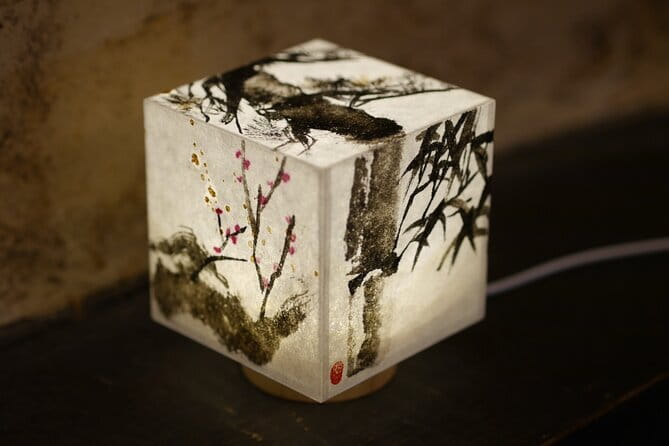
Suiboku-ga is a form of Japanese sumi-e ink painting. Instead of building a picture with many layers of colored paint, you use diluted and concentrated ink to create light, shadow, texture, and contrast.
That sounds simple. It is not quite as easy as it looks.
A single brushstroke may suggest the bend of bamboo, the branch of a pine tree, or the shape of a chrysanthemum. The amount of water matters. The amount of ink matters. Pressure, speed, and the point at which you lift the brush all change the result.
This is the appeal of the class. You are not copying a detailed picture with dozens of small steps. You are learning how to make a few deliberate marks carry meaning. The method is closely linked with a Japanese aesthetic of restraint and with the idea that a painting can reflect the artist’s state of mind.
You do not need to arrive as an artist. The workshop is built for beginners, and the focus is on basic techniques. Still, you should bring patience. Your first attempt may look less controlled than expected, which is part of understanding why the finished work can feel personal.
A few more Tokyo tours and experiences worth a look


Meeting Rensui in a Tsukiji teahouse
The workshop begins at Uogashi Meicha Chanomi Club, at 2-chōme-11-12 Tsukiji, Chuo City, Tokyo. The activity ends at the same meeting point, so you do not need to arrange a separate return transfer.
The venue is a teahouse, and the setting helps shape the experience. You are not simply sitting at a generic art table. Tea, ink, brushwork, and quiet concentration all belong to the same cultural setting.
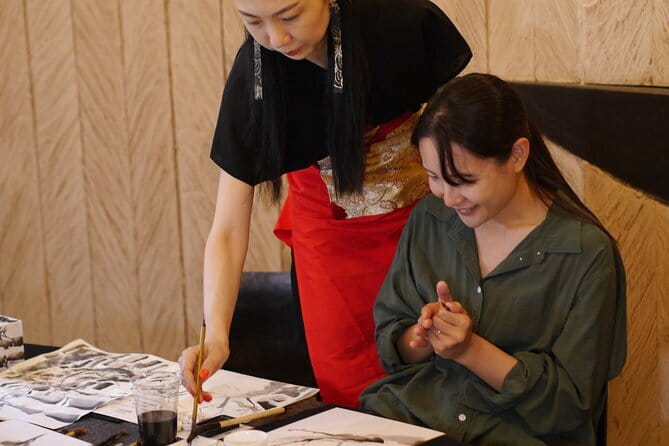
Artist Rensui leads the class. Rensui is described as an award-winning calligrapher and artist, and the instruction centers on practical methods rather than a long lecture. You learn how to handle the brush and water, then put those ideas to work on your own image.
I like this approach for a short Tokyo activity. A one-hour class has no room for excessive theory. Direct instruction is more useful, especially when the technique depends on small physical details that are difficult to understand from a written explanation.
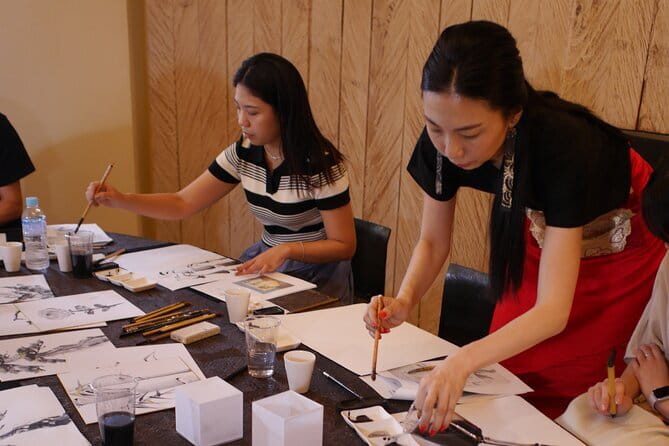
The group is limited to eight people. That matters because a brush technique is easiest to learn when you can watch the teacher demonstrate it and then receive some correction as you try. It also keeps the session from feeling like a large public demonstration.
Choosing between bamboo, pine, flowers, and kanji
At booking, you choose the object or theme you would like to paint. The available subjects are pine, bamboo, plum, orchid, chrysanthemum, and Chinese kanji characters.
These themes are tied to familiar subjects in East Asian ink painting and calligraphy. Each one gives you a different kind of challenge. Bamboo may require long, controlled strokes. Pine can call for a stronger sense of branch and needle texture. Flowers depend on shape and spacing, while kanji places more attention on line quality and balance.
The exact subject you select will affect how your class feels. If you want a recognizable natural image, bamboo or plum may suit you. If you like calligraphy and prefer a more symbolic result, kanji may be the better choice.
The information provided does not specify how many characters or designs you can choose from within each theme. I would treat the listed subjects as the available categories and confirm your preference when booking if you have a very specific image in mind.
One useful point comes from the family experience included with this class. A seven-year-old and a nine-year-old took part with their parent, and the children were offered bamboo or pine as subjects. That suggests the workshop can work for families with mature children, although the short class still requires children to listen, wait, and handle art materials carefully.
The brush, water, and the single stroke
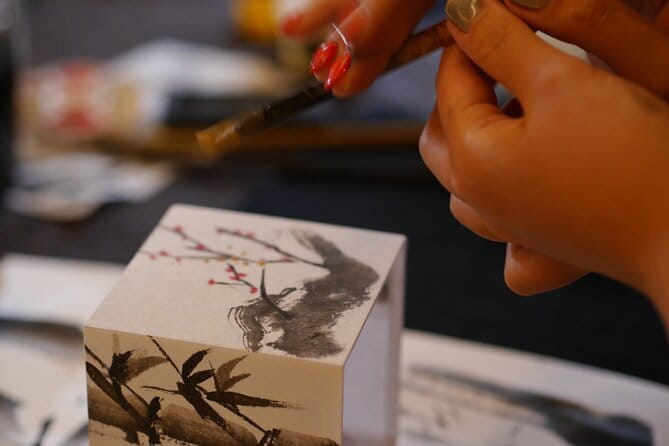
The heart of the lesson is learning how water changes ink. More water creates a lighter wash. Less water produces a darker mark. A brush loaded with different amounts of ink and moisture can create variation within one stroke.
This technique makes the class different from a standard paint-and-follow activity. You are not filling in a pre-drawn outline. You are making choices about pressure, movement, and tone.
Rensui teaches simple methods, including the idea of completing part of the image with a single brushstroke. That may sound like a small detail, but it is a useful lesson in control. A hesitant stroke can look weak. A rushed stroke can lose its shape. A steady stroke can suggest an entire branch or leaf.
I appreciate that the class does not promise instant mastery. One participant found the ink painting more difficult than expected but still enjoyed the process and felt pleased with the finished artwork. That is probably the right way to approach it. Your success is not measured by producing a flawless traditional painting. It is measured by learning enough to make a piece that feels like yours.
Tea adds a calm Japanese rhythm
A light green tea refreshment is included during the workshop. You also leave with a packet of green tea as a souvenir.
The tea is not the main event, but it gives the hour a pleasant rhythm. You can pause from the brushwork, enjoy a drink, and take home something small that connects the class to Japanese daily culture.
The souvenir packet is also a practical inclusion. It has more use than a decorative trinket, and it adds value to the $93.34 price. Still, the price is mainly paying for the private instruction, materials, and setting, not for the tea itself.
If you are comparing this with a basic art class, it may look expensive for only one hour. The value improves if you want a guided cultural activity in a small group, an artist-led lesson, and a finished piece to carry home. It is less compelling if you only want the cheapest way to try painting in Tokyo.



Why the small group matters
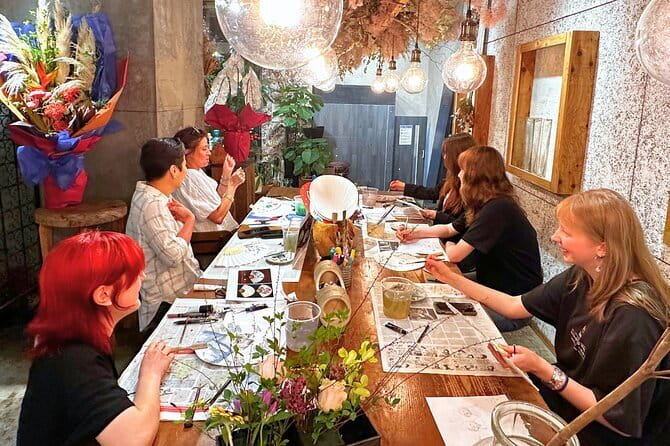
Eight people is the maximum, and the class may be smaller. For this particular art form, that limit is important.
Ink painting depends on movement that can be hard to describe. You need to see how the brush is held, how much ink is loaded, and how quickly the stroke is made. In a crowded class, you might spend much of the hour watching from a distance. Here, the format is better suited to watching closely and then trying the technique yourself.
The small number also works well for couples, families, and solo visitors who want a social activity without a large crowd. You can concentrate on your own work while still seeing how other people approach the same theme.
The class has received a perfect 5 out of 5 rating from 20 reviews, with 100 percent recommending it. That is a small sample, so I would not treat it as proof that every person will love the format. It does support the idea that the teacher, the personal atmosphere, and the finished artwork are the strongest parts of the experience.
A souvenir with a story behind it
Your finished work becomes a souvenir to take home or give to family and friends. This is one of the best reasons to choose the workshop over a short demonstration.
A purchased print can be beautiful, but it does not show your hand. Your ink painting will probably have uneven areas, unexpected marks, and a few strokes that do not turn out as planned. Those flaws are part of its value. The image records a particular hour in Tokyo and the first time you tried a demanding Japanese art form.
The class also works well for parents looking for a souvenir their children can make themselves. The family example shows that children aged seven and nine took part and produced a meaningful keepsake. I would still think about your child’s attention span before booking, since the experience lasts an hour and involves careful brushwork rather than a fast craft project.
For adults, the finished painting can be a thoughtful gift. A bamboo, pine, flower, or kanji image is easy to pack compared with a larger art object, though the provided details do not state the exact size or packaging. If protecting the painting matters to you, ask about that at the venue.
Who should book this activity
I would recommend this workshop to art lovers, first-time visitors seeking a quieter Tokyo activity, couples, and families with older or attentive children. It is also a good fit if you like experiences that leave you with something made by your own hands.
The class may suit you especially well after several days of temples, shopping, and city streets. It gives you a change of pace without requiring a full day away from Tokyo. Since it lasts about an hour and ends where it starts, it can fit into a wider Tsukiji or central Tokyo plan.
You should be comfortable with an activity that has an uncertain artistic result. If you need a guaranteed attractive souvenir, a shop purchase will be safer. If you enjoy learning through trial and error, the imperfect marks are likely to be part of the fun.
I would not book it mainly for sightseeing. The appeal is the class itself, not a guided tour of Tsukiji or a long cultural presentation. You also should not expect hotel pickup or drop-off. You make your own way to the meeting point, which is near public transportation.
Timing, booking, and cancellation
The workshop lasts approximately one hour. Confirmation is sent within 48 hours of booking, subject to availability, and the experience is commonly reserved about 25 days ahead. If your Tokyo dates are fixed, booking early is sensible because the group limit is only eight people.
A mobile ticket is available, which makes the booking easy to keep on your phone. The meeting point is Uogashi Meicha Chanomi Club, and the activity ends back there.
Most people can participate, according to the supplied details. No hotel transportation is included, and any service not specifically listed is outside the price.
Free cancellation is available until 24 hours before the start time for a full refund. Cancellations or changes made less than 24 hours ahead are not accepted for a refund, with cut-off times based on local time.
Is the $93.34 price fair?
At $93.34 per person, this is not a low-cost drop-in art activity. The fee includes the workshop, all materials, a light green tea refreshment, and a packet of green tea to take home.
The strongest value comes from the combination of a small group and direct instruction from Rensui. You are paying for access to a specialist, a prepared class, and a finished work. The teahouse setting also gives the activity a stronger sense of place than a standard studio might provide.
The price is harder to justify if you have little interest in painting or if you want a longer lesson. One hour is enough for an introduction, but not enough to cover advanced composition, multiple subjects, or detailed practice.
For the right person, the cost is reasonable for a compact cultural experience with a personal souvenir. I would think of it as a focused workshop rather than a sightseeing ticket.
Should you book the suiboku-ga workshop?
Book this experience if you want to slow down, try a distinctly Japanese brush art, and take home a souvenir you made yourself. The best reasons to go are the eight-person limit, Rensui’s instruction, the tea setting, and the chance to learn how a few strokes can create an image.
Skip it if you dislike hands-on activities, need a packed schedule, or expect professional-level results after one hour. For everyone else, this is a thoughtful way to add a quiet creative break to a Tokyo itinerary, with enough structure for beginners and enough challenge to keep the brushwork interesting.
FAQ
Where does the suiboku-ga workshop take place?
The workshop starts and ends at Uogashi Meicha Chanomi Club, 2-chōme-11-12 Tsukiji, Chuo City, Tokyo 104-0045, Japan.
How long does the experience last?
The workshop lasts approximately one hour.
What is the maximum group size?
The class has a maximum of eight participants.
Who teaches the workshop?
Award-winning calligrapher and artist Rensui leads the workshop.
What will I learn?
You will learn basic suiboku-ga ink-wash techniques, including ways to use water and ink for texture and contrast. The lesson also includes simple methods such as finishing with a single brushstroke.
Which subjects can I paint?
The available themes are pine, bamboo, plum, orchid, chrysanthemum, and Chinese kanji characters.
Are materials included?
Yes. The workshop fee includes the materials needed for the activity.
Do I receive anything to take home?
Yes. You take home your finished artwork and a packet of green tea.
Is green tea served during the class?
Yes. A light green tea refreshment is included.
Can children participate?
Most people can participate, and the experience has included children aged seven and nine. The provided information does not specify a minimum age, so confirm age requirements when booking if needed.
More Workshops & Classes in Tokyo
More tours in Tokyo we've reviewed



Workshops, compared.
 ★ 5.0Sushi Making Tokyo Roll and Authentic Japanese Sushi ClassFrom $59
 ★ 4.9Tokyo: Roll and Authentic Sushi Making Class in AsakusaFrom $581h 40m
 ★ 5.0Tokyo Shinjuku Chopsticks Making ClassFrom $20
 ★ 4.9Tokyo: Sushi Making Class in a Happi Coat near a Famous SpotFrom $421h 30m
 ★ 4.8Chopstick Making Workshop in GinzaFrom $251 hour
 ★ 5.0Tokyo Sushi Making Class in Tsukiji with Professional ChefFrom $49