
Reviewed · SAMURAI & NINJA EXPERIENCES
Samurai Sword Training and Katazome Dyeing Experience in Tokyo
Tokyo has plenty of cultural shows, but this two-hour experience lets you make something with your hands and then practice samurai movements inside a dojo. You begin with Katazome stencil dyeing at 染の里おちあい, or Somenosato Ochiai, and finish at 武蔵国無外会 with a real sword demonstration and supervised training.
I like the clear connection between Edo Komon patterns and samurai clothing, and I like that the two workshops sit only a one-minute walk apart. The main thing to consider is that this is a short introduction, not a full craft course or martial arts class, and the $97.73 price may feel high if you mainly want a souvenir.
In This Review
- Key points to know before booking
- Why this Tokyo workshop feels different
- Somenosato Ochiai and the world of Katazome
- What to expect during the 40-minute dyeing lesson
- The one-minute walk to the dojo
- Watching the 15-minute real sword demonstration
- Practicing defensive actions with toy swords
- What the $97.73 price gets you
- Who should book this experience
- Timing, meeting point, and small practical details
- Is this a good way to spend a Tokyo morning?
- Should you book it?
- FAQ
- Where does the experience start?
- What time does the experience begin?
- How long does the activity last?
- What do you make during the Katazome session?
- What are Edo Komon patterns connected to?
- Do you use a real sword during the training?
- How large is the group?
- Where does the experience end?
- Can you cancel for a full refund?
Key points to know before booking
- Two hands-on activities in two hours: You make a dyed tenugui headband, then learn basic sword actions.
- Edo Komon adds cultural context: The small repeating patterns are explained through their use on samurai kamishimo clothing.
- A real sword demonstration comes first: You watch trained instruction before using toy swords for defensive actions.
- The two venues are one minute apart: You leave the dye workshop, remove your shoes, and enter the dojo.
- Small groups keep the lesson personal: The maximum group size is eight people.
- The experience ends at the dojo: It begins at Somenosato Ochiai at 10:00 a.m. and does not return to the first venue.
Why this Tokyo workshop feels different
I like the way this experience links two parts of Japanese culture that can otherwise feel separate. The dyeing lesson gives you a look at clothing and pattern design, while the sword session turns samurai culture into something physical and easy to understand.
You are not simply watching a performance. At the first stop, you work with fabric. At the second, you practice movements with a toy sword after seeing a real sword demonstration. That combination gives the morning a good rhythm: quiet concentration first, then movement and controlled action.
The activity is also compact. You do not spend half the morning crossing Tokyo between unrelated attractions. Both venues are in Kamiochiai, in Shinjuku City, and the transfer takes about one minute on foot. That saves time and makes this a sensible choice if you have a packed Tokyo schedule.
The small group size matters, too. With no more than eight participants, the instructors have a better chance to watch what you are doing and offer direct help. It also keeps the dojo session from feeling like a large stage show.
A few more Tokyo tours and experiences worth a look

Somenosato Ochiai and the world of Katazome
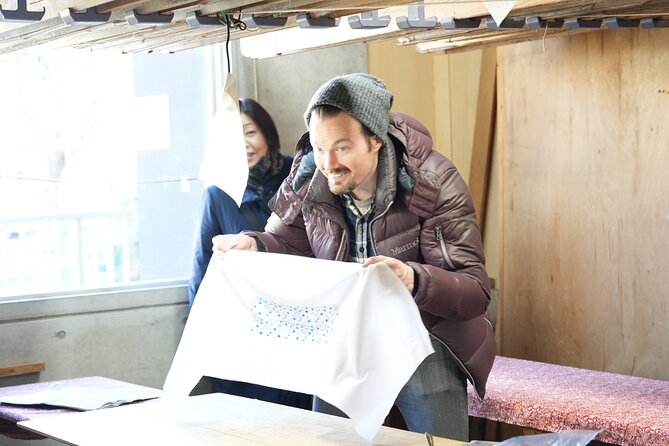
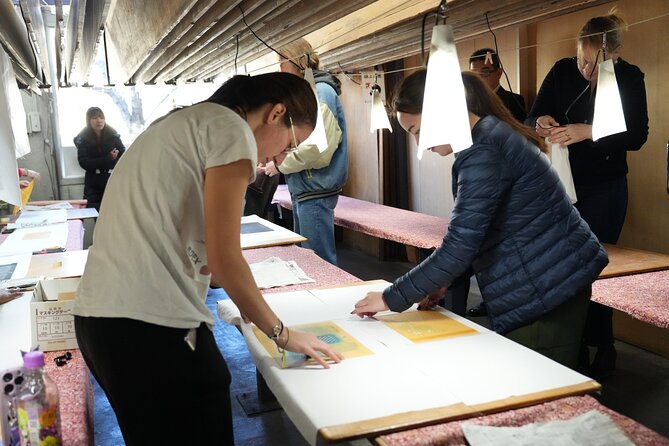
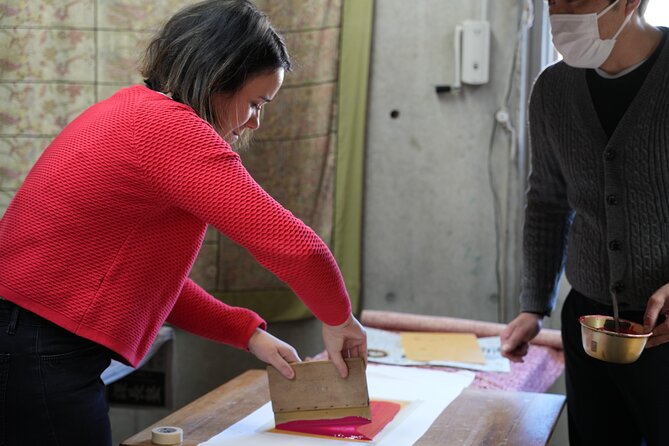
The first hour takes place at 染の里おちあい, written in English as Somenosato Ochiai. The workshop begins with a 10-minute introduction to Edo Komon patterns and their connection to samurai kamishimo clothing.
Edo Komon is known for small, repeated designs. From a distance, the patterns can look plain or even solid. Up close, the detail becomes the point. In the setting of this activity, you learn why these designs mattered in samurai dress and how stencil dyeing helped create them.
That short explanation gives the craft lesson more meaning. You are not just applying color to a cloth. You are working with a pattern tradition connected to a specific period and social setting in Japan.
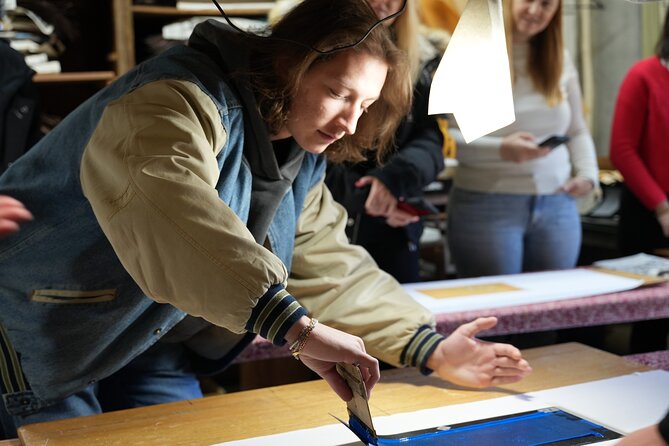
The main dyeing session lasts about 40 minutes. An artisan gives instructions, and you take part in the work yourself. The stated activity includes Komon pattern dyeing on a tenugui, a long, lightweight Japanese hand towel.
A tenugui is a practical souvenir because it is easy to carry and has many everyday uses. Here, the cloth also becomes part of the activity. You leave with a piece that reflects the pattern work you completed rather than a generic item bought from a shop.
You then spend about 10 minutes wrapping the dyed tenugui as a headband before departing Somenosato Ochiai. That final step makes the first workshop feel complete and sets up the transition to the dojo.
The craft session should suit people who like careful, hands-on work. It may be less appealing if you want a fast-moving activity from the start. Dyeing takes attention, and the finished pattern depends on following the instructions.
What to expect during the 40-minute dyeing lesson
The supplied details do not name the individual artisan leading the dyeing session, so you should expect instruction from the workshop staff rather than a named personal guide. The teaching includes both cultural explanation and technical guidance.
I like that balance. A craft lesson can feel thin when it gives you only a quick demonstration and sends you away with a souvenir. Here, the explanation of Edo Komon and samurai kamishimo gives you a reason to pay attention to the design.
You should also expect the finished cloth to reflect your own work. Small variations are part of the appeal of a handmade item. This is not a factory-perfect souvenir, and you should not approach it as one.
The tenugui is wrapped as a headband before you leave. That detail connects the object to the next part of the morning and gives you a simple way to carry or wear what you made.
The one-minute walk to the dojo
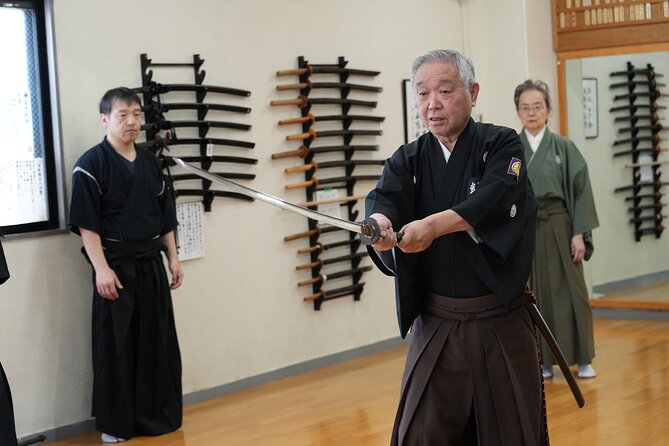
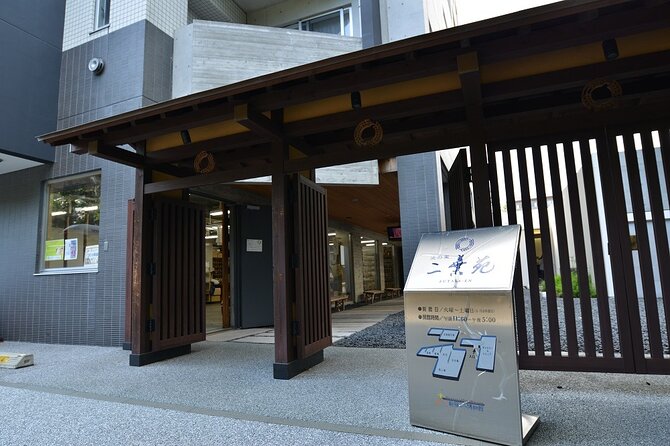
After the cloth workshop, you walk about one minute to 武蔵国無外会, the dojo at 2-chōme-4-6 Kamiochiai. The route is very short, but there is one practical detail: you take off your shoes before entering the dojo.
Wear shoes that are easy to remove and put back on. The provided information does not specify a dress code, but you should expect to move during the training, so comfortable clothing is a sensible choice.
The close location keeps the changeover quick. You do not lose a large portion of the two-hour booking to transport, and the contrast between the two spaces becomes part of the experience. One moment you are working with cloth and pattern. Soon after, you are standing in a dojo preparing for sword instruction.
The tour ends at the dojo. Plan your next Tokyo stop from that location rather than from Somenosato Ochiai.
Watching the 15-minute real sword demonstration
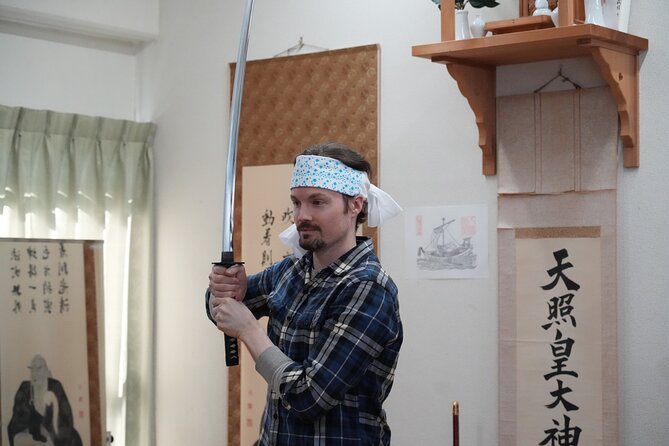
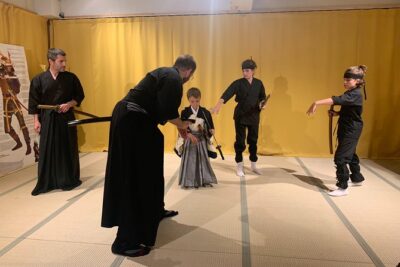
The sword portion begins with a 15-minute demonstration using a real sword. This is an important part of the sequence because you first see the form and handling before taking part yourself.
The demonstration also gives the activity a sense of seriousness. The workshop is not simply a costume photo opportunity. You are introduced to traditional sword technique through observation, then move into safer practice with toy swords.
The details do not state the exact style of swordsmanship or identify the demonstrator by name, so you should not book this expecting a particular school or famous instructor. The value here is the order of the lesson: watch, listen, then try.
For many people, this will be the most memorable part of the morning. Seeing a real sword used in a controlled demonstration helps explain why posture, distance, and defensive movement matter. It also gives you useful context for the next exercise.





Practicing defensive actions with toy swords
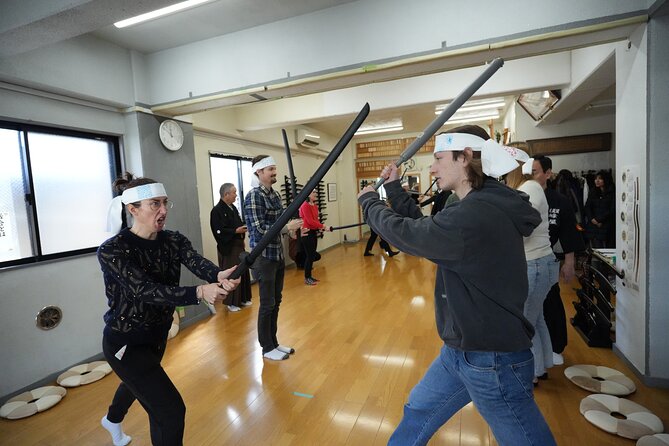
After the demonstration, about 15 minutes are devoted to defensive actions with toy swords. This is the bridge between watching and training.
The use of toy swords makes the session suitable for a broad range of participants. You can focus on the instructor’s directions and the shape of each movement without handling a real blade. The lesson is still active, but it is presented as guided practice rather than combat.
You then spend about 30 minutes on sword training. This is the longest single block in the dojo, giving you time to repeat the techniques and get a feel for the discipline involved.
I would approach this with the right expectations. You will learn introductory actions in a short session, not become proficient in samurai swordsmanship. The activity is valuable because it lets you try the basic mechanics and understand the focus required, not because it offers advanced martial arts training.
The provided description says most travelers can participate, but it does not give specific details about mobility requirements, physical intensity, or adaptations. If you have concerns about participation, ask the provider before booking.
What the $97.73 price gets you
At $97.73 per person, this is not the cheapest two-hour activity in Tokyo. Its value depends on how much you want from the experience.
You are paying for two guided sessions, artisan instruction, a hands-on dyed tenugui activity, and access to the dojo training. You also get a morning that combines making, learning, watching, and practicing without requiring separate bookings.
The price makes more sense if you value personal attention and a finished object. With a maximum of eight people, the group is small enough for instruction to feel more direct than at a large cultural demonstration.
It may feel less worthwhile if your priority is shopping for an inexpensive souvenir or seeing a long sword performance. The sword session is only about an hour, and half of the overall experience is devoted to dyeing.
The key question is simple: do you want to take part, or do you mainly want to watch? If you want to make a cloth and train with a toy sword, the two-part format gives the fee a reasonable purpose. If you prefer a passive show, there are likely cheaper options, though this activity offers more personal involvement.
Who should book this experience
I would recommend it most strongly to first-time visitors who want an introduction to Japanese culture that feels active rather than purely observational. The session gives you two clear subjects, traditional textile work and samurai sword practice, in a short block.
It also suits couples, families with older children, and small groups of friends who want a shared activity. The maximum of eight people helps keep the group manageable, and the two workshops offer different kinds of engagement.
Art and craft fans should pay attention to the first stop. The explanation of Edo Komon patterns adds a useful design lesson, while the handmade tenugui gives you something tangible to take away.
People interested in martial arts will probably enjoy the dojo, but they should remember that this is an introduction. It includes a real sword demonstration, defensive actions with toy swords, and 30 minutes of training. It does not promise a full course in a named martial arts style.
This may not be the best pick for someone who dislikes removing shoes, prefers a relaxed sightseeing tour, or wants a long, detailed workshop in only one subject. The experience changes pace quickly, from textile work to sword training.
Timing, meeting point, and small practical details
The start time is 10:00 a.m. You meet at 染の里おちあい, 2-chōme-3-6 Kamiochiai, Shinjuku City, Tokyo 161-0034.
The booking includes a mobile ticket, and confirmation is provided at the time of booking. Since the group can have up to eight people, arriving ready for the 10:00 a.m. start is important. The supplied information does not state a late-arrival policy, so do not assume the activity can wait.
The planned length is about two hours. The first stop takes one hour, including the introduction, dyeing, and headband wrapping. The second stop also takes one hour, including the demonstration, defensive actions, and training.
The finish point is 武蔵国無外会, 2-chōme-4-6 Kamiochiai, Tokyo 161-0034. Since the experience disbands at the dojo, use that address when planning your next stop.
Free cancellation is available if you cancel at least 24 hours before the local start time. Cancellations or changes made within 24 hours are not accepted for a refund. The activity also requires a minimum number of participants, so if the provider cancels because that number is not reached, you are offered another date or experience, or a full refund.
Is this a good way to spend a Tokyo morning?
I like this experience because it avoids the usual split between a craft class and a cultural performance. You learn about samurai clothing while working with Edo Komon patterns, then move into a dojo and try basic sword techniques after watching a real demonstration.
The strongest feature is the teaching sequence. The dyeing staff explain the cultural meaning and the practical method, while the dojo instructors explain defensive actions before training begins. That attention to both cultural context and technique is exactly what gives the morning substance.
The main limits are just as clear. Two hours is enough for a taste, not mastery. The price is substantial for a short activity, and the published details do not include named guides or extensive information about physical requirements.
Should you book it?
Book this if you want a small-group, hands-on introduction to two distinct Japanese traditions and like the idea of taking home a tenugui you helped dye. It is especially useful when your Tokyo schedule is tight, since the two venues are one minute apart.
Skip it if you want a long craft class, advanced sword instruction, or a low-cost sightseeing stop. For the right audience, the combination of Edo Komon dyeing, a real sword demonstration, toy sword practice, and a group capped at eight makes this a focused and memorable morning.
FAQ
Where does the experience start?
It starts at 染の里おちあい, located at 2-chōme-3-6 Kamiochiai, Shinjuku City, Tokyo 161-0034, Japan.
What time does the experience begin?
The scheduled start time is 10:00 a.m.
How long does the activity last?
The experience lasts approximately two hours, with about one hour at the dye workshop and one hour at the dojo.
What do you make during the Katazome session?
You dye a tenugui using Komon patterns and then wrap the dyed cloth as a headband before leaving the workshop.
What are Edo Komon patterns connected to?
The introduction explains their connection to samurai kamishimo clothing.
Do you use a real sword during the training?
You watch a 15-minute real sword demonstration. The defensive actions and training use toy swords.
How large is the group?
The activity has a maximum of eight travelers.
Where does the experience end?
It ends at 武蔵国無外会, located at 2-chōme-4-6 Kamiochiai, Tokyo 161-0034. The group disbands at the dojo.
Can you cancel for a full refund?
Yes. You can cancel at least 24 hours before the experience start time for a full refund. Cancellations or changes made less than 24 hours before the start are not accepted for a refund.
More Samurai & Ninja Experiences in Tokyo
More tours in Tokyo we've reviewed









Samurai & Ninja Experiences, compared.
 ★ 4.5Tokyo: Samurai Restaurant Show Ticket with 2 DrinksFrom $551h 30m
 ★ 4.6Tokyo: Samurai Ninja Museum Guided tour and ExperienceFrom $27
 ★ 5.0Tokyo: Samurai Sword & Archery Class from Samurai DescendantFrom $1933 hours
 ★ 5.0Best Samurai Experience in TokyoFrom $65
 ★ 5.0Ninja Experience (Family Friendly) at Samurai Ninja Museum TOKYOFrom $47
 ★ 4.6Tokyo: Samurai Entertainment Night Show in Kanda ShrineFrom $412 - 3 hours