
Reviewed · E-BIKES
Tokyo Cherry Blossoms blooming spots E-bike Tour, 3hrs
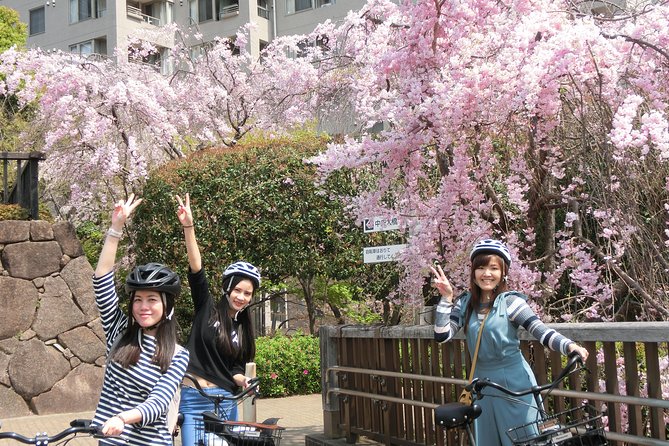
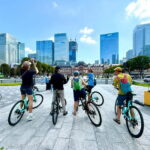
Tokyo’s cherry blossoms are best seen while moving. This three-hour E-bike tour links several central Tokyo viewing spots that would take far more effort to reach on foot. You ride beside the Imperial Palace area, through parks, and along the Sotobori outer moat, with stops for photos and short walks.
I like the easy electric assist and the small group size, limited to six people. Guides including Jenny, Take, Kenta, and Yoshihisa add useful background about Tokyo, Japanese culture, and sakura traditions. The main drawback is timing: if the blossoms are late, early, or past their peak, the experience cannot promise a full display.
In This Review
- Key points to know
- Why an E-bike is a smart way to see Tokyo in spring
- Starting near Kanda Station
- Chidorigafuchi: a strong first look at the blossoms
- Yasukuni Shrine: step off the bike for context
- Sotobori Park: cycling beside the outer moat
- Hibiya Park: a brief urban green pause
- Kensei Kinenkan: another chance to get off and look around
- The guides shape the experience
- Cherry blossom timing is the biggest variable
- What the $64.57 price gets you
- Who should book this ride
- Booking and cancellation details to keep in mind
- Should you book the Tokyo cherry blossom E-bike tour?
- FAQ
- How long is the Tokyo cherry blossom E-bike tour?
- Where does the tour start?
- Where does the tour end?
- Which cherry blossom locations are included?
- Is the E-bike rental included?
- Is a guide included?
- Is food included?
- Can I leave luggage at the meeting point?
- What is the minimum age and height?
- What happens if the cherry blossoms are not blooming?
Key points to know
- Five central blossom stops: Chidorigafuchi, Yasukuni Shrine, Sotobori Park, Hibiya Park, and Kensei Kinenkan fit into one well-planned ride.
- Electric assistance matters: You can cover about 15 kilometers without treating the tour like a fitness challenge.
- Small groups help: A maximum of six people makes city riding and photo stops easier to manage.
- Cherry blossom timing is uncertain: The company may offer a regular Tokyo cycling route or a refund if the blossoms are not showing.
- Practical meeting point: The ride begins and ends at Cycling Holiday Tokyo near Kanda Station.
- Basic gear is included: You receive an E-bike, helmet, guide service, insurance, and luggage storage for nonvaluables.
Why an E-bike is a smart way to see Tokyo in spring
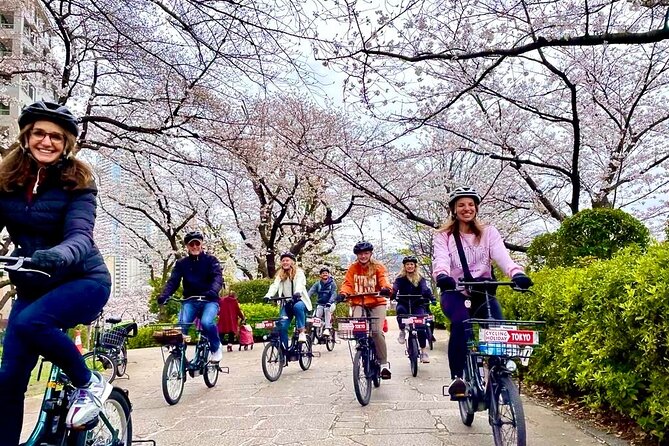
Tokyo is huge, and its best cherry-blossom sites are spread across central districts. You could connect them by train, but stations, transfers, and crowded sidewalks eat up time. A bicycle lets you move between the major sights while seeing the streets in between.
The electric motor is the key. You still pedal, but the assist takes the sting out of hills and longer stretches. One reported route covered about 15 kilometers, a useful indication of how much ground you may cover in three hours. You do not need to be a keen cyclist, but you do need to ride a bicycle confidently.
The group limit of six is another real advantage. Tokyo traffic requires attention, and a compact group is easier to guide through city streets than a large sightseeing procession. It also leaves more room for questions and quick photo stops.
This is not a slow, formal garden tour. You will spend much of the time riding, with short stops at the listed sights. If you want to sit beneath one tree for an hour with a picnic, visit a park independently after the tour.
Other cycling tours in Tokyo
Starting near Kanda Station
The meeting point is Cycling Holiday Tokyo at 3-chome-8-6 Uchikanda, Chiyoda City. It is near Kanda Station, served by the JR Yamanote Line and Tokyo Metro, and the base offers free Wi-Fi.
The tour returns to the same point, which makes the outing easy to fit into a Tokyo day. You can leave luggage at the base during the ride, except for valuables. That is useful if you are carrying a day bag or checking out of a hotel, though you should keep passports, cash, electronics, and other important items with you.
Plan to arrive ready to ride. The operator supplies the bicycle and helmet, but food, drinks, and rain gear are not included. Sunscreen and a towel make sense in warm weather. In winter, bring warm clothes and gloves because the breeze feels colder on a bicycle.
You must be at least 12 years old and at least 147 centimeters, or about 4 feet 10 inches, tall. The supplied information lists a minimum of 4.8 feet, with 147 centimeters as the metric measurement, so anyone close to the limit should confirm fit before booking. You cannot join if you do not know how to ride a bicycle.
Chidorigafuchi: a strong first look at the blossoms
Chidorigafuchi is the first listed stop, with about 10 minutes of cycling and blossom viewing. The route takes you along the area around the Imperial Palace moat, where cherry trees create one of Tokyo’s most recognizable spring scenes.
This is a good place to begin because you get an immediate sense of scale. The water, stone walls, and rows of trees make for strong photographs, and riding gives you changing views instead of one fixed viewpoint. Your guide can also help you pause in sensible places rather than stopping wherever the path is most crowded.
The trade-off is time. Ten minutes passes quickly, especially when the trees are in full bloom. Think of this as a moving introduction, not a long garden visit. If photography is your top priority, tell your guide early so you can understand how much time is available at each stop.
Yasukuni Shrine: step off the bike for context
At Yasukuni Shrine, you leave the bicycle and spend around 15 minutes viewing cherry trees in the grounds. This is one of the more useful stops for anyone who wants a little cultural context along with spring scenery.
The shrine is not simply another photo backdrop. Its history can be politically sensitive, and a local guide can explain the setting in a way that is difficult to pick up during a quick independent visit. Take was praised for giving background on Tokyo, the sites, and the blossoms, while other guides have also been noted for connecting places to Japanese culture.
The stop is short, so do not expect a full shrine visit. You will have time to look around and take photographs, but the main purpose is to combine the blossoms with the site’s broader meaning.
Sotobori Park: cycling beside the outer moat
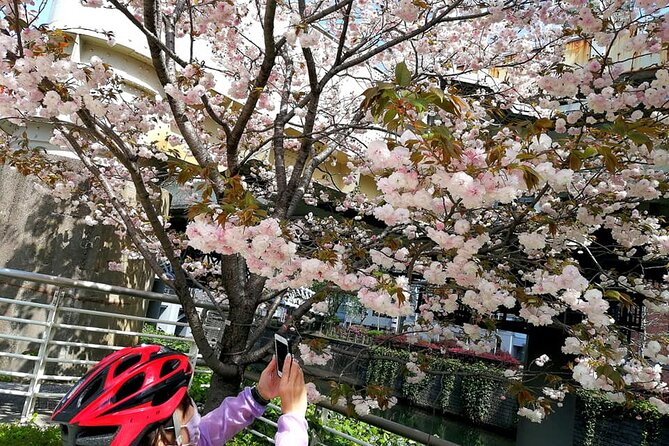
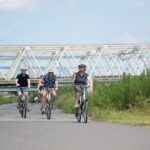
Sotobori Park offers one of the tour’s most appealing riding sections. You cycle beside the SOTOBORI outer moat while looking at the cherry trees, with about 10 minutes allocated to this part of the route.
This is where the bicycle earns its keep. The point is not only to arrive at a park, but to enjoy a continuous line of trees while moving through the city. You get a better feel for the relationship between Tokyo’s waterways, roads, rail lines, and green spaces.
Keep your eyes on the road, not just the blossoms. A bicycle tour requires you to balance sightseeing with safe riding. The electric assist helps with effort, but it does not remove the need to watch traffic, pedestrians, and other cyclists.
A few more Tokyo tours and experiences worth a look

Hibiya Park: a brief urban green pause
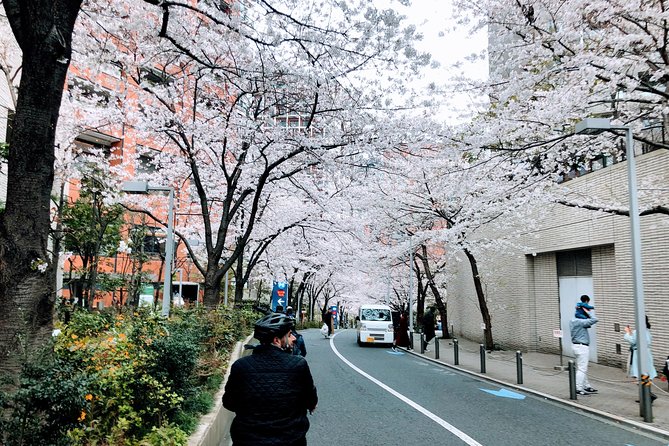
The tour passes through Hibiya Park for about five minutes while you look at the cherry trees. This is the shortest stop, so it functions more as a scenic passage than a full park visit.
Hibiya Park gives you a different view of Tokyo’s spring season. Instead of a shrine or moat, you see blossoms set within a central urban park. That contrast helps make the route feel like a tour of Tokyo itself, not only a search for one type of tree.
Five minutes is enough to take in the setting, but it may feel rushed if the trees are especially attractive that year. The benefit is that the tour keeps moving and can include several distinct areas in one morning or afternoon.
Kensei Kinenkan: another chance to get off and look around
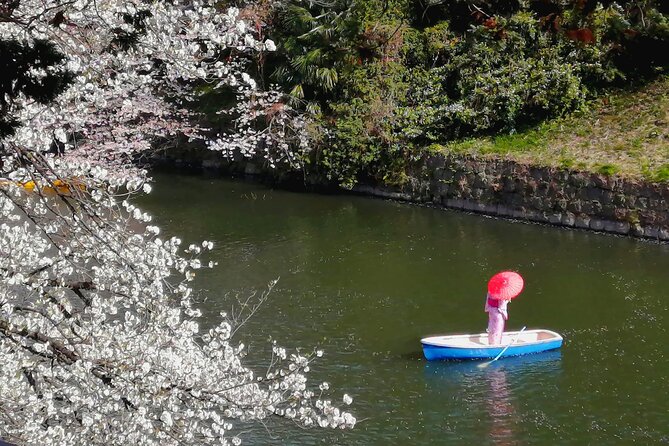
At Kensei Kinenkan, you park the E-bikes and spend about 10 minutes seeing the cherry blossoms in the park. Like Yasukuni Shrine, this stop gives you a chance to stretch your legs and view the trees without watching the road.
The route’s mix of moving sections and short walking stops is well suited to a three-hour format. You see more ground than on a walking tour, but you still have several opportunities to step away from the saddle. Guides have also adjusted routes when bloom conditions were poor, taking people to other places where the experience could still work.
Do not expect every blossom tree in the area to be known in advance. One piece of feedback pointed out that a fully flowered street was missed. That is a fair limitation of a set-duration guided ride: the guide has to balance the planned route, traffic, group needs, and available time.
The guides shape the experience
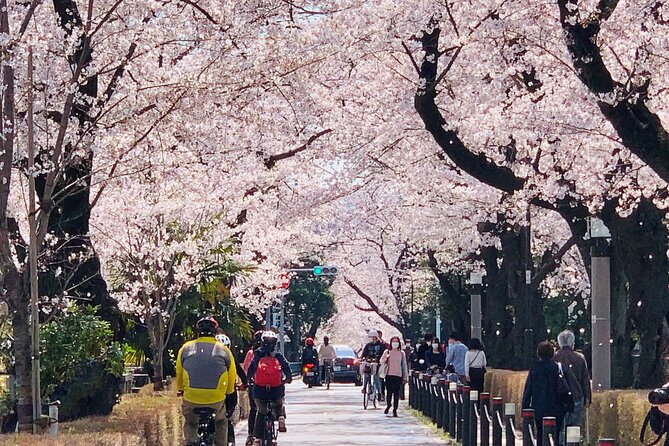
The guide is central to this tour. The strongest accounts describe guides who are polite, warm, entertaining, and good at explaining Tokyo’s past and present. Take provided a 13-year-old and parent with background they would not have picked up alone. Jenny was praised for combining local knowledge with an upbeat manner, while Kenta was described as energetic and fun.
Yoshihisa, also called Yoppi, has led rides in cold weather and during uncertain bloom periods. His responses show an effort to adjust the experience when nature does not cooperate. Takako, known as Jenny, has also guided routes when the sakura season arrived late.
The commentary seems to be a major reason to choose this tour instead of simply renting a bicycle. You are not only following a map. You can ask questions about the parks, shrines, Tokyo, and the cultural importance of cherry blossoms.
There is one small point to manage. Some people enjoy group photos, while others do not want pictures with unfamiliar people. If you prefer private photos or would rather spend more time shooting trees than posing, say so politely at the start. The group can also communicate its priorities about food stops and photography. One outing included an offered food break that the group declined, while more flexible planning might have helped with the available viewing time.
Cherry blossom timing is the biggest variable
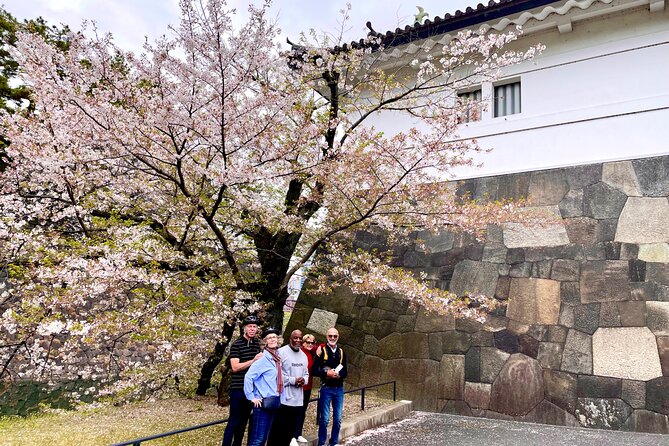
No tour can control when Tokyo’s sakura bloom. The season can arrive late, and full bloom may last only a short time. Even local people cannot always predict the exact peak, and different varieties flower at different times.
The company has handled poor timing in several ways. It has offered a regular Tokyo E-bike route, adjusted the route to find more flowers, or proposed a refund when there was not enough bloom to make the advertised theme worthwhile. That flexibility reduces the risk, but it does not guarantee the classic scene shown in spring photographs.
I would place this tour early in your Tokyo schedule if cherry blossoms are a major goal. If the trees are not yet open, you may have time to try again independently or book another activity. You should also avoid making the ride the only reason for visiting Tokyo in spring.
The best-case day is special. You ride through full bloom while local families and friends enjoy picnics and park walks. That public, everyday side of hanami, or flower viewing, is often more memorable than a carefully framed photograph.
What the $64.57 price gets you
At $64.57 per person, the tour is reasonably priced for a three-hour guided outing that includes an E-bike, helmet, insurance, and luggage storage. The value comes from combining equipment rental, route planning, local commentary, and access to several sites in one booking.
A bicycle rental alone would not provide the same orientation. You would need to choose a route, find the blossom areas, navigate central Tokyo, and decide how to connect Chidorigafuchi, Yasukuni Shrine, Sotobori Park, Hibiya Park, and Kensei Kinenkan.
The price is less compelling if you only want to sit in one park or if you already know central Tokyo well. It is also a gamble if the bloom forecast is poor, although the operator’s alternate-route and refund options help.
With a 4.9 rating from 27 ratings and a 93 percent recommendation figure, the overall record is strong. Still, the price does not buy unlimited photo time or food. Bring your own drinks, and treat the tour as an active sightseeing circuit rather than a leisurely meal-and-picnic excursion.
Who should book this ride
I would recommend it to first-time Tokyo visitors who want a quick orientation around the Imperial Palace area and central parks. Families with older children can also fit well, provided everyone meets the age, height, and cycling requirements. A 13-year-old has completed the ride successfully with a parent.
It suits adults who are comfortable on a bicycle but do not want a hard workout. The electric motor makes the distance manageable, though you still spend three hours outdoors and in the saddle.
It is less suitable for anyone who cannot cycle, dislikes riding near city traffic, or wants a slow, highly flexible photography tour. It may also disappoint people who expect a guaranteed peak-bloom day. The route is designed to show several places, so your time at each one is limited.
The maximum of six helps, but the tour may include other participants. If you want a private outing, ask about that before booking rather than assuming the small group is exclusive.
Booking and cancellation details to keep in mind
Confirmation is sent within 48 hours, subject to availability. The tour requires at least two people per booking, although one-person participation may be possible if you contact the operator. The maximum is six people.
The listed availability includes Sundays and public holidays. The experience depends on good weather. If rain or other poor conditions cause cancellation, you are offered another date or a full refund. You can cancel for a full refund up to 24 hours before the local start time, but cancellations and changes inside that window are not refunded or accepted.
Should you book the Tokyo cherry blossom E-bike tour?
Book it if you want to cover several central Tokyo blossom areas in one outing and value a guide who can explain what you are seeing. The E-bike, compact group, and return to the Kanda meeting point make it an efficient choice, especially early in a Tokyo visit.
Book with realistic expectations about sakura timing and stop lengths. Check the forecast and bloom reports, bring weather-appropriate clothing, and tell your guide how you feel about group photos or extra photo time. If the blossoms are late, accept the alternate Tokyo cycling route only if that still sounds worthwhile, or use the weather and minimum-group cancellation options.
For a first look at Tokyo in spring, this is a practical and enjoyable ride. It gives you more than a blossom checklist, but the quality of the day depends on the season, the weather, and how much flexibility your small group wants.
FAQ
How long is the Tokyo cherry blossom E-bike tour?
The tour lasts approximately three hours.
Where does the tour start?
It starts at Cycling Holiday Tokyo, 3-chome-8-6 Uchikanda, Chiyoda City, Tokyo 101-0047, near Kanda Station.
Where does the tour end?
The activity ends back at the Kanda meeting point.
Which cherry blossom locations are included?
The listed stops are Chidorigafuchi, Yasukuni Shrine, Sotobori Park, Hibiya Park, and Kensei Kinenkan.
Is the E-bike rental included?
Yes. The tour includes an E-bike rental and a helmet.
Is a guide included?
Yes. A guide leads the tour and provides commentary along the route.
Is food included?
No. Food and drinks are not included.
Can I leave luggage at the meeting point?
Yes. You can leave luggage with the operator during the tour, but valuables should not be left there.
What is the minimum age and height?
The minimum age is 12 years, and the minimum height is listed as 147 centimeters, or about 4 feet 10 inches.
What happens if the cherry blossoms are not blooming?
The operator may offer a regular Tokyo E-bike tour, adjust the route, provide another date or experience, or offer a full refund depending on the circumstances. The exact bloom timing cannot be guaranteed.
More E-Bikes in Tokyo
More Cycling Tours in Tokyo
More tours in Tokyo we've reviewed





E-Bikes, compared.
 ★ 5.0Tokyo Top Highlights 3h Guided E-bike TourFrom $63
 ★ 5.03h Tokyo E-Bike Tour: Hidden Gems, and Local Life with guideFrom $63
 ★ 4.8Tokyo: 3-Hour Bike or E-Bike City Highlights TourFrom $453 hours
 ★ 4.8Tokyo: 3-hour Guided E-Bike Tour of the City’s Hidden GemsFrom $65
 ★ 5.0Tokyo: 3-Hour Bike/E-Bike Tour of the City’s HighlightsFrom $63
 ★ 5.03-Hour Tokyo Private E-Bike Tour Starting from Your HotelFrom $145