
Reviewed · ASAKUSA TOURS
Tokyo: Asakusa and Tokyo’s Oldest Temple Senso-ji Tour
Tokyo’s oldest temple is only part of the appeal here. Asakusa still feels like old Tokyo, with red lanterns, narrow lanes, shrine gates, sweet shops, and the steady ritual of people visiting Senso-ji. A good guide turns a famous photo stop into a place you can understand.
I like the small groups of no more than 10 and the practical local advice, especially food and souvenir suggestions from guides such as Shino. The main drawback is the short two-hour schedule: you get a fine introduction, but not enough time to explore every side street, shop, and temple building at an easy pace.
In This Review
- Key points at a glance
- Why Asakusa makes such a good first Tokyo walk
- Meeting at Asakusa Station
- Kaminarimon and the first look at old Tokyo
- Nakamise Street and the edible side of Asakusa
- Senso-ji, Tokyo’s oldest temple
- Asakusa Shrine and the Buddhist-Shinto contrast
- The local stories that make the walk worthwhile
- Pace, crowds, and what to wear
- What $14 gets you
- Who should book this Asakusa tour
- Booking details worth knowing
- Should you book it?
- FAQ
- How long does the Asakusa and Senso-ji tour last?
- What language is the tour offered in?
- Where does the tour meet?
- Where does the tour finish?
- How many people can join the tour?
- Which places are included?
- Is admission included?
- Can I cancel for a refund?
- Do I need WhatsApp?
Key points at a glance
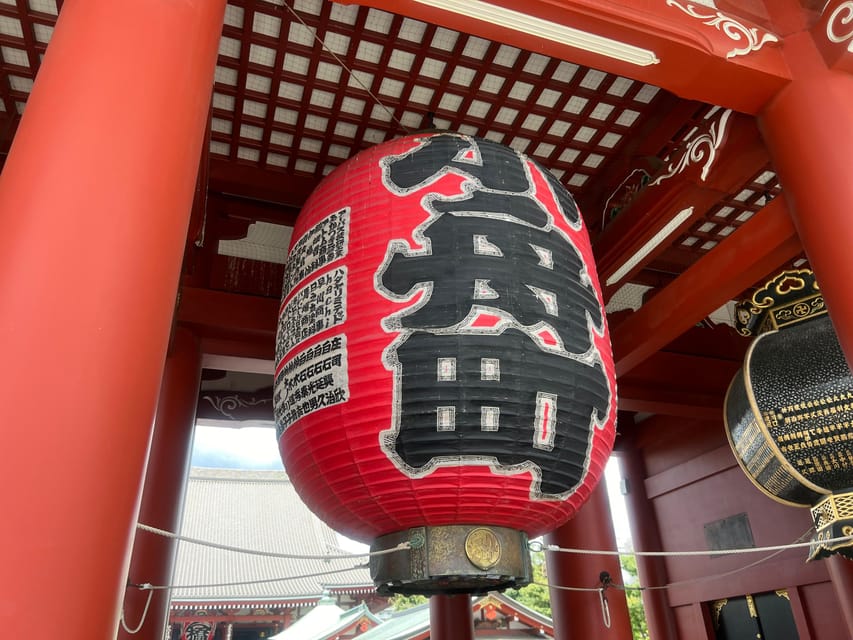
- Kaminarimon begins the story: Start beneath Asakusa’s giant red gate and its famous lantern.
- Nakamise is more than a shopping strip: Learn how its sweets, souvenirs, and traditional goods fit into the temple approach.
- Senso-ji gets proper cultural context: Your guide explains Buddhist customs, temple etiquette, and local legends.
- Asakusa Shrine adds a different tradition: Compare a Shinto shrine with the Buddhist temple next door.
- Guides make the difference: Shino, Embla, Nicolas, Aska, Joe, and others have been praised for clear English, patience, and useful local advice.
- $14 is a strong price: For two hours with a live guide and a group capped at 10, this is inexpensive by Tokyo tour standards.
Why Asakusa makes such a good first Tokyo walk
Tokyo can feel enormous and hard to read. Asakusa gives you a manageable place to begin. Within a short walk, you see a major Buddhist temple, a Shinto shrine, an old shopping street, traditional snacks, souvenir stalls, and traces of Edo-era Tokyo.
I like this area because its past is not kept behind glass. People still come to pray, buy sweets, draw fortunes, and shop for small reminders of Japan. At the same time, Asakusa is not a perfectly preserved historical village. It is an active Tokyo neighborhood shaped by war, reconstruction, tourism, and daily life.
That mix is the real subject of the tour. Your guide explains how the district changed from samurai-era Edo through the post-war period and into modern Tokyo. You hear about geisha districts, lesser-known shrines, local customs, and the way the neighborhood recovered after destruction.
The route is also mercifully focused. You are not being marched across half of Tokyo. The walk begins and ends near Asakusa Station, making it easy to fit into a first morning in the city or a short visit to the district.
A few more Tokyo tours and experiences worth a look



Meeting at Asakusa Station
The meeting point is in front of the Starbucks closest to Asakusa Station, at approximately 35.7119461, 139.7979446. That detail matters because Asakusa has several station exits and a busy flow of pedestrians. Check the exact location before you leave your hotel.
You are asked to download WhatsApp before meeting. Guides use it to coordinate the group, and Nicolas even helped a delayed participant catch up by sharing his location. Do not treat that as permission to arrive late, but it is reassuring if Tokyo transport or a crowded station causes trouble.
The walk lasts two hours and is conducted in English. Groups are limited to 10 people. That is small enough for questions and personal attention, but the experience is not guaranteed to feel private. One solo participant happened to join a group of just two, while another group had seven people.
The guide may change. Names praised for their friendly manner, clear English, and local insight include Shino, Embla, Nicolas, Aska, Joe, Naoya, Ryota, Yota, and others. The consistent strength is not one particular personality. It is the care taken to explain customs, keep people together, and adjust the pace.
Kaminarimon and the first look at old Tokyo
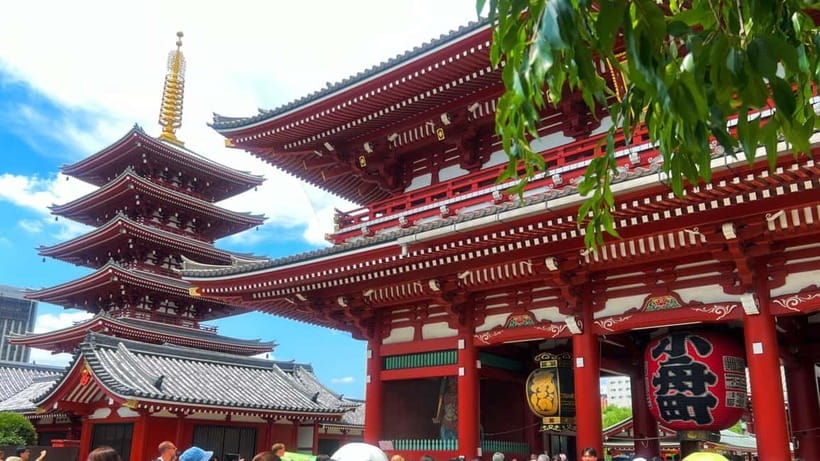
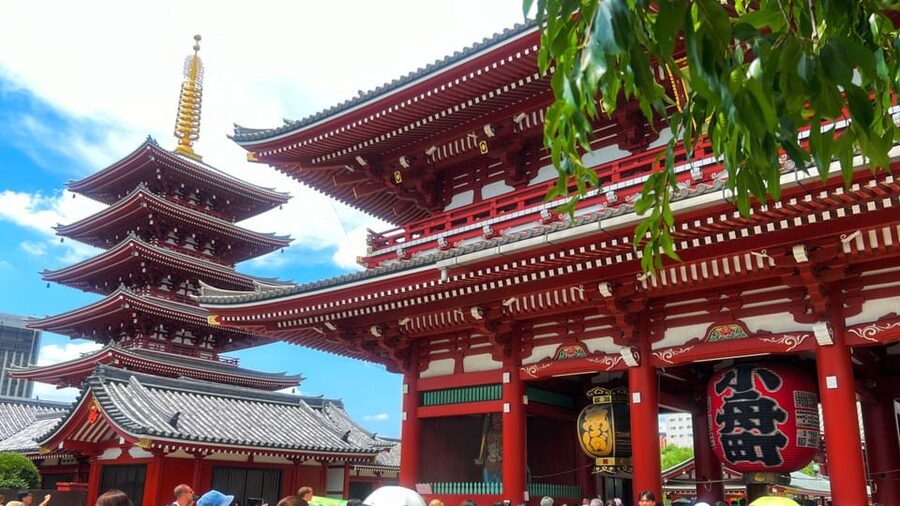
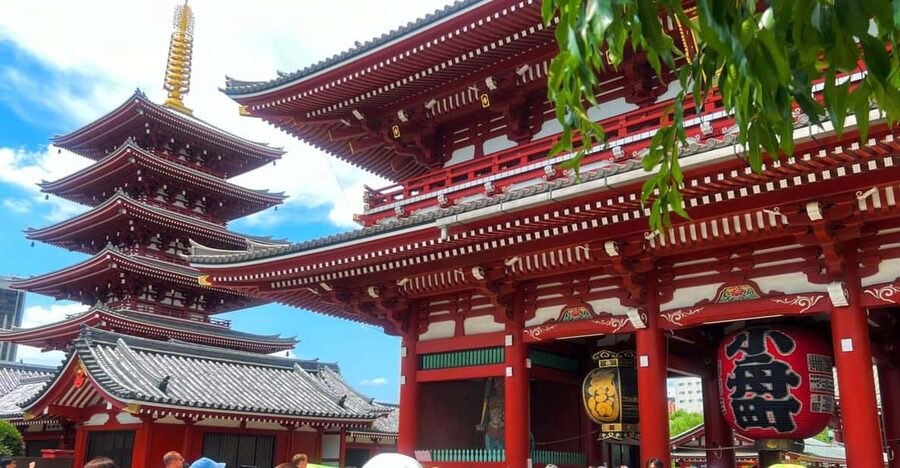
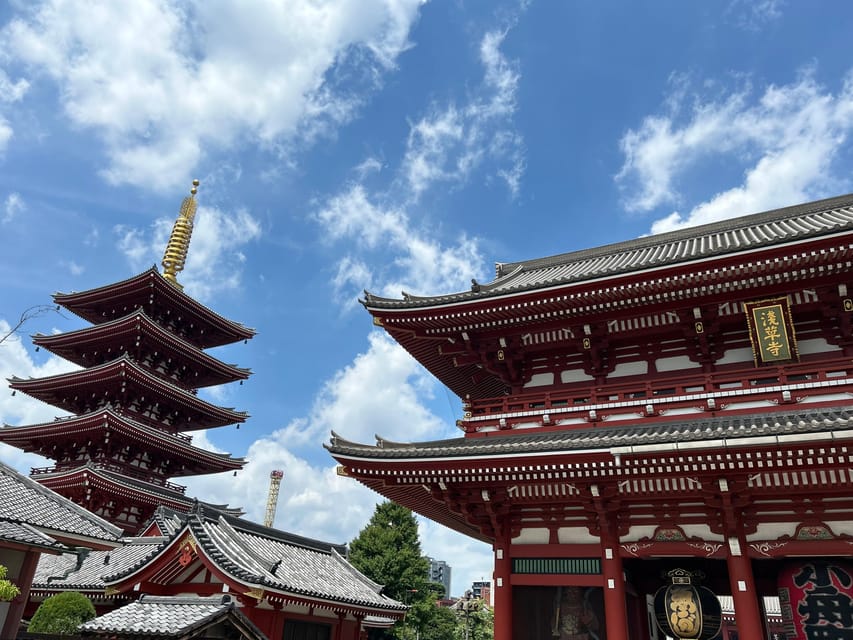
The first formal stop is Kaminarimon, or the Thunder Gate. This is the grand entrance to the Senso-ji area, marked by a huge lantern and powerful guardian figures. It is the spot most people recognize from photographs, but the guide gives you a reason to pause instead of simply taking a picture and moving on.
Expect around 30 minutes here for a guided visit and photo stop. The time allows your guide to explain the gate, the temple approach, and the way this entrance frames the rest of the visit.
This is also where the group may face its first crowd-management challenge. Kaminarimon and the surrounding streets can be packed, especially when several groups arrive at once. Regina specifically praised her guide for checking constantly that no one was left behind, while another participant noted that the guide had to become more firm when part of the group moved too slowly.
I suggest arriving with your phone or camera ready, but keeping it away long enough to listen. The visual impact is immediate. The historical setting takes a little more attention.
Nakamise Street and the edible side of Asakusa
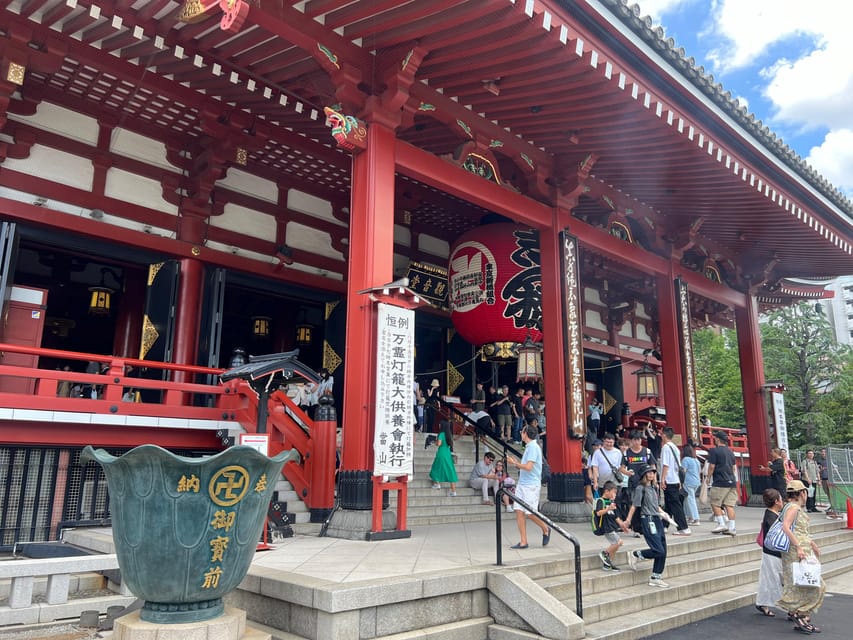
From Kaminarimon, you walk along Nakamise Shopping Street for about 20 minutes. This is the approach leading toward Senso-ji, lined with small shops selling snacks, sweets, souvenirs, and traditional goods.
Nakamise can feel commercial, and it is. That is not a flaw, but you should know what kind of place it is. This is a working visitor street rather than a quiet lane untouched by modern tourism. Its value comes from the connection between commerce and temple life. Buying food and small goods here is part of the long-established approach to visiting the temple.
The guides make this stop more useful by pointing out local foods and explaining what is worth trying. Red bean-filled ningyo-yaki, a small traditional cake, received a specific mention from one participant. Shino also gave advice on popular places to eat and souvenirs with genuine meaning rather than simply the most obvious tourist purchase.
You may want to return after the tour with cash and time to browse. The 20-minute stop is enough to understand the street, but not enough for a relaxed shopping session. If you find a snack you like, note the shop and come back later.
Senso-ji, Tokyo’s oldest temple
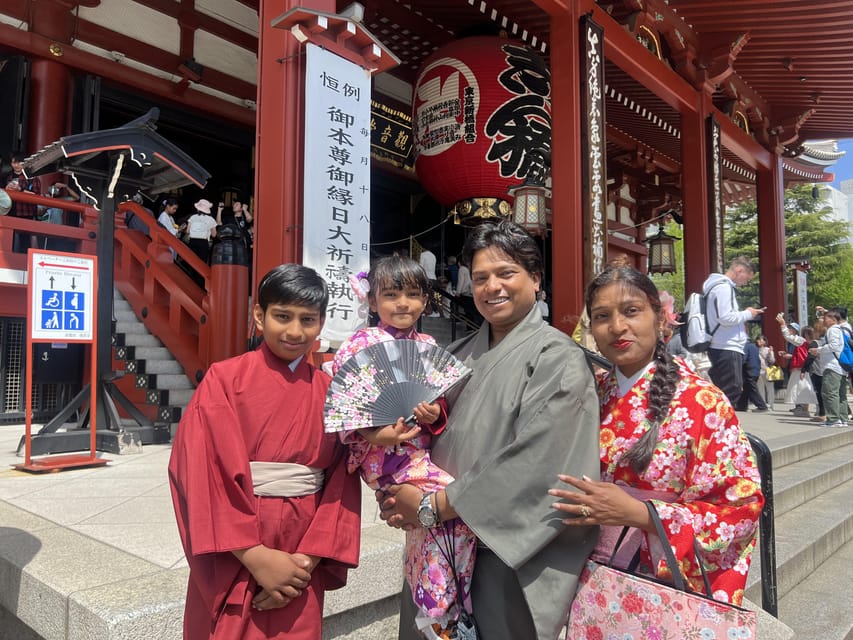
Senso-ji is the heart of the experience. Founded in the seventh century, it is recognized as one of Tokyo’s oldest temples and remains one of the city’s most important cultural sights.
The tour gives this stop about 30 minutes for walking, explanation, and photographs. That is enough for an introduction to the temple grounds and the basic traditions connected with a visit. Your guide explains the Buddhist significance of the site, shares stories and legends, and helps you read the setting beyond its bright colors and enormous scale.
One of the best parts is learning how to approach the temple respectfully. Guides have shown people how to pray and how to follow temple customs. Nicolas received particular praise for explaining Buddhism and the proper approach to the temple, while Shino was singled out for careful explanations of the temple and shrine.
You may also choose to draw a fortune during your visit. One participant particularly enjoyed getting a fortune at the temple. If you do, ask your guide to explain the custom rather than treating it as a novelty. Small details like this help you take part in the place instead of only observing it.
The limitation is time. Senso-ji has enough buildings, gates, statues, and visual details to fill much longer than half an hour. This tour helps you understand the main points, but you should return later if you want quiet photographs, a closer look at the grounds, or more time for prayer.
A few more Tokyo tours and experiences worth a look

Asakusa Shrine and the Buddhist-Shinto contrast
The final major stop is Asakusa Shrine, with roughly 30 minutes for a guided visit and photographs. Its position near Senso-ji makes it especially useful for understanding two Japanese religious traditions side by side.
Senso-ji is a Buddhist temple. Asakusa Shrine is a Shinto shrine. The tour does not merely point out the difference in names. Guides explain customs, prayer practices, and the religious meaning of each setting. That comparison is one of the most valuable parts of the walk because it gives you a basic framework for many other Japanese sites.
Aska was praised for teaching the correct way to pray and for explaining Japanese culture and history through the shrine visit. This kind of instruction is practical. Once you understand the pattern, other temples and shrines during your Japan trip become easier to approach with confidence.
The shrine stop also gives the tour a quieter counterpoint to the main temple approach. Do not expect complete silence, since this is still a popular part of Asakusa, but the mood and visual language change enough to make the contrast clear.
The local stories that make the walk worthwhile
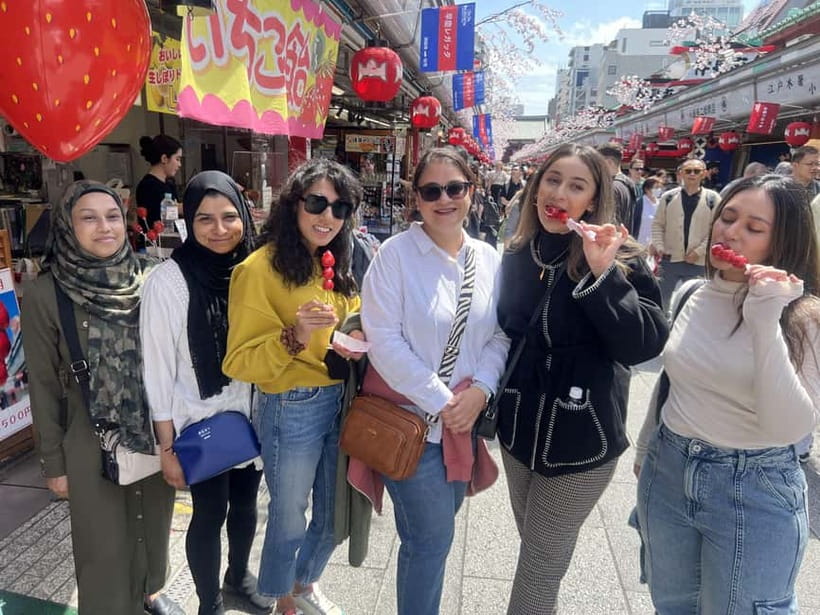
A guide is most useful in Asakusa when the talk moves beyond dates and famous names. This experience includes stories of geisha districts, hidden shrines, samurai-era Tokyo, post-war recovery, and everyday customs.
That range gives you a fuller picture of the neighborhood. You are not only learning that Senso-ji is old. You are learning how the surrounding district developed, why the streets look as they do, and how older traditions remain part of modern Tokyo.
The best guide style here seems to be conversational rather than academic. Joe was praised for making the walk feel like exploring with a local friend, while Embla was appreciated for humor, organization, and patient answers. Nicolas was described as an engaging storyteller who added anecdotes and recommendations. These qualities matter in a crowded district, where a dry lecture would be easy to lose.
English ability has also been a strong point across the guiding team. Shino, Naoya, Yota, Ryota, Aska, and others were praised for explaining Japanese history and customs clearly. That makes the tour suitable for first-time visitors who want cultural background without a specialist lecture.
Pace, crowds, and what to wear
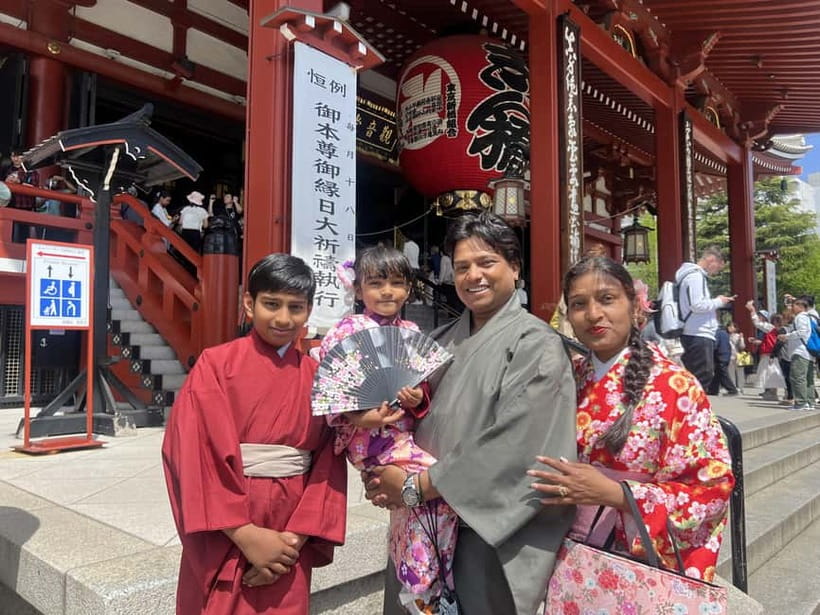
The walk is not physically demanding, but you will be on your feet for two hours. Wear comfortable shoes and expect regular stops rather than a long uninterrupted march.
Crowds are the main practical issue. Asakusa is a major Tokyo sight, and the route includes some of its most popular spaces. Stay close to the guide, especially around Kaminarimon and Nakamise. The small group limit helps, but it cannot make a crowded street empty.
Pacing depends partly on the group. Most accounts praise guides for making sure everyone stayed together and for answering questions without rushing. One account also shows the other side: slow participants or people talking over the guide can affect the rhythm. If you need a very private, perfectly controlled walk, book a private guide instead.
Weather matters as well. The experience is outdoors for much of its duration. A summer participant praised Aska for looking after the group in very hot conditions, but you should still plan sensibly with water, sun protection, and weather-appropriate clothing.
What $14 gets you
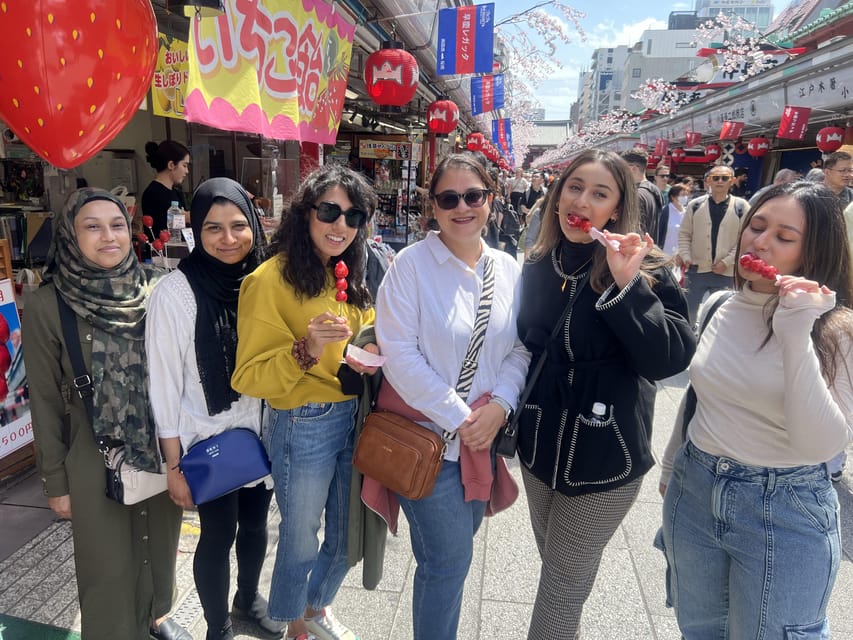
At $14 per person, this is an unusually affordable guided introduction to one of Tokyo’s most important districts. The price includes the guide, the walking tour, and admission connected with Asakusa, Senso-ji, and Nakamise Street.
The real value is not an entrance ticket. Senso-ji is a public religious site, and you can visit the general area without paying for a tour. You are paying for orientation, translation of customs, historical context, and a route that links the key places in a sensible order.
I think the price works best if you are new to Tokyo, short on time, or unsure how to behave at temples and shrines. It also works for solo visitors who want a small social setting without joining a huge coach group.
It is less useful if you already know Asakusa well or prefer to wander alone. A two-hour tour cannot cover every shop or side street. Think of it as a guided foundation, followed by your own extra time in the neighborhood.
Who should book this Asakusa tour
I would recommend it to first-time Tokyo visitors, culture-focused visitors, solo visitors, and families who want a clear introduction without spending half a day on a formal excursion. The small group size makes it easier to ask about food, etiquette, and what to see next.
It suits people who enjoy stories as much as photographs. You will get more from the tour if you are willing to listen to the explanation behind a gate, snack, prayer ritual, or street layout.
It is also a smart first-day activity in Asakusa. After two hours, you will know where Senso-ji and Asakusa Shrine are, how Nakamise fits into the temple approach, and which nearby foods or shops deserve a second look. Several guides also offer useful suggestions for eating and shopping in the area.
Booking details worth knowing
You can cancel up to 24 hours before the start for a full refund, and the reserve-now, pay-later option keeps your schedule flexible. Starting times vary, so check availability for your chosen date.
The meeting point is outside the Starbucks nearest Asakusa Station. Download WhatsApp before you go, and allow enough time to identify the correct station exit and meeting area.
The tour is offered in English with a live guide. Since the group can include up to 10 people, arrive ready to keep pace and stay within sight of the guide.
Should you book it?
Book this tour if you want Asakusa explained, not merely photographed. For $14, two hours, and a group capped at 10, the value is excellent. The strongest features are the guides, the clear explanations of temple and shrine customs, and the practical advice about local food and souvenirs.
Skip it if you have already spent serious time in Asakusa or want a slow private exploration. Otherwise, it is a sensible way to get your bearings fast, learn how to approach Senso-ji respectfully, and leave with a better plan for exploring the neighborhood on your own.
FAQ
How long does the Asakusa and Senso-ji tour last?
The walking tour lasts two hours.
What language is the tour offered in?
The tour is conducted in English with a live English-speaking guide.
Where does the tour meet?
The group meets in front of the Starbucks closest to Asakusa Station. The listed coordinates are 35.7119461, 139.7979446.
Where does the tour finish?
The tour returns to the same Starbucks meeting point near Asakusa Station.
How many people can join the tour?
It is a small-group tour limited to 10 participants.
Which places are included?
The route includes Kaminarimon, Nakamise Shopping Street, Senso-ji Temple, and Asakusa Shrine.
Is admission included?
Admission connected with Asakusa, Senso-ji Temple, and Nakamise Shopping Street is included, along with the guide and walking tour.
Can I cancel for a refund?
Yes. You can cancel up to 24 hours in advance for a full refund.
Do I need WhatsApp?
You are asked to download WhatsApp before the meeting so the guide and group can coordinate smoothly.
More Temples & Meditation in Tokyo
More Asakusa Tours in Tokyo

More tours in Tokyo we've reviewed






Asakusa Tours, compared.
 ★ 4.8Tokyo: Japanese Dance Cabaret Theater Asakusa-Kaguwa TicketFrom $492 hours
 ★ 4.7Tokyo: Meiji Shrine, Asakusa, Skytree Bus Tour and CruiseFrom $12210 hours
 ★ 4.9Tokyo: Roll and Authentic Sushi Making Class in AsakusaFrom $581h 40m
 ★ 4.8Tokyo: Asakusa Walking Tour with Sensoji Temple VisitFrom $222 hours
 ★ 5.0Tokyo Asakusa Rickshaw TourFrom $42
 ★ 4.5Tokyo Panoramic 1 Day: Meiji Shrine, Asakusa, Odaiba and SKYTREE®From $85