
Reviewed · ASAKUSA TOURS
Tokyo: Origami Fun for Families & Beginners in Asakusa
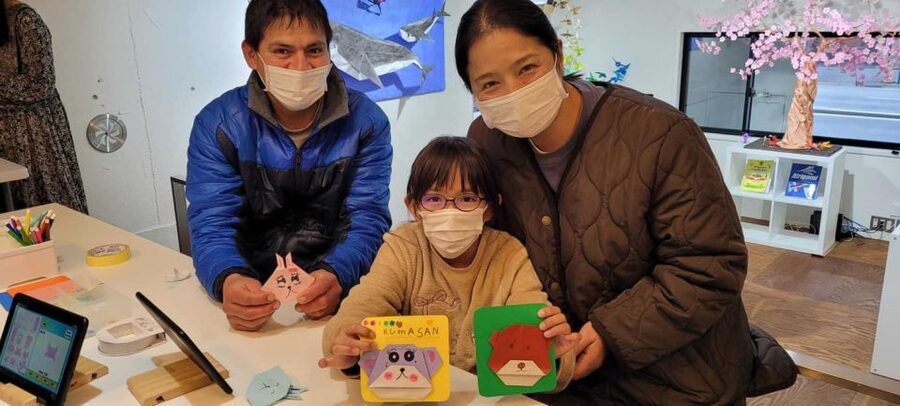
Asakusa is famous for temples, old streets, and souvenir shops, but this 45-minute origami session offers a quieter way to spend part of your visit. You choose from more than 100 models, pick a color from a wall of 50 paper options, and follow tablet instructions at your own pace. I like the huge choice of designs and the fact that children and first-time folders can start without feeling behind.
I also like the small group limit of six, which gives the staff a fair chance to help when a fold goes wrong. The main consideration is that this is not a teacher-led class. The tablet does most of the explaining, so you should book it for relaxed, self-guided making rather than a formal lesson. Forty-five minutes can also feel short if your family wants to make several detailed models.
In This Review
- Key points at a glance
- A calm craft break in the middle of Asakusa
- Finding the studio on the right side of the building
- Choosing a design from over 100 models
- Picking paper from the 50-color wall
- Following the tablet without feeling rushed
- Getting help when the paper fights back
- Decorating your finished animals and flowers
- What 45 minutes can realistically include
- Is $27 a fair price?
- Age, seating, and studio rules
- Who will enjoy this Asakusa activity most?
- Should you book Taro’s Origami Studio?
- FAQ
- How long does the origami activity last?
- How much does it cost?
- How many participants are in the group?
- Is the activity suitable for beginners?
- How many origami models can I choose from?
- How many paper colors are available?
- Is a teacher-led lesson included?
- What should I bring?
- Is the studio wheelchair accessible?
Key points at a glance
- More than 100 models: Pick from animals, flowers, vehicles, and designs ranging from beginner to intermediate.
- 50 paper colors: Choose your sheet after seeing the model, then add stickers, stamps, and marker details.
- Tablet-guided folding: Pause, replay, and return to earlier steps whenever you need.
- Small group of six: The limited size makes it easier to ask staff for help with a tricky crease.
- Asakusa location: The entrance is on the main street side, marked by company signage and a brown sea turtle on the wall.
- Plan for studio rules: Wear socks, expect stairs and seating without back support, and provide adult supervision for children under 13.
A calm craft break in the middle of Asakusa
Taro’s Origami Studio gives you a change of pace from sightseeing. Instead of rushing between landmarks, you sit down with a square sheet of paper and work through a series of small decisions: fold, turn, open, crease, and fold again.
That rhythm suits Asakusa well. The area can fill your day with visual noise, crowds, shops, and temples. This activity offers a quieter indoor pause without taking up half a day. You do not need to arrive with an interest in Japanese paper art. The format is built for beginners, and the first model can be as simple or as challenging as you choose.
The studio uses a small group format with no more than six participants. That matters for origami. A crowded room would make it harder to see the tablet, spread out your paper, or get help at the exact moment a fold starts to go wrong.
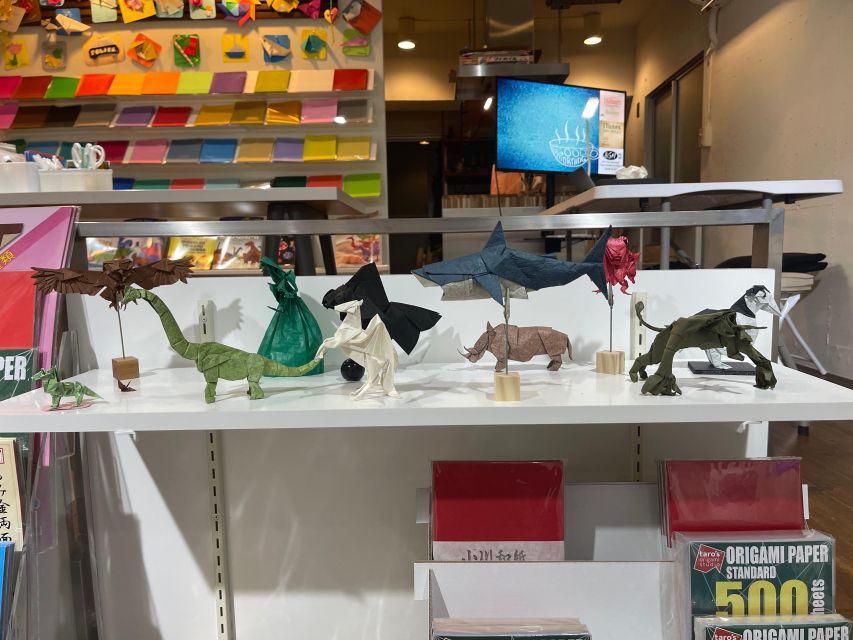
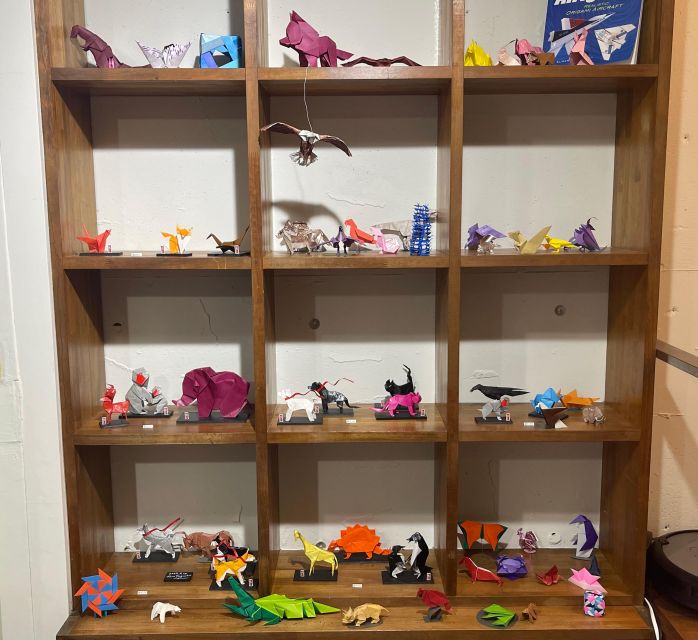
The setting is designed to feel pleasant and orderly, with origami displays to look at during or after your session. You can take photos, browse the finished examples, and purchase items if something catches your eye. Food and drinks are not included, so plan to eat before or after in Asakusa.
A few more Tokyo tours and experiences worth a look



Finding the studio on the right side of the building
The meeting point has one detail worth taking seriously. The entrance is on the main street side of the building, not the side next to the park. If you are standing by the park, you are at the back and cannot enter from there.
Look for the company sign on the front of the building and a brown sea turtle fixed to the wall below the window. That unusual marker should make the door easier to spot, but allow a little time to walk around the building if you first approach from the park.
The studio is in Asakusa, so you can fit it around sightseeing in the district. Its 45-minute length is useful if you have a busy day. It can work as a morning activity, a mid-afternoon rest, or a family stop between nearby sights. Starting times vary, so check the available slot before planning the rest of your day.
Choosing a design from over 100 models
The session begins with the tablet menu. You browse model categories on a PC tablet and select the design you want to make. The choice is unusually broad for such a short activity. You can work on animals, flowers, vehicles, and other paper forms, with instructions ranging from beginner to intermediate.
I suggest starting with a simpler model, especially if you are folding with young children. Origami has a way of looking easy until several folds meet in the center. A quick first success helps you understand how the tablet works and leaves time for a second or third creation.
More experienced folders can choose an intermediate model from the start. The useful part is that you are not locked into one project. You can return to earlier steps, replay instructions, and select another design if your first choice proves too ambitious.
The broad menu also helps mixed-age groups. One person can make a simple animal while another tries a flower or vehicle with more folds. You do not all have to work on the same model, which keeps the session flexible for families and small groups with different skill levels.
Picking paper from the 50-color wall
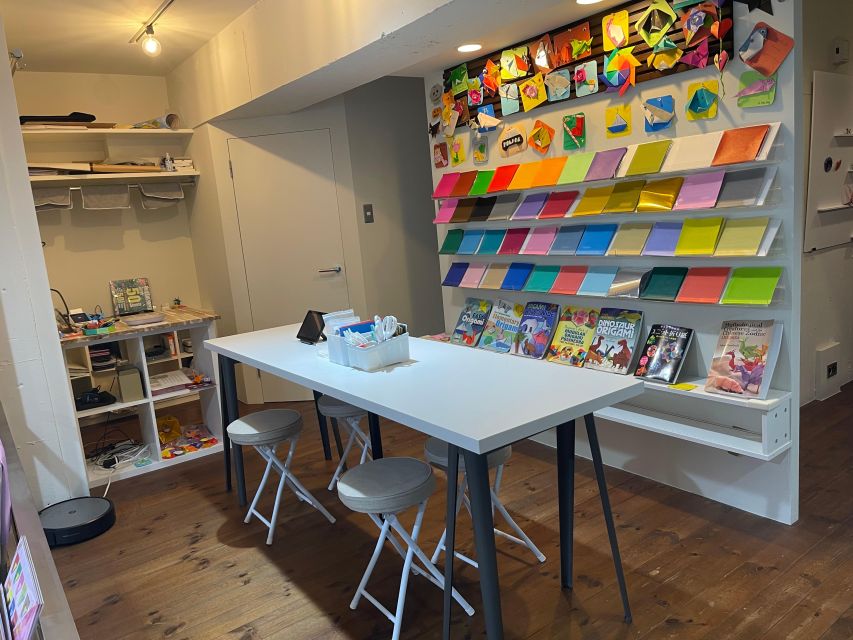
After selecting a model, you go to the paper wall and choose your sheet. There are 50 colors, so the paper itself becomes part of the creative decision.
The instructions sensibly suggest thinking about the finished design before choosing a color. A bright sheet may suit an animal or vehicle, while a softer shade may work better for a flower. You can also choose several sheets if you plan to make more than one model during the session.
This is a small detail, but it gives the activity more personality than simply receiving a fixed kit. Children get to make a real choice before they begin. Adults who enjoy design can spend a minute matching color and shape. If your family has trouble deciding, choose quickly and save your time for folding. Forty-five minutes passes fast.
Origami paper and the needed supplies are included in the price. You do not need to bring your own paper, tools, or decorating materials.
Following the tablet without feeling rushed
Once you return to your place, press Play on the tablet. The program takes you from a square sheet to the selected model through a series of visual steps.
The self-guided format is the heart of the experience. You can pause, replay, or go back to a previous step. That is useful because origami instructions often make sense only after you see a fold from a second angle. You can work slowly instead of trying to keep up with a live demonstration.
Staff members are present to help with the models, but they do not lead a full class. This distinction is important. You receive instruction through the tablet, then ask for assistance when a particular step is unclear. The staff can keep an eye on your work without hovering over every fold.
That balance suits people who prefer to figure things out independently. It may be less satisfying if you want a long explanation of Japanese origami traditions or a teacher speaking to the entire group. The activity focuses on making paper objects, not on a formal cultural lecture.
English and Japanese are available, so the format can work well for international visitors. Much of the folding is visual, which also makes the process easier for people who prefer to learn by watching rather than listening.





Getting help when the paper fights back
Origami has a few common trouble spots: lining up corners, pressing a crease cleanly, and turning a partly folded shape inside out without crushing it. The staff can help you through those moments.
The small group limit is especially useful here. With a maximum of six participants, you have a reasonable chance of getting attention when you need it. One session even included one-on-one guidance from an instructor named David, who explained origami while helping fold several figures. That kind of personal support can make a difference for a complete beginner.
At the same time, keep your expectations realistic. Staff help is available, but you are not signing up for a private lesson. If you want constant instruction from start to finish, this is not the right format. If you like trying first and asking for a hand when necessary, it should feel comfortable.
A helpful staff member may also add a warm personal touch. In one family session, an instructor folded a rose for a child. Small moments like that can turn a simple craft stop into a pleasant memory, though you should not count on a custom figure being part of every booking.
Decorating your finished animals and flowers
When the folding is finished, you can personalize your creation with stickers, stamps, and markers. This final stage is particularly useful for families because it gives younger children another way to participate.
A child who struggles with a complicated fold may still enjoy choosing eyes, patterns, or other details. An adult can focus on making the shape neat, while a child adds the character. The result does not need to be perfect to be fun.
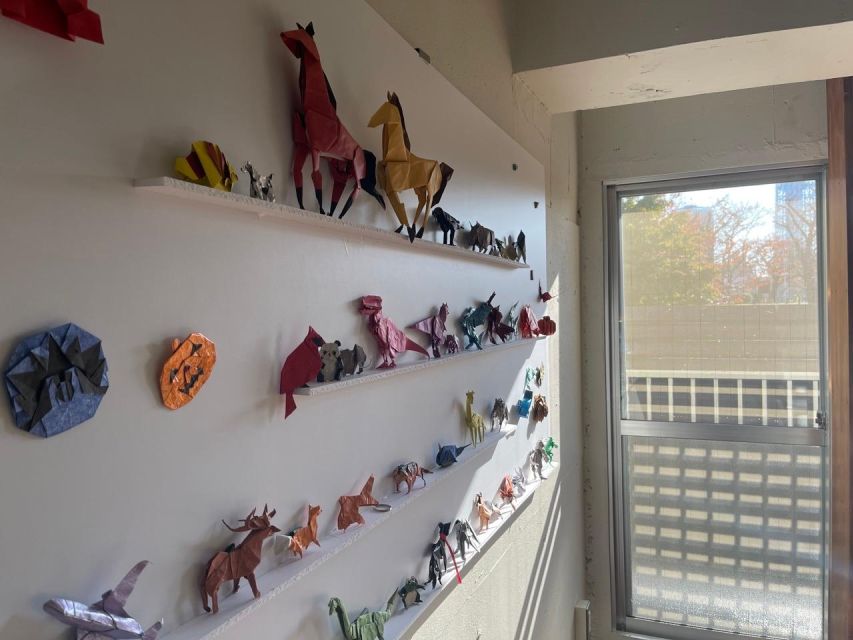
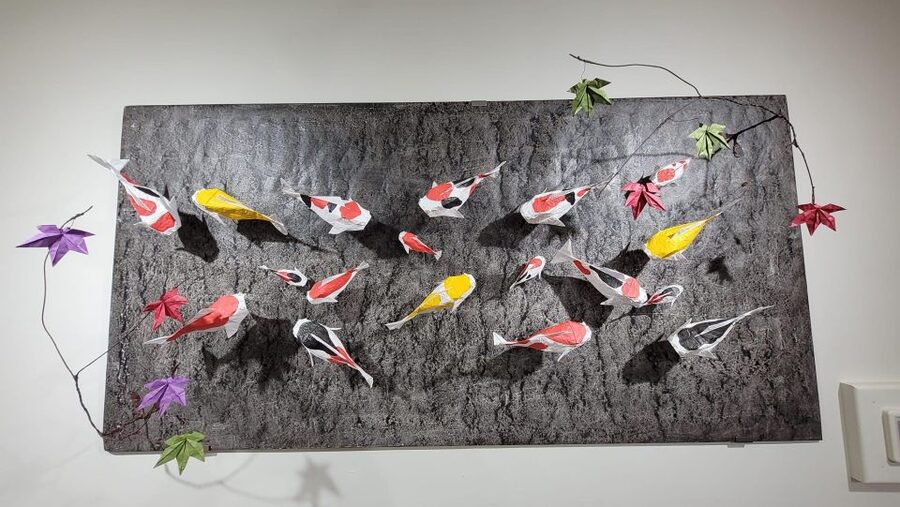
You can take photos during the session and enjoy the studio’s origami displays after finishing. The displays may also help you decide what to make next, especially if you are drawn to a model that was not your first choice.
The goal is not to produce museum-quality paper art in 45 minutes. It is to learn a few basic folds, make something with your hands, and leave with a small object you shaped yourself. That is a modest goal, but it fits neatly into a day of sightseeing.
What 45 minutes can realistically include
The time limit is both a strength and a weakness. It keeps the activity easy to fit into an Asakusa schedule, but it also limits how many detailed models you can complete.
A beginner who works steadily may make several simple pieces. One family of three, including a seven-year-old, made about four items per person during the allotted time. That gives you a useful sense of the pace, though the number will depend on model choice, age, and how much time you spend decorating.
If you choose intermediate designs, expect fewer finished pieces. I would rather complete two careful models than rush through four difficult ones. Families may want to agree at the start that everyone can choose a design, but nobody has to finish the same number.
The session includes enough time for an introduction and practice, but not for a long lesson. If you are hoping to learn a large set of traditional techniques, book with modest expectations. If you want a compact activity that gives you a taste of origami, the timing works well.
Is $27 a fair price?
At $27 per person, this is not the cheapest way to obtain paper and online folding instructions. You are paying for the studio setting, the large model library, the 50-color paper selection, supplies, staff assistance, and a reserved place in a small group.
The value improves if you are visiting as a family. Each person can choose a different model, and the activity gives children a structured creative break that does not depend on their reading level or previous experience. The included decorations also make the session feel more complete than a bare-bones paper lesson.
The value is less convincing for an experienced origami folder who already has paper and instruction books. That person may find the tablet system too basic unless the studio’s model selection or displays are a particular draw.
For a first introduction, I consider the price reasonable, especially if you value a tidy indoor activity in a major sightseeing district. Just remember that food and drinks are extra, and the session lasts only 45 minutes. The best reason to book is the guided setting and family-friendly structure, not the quantity of paper you receive.
Age, seating, and studio rules
The activity is recommended for children four and older, with the more detailed guidance suggesting at least five for independent folding. Children under five who cannot fold on their own need an adult supervising them throughout.
All children under 13 need adult supervision for the full activity. This is not a drop-off program. An adult should be ready to help with paper, follow tablet steps, and keep track of younger children.
You must wear socks in the studio. Bring a pair or buy them before arriving. This rule is easy to miss and could prevent you from taking part if you arrive unprepared.
The facility is not wheelchair accessible. There are stairs only, with no ramps or lifts. Seating has no back support, another point to consider if you need a chair with stronger physical support.
People with a cold should not take part. That restriction is simple, but it is worth checking before you leave for the studio, particularly if someone in your group feels unwell.
Who will enjoy this Asakusa activity most?
I would recommend it most strongly to families with school-age children, first-time folders, and adults who want a hands-on break from sightseeing. The tablet makes it easy to begin, while the staff presence keeps the activity from becoming frustrating.
It also suits a small group of friends who want to make different things at the same time. The choice of more than 100 models prevents the session from feeling repetitive, and the color wall gives everyone a personal starting point.
It is less suitable for anyone looking for a traditional classroom lesson, a long cultural talk, or a full morning of paper craft. It is also a poor fit for children under four, people who cannot manage stairs, or anyone who needs back-supported seating.
The strongest praise has focused on helpful guidance, a pleasant small-group atmosphere, and the ease of learning as a beginner. Those are exactly the areas where this experience earns its price. The main complaints to keep in mind are the short time and the limits of a tablet-guided format.
Should you book Taro’s Origami Studio?
Book it if you want a calm, creative 45 minutes in Asakusa and your group includes beginners. The large model choice, 50 paper colors, decoration supplies, and available staff help give the activity more substance than a simple craft table.
I would be especially keen to book for a family with children around school age. A seven-year-old can take part, adults can choose harder models, and nobody needs to compete with the rest of the group. Wear socks, arrive at the main street entrance, and choose a manageable first model so you have time to enjoy the process.
Skip it if you want a private teacher-led class or have mobility needs that make stairs and unsupported seating difficult. For everyone else, this is a practical little Asakusa activity that lets you take home something made by your own hands.
FAQ
How long does the origami activity last?
The activity lasts 45 minutes.
How much does it cost?
The price is $27 per person.
How many participants are in the group?
The group is limited to six participants.
Is the activity suitable for beginners?
Yes. Tablet instructions guide beginners from a square sheet of paper through each model, and you can replay steps or return to earlier instructions.
How many origami models can I choose from?
You can choose from more than 100 models, including animals, flowers, and vehicles. The designs range from beginner to intermediate difficulty.
How many paper colors are available?
The studio offers 50 colors of origami paper.
Is a teacher-led lesson included?
No. The activity is tablet-guided rather than teacher-led. Staff members are present to help with models when needed.
What should I bring?
You must bring socks or purchase a pair before entering the studio. Socks are required for studio activities.
Is the studio wheelchair accessible?
No. The facility has stairs only, with no ramps or lifts. The seating also does not have back support.
More Asakusa Tours in Tokyo



More tours in Tokyo we've reviewed











Asakusa Tours, compared.
 ★ 4.8Tokyo: Japanese Dance Cabaret Theater Asakusa-Kaguwa TicketFrom $492 hours
 ★ 4.7Tokyo: Meiji Shrine, Asakusa, Skytree Bus Tour and CruiseFrom $12210 hours
 ★ 4.9Tokyo: Roll and Authentic Sushi Making Class in AsakusaFrom $581h 40m
 ★ 4.8Tokyo: Asakusa Walking Tour with Sensoji Temple VisitFrom $222 hours
 ★ 5.0Tokyo Asakusa Rickshaw TourFrom $42
 ★ 4.5Tokyo Panoramic 1 Day: Meiji Shrine, Asakusa, Odaiba and SKYTREE®From $85