
Reviewed · SUMO EXPERIENCES
The SUMO Show & Experience with Hot pot lunch
The best part of this two-hour experience is getting close to the sport without needing to understand a tournament schedule or secure a hard-to-find seat. In a sumo-themed restaurant with a real clay ring, a bilingual MC and two former wrestlers explain the rituals, demonstrate the footwork, and invite you to try the sport yourself.
I like the hands-on ring challenge, which turns sumo from something you watch into something you feel. I also like the chanko hotpot lunch, since it gives the morning a proper finish and can be adapted for vegetarian, vegan, halal, and allergy needs with 48 hours’ notice.
The main drawback is scale: this is a lively group activity, not a quiet visit to a training stable or a full tournament match. With up to 40 people, your view and time in the ring may vary, and the $97.55 price is easier to justify if you plan to join the activities and eat the meal.
In This Review
- Key points to know before booking
- Why Ryogoku is the right place for a sumo introduction
- What the bilingual introduction adds
- Watching the wrestlers demonstrate shiko, teppen, and suriashi
- The live match brings the morning to life
- The padded 160-kilogram challenge
- Photos with the wrestlers
- Chanko nabe gives the experience a proper finish
- Who will enjoy this most
- Timing, group size, and practical planning
- Should you book the sumo show?
- FAQ
- Where does the sumo experience take place?
- What time does the experience start?
- How long does the activity last?
- Where does the activity end?
- Is lunch included?
- Are alcoholic drinks included?
- Can children participate?
- Can I request a special meal?
- Does a child under five receive lunch?
- What is the cancellation policy?
Key points to know before booking
- A real clay dohyo in Ryogoku: Learn and play inside a sumo ring in Tokyo’s traditional sumo district.
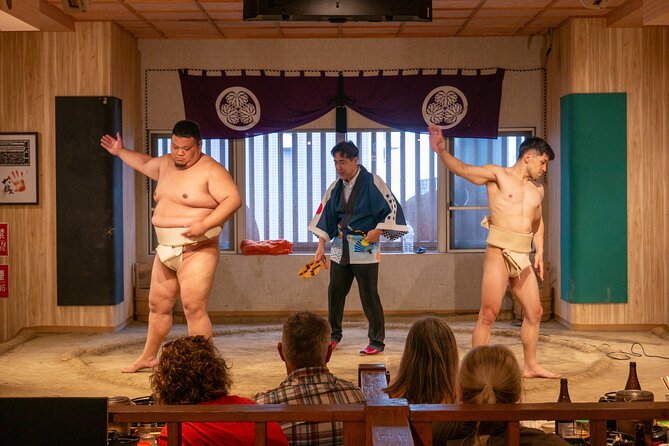
- Former wrestlers lead the action: See shiko leg stomps, teppen push drills, and suriashi sliding steps explained in English.
- A safe bout with a 160-kilogram wrestler: A volunteer can wear a padded suit and try to push a professional-sized opponent.
- Family-friendly from toddlers to seniors: Parents can join or watch, and the format has worked well for children and older family members.
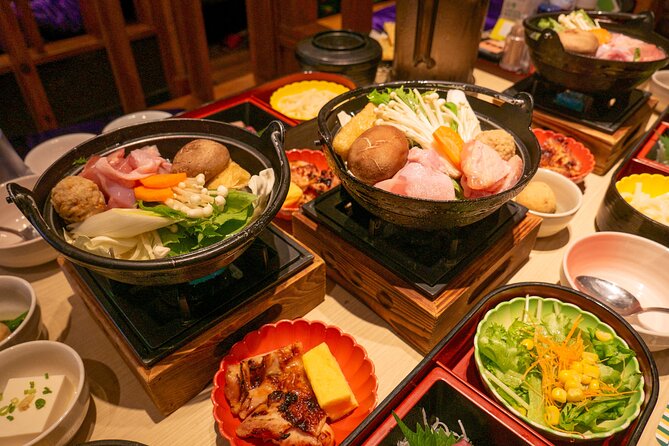
- Chanko nabe is included: The meal is a mini hotpot with fresh ingredients, plus sashimi according to the supplied details.
- Dietary requests need planning: Vegetarian, vegan, halal, gluten-free, and allergy-friendly arrangements should be requested at least 48 hours ahead.
Why Ryogoku is the right place for a sumo introduction
Ryogoku is the natural setting for this activity. It is the part of Tokyo most closely linked with sumo, and the experience keeps that connection practical rather than turning the morning into a museum lecture.
You meet at Hana no Mai Edo Tokyo Museum, at 1-chome-1-15 Kamezawa, Sumida City. The start time is 10:00 a.m., and the event finishes back at the same place. That simple arrangement matters in Tokyo, where a tour with several meeting points can eat up more time than expected.
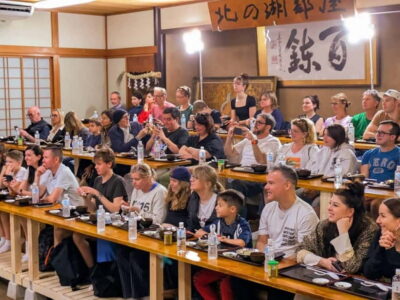
The restaurant has a sumo theme and a real clay dohyo, or wrestling ring. You are not simply watching a staged performance from a distant table. The ring becomes the classroom, photo spot, and playing field.
The experience lasts about two hours. That makes it a useful morning plan before an afternoon in Asakusa, Ueno, or another part of eastern Tokyo, although you should allow extra time for getting to the meeting point and finding the venue.
A few more Tokyo tours and experiences worth a look
What the bilingual introduction adds
Sumo can look simple from a distance: two large wrestlers push, slap, and try to force each other out of the ring. The opening explanation helps you see the rules and rituals behind those movements.
A bilingual MC introduces the sport and explains why the wrestlers toss salt before a bout. You also learn about shiko, the dramatic leg stomps that are linked with driving away evil spirits. Suriashi, the low sliding footwork, and teppen, the push drill, are also part of the demonstration.
I find this practical approach more useful than a long historical talk. You see the movement, hear its purpose, and then get a chance to copy it. That works especially well for children, who may not sit still for a formal cultural presentation but will gladly attempt a giant leg stomp.
The English element is important for families and mixed-language groups. The supplied details describe the event as fully in English, with a bilingual MC guiding the session. That does not mean every joke or aside will land perfectly for every person, but you should be able to follow the activity and instructions.
Watching the wrestlers demonstrate shiko, teppen, and suriashi
Two former wrestlers lead the physical part of the morning. Their demonstrations show the gap between knowing a movement and making it look easy.
Shiko is more than a theatrical stamp. The controlled lift, balance, and heavy placement of the foot demand strength and coordination. Suriashi looks modest, since the feet slide instead of lifting high, but the low position gives you a quick lesson in how awkward sumo posture can be.
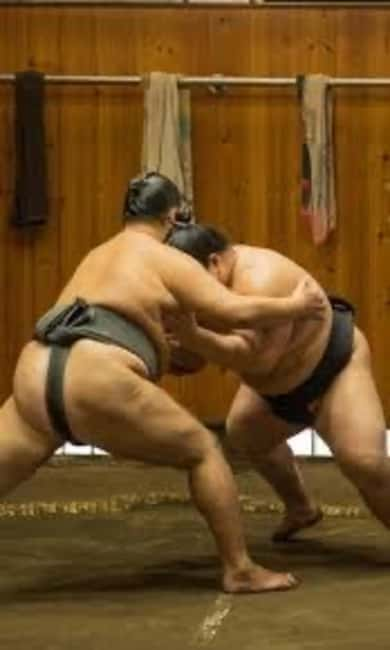
Teppen is a push drill. It helps explain why a sumo bout is not just about body weight. Timing, balance, leg drive, and the ability to stay low all matter.
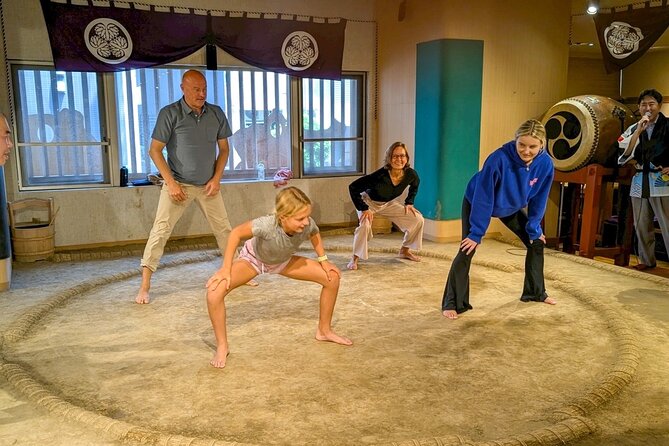
You can join the wrestlers in the ring for these exercises or stay outside and take photos. That choice is useful for families with mixed energy levels. A parent can watch a child participate, an older family member can remain seated, and more adventurous visitors can step forward.
The activity is described as suitable for most people. Still, you should be honest about your comfort with physical activity. Sumo footwork is not a competitive fitness class, but the ring challenge involves pushing and moving. Joining is optional, so you can enjoy the lesson without taking part in every drill.
The live match brings the morning to life
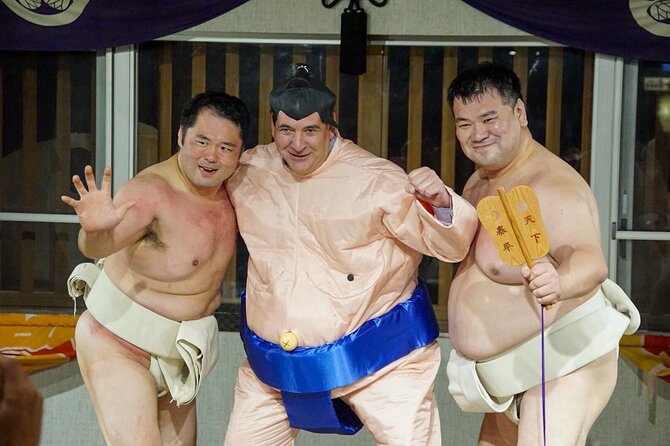
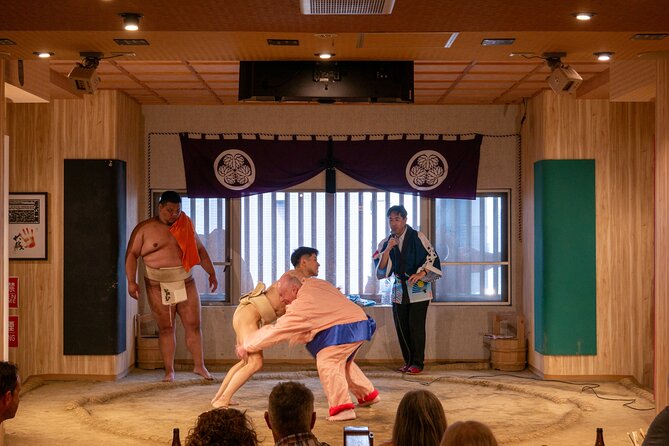
After the instructional section, professional wrestlers compete in a live match. This is the moment when the explanation becomes clear.
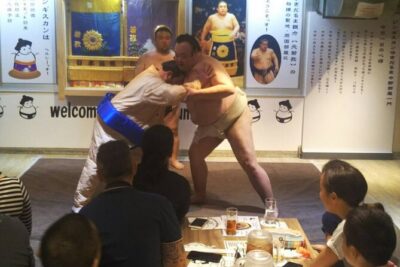
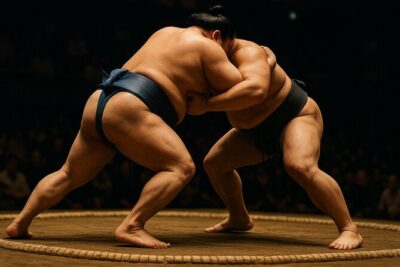
Even a short sumo bout can be surprisingly sudden. The wrestlers face each other, settle into position, and then explode forward. You hear the impact of the collisions at close range, which gives the match more force than watching the sport on a screen.
The format is not a full tournament day at the Kokugikan arena. It is a demonstration designed for this small-group setting, so you should come for access and interaction rather than a complete professional contest.
That distinction helps set fair expectations. If your main goal is to watch elite sumo in a formal stadium, book a tournament ticket instead. If you want to understand the basic movements and see a match close enough to appreciate the physical force, this presentation is more convenient and approachable.
The padded 160-kilogram challenge
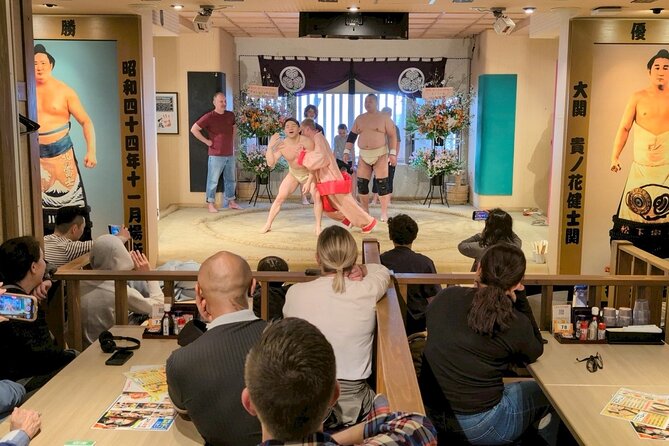
The final challenge is the most playful part of the session. A volunteer wears a padded suit and tries to push a wrestler weighing about 160 kilograms.
This is not a serious contest. It is a safe, comic way to discover how difficult it is to move a much larger opponent who knows how to hold position. The padding lets people test the experience without turning the activity into a risky wrestling bout.
You may want to volunteer if you enjoy being part of a show. If not, watching can be just as entertaining, particularly for children. The format gives them a clear sense of scale, since the wrestler is no longer an abstract figure across a stadium.
The challenge also explains why this activity suits families. Children aged 12 and 15 can take part in the interaction, while younger children can watch. The event has also accommodated an infant and senior family members, according to the supplied experience details.
No one needs to prove anything in the ring. The appeal is the shared laugh and the chance to feel the sport’s strength at close range.
A few more Tokyo tours and experiences worth a look

Photos with the wrestlers
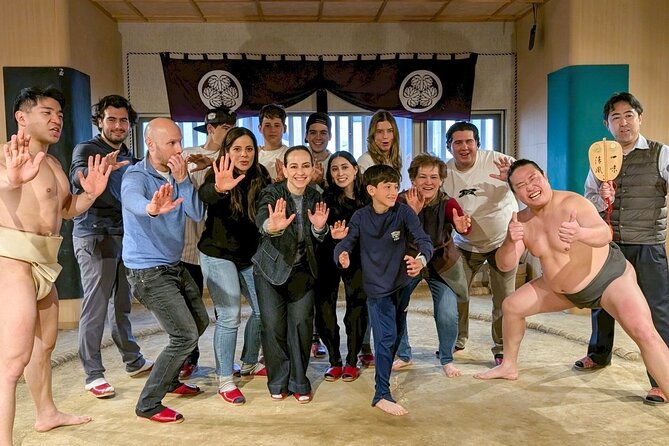
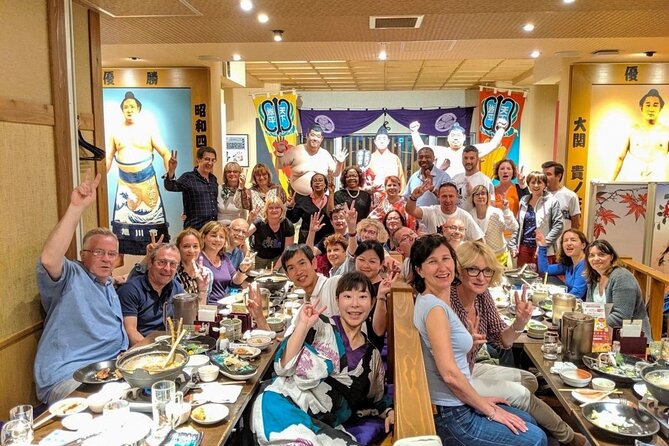
A photo session follows the ring activities. You stand beside the wrestlers, which is when their size becomes most obvious.
This is more than a standard group snapshot. Standing next to a professional-sized sumo wrestler gives you a useful visual comparison that is difficult to capture during a match. The photo also marks the difference between this experience and a regular stage performance.
Bring a phone with enough storage and keep it ready, since the session moves from demonstration to challenge to photographs before lunch. The ticket is mobile, so you do not need a printed voucher, but you should still have the booking accessible when you arrive.
The group limit is 40 people. That is not a tiny private class, and the photo session may be organized in turns. If you want a long private conversation or many individual photographs, this may feel structured. For most people, the chance to pose beside the wrestlers is a worthwhile part of the morning.
Chanko nabe gives the experience a proper finish
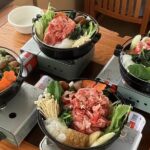
Lunch is a mini chanko nabe hotpot. Chanko is closely linked with sumo wrestlers, since hotpot provides a practical combination of protein, vegetables, and broth.
Here, the meal is part of the ticket rather than an optional extra. Fresh ingredients are cooked in the hotpot, and the supplied details also mention sashimi. Alcohol and additional menu items cost extra and can be ordered on site.
The meal makes the $97.55 price easier to assess. You are paying for a two-hour cultural activity, live demonstrations, access to former wrestlers, the ring challenge, photographs, and lunch. It is not a low-cost meal with a brief performance attached.
The value depends on how much you use. If you watch from the side, skip the challenge, and have little interest in sumo, the price may feel high. If you take part, ask questions through the bilingual MC, enjoy the photo session, and eat the included hotpot, the package is more reasonable for a special Tokyo morning.
Dietary planning deserves attention. Vegetarian, vegan, halal, gluten-free, and allergy-friendly requests can be handled, but you should provide the details at least 48 hours before the start. One meal was adapted for a gluten-free child by changing ingredients, and vegetarian food was also arranged successfully.
Children under five do not receive a meal when booked at the child rate. If you need lunch for a child under five, book that child at the adult rate. This is an easy detail to miss, especially when traveling with several children.
Who will enjoy this most
I would put this high on the list for families with school-age children and teenagers. The morning has enough action to hold their attention, while the rituals and lunch give parents something beyond simple entertainment.
It also works for adults who want a short introduction to sumo without spending half a day at a tournament. The English explanations, direct access to wrestlers, and chance to enter the ring remove much of the mystery.
Older family members can participate at their own pace. The supplied information specifically describes the experience as senior-friendly, and parents can watch rather than join the physical parts. Most people can participate, but the ring exercises are optional.
This is less suitable for someone seeking a formal, solemn cultural ceremony. The tone is friendly and interactive, with laughter built into the padded challenge. It is also not the best choice if you want a long, quiet meal or a full professional tournament.
Timing, group size, and practical planning
The 10:00 a.m. start is convenient, but arrive with enough time to locate Hana no Mai Edo Tokyo Museum. The activity begins and ends at the same meeting point, which keeps the day simple.
A maximum of 40 people means the room can feel active. The upside is a social setting where families can watch each other take part. The downside is that ring time and photographs may be shared among many people.
The experience is near public transportation, and confirmation is sent at booking. The mobile ticket makes arrival easier, especially if you are already using your phone for Tokyo train directions.
Free cancellation is available if you cancel at least 24 hours before the local start time. Changes or cancellations inside that window are not refunded. Poor weather or failure to reach the minimum number of participants can lead to a different date or a full refund.
The weather clause is worth noting even though much of the activity takes place at the restaurant. Keep your schedule flexible if this is an important part of your Tokyo plans.
Should you book the sumo show?
Book it if you want a family-friendly introduction to sumo that combines explanation, physical participation, photos, and a Japanese lunch. The strongest reasons are the real clay ring, the close view of the wrestlers, the English presentation, and the chance to test your strength in a padded suit.
The $97.55 cost is fairer for people who take part and make use of the included meal. Dietary flexibility is another plus, but you must request special arrangements 48 hours ahead.
Skip it if you want a full tournament day, a quiet cultural visit, or the lowest possible price. For everyone else, this is a lively and accessible way to meet Japan’s national sport in the neighborhood most associated with it.
FAQ
Where does the sumo experience take place?
It takes place at Hana no Mai Edo Tokyo Museum, 1-chome-1-15 Kamezawa, Sumida City, Tokyo 130-0014, Japan.
What time does the experience start?
The scheduled start time is 10:00 a.m.
How long does the activity last?
The experience lasts approximately two hours.
Where does the activity end?
It ends back at the meeting point.
Is lunch included?
Yes. A mini chanko hotpot lunch is included. The meal may also include sashimi, according to the supplied experience details.
Are alcoholic drinks included?
No. Alcoholic beverages and additional menu items are not included, but they can be ordered on site.
Can children participate?
Yes. The activity is designed for families, and children can join the demonstrations and interaction with the wrestlers. Parents may participate or watch.
Can I request a special meal?
Yes. Vegetarian, vegan, halal, gluten-free, and allergy-friendly options are available with advance notice. Dietary requests should be made at least 48 hours before the activity.
Does a child under five receive lunch?
Children under five do not receive a meal when booked at the child rate. If you need a meal for that child, book at the adult rate.
What is the cancellation policy?
You can cancel at least 24 hours before the local start time for a full refund. Cancellations or changes made less than 24 hours before the start are not refunded or accepted. If poor weather or insufficient bookings causes cancellation, you will be offered another date or a full refund.
More Lunch Experiences in Tokyo




More Shows & Performances in Tokyo
More Sumo Experiences in Tokyo
More tours in Tokyo we've reviewed










Sumo Experiences, compared.
 ★ 4.8Tokyo: Sumo Show Experience with Chicken Hot Pot and a PhotoFrom $1032 hours
 ★ 4.8Tokyo: Sumo Show and Dining ExperienceFrom $7990 minutes - 2 hours
 ★ 5.0the SUMO showFrom $89
 ★ 5.0Tokyo Shinjuku Sumo Show & Experience with PhotoFrom $79
 ★ 4.8Tokyo: Sumo Show and Experience in ShinjukuFrom $691h 30m
 ★ 4.6Tokyo: Sumo Tournament Tour with Chair Seat TicketsFrom $141