
Reviewed · CRAFT WORKSHOPS
Tokyo: Japanese Calligraphy Lesson with Skilled Instructor
Japanese calligraphy becomes much more personal when you choose the word yourself. In this one-hour Asakusa lesson, instructor Shusuke explains the meaning of sample words in English, then helps you turn one into a souvenir you actually made. You finish with a photo of your work, not just another shop-bought keepsake.
I like the small group size of four, which gives you room to ask questions and get direct advice. I also like the choice of three souvenirs: a traditional uchiwa fan, a decorative shikishi board, or a hanging kakemono scroll. The main drawback is the short one-hour schedule. You will have time to learn and make one piece, but not to become a calligraphy master.
In This Review
- Key points to know
- Choosing a Japanese word in Asakusa
- Thirty minutes of brush practice
- Selecting the right souvenir
- A calm class with a skilled teacher
- What the one-hour schedule feels like
- Why $45 can be fair value
- Who will enjoy this Asakusa activity
- Practical tips before you book
- Should you book this calligraphy lesson?
- FAQ
- Where does the calligraphy class take place?
- Is the lesson available in English?
- How many people can join the class?
- How much calligraphy practice paper is included?
- What souvenir can I make?
- Can I cancel my reservation?
Key points to know
- Choose a word with meaning: Shusuke explains the cultural sense of sample Japanese words in English before you pick one.
- Practice on 20 sheets: You get about 30 minutes to work on brush control, balance, and stroke order.
- Make one lasting souvenir: Transfer your finished word to an uchiwa, shikishi, or kakemono.
- Learn from a trained instructor: Shusuke holds 3rd Dan certification from the Japan Educational Calligraphy Federation and has taught for more than 10 years.
- Expect a calm, personal lesson: The class is limited to four people and takes place in a rented Asakusa room.
- Book with some flexibility: The activity costs $45 per person, lasts one hour, and allows free cancellation up to 24 hours ahead.
Choosing a Japanese word in Asakusa
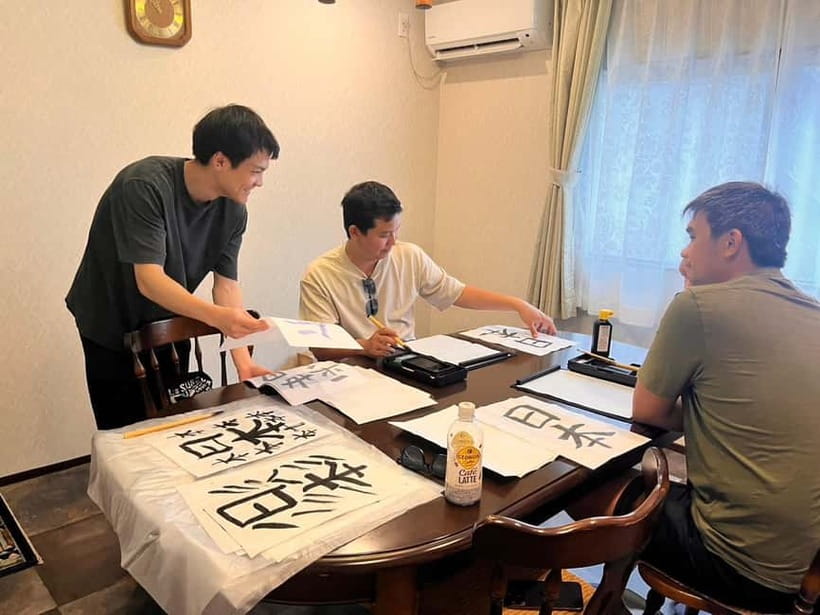
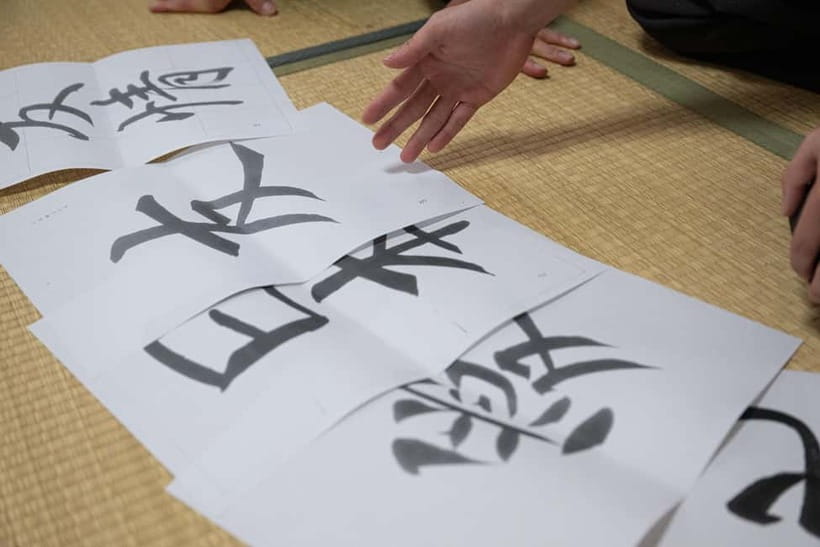
The class begins with the part many people find most rewarding: choosing what to write. Rather than copying an attractive character without knowing what it means, you look through sample calligraphy pieces while Shusuke explains the words and their cultural meanings in English.
That small step changes the whole activity. A character can represent an idea, a feeling, or a hope, and the meaning gives your final piece a personal connection to Japan. You might find yourself choosing a word because it reflects your trip, your family, or something you want to remember after returning home.
Shusuke teaches in English and Japanese. He is a native Japanese speaker with advanced English and beginner Korean, so English-speaking participants can ask about the meaning and use of the words without needing prior Japanese study.
The samples also give you a useful introduction to Japanese writing. One of the class reviews specifically praised the explanation of the three Japanese calligraphy styles, along with the exercises in kanji. That makes this more than a brush-and-ink craft session. You get a short lesson in how Japanese writing can look and feel different depending on the form being used.
I would take your time at this stage. The prettiest character on the page is not always the best choice for you. Ask what a word suggests, how it is used, and how it will fit on the souvenir you select later.
A few more Tokyo tours and experiences worth a look

Thirty minutes of brush practice
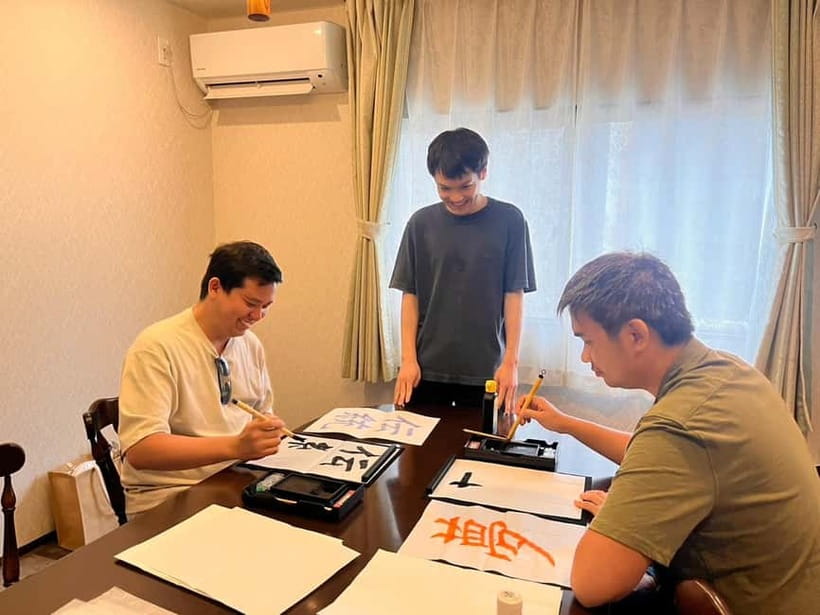
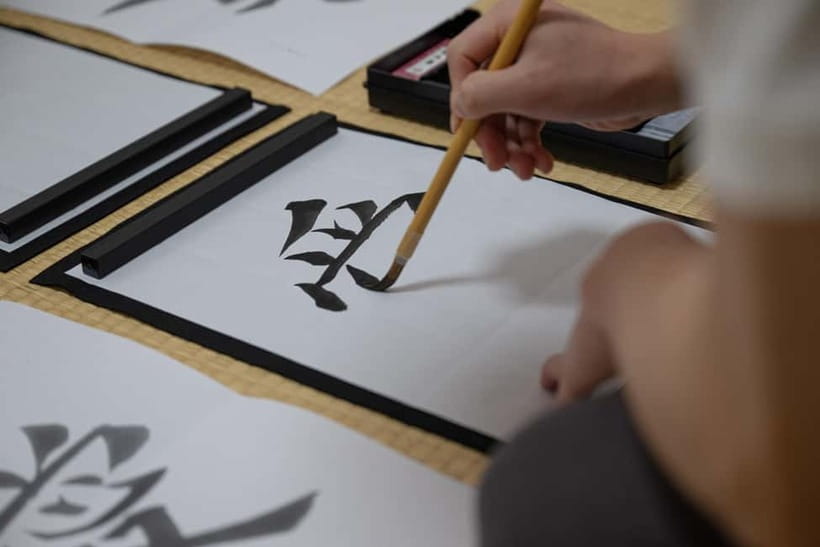
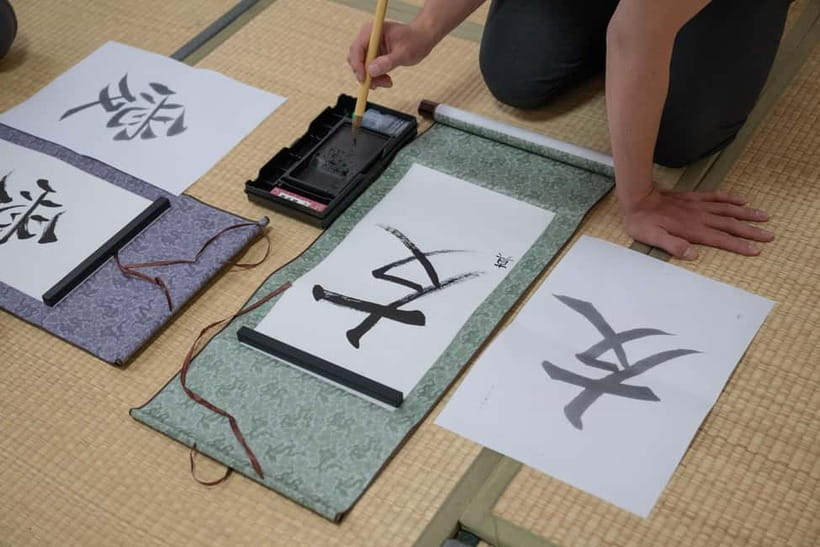
After choosing your word or phrase, you practice on hanshi, the thin paper used for Japanese calligraphy. You receive 20 sheets, which is generous for a one-hour class. About half the session is set aside for practice, giving you enough attempts to improve instead of having to commit your first uncertain brushstroke to the final piece.
The instructor demonstrates the technique and then watches your work. Expect guidance on the shape and order of strokes, brush pressure, spacing, and overall balance. Calligraphy is not simply drawing a symbol. The movement of the brush matters, and small changes in pressure can make a character look heavier, lighter, wider, or more controlled.
This is where the group limit matters. With no more than four participants, Shusuke can give individual corrections. You can also work at your own pace and ask for help when a stroke does not behave as planned.
The practice period should feel accessible to beginners. No previous Japanese language or calligraphy experience is listed as a requirement, and the lesson is built around step-by-step instruction. Still, you should expect a little concentration. The work is quiet and deliberate, not a fast tourist activity where you write one character and move on.
You may use several sheets before you feel ready. That is part of the point. A practice page has no pressure attached to it, while the final fan, board, or scroll is meant to be kept. I like that the class lets you make mistakes before the souvenir matters.
Selecting the right souvenir
Once you have practiced your word, you transfer it to one item of your choice. Each option gives the finished work a different character.
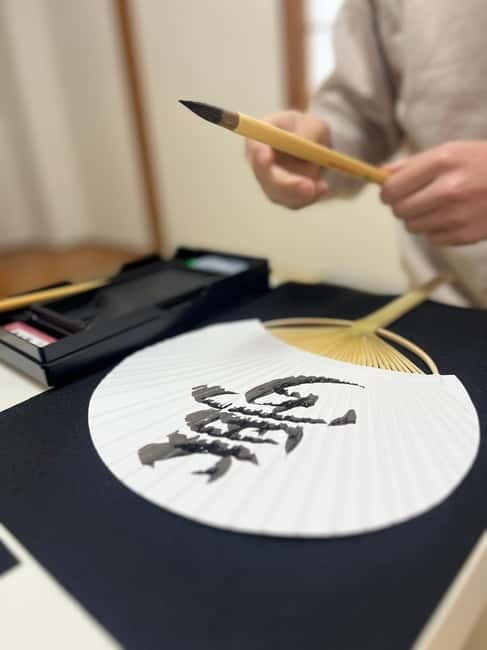
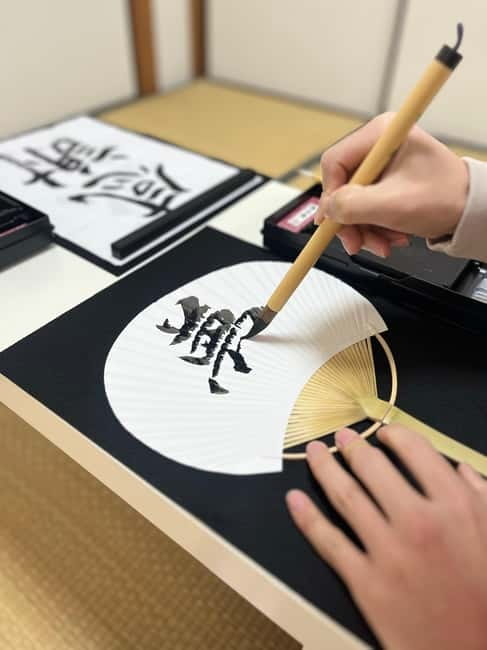
An uchiwa is a traditional Japanese fan. It is a light, decorative choice and makes sense if you want something easy to display or pack. Its curved shape can affect how your word sits on the surface, so ask for help with placement before you begin the final version.
A shikishi is a decorative board used for writing, artwork, and signatures. It gives your calligraphy a firm, compact format that can sit on a shelf or hang on a wall. If you prefer a neat display piece rather than a functional object, this may be the best fit.
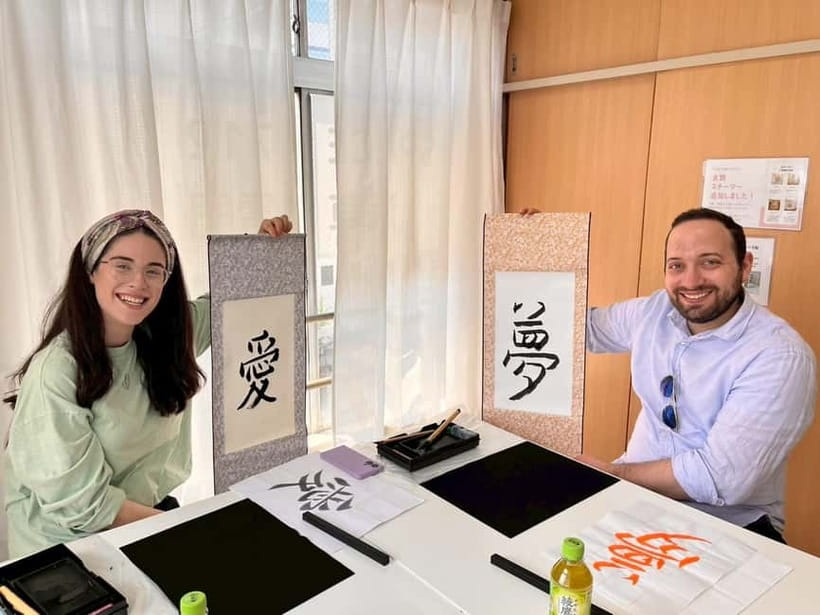
A kakemono is a hanging scroll. It offers the most traditional presentation and gives the writing a vertical format. One participant specifically took home a scroll with a kanji character they had written themselves, so this choice can feel especially satisfying if you want a classic Japanese souvenir.
The activity includes one of these three options. The information does not specify different prices for the choices, so you should confirm any current selection details when booking if you have your heart set on a particular format.
Your final piece will still be beginner work. That is not a flaw. The value comes from understanding the word, learning the basic method, and carrying home something made during your time in Tokyo. A small irregularity in a stroke is part of the story.
A calm class with a skilled teacher
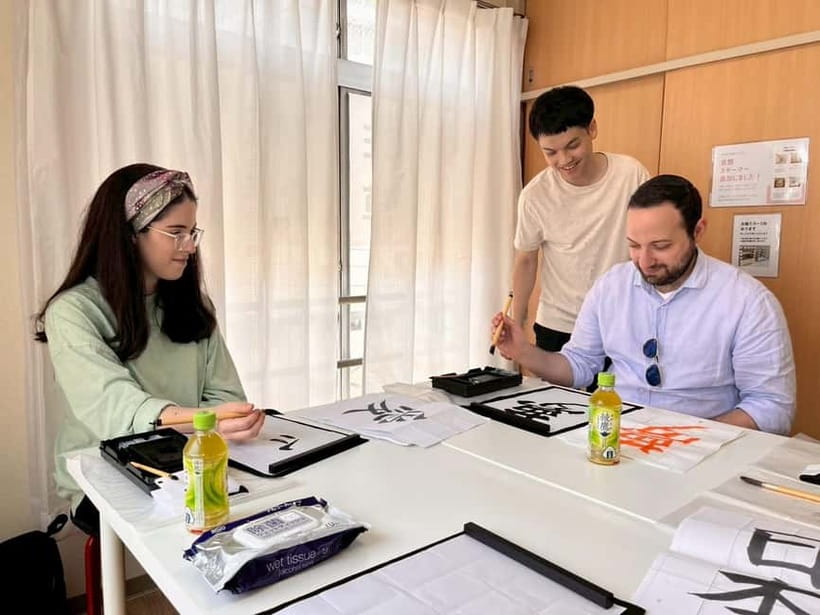
Shusuke is certified at 3rd Dan by the Japan Educational Calligraphy Federation and has more than 10 years of calligraphy instruction behind him. Those credentials matter most in the way the lesson is structured: demonstration first, practice next, then personal correction before the final work.
His background also suits a cultural activity. He has traveled in more than 20 countries, studied abroad in the Philippines and Canada, and enjoys traveling around Japan. You can ask him for ideas about places to visit in Japan, although the core class remains calligraphy rather than a sightseeing talk.
The most praised qualities in the feedback are his calm manner, clear communication, and willingness to help. One British participant described the setting as intimate and relaxed, with easy communication before the class and plenty of photographs during it. That is useful to know if you want a quiet break from Tokyo’s crowded streets.
Another participant booked Shusuke for a custom calligraphy project and praised the careful lettering, balanced design, and professional communication. That experience is separate from the standard one-hour class, but it gives you a sense of the instructor’s work beyond beginner teaching.
The room is rented in Asakusa and may be Japanese-style with tatami or Western-style with a table and chairs, depending on availability. The exact meeting point arrives by email after booking. Since the room type is not fixed, do not book this expecting a guaranteed tatami setting. The flexible space may be less atmospheric than a formal calligraphy studio, but it keeps the lesson personal and practical.
What the one-hour schedule feels like
The timing is compact but sensible:
- You begin by looking through sample works and learning what the words mean.
- You spend roughly 30 minutes practicing on 20 sheets of hanshi paper.
- You write your chosen word on the uchiwa, shikishi, or kakemono.
- You finish with a commemorative photograph.
The first stage helps you make a thoughtful choice. The practice stage takes up the largest share of the class, which is exactly where it should. A quick explanation followed by one final attempt would make the activity feel thin. Here, you have time to build a little confidence.
The final transfer needs care. Once your brush touches the souvenir, you cannot simply erase the mark and start again. Your instructor’s help at this point is important, especially for spacing and placement.
The photograph gives you a record of the finished piece. One participant noted that Shusuke took many photographs and offered help with questions. If you want a specific pose or a picture showing the writing process, ask during the session. The included photo is a nice touch, since calligraphy can be hard to photograph alone without making the brushwork look flat.
The hour will pass quickly. If you want a long cultural workshop with time to try several writing styles and make multiple objects, this activity may feel too brief. If you want one focused project that fits between sightseeing plans, the schedule works well.
A few more Tokyo tours and experiences worth a look


Why $45 can be fair value
At $45 per person, this is not the cheapest souvenir activity in Tokyo. You are paying for more than paper and ink, though. The fee includes instruction from a certified teacher with over a decade of experience, 20 practice sheets, your finished fan, board, or scroll, and a commemorative photograph.
The small group limit strengthens the value. A large class might offer the same materials but less direct correction. Here, the maximum of four participants means you have a better chance of receiving help when your strokes feel awkward or your word is not fitting the surface.
The final souvenir also has more meaning than a mass-produced item. You choose the word, practice it, and write the final version yourself. That makes the $45 easier to justify for someone who values an activity and a keepsake together.
The price is less compelling if you only want a polished piece of Japanese calligraphy made by a professional. In that case, buying finished artwork may cost less time and produce a cleaner result. This class is for the process, not just the object.
At the time of booking, you can reserve and pay later, which helps if your Tokyo schedule is still changing. Free cancellation is available up to 24 hours before the activity for a full refund. Starting times vary, so check availability before arranging other plans.
Who will enjoy this Asakusa activity
I would recommend this class to first-time visitors who want a quieter cultural experience between temples, shopping, and city walks. It also suits couples, friends, and families who want to create something together without committing to a half-day workshop.
It is a good fit for:
- Beginners with no Japanese language background
- People who prefer making a souvenir to buying one
- Anyone curious about kanji and Japanese writing styles
- Small groups wanting personal instruction
- Visitors who enjoy calm, hands-on activities
- People who want an experience that works in a one-hour gap
Children may enjoy the brush practice, but the provided information does not give a minimum age or specific child policy. Ask before booking if you are planning to bring young children.
This may not suit you if you want a major sightseeing stop, a large cultural performance, or a full lesson in advanced calligraphy. You will learn the basics and make one piece, but the class is not designed to cover every technical detail.
Practical tips before you book
Keep your schedule loose enough to allow for the emailed meeting-point details. The class uses one of several rented rooms in Asakusa, and the specific address is supplied after reservation. Read that message carefully and allow enough time to find the room.
Think about your souvenir choice before the brushwork begins. The uchiwa, shikishi, and kakemono each have a different look, so decide if you want something light, compact, or traditionally styled.
Wear something you can relax in and treat the ink with care. The supplied information does not state whether protective clothing is provided, so avoid assuming that spills will be covered. Follow the instructor’s directions when handling the brush and paper.
If you have a particular word in mind, bring the idea with you and ask about its Japanese meaning. Still, do not insist on a direct translation until you understand the cultural sense. A word that seems simple in English may have several possible choices in Japanese.
Finally, leave room in your luggage for the finished work. The activity does not state the exact size of each souvenir, and a kakemono may need more care than a small board or fan.
Should you book this calligraphy lesson?
Book it if you want a personal, peaceful activity with a real teacher and a souvenir made by your own hand. The small group, clear English explanations, generous practice paper, and choice of three formats give the hour real substance.
I would be more cautious if your main goal is expert-level technique or several finished pieces. You have only one hour, and the meeting room may be either tatami-style or Western-style rather than a fixed traditional studio.
For most visitors, the balance is good. You learn what your chosen word means, practice it with direct help from Shusuke, and leave Asakusa carrying something that connects to your own trip. At $45, that is a reasonable trade for a focused lesson and a personal keepsake.
FAQ
Where does the calligraphy class take place?
The class takes place in one of the rented rooms in Asakusa. The exact location and meeting point are sent by email after you reserve.
Is the lesson available in English?
Yes. The instructor teaches in English and Japanese. Sample words and their meanings are explained in English.
How many people can join the class?
The activity is limited to four participants, making it a small-group lesson with time for individual guidance.
How much calligraphy practice paper is included?
Each participant receives 20 sheets of hanshi calligraphy paper for practice. About 30 minutes of the one-hour session is set aside for refining your strokes.
What souvenir can I make?
You can choose one souvenir: an uchiwa traditional fan, a shikishi decorative board, or a kakemono hanging scroll.
Can I cancel my reservation?
Yes. You can cancel up to 24 hours in advance for a full refund. You can also reserve now and pay later.
More Workshops & Classes in Tokyo
More Craft Workshops in Tokyo

More tours in Tokyo we've reviewed










Craft Workshops, compared.
 ★ 5.0Tokyo Shinjuku Chopsticks Making ClassFrom $20
 ★ 4.8Chopstick Making Workshop in GinzaFrom $251 hour
 ★ 5.0Kintsugi Experience: Art of Golden Joinery in TokyoFrom $59
 ★ 5.0Tokyo Chopstick Making Workshop with ArtisanFrom $26
Tokyo: Shinjuku Chopstick Making ClassFrom $121 hour
Tokyo: Chopstick-Making WorkshopFrom $61 hour