
Reviewed · WORKSHOPS
Tokyo: 1.5-Hour Edo Kiriko Glass Cutting Workshop in Sumida
Edo Kiriko is not simply painted glass. The color comes from a thin outer layer that you carefully cut through to reveal the clear glass below. In this 90-minute Sumida workshop, you watch an artisan work, practice on test glass, then make a piece of your own.
I like the small group limit of four people, which gives the session a calm, personal feel. I also like that you choose your glass from a changing daily selection, so your finished piece is not just a standard souvenir. The main consideration is that cutting takes patience and a steady hand. One participant found the relaxed freedom welcome but wished for a little more supervision during the cutting itself.
In This Review
- Key points to know before booking
- Entering a working Edo Kiriko studio in Sumida
- The practice session makes the workshop beginner-friendly
- Choosing a one-of-a-kind glass
- Cutting your own design with an artisan nearby
- What your finished piece means
- The on-site shop and modern Edo Kiriko
- Is $122 a fair price?
- Who should book this workshop?
- Practical details for planning your visit
- Should you book the Edo Kiriko workshop?
- FAQ
- How long does the Edo Kiriko workshop last?
- Where does the workshop take place?
- Is English support available?
- What will adults make?
- What will elementary school children make?
- What is the minimum age?
- Can someone come along without participating?
- Is the finished piece included?
Key points to know before booking
- You work inside a real glass-cutting studio: Watch Japanese craftsmen use traditional tools while active work continues around you.
- Practice comes before the final piece: You get test glass first, which helps beginners understand the pressure and movement required.
- Your glass is chosen on the day: Stock changes daily, so the available colors and shapes are not fixed.
- The finished item depends on your own hand: Adults and middle school students cut drinking glasses, while elementary school children make lidded containers.
- English support is available: The artisan speaks Japanese, with English interpretation provided during the workshop.
- The group is very small: A maximum of four participants makes this more focused than a large craft class.
Entering a working Edo Kiriko studio in Sumida
The workshop begins by bringing you into a functioning Edo Kiriko studio in Tokyo’s Sumida Ward. This matters because you are not only sitting at a craft table with a prepackaged activity. You first see artisans cutting glass as part of their regular work.
Edo Kiriko is a Tokyo craft dating from the Edo period, and its appeal comes from the contrast between color and light. A colored glass blank is cut with precise lines and patterns until the clear layer underneath appears. The result can look delicate, but the work requires control, concentration, and repeated practice.
The opening demonstration gives you a useful sense of the craft before you touch the tools. Watch the artisan’s hand position and the way the glass meets the cutting wheel. You will quickly understand why a finished Edo Kiriko piece costs more than an ordinary drinking glass.
Photography is allowed in designated areas, so you can record parts of the visit without assuming that every part of the studio is open for pictures. Follow the staff’s directions, especially while artisans are working.
A few more Tokyo tours and experiences worth a look



The practice session makes the workshop beginner-friendly
Before you work on your chosen piece, you practice with the tools on test glass. This is one of the best parts of the session, particularly if you have never used glass-cutting equipment.
The point is not to produce something beautiful right away. You are learning how much pressure to use, how the tool moves, and how to keep your hand steady. The process requires dexterity and focus, but the atmosphere is relaxed. You are not expected to arrive with craft experience.
A participant described the practice glass as especially helpful because it allowed time to get comfortable before working on the final item. That is important here. Once you cut the surface of your selected glass, the mark is permanent, so a short trial run can prevent a nervous start.
The teaching style gives you room to experiment. That freedom can be enjoyable if you like making your own choices rather than copying a fixed design. At the same time, beginners who prefer close, step-by-step instruction may find the guidance a little light once the actual cutting begins.
Choosing a one-of-a-kind glass
After practice, you select the glass you will decorate. The stock changes each day, and the pieces are described as unique, so the exact colors, shapes, and choices cannot be promised in advance.
This part adds a real element of decision-making. You are not simply handed an identical glass to everyone else. Look carefully at the available pieces and consider which shape feels comfortable in your hand and which color will show the cut pattern clearly.
The outer color is important to the final look. As you cut through it, clear lines appear. A careful design can create a striking contrast, while a more uneven pattern becomes a record of your first attempt. That personal mark is part of the appeal, but it also means your finished item may look handmade rather than factory-perfect.
Adults and middle school students work on drinking glasses. Elementary school children make lidded containers under supervision. This division gives younger children a suitable project while older participants work with a practical item they can use at home.
Cutting your own design with an artisan nearby
The main activity is cutting your original design onto the glass. Staff explain the safe use of the tools and provide guidance, but you remain responsible for the actual decoration.
This is a hands-on craft class, not a demonstration where you watch an expert make the entire piece. You need to concentrate as you follow your lines across the surface. A simple pattern may be the sensible choice for a first attempt, especially if you want a clean result.
The atmosphere is described as friendly and unhurried. Mistakes are not treated as a reason to panic, and no one expects professional-level work from a first-time participant. Still, you should understand the tradeoff: a relaxed workshop can give you freedom, but it may not offer constant correction at every stage.
English-speaking support helps bridge the language gap. The master artisan speaks Japanese, and an interpreter provides explanations in English. The arrangement works best if you listen closely during the demonstration and ask for help when you are unsure about a step.
The class limit of four participants is a real advantage here. With only a few people at the workstations, you have a better chance to ask questions than in a large class. Companions can observe, but they cannot take part in the cutting unless they have booked as participants.
What your finished piece means
You take home the item you cut during the workshop. For adults and middle school students, that means a drinking glass. For elementary school children, it is a lidded container.
The value is not only in the object itself. You have seen the process, handled the tools, and felt how much control the craft demands. That makes the glass a useful reminder of your time in Tokyo rather than a generic purchase from a souvenir shop.
You should also keep your expectations realistic. Your first design may have small irregularities, and that is normal for a beginner’s work. If you want a perfectly uniform Edo Kiriko piece, buying a finished item from a specialist shop may suit you better. If you want to understand the labor behind the craft, making your own is the stronger choice.





The on-site shop and modern Edo Kiriko
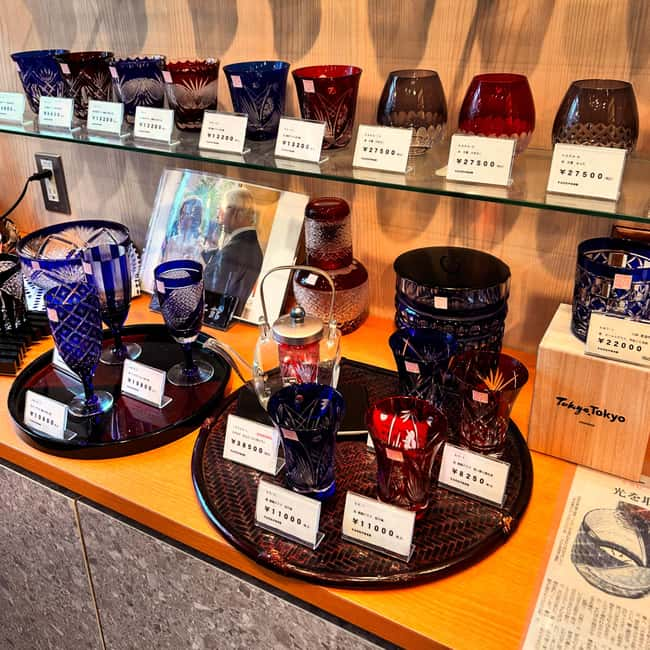
After the workshop, you can browse the studio shop. It features traditional Edo Kiriko designs alongside more modern pieces and collaborations with major brands, including Starbucks.
This shop gives you a wider view of the craft. The workshop shows the physical work involved, while the displays show how the style can move beyond classic forms. You may find colorful designs that appeal to you even if your own piece is simpler.
Shop purchases are not included in the $122 activity price. Treat the store as an optional final stop, not part of the value calculation. It is useful if you want to compare your beginner’s work with professionally finished pieces, but you do not need to buy anything to complete the experience.
Is $122 a fair price?
At $122 per person, this is not a cheap Tokyo activity. The price makes more sense when you consider what is included: a 90-minute guided class, practice time with tools, the glass-cutting session, observation of working artisans, English support, and the finished glass or container.
You are paying for access to a specialist craft setting and for an item you make yourself. That is different from paying for a short craft demonstration or a standard souvenir. The small group size also adds value, since the maximum is four participants.
The price is harder to justify if you mainly want a quick cultural stop or a low-cost keepsake. Ninety minutes is a meaningful block of time, and the activity requires focus rather than passive sightseeing. I would compare it with the cost of buying a finished Edo Kiriko piece, then ask which matters more to you: owning a polished object or understanding how the object is made.
For someone interested in Japanese crafts, the personal instruction and finished piece make the cost reasonable. For a family paying for several people, the total can rise quickly, so decide in advance who truly wants to cut glass and who would rather observe.
Who should book this workshop?
This is best for adults, couples, solo visitors, and families with older children who enjoy making things by hand. It also suits anyone looking for a quieter cultural activity away from Tokyo’s major sightseeing stops.
Children must be at least in fourth grade of elementary school, and adults must accompany children. The activity is listed as not suitable for children under nine, so families should take that limit seriously even if a younger child is interested.
Companions may watch without cutting. That can work well if one family member wants to participate while another prefers to take photos or supervise. Pets are not allowed.
You do not need prior glass-cutting experience. The practice session and staff support are designed for first-timers. You should, however, be comfortable following safety directions, working carefully, and accepting that your final pattern may not look exactly like a professional artisan’s work.
Practical details for planning your visit
The workshop lasts 1.5 hours, with starting times based on availability. Hotel pickup and drop-off are not included, so you arrange your own way to the studio in Sumida.
The activity is indoors and wheelchair accessible. Food and drinks are not included, and there is no meal portion to plan around. Allow extra time if you want to browse the on-site shop after cutting your piece.
Japanese and English are used during the experience. The live guide support is especially useful during the safety explanation and practice session. Listen carefully at the beginning, since the later work gives you freedom and may involve less direct supervision than some first-time participants expect.
Cancellation is free up to 24 hours before the start time for a full refund. You can also reserve and pay later, which helps if your Tokyo schedule is still changing.
Should you book the Edo Kiriko workshop?
Book it if you want more than a photo of Tokyo. You will see a traditional craft in a working studio, learn why the technique demands care, and leave with a glass or container marked by your own design.
The strongest reasons to go are the tiny four-person group, the chance to practice before touching the final piece, and the English interpretation during the Japanese artisan’s demonstration. The main caution is the level of supervision. You receive help, but you also have freedom, so people who want constant instruction may prefer a more tightly managed class.
At $122, this is a special-interest activity rather than a bargain. For a craft-minded visitor, it offers a personal connection to Edo Kiriko that a shop purchase cannot match. If that sounds like your kind of souvenir, reserve a place and choose your design with patience.
FAQ
How long does the Edo Kiriko workshop last?
The workshop lasts 1.5 hours, or 90 minutes.
Where does the workshop take place?
It takes place in an Edo Kiriko glass studio in Sumida Ward, Tokyo.
Is English support available?
Yes. The activity provides English-speaking support. The artisan speaks Japanese, and an English interpreter helps explain the process.
What will adults make?
Adults and middle school students cut their own designs onto drinking glasses.
What will elementary school children make?
Elementary school children make lidded containers with supervision.
What is the minimum age?
Participants must be at least in fourth grade of elementary school. The activity is not suitable for children under nine, and adults must accompany children.
Can someone come along without participating?
Yes. Companions may observe, but they may not take part in the glass cutting unless they have booked the activity.
Is the finished piece included?
Yes. The glass or lidded container you cut during the workshop is included. Purchases from the on-site shop are separate.
More Workshops & Classes in Tokyo

More tours in Tokyo we've reviewed










Workshops, compared.
 ★ 5.0Sushi Making Tokyo Roll and Authentic Japanese Sushi ClassFrom $59
 ★ 4.9Tokyo: Roll and Authentic Sushi Making Class in AsakusaFrom $581h 40m
 ★ 5.0Tokyo Shinjuku Chopsticks Making ClassFrom $20
 ★ 4.9Tokyo: Sushi Making Class in a Happi Coat near a Famous SpotFrom $421h 30m
 ★ 4.8Chopstick Making Workshop in GinzaFrom $251 hour
 ★ 5.0Tokyo Sushi Making Class in Tsukiji with Professional ChefFrom $49