
Reviewed · ASAKUSA TOURS
Asakusa: 2-hour history exploration
Asakusa’s famous red gate and temple are easy to photograph, but much harder to understand on your own. This two-hour walk connects the Sumida River to Senso-ji’s incense burner, fortune slips, gates, and neighboring shrine, turning a quick sightseeing stop into a clear story about Tokyo’s oldest districts. I like the small-group limit of 20 and the chance to sample traditional snacks along Nakamise Street.
I also like the practical touches: the guide meets you near the river, uses headsets for groups of three or more, and ends near a restaurant hosting a geisha activity. The main caution is pace. Fifteen minutes at several stops can feel short, and one person found the structure less clear than expected when too many details crowded out the main story.
In This Review
- Key points to know before booking
- Why a guided walk helps in Asakusa
- Starting beside the Sumida River
- Seeing the whole route from the tourist center
- Decoding the giant lantern at Kaminarimon
- Sampling snacks on Nakamise Shopping Street
- Passing through Hozomon and its large sandals
- Learning the rituals at Senso-ji Temple
- Understanding why Asakusa Shrine shares the grounds
- How the guides shape the experience
- Price, group size, and practical value
- Who should choose this Asakusa walk?
- Should you book the two-hour Asakusa history exploration?
- FAQ
- How long is the Asakusa history exploration?
- What time does the tour begin?
- Where does the tour meet?
- Where does the tour finish?
- Which sights are included?
- Is the tour conducted in English?
- Are headsets provided?
- What is the cancellation policy?
Key points to know before booking
- A 1,400-year story in two hours: The walk links Asakusa’s river origins with Senso-ji Temple and Asakusa Shrine.
- Traditional snacks are included: Your guide buys local treats along the way, with choices shaped by the group when possible.
- Clear guiding in busy streets: Headsets are provided for groups of three or more.
- Strong guide feedback: Choco, Yasu, and Amy are praised for clear English, local knowledge, and helpful shopping advice.
- Views before the temple visit: The Asakusa Culture Tourist Information Center terrace gives you a useful preview of the route.
- A convenient morning start: The tour begins at 9:30 a.m. near Azumabashi Bridge and finishes around Senso-ji.
Why a guided walk helps in Asakusa
Asakusa can look simple at first: a large red gate, a straight shopping street, and a temple at the far end. Yet nearly every object along that route has a religious or historical purpose. The giant lantern at Kaminarimon, the smoke from the bronze incense burner, the water at the purification fountain, and the fortunes sold at Senso-ji all make more sense when someone explains what you are seeing.
That is the real reason to book this walk. You are not paying for entry to a major attraction, since the listed stops are free. You are paying for context, translation, direction, and small details that are easy to miss while managing a map and a camera.
The tour also gives you a sensible order for seeing the area. It begins beside the Sumida River, moves toward the tourist center and Kaminarimon, follows Nakamise Shopping Street, and then reaches the temple and shrine. You get a steady introduction rather than arriving at Senso-ji with no idea why the gates and rituals matter.
The group can reach 20 people, so this is not a private walk. Still, the headsets should help, particularly around Kaminarimon and Nakamise, where foot traffic and street noise can make a guide difficult to hear. They are supplied for groups of three or more, so confirm that detail if your party is smaller.
A few more Tokyo tours and experiences worth a look


Starting beside the Sumida River
The meeting point is outside Burger King Asakusa Azumabashi, near 2-chome-20-6 Kaminarimon. The start time is 9:30 a.m., and the first stop is the Sumida River, only a short distance away.
This opening is more useful than it may sound. Asakusa’s story is tied to the river, so the tour begins with geography rather than dropping you directly in front of a temple. From across Azumabashi Bridge, you can see Tokyo Skytree and the Asahi Breweries headquarters, including the famous golden flame object.
You get about 15 minutes here. That is enough for an orientation and photographs, but not a long riverfront stop. I would treat it as a starting frame for the district, not as a separate attraction.
The bridge also helps you understand Asakusa’s position within Tokyo. You can look back toward the city and then toward the older temple quarter. Your guide uses the view to explain how the neighborhood developed around the river and Senso-ji.
Seeing the whole route from the tourist center
From the river, the group walks to the Asakusa Culture Tourist Information Center. The building is an attraction in its own right, designed by a well-known Japanese architect as a stack of wooden-looking structures set at different angles.
The important feature for this tour is the open observation terrace on the eighth floor. From there, you can preview the route: Tokyo Skytree and the Asahi flame behind you, then Kaminarimon, Nakamise, Hozomon, and Senso-ji ahead.
I like this stop because it gives you a map in your head before the crowds and shopfronts take over. When you later walk along Nakamise, you already understand how the street leads from the outer gate toward the temple grounds.
The stop lasts roughly 15 minutes, so the emphasis is on orientation and views rather than a detailed architectural visit. If you prefer to spend every minute at the temple itself, this may feel like a detour. For a first visit, though, the terrace adds useful shape to the morning.
Decoding the giant lantern at Kaminarimon
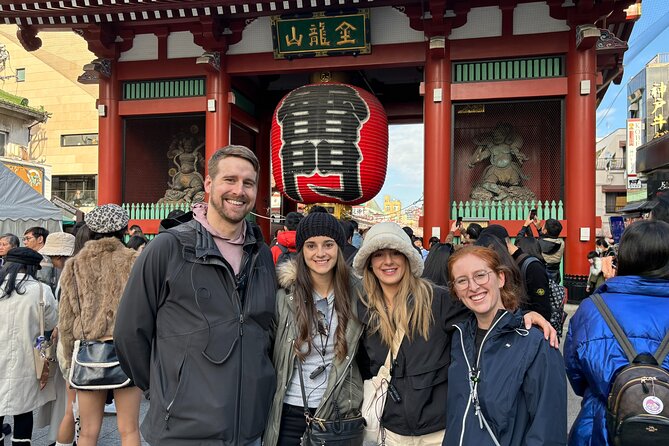
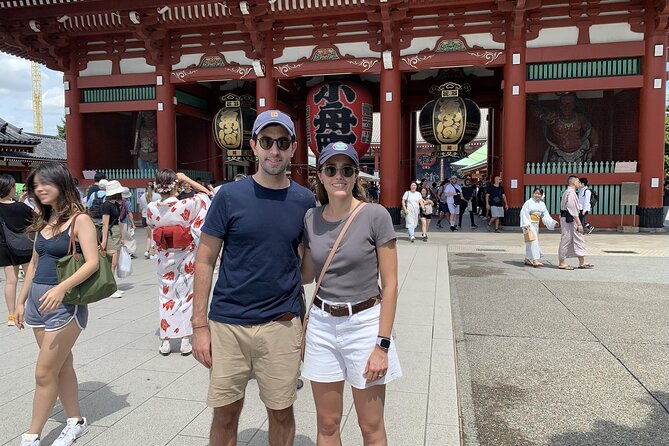
Kaminarimon means Thunder Gate, and it forms the outer entrance to the Senso-ji approach. Its huge red lantern is one of Tokyo’s most recognizable sights, but a photograph tells you very little about the gate’s religious meaning or the statues around it.
Your guide explains the lantern and its surrounding objects before you move on. That short explanation matters because this is where many independent visitors pause for a picture and then continue without understanding what they have passed.
Allow about 15 minutes. Kaminarimon is a public gateway, not a quiet museum room, so the stop will include people taking photos and moving through the entrance. The headsets are especially useful here if your group has three or more people.
This is also a good point to ask questions. Guides such as Choco and Amy received particular praise for answering questions clearly and helping with practical matters. Amy also gave useful advice about finding a Japanese knife, which shows the value of asking your guide about specific shopping goals.
Sampling snacks on Nakamise Shopping Street
Nakamise runs about 250 meters from Kaminarimon to the temple’s inner gate. Its stalls sell souvenirs and traditional Japanese snacks, making it both a route into Senso-ji and one of the liveliest parts of the walk.
The guide buys snacks for the group along the way. The exact choice can depend on what people prefer, and snacks may be purchased at another point during the tour. This is a small inclusion, but it changes the feel of the walk. You are not simply being pointed toward food stalls. You get a chance to try something with an explanation of what it is and why it belongs in Asakusa.
The stop takes about 30 minutes, the longest single portion of the itinerary. That gives you time to look at souvenirs, taste something, and hear about the district’s development. Near the end of the street, historical tablets show how Asakusa began and grew around Senso-ji.
A practical note: Nakamise is a shopping street, not a dedicated food tour. You should expect a sampling moment rather than a full meal. If you have a particular food preference, tell the guide early. The snack choice may be adjusted to suit the group, but no detailed menu is promised.
This is also the section where the tour’s group size may matter most. Twenty people can spread out along a narrow commercial street. Headsets should make the explanation easier to follow, but keep close to the guide so you do not miss the transition toward Hozomon.
Other historical tours in Tokyo
Passing through Hozomon and its large sandals
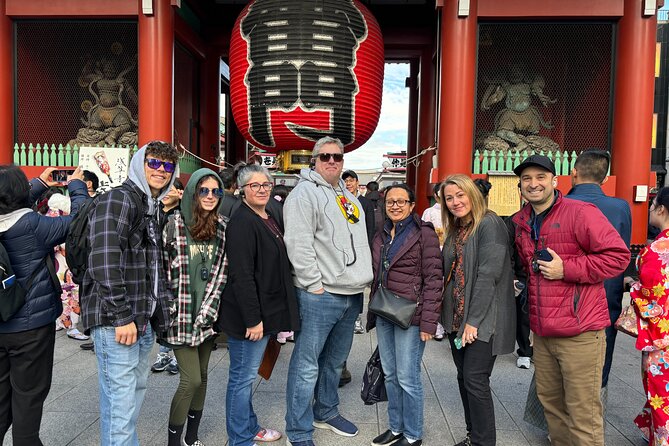
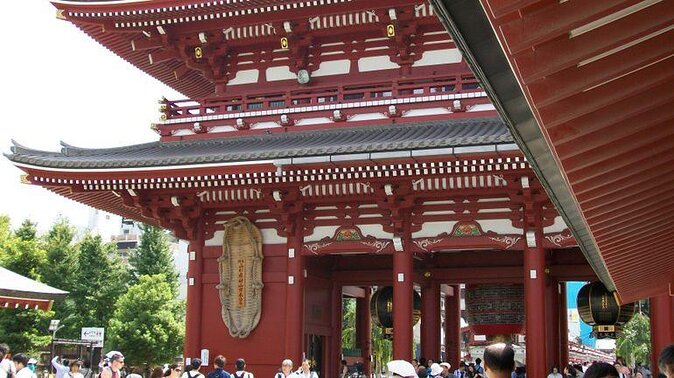
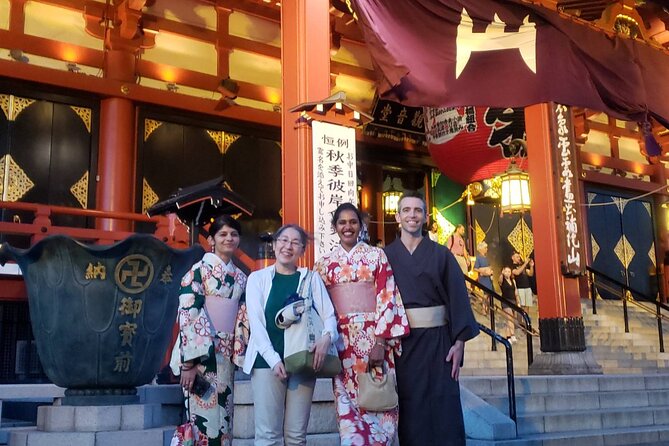
Hozomon, or Treasure-House Gate, is the inner gate before Senso-ji’s main hall. Its upper level holds temple treasures, while the lower level contains statues, three lanterns, and two enormous sandals.
The guide points out these details during a roughly 15-minute stop. The sandals are particularly memorable because they make the gate feel human in scale and give you something concrete to look for beyond the main lanterns.
This is a useful pause between the commercial approach and the religious center. Kaminarimon introduces the route. Nakamise fills it with shops and food. Hozomon signals that you are entering the temple’s principal grounds.
You will not be visiting a separate paid exhibit here. The value comes from knowing where to look and understanding why the gate is more than a dramatic entrance.
Learning the rituals at Senso-ji Temple
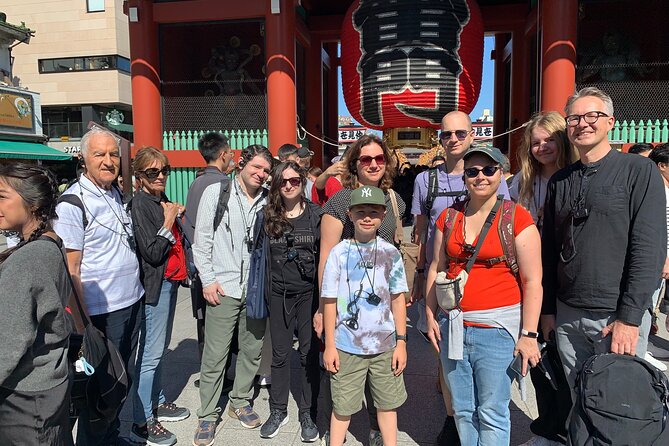
Senso-ji is the heart of the tour. The temple is linked to roughly 1,400 years of Asakusa history, and the walk gives you about 15 minutes to focus on the main features between Hozomon and the main hall.
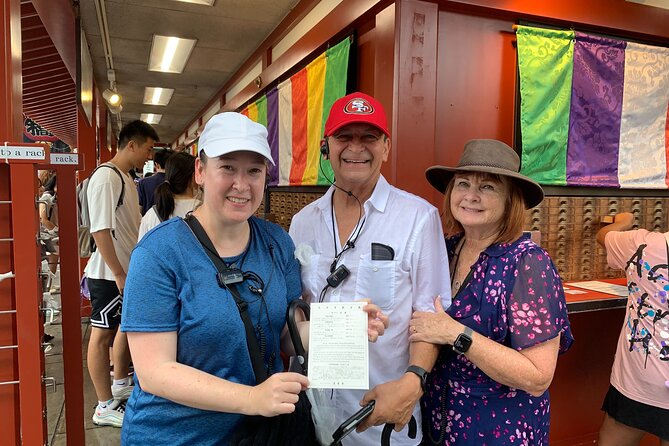
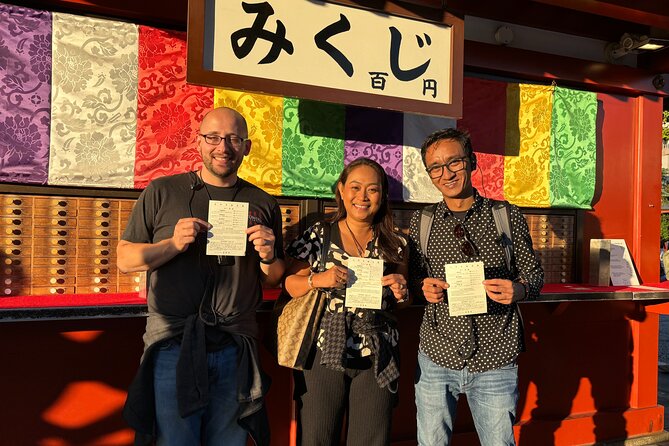
First, you can try omikuji, a paper fortune used to consider what the future may hold. Drawing one is optional, but it gives you a direct way to take part in a familiar Japanese temple custom.
Next comes the large bronze incense burner. People use the smoke around their hands and faces as a ritual associated with warding off illness before offering prayers. Your guide explains the custom so you are not left wondering why people gather around the burner.
You will also see the water purification fountain. Visitors use it to purify themselves before entering the main worship area. These are simple actions, but they are the details that turn a temple visit into a cultural experience rather than a quick photograph.
The five-story pagoda nearby is 53 meters high and is described as the second-highest pagoda in Japan. Its top floor holds Buddha’s ashes, given by the Sri Lankan government. This is the kind of detail that can be difficult to absorb while walking alone, especially when the grounds are crowded and your attention is split.
The short time at Senso-ji is both a strength and a limitation. It keeps the overall tour moving and allows you to see several major sites in one morning. It also means you will not have an extended period for quiet prayer, careful photography, or a full exploration of the temple grounds. If Senso-ji is your main reason for coming to Asakusa, plan to return after the tour.
Understanding why Asakusa Shrine shares the grounds
The final listed stop is Asakusa Shrine, a Shinto shrine that shares the wider Senso-ji setting. For many people, the presence of a Buddhist temple and Shinto shrine side by side raises an obvious question: how can both traditions exist in the same place and serve many of the same worshipers?
The guide uses Asakusa Shrine to explain how Buddhism and Shinto have shaped ordinary Japanese life together. This is one of the most valuable parts of the walk because it moves beyond architecture and shows how religious customs operate in daily practice.
The stop lasts about 15 minutes. It is a compact lesson, not a full religious studies lecture, but it gives you a better way to read other sites during your time in Japan. You begin to recognize that a shrine and a temple are not interchangeable, even when they sit within the same historic precinct.
The ending is near Saryō Ichimatsu, a restaurant where a geisha activity is held. That makes the finish convenient if you have booked or plan to attend that activity. Hotel pickup is not provided, so you need to reach the starting point on your own and arrange your next move from the restaurant area.
How the guides shape the experience
The tour is led in English by a local certified guide. The strongest guide feedback centers on clear explanations, friendly conversation, and a willingness to answer questions.
Choco is praised for explaining Asakusa and its history in clear English. Yasu is described as a strong storyteller, especially when discussing the founding of the city. Amy is noted for her knowledge of Tokyo and for practical shopping help, including advice about Japanese knives.
These names do not guarantee who will lead your walk, but they show the sort of guiding style to expect: less formal lecture, more direct explanation and conversation. One guide also added an origami lesson at the end, though that should be treated as a possible extra rather than a promised part of the tour.
The one weaker point raised about the experience was structure. A participant felt that too many details sometimes pushed the main story into the background. That is a fair concern on a two-hour walk. If you want a clean narrative, tell your guide that you would like the central story kept in view. The operator has indicated that it aims to follow the planned structure more closely.
Price, group size, and practical value
At $64.55 per person, this is not the cheapest way to walk around Asakusa. The temple, gates, shrine, bridge, and public viewpoints do not require an admission ticket.
The price makes more sense if you value explanation and a planned route. You receive two hours with a certified English-speaking guide, headsets for groups of three or more, and traditional snacks. You also avoid spending your first visit trying to work out what the rituals mean or how the main sights fit together.
The tour has a maximum of 20 people and offers group discounts. That size is manageable, but it is not the close attention of a private guide. I would call the value strongest for a first-time visitor who wants a clear cultural introduction and would otherwise pay for a separate guidebook, food tasting, or orientation walk.
The tour is booked, on average, about 30 days ahead. That does not mean you must reserve exactly a month early, but it is a useful sign that popular morning dates may fill. Confirmation arrives when you book, and mobile tickets are supported.
Most people can participate, service animals are allowed, and the meeting point is near public transportation. You should be ready for two hours on foot, with no hotel pickup. Free cancellation is available if you cancel at least 24 hours before the 9:30 a.m. start. Changes or cancellations inside that window are not refunded.
Who should choose this Asakusa walk?
I would recommend it most strongly to:
- First-time visitors who want Asakusa explained in plain English
- People interested in Japanese religious customs and early Tokyo history
- Anyone who likes a gentle walking pace rather than a packed full-day tour
- Families or groups who appreciate snacks and a guide who can answer questions
- Visitors planning a geisha activity afterward, since the walk ends near the relevant restaurant
You may want another option if you have already spent several days studying Senso-ji, prefer to explore alone, or want extended time for shopping and photography. The 15-minute temple stop will feel brief if you want to linger at every gate and shrine feature.
The score of 4.9 out of 5 from 32 ratings, along with a 97 percent recommendation rate, reflects a consistently strong experience. I would still read those numbers with the tour’s format in mind: its success depends heavily on the guide’s storytelling and on your comfort walking with a group.
Should you book the two-hour Asakusa history exploration?
Book it if you want your first Asakusa visit to have a clear beginning, middle, and end. The river, observation terrace, gates, snacks, temple rituals, and Shinto shrine create a well-shaped morning, and the guides appear especially good at making history understandable without turning the walk into a dry lecture.
The best reason to choose it is not simple sightseeing. It is the explanation of why Asakusa works the way it does, from the river and temple origins to the shared Buddhist and Shinto setting. The main tradeoff is limited time at each stop and a possible loss of structure if the guide goes too far into side details.
For $64.55, I see fair value for a first visit, especially if the snack, headsets, and local advice matter to you. If you want quiet temple time or extensive shopping, use the tour as an introduction and return to Senso-ji afterward on your own.
FAQ
How long is the Asakusa history exploration?
The walking tour lasts approximately two hours.
What time does the tour begin?
The tour starts at 9:30 a.m. local time.
Where does the tour meet?
The meeting point is Burger King Asakusa Azumabashi, at 2-chome-20-6 Kaminarimon in Taito City, Tokyo.
Where does the tour finish?
The tour ends at Saryō Ichimatsu at 1-chome-15-1 Kaminarimon. This is the restaurant where the geisha activity is held.
Which sights are included?
The route includes the Sumida River, Asakusa Culture Tourist Information Center, Kaminarimon, Nakamise Shopping Street, Hozomon, Senso-ji Temple, and Asakusa Shrine.
Is the tour conducted in English?
Yes. A local certified guide provides live guiding in English.
Are headsets provided?
Headsets are provided for groups of three or more so you can hear the guide clearly from a short distance.
What is the cancellation policy?
You can cancel for a full refund up to 24 hours before the experience begins. Cancellations or changes made less than 24 hours before the start time are not refunded or accepted.
More 2-Hour Experiences in Tokyo


More Historical Tours in Tokyo
More Asakusa Tours in Tokyo
More tours in Tokyo we've reviewed


Asakusa Tours, compared.
 ★ 4.8Tokyo: Japanese Dance Cabaret Theater Asakusa-Kaguwa TicketFrom $492 hours
 ★ 4.7Tokyo: Meiji Shrine, Asakusa, Skytree Bus Tour and CruiseFrom $12210 hours
 ★ 4.9Tokyo: Roll and Authentic Sushi Making Class in AsakusaFrom $581h 40m
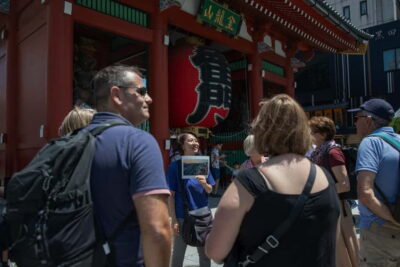 ★ 4.8Tokyo: Asakusa Walking Tour with Sensoji Temple VisitFrom $222 hours
 ★ 5.0Tokyo Asakusa Rickshaw TourFrom $42
 ★ 4.5Tokyo Panoramic 1 Day: Meiji Shrine, Asakusa, Odaiba and SKYTREE®From $85