
Reviewed · MT FUJI DAY TRIPS
[Seasonal Limited] Mt. Fuji 5th Station &Hot Spring Day Tour
The best part of this day trip is the Fuji variety. In one long day, you ride to 2,300 meters, photograph the mountain beside a red pagoda and old-style buildings, see Oshino Hakkai’s clear spring ponds, then soak in a hot spring with views toward Mt. Fuji. I especially like the easy access to the 5th Station, since you get the high-altitude setting without hiking, and the two-hour onsen stop gives the day a proper pause.
I also like the mix of postcard sights and local atmosphere. The red pagoda at Shinkurayama Asama Park and the thatched houses at Oshino Hakkai give you classic Japan scenes, while guides such as Ken, Coco, Anna, and Jacob have been praised for friendly help and clear explanations. The main drawback is the long bus ride, roughly four hours in total, and weekend traffic can cut into time at the stops.
In This Review
- Key points to know before booking
- What this Fuji day trip is really like
- Reaching Mt. Fuji 5th Station at 2,300 meters
- Shinkurayama Asama Park and the famous red pagoda view
- Oshino Hakkai’s eight clear spring ponds
- Two hours at Konohananoyu Onsen
- Weekday choice: hot spring or Gotemba shopping
- Guides, language, and the coach ride
- Timing problems and how to protect your day
- Who will enjoy this tour most
- Should you book the Fuji 5th Station and onsen day trip?
- FAQ
- How long does the Mt. Fuji day tour last?
- Where can I join the tour?
- Is Mt. Fuji 5th Station open all year?
- Do I need to hike to reach the 5th Station?
- Is the onsen fee included?
- Are tattoos allowed at Konohananoyu?
- Do Japanese hot springs require nude bathing?
- Can I choose Gotemba Premium Outlets instead of the onsen?
- What languages are available?
Key points to know before booking
![[Seasonal Limited] Mt. Fuji 5th Station &Hot Spring Day Tour - Key points to know before booking](https://tokyotravelguide.com/wp-content/uploads/2026/08/seasonal-limited-mt-fuji-5th-station-hot-spring-day-tour-1.jpg)
- Mt. Fuji 5th Station reaches 2,300 meters, giving you mountain air and big views without a climb.
- The 5th Station is seasonal, usually open from May 10 through November 30. Outside that period, the tour visits Shinkurayama Asama Park instead.
- Oshino Hakkai has eight spring ponds fed by snowmelt from Mt. Fuji, with bridges, flowers, and traditional homes.
- Konohananoyu offers indoor and open-air baths with direct views toward Mt. Fuji, but the onsen fee is extra.
- Weekday bookings may offer a choice between the hot spring and Gotemba Premium Outlets.
- The group may be multilingual, and on smaller departures the driver may also guide with limited English commentary.
What this Fuji day trip is really like
![[Seasonal Limited] Mt. Fuji 5th Station &Hot Spring Day Tour - What this Fuji day trip is really like](https://tokyotravelguide.com/wp-content/uploads/2026/08/seasonal-limited-mt-fuji-5th-station-hot-spring-day-tour-2.jpg)
This is a full-day coach outing from Tokyo, not a slow rural tour. You meet at either SMBC Bank Shinjuku Nishiguchi or Tokyo Station’s Marunouchi North Exit, depending on your booking, then spend about two hours reaching the Fuji area.
That travel time matters. Mount Fuji is far enough from central Tokyo that no road-based day trip can avoid a long ride. The reward is that you do not need to arrange trains, buses, local transfers, or entrance tickets yourself. You sit back, watch the city give way to the countryside, and arrive at several major Fuji sights in one organized run.
The tour costs about $50 per person. That is a useful price for round-trip transport, a guide, fuel, parking, and several stops. It is not an all-inclusive day, though. You pay separately for the onsen, meals, drinks, souvenirs, and personal purchases. If you want a private guide, a quiet pace, or long time at one location, this is not the right format. If you want broad coverage at a modest cost, it makes good sense.
A few more Tokyo tours and experiences worth a look



Reaching Mt. Fuji 5th Station at 2,300 meters
The first main stop is Mt. Fuji’s 5th Station, with about an hour for photos, sightseeing, walking, and free time. The coach takes you high up the mountain, so this is the easiest way to experience the upper slopes without committing to a hike.
At the station, you can expect crisp air, open mountain views, and souvenir shops with Fuji-themed goods. It is a practical stop rather than a wilderness outing. You will have time to look around, take pictures, and enjoy the altitude, but not enough time for a serious mountain walk.
Clouds are the great spoiler here. Even on a well-run day, Mt. Fuji may hide behind weather. One departure had clear skies and striking views, while another reached the area under cloud cover and could not see the mountain. The rest of the day still worked, but you should treat a clear Fuji view as a gift, not a guarantee.
The 5th Station normally operates from May 10 to November 30. Winter conditions or other closures can force a change to Shinkurayama Asama Park. That seasonal switch is important if you are booking outside the main climbing and sightseeing months.
Shinkurayama Asama Park and the famous red pagoda view
![[Seasonal Limited] Mt. Fuji 5th Station &Hot Spring Day Tour - Shinkurayama Asama Park and the famous red pagoda view](https://tokyotravelguide.com/wp-content/uploads/2026/08/seasonal-limited-mt-fuji-5th-station-hot-spring-day-tour-4.jpg)
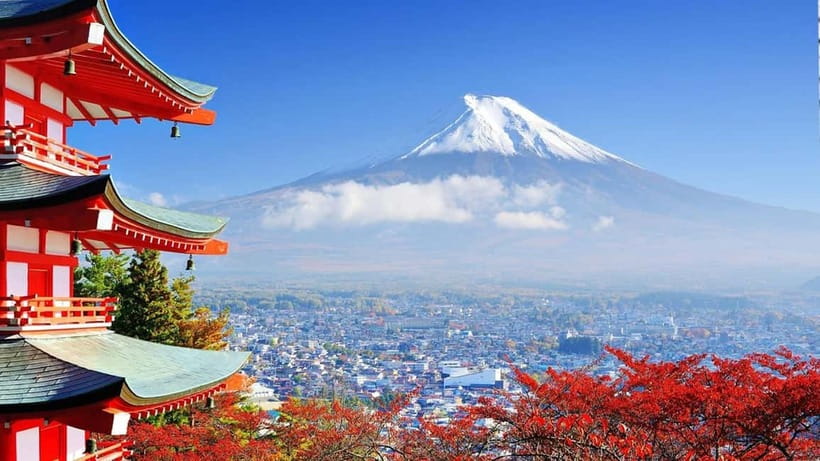
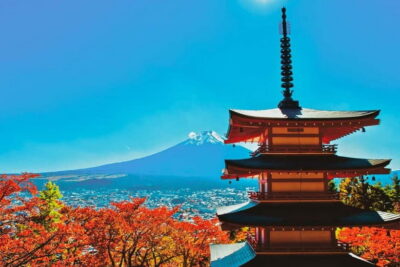
Shinkurayama Asama Park is one of Japan’s most recognizable Fuji photo spots. From the park, you can frame the mountain with a crimson five-story pagoda and traditional Japanese architecture. This is the scene that often appears on postcards and travel posters.
The view is highly photogenic, but reaching the best lookout involves walking and stairs. That makes the park less suitable for anyone with mobility limitations. The tour specifically excludes wheelchair users and people with mobility impairments, so take that warning seriously.
This stop also gives you a different view of Japan than the 5th Station. At the mountain station, the focus is height and open sky. At the park, the picture combines nature, religious architecture, and a carefully composed town view. If your main goal is a classic Fuji photograph, this may be the most important stop of the day.
The exact order can change. If traffic is heavy or a stop closes early, the guide may adjust the route and time spent at each place. Keep your phone charged and listen closely for meeting instructions, especially at scenic spots where it is easy to wander a little too far.
Oshino Hakkai’s eight clear spring ponds
![[Seasonal Limited] Mt. Fuji 5th Station &Hot Spring Day Tour - Oshino Hakkai’s eight clear spring ponds](https://tokyotravelguide.com/wp-content/uploads/2026/08/seasonal-limited-mt-fuji-5th-station-hot-spring-day-tour-5.jpg)
After roughly 30 minutes on the road, you reach Oshino Hakkai for about an hour. This old-style village is built around eight clear spring ponds fed by Mt. Fuji’s snowmelt. The water is the star here, but the setting makes the ponds memorable: thatched-roof houses, small bridges, flowers, walking paths, and views toward the mountain.
An hour is enough to see the main ponds, take photographs, browse local stalls, and sample the atmosphere. It is not enough for a long, unhurried village exploration. If you stop for food or shopping, keep an eye on the meeting time.
Oshino Hakkai can become crowded, especially on weekends and national holidays. The village has strong visual appeal, but busy paths can make it feel more like a popular sightseeing stop than a quiet country retreat. Go early within your allotted time, photograph the ponds first, then look around the shops.
I like this stop because it adds a touch of old Japan to a day otherwise built around large scenic viewpoints. The clear water also gives the visit a strong sense of place. You are not just looking at Mt. Fuji from far away. You are seeing how water from the mountain shapes the village below.
Two hours at Konohananoyu Onsen
The final major stop is Konohananoyu, where you have about two hours to relax. The facility includes indoor and open-air baths, plus a rest area where you can have a meal or tea after bathing. The main attraction is the chance to soak while looking toward Mt. Fuji.
This is a smart way to finish a sightseeing day. The bus ride, walking, crowds, and repeated photo stops can wear you down. A long bath gives you time to slow down rather than rushing straight from one landmark to another.
There are important rules. Japanese hot springs require nude bathing, and tattoos must be fully covered. If you cannot cover a tattoo as required, entry will be refused. The onsen admission is not included in the tour price, so bring cash and allow for that added cost.
Weekend and holiday visits may be crowded. Queues can become long, and in especially busy conditions you may not be able to use the baths. The tour may then direct you toward a nearby shopping center instead. This is one reason weekday departures are preferable if the onsen is the feature you care about most.
The two-hour period does not mean two hours in the water. You need time to change, wash before entering the bath, soak, dry off, and perhaps use the rest area. Even so, it is far more generous than the short bathing stops found on many day tours.
A few more Tokyo tours and experiences worth a look
Weekday choice: hot spring or Gotemba shopping
![[Seasonal Limited] Mt. Fuji 5th Station &Hot Spring Day Tour - Weekday choice: hot spring or Gotemba shopping](https://tokyotravelguide.com/wp-content/uploads/2026/08/seasonal-limited-mt-fuji-5th-station-hot-spring-day-tour-6.jpg)
From Monday through Friday, you may be able to choose between Konohananoyu and Gotemba Premium Outlets. The outlet center sits at the foot of Mt. Fuji and combines brand shopping, food, and mountain views.
This choice changes the feel of the day. The onsen is about rest and Japanese bathing culture. Gotemba is about shopping, meals, and a polished retail setting with Fuji in the distance. If your luggage is already full or you do not care about outlet stores, the hot spring is probably the better use of your time.
On weekends and Japanese national holidays, hot spring arrangements are not guaranteed. You may need to ask at the facility yourself, and heavy crowds can affect access. Check the option attached to your chosen departure rather than assuming the same plan applies every day.
Guides, language, and the coach ride
![[Seasonal Limited] Mt. Fuji 5th Station &Hot Spring Day Tour - Guides, language, and the coach ride](https://tokyotravelguide.com/wp-content/uploads/2026/08/seasonal-limited-mt-fuji-5th-station-hot-spring-day-tour-7.jpg)
The tour offers English and Chinese service. On a small departure, the driver may also act as the guide, with limited English commentary. There is no commentary while the vehicle is moving, and multilingual service means information may be shared in more than one language.
That setup can work well if you mainly need transport, timing help, and basic explanations. It may disappoint you if you want a long, detailed lecture about Fuji, local religion, or Japanese culture. The quality can also depend on the individual guide. Ken has been praised for clear explanations and help with photographs, while Coco was noted for sharing information about Japan and being accommodating. Anna was praised for a smooth, well-explained day, and Jacob was warmly thanked for his help.
The vehicle is assigned according to the number of people on that date, so the exact coach type is not guaranteed. Some departures may use a basic or smaller bus. The ride takes about two hours each way, plus shorter transfers between the Fuji-area stops. Wear comfortable clothes, choose practical shoes, and bring something to occupy you during the longer road sections.
Food and drinks are not allowed in the vehicle. Plan to eat during designated stops, and carry cash for the onsen, snacks, shopping, and small purchases.
Timing problems and how to protect your day
![[Seasonal Limited] Mt. Fuji 5th Station &Hot Spring Day Tour - Timing problems and how to protect your day](https://tokyotravelguide.com/wp-content/uploads/2026/08/seasonal-limited-mt-fuji-5th-station-hot-spring-day-tour-8.jpg)
Traffic is the biggest practical risk. The roads around Mt. Fuji and Tokyo can slow sharply on weekends and holidays. Heavy traffic may lead to a later return, shorter sightseeing periods, a changed stop order, or an early closure at one of the attractions.
Your pickup details can also change. Confirm the meeting point and time shortly before departure, and check any updated message rather than relying only on an earlier app display. One missed pickup caused by an outdated meeting location turned an otherwise promising day into a costly disappointment.
Arrive early at the chosen pickup point. Keep the phone used for booking charged, and save the operator’s contact details. At each stop, note the coach location and return time before walking off to take photographs.
The return is to either SMBC Bank Shinjuku Nishiguchi or Tokyo Station’s Marunouchi North Exit, matching the available option. Since the ride back can take about two hours, avoid scheduling a tight evening reservation or airport transfer afterward.
Who will enjoy this tour most
![[Seasonal Limited] Mt. Fuji 5th Station &Hot Spring Day Tour - Who will enjoy this tour most](https://tokyotravelguide.com/wp-content/uploads/2026/08/seasonal-limited-mt-fuji-5th-station-hot-spring-day-tour-9.jpg)
I would recommend this tour to first-time Tokyo visitors who want to see several Fuji-area highlights without learning a complicated regional transport system. It also suits couples, families with older children, and solo visitors who prefer a planned day with transport included.
It is a good match for you if:
- You want a Fuji photo without hiking.
- You like combining nature, architecture, village scenery, and bathing.
- You are comfortable spending several hours on a coach.
- You prefer a value-priced group outing to a private tour.
- You are happy with basic multilingual commentary.
- You can handle walking and stairs at scenic stops.
I would be more cautious if you need step-free access, dislike group schedules, or want guaranteed clear views of Mt. Fuji. The tour is not suitable for pregnant women, wheelchair users, people with mobility impairments, or people over 70 according to the stated restrictions. Children aged 0 to 3 may join, but you should contact customer service before booking for safety guidance.
Should you book the Fuji 5th Station and onsen day trip?
Book it if you want maximum Fuji coverage for about $50 and do not mind a long day on the road. The combination of the 5th Station, Shinkurayama Asama Park, Oshino Hakkai, and a Fuji-viewing onsen gives you more range than a simple photo stop.
Choose a weekday if possible, especially if the hot spring matters to you. For the best chance of seeing Mt. Fuji, aim for favorable weather and keep your expectations flexible. Clouds can defeat even a carefully planned route.
This is not a slow, deeply guided look at the Fuji region. It is a practical sampler with excellent photo potential, a pleasant bathing finish, and enough structure to remove the usual transport headaches. If that sounds like your kind of day, it is a sensible choice. If you want guaranteed views, private pacing, or an in-depth cultural guide, spend more for a different style of trip.
FAQ
How long does the Mt. Fuji day tour last?
It is a one-day tour. The scheduled coach journey takes about two hours from Tokyo to the Fuji area and about two hours back, with additional short transfers between stops.
Where can I join the tour?
The two stated pickup choices are SMBC Bank Shinjuku Nishiguchi and Tokyo Station’s Marunouchi North Exit. The exact meeting point depends on the option you book.
Is Mt. Fuji 5th Station open all year?
No. The stated opening period is May 10 through November 30. If the 5th Station is closed because of winter conditions or another reason, the tour visits Shinkurayama Asama Park instead.
Do I need to hike to reach the 5th Station?
No. The tour uses a bus to reach the 5th Station at about 2,300 meters, so you can enjoy the high-altitude setting without a mountain hike.
Is the onsen fee included?
No. The admission fee for Konohananoyu is paid separately, as are meals, drinks, and personal purchases.
Are tattoos allowed at Konohananoyu?
Tattoos must be covered. If you cannot cover them as required, you will be refused entry.
Do Japanese hot springs require nude bathing?
Yes. Japanese onsens require nude bathing, and swimwear is not used in the baths.
Can I choose Gotemba Premium Outlets instead of the onsen?
From Monday through Friday, you may be able to choose Gotemba Premium Outlets or the hot spring. Hot spring arrangements are not available on weekends and national holidays, and crowded conditions may also affect access.
What languages are available?
The tour provides English and Chinese service. On small departures, the driver may also guide with limited English commentary, and there is no commentary while driving.
More Spa & Hot Springs in Tokyo
More Mt Fuji Day Trips in Tokyo
More tours in Tokyo we've reviewed





Mt Fuji Day Trips, compared.
 ★ 5.0Mt Fuji and Hakone 1-Day Bus Tour Return by Bullet TrainFrom $163
 ★ 4.0Mt Fuji & Hakone Cruise, Drum Show Bullet Train 1 Day from TokyoFrom $149
 ★ 4.4Tokyo Mt Fuji 5th St & Hakone Cruise Bus Tour w/Bullet TrainFrom $15410 hours
 ★ 4.5From Tokyo: Mount Fuji Full-Day Sightseeing TripFrom $6810 hours
 ★ 4.7Tokyo: Mt. Fuji Tour, Hakone Ropeway, Owakudani, Lake AshiFrom $5410 hours
 ★ 4.4Tokyo:Mt.Fuji,Kawaguchiko Oishi Park,Arakurayama Sengen ParkFrom $5410 hours