
Reviewed · WALKING TOURS
Private Walking Tour: The Little Kyoto of Tokyo, Kagurazaka
Kagurazaka gives you a side of Tokyo that can vanish between train stops: cobblestone lanes, black wooden fences, old shrines, and small surprises tucked behind a busy shopping street. This private two-hour walk connects the neighborhood’s samurai roots, geisha past, religious sites, and modern design.
I like the quiet, local feel and the way the route links places that are easy to miss on your own. I also like the private format, especially if you want to ask plenty of questions, as one small group did with its guide. The main drawback is the price: at $104.05 per person, this is a serious fee for two hours, and snacks are not included.
In This Review
- Key points about the Kagurazaka walk
- Why Kagurazaka feels different from central Tokyo
- Starting at la kagū and AKOMEYA TOKYO
- Akagi Shrine and the neighborhood’s long religious life
- Zenkoku-ji Temple and Bishamonten
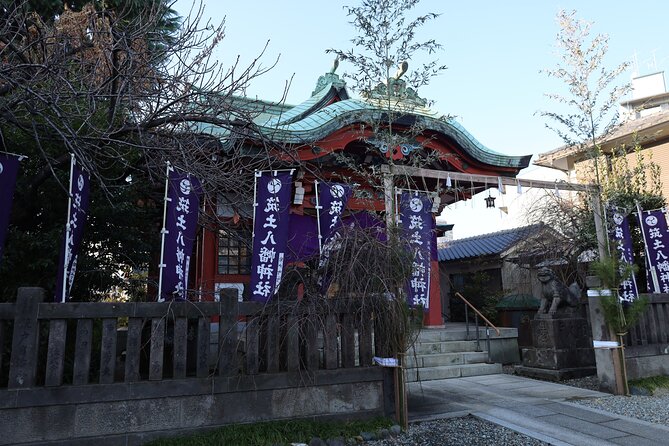
- Tsukudo Hachiman Shrine and an older Tokyo
- Ushigome Gate and Edo Castle’s outer moat
- A private walk with room for questions
- The food you can add on your own
- Is $104.05 per person good value?
- Timing, meeting point, and what to expect
- Who will get the most from this experience?
- Should you book the Kagurazaka tour?
- FAQ
- How long does the Kagurazaka walking tour last?
- Where does the tour begin?
- Where does the tour finish?
- Is this a private tour?
- Which languages are available?
- What places are visited?
- Are admission tickets included?
- Are snacks included?
- Can the tour be canceled or changed?
Key points about the Kagurazaka walk
- Kengo Kuma’s la kagū: Begin at a former publishing warehouse turned shopping and dining space, with Japanese food goods and design touches.
- Five historic stops: Visit Akagi Shrine, Zenkoku-ji Temple, Tsukudo Hachiman Shrine, the remains of Ushigome Gate, and more.
- A private group: Only your party takes part, giving you room to ask questions and set the pace within the two-hour schedule.
- A multilingual guide: English, French, German, and Spanish guiding is offered.
- Old Tokyo in central Tokyo: See samurai-era defenses, religious sites, former geisha-district streets, and modern shops without leaving the city center.
- Food is extra: Local sweets, doughnuts, tofu desserts, croquettes, and other treats are available around the neighborhood but are not part of the tour price.
Why Kagurazaka feels different from central Tokyo
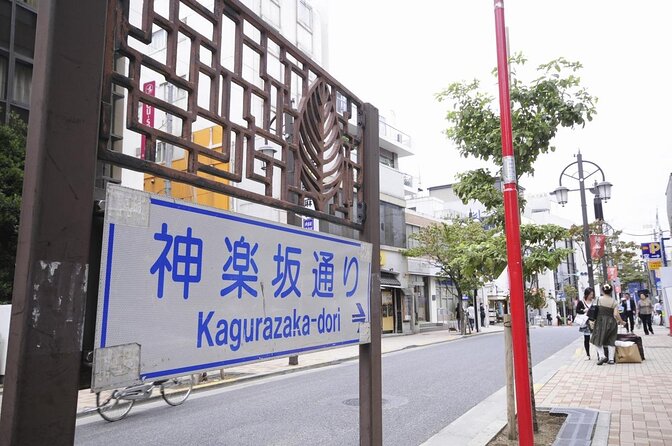
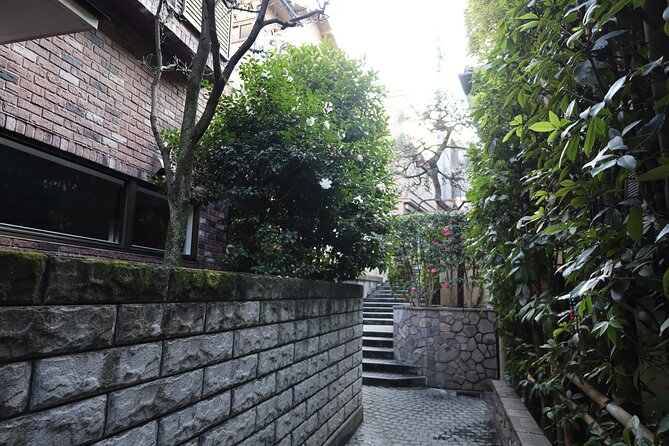
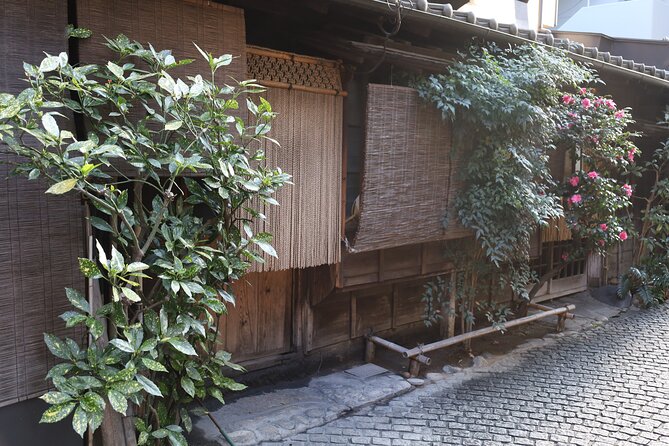
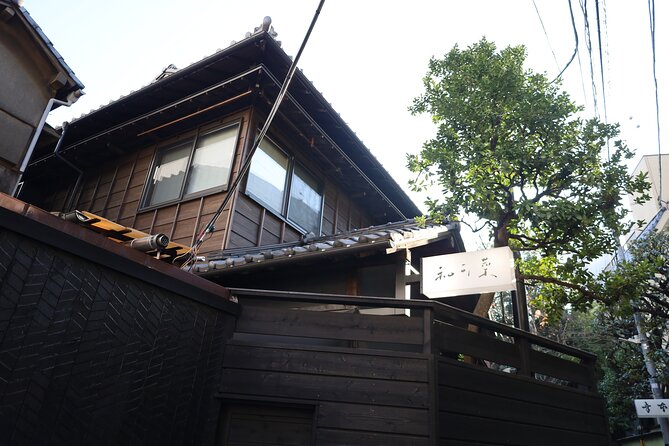
Kagurazaka is not a grand monument district. Its appeal comes from the way layers of Tokyo sit close together. A shopping street leads to a narrow lane. A modern shop occupies an old warehouse. A shrine appears behind a wall. Stone remnants recall Edo Castle while restaurants and residences carry on with everyday city life.
The neighborhood street was constructed in 1636 under Tokugawa Iemitsu, the third shogun. That date gives the walk a useful anchor. You are not simply wandering through an attractive quarter. You are following a route shaped by the Tokugawa government and later changed by religion, commerce, entertainment, publishing, and residential life.
The area is also linked with samurai culture, a former geisha district, Japanese modern literature, and traditional worship. You should not expect a preserved open-air museum. Kagurazaka works better as a living neighborhood where old traces turn up beside ordinary Tokyo activity.
That is why a guide matters here. The streets alone can be pleasant, but the meaning sits in the details: why a gate was built, how a shrine moved, what a temple’s guardian deity represents, and how the neighborhood developed its particular character.
Other walking tours we've reviewed in Tokyo

Starting at la kagū and AKOMEYA TOKYO
The walk begins at Kagurazaka Station, at AKOMEYA TOKYO in la kagū. The building was renovated by architect Kengo Kuma from a warehouse once used by Shinchosha Publishing Company.
This is a smart starting point because it introduces two sides of Kagurazaka at once. The building points to modern Japanese architecture and publishing, while AKOMEYA TOKYO sells carefully selected food and household goods, including rice, dashi, and seasonings.
You get about 10 minutes here, and admission is free. Do not think of this as a major shopping stop that will fill half your day. It is more useful as a quick orientation point and a reminder that Kagurazaka’s past is not frozen. The neighborhood has room for contemporary design and old religious sites on the same walk.
If you are tempted by the food shelves, remember that snacks are not included in the tour. You can buy local delicacies separately, but allow for the fact that this is a walking tour, not a food tour.
Akagi Shrine and the neighborhood’s long religious life
The next stop is Akagi Shrine, with about 15 minutes set aside for a look around. The shrine was founded in 1300 by Ohgoshi Hikotaro Shigeharu, who had moved from the area beneath Mount Akagi in Gunma Prefecture. It was relocated to its present site in 1555.
Those dates help show how old Tokyo’s religious networks can be. The shrine is not simply a stop for a quick photograph. Its story reaches back before the Tokugawa shogunate and connects Kagurazaka to a founder who came from outside the immediate area.
The visit is short, so you should expect a focused explanation rather than a long ceremony or extended free time. That suits the overall tour. You move through several distinct places, and the guide can explain how each one adds another piece to Kagurazaka.
I find this kind of stop especially useful early in a neighborhood walk. It shifts your attention from the commercial street to the older beliefs and local traditions that helped shape the area.
Zenkoku-ji Temple and Bishamonten
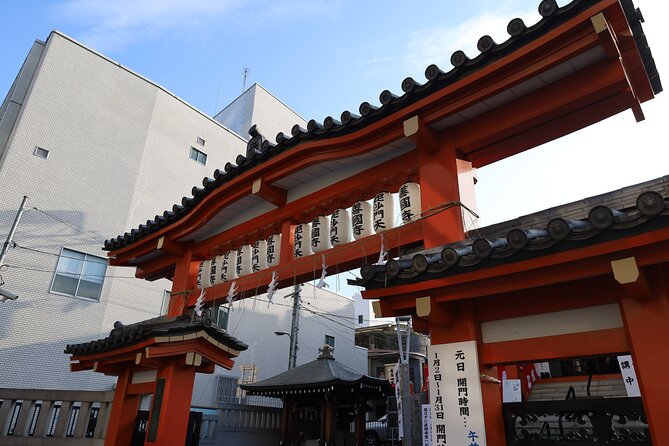
Zenkoku-ji Temple receives another 15 minutes. Also known as Bishamonten, the temple was established in 1595 in Nihonbashi Bakurocho under the order of Tokugawa Ieyasu, the first shogun of the Edo shogunate. It was intended to protect the nation and later moved after repeated fires.
The temple gives the walk a direct connection to the early Edo government. Its story is also a practical lesson in Tokyo’s vulnerability to fire and the way the city has repeatedly rebuilt itself.
Bishamonten is associated with protection, so the site offers more than an architectural pause. Your guide can place the temple within the religious and political setting of the time, then connect it to the neighborhood you are seeing today.
The schedule allows enough time to hear the main points and look around, but not enough for a slow, unstructured temple visit. If you prefer spending 30 or 40 minutes at one sacred site, this tour may feel brisk. If you want a broad introduction to Kagurazaka, the short stop works well.
Tsukudo Hachiman Shrine and an older Tokyo
Tsukudo Hachiman Shrine is described as an ancient shrine, believed to have been established about 1,200 years ago. The small shrine is also associated with a statue of Amitabha Buddha said to have been carved by Saicho, the Buddhist monk better known for founding the Tendai school.
You have about 15 minutes here. The value of the stop lies in its age and in the way it points to the overlapping religious traditions of Japan. A compact neighborhood shrine can carry stories that reach far beyond the streets around it.
This part of the walk also rewards patient looking. Kagurazaka’s character is built from modest sites rather than one huge attraction. A short stop may leave you with more questions, which is where a private guide has an advantage. You can ask for clarification instead of simply moving on with a large group.
The tour description also highlights small details such as heart-shaped stones. There is no guarantee of exactly when or where you will spot one, but this gives you a sense of the walk’s mood. It is designed around small discoveries, not only famous landmarks.
Other private tours in Tokyo




Ushigome Gate and Edo Castle’s outer moat
The final listed stop is the remains of Ushigome Gate, with about 10 minutes planned. The gate was built in 1636 as part of the outer moat of Edo Castle. Today, the surviving stone walls help you understand the scale of the original structure.
This is one of the strongest historical stops because the remains connect the present street directly to the defensive system of Edo. The stones may not look dramatic at first glance, but they become more meaningful once you understand that this was part of a large castle complex.
The stop also brings the walk back to the date introduced at the beginning: 1636, the year Kagurazaka Street was constructed under Tokugawa Iemitsu. You see how the neighborhood’s street pattern and the shogun’s defensive city were linked.
Ten minutes is enough for an explanation and a look at the stonework. It is not enough to explore a large castle site, but there is no large castle complex here to tour. This is a compact urban remnant, best appreciated with context.
A private walk with room for questions
The private format is the clearest practical advantage. Only your group participates, so you do not need to match a stranger’s interests or wait for a large crowd to gather around the guide.
That matters in Kagurazaka because the subject changes quickly. You may want to ask about samurai history at one stop, then switch to architecture, religion, literature, or the old geisha district. A private guide can respond to those interests more naturally than a fixed lecture.
One small group of four found this particularly useful because everyone could ask many questions. That detail matters more than a generic promise of personal service. If you are traveling with family or friends who enjoy history, the private setup gives you a better chance to turn a short tour into a real conversation.
The provider offers multilingual local guiding in English, French, German, and Spanish. The specific guide assigned to your booking is not given in the tour information. Shinya Yamada is named in the tour company’s correspondence, and Chiharu Iida is also identified as a guide, but you should not assume either person will lead your particular departure.
The walking pace should be manageable for most participants, and the activity is near public transportation. Service animals are allowed. Still, you should be comfortable walking for roughly two hours on streets that include cobblestones and older lanes.
The food you can add on your own
Food is not included, but that is not necessarily a weakness in Kagurazaka. The area offers chances to buy traditional Japanese sweets, doughnuts, tofu desserts, and butcher-shop croquettes.
These optional purchases can make the walk feel more personal. You choose what interests you rather than paying for a fixed tasting menu. A croquette from a neighborhood butcher may tell you more about daily local life than another formal sightseeing stop.
The catch is that the tour price does not cover these items, and the two-hour schedule may not allow a long food break. If snacks are important to you, ask the guide early how much time is practical. Do not assume the walk includes tastings just because food shops are part of the neighborhood experience.
I would treat the snacks as optional spending, not as part of the tour’s value calculation. The main product here is interpretation of the streets and historic sites.
Is $104.05 per person good value?
At $104.05 per person, the cost is high for a two-hour walk. The value improves if you are traveling with people who care about history and can make good use of a private guide’s attention.
A solo booking or a pair will pay more per person for the private format. A larger group may benefit from the stated group discounts, though the exact discount is not provided. Check the final price before booking rather than assuming the discount will be substantial.
You are paying for more than a route between five free sites. You are paying for local interpretation, multilingual support, a private group, and a neighborhood that can be difficult to understand from a map alone. If you would otherwise stroll through Kagurazaka without learning why the shrines, temple, gate, and street layout matter, the guide adds real value.
The price makes less sense if you mainly want photographs or a casual walk. You can visit these public places without an admission charge, and the tour does not include snacks. Budget-conscious visitors may prefer to explore independently and spend the money on food or another paid sight.
Timing, meeting point, and what to expect
The meeting point is AKOMEYA TOKYO in la kagū near Kagurazaka Station in Shinjuku City. The walk ends at the west exit of JR Iidabashi Station.
That start and finish are useful because you do not return to the original station. You can continue from Iidabashi to another Tokyo stop, meet friends, or plan lunch nearby. The published operating window is Monday through Sunday, from 9:00 a.m. to 8:30 p.m., for the stated booking period.
Confirmation is sent within 48 hours of booking, subject to availability. The tour is non-refundable and cannot be changed for any reason, so I would not book until your date and group size are firm.
The experience is available by mobile ticket. Since the route includes several short stops, arrive ready to walk rather than expecting a sit-down sightseeing experience. Comfortable shoes are the sensible choice, especially on cobblestone sections.
Who will get the most from this experience?
I would recommend this walk to first-time visitors who want a quieter introduction to Tokyo, repeat visitors who have already seen the major districts, and anyone interested in the city’s samurai-era structure.
It also suits people who enjoy asking questions. The private format gives you the best return if you want to connect the sites to Japanese history, religion, literature, architecture, and neighborhood life.
Families and mixed-age groups may like the short stops and changing subject matter. The tour is also a good match for visitors who want a central Tokyo outing without spending the whole day in a crowded attraction.
I would hesitate if you dislike walking, want a food-focused activity, or need flexible cancellation. I would also think twice if your budget is tight and you are comfortable researching the neighborhood on your own.
Should you book the Kagurazaka tour?
Book it if you want context, conversation, and a close look at an old Tokyo neighborhood rather than a checklist of major sights. The route covers a lot in two hours: modern design at la kagū, a 1,200-year-old shrine tradition, an Edo-era temple, castle defenses, and the traces of a former geisha district.
The strongest reason to choose it is the private guide. You can ask why Kagurazaka developed as it did and follow your own interests instead of listening to a standard speech in a large group.
Skip it if $104.05 feels too steep for a short walk, or if you mainly want included food and free time. For the right visitor, though, Kagurazaka offers a calm and revealing pause in central Tokyo, and this tour gives its quiet details a useful voice.
FAQ
How long does the Kagurazaka walking tour last?
The tour lasts approximately two hours.
Where does the tour begin?
It begins at AKOMEYA TOKYO in la kagū near Kagurazaka Station, at Kagurazaka Sta. Yaraicho in Shinjuku City, Tokyo.
Where does the tour finish?
The tour ends at the west exit of JR Iidabashi Station.
Is this a private tour?
Yes. Only your group participates in the activity.
Which languages are available?
A multilingual local guide is available in English, French, German, or Spanish.
What places are visited?
The route includes AKOMEYA TOKYO in la kagū, Akagi Shrine, Zenkoku-ji Temple, Tsukudo Hachiman Shrine, and the remains of Ushigome Gate.
Are admission tickets included?
The listed stops have no admission charge, and the tour includes access to the walking experience. No separate attraction ticket is listed as required.
Are snacks included?
No. Snacks are not included. You may buy local sweets, doughnuts, tofu desserts, croquettes, and other local delicacies separately.
Can the tour be canceled or changed?
No. The experience is non-refundable and cannot be changed for any reason.
More Private Tours in Tokyo
More Walking Tours in Tokyo


More tours in Tokyo we've reviewed









Walking Tours, compared.
 ★ 5.0Tokyo Tsukiji Fish Market Food and Culture Walking TourFrom $99
 ★ 5.0Tokyo: Imperial Palace and Shogun Historical Walking TourFrom $22
 ★ 4.9Tokyo: Shinjuku Local Bar and Izakaya Guided Walking TourFrom $343 hours
 ★ 5.0Tokyo: Tsukiji Fish Market Food and Walking tourFrom $30
 ★ 4.8Tokyo: Asakusa Walking Tour with Sensoji Temple VisitFrom $222 hours
 ★ 4.9Tokyo: Tsukiji Fish Market Guided Walking TourFrom $222 hours