
Reviewed · ASAKUSA TOURS
Tokyo: Asakusa Walking Tour with Japanese Comedian
The unusual hook here is simple: Ryo is both a comedian and an Asakusa guide. In about 90 minutes, he leads you from the Asakusa Culture Tourist Information Center to Senso-ji, mixing Buddhist and Shinto traditions with jokes, local tips, and stories you would likely miss on your own.
I like the small-group format, which gives you room to ask questions, and I like the way the walk includes quiet corners beside the famous temple grounds. The main consideration is timing: Asakusa can turn hot and crowded, so an early start is a smart choice.
In This Review
- Key points
- Starting above Asakusa at the Culture Tourist Information Center
- Kaminarimon and Nakamise, Asakusa’s grand entrance
- Bentendo and the Bell of Time
- Quiet statues and the Nitenmon Gate
- Asakusa Shrine and the temple’s smaller corners
- Nishi-sando and the melon bread stop
- Hozomon and the main hall of Senso-ji
- What Ryo adds beyond a standard sightseeing walk
- Group size, pace, and the best time to go
- Is $37.99 a good value?
- Who should book this Asakusa walk?
- Should you book the Karate Comic Ryo tour?
- FAQ
- How long does the Asakusa walking tour last?
- Where does the tour begin?
- Where does the tour finish?
- How many people can join the tour?
- Is the tour near public transportation?
- Can I cancel for a full refund?
Key points
- Ryo brings two useful skills: He works as a guide and has a background as a rickshaw driver in Asakusa, giving him both historical context and local orientation.
- The walk covers more than Senso-ji: You’ll see Asakusa Shrine, Nitenmon Gate, Bentendo, the Bell of Time, and several less obvious temple sites.
- Small groups make conversation easy: The tour is described as capped at six people, while the additional booking details state a maximum of eight.
- Early morning is the best bet: An 8 a.m. start can offer cooler, calmer temple grounds before crowds build later in the morning.
- Melon bread adds a tasty local pause: The route can include Kagetsu-do in Nishi-sando Shopping Street for the well-known Japanese sweet bread.
- The price is modest: At $37.99 per person, you are paying mainly for interpretation, local pointers, and efficient sightseeing rather than entrance tickets.
Starting above Asakusa at the Culture Tourist Information Center
The walk begins at the Asakusa Culture Tourist Information Center, near Asakusa Cruise Pier. Before heading into the temple district, you go up to the eighth-floor observation area for a broad view of the neighborhood.
This is a smart opening. Asakusa can feel like a maze of gates, lanes, shops, shrines, and temple buildings. Seeing it from above helps you understand the layout before you begin walking. You get your bearings quickly, then descend into the older center of the district.
There is no admission charge for this stop. The visit lasts about 10 minutes, so do not expect a long observation-deck session. Think of it as a useful orientation point and a chance to take a few city photographs.
The starting point also works well for anyone arriving by public transportation. The tour is near transit, and the meeting address is at Tokyo Cruise Asakusa Pier, 1-chome-1-1 Hanakawado.
A few more Tokyo tours and experiences worth a look


Kaminarimon and Nakamise, Asakusa’s grand entrance
From the information center, the walk enters the main Asakusa area through Kaminarimon Gate. This is the huge red entrance gate associated with Senso-ji and one of the clearest visual symbols of old Tokyo.
You then move along Nakamise Shopping Street toward the temple. The street is lined with souvenir shops and food stalls, but the real value of having Ryo here is that he can explain what you are seeing instead of leaving you to guess at the meaning of every gate, statue, and ritual.
The scheduled time is about 10 minutes. That is enough for an introduction, but not enough for leisurely shopping. The market atmosphere also changes during the morning. An early start can mean fewer people and less heat, while a later start gives you a better chance of seeing the shops and food stalls fully open.
That creates a useful choice. Start early if you want clean photographs, easier walking, and more relaxed conversation. Start later if browsing and snack stops matter more to you.
Bentendo and the Bell of Time
After passing into the central temple area, the route pauses at Bentendo, a small temple connected with art and prosperity. It is an easy place to overlook when your attention is fixed on the main hall, which is precisely why a guide adds value here.
The stop lasts about five minutes. Ryo’s role is not only to name the building but to connect it with Japanese religious traditions and the way different forms of Buddhism appear within the larger Senso-ji grounds.
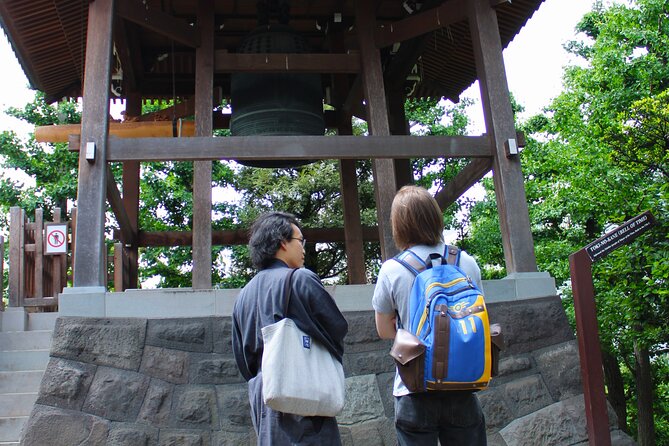
Next comes the Bell of Time, beside Bentendo. During the Edo period, the bell was rung regularly by a monk so people could keep track of the hour. That short detail turns an old structure into something practical and human. You can picture the sound carrying across the district before modern clocks and phones took over.
Neither stop requires an admission ticket. The pace is brisk, but you are not simply marching from one famous photo spot to the next. The smaller pauses give the walk its character.
Quiet statues and the Nitenmon Gate
The next stop is Senso-ji’s Nisombutsu area, a calmer corner with two bronze statues and four stone statues of Buddhist deities dating from the 17th century. The scheduled visit is only five minutes, yet it offers a break from the better-known procession toward the main hall.
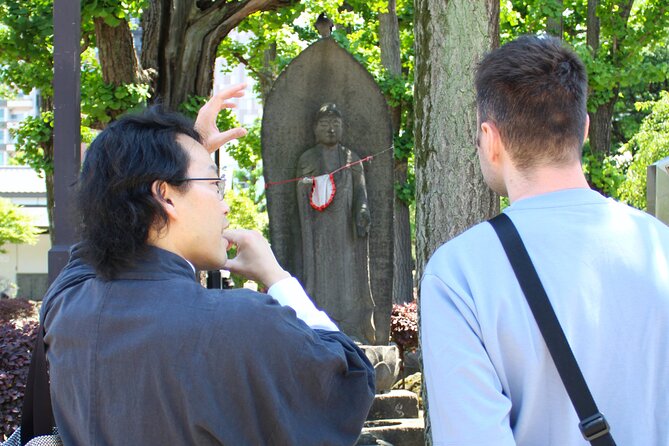
This is one of the places where Ryo’s detailed explanations can change the experience. Without help, you might see a group of old statues and move on. With context, you can pay attention to their placement, symbolism, and connection to the temple complex.
The walk then reaches Nitenmon Gate, on the right side of the main Senso-ji hall. Nitenmon is a National Cultural Property in Japan and was once used as the shogun’s gate, meaning it was reserved for the military ruler.
You have about 10 minutes here. That gives you time to look at the gate itself and ask questions about its former role. The stop also helps explain that Senso-ji is not one isolated building. It is a collection of gates, worship spaces, shrines, statues, and small structures that developed over centuries.
Asakusa Shrine and the temple’s smaller corners
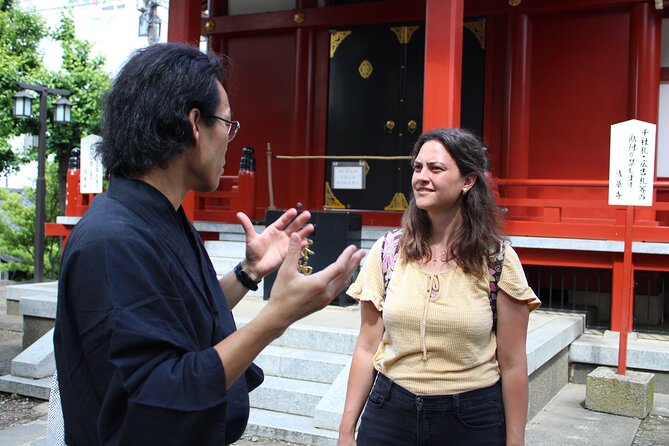
After Nitenmon, the route visits Asakusa Shrine. This is a Shinto shrine connected to the origins of Senso-ji and dedicated to three figures associated with the temple’s founding.
The relationship between Asakusa Shrine and Senso-ji is especially useful for first-time visitors trying to understand the difference between Shinto and Buddhism in Japan. They occupy the same historic area, but they are distinct religious traditions. The tour gives you a chance to see both without treating them as interchangeable.
The stop lasts about 10 minutes. You also see the garage for three large portable shrines used during local processions. That detail brings the neighborhood’s religious life beyond architecture and into the yearly events that shape the community.
From there, the route continues to Yogodo and Awashimado, each receiving roughly five to 10 minutes. These are not the headline sights of Asakusa, and that is their advantage. You get a quieter look at the wider temple grounds and a better sense of how much is hidden behind the main approach.
I would pay close attention during these stops and ask questions. The tour’s strongest feature is not simply reaching the places. It is learning why a small building, memorial, statue, or ritual detail matters.
Other walking tours we've reviewed in Tokyo



Nishi-sando and the melon bread stop
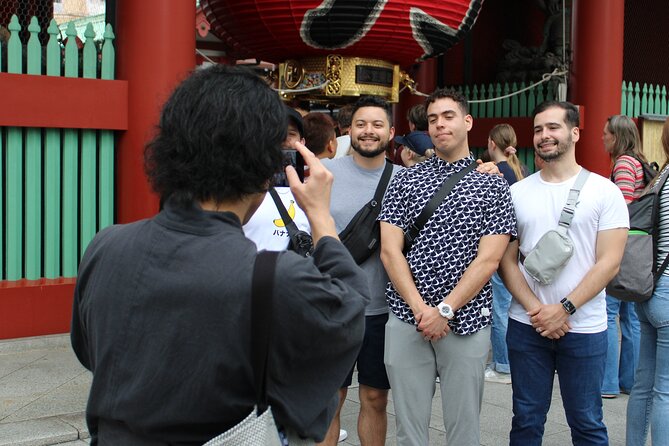
The walk includes Asakusa Nishisando, a shopping street where you can stop at Kagetsu-do for melon bread if you wish. Japanese melon bread is sweet, soft, and lightly crisp on the outside. It is a snack rather than a full meal, so plan accordingly.
This is a useful pause in a history-focused walk. You get a chance to taste something associated with Japanese shopping streets, take photographs, and reset before the final temple approach.
The food stop is not an included meal, and the information provided does not state that snacks are covered in the tour price. Carry some yen or another accepted payment method if you want to buy something, and remember that this short stop may not suit you if you need a substantial breakfast.
The route’s flexibility appears to be one of its practical strengths. Ryo has offered recommendations for local shops, souvenirs, sandals, and food, and he can answer questions about what to buy in the area. Those suggestions can be more useful than a generic shopping list because they come from someone who has worked around Asakusa for years.
Hozomon and the main hall of Senso-ji
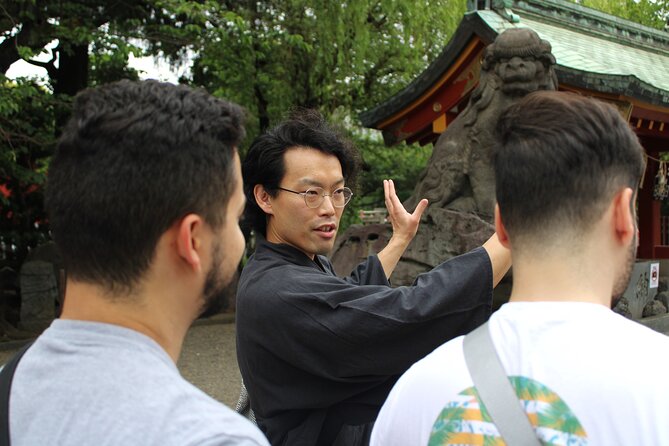
Near the end of the walk, you reach Hozomon Gate, another large entrance with a pair of guardian statues. It is a dramatic approach to the temple’s main hall and gives you one more chance to look at the way gates frame the religious buildings beyond them.
The final destination is Senso-ji, described as Tokyo’s oldest temple, with a history reaching back 1,400 years. The main hall is dedicated to Kannon Bodhisattva, a Buddhist figure associated with compassion.
You finish in front of the main hall after roughly 90 minutes. The tour does not include an admission charge for the sites, and the outdoor route makes it easy to continue exploring after the guide leaves. You can remain in the temple area, return to Nakamise, visit nearby shops, or use the surrounding transit connections to reach another part of Tokyo.
The ending is practical. You do not finish in an obscure side street or far from the area’s main sights. You finish at the place most people want to see, with the rest of Asakusa close at hand.
What Ryo adds beyond a standard sightseeing walk
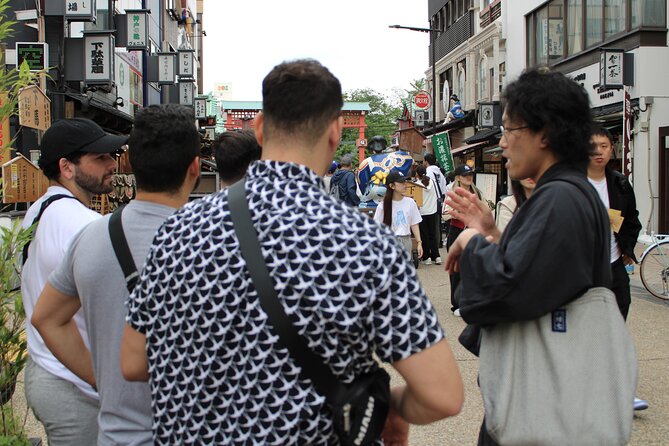
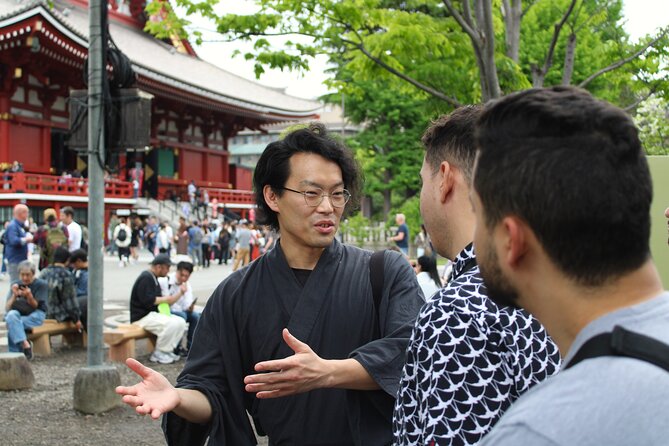
Ryo’s appeal is not just that he tells jokes. The useful mix is history, everyday conversation, and humor. Several aspects of his background shape the walk:
- He works as a stand-up comedian, so the tone is conversational rather than formal.
- He has worked as a rickshaw driver in Asakusa, which gives him strong familiarity with the local streets and practical recommendations.
- His English is described as very good, making it easier to ask about traditions, food, shopping, and the meaning of specific sites.
- He is willing to adapt the experience to the people in the group and answer questions at length.
- He can point out small details, memorials, and out-of-the-way spots that are easy to pass without guidance.
The comedy angle will not matter equally to everyone. If you want a quiet, strictly academic lecture, this may feel too casual. If you learn better through conversation and enjoy a guide who does not simply recite dates, the format should work well.
The humor also seems to be cultural rather than a separate comedy performance. Do not book this expecting a full stand-up show during the walk. You are booking a sightseeing tour led by a comedian who uses humor to keep the explanations lively.
Group size, pace, and the best time to go
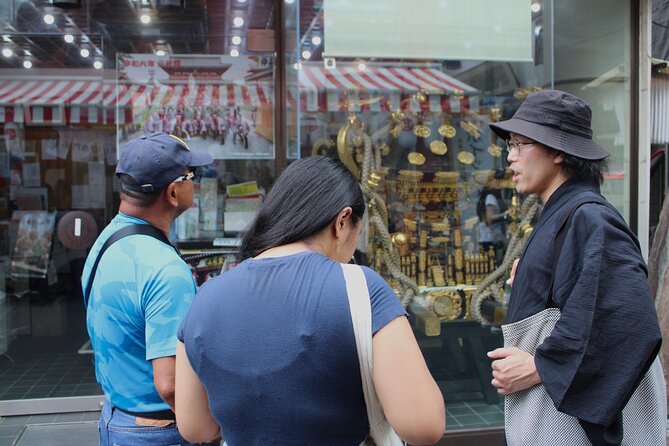
The experience lasts about one hour and 30 minutes and visits 12 places. That means the pace is efficient. Most stops last between five and 10 minutes, so you will not have unlimited time at any one gate or shrine.
The published details describe a small group capped at six people, while the additional information gives a maximum of eight. Either way, this is much more personal than a large coach outing. You should have a reasonable chance to ask questions, take photographs, and hear the guide without being separated from the group.
The walk is outdoors and on foot. Wear comfortable shoes, especially if you plan to keep exploring after the formal finish. The tour does not require paid entry to the listed sites, but you should budget for food or souvenirs if those interest you.
Timing matters most in Asakusa. One 8 a.m. start allowed a group to enjoy the area before the crowds arrived around 9 a.m., while the markets opened closer to 10 a.m. That gives you a clear rule of thumb:
- Choose early morning for cooler air, easier photographs, and a calmer temple visit.
- Choose later morning for more open shops, food stalls, and shopping activity.
- Avoid assuming that the quietest time will also have the most market action.
The best slot depends on your priorities. I would choose early if this is your first look at Senso-ji and you want to hear the explanations without constant crowd noise.
Is $37.99 a good value?
At $37.99 per person, the price is reasonable for a small-group, English-language orientation to one of Tokyo’s most important historic districts. You are not paying for entry tickets, since the scheduled stops are free. You are paying for the guide’s time, route planning, explanations, local knowledge, and the convenience of seeing many important places without sorting them out yourself.
The value is strongest if you have limited time in Tokyo or want cultural context before exploring independently. In 90 minutes, you cover the central gates, temple buildings, shrine grounds, statues, shopping street, and main hall. Recreating that route alone is possible, but understanding the connection between each place would take more preparation.
The value is also strong for families and first-time visitors. Children and teenagers may respond better to a guide who mixes facts with jokes, while adults can ask more detailed questions about religion, history, shops, or local customs.
It is less compelling if you have already spent several days studying Senso-ji and know the temple grounds well. It is also not a food tour, a rickshaw ride, or a long neighborhood walk. Keep your expectations matched to the product: this is a compact, guided introduction with a personable host.
Free cancellation is available if you cancel at least 24 hours before the start time. Cancellations made inside that window are not refunded, and changes are not accepted within 24 hours.
Who should book this Asakusa walk?
I would recommend it to you if you want:
- A friendly introduction to Buddhist and Shinto sites
- A short tour that fits neatly into a Tokyo morning
- A small group with room for questions
- Local suggestions for snacks, souvenirs, and shops
- A guide who uses humor instead of a stiff lecture
- More than the standard Kaminarimon and main-hall photographs
Families can benefit from the relaxed style and patient answers. Solo visitors may especially appreciate the easy conversation and the chance to ask about personal interests. It also suits anyone who wants to understand why Senso-ji matters before returning later on their own.
You may want another type of experience if you need extensive time for shopping, a full meal, a formal religious lecture, or transportation between distant parts of Tokyo. The tour stays within the Asakusa area and moves at a purposeful walking pace.
Should you book the Karate Comic Ryo tour?
Book it if you want efficient sightseeing with personality. Ryo’s combination of local experience, strong English, historical explanations, and comedy gives the walk more warmth than a basic landmark checklist. The route also goes beyond the obvious sights, reaching smaller temple corners and explaining the relationship between Senso-ji and Asakusa Shrine.
Choose an early start if you can, especially in warm weather. At $37.99, the tour is a good buy for first-time visitors, families, solo explorers, and anyone who wants Asakusa to make more sense in a short time.
FAQ
How long does the Asakusa walking tour last?
The tour lasts approximately one hour and 30 minutes.
Where does the tour begin?
It begins at Tokyo Cruise Asakusa Pier, 1-chome-1-1 Hanakawado, Taito City, Tokyo.
Where does the tour finish?
The walk finishes in front of the main hall of Senso-ji Temple.
How many people can join the tour?
The experience is described as a small-group tour capped at six people, while the additional details state a maximum of eight travelers.
Is the tour near public transportation?
Yes. The meeting point is near public transportation, and confirmation is provided when you book.
Can I cancel for a full refund?
Yes, if you cancel at least 24 hours before the experience start time. Cancellations made less than 24 hours before the start time are not refunded.
More Walking Tours in Tokyo
More Asakusa Tours in Tokyo

More tours in Tokyo we've reviewed


Asakusa Tours, compared.
 ★ 4.8Tokyo: Japanese Dance Cabaret Theater Asakusa-Kaguwa TicketFrom $492 hours
 ★ 4.7Tokyo: Meiji Shrine, Asakusa, Skytree Bus Tour and CruiseFrom $12210 hours
 ★ 4.9Tokyo: Roll and Authentic Sushi Making Class in AsakusaFrom $581h 40m
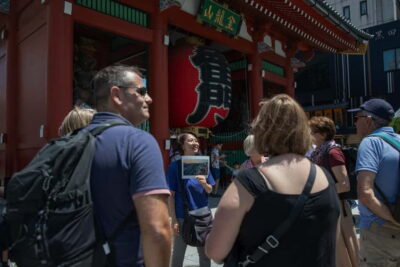 ★ 4.8Tokyo: Asakusa Walking Tour with Sensoji Temple VisitFrom $222 hours
 ★ 5.0Tokyo Asakusa Rickshaw TourFrom $42
 ★ 4.5Tokyo Panoramic 1 Day: Meiji Shrine, Asakusa, Odaiba and SKYTREE®From $85