
Reviewed · ASAKUSA TOURS
Asakusa: Culture exploring bar visits after history tour
Asakusa makes a fine introduction to old Tokyo, but this tour adds something many sightseeing walks miss: three real drinking stops after the temples. You begin with Sumida River views, Kaminarimon, Nakamise Street, Sensoji, and Asakusa Shrine, then spend the evening eating and drinking in local-style izakayas.
I especially like the clear mix of culture and dinner, plus the small maximum of eight people. The guide can explain why a Buddhist temple and Shinto shrine sit side by side, then help you make sense of sake and neighborhood bar customs. The main drawback is the price, $156.07 per person, which is a serious spend if you mainly want a quick temple visit.
In This Review
- Key points to know before booking
- Why the temple-to-izakaya format works
- Starting beside the Sumida River
- Kaminarimon, Nakamise, and the approach to Sensoji
- Sensoji and the neighboring Asakusa Shrine
- From temple grounds to the Rokku entertainment area
- Hoppy Street, the first izakaya stop
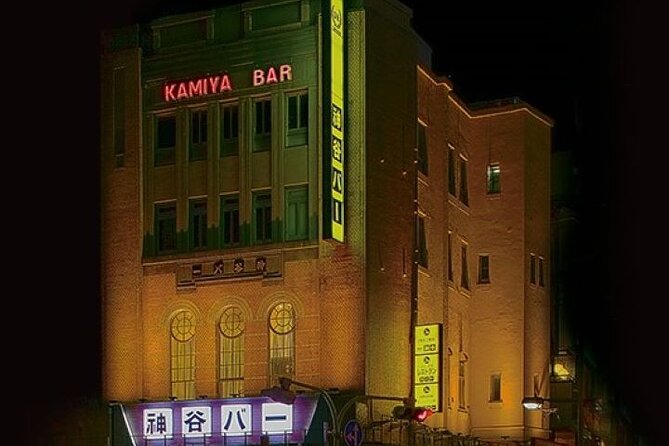
- Kamiya Bar and a drink with Tokyo history
- Sake education at the final izakaya
- What the $156.07 price includes
- Timing, fitness, and practical details
- Who will enjoy this Asakusa evening most
- Should you book this Asakusa tour?
- FAQ
- Where does the Asakusa tour begin?
- How long does the experience last?
- How many people can join the tour?
- What food and drinks are included?
- Does the tour include hotel pickup or drop-off?
- What is the cancellation policy?
Key points to know before booking
- Three drinking stops are included: You receive about 3 to 4 drinks and 3 to 4 dishes, enough to serve as a full dinner.
- The walking route covers Asakusa’s major sights: Expect Sumida Park, Kaminarimon, Nakamise Street, Hozomon, Sensoji Temple, Asakusa Shrine, and the Rokku entertainment area.
- The group is capped at eight people: That matters when asking questions or moving through crowded parts of Asakusa.
- The tour starts at 3 pm: The timing carries you from afternoon sightseeing into the evening bar scene.
- Kamiya Bar is a historic stop: Founded in 1880, it is described as Japan’s oldest Western-style bar.
- You return to the starting point: There is no hotel pickup or drop-off, so plan your route to Burger King Asakusa Azumabashi.
Why the temple-to-izakaya format works
A standard Asakusa visit can feel like a chain of gates, lanterns, and souvenir shops. You take a photo, read a sign, and move on. This experience gives those sights a larger setting, then shows you how the district functions after the temple crowds thin out.
That change of pace is the main attraction. The first half explains Asakusa through its river, religious buildings, and entertainment streets. The second half moves into food and drink, where the guide can explain customs that are hard to pick up from a map.
The structure also solves a common Tokyo problem: deciding where to eat when you cannot read every menu or tell which small bar suits you. Your guide leads you to three places, and the food and drinks are already included. You still need to be open to shared snacks, local bar settings, and a meal that may feel less formal than a restaurant dinner.
The group limit of eight is useful here. Small bars have limited space, and a large tour would make the evening clumsy. A smaller group should also give you more time to ask about the neighborhood, the drinks, and the customs around ordering.
A few more Tokyo tours and experiences worth a look

Starting beside the Sumida River
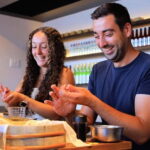
The tour begins at 3 pm at Burger King Asakusa Azumabashi, at Kaminarimon 2-chome in Taito City. The exact meeting point matters because Asakusa has several busy exits, bridges, and temple approaches. Give yourself enough time to find the location rather than arriving at the last minute.
Your first stop is Sumida Park, where you spend about 15 minutes. The Sumida River is not just a pleasant place for a view. The story of Sensoji is tied to this river, with the temple’s origin reaching back about 1,400 years.
That brief riverside stop gives the rest of the walk some context. You are not simply heading toward a famous temple. You are seeing the waterway connected to the district’s oldest religious story, with Tokyo Skytree and the river forming part of the view.
Next comes the Asakusa Culture Tourist Information Center. The group goes up for a preview of the route, with a high view across Asakusa. The building was designed by a well-known Japanese architect, and this short stop helps you understand how the river, temple grounds, shopping streets, and entertainment quarter fit together.
The stop lasts about 15 minutes, so do not expect a long museum visit. Its value is orientation. You see the district before walking through it, which can make the later route easier to follow.
Kaminarimon, Nakamise, and the approach to Sensoji
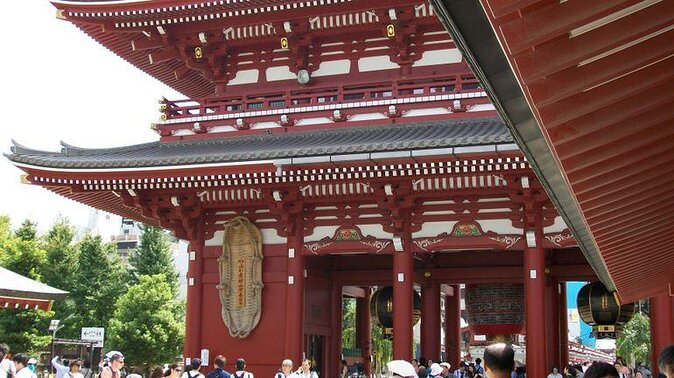
Kaminarimon, or Thunder Gate, is one of Tokyo’s instantly recognizable entrances. The giant red lantern hangs beneath the gate, marking the approach to the Buddhist temple and Shinto shrine area.
The gate is a major photo spot, so it can be crowded. A guide helps by giving the place meaning beyond its appearance. You learn that this is the entry into a sacred complex, not just a colorful landmark on a sightseeing checklist.
From there, you walk along Nakamise Shopping Street. The street leads toward Sensoji and mixes small shops with the steady flow of people heading to the temple. Its tone may surprise you. Instead of a quiet, solemn approach, you get a lively commercial street with a friendly feel.
This is one place where the tour’s short stop, about 15 minutes, can feel limited. You will see the street and hear about its role, but the schedule does not leave much room for relaxed shopping. If you want souvenirs or snacks from Nakamise, you may need to return on your own later.
The route then reaches Hozomon, the inner of Sensoji’s two large gates. The name means Treasure-House Gate, and the second story houses temple treasures. It is a striking building in its own right, but the guide’s explanation is what makes the stop worthwhile.
Sensoji and the neighboring Asakusa Shrine
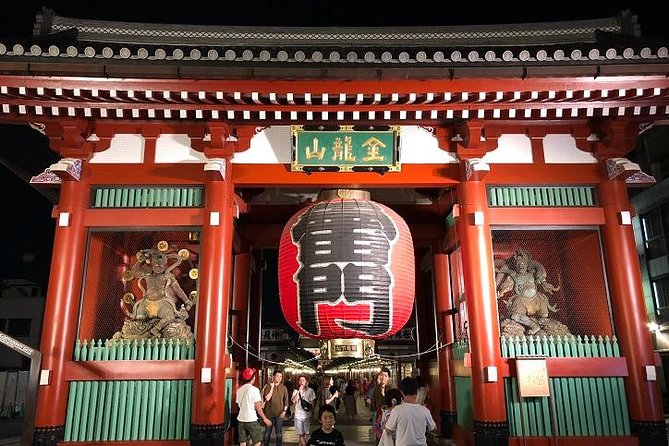
Sensoji is the oldest temple in Tokyo and the main cultural stop on the walk. You begin learning about it at Kaminarimon, then continue through the temple approach toward the main grounds.
The listed timing gives each temple stop roughly 15 minutes. That is enough for an introduction and a focused explanation, but not enough for a slow, detailed study of every building. I would treat this as a strong first visit, not a replacement for returning independently.
Asakusa Shrine sits right beside Sensoji. One is Buddhist and the other belongs to Shinto, Japan’s indigenous religion. Their proximity offers one of the tour’s best teaching moments because it shows how different religious traditions share the same district.
The guide explains why the two can exist side by side, turning what may seem confusing into an important part of Japanese culture. This is exactly the sort of detail you may miss if you move through the gates alone with only a camera.
The cultural portion is especially useful for first-time visitors to Japan. You do not need prior knowledge of Buddhist or Shinto practice to follow it. The explanations connect the buildings to the way the district developed, rather than treating each stop as an isolated monument.
From temple grounds to the Rokku entertainment area
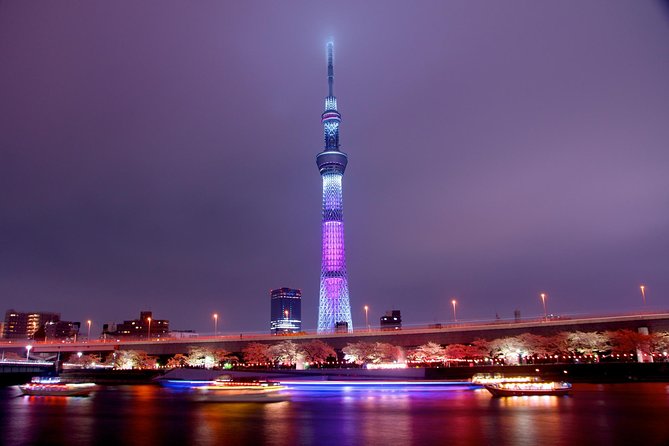
After Sensoji, the route shifts toward Asakusa Demboin-dori and the Rokku area. This was Asakusa’s traditional entertainment district, and the walk here gives you a different view of the neighborhood.
The area is described as active but rarely overwhelming. That makes it a useful bridge between the temple grounds and the evening bars. You move from formal religious architecture into streets shaped by entertainment and everyday social life.
This part of the route also keeps the experience from becoming a standard temple tour. Asakusa is more than Sensoji. Its older entertainment quarter helps explain why the district has long attracted people looking for food, drinks, performances, and a night out.
The tour spends about 15 minutes here before the first izakaya stop. Since the sightseeing section is divided into many short visits, expect a brisk walking pace. Wear comfortable shoes and keep your belongings easy to manage while moving through public streets.
Other historical tours in Tokyo
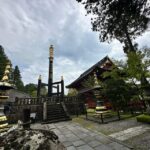
Hoppy Street, the first izakaya stop
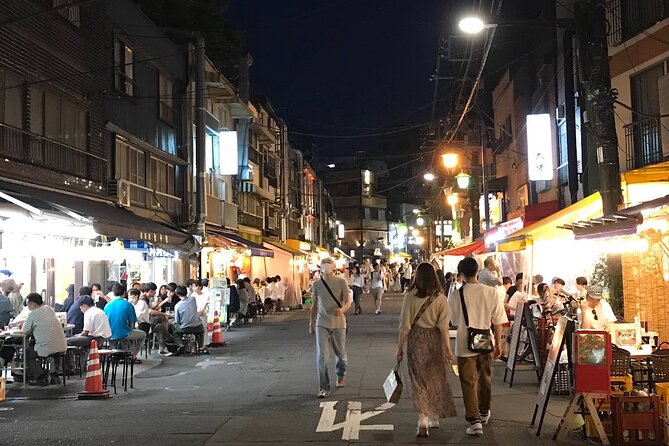
The first bar visit takes place around Hoppy Street, an 80-meter stretch lined with izakayas, lanterns, and outdoor seating. The street operates during the day and night, but the atmosphere becomes more festive as the day moves toward evening.
This is where the tour changes from explanation to participation. You sit down for about 40 minutes, receive a drink and food, and get a look at the casual bar culture that makes the area distinct.
The stop is not presented as a formal tasting menu. Izakaya food is designed for sharing and pairing with drinks, so you should expect small dishes rather than one carefully plated entrée. Across all three bars, you receive about 3 to 4 dishes, enough to count as dinner according to the tour details.
Hoppy Street is a good first stop because it places you in a concentrated bar district. The drawback is that the setting may feel busy and close-packed, especially as the afternoon fades. If you prefer quiet dining or a private table, this format may not suit you.
Kamiya Bar and a drink with Tokyo history
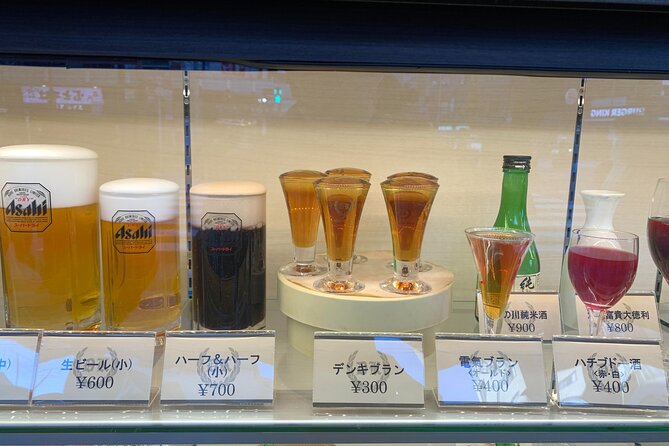
The second stop is Kamiya Bar, founded in 1880 and described as the oldest Western-style bar in Japan. Despite its name, it is not simply a modern cocktail lounge. Its long history makes it a useful example of how imported drinking styles became part of Tokyo life.
You spend about 40 minutes here. That gives you time to have a drink, eat another dish, and listen to the guide place the bar in the story of Asakusa.
This stop adds variety to the evening. Hoppy Street represents a cluster of casual izakayas, while Kamiya Bar brings a more established institution into the route. The contrast helps you see that Asakusa’s drinking culture is not one single thing.
The tour includes the drinks and food, so you do not have to worry about choosing an expensive item at a famous old bar. Still, the overall cost means you should value the setting and interpretation, not just the amount of food in front of you.
Sake education at the final izakaya
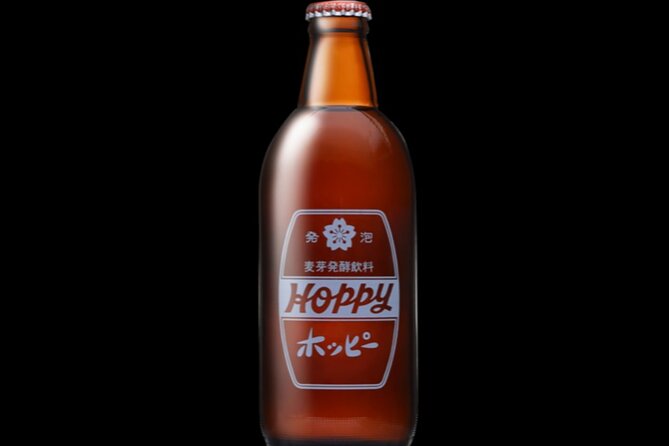
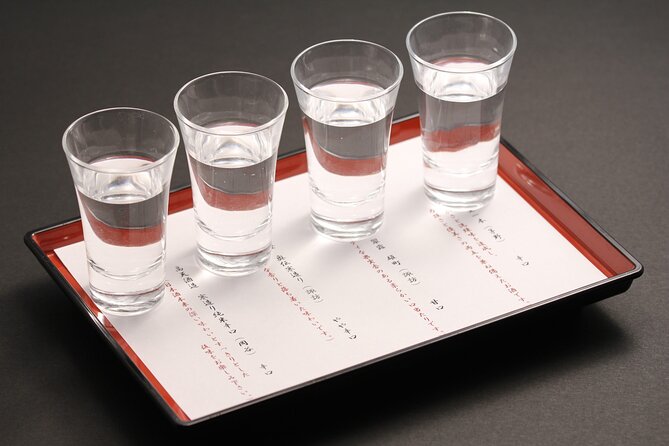
The third and final bar specializes in sake and carries a wide range of varieties. You spend another 40 minutes here, with the guide explaining why sake developed in Japan and which ingredients play key roles in its production.
This is the most focused drink lesson of the evening. You are not just served a beverage and sent on your way. The guide helps connect sake to Japanese agriculture, cooking, and drinking habits, although the exact selection can vary.
The final stop works well at the end because you have already seen the neighborhood and tried other types of drinks. By this point, you can compare the different bar settings and ask more specific questions.
You receive roughly 3 to 4 drinks in total across the tour. Anyone who does not drink alcohol should check suitability before booking, since the supplied details describe drinks as a central part of the experience and do not list nonalcoholic alternatives.
What the $156.07 price includes
At $156.07 per person, this is not a budget walking tour. The price makes more sense if you plan to use it as both sightseeing and dinner, since about 3 to 4 drinks and 3 to 4 dishes are included.
You are also paying for a local guide, a planned route, and access to three different drinking settings without having to research them yourself. For a first visit to Tokyo, that convenience can be worth more than it appears on paper. You avoid navigation problems and do not have to make three separate decisions about where to eat.
The value is weaker if you already know Asakusa well or mainly want to see Sensoji. Most of the major sights are free to enter, and the temple portion is made up of short stops. In that case, you could visit the landmarks independently and spend only what you choose on dinner.
Group discounts are available, which may improve the price for parties booking together. The maximum group size is eight, a useful balance between a social evening and a tour that still allows personal questions.
Timing, fitness, and practical details
The experience lasts about four hours and ends back at the meeting point. Since the route combines several 15-minute sightseeing stops with three 40-minute bar visits, the schedule is fairly structured.
Most people can participate, and the tour is near public transportation. Hotel pickup and drop-off are not included, so you need to arrange your own way to and from Asakusa. Service animals are allowed.
Good weather is required. If poor weather cancels the experience, you are offered another date or a full refund. The tour also requires a minimum number of participants, so a cancellation for that reason brings the same choice of another date or a refund.
You can cancel for a full refund up to 24 hours before the start time. Changes or cancellations inside that 24-hour window are not accepted for a refund, so keep the local Tokyo time in mind.
The tour is booked, on average, 26 days ahead. That is a useful sign for planning, especially if your Tokyo schedule is fixed. Confirmation is normally immediate, though bookings made within five days of the date may receive confirmation within 48 hours, subject to availability.
Who will enjoy this Asakusa evening most
I would choose this tour if you want a guided introduction to Asakusa that includes dinner and conversation. It suits first-time visitors who want more context than a self-guided temple walk can provide, especially if choosing an izakaya feels uncertain.
It is also a good match for people who enjoy sampling several places rather than sitting in one restaurant for the whole evening. The three-stop format gives you different settings, from Hoppy Street to historic Kamiya Bar and a sake-focused izakaya.
You should think twice if you dislike alcohol, want a quiet meal, or prefer to set your own pace. The tour is built around drinks, shared dishes, walking, and a fixed schedule. It also may not offer enough time for serious shopping on Nakamise Street or a detailed visit inside every temple building.
The guide is a major part of the value. The available feedback describes the guide as friendly, well informed, and a strong conversationalist, with special praise for the combination of historical insight and food stops. Since no guide name is provided, you should not book expecting a particular individual, but you can reasonably expect the interpretation to be central to the experience.
Should you book this Asakusa tour?
Book it if you want Asakusa explained in plain terms, followed by a ready-made evening of local-style food and drinks. The best features are the small group, the temple-to-bar route, the historic Kamiya Bar stop, and the included dinner.
Skip it if $156.07 feels high for a four-hour activity or if you would rather explore Sensoji and the bars independently. For everyone else, this is a practical way to turn a famous sightseeing district into a more social and flavorful evening, with enough structure to keep you from getting lost and enough local detail to make the streets easier to understand afterward.
FAQ
Where does the Asakusa tour begin?
The meeting point is Burger King Asakusa Azumabashi in Taito City, Tokyo, near Kaminarimon 2-chome. The tour begins at 3 pm.
How long does the experience last?
The tour lasts approximately four hours and ends back at the starting point.
How many people can join the tour?
The maximum group size is eight people.
What food and drinks are included?
Dinner is included, with approximately 3 to 4 drinks and 3 to 4 dishes. This amount is intended to be enough for a full dinner meal.
Does the tour include hotel pickup or drop-off?
No. Hotel pickup and drop-off are not included. You must make your own way to the meeting point and return from there after the tour.
What is the cancellation policy?
You can cancel up to 24 hours before the start time for a full refund. Cancellations or changes made less than 24 hours before the start time are not accepted for a refund.
More Historical Tours in Tokyo
More Asakusa Tours in Tokyo
More tours in Tokyo we've reviewed










Asakusa Tours, compared.
 ★ 4.8Tokyo: Japanese Dance Cabaret Theater Asakusa-Kaguwa TicketFrom $492 hours
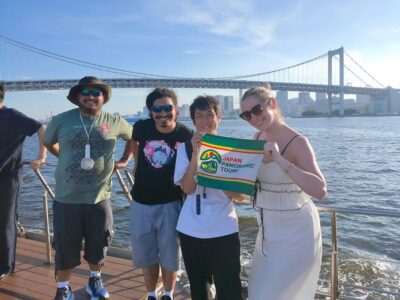 ★ 4.7Tokyo: Meiji Shrine, Asakusa, Skytree Bus Tour and CruiseFrom $12210 hours
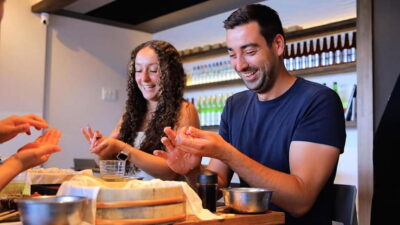 ★ 4.9Tokyo: Roll and Authentic Sushi Making Class in AsakusaFrom $581h 40m
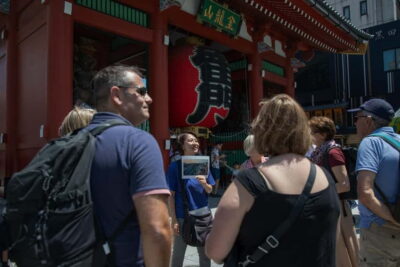 ★ 4.8Tokyo: Asakusa Walking Tour with Sensoji Temple VisitFrom $222 hours
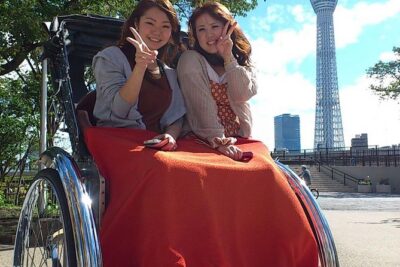 ★ 5.0Tokyo Asakusa Rickshaw TourFrom $42
 ★ 4.5Tokyo Panoramic 1 Day: Meiji Shrine, Asakusa, Odaiba and SKYTREE®From $85