
Reviewed · JDM & CAR CULTURE
Tokyo Car Meet JDM Experience in Daikoku
The main draw here is Daikoku Parking Area, the famous meeting point for Japan’s modified cars and JDM machinery. You ride out from Tokyo in a private, air-conditioned vehicle, look for rare models and local enthusiasts, then return through some of the city’s best-known sights.
I like the private format and the chance to tailor the outing to your interests. I also like the mix of car culture and city views, from the Wangan highway to Rainbow Bridge and Shibuya Crossing. The main catch is that Daikoku is a working highway rest area, not a guaranteed car show, so the cars and crowd can vary.
In This Review
- Key points at a glance
- Why Daikoku Futo is worth the ride
- The Wangan connection makes the drive part of the experience
- What the two hours at Daikoku feel like
- A PIT Super Autobacs: a useful second look at Japanese car culture
- Rainbow Bridge adds a visual change of pace
- Shibuya Crossing brings the tour back into central Tokyo
- Private transport is the biggest practical advantage
- Is $115 a fair price?
- Who will enjoy this most?
- Weather, cancellation, and small practical points
- Should you book the Daikoku JDM experience?
- FAQ
- How long does the Tokyo car meet experience last?
- Where does the tour take place?
- Is hotel pickup available?
- Is this a private tour?
- What is included in the price?
- Is dinner included?
- Does Daikoku Parking Area charge an admission fee?
- Can the tour be customized?
- What happens if the weather is poor?
Key points at a glance
- Daikoku Futo is the main event: Spend about two hours at Tokyo’s best-known JDM gathering point.
- Wangan road culture adds context: The route connects Tokyo and Yokohama and is linked with 1990s street-racing stories and the manga Wangan Midnight.
- Private pickup keeps the evening simple: Your group rides together in an air-conditioned vehicle rather than piecing together trains and taxis.
- A PIT Super Autobacs adds a hands-on stop: Browse a major Japanese car parts and service store in Shinonome.
- The tour blends cars with Tokyo icons: Rainbow Bridge and Shibuya Crossing make this more than a single parking-lot visit.
- The five-hour length gives the outing room to breathe: You are not limited to a quick photo stop before heading back.
Why Daikoku Futo is worth the ride
Daikoku Parking Area sits on the highway system between Tokyo and Yokohama. It became famous through the street-racing stories associated with the Wangan roads in the 1990s, along with Wangan Midnight, a manga that helped spread the mystique of this route and its cars.
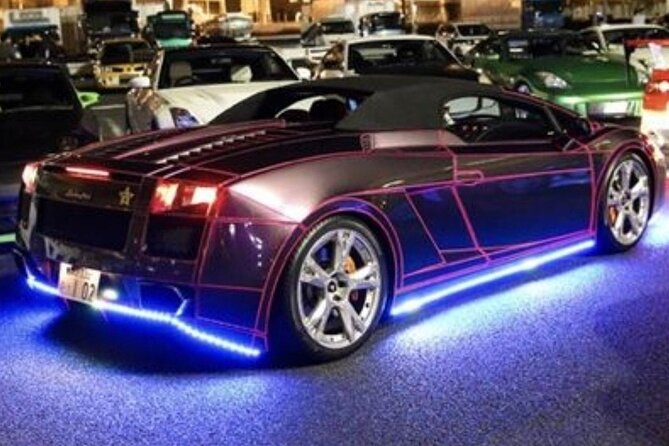
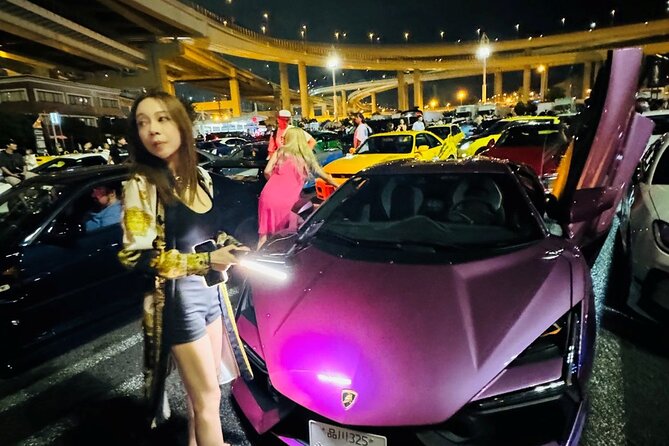
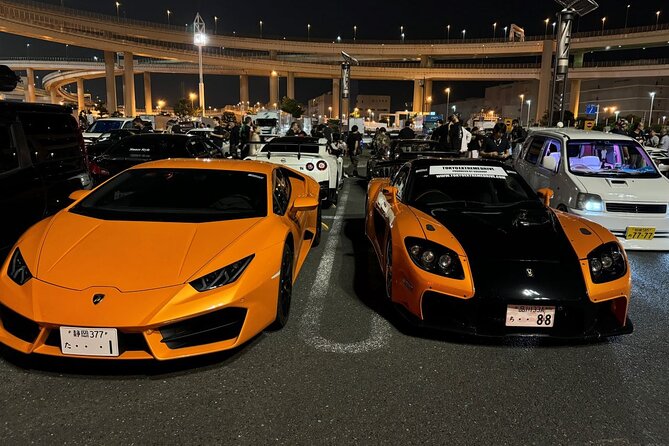
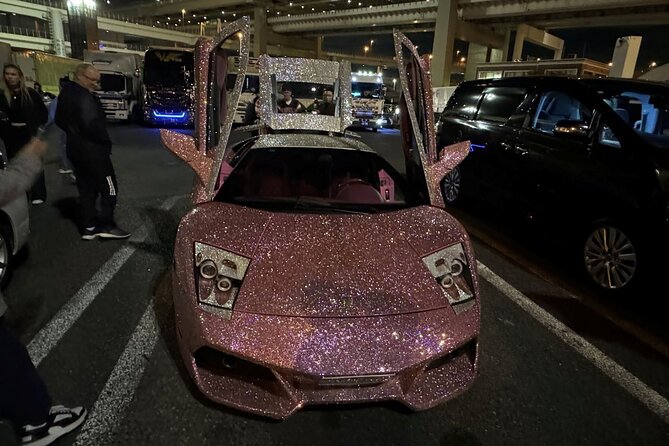
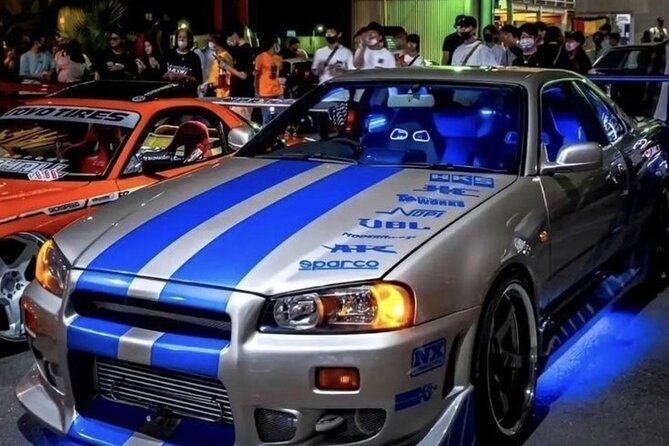
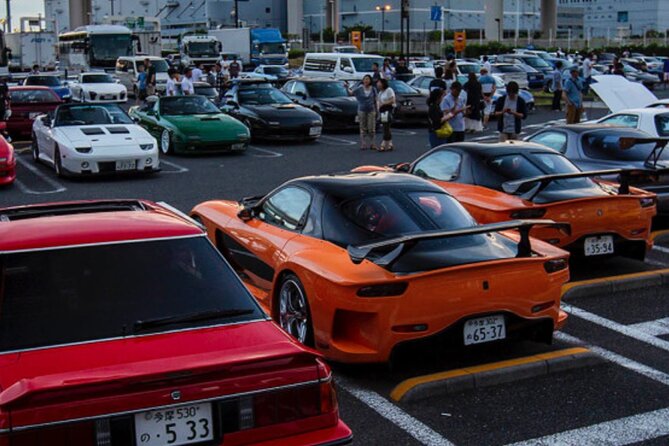
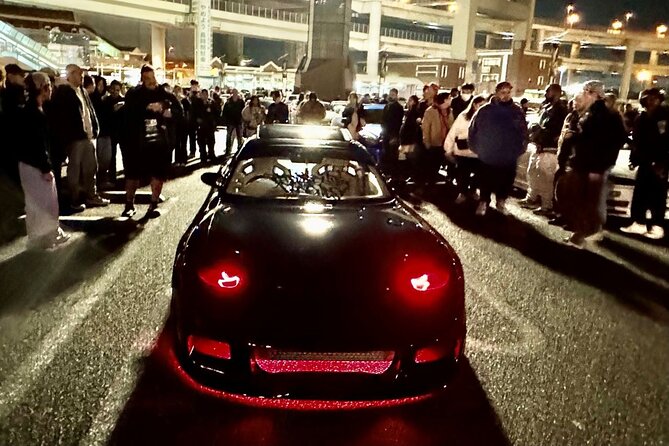
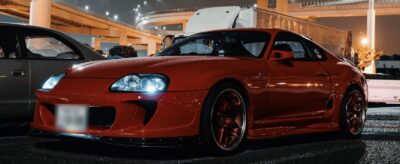
Today, the appeal is less about racing and more about seeing Japan’s car scene in its natural setting. You may find modified street cars, rare JDM models, and owners meeting up around their vehicles. The attraction is the mix of machines, styling choices, and car culture rather than a formal exhibition with a fixed program.
That distinction matters. You are not buying a ticket to a scheduled motor show. You are visiting a real meeting place, so the number and type of cars can change. Some visits may feel packed with interesting vehicles, while others may be quieter. I see that uncertainty as part of the deal, but anyone expecting a guaranteed lineup of rare cars should keep expectations sensible.
The stop lasts about two hours, which is a useful amount of time. You can walk around, take photos, look closely at the cars, and listen as your guide explains how the scene fits into Japanese performance-car culture. Admission is included at no extra charge, according to the tour details.
A few more Tokyo tours and experiences worth a look


The Wangan connection makes the drive part of the experience
The road to Daikoku is not simply a transfer between attractions. The Wangan highway is part of the story. It is a long, straight route linking Tokyo and Yokohama, and its reputation grew from the street-racing culture of the 1990s.
I like this part because it gives the visit some context. Instead of seeing parked cars without background, you get a sense of why this particular place matters to enthusiasts. The connection with Wangan Midnight also helps explain why the route has such a strong place in Japanese car culture.
The tour does not present itself as a racing activity, and you should not expect to drive at speed or take part in anything illegal. You are riding with a guide and looking at the culture from the safe position of a passenger. For families, that is a useful balance. One published account described the experience as a highlight for a husband and two car-loving boys, while the parent who was not especially focused on cars also enjoyed the energy of the scene.
That broad appeal is one of the tour’s strengths. You can be a serious JDM fan, a casual admirer, or simply curious about a part of Tokyo that most sightseeing routes skip.
What the two hours at Daikoku feel like
At Daikoku, the focus is on observation and conversation. You can expect to see modified street cars and possibly unusual or rare Japanese models, depending on what is gathered during your visit.
The private guide format is especially helpful here. A guide can explain what you are seeing, point out details you might miss, and adjust the pace to your group. The experience provider is Mukarram Muhammad, and the tour description presents the guide as someone who shares insider knowledge of Japanese car culture and its past.
The details are worth noticing. JDM cars are often appreciated not only for speed, but also for model history, tuning, bodywork, wheels, exhausts, and the personal choices made by owners. A guide can give those details meaning instead of leaving you to identify everything from badges and emblems.
Photography should be a natural part of the stop, but you should still be respectful around privately owned cars and their owners. The supplied information does not promise any particular make, model, or owner interaction, so treat conversations and close looks as possibilities rather than guaranteed features.
The parking area itself is functional, not polished for sightseeing. You will not find a museum display, a formal stage, or a climate-controlled gallery. That plain setting is precisely what gives the stop its character, but it also means the experience depends on the day, the weather, and the activity at the parking area.
A PIT Super Autobacs: a useful second look at Japanese car culture
The stop at A PIT Super Autobacs in Shinonome lasts about 30 minutes. This is a car parts and service specialty store in Koto-ku and part of the Autobacs Group, which provides maintenance, repair, and customization services.
This stop works well after Daikoku because it shows the practical side of the hobby. At the parking area, you see finished cars and the social side of the scene. At A PIT, you can browse the commercial world that supports maintenance and customization.
Thirty minutes is enough for a quick look, but not enough for a long shopping trip. If you are passionate about car parts, you may wish the visit were longer. The private format may allow some flexibility, but the tour information does not guarantee a particular amount of shopping time or any purchases.
For companions who are less interested in cars, this could be the least compelling stop. On the other hand, the store gives the outing variety and helps prevent the whole experience from feeling like two hours of standing in one place.
Rainbow Bridge adds a visual change of pace
The route also crosses Tokyo’s Rainbow Bridge by car. The bridge connects Shibaura Wharf with Odaiba across Tokyo Bay and is white during the day. After dark, it lights up with colorful solar-powered lights.
This is a short scenic section rather than a separate attraction with admission or a long visit. Its value comes from the change in setting. After the cars and highways, you get a broad Tokyo Bay view and a look at one of the city’s recognizable structures from inside the vehicle.
The exact lighting and views depend on the time of day and weather. The tour details refer to crossing the bridge by car, not stopping for a dedicated walking visit, so you should not book this expecting a long photo session on the bridge itself.
Still, it is a smart part of the route. You get a little city sightseeing without losing the main focus on cars, and the drive helps connect the waterfront and Tokyo’s central neighborhoods.

Shibuya Crossing brings the tour back into central Tokyo
The final listed sightseeing stop is Shibuya Crossing, with about 30 minutes in the area. Shibuya Station is surrounded by bright advertising, shops, malls, and heavy foot traffic, making it one of Tokyo’s most recognizable urban scenes.
This stop gives non-car enthusiasts something familiar to enjoy and rounds out the experience for mixed groups. You can take in the crossing, walk around the nearby streets, and finish the outing in one of Tokyo’s most energetic districts.
The timing is brief, so think of it as a taste of Shibuya rather than a full neighborhood tour. You will not have time to explore every shopping street or spend an evening at a restaurant unless the schedule is adjusted and dinner is arranged separately.
Dinner is not included. That is easy to plan around, since the activity ends back at the meeting point and Shibuya offers many places to eat, but you should budget for your own meal.
Private transport is the biggest practical advantage
The tour lasts about five hours and includes pickup and drop-off from a Tokyo hotel. The vehicle is air-conditioned, and free Wi-Fi is provided. A water bottle is included as well.
For this particular outing, private transport is more than a comfort perk. Daikoku Futo is reached by highway, and the route combines Tokyo, Yokohama-area car culture, Shinonome, Rainbow Bridge, and Shibuya. Arranging those locations independently would mean managing several connections and working out the best order.
With a private vehicle, your group stays together and the guide handles the road plan. That is especially useful for families, small groups, and anyone who wants to spend the evening looking out the window rather than navigating transport.
The tour is private, so only your group participates. That gives you room to ask questions, take more time at a car that interests you, or explain that your companions need a slower pace. The information says the route can be customized according to your interests and schedule, although you should confirm any major changes before booking.
Pickup details deserve a quick check. The activity is listed as starting in Tokyo and ending back at the meeting point, while hotel pickup and drop-off are offered. Confirm the exact pickup location and timing when you reserve, particularly if your hotel is outside the usual central area.
Is $115 a fair price?
At $115 per person, this is not the cheapest way to see Tokyo at night. You are paying for a private five-hour outing, vehicle use, hotel pickup and return, a guide, bottled water, and the convenience of combining several stops.
The value improves when two or more people share the experience and care about the subject. A family with car fans can avoid separate taxis, uncertain highway access, and the challenge of finding Daikoku independently. The private setting also means the cost buys time and attention, not just transportation.
The price is harder to justify if you only want a quick look at Shibuya Crossing or a shop visit. Those sights can be reached through ordinary Tokyo transport, and Daikoku itself does not charge an admission fee. The tour earns its price through access by car, route planning, cultural context, and the chance to make the outing fit your group.
The five-hour duration is another reason the cost can make sense. You are not paying for a short transfer dressed up as a tour. You have time for the principal Daikoku stop, the Autobacs visit, the bridge crossing, and Shibuya.
Who will enjoy this most?
I would recommend this to:
- JDM and Japanese performance-car fans
- Families with children or teenagers who love cars
- Visitors who want a private evening rather than a large group activity
- People curious about Japanese car culture but not ready to spend a full day on it
- Small groups that value hotel pickup and a vehicle with Wi-Fi
- Photographers who want cars, highways, bridges, and city streets in one outing
It may be less suitable if you need a guaranteed list of specific cars. Daikoku is an active meeting place, so no responsible tour can promise that a particular model will appear.
It is also not the right choice for someone seeking a technical workshop, a racing session, or a long shopping trip. The emphasis is on seeing the scene, learning its background, and moving through several Tokyo locations.
Weather, cancellation, and small practical points
Good weather is required. If poor weather causes cancellation, you can choose another date or receive a full refund. You can cancel for a full refund up to 24 hours before the start time, but cancellations or changes within 24 hours are not refunded or accepted.
Confirmation is provided when you book. The activity is near public transportation, and most people can participate. No special mobility details are supplied, so if you have specific access needs, ask the provider before reserving.
The included water and air conditioning are modest details, but they matter during a five-hour drive. Dinner is not included, so plan to eat before or after the tour. Since the activity returns to the meeting point, you can arrange your meal around the final stop in Shibuya if that suits your schedule.
Should you book the Daikoku JDM experience?
Book it if you want real car-meet culture paired with easy private transport. The best parts are the two-hour visit to Daikoku, the Wangan connection, and the freedom to share the outing with your own group rather than strangers.
I especially like it for families. The car focus gives enthusiasts something special, while Rainbow Bridge and Shibuya Crossing give everyone else familiar Tokyo scenery. The published rating is 5 out of 5 from 12 reviews, with 100 percent recommending it, and the strongest praise centers on the cars, the city mix, the convenience, and the guide.
Skip it if you need a guaranteed car lineup, a formal museum experience, or the lowest possible price. If you accept that Daikoku’s activity can change from night to night, the tour offers a memorable look at a side of Tokyo that standard sightseeing rarely reaches.
FAQ
How long does the Tokyo car meet experience last?
The experience lasts approximately five hours.
Where does the tour take place?
The tour is based in Tokyo and includes Daikoku Parking Area, A PIT Super Autobacs in Shinonome, Rainbow Bridge, and Shibuya Crossing.
Is hotel pickup available?
Yes. Private Tokyo hotel pickup and drop-off are offered.
Is this a private tour?
Yes. Only your group participates in the activity.
What is included in the price?
The price includes an air-conditioned vehicle and a water bottle. The vehicle also offers free Wi-Fi according to the tour description.
Is dinner included?
No. Dinner is not included.
Does Daikoku Parking Area charge an admission fee?
The Daikoku Parking Area stop is listed with free admission.
Can the tour be customized?
Yes. The experience offers flexibility to customize the route according to your interests and schedule.
What happens if the weather is poor?
The experience requires good weather. If it is canceled due to poor weather, you can choose a different date or receive a full refund.
More JDM & Car Culture in Tokyo


More tours in Tokyo we've reviewed




JDM & Car Culture, compared.
 ★ 4.7FAST&FURIOUS EXPERIENCE Tokyo Car Club membershipFrom $138
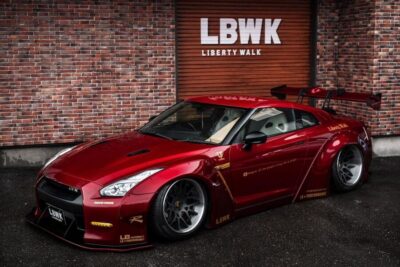 ★ 4.8GT-R35 800hp Club Membership – secret underground car meetFrom $205
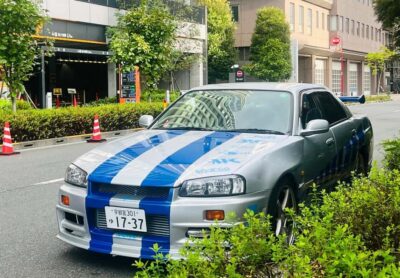 ★ 4.8Tokyo: Fast & Furious Tokyo Drift 3 Experience (Kaila Yu SP)From $157
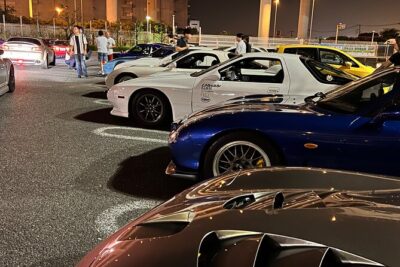 ★ 4.8Tokyo: Daikoku JDM Car Meet & Night Car Culture TourFrom $984 hours
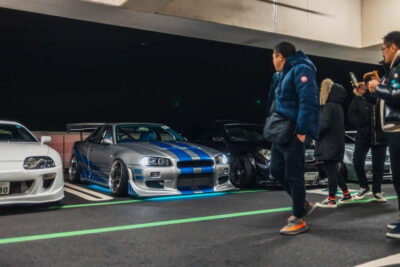 ★ 4.8Secret Car Meet: R34 Skyline Car Club MembershipFrom $236
 ★ 4.7Tokyo Drift: Daikoku PA Supreme Car Experience 大黒PAFrom $583 hours