
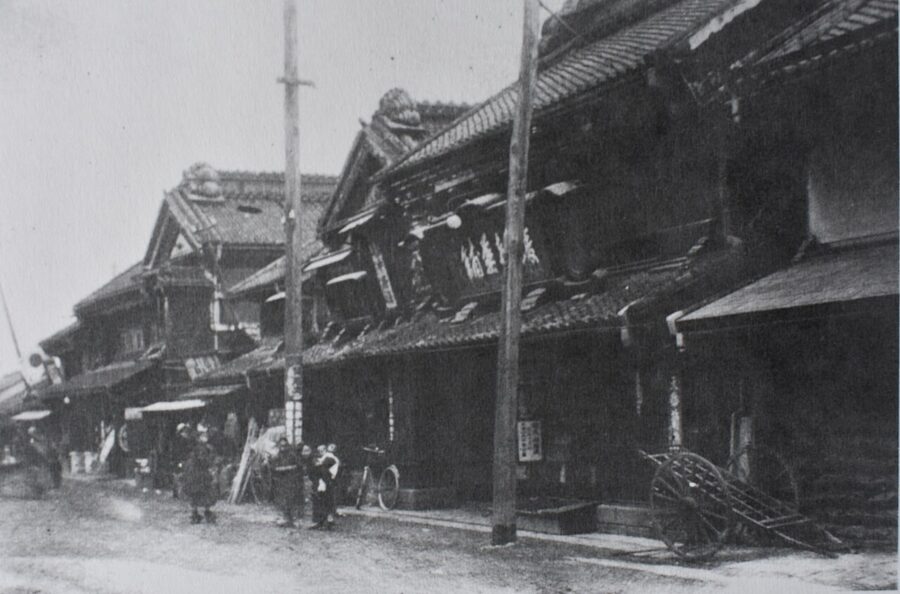
Here is the thing about Kawagoe that most guides bury halfway down the page: the reason the old town looks the way it does is a fire. In March 1893, the Great Kawagoe Fire burned through most of the central town in a single night. The wealthy merchants who rebuilt did it in fireproof kura-zukuri style — those squat, blackened storehouse fronts with tiled roofs that you now see lined up along Ichibangai street. So the “Little Edo” you walked into is technically Meiji-era reconstruction, faithful to the Edo merchant aesthetic but built specifically not to burn down a second time. It worked. The town survived both the 1923 Kanto earthquake and the air raids of WWII almost untouched, which is why a 35-minute train ride from Ikebukuro can drop you into a streetscape that almost nowhere else in greater Tokyo still has.

I’ve done Kawagoe twice now — once on a packed October Saturday during the matsuri (chaotic, magical, you can’t move) and once on a cold quiet Tuesday in February (small queue at the unagi place, almost no kimono rentals on the street, very different town). It’s a real day trip from central Tokyo. You leave after breakfast, you’re back before dinner, and you’ve eaten a stick of grilled sweet potato, walked under a tunnel of 2,000 wind chimes, paid your respects to a 1,500-year-old shrine, and seen 538 stone Buddha statues with 538 different faces. Here’s the version of the trip I’d give to a friend.
In This Article
- Why Kawagoe earned the “Little Edo” nickname
- Getting to Kawagoe from Tokyo
- How to walk into the old town from each station
- Walking Ichibangai, the kura-zukuri street
- Toki no Kane, the Time Bell Tower
- Kashiya Yokocho, the Candy Alley
- Hikawa Shrine, matchmaking and 2,000 wind chimes
- Kitain Temple and the 538 Rakan
- The Kawagoe Matsuri
- Eating in Kawagoe
- Renting a kimono for the day
- A practical full-day route
- When to go
- Practical info
- How I’d actually spend a half-day in Kawagoe
Why Kawagoe earned the “Little Edo” nickname
“Koedo” (小江戸) literally means “Little Edo”. The Japanese Wikipedia entry on the term is straightforward: it’s used for towns that prospered like Edo and that still feel like the Edo period today. There are several contenders — Sawara in Chiba, Tochigi in Tochigi Prefecture — but only Kawagoe has the saying attached to it: “Of small Kyotos there are many, but the only Little Edo is Kawagoe.”

The reason is that during the Edo period (1603–1868), Kawagoe was unusually wealthy and unusually well connected to Edo (now Tokyo). It was the castle town of the Kawagoe Domain, one of the most prestigious in the country. Senior shogunate ministers like Matsudaira Nobutsuna and Yanagisawa Yoshiyasu were posted as lords here. Goods flowed from Kawagoe down the Shingashi River to Edo by boat — sweet potatoes, rice, silk, miso. The city was sometimes called “Edo’s kitchen”. By the early 1900s, it had Saitama Prefecture’s first national bank, first power station, and first electric tram.
Then the 1893 fire destroyed about a third of the town overnight. The merchants who could afford to rebuild — and they could — chose the kura-zukuri storehouse style, which uses fireproof clay-plastered walls a foot thick, heavy tiled roofs, and iron shutters. It’s the same construction principle as the historic merchant warehouses in Tokyo’s old districts, except those mostly didn’t survive. Kawagoe’s did. So when you walk down Ichibangai today, you’re looking at a single architectural moment frozen in place: the few years right after one of the worst fires in Meiji-era Saitama.
Getting to Kawagoe from Tokyo

There are three train stations and three competing routes. The good news is the cheapest is also the fastest, and the platform announcements are all in English now.
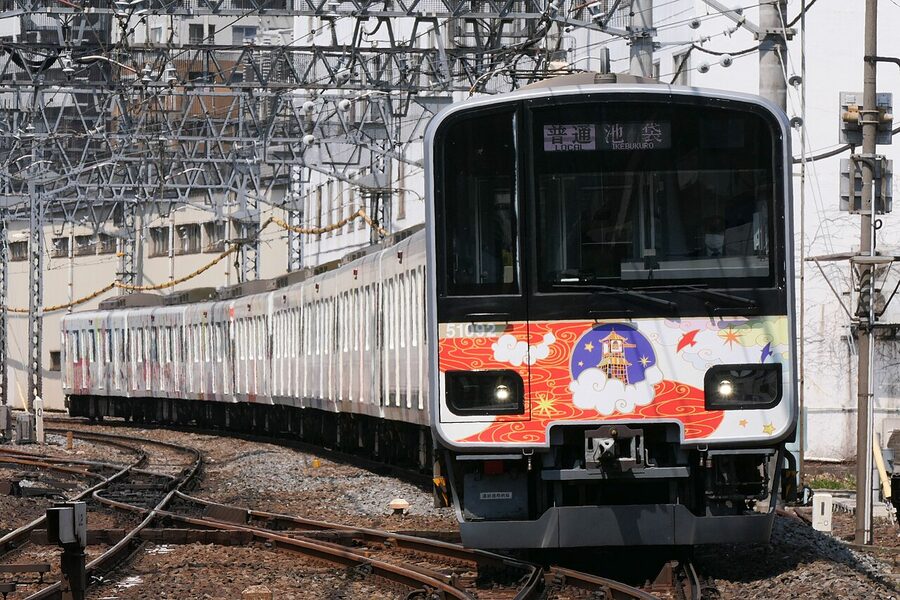
Tobu Tojo Line from Ikebukuro to Kawagoe Station is what I’d use. About 30 minutes on the rapid express, ¥490 one way, no reserved seat needed. Trains run every few minutes from Ikebukuro’s south side. If you want a guaranteed seat there’s the TJ Liner with a small reservation fee, but the rapid express is fine standing.
Seibu Shinjuku Line to Hon-Kawagoe Station takes about 45 minutes on the Koedo limited express (¥520 base + ¥600 reserved-seat fee), or an hour on regular trains for around ¥520. The big advantage of Hon-Kawagoe is that it’s the closest station to the old town — about 5 minutes’ walk to the kura district. From Kawagoe Station you’re looking at a 15- to 20-minute walk or a short bus.
JR Kawagoe Line (covered by the JR Pass if you’ve got one): from Shinjuku via Omiya, around an hour, around ¥770. Not faster, but worth knowing if you have a pass and would rather not pay for a Tobu ticket.
Two passes worth knowing about. Tobu sells the Kawagoe Discount Pass for foreign passport holders — about ¥950 for the round trip from Ikebukuro plus unlimited rides on the local Tobu buses around Kawagoe (¥1,200 if you want the premium version with the express add-on). Seibu has a similar Hon-Kawagoe pass for around ¥700. They’re both worth it if you’re going to take more than one bus inside the city, which you probably won’t — most of the sights are walkable. If you’re a heavy walker (I am) you don’t need either pass; just get a regular ticket.
Inside Kawagoe there’s a Koedo Loop Bus (operated by Eagle Bus) and a Warera Machi Bus that loop the major attractions for around ¥200 a ride or ¥500 for a one-day pass. Useful in summer when walking 25 minutes in 35°C with humidity is a bad time, much less useful in spring and autumn.
How to walk into the old town from each station
- From Hon-Kawagoe (Seibu): exit, turn right onto Crea Mall, walk straight north for about 10 minutes. You’ll hit Taisho Roman-dori and then Ichibangai. Easiest of the three.
- From Kawagoe-shi (Tobu Tojo, the secondary station): head north up the same Crea Mall, around 12–15 minutes.
- From Kawagoe (JR / Tobu Tojo main): exit east, walk up Crea Mall (it changes name a couple of times) for about 20 minutes, or grab the loop bus if you don’t fancy the warm-up.
Walking Ichibangai, the kura-zukuri street
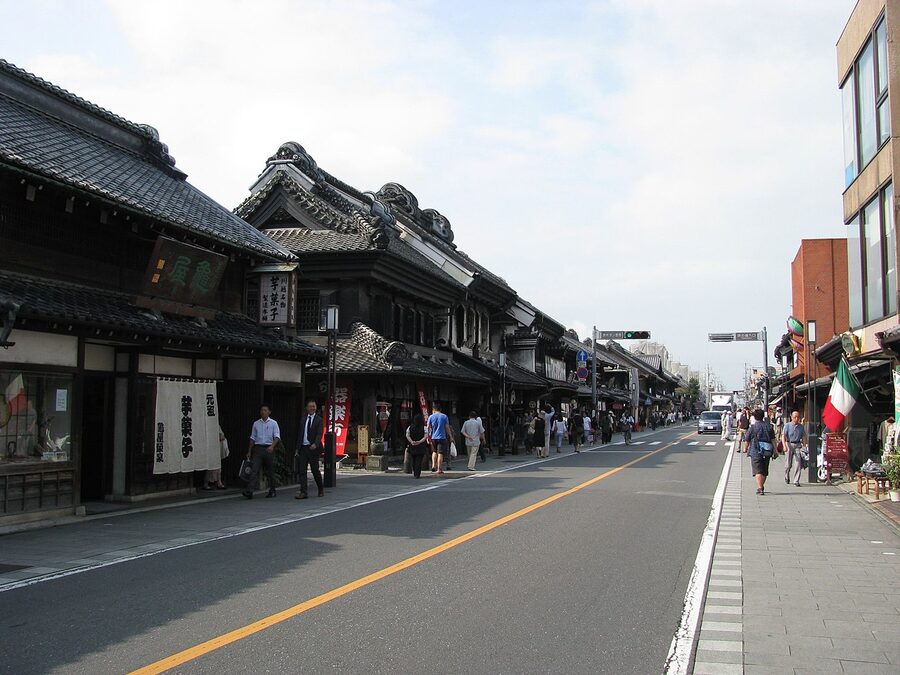

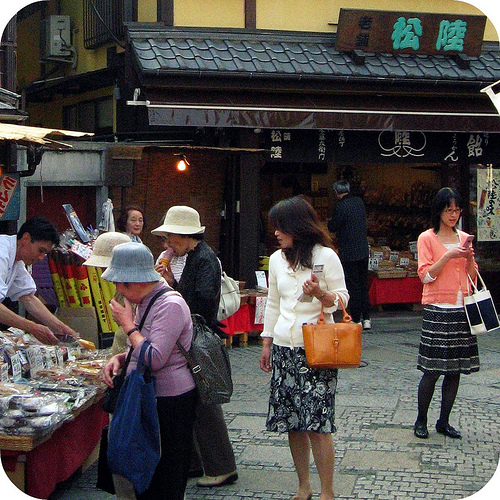
Ichibangai is the headline. It’s a single straight street about 400 metres long, lined on both sides with two-storey kura buildings now used as miso shops, kimono rentals, soba restaurants, sweet shops, and dozens of cafes. You can walk it in 15 minutes. You’ll spend an hour, easily.
What I’d look for, slowly, instead of just photographing the street:
- The signage on individual buildings. Many shops still have their pre-war wooden trade signs. The Yamasaki Art Museum building (a former merchant’s house) has a classical kanji shop curtain you can spot from the street.
- The miso shop, Matsumoto Shoyu. Stop in even if you’re not buying — the dark interior with stacked wooden barrels is exactly what you imagine an Edo merchant shop looked like.
- The narrow side alleys. Step off Ichibangai onto any of the cross-streets for 30 seconds and the crowd density drops by 80%. Some of the prettiest residential kura are tucked back here.
One honest note: on weekend afternoons between about midday and 3pm, Ichibangai gets genuinely uncomfortable. The street is narrow, there’s no pavement, cars still drive through, and on a sunny October Saturday I once stood in a complete jam of kimono-renting day-trippers for several minutes without moving. If you can come on a weekday or before 10am, the photos are easier and the atmosphere is much closer to what the guidebooks promise.
Toki no Kane, the Time Bell Tower
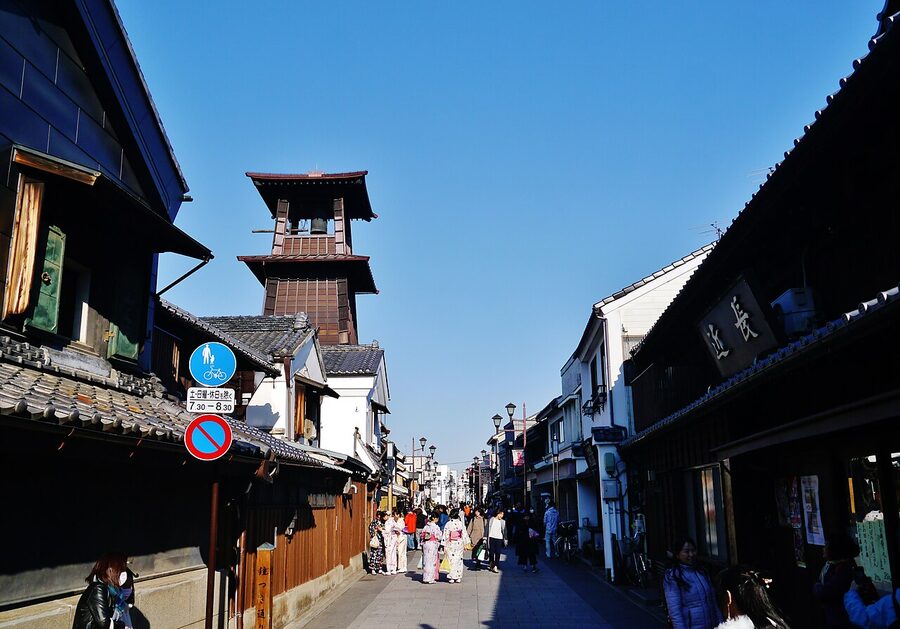

Step a few metres off Ichibangai onto a side lane and you’ll find the Toki no Kane (時の鐘), the bell tower that has been Kawagoe’s symbol since the 17th century. The original was built in the Kan’ei era (1624–44) by then-lord Sakai Tadakatsu. It burned several times. The fourth-generation tower you see today went up in 1894, paid for by donations from local merchants and — interestingly — the businessman Shibusawa Eiichi, who spent his last years in Kawagoe.
The bell still rings, automatically these days, four times a day: 6am, noon, 3pm, and 6pm. In 1996, the Ministry of the Environment chose it as one of Japan’s 100 Soundscapes — there’s a national list, and the Toki no Kane is on it. If you’re anywhere in the old town when noon or 3pm comes around, stop walking and listen. It’s a single tolling note that holds for about ten seconds and then repeats. The whole thing takes maybe 90 seconds. People around you stop talking when it starts. It’s genuinely affecting.
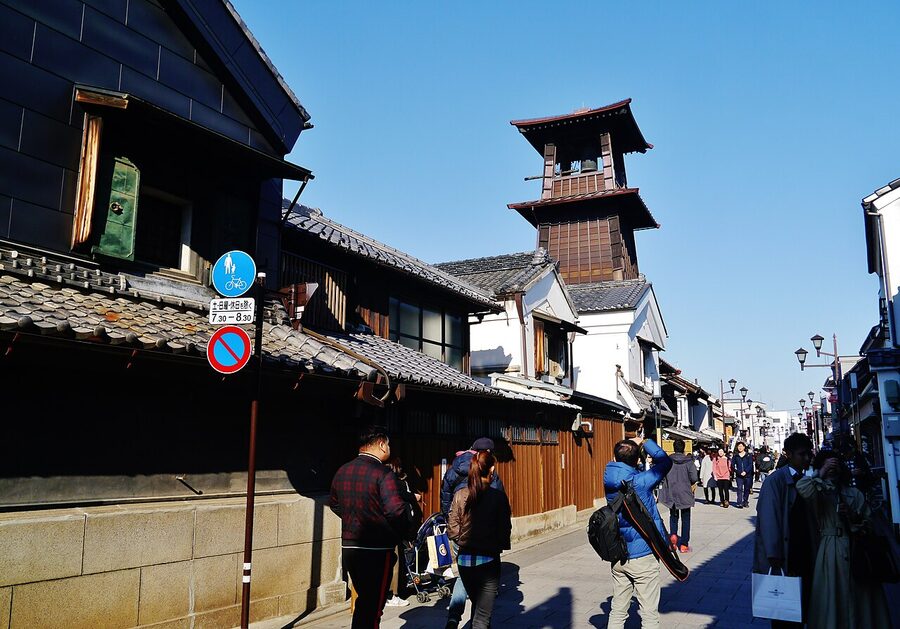

You can’t go up the tower itself. Don’t be the person who tries the door. Between 2015 and 2017 the whole structure was earthquake-retrofitted — a 100-million-yen project that involved pouring 60 tonnes of concrete underneath as a foundation pad. So it’s been recently and seriously restored. It’s designated a Tangible Cultural Property by Kawagoe city.
Kashiya Yokocho, the Candy Alley
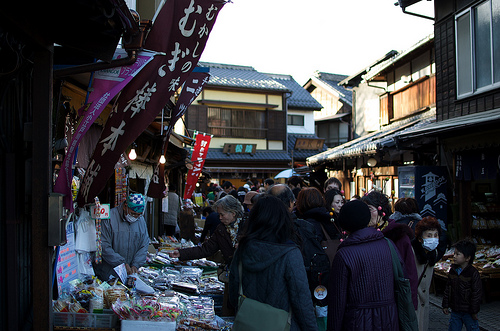

A two-minute walk north of the Toki no Kane is Kashiya Yokocho (菓子屋横丁), the “candy alley”. It started in 1796 when a confectioner called Suzuki Tozaemon opened a shop selling cheap unfussy sweets aimed at the Edo working class. Word spread. By the early 20th century there were 70-plus little candy shops crammed into this one alley.
Today there are around 22, working from old recipes — hard candy, kintaro-ame (those long sticks of rock candy with a face stamped through the centre), karinto, water yokan, and an absolutely enormous amount of sweet potato everything. The lane itself is selected as one of the Ministry of the Environment’s “100 Best Aroma Landscapes” (yes, Japan also has a list for smells), apparently because of the combined caramel-and-soy-sauce aromas that drift out of the shops.

The biggest single thing on offer is a one-metre-long stick of fugashi (an airy puffed-wheat candy). It’s about ¥300, looks ridiculous in photos, and is genuinely tasty in a chalky-sugary way. The other purchase I’d defend is a stick of imo-kiri — sweet potato cut into chip-shape and drizzled with hot sugar syrup. It’s the local specialty and you can eat it walking.
One thing to know: in 2015 a fire in one of the shops destroyed five buildings on the alley. Things were rebuilt, but the alley feels slightly newer in places than the rest of the old town. Don’t expect every building here to be 19th century.
Hikawa Shrine, matchmaking and 2,000 wind chimes
.jpg)
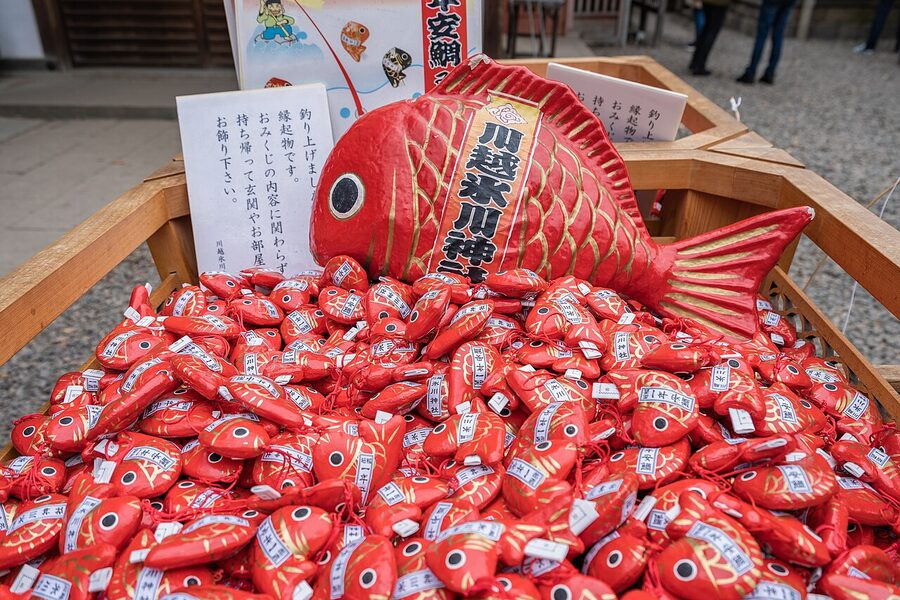
About 15 minutes’ walk north of Ichibangai is Kawagoe Hikawa Shrine (川越氷川神社), the city’s tutelary shrine. According to its own foundation legend, it was established in 541 AD, in the second year of Emperor Kinmei, after a mysterious light was seen rising from the Iruma River and interpreted as the spirit of the Hikawa kami. That makes it about 1,500 years old as a sacred site, although the buildings you see today are much later — the main hall was rebuilt in 1849 by Lord Matsudaira Naritsune.
Two of the four kami enshrined here are married deities. That’s why Kawagoe Hikawa is famous for enmusubi — the “tying of bonds”, particularly romantic ones. There’s a tradition that picking up a piece of the white gravel from the shrine grounds and keeping it carefully will bring good marriage luck. The shrine, sensibly, formalised this: every morning at 8am they hand out 20 small charms called enmusubi-dama — gravel wrapped in mesh, blessed by the priest. They go fast. If you want one, queue from about 7am.
.jpg)
The reason most foreign visitors plan their visit around Hikawa is the summer Enmusubi Furin Matsuri (Wind Chime Festival). From early July to early September, the shrine grounds are filled with over 2,000 hand-blown Edo-style glass wind chimes hung from green bamboo frames. You walk under tunnels of them. You write a wish on a paper strip and tie it to the bamboo. They’ve been doing this since 2014. It’s one of the prettiest summer events anywhere in greater Tokyo, and at night the chimes are lit with LED lanterns called koi-akari.
Kitain Temple and the 538 Rakan
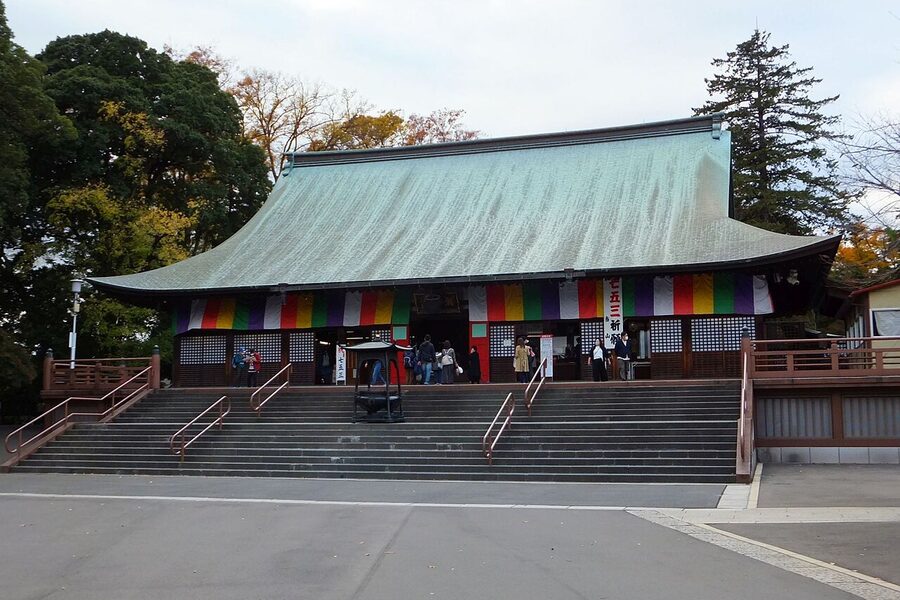

Kitain (喜多院) is on the southern edge of the old town, about 15 minutes’ walk south of Ichibangai. It’s a Tendai sect temple founded in 830 AD. The interesting bit is the Tokugawa connection: in 1638, after another Kawagoe fire, the third shogun Tokugawa Iemitsu ordered that buildings from Edo Castle’s Momijiyama palace be dismantled and shipped up the Shingashi River to Kitain to replace what had burned. They were rebuilt here. So today, in Kawagoe of all places, you can sit in a room labelled “the room where Tokugawa Iemitsu was born” — the actual physical room, transported here from Edo Castle. The bath, the toilet, and the dressing room of his wet nurse Lady Kasuga are also preserved. It’s ¥500 to enter the inner halls, and absolutely worth it for that small piece of architecture if you have any interest in the Tokugawa shogunate.
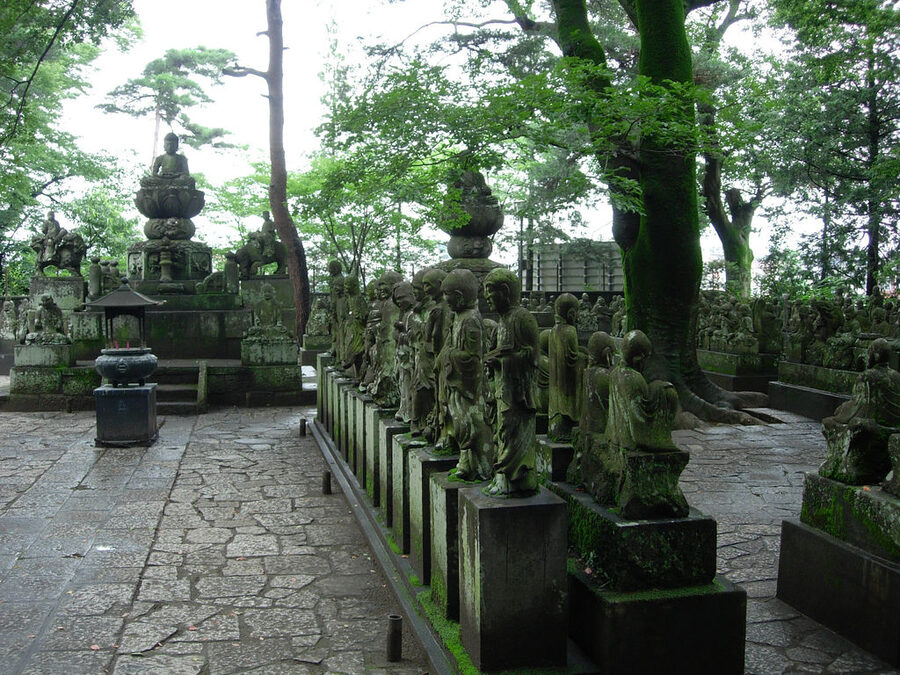

The headline is the Gohyaku Rakan — “500 Rakan” — though the actual count is 538. Rakan are stone disciples of the Buddha. They’re arranged in dense rows in a small open courtyard, and every single one is carved with a different face and gesture. Some are praying. Some are laughing. Two are obviously talking to each other. One has his hand cupped to his ear. One is sleeping. They were carved over 50 years from 1782, mostly funded by donations from worshippers, so each face was probably modelled on a real person. ¥500 to enter (combined with the inner halls). Spend at least 30 minutes here. It rewards slow looking.
If you do come for New Year, brace yourself — the first three days of January draw 400,000 people to Kitain, which is the biggest hatsumode crowd in Saitama. February with sparse plum blossom is much, much calmer.
The Kawagoe Matsuri
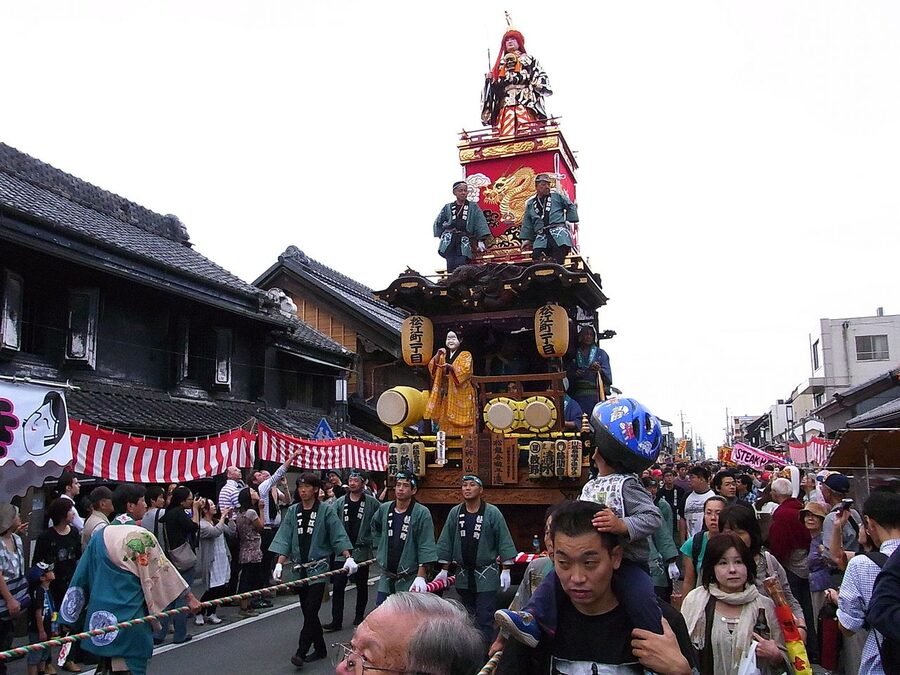

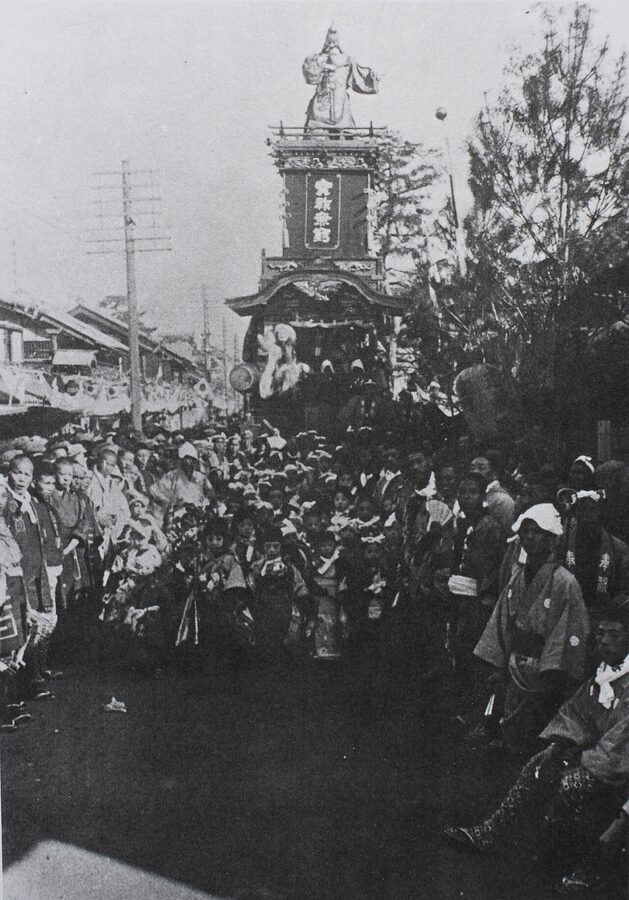
The Kawagoe Matsuri (川越まつり, formally Kawagoe Hikawa Matsuri) is held annually on the third weekend of October — Saturday and Sunday. It’s the festival of Kawagoe Hikawa Shrine and it has been running for over 360 years, since Lord Matsudaira Nobutsuna formalised it in 1648. There are 29 registered floats; about 15 are pulled in any given year, on rotation. In 2005, the matsuri was designated a Nationally Important Intangible Folk Cultural Property. In October 2016, it was added to the UNESCO Intangible Cultural Heritage list as part of the “Yama, Hoko and Yatai Float Festivals” group entry. Eight hundred thousand people attend the festival across the two days.
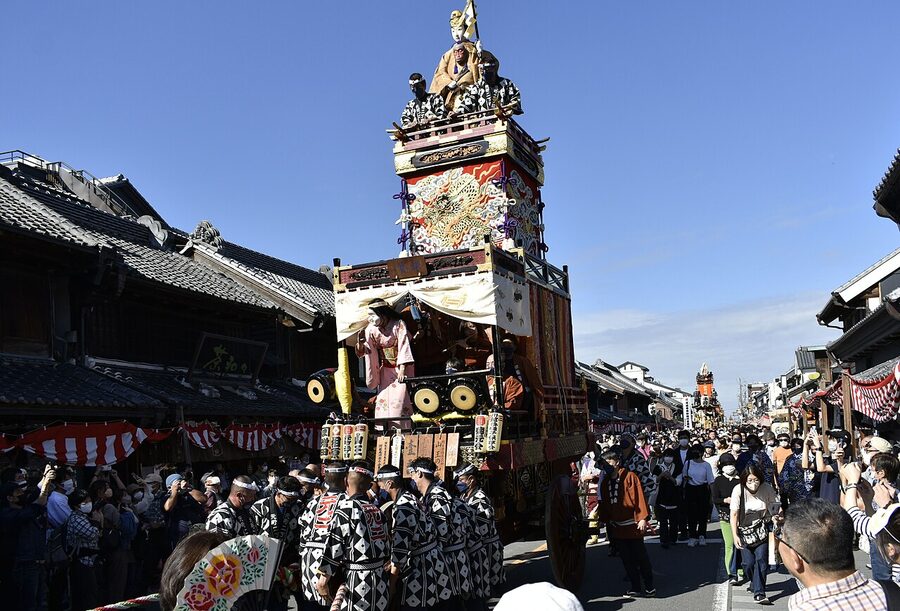

What makes the Kawagoe matsuri unusual: most of Tokyo’s old tenka matsuri (the “great Edo festivals”) lost their floats in the late 19th century when telegraph wires were strung up over the city — the wires were too low for the towering wooden float-tops to pass under. Kawagoe never had that problem because it never went modern in the same way, so the floats here are the closest surviving thing to what an Edo-period festival would have looked and sounded like. Many of the dolls on top are by 19th-century Edo masters like Hara Shugetsu and Naka Hidehide.
If you can come during the festival, do — but two warnings. (a) Kawagoe is at full crush capacity. The kura-zukuri street is impassable. Hotels in Kawagoe sell out months ahead and Tokyo trains in are packed. (b) The best part of the festival is after dark, when the floats are lit by lanterns. So plan to stay until 8 or 9pm and either catch a late train back or book ahead.
Eating in Kawagoe
Two specialties to know about: sweet potato, and unagi (freshwater eel).
Sweet potato (satsumaimo). Kawagoe was a major sweet-potato producer in the Edo period — local farmers worked out a particularly good variety called the Kawagoe-imo (川越芋), and the saying went “tastier than chestnut, the thirteen-ri imo”, where thirteen-ri (about 50km) was the distance from Edo. So today the food shopping in Kawagoe is overwhelmingly sweet potato everything: imo-senbei (sweet potato rice cracker), imo-kempi (deep-fried matchsticks in sugar syrup), daigaku-imo (caramelised cubes), sweet potato soft-serve ice cream, sweet potato sake, and a sweet potato beer brewed by the local Coedo brewery. Try the soft-serve. It’s actually good. Most shops on Ichibangai sell it for ¥350–¥500.
Unagi. Kawagoe was also wealthy in eel. Several long-running unagi specialists are in walking distance of Ichibangai. The names you’ll see come up in every guide are Ogakiku (more than 200 years old, set inside an old kura), Ichinoya (1832, the most touristed), and Ogato (also old, slightly off the main drag). Set lunches start around ¥3,500 and run to ¥6,000-plus for a full unaju (eel on rice in a lacquered box). Honest opinion: they’re all good. The reason to book ahead at any of them is the queue. On a weekend without a reservation you can wait two hours. Phone the day before; even if your Japanese is bad, “tomorrow, two people, midday” with a polite tone usually works.
If you want non-eel: there’s very good handmade soba on every other street, the Coedo brewery has a tasting bar near Hon-Kawagoe station, and the cafes inside the kura buildings on Taisho Roman-dori do solid coffee and Showa-era set lunches.
Renting a kimono for the day
Most photos you see of Kawagoe are of someone in a kimono. There are around 20 rental shops in the old town, with prices clustered between ¥4,000 and ¥6,000 for a basic full-day kimono with obi belt and zori sandals. Add ¥2,000 if you want hair-styling. Wargo, VASARA, and Sophy are the big chains; they all give you a polite English-speaking staff member, a rental locker for your normal clothes, and a 6pm return deadline.
Honest opinion on this: I’d only do it if you’re visiting in cherry-blossom season, autumn-leaves season, or specifically for the Hikawa Shrine wind-chime festival. The photos in those settings are something special. On a grey February afternoon you’ll just be cold. The kimono includes thin tabi socks and zori sandals — bring chunky tights if it’s under 10°C, you’ll need them.
A practical full-day route
If you have one day and you want to see the headlines without rushing:
- 9:00 — leave central Tokyo. Tobu Tojo from Ikebukuro, rapid express, arrive Kawagoe Station 9:30.
- 9:45–10:15 — walk up Crea Mall to the start of the kura district. Stop at a coffee place to pick up sweet potato everything along the way.
- 10:15–11:30 — Ichibangai, slowly. Toki no Kane in the side street. Be there at 12 noon for the bell.
- 11:45–12:30 — Kashiya Yokocho. Eat your way through it.
- 12:30–14:00 — Lunch (booked unagi if you reserved, soba if you didn’t).
- 14:00–15:30 — Walk south to Kitain. Pay the combined ¥500 ticket. Spend a long time with the Rakan statues. Listen for the 3pm bell from the direction of Ichibangai.
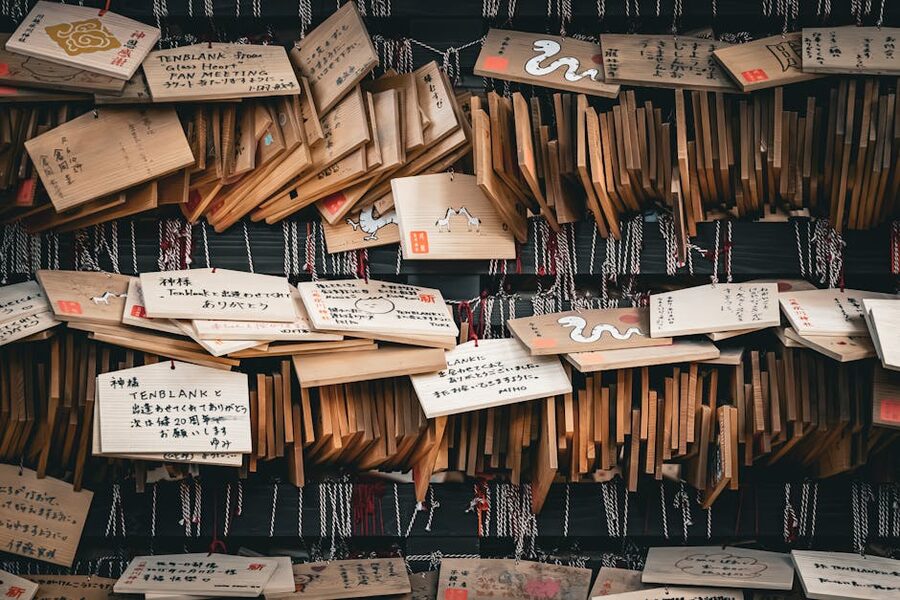
- 15:30–17:00 — Walk north to Hikawa Shrine. Walk through the ema tunnel. If summer, the wind-chime tunnel.
- 17:00 onwards — Walk back to Hon-Kawagoe (closer than Kawagoe), board Seibu, home for dinner.
If that’s too tight, drop Kitain — it’s the furthest from the kura district and the easiest to lose. You’ll lose the Rakan, which is genuinely a shame, but you’ll save 90 minutes of walking and queue.
When to go
- April — cherry blossom along the Shingashi River, behind Hikawa Shrine. Underrated. Most foreigners don’t know about it; locals do, but it’s not Tokyo-level packed.
- July to early September — the Hikawa Enmusubi Furin wind-chime festival. Hot, but the prettiest summer thing in greater Tokyo.
- Third weekend of October — the Kawagoe Matsuri. The most atmospheric weekend of the year, also the most crowded. Reserve trains and book any meals in advance.
- November — late autumn leaves around Kitain’s pond garden. Quieter than spring, similarly photogenic.
- February — coldest, quietest, easiest. No queues. The atmosphere is more “old town in winter” and less “heritage theme park”.
Practical info
- Train: Tobu Tojo from Ikebukuro to Kawagoe Station — 30 min, ¥490 one way; or Seibu Shinjuku to Hon-Kawagoe — 45 min limited express (¥520 + ¥600 reservation), 60 min local (¥520).
- Discount passes: Tobu Kawagoe Discount Pass ¥950 (round trip + bus), Seibu Hon-Kawagoe pass ¥700 — for foreign passport holders only.
- Local buses: Koedo Loop Bus / Warera Machi Bus, ¥200 per ride, ¥500 day pass.
- Old town admission: Ichibangai, Toki no Kane, Kashiya Yokocho — all free, all outdoor.
- Hikawa Shrine — free entry; 8am–5pm. Wind-chime festival approx. early July to early September.
- Kitain — outer grounds free; inner halls + 500 Rakan ¥500 combined; 8:50–16:30 (closes 16:00 in winter), shorter on Sundays.
- Kimono rental — ¥4,000–¥6,000 day rate; advance booking advised on weekends.
- Best months: April (cherry blossoms), July–Sept (wind-chime festival), 3rd weekend October (matsuri), November (autumn leaves).
- Avoid: Saturdays 12–3pm if you don’t love crowds.
How I’d actually spend a half-day in Kawagoe
If I only had a half-day — a real possibility on a Tokyo trip — I’d go on a weekday in late April. I’d catch the 9:30am Tobu Tojo from Ikebukuro, walk up Crea Mall and arrive at Ichibangai by about 10:30, slowly drift north so that I was standing under the Toki no Kane when it tolled at noon. Lunch would be unagi at Ogakiku, booked. After that, a coffee in one of the kura cafes on Taisho Roman-dori, half an hour at the wind-chime tunnel at Hikawa, and the cherry blossoms along the Shingashi River walking back to Hon-Kawagoe. Home in central Tokyo by 5pm. No museum, no Kitain — they’re lovely but a different trip — just the kura streets, the bell, the sweet potato, the eel, and the river.
If you’re building a longer Tokyo plan around this, Kawagoe pairs well with the older parts of the city. After this, the natural follow-up is Asakusa for more old-Tokyo atmosphere, or the quiet alleys of Yanaka. For the train logistics generally, my full Tokyo trains and IC card guide has Tobu and Seibu covered. If you’re here for several days and trying to slot Kawagoe in, the 3 days in Tokyo piece has a flexible day where Kawagoe drops in nicely. And before you sit down for unagi, the dining etiquette guide is worth a quick read so you’re not the person trying to put soy sauce on the eel (you don’t — it’s already glazed).
Official sources for the latest hours and event dates: the Kawagoe tourism association at koedo.or.jp, the city of Kawagoe’s tourism page at city.kawagoe.saitama.jp, and the official Kawagoe Matsuri site at kawagoematsuri.jp.