
Here’s the thing about the Sumida River Fireworks Festival that nobody tells you until after you’ve gone: it isn’t “a fireworks show in Tokyo.” It’s a competition. About 20,000 shells go up in 90 minutes from two points along the Sumida River near Asakusa, and the first 200 or so of those are part of a juried contest between ten of Japan’s top pyrotechnic companies. People in the crowd actually yell out “Tamaya!” and “Kagiya!” while they watch, which are the names of two rival Edo-period firework guilds that started the whole rivalry almost three centuries ago. The 2026 edition falls on Saturday 25 July, and roughly one million people will be out to watch it.
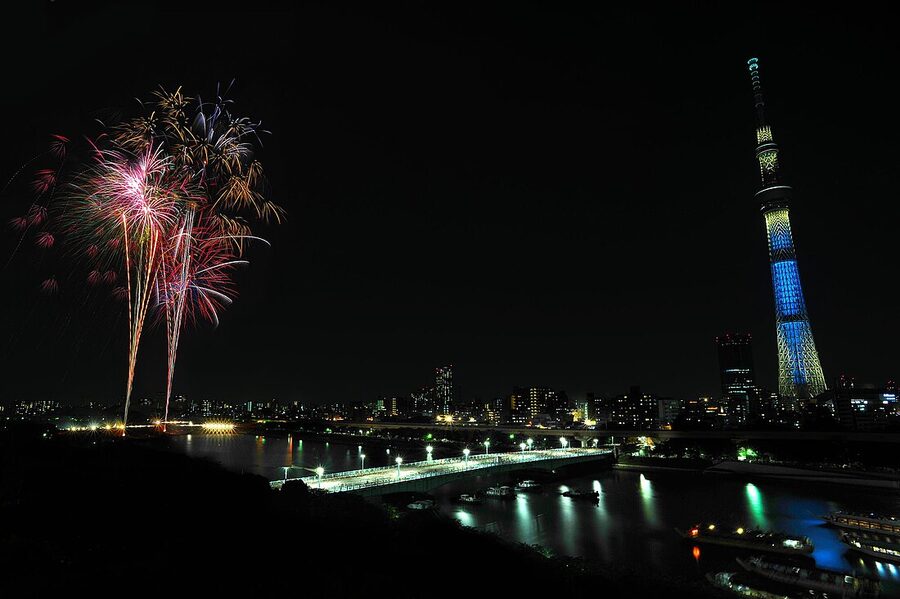
I’ll say up front: this is not a festival you show up to casually. Asakusa Station becomes near-unusable from about 5pm on the day. The viewing spots along the riverbank fill by early afternoon. If you try to “pop over after dinner” you will end up watching fireworks between the shoulders of strangers, unable to sit, with no route back to your hotel that doesn’t involve an hour-plus of queueing. Done right though, it’s one of the great Tokyo experiences — genuinely old, genuinely huge, and tied into shitamachi (old downtown) neighbourhoods that are beautiful to wander through even when there isn’t a festival on.
In This Article
- A brief history (and why it’s older than it looks)
- Scale, format, and what’s actually happening
- Dates for the next few years
- Where to watch
- The riverbank streets in Asakusa (the hardcore option)
- Sumida Park (still crowded but grassier)
- Shiori Park / Shioiri Park
- Towards Tokyo Skytree
- The official paid seats (有料観覧席)
- Hotel rooftops and restaurants with river views
- Yakatabune (river boats)
- How to actually get there
- Stations to consider
- Arrival timings
- Getting home afterwards
- Finding a spot without buying paid seating
- What to bring
- The competition, and why you hear people shout “Tamaya!”
- Two opinions, since you asked
- Pairing with the rest of Asakusa
- Essential info at a glance
- How I’d do Sumidagawa if it’s my first one
A brief history (and why it’s older than it looks)
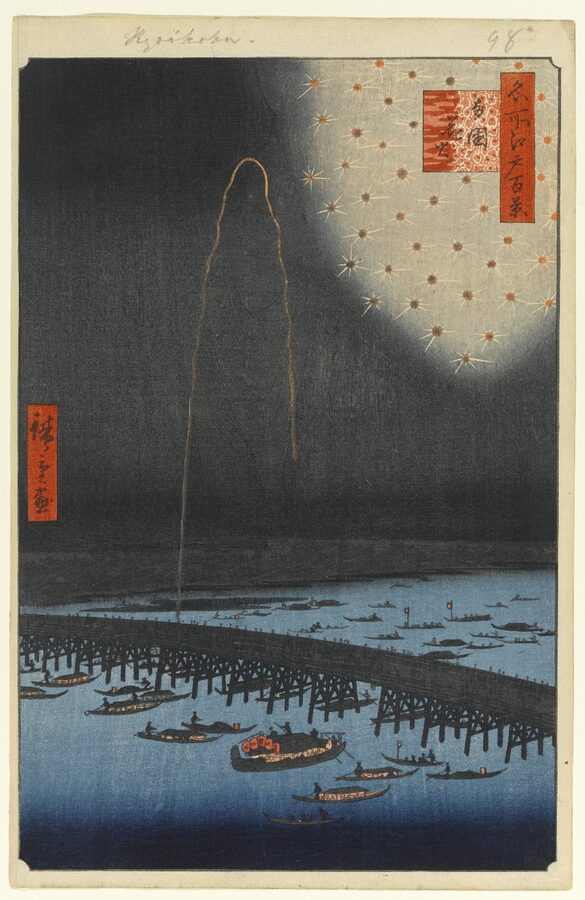
The dates you’ll see in most guides put the origin at 1733 — the fifth month of Kyoho 18 in the old calendar. That year, during the Ryogoku Kawabiraki (the ceremony marking the start of the Sumida River’s summer boating season), a pyrotechnician called Kagiya Yahei launched fireworks from the river, and that’s treated as the official beginning of the festival. The popular version of the story adds that this was a memorial response to the previous year’s Kyoho famine and a cholera outbreak — a water god ceremony to comfort the dead and ward off further misfortune.
The less tidy version is a bit messier. Japanese historians have shown that the “1733 famine memorial” narrative was stitched together between the 1890s and 1930s, well after the fact. The earliest accounts frame the fireworks as advertising for fireworks-makers, not mourning. Either way, the Ryogoku display quickly became one of Edo’s biggest annual events, with rival firework guilds — Kagiya and Tamaya — battling for crowd favour every summer. By around 1810 the competition format was fully set. The tradition survived into the Meiji era, got battered by World War II, and then had a long pause. From 1962 to 1977 the Ryogoku fireworks went quiet — partly because of traffic chaos around the old venue, partly because the Sumida had become badly polluted and the smell around the riverbanks was miserable.
The festival came back in 1978 under its current name (Sumidagawa Hanabi Taikai) on 29 July, moved upstream to the Asakusa reach of the river, and split across two launch points. That’s the version you’re going to see.
Scale, format, and what’s actually happening
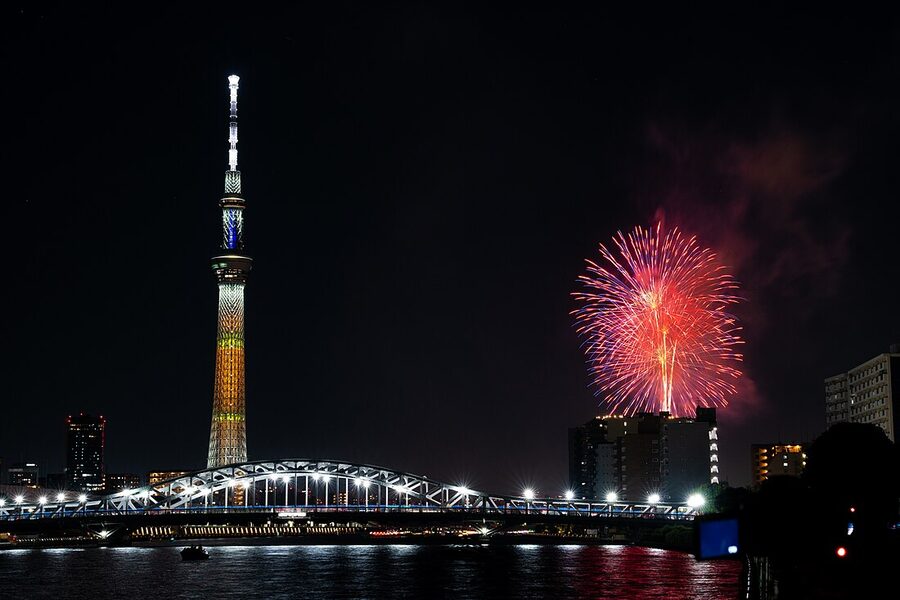
Two launch sites run simultaneously for most of the show. The first (dai-ichi kaijo, 第一会場) sits between Sakurabashi Bridge and Kototoi Bridge, a little upstream of Asakusa. The second (dai-ni kaijo, 第二会場) is further downstream between Komagata Bridge and Umaya Bridge. In a typical year:
- Dai-ichi kaijo — about 9,350 shells. This is where the official fireworks competition happens for the first 20 minutes or so. Ten companies each fire a short entry, and both the judges and the crowd score them.
- Dai-ni kaijo — about 10,650 shells. This one is pure show, leaning heavily on large warimono (the big round shells that explode into a single huge flower shape) and showpiece starmines.
- Total: around 20,000 shells across both sites.
The first site launches from 19:00. The second joins in at 19:30. Both finish at 20:30. So the last hour is the two venues firing in sync, which is when the sky gets properly saturated.
The less-advertised bit: you’ll see pop-culture fireworks. Anpanman’s face. A Pokemon Pokeball. Smiley faces. These are shikake hanabi (仕掛け花火, “contrivance fireworks”) and they only read as their intended shape from certain angles. If you’re watching from Asakusa Station side and the logo looks like a blurry blob, it was probably pointed at the Sumida side — walk a couple of blocks and look again.
Dates for the next few years
The festival runs on the last Saturday of July unless that clashes with something unworkable. Confirmed dates:
- 2026: Saturday 25 July, 19:00–20:30
- 2027: Saturday 31 July
- 2028: Saturday 29 July
It’s not postponed if the weather turns bad. Unlike most Japanese fireworks festivals, the Sumidagawa Hanabi Taikai has no rain date. Light rain goes ahead. A typhoon means the whole thing is simply cancelled (the organisers usually announce by 08:00 on the morning of the event). In 2013 a sudden downpour 30 minutes in ended it for the night — no one got a refund on paid seats. In 2018 it was rescheduled to the Sunday because of Typhoon Jongdari, which was an unusual exception.
Where to watch
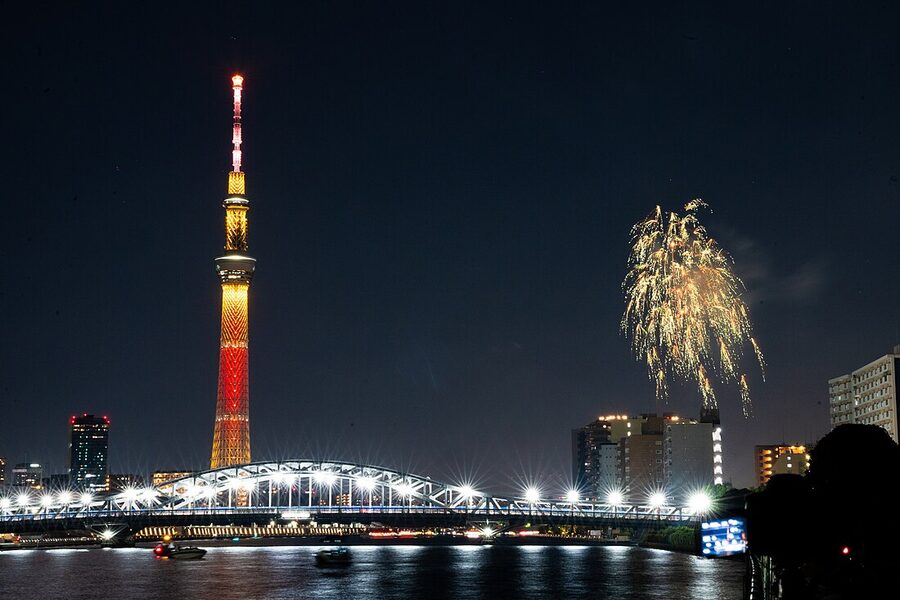
The real question is how much crowd you’re prepared to swallow. Your options, from most intense to most civilised:
The riverbank streets in Asakusa (the hardcore option)
The roads immediately alongside the river in Asakusa close to cars from around 18:00, and the front-row spots along the barriers fill from roughly 14:00. You get stunning views from here — the whole thing is happening right above you — but you need to commit to a 3-4 hour wait on tarmac, with sun beating down for most of that, and a very slow crawl home afterwards. Bring a leisure sheet (a thin plastic picnic mat from any 100-yen shop), sports drinks, sun protection, and more water than you think.
The very busiest stretch is between Azumabashi (the big red bridge in front of the Asahi Beer Hall) and the Sumida Park embankment. If you can’t secure a spot by 15:30, don’t bother queueing here — push elsewhere.
Sumida Park (still crowded but grassier)
Sumida Park runs along both banks. The Taito (western) side is closer to Asakusa Station and gets busy earlier. The Sumida (eastern) side, across Azumabashi, is slightly less crushing and has better food options nearby if you walk towards the Skytree. Either way, spots inside the park proper are claimed well before the roads close.
Shiori Park / Shioiri Park
Shiori (also written Shioiri) Park is a smaller park a short walk north from the first launch site. View’s a bit obstructed by trees, but the crowd density drops sharply and you can actually sit down. Worth considering if you want to see the show without battling for the last metre of barrier.
Towards Tokyo Skytree
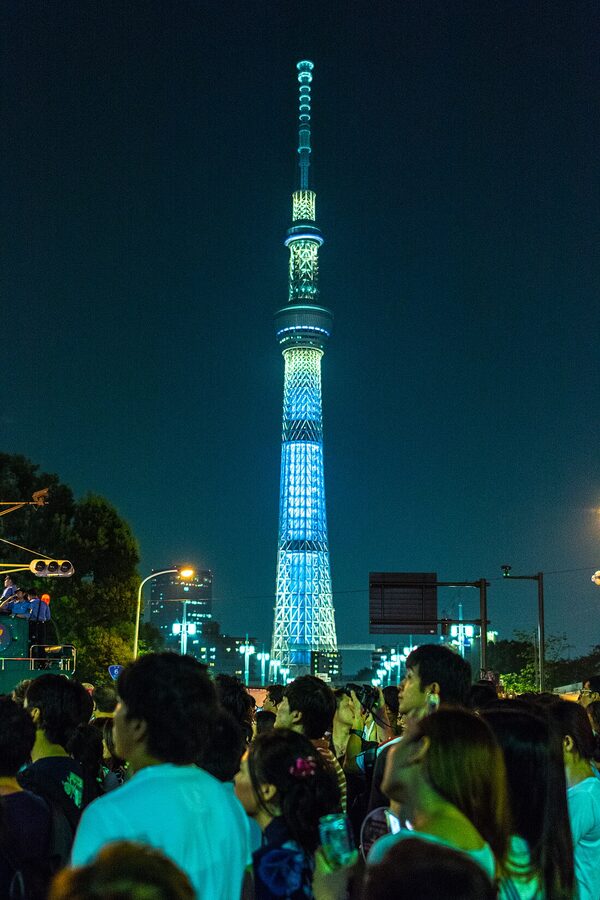
The Tokyo Cheapo editors’ open secret: walk from Asakusa Station towards the Skytree. As you move east, the crowd thins out, and there are several cross-street intersections where you get a clean view of the northern (dai-ichi) display with the Skytree in shot. Not full-sky saturation, but a more pleasant human experience. If you want to pair this with a proper visit to the tower, we’ve got a full guide to visiting Tokyo Skytree.
The official paid seats (有料観覧席)
The organisers release a limited run of paid seating every year. In 2025 these started at around ¥7,000 and were sold from late April through mid-May (postal applications first, then online around the 11th). For 2026 expect something similar — watch the official site from mid-April. They go very quickly. What you’re paying for is less the view (it’s not dramatically better than the free spots along the river) and more a guaranteed seat, a toilet you can actually access, and less of a scrum going home. For a family or anyone not keen on sitting on hot concrete for four hours, it’s worth the money.
Hotel rooftops and restaurants with river views
Asakusa View Hotel, One@Tokyo (by the Skytree), and several of the mid-range Asakusa hotels run fireworks-night packages with rooftop access or a window room facing the river. They sell out by winter for the following summer — genuinely book six to nine months ahead. Riverside restaurants with fireworks-night reservations also fill up a full year ahead in some cases. If you’re the kind of traveller who prefers paying to skip the logistics, this is the play.
Yakatabune (river boats)
A yakatabune is a traditional flat-roofed pleasure boat. On Sumidagawa Hanabi night, they run fireworks dinner cruises right on the water, with all-you-can-drink packages that usually run around ¥79,000 per person. Bookings open months in advance and typically close out by late spring. It’s a once-in-a-lifetime setup if the budget allows.
How to actually get there
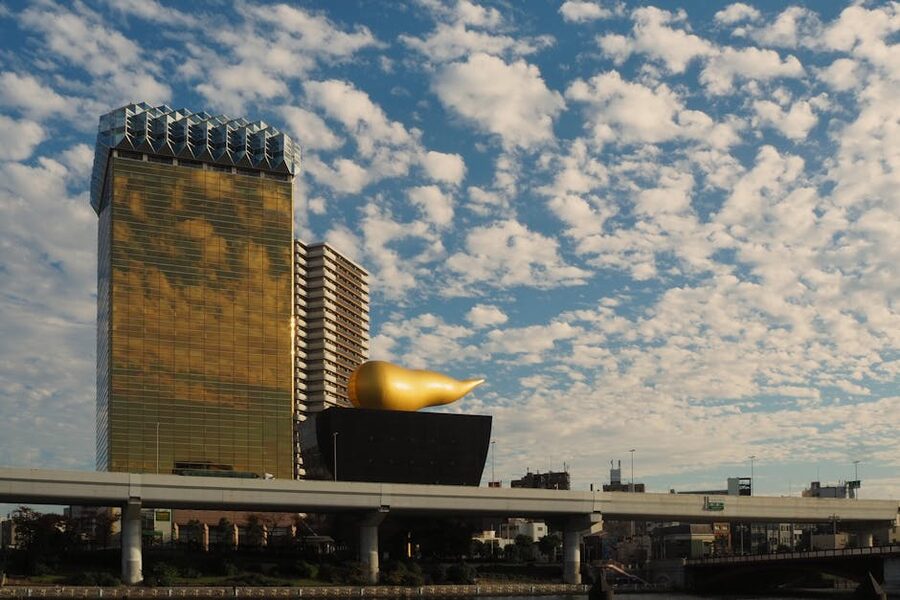
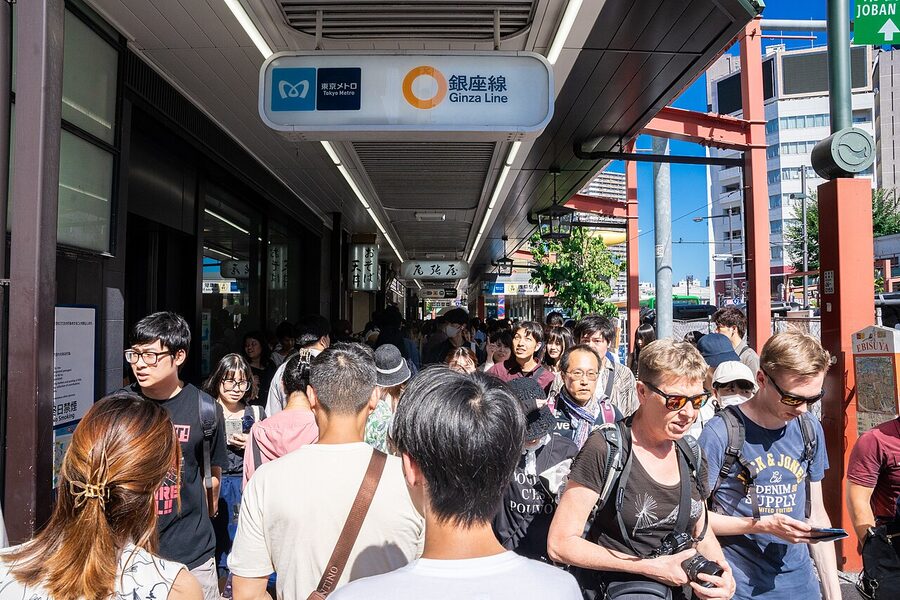
Asakusa Station is the closest to the action — and the worst station to arrive at on the day. Trains still run, but getting out of the station itself takes 20-40 minutes at peak, and getting back in afterwards is worse. The walking routes are staff-directed and one-way, so you can’t simply double back.
Stations to consider
- Asakusa Station (Ginza Line / Asakusa Line / Tobu Skytree Line) — 10-minute walk to the first venue, 8 minutes to the second. Crushing 17:00-22:00.
- Oshiage / Tokyo Skytree Station — 10 minutes to the first venue. Busy but less punishing than Asakusa for the return trip.
- Hikifune Station (Tobu Skytree Line / Keisei Oshiage Line) — 10 minutes to the first venue. Good approach from north-east Tokyo.
- Kuramae Station (Asakusa Line / Oedo Line) — 9 minutes to the second venue. Much calmer than Asakusa.
- Tawaramachi Station (Ginza Line) — about 7 minutes from the Asakusa core and substantially less crowded.
- Ryogoku Station (JR Sobu Line / Oedo Line) — 12 minutes to the second venue. Historic Ryogoku atmosphere.
- Asakusabashi Station (JR Sobu Line / Asakusa Line) — 12 minutes. Good southern approach.
If you’re unsure how the Tokyo train system connects together, my full Tokyo trains guide covers IC cards, line colours, and how to avoid the expensive limited expresses.
Arrival timings
- By 14:00-15:00 for front-row riverbank spots. Seriously. I know that sounds extreme. Locals bring books.
- By 16:30 for decent but not front-row viewing at parks slightly set back from the water.
- Before 17:00 from any direction if you want any choice at all.
- After 17:00, arrive via Kuramae, Tawaramachi or Honjo-Azumabashi rather than Asakusa itself — these are less overwhelmed, and staff-directed paths from them will still get you to a viewing zone.
- Do not arrive 18:30 expecting to find a spot. By this point the streets are barricaded and staff are actively stopping new people joining the main zones. You’ll end up watching from a cross-street.
Getting home afterwards
The thing I wish someone had told me the first time: don’t head back to Asakusa Station for the first 30-45 minutes after the finale. Half a million people will have the same idea. Instead:
- Walk away from the river rather than towards it.
- Aim for Tawaramachi, Shin-Okachimachi, or Kuramae — each about 10-15 minutes on foot through the shitamachi streets.
- If you’re near the second venue, Ryogoku or Asakusabashi are perfectly usable and much less crushed.
- Or just stay where you are. Grab food from a street stall, sit on a kerb, let the crowd thin for an hour. There’s no rush.
Finding a spot without buying paid seating
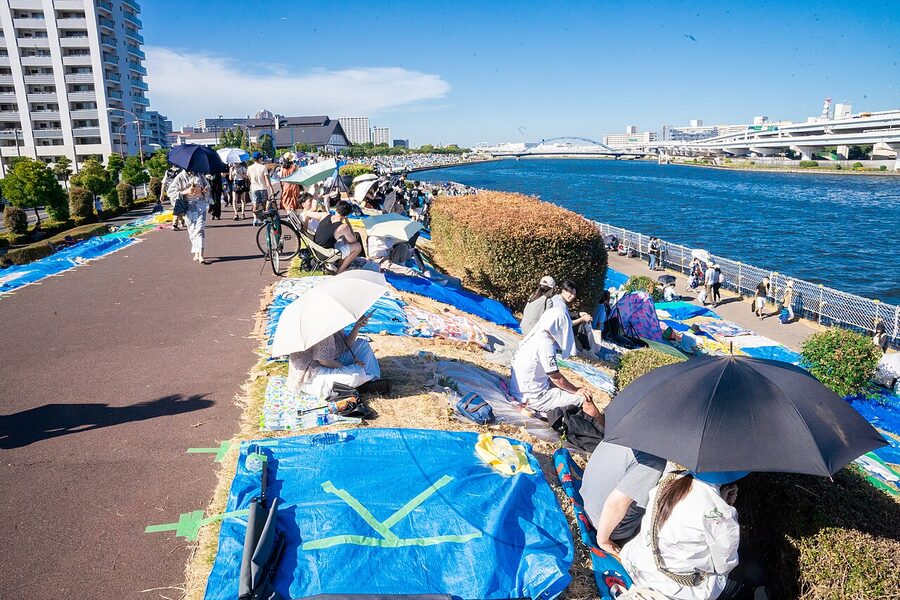
The realistic strategy for first-timers who aren’t booking paid seats:
- Arrive at Tawaramachi or Kuramae by 15:00. Both stations have festival food stalls in the adjacent streets, so you can eat and drink before locking into a spot.
- Buy everything you’ll need for the next five hours at a conbini on the way — water, sports drinks, onigiri, snacks, wet wipes, a cheap leisure sheet. There are no food stalls directly on the main viewing streets once they barricade.
- Walk towards the river through the back streets until you hit the first staff-directed path. Follow it. Don’t try to get cleverer than the staff — the crowd flow is engineered for a reason.
- Pick a spot and commit. Once you’re sat down, leaving and coming back to the same patch is essentially impossible — barricades get moved, and the returning crowd fills any gap within minutes. Agree a meeting point with anyone you’re with in case you get separated.
What to bring
Tokyo in late July averages 30-33°C during the day and stays around 28°C well into the evening. Humidity’s around 75%. You will sweat through whatever you wear. Pack:
- A leisure sheet (レジャーシート) — the thin plastic picnic sheet you can buy for ¥300 at any 100-yen shop. Essential for sitting.
- An uchiwa (rigid fan) or a handheld electric fan. Both are sold cheaply around the stations on the day.
- Two litres of water minimum per person. Machines sell out.
- Wet towels or cooling sheets (Biore Cooling Sheets are sold in every conbini in summer).
- Snacks and conbini bento bought before you arrive.
- Toilet paper or tissues. The portable toilets will run out.
- Sunscreen. You’ll be sitting in the sun from mid-afternoon onwards.
- A small bin bag. You take your rubbish with you — there are almost no public bins.
- A rain poncho. Light rain doesn’t cancel the show, and umbrellas are basically banned inside viewing zones because they block others.
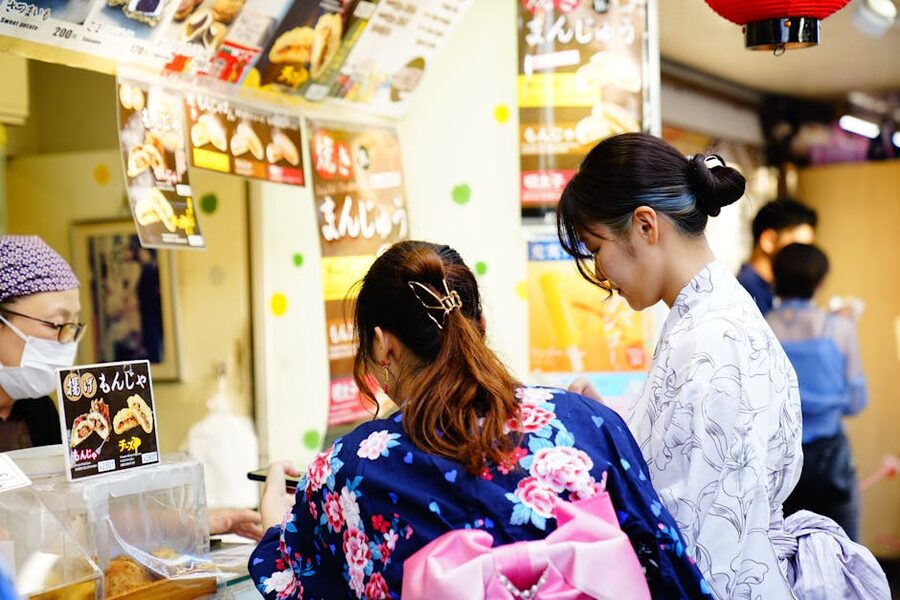
A yukata is absolutely welcome. Plenty of locals wear them and it adds to the atmosphere of the night. If you want to pick one up in Tokyo, the department stores around Shinjuku and Asakusa carry affordable summer versions from around ¥3,000-5,000 in the weeks before the festival.
The competition, and why you hear people shout “Tamaya!”
During the first 20 minutes at the dai-ichi kaijo, ten firework companies each fire a short competitive entry — around 200 shells total for the contest. Seven of those companies have historic ties to the Sumida River; three are national names invited to push the others. Shells are scored both by judges on the night and by spectator reaction, with the results feeding back into the industry’s prestige rankings.
The old Edo-era rivalry between the Tamaya and Kagiya guilds is where the shouts come from. Tamaya was banished from Edo in 1843 after a fire that levelled part of the neighbourhood around their workshop. Kagiya continued. Both names survived as the traditional appreciation shouts at Japanese fireworks shows, and you’ll still hear “Tamaya!” and “Kagiya!” yelled when something particularly pretty goes up.
Two opinions, since you asked
First: if you don’t love crowds, skip the front row. The view from the first-row barrier is nominally better, but you’re trading three hours of hot pavement waiting for about ten extra metres of height on the shells. Sumida Park set back a block, or a quieter cross-street towards the Skytree, gives you 90% of the experience with 30% of the misery. I’ve done both; I’d do the quieter version again before the hardcore one.
Second: the hotel packages are genuinely worth it. I was sceptical at first — the rooftop with champagne deals feel very “paying to avoid effort.” But on a Tokyo summer night in the thick of Asakusa, having a guaranteed seat, a toilet three metres away, and a five-minute walk back to your room instead of a two-hour commute home is not a luxury. It’s the difference between remembering the fireworks fondly and remembering the return train.
Pairing with the rest of Asakusa
If you’re flying in specifically for the festival, don’t just show up for the evening. Asakusa is one of the best areas in Tokyo even on a normal day, and all the surrounding sights are much more pleasant at 10am than at 10pm on hanabi night.
- Senso-ji Temple opens early, crowds are manageable before 9am, and it’s a 10-minute walk from the river. See my Senso-ji guide for the full temple routine and what to do at the temizuya.
- Nakamise-dori — the shopping street leading to Senso-ji — is lined with souvenir stalls and small sweets shops. Good for a cheap, early lunch before settling into your viewing spot.
- Hoppy-dori (just west of Senso-ji) is a densely packed street of small izakayas, open from lunchtime. A decent pre-fireworks beer spot.
- Tokyo Skytree itself has tickets specifically for fireworks viewing from the observation deck. They sell out months ahead. More on the tower in my Tokyo Skytree guide.
- Asakusa as a district deserves its own half-day. My Asakusa guide covers the full neighbourhood — rickshaws, Kappabashi-dori (kitchenware street), Hanayashiki amusement park, the lot.
Essential info at a glance
- Next date: Saturday 25 July 2026
- Time: First venue 19:00, second venue 19:30, both finish 20:30
- Duration: 90 minutes
- Total shells: ~20,000 (9,350 at first venue, 10,650 at second venue)
- Cost: Free for all public viewing areas. Official paid seats from around ¥7,000. Yakatabune cruises around ¥79,000.
- Expected attendance: ~900,000 to 1,000,000+ spectators
- Closest stations: Asakusa, Oshiage, Tokyo Skytree, Kuramae, Tawaramachi, Ryogoku, Hikifune
- Rain policy: Light rain goes ahead. Typhoon = cancelled, no rain date
- Official site: sumidagawa-hanabi.com
- Sumida ward info: city.sumida.lg.jp
How I’d do Sumidagawa if it’s my first one
A rough running order that’s served me well, assuming you’re not buying paid seats:
- Morning (09:00-11:30): Get to Asakusa early. Do Senso-ji while the crowds are bearable. Walk through Nakamise-dori. Grab a bento from Rox supermarket or any conbini.
- Late morning / lunch (11:30-13:30): Light lunch in Asakusa — soba, tempura, or just a rice ball. Pick up everything on the bring-list above at a conbini. A fresh 2-litre water per person is non-negotiable.
- Early afternoon (14:00-15:00): Walk towards your chosen viewing spot. If you’re going for the Tawaramachi/quieter option, you can stroll in at 15:00 without drama. If you want the main Sumida Park area, you want to be settled by 14:30.
- Afternoon wait (15:00-19:00): Read, nap, drink water, rotate through the leisure sheet. Do not try to leave your spot once you’re committed.
- Show (19:00-20:30): Look up.
- Afterwards: Don’t rush. Take the long way back through the shitamachi streets. Grab a late bowl of ramen near Tawaramachi or Kuramae. Don’t attempt Asakusa Station for at least 45 minutes after the finale.
If everything lines up — weather, timing, a decent spot — Sumidagawa Hanabi Taikai is the summer Tokyo memory you don’t forget. The sky is full of noise, Skytree is lit up in the background, the kid next to you is eating shaved ice, and someone behind you is absolutely still shouting “Tamaya!” like it’s 1810.