
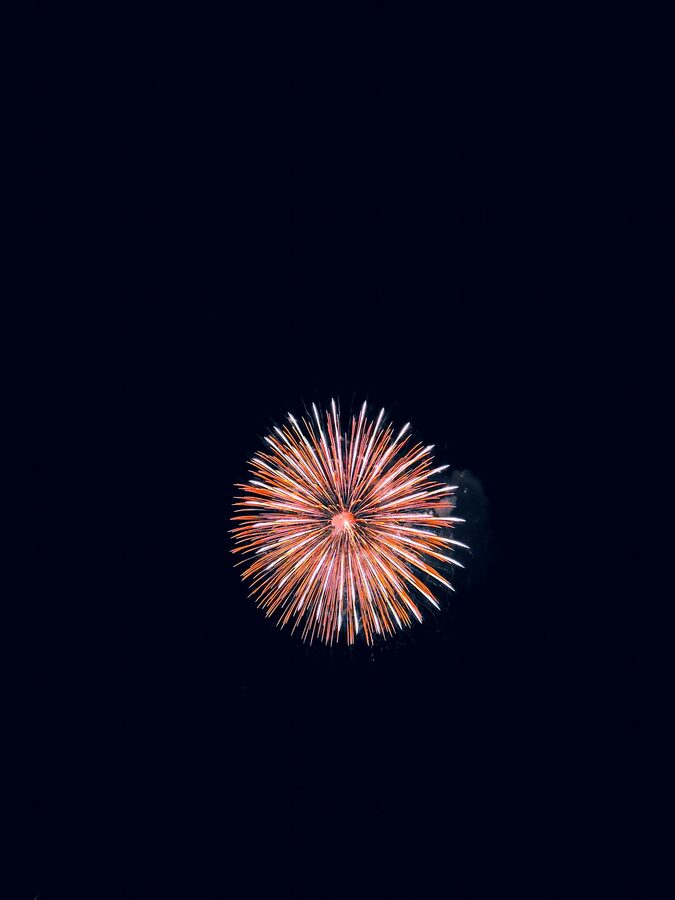
The Katsushika Noryo Hanabi Taikai is the one Tokyo fireworks festival where, before the first shell goes up, you can walk to a baseball stadium along a 200-year-old temple approach, catch a wooden rowboat across the river that Tora-san used to board in film after film, and then sit on the Edogawa riverbank for a display that’s been running, in one form or another, since 1953. It’s also — for 2026 only — the 60th-anniversary edition, with roughly 20,000 shells instead of the usual 13,000, a drone show, and a Tuesday-evening schedule that feels almost wrong for a fireworks festival of this scale.
A quick note on geography, because this confused me the first time I tried to research it. The Katsushika fireworks happen on the Edogawa (Edo River), but so does the bigger Edogawa-ku Fireworks Festival in early August. They are two different events on the same river — Edogawa-ku’s is downstream near Shinozaki, Katsushika’s is upstream at Shibamata. If someone tells you the “Edogawa fireworks” in late July, they almost certainly mean Katsushika Noryo. Same river, different night, different ward.
In This Article
- The 60th-anniversary year
- A bit of history (and why it’s called “Noryo”)
- Where it actually is
- Getting there
- Where to watch (free vs paid)
- The Shibamata day-walk — this is the killer pairing
- The Tora-san connection
- What to bring
- Timing your day
- Weather and cancellation
- Yamamoto-tei and a quieter alternative
- The yukata question
- Katsushika or Sumida River or Adachi?
- Quick facts for 2026
- How I’d do Katsushika if it’s my first Tokyo hanabi
The 60th-anniversary year
So here’s the short version for 2026. The 60th Katsushika Noryo Fireworks Festival is on Tuesday 28 July 2026, from 19:20 to 20:30, launched from the Edogawa riverbank next to Shibamata Baseball Stadium. The city has confirmed the date, the 70-minute runtime, and the fact that this year’s shell count is roughly 20,000 — up from the usual 13,000 — to mark the milestone edition. There’s also a drone show, which is new.
I’m writing this in April 2026 and the official city page was updated on 1 April with the full plan. Sponsorship fundraising opened in late April; paid seats go on sale in two waves from early to mid June through CN Playguide and the 7-Eleven and Family Mart ticketing kiosks. So if you’re reading this before June and you want a paid seat, you’ve still got time.
The one unusual thing about Katsushika, and probably the thing worth knowing before you decide to go, is the day of the week. Most Tokyo fireworks festivals — Sumidagawa, Adachi, Edogawa-ku — are held on a Saturday. Katsushika Noryo is almost always on a Tuesday. Always has been. It’s a proper weekday evening event. The upside is that the crowd, while still enormous at around 700,000 people for recent editions, tends to skew local rather than tourist-heavy, and the trains aren’t dealing with Saturday-matsuri chaos. The downside is you lose a working Tuesday in Tokyo. I’d still make the trade. It’s one of the most atmospheric evenings you can have in the city.
A bit of history (and why it’s called “Noryo”)
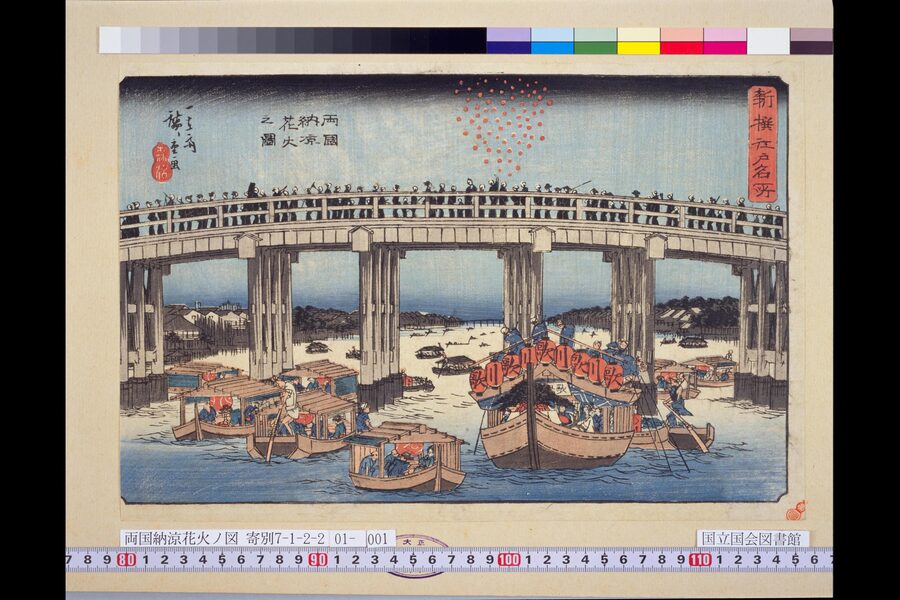
Noryo (納涼) literally means “enjoying the cool” — it’s the old summer-evening concept of taking in the night breeze off a river to escape the humid heat of a Tokyo August. Every old Tokyo riverfront neighbourhood had some form of it, and most of the city’s historic fireworks festivals grew out of noryo gatherings. The Ryogoku Bridge noryo fireworks, which Hokusai drew in 1780, are the most famous; the tradition is that old.
The Katsushika festival itself started in 1953 — quite young by Tokyo standards — when the ward tourism association began running a “Shibamata Hanabi” on the Edogawa riverbank. In 1980, from the 14th edition, Katsushika ward took over joint organisation and it grew into the regional event it is now. The cumulative number 60 (for 2026) tracks continuously from 1953, with a few interruptions for flood damage, reconstruction and the pandemic pause, which is why I keep having to double-check edition numbers against years.
What makes the festival stand out on the Tokyo hanabi map — and this is Japanese Wikipedia’s own summary, quoted on half the event pages — is that the observation area is unusually close to the launch site. The shells explode almost directly over your head. You feel the percussion in your chest before you see the colour. That’s a genuinely different experience from the long-sightline festivals where you’re a kilometre back.
Where it actually is
The venue is the Shibamata Baseball Stadium on the Edogawa riverbank, at Katsushika-ku Shibamata 7-17-13. That’s the south-west bank of the Edogawa, directly across the river from Matsudo City in Chiba. The shells launch from the grass apron next to the baseball diamond and burst over the river itself, so you get roughly the same view from either bank — but the Katsushika (Tokyo) side is where all the access, food stalls and paid seating are.
One useful thing to know: from the right spot on the levee you can see the Tokyo Skytree in the background. Walker Plus, the Japanese hanabi guide site, notes that there are viewing angles where the Skytree sits frame-right behind the shells. It’s not guaranteed — you need to be far enough south on the Katsushika bank — but for a photography-minded traveller, that’s the trick.
Getting there
Three stations serve the venue, and the choice you make for arrival is different from the choice you make for getting out.
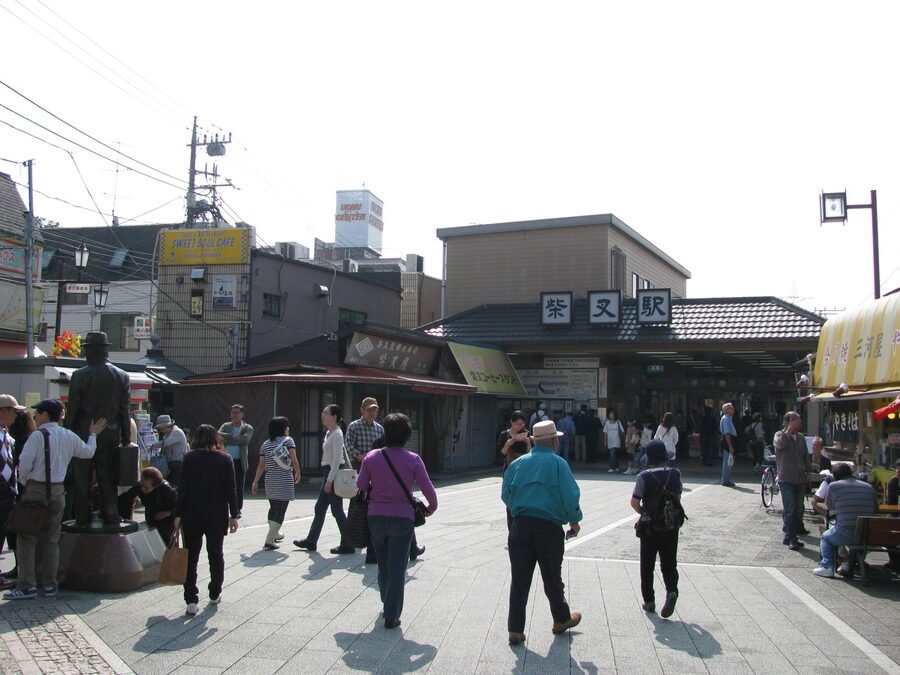
Keisei Kanamachi Line — Shibamata Station. 10 minutes on foot to the venue, through the Taishakuten approach street. This is the station every guidebook and official page names first, and the one most people use. The catch: Shibamata Station is small — one platform, one exit, one ticket gate — and after 700,000 people watch a fireworks display, it becomes the tightest bottleneck on the network. Arriving through Shibamata is lovely. Leaving through Shibamata is not.
JR Joban Line / Keisei Kanamachi Line — Kanamachi Station. About 20 minutes on foot. This is the bigger station, with JR service that connects you straight back into the central Tokyo rail network (Ueno, Nippori, Tokyo Station). If you want the smoothest exit after the finale, walk the 20 minutes to Kanamachi rather than fighting the Shibamata crush.
Hokuso Line — Shin-Shibamata Station. About 15 minutes on foot. This is the official alt-route recommendation from Katsushika ward itself — their tourism page explicitly says “Shin-Shibamata is comparatively uncrowded.” The downside is that the Hokuso line is one of the most expensive per-kilometre train lines in Japan, and it doesn’t go through central Tokyo directly. If you’re staying in Asakusa or Ueno, it’s not your obvious route. But if you’re only focused on the return journey and want to avoid the bottleneck, it’s worth the fare.
The trick I’d suggest: arrive via Keisei Shibamata (it’s the photogenic option, you walk the sando, you get the full atmosphere), and leave via Kanamachi or Shin-Shibamata (the walk is longer but the station queue is far shorter). You’ll need to think about this mid-evening, not on arrival, because the walk to Kanamachi doubles back slightly.
Where to watch (free vs paid)
The free riverbank is the default. The Edogawa levee at Shibamata is a long flat stretch of grass with a paved walkway down the middle; you find a patch, put down a vinyl leisure sheet, and settle in. The closer you are to the launch site (directly in front of the baseball stadium), the more overhead the shells go. The further you walk north or south along the bank, the quieter the crowd and the more laterally you’re viewing — worse for immersion, better if you’ve got a restless toddler.
Paid seating is real, and for this festival I think it’s more worth it than at most Tokyo hanabi. The venue is compact enough that “paid” and “free” both mean “close to the shells” — but the paid blocks are right on the launch-site levee slope, with assigned blue-tarpaulin mats. Tickets sold through CN Playguide at 2025 prices (and 2026 should be in the same band) ran as follows:
- SS seat (directly in front of launch) — 2-person mat ¥16,000; 4-person mat ¥30,000
- S1 / S2 / S3 seats (slightly angled) — 2-person ¥14,000; 4-person ¥26,000
- A seat (angled right) — 2-person ¥12,000; 4-person ¥22,000
- B seat (further right, with dedicated toilets) — 2-person ¥11,000; 4-person ¥20,000
- Flat ground seat (side-on view) — 2-person ¥10,000; 4-person ¥18,000; 6-person ¥27,000
- Pipe chair (single seat on flat ground) — ¥5,000
The pipe chair at ¥5,000 is the best paid-ticket value in Tokyo hanabi, honestly. You get a guaranteed seat, you don’t need a companion to split the mat cost, and you’re still inside the venue. For a solo traveller on a mid-range budget, that’s the one.
Ticket sales open in two tranches: a ward-resident priority lottery in early June, then public sale in mid-June. All purchases are via the CN Playguide site, or via the in-store kiosk terminals at any 7-Eleven or Family Mart in Japan — which is how most Japanese people actually buy them. If your trip dates line up with early to mid June, you could technically walk into a conbini in Shinjuku and buy a ticket off the machine. I love that about Japan.
The Shibamata day-walk — this is the killer pairing
Here’s where Katsushika gets really good. Shibamata is not a fireworks-only neighbourhood. It’s one of the most distinctive shitamachi (old-Tokyo) districts left in the city, and Japan’s Ministry of Environment has designated the soundscape around Taishakuten as one of the 100 Soundscapes of Japan. In 2018 the whole Shibamata area became Tokyo’s only nationally-designated Important Cultural Landscape. It’s a genuinely protected, genuinely lived-in old-Tokyo neighbourhood, and on the afternoon before the fireworks you can walk almost all of it.
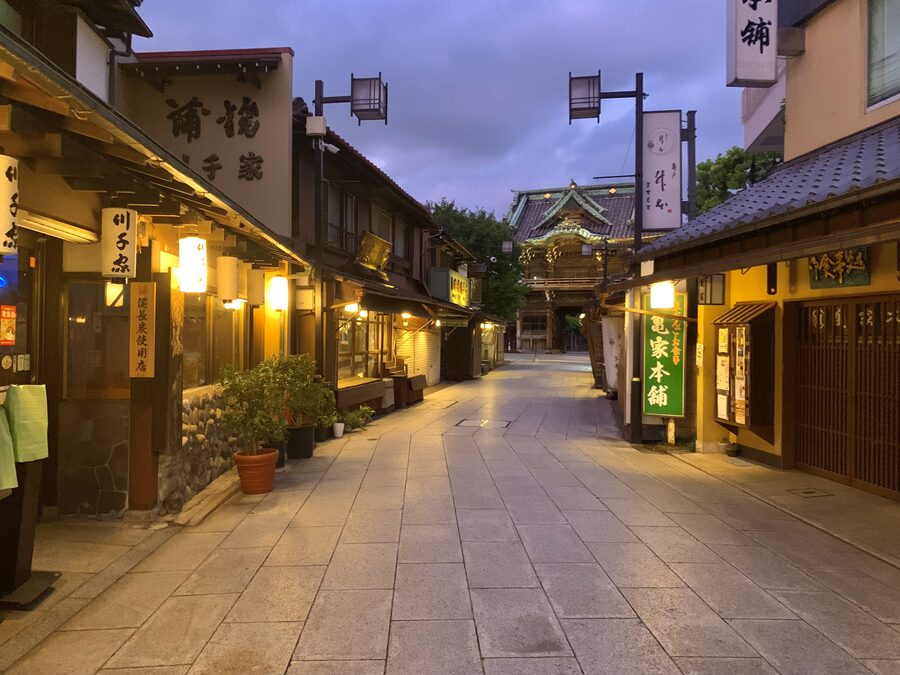
Here’s the walking route I’d recommend, starting from Shibamata Station:
- Shibamata Station exit — there’s a Tora-san statue right outside on the station square, one of several Tora-san landmarks around here. It’s small, slightly weather-worn, and everyone takes a photo with it.
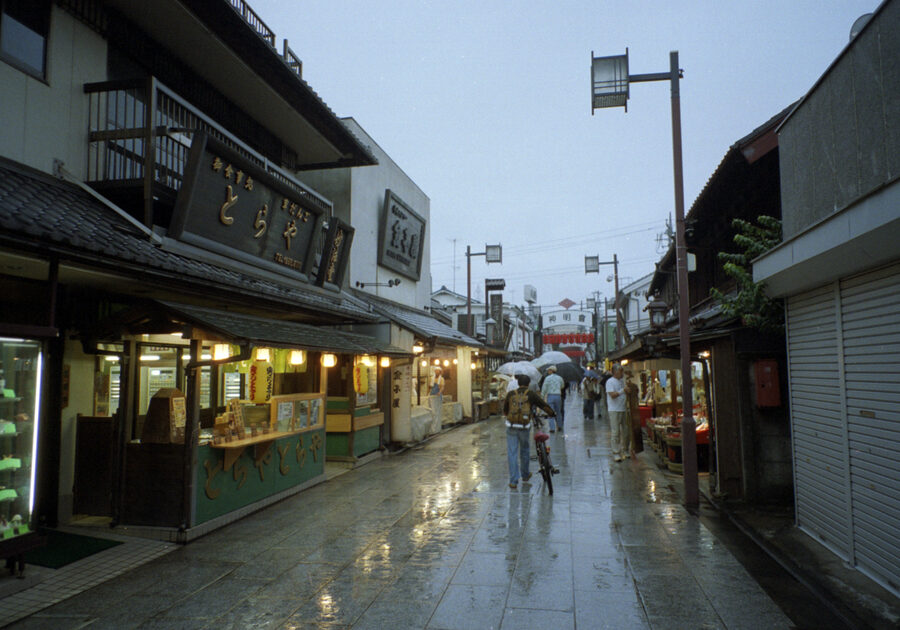
- Taishakuten-sando (the approach street) — about 200 metres of old wooden shopfronts, each one selling something specific: grilled kusa-dango (mugwort rice balls), shio-senbei (salt-grilled rice crackers), unagi from shops that have been there since the 1790s, and soft-serve ice cream to hand to children. Graze as you go. Don’t fill up.
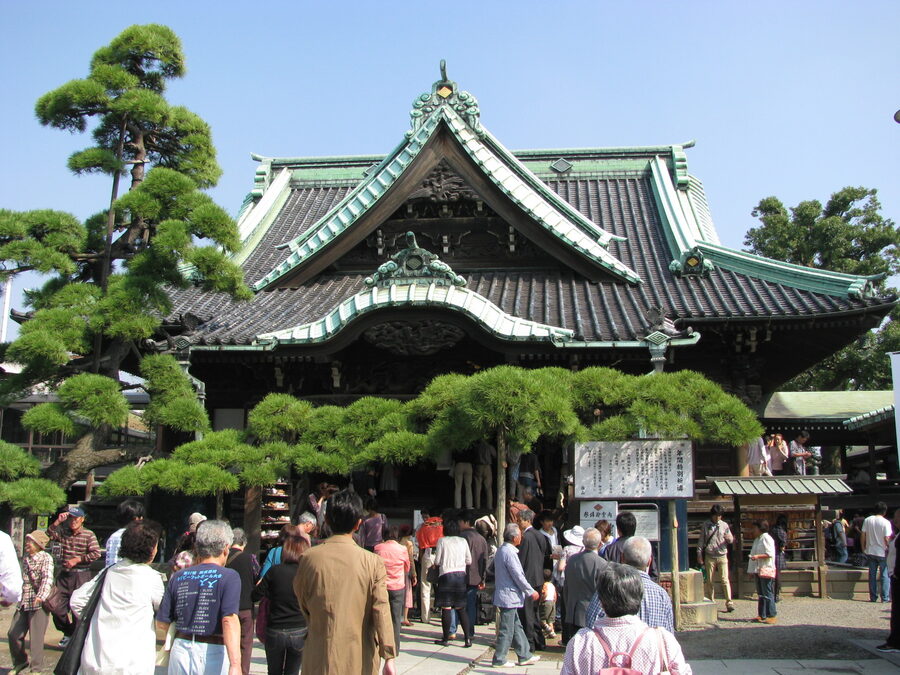
- Shibamata Taishakuten (Daikyō-ji) — the Nichiren-sect temple at the end of the sando. Founded 1629. The main Teishakudō hall has astonishingly dense carved panels on its outer walls — ten relief panels depicting scenes from the Lotus Sutra, carved by ten different master woodcarvers between 1922 and 1934. Entry to the temple itself is free; the “carving gallery” and the Suikei-en garden at the back are ¥400.
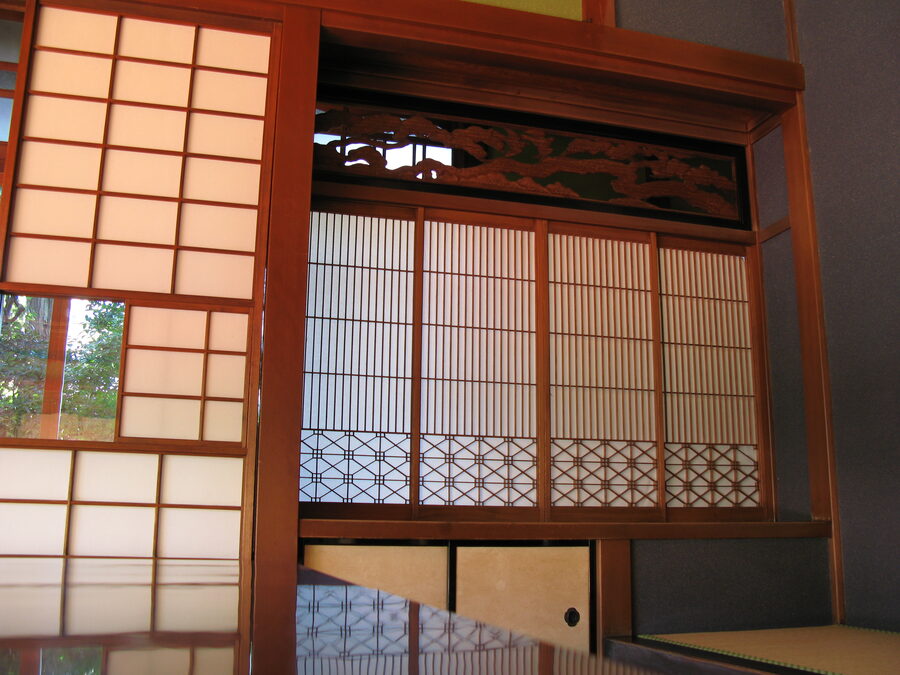
- Yamamoto-tei — about four minutes further on. A Taisho-era Japanese residence converted into a tea house. Entry is ¥100; you can sit on tatami, drink matcha, and look out at a small traditional garden that’s been ranked in Japanese garden magazines as one of the best in eastern Japan. Small, quiet, undervisited.
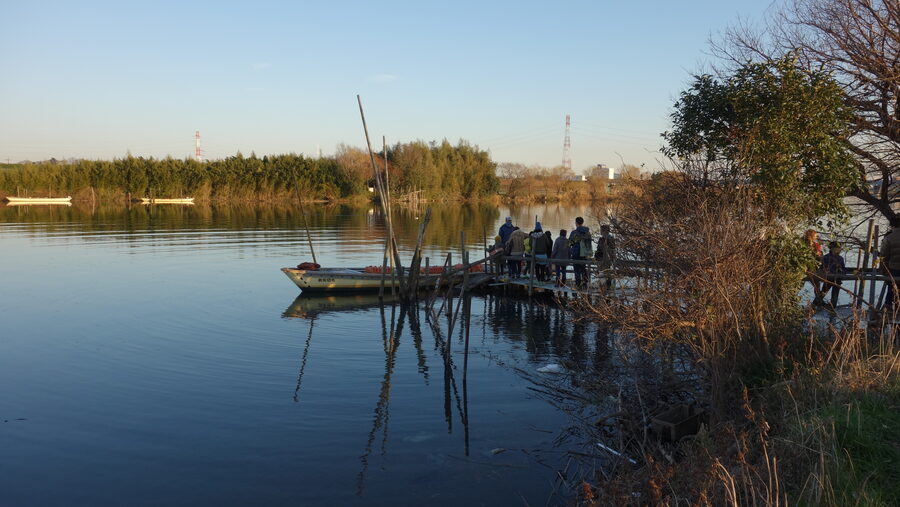
- Yagiri-no-Watashi — walk down to the river. There’s a wooden rowboat ferry that crosses the Edogawa to the Matsudo side in Chiba. It’s been running in some form since the early Edo period — it’s one of only 15 ferries the Tokugawa shogunate originally licensed on the Tone River system, and the Sugiura family has operated this one since early Meiji. A one-way crossing takes about five minutes and costs ¥300 for adults, ¥100 for children. Round-trip in the late afternoon before the fireworks is deeply romantic.
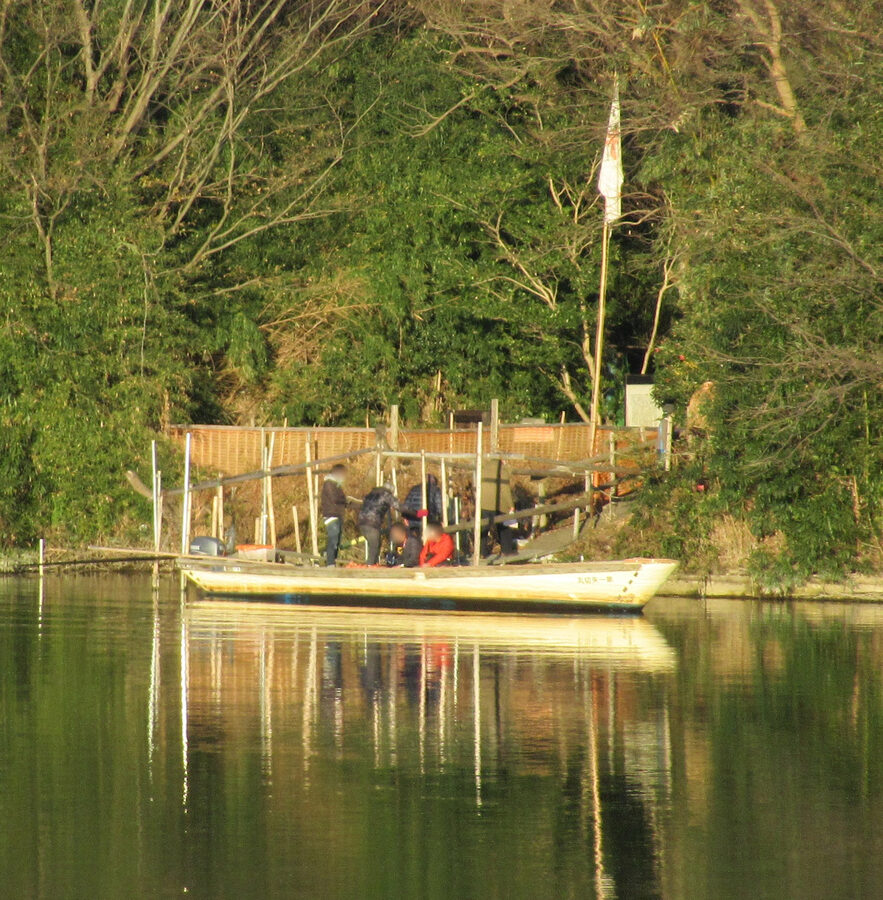
About the ferry timing on fireworks day: it runs 10:00–16:00 in normal season, so aim to do the round-trip between 14:00 and 15:30. After 16:00 you’ve missed it and you’ll be among the millions hurrying toward the riverbank. The ferry closes in bad weather even when the boats on the Sumida are still running — it’s a genuinely old-fashioned operation.
The Tora-san connection
If you’ve never heard of Otoko wa Tsurai yo (“It’s Tough Being a Man”), the short version: it’s a Japanese film series of 50 films made between 1969 and 1995 (with two posthumous films), directed by Yamada Yoji, starring Atsumi Kiyoshi as Kuruma Torajiro — “Tora-san” — a wandering travelling salesman who always comes home to his sister’s dango shop on the Shibamata-sando. It’s the longest film series in the world by a single lead actor. Tora-san is Shibamata and Shibamata is Tora-san.
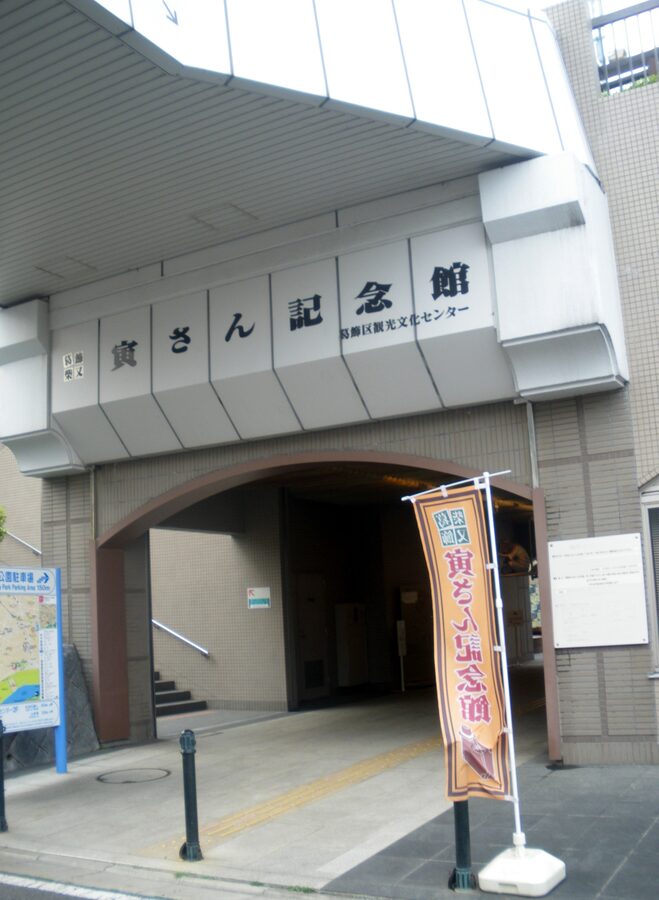
You don’t need to have seen any of the films to enjoy Shibamata, but half the visitors who come here are older Japanese people with a specific relationship to Tora-san — it was the family film series of Showa-era Tokyo, roughly the cultural weight of the James Bond series in Britain. You’ll see older couples standing at the Yamada Yoji museum looking quietly emotional, and it’s charming.
What to bring
- Vinyl leisure sheet (rejaa shiito) — any conbini on the way from Shibamata station sells them for about ¥500. Get a 1.8 × 1.8 m one. Don’t sit on bare grass — the Edogawa levee holds dew even on hot evenings.
- Cold drinks from a conbini before Shibamata. The Family Mart and Lawson nearest Shibamata Station run out of cold drinks by 17:00. The ones near Kanamachi station, slightly further off, stay stocked much longer.
- Hand fan (uchiwa) or a cooling towel. Late July in Tokyo is brutal. The riverbank is exposed. The breeze helps but doesn’t fix it.
- Portable phone battery. Phones die fast trying to photograph fireworks, and you’ll want your phone working for the walk back.
- Cash. The food stalls along the sando and on the levee mostly want cash. A few thousand yen in small notes covers a full dinner from skewers and beer cans.
- A small bin bag. There are no public bins at the festival. You take your rubbish home. This is Japan.
- Light long sleeves, optional, for after sunset. Late July evenings are still warm, but the Edogawa breeze picks up after dark.
Timing your day
This is the sequence I’d run for the 2026 festival.
- 13:30 — leave central Tokyo on the Keisei main line from Keisei-Ueno. Change at Keisei-Takasago for the Kanamachi line to Shibamata, using your Suica or Pasmo. Arrive Shibamata around 14:15.
- 14:15 — Tora-san statue photo at the station. Walk the sando slowly. Buy a bag of shio-senbei and a kusa-dango on the way to Taishakuten.
- 14:45 — Taishakuten temple and the carving gallery. Budget 45 minutes. The carving gallery alone is worth the ¥400 — the relief panels are genuinely astonishing up close.
- 15:30 — walk down to the river and do the Yagiri-no-Watashi round trip. One-way five minutes, you’ll need about 25 minutes total including the wait.
- 16:00 — Yamamoto-tei stop for matcha. 30 minutes on tatami looking at the garden.
- 16:45 — back up to a conbini for leisure sheet and drinks. Head to the riverbank.
- 17:00 — claim your spot on the free levee. Put down the sheet. The good spots go fast — if you’re flexible, walk 10 minutes north or south of the launch site for more space.
- 18:30 — local food stall pilgrimage. Yakisoba, takoyaki, grilled corn, ikayaki (grilled squid on a stick). Local cans of beer or chūhai.
- 19:20 — first shell. Seventy minutes of fireworks. The 60th-anniversary drone show fits somewhere in the programme; the city hasn’t released the exact slot yet.
- 20:30 — finale. Don’t rush.
- 20:45 — start walking. Head north to Kanamachi or east to Shin-Shibamata rather than Shibamata Station. Allow 40 minutes for the walk. You’ll be on a train by 21:30.
Weather and cancellation
The official policy is “cancelled in adverse weather, no rescheduling.” Light rain during the event is usually fine. Heavy rain, lightning, or strong wind cancels it outright; refunds for paid seats are processed if the cancellation is announced before the display starts. If cancellation is called after the fireworks have begun, no refunds. Check the official Katsushika city page and the official X account (@katsuhanabi) from 14:00 on the day.
Yamamoto-tei and a quieter alternative
If the levee crowd doesn’t appeal — and 700,000 people is a lot of crowd — Yamamoto-tei itself sometimes operates extended hours on fireworks night. The garden view from the tatami room doesn’t face the launch site directly, but you can see part of the display from the veranda and, more to the point, you’re sitting on a tatami mat with a matcha in your hand rather than on dewy grass. It’s not the “experience” most guides recommend, but as a first Tokyo hanabi for a traveller who hates big-crowd events, it’s a clever alternative.
Or there’s the Chiba side — take the Yagiri-no-Watashi across to Matsudo in the afternoon, walk a kilometre or two on the Matsudo bank, find a grassy spot, and watch from the Chiba side of the river. The view’s essentially the same and you’ll share the bank with maybe five percent of the crowd. The catch: you need to be back across before the ferry closes at 16:00, or walk a long way south to a road bridge. I’d try this on a second visit, not a first.
The yukata question
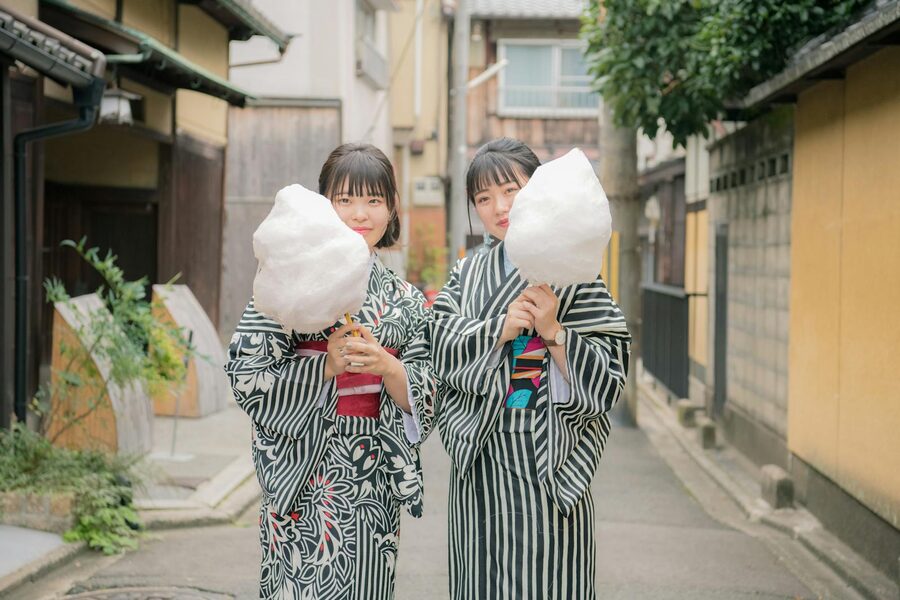
Do you need to wear a yukata? No. Most Japanese attendees under 30 wear them, most over 50 don’t. Tourists wearing yukata are genuinely welcome — the festival encourages it, there are photo spots set up at the sando — but jeans and a t-shirt are completely fine. I’ve done Katsushika in normal clothes several times and nobody looks twice.
If you do want to try one, the Shibamata-sando has two or three rental shops that do a same-day yukata hire for around ¥4,000 including basic kitsuke (dressing), starting from about 11:00 on the day. Book ahead on fireworks afternoon because they sell out.
Katsushika or Sumida River or Adachi?
People sometimes ask which Tokyo fireworks to pick if they only have one evening. Quick honest take:
Sumida River (late July Saturday) is the big-name, Skytree-in-the-background bucket-list festival. A million-plus people, 20,000 shells in 90 minutes. You come for the postcard shot.
Adachi (Saturday, moved to late May for 2026) is the concentrated one — 60 minutes, 13,000 shells, the densest shells-per-minute display of the major Tokyo festivals, on the wide Arakawa levee.
Katsushika (Tuesday 28 July 2026) is the neighbourhood one — 70 minutes, 20,000 shells for the 60th anniversary, 700,000 people, the overhead-launch immersive feel, and the fact that the daytime pairing with the Shibamata sando is one of the best half-day walks in Tokyo. For a first-time visitor who wants atmosphere plus a proper old-Tokyo neighbourhood experience, I’d take Katsushika over Sumida.
Quick facts for 2026
- Date: Tuesday 28 July 2026 (60th edition)
- Time: 19:20–20:30 (70 minutes)
- Shells: approximately 20,000 (up from ~13,000; special 60th-anniversary count)
- Drone show: included for the first time, anniversary special
- Venue: Shibamata Baseball Stadium, Edogawa riverbank, Katsushika 7-17-13
- Attendance: approximately 700,000 (2025 figure)
- Cost: free riverbank viewing; paid seats ¥5,000 (pipe chair) to ¥30,000 (SS 4-person mat)
- Nearest stations: Keisei Shibamata (10 min walk), Hokuso Shin-Shibamata (15 min walk, quieter), JR/Keisei Kanamachi (20 min walk, best for return)
- Rain policy: cancelled in adverse weather, no rescheduling
- Japanese name: 葛飾納涼花火大会 (Katsushika Noryo Hanabi Taikai)
- Organiser: Katsushika Noryo Hanabi Executive Committee (Katsushika ward + tourism association)
How I’d do Katsushika if it’s my first Tokyo hanabi
- Start in Keisei-Ueno. If you’re coming off the Narita route on the Keisei Skyliner, you can literally land, drop bags in Ueno, and be at Shibamata by 15:00.
- Do the sando and Taishakuten before the heat peaks. Buy kusa-dango and shio-senbei on the way.
- Cross the Yagiri ferry and back. This is the cinematic moment.
- Matcha at Yamamoto-tei to cool down.
- Conbini run, riverbank by 17:00, sheet down, dinner from stalls.
- Fireworks 19:20–20:30.
- Walk 30-40 minutes out to Kanamachi or Shin-Shibamata for the return. Central Tokyo by 21:30.
If you want to stretch the trip, Kita-Senju and the Arakawa riverfront of Adachi are two stops west on the JR Joban line, and worth a second visit later. Or head south from Kanamachi back towards Asakusa — the same river runs past Shibamata as past Senso-ji, roughly, though the neighbourhoods couldn’t feel more different.
Katsushika is the fireworks festival that rewards arriving early and walking slowly. The hour of shells at the end is wonderful, but it’s the afternoon — the sando, the temple, the dango, the ferry, the tatami room at Yamamoto-tei — that makes the evening feel earned rather than endured. Give yourself the full day. You won’t regret the Tuesday off work.