
Do not itinerary Yanaka. Do not show up with a list of temples to tick off. Do not try to “do” Yanaka between Ueno at 10am and Asakusa at 2pm, because that’s how you miss the whole point. The way to visit Yanaka is to walk out of the west side of Nippori Station, descend a set of sunset stairs, and then get slightly lost for two hours. Bring comfortable shoes and the patience to let a cat stare at you from a wall for longer than is strictly necessary.
.jpg)
In This Article
- Why Yanaka feels like nowhere else in Tokyo
- The walk from Nippori Station
- Yanaka Ginza — the 170-metre shopping street
- Yanaka Cemetery and the last shogun
- Tennoji Temple and the Edo-era Buddha
- The cats, honestly
- Nezu Shrine and the azalea hill
- SCAI the Bathhouse
- Asakura Museum of Sculpture
- What to eat, in more detail
- Cherry blossom in Yanaka
- Access and timing
- Practical info
- Honest opinions on Yanaka
- Where to stay nearby
- Pairing Yanaka with other districts
- External resources
- My half-day Yanaka walk
Why Yanaka feels like nowhere else in Tokyo
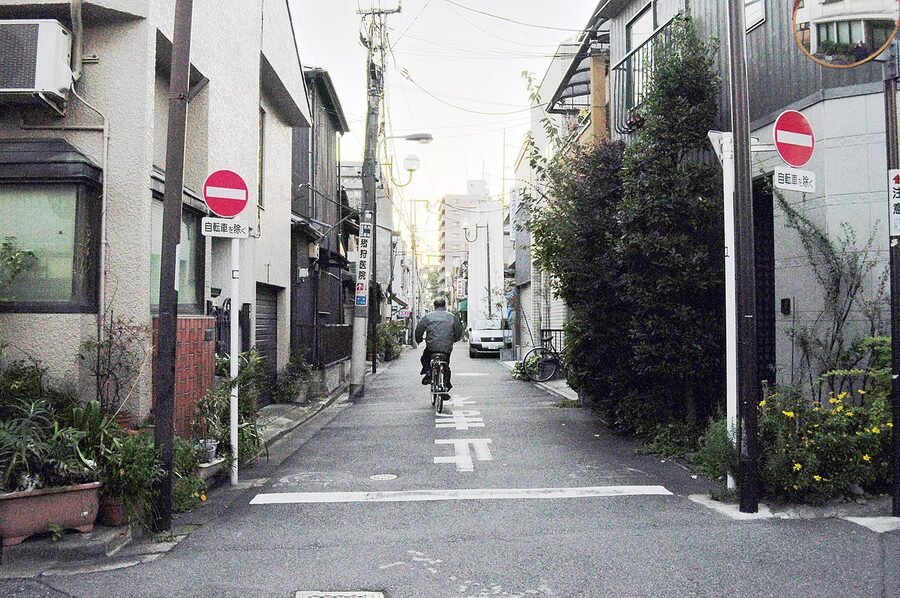
Most of central Tokyo was flattened twice in the 20th century. The Great Kanto Earthquake of 1923 took out huge swathes of the low city, and the 1945 firebombing finished most of what remained. Yanaka got missed by both. It also mostly got missed by the postwar redevelopment that turned the rest of Tokyo into tower blocks. That’s why the streets here still look how they did in the Meiji and Taisho eras — wooden shopfronts, tin roofs, narrow alleys, wires slung in a tangle overhead. It is not a reconstruction. It is just the bit that didn’t get knocked down.
The neighbourhood sits in Taito ward, tucked north of Ueno Park, centred around Nippori and Nishi-Nippori stations. If you like the preserved-wooden-town feel of parts of Kyoto or Kanazawa, Yanaka gives you a similar experience without the three-hour train ride. You should know going in that it isn’t a picture-perfect theme-park version of old Tokyo — there are 100-yen shops, beige apartment blocks, and a convenience store or two. That’s part of why it feels alive rather than staged. People still live here. Artisans still work here. Cats still live on the cemetery wall.

The term you’ll sometimes see is Yanesen, which is Yanaka plus the two neighbouring districts of Nezu and Sendagi treated as one walking zone. The three blur into each other — the boundaries only really matter to the postmen. If you wander from Yanaka Ginza southwest toward Nezu Shrine, you’ve crossed into Nezu without noticing. Good. That’s the whole idea.
The walk from Nippori Station
Yanaka works because you walk it. If you take a taxi in, you ruin it. Start at Nippori Station on the JR Yamanote Line — the north exit (technically the west exit from the north ticket gate). Within two minutes of leaving the station, you’re at the top of Yuyake Dandan, which translates as “sunset stairs” and is the single most photographed spot in the neighbourhood. It’s a steep-ish flight of steps with red handrails that drops down into the start of Yanaka Ginza shopping street.
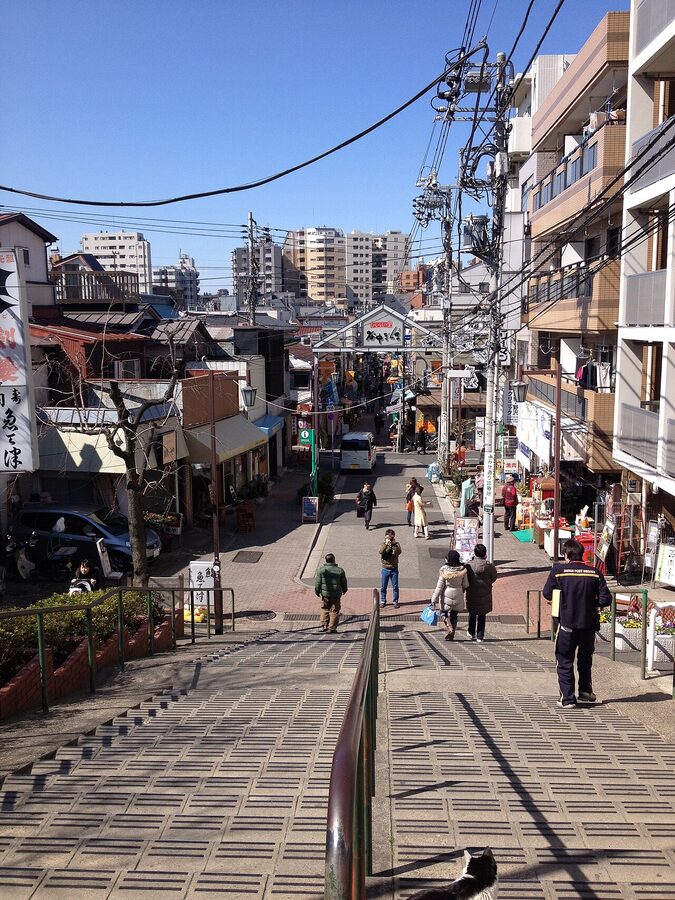

From there, the whole of central Yanaka is walkable. I usually lay it out like this:
- Start: Nippori Station north/west exit, 5 minutes to Yuyake Dandan.
- Shopping street: descend into Yanaka Ginza, eat and browse, 45 minutes to 1 hour.
- Yomise-dori and side lanes: drift south-west and get lost, 30-45 minutes.
- Asakura Museum of Sculpture (optional): short detour back near the stairs, 45 minutes.
- Yanaka Cemetery: come back via the cemetery’s cherry-lined Sakura-dori, 30-40 minutes.
- Nezu Shrine: walk on south-west to Nezu, 20 minutes each way. Or end here and ride Chiyoda Line from Nezu Station.
Total: three hours if you pace yourself, longer if you get properly stuck in a pottery shop. Five hours if you also do Nezu Shrine and the Asakura Museum properly. You could technically cover all of it in 90 minutes if you treated it as a box to tick, but then I’d ask why you bothered coming.
Yanaka Ginza — the 170-metre shopping street
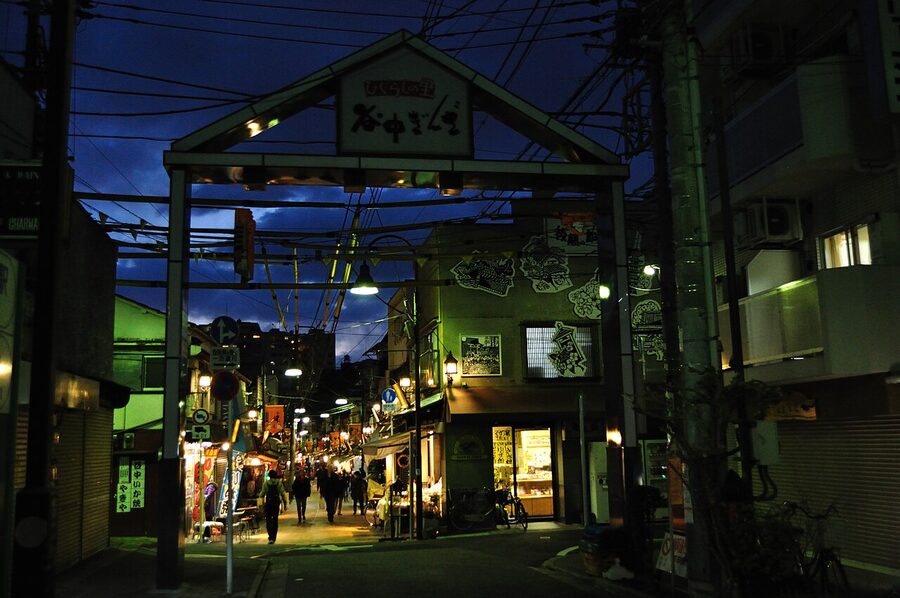

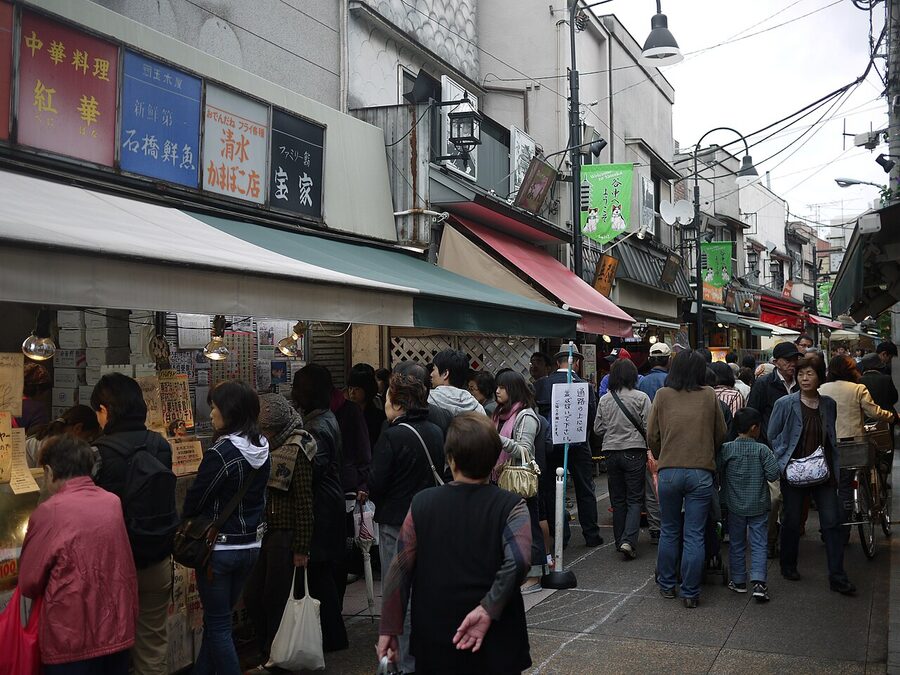
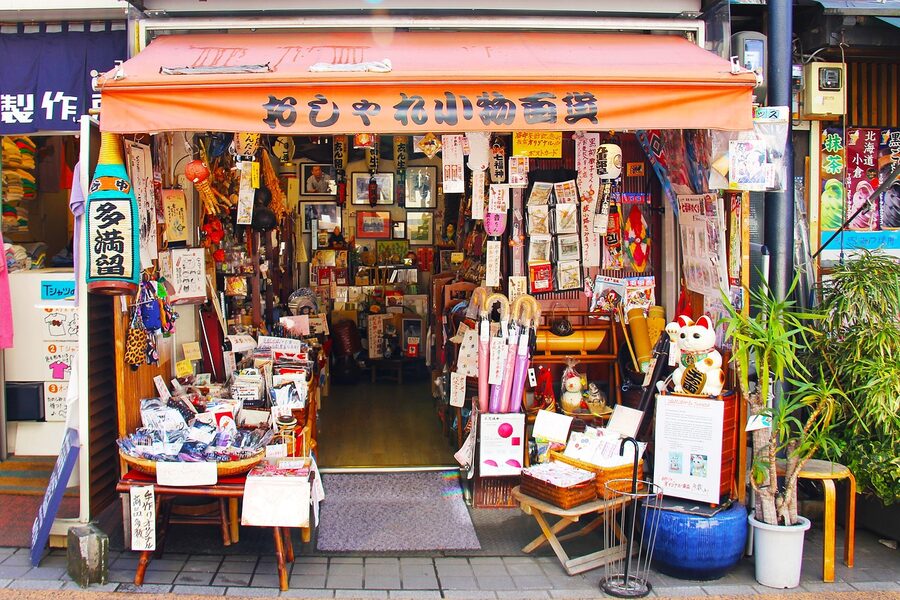
Yanaka Ginza is a 170-metre shotengai (shopping street) with around 60 small independent shops, mostly food stalls and traditional crafts. It’s pedestrianised most afternoons — cars are banned weekdays from 3pm to 8pm — which is when you want to be there. Before 3pm, especially in the morning, the street is still good but a bit quieter and a few stalls haven’t opened yet.
Here is what I would not skip, and a few I would:
- Niku-no-Suzuki: the butcher’s stall selling menchi-katsu (minced beef cutlets, breadcrumbed and deep-fried). Around ¥300 each, eat standing on the street. This is the one thing most people tell you about, and it lives up to it. The queue at 4pm can be ten deep — go earlier or later.
- Habutae Dango: mochi shop operating since 1819 (yes, that’s 200+ years). The dango are simple and slightly chewy, dipped in soy-sweet sauce or red bean paste. This is a short walk off Yanaka Ginza proper, but it’s the oldest thing on the menu in the neighbourhood and worth the detour.
- Yanaka Shippoya: sells cat-tail-shaped sweet pastries in maple, matcha and other flavours. Silly, yes. Photogenic, also yes. The pastry is genuinely decent, not a tourist trap.
- A senbei shop (several options): the rice crackers are freshly grilled, sometimes while you wait. Matcha-coated senbei is the one I always come back for.
- A korokke stall: Japanese croquettes, cheap, hot, crispy. Pick whichever one has the queue.
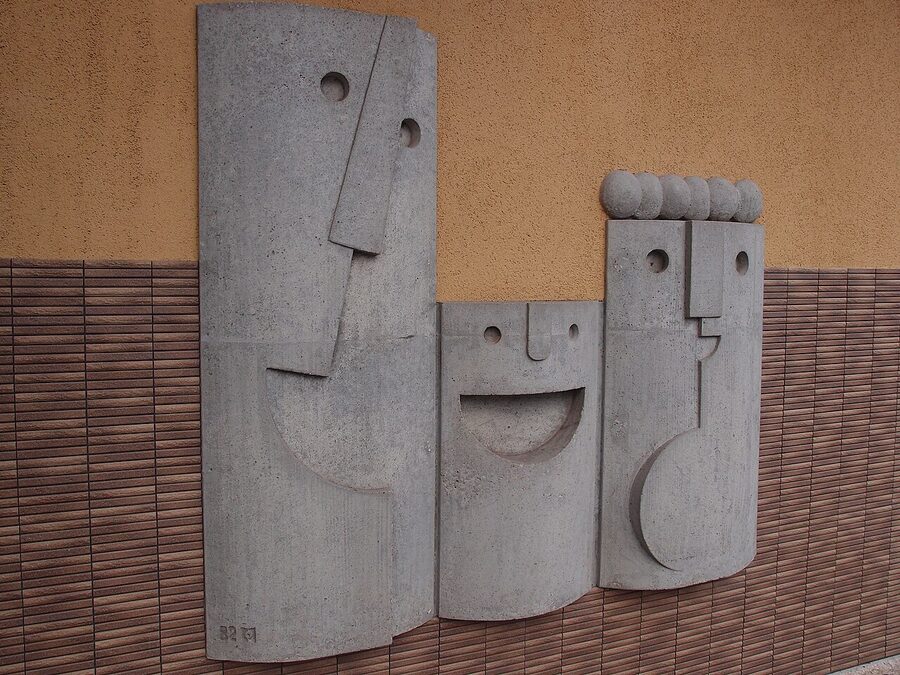
The one piece of advice I’d give is this: don’t come with a “top 10 Yanaka Ginza snacks” list. Every blog has a slightly different one. Just walk the street, buy whatever is steaming and smells good, and eat it while walking. That is more or less how the street is meant to be used. There is a cat-shaped bridge sculpture called Nyannya (two stylised cats touching noses) at the top of the stairs — it’s the street’s mascot, and a very honest souvenir of the visit.
Yanaka Cemetery and the last shogun
This is the part people skip and shouldn’t. Yanaka Cemetery is 10 hectares — about twice the size of the Olympic Park in London — which in Tokyo is a genuinely large amount of open ground. It sits between the station and the main part of the district, so you walk through it either on the way in or the way out. The cemetery’s central road is called Sakura-dori (Cherry Blossom Avenue), and it is lined with cherry trees that are spectacular for about ten days in late March or early April.
.jpg)
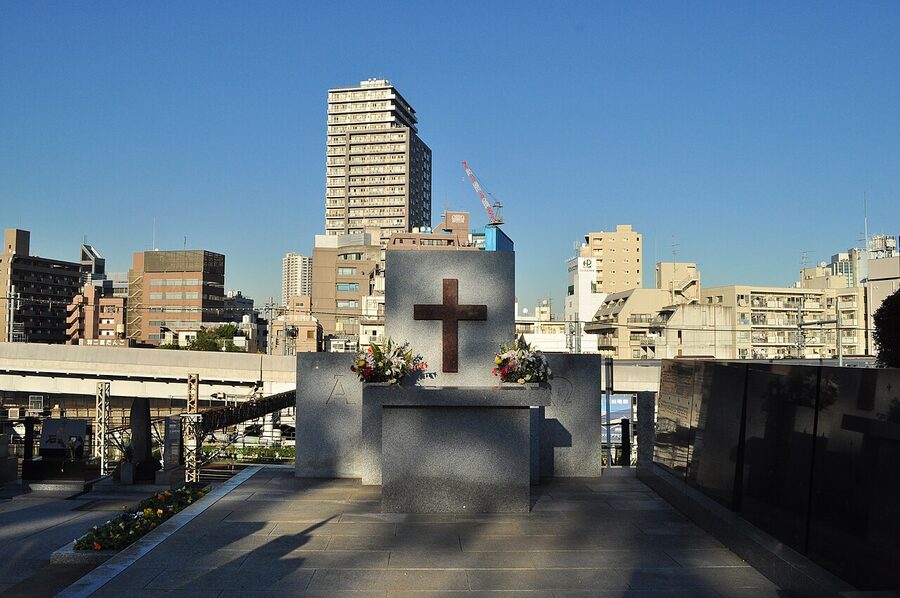
Two graves matter here. One is Tokugawa Yoshinobu — the fifteenth and final shogun of Japan, the man who handed power back to the Meiji Emperor in 1867 and effectively ended 250 years of Tokugawa rule. His grave is inside a walled enclosure off Sakura-dori; you can peer through the iron gate but not enter. The second is the novelist Natsume Soseki, whose face used to be on the ¥1000 note and whose books are still required reading in Japanese schools. His gravestone is a squat square slab near the cemetery office and is easier to find if you ask at the admin building for the English-language map.
.jpg)
A practical note on respect: don’t photograph individual graves with families at them. Don’t pose for selfies leaning on stones. Keep voices low near active visiting. Otherwise, you are fine to walk, sit, and take pictures of the cherry-lined avenue. The cemetery is open 24 hours and free. The administration office has English pamphlets during business hours if you want to know which famous person is buried where.
One small thing I love: Yanaka Cemetery is also one of the places the neighbourhood’s cats sleep during the day. You will see them on the gravestones, in the sun. They know the cemetery is quiet.
Tennoji Temple and the Edo-era Buddha
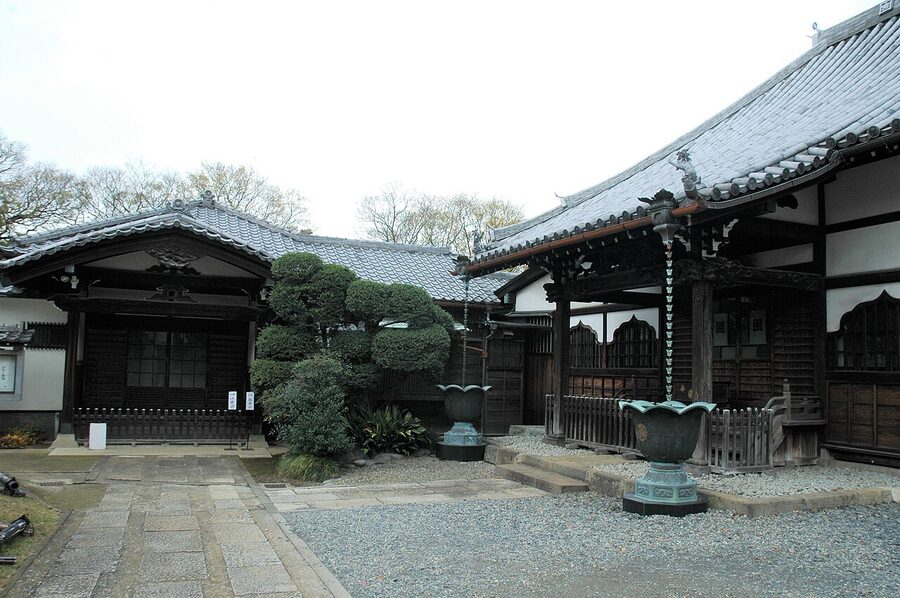

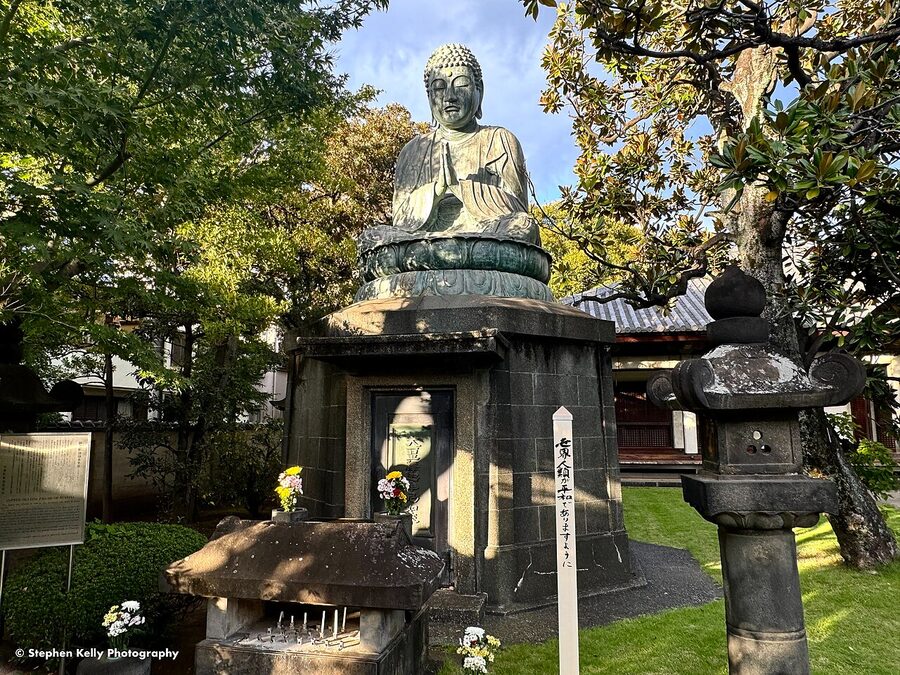
Tennoji Temple sits at the northern edge of Yanaka Cemetery, close to Nippori Station’s south exit. It was founded in 1274, which makes it older than almost anything else you’ll see in central Tokyo. The current buildings are later, because fires, but the temple has continuously occupied this ground since the Kamakura era. Its most photographable feature is a large bronze Buddha statue cast in 1690 and modelled on the Great Buddha at Kamakura. It sits out in the open in the temple precinct and you can walk right up to it.
.jpg)
Tennoji is free to enter. There is no queue. There is often nobody else there. It takes fifteen minutes. It’s the kind of place that, in Kyoto, would have a ¥500 ticket and thirty tourists on a Tuesday morning. In Yanaka you can have it to yourself. Treat that as a gift.
The cats, honestly
People come to Yanaka specifically for cats. I understand it. I’ve done it. But I’ll be straight with you about what you’re going to see.
The live cats are strays — although “strays” understates it. The local community has been deliberately feeding, neutering, and looking after them for decades. There is no formal cat sanctuary; there is just an informal agreement that these cats belong to the neighbourhood collectively. You will see some of them — on walls, in the cemetery, at shop doorways. You will not always see them, particularly if you come on a cold or rainy day, because they are not on a schedule. Some days you see six. Some days you see none.
The sculpted and painted cats, on the other hand, are everywhere — the maneki-neko (beckoning cat) figures in shop windows, the cat-tail pastries at Yanaka Shippoya, the Nyannya mascots on the bridge over Yanaka Ginza, the cat-painted senbei on sticks. That half is guaranteed. If your kid or partner is visiting specifically for cats, explain the difference in advance. Showing up in cold drizzle expecting a cat parade and getting none is an avoidable disappointment.
Nezu Shrine and the azalea hill
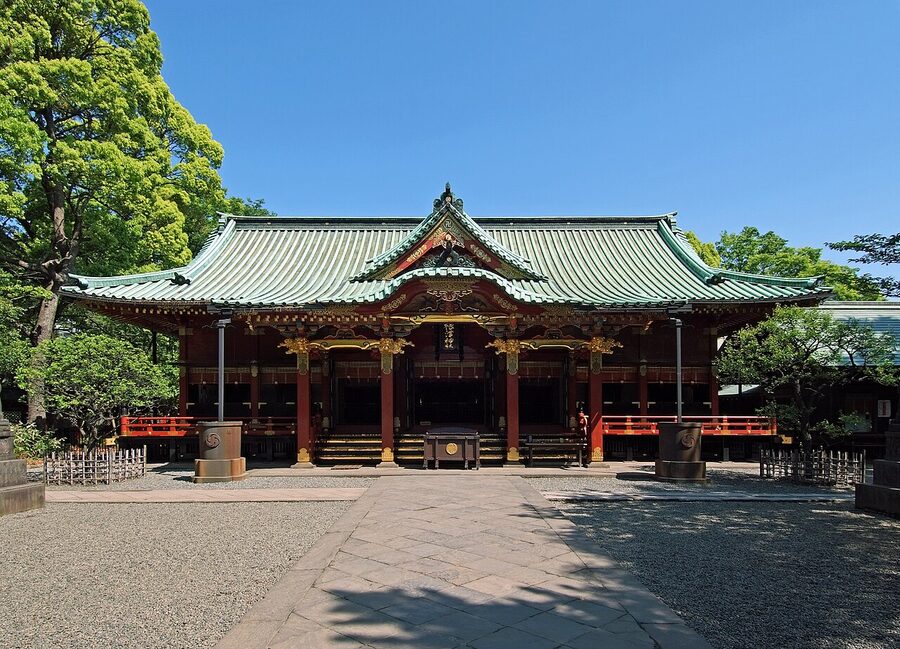

Nezu Shrine technically sits in the neighbouring district of Nezu, about a 20-minute walk southwest of Yanaka Ginza. If you only have half a day, skip it. If you’ve got a full day, do not miss it. This is one of the oldest shrines in Tokyo and one of the most beautiful, and the crowds here are a tenth of what Meiji Shrine or Sensoji get.
Two things to see specifically. First, the tunnel of small red torii that climbs the hillside behind the main shrine. It’s a scaled-down version of the famous Fushimi Inari in Kyoto — maybe 50 metres of torii gates rather than kilometres — and it’s a fraction as crowded. You can walk through it slowly and take a picture without waiting for gaps.
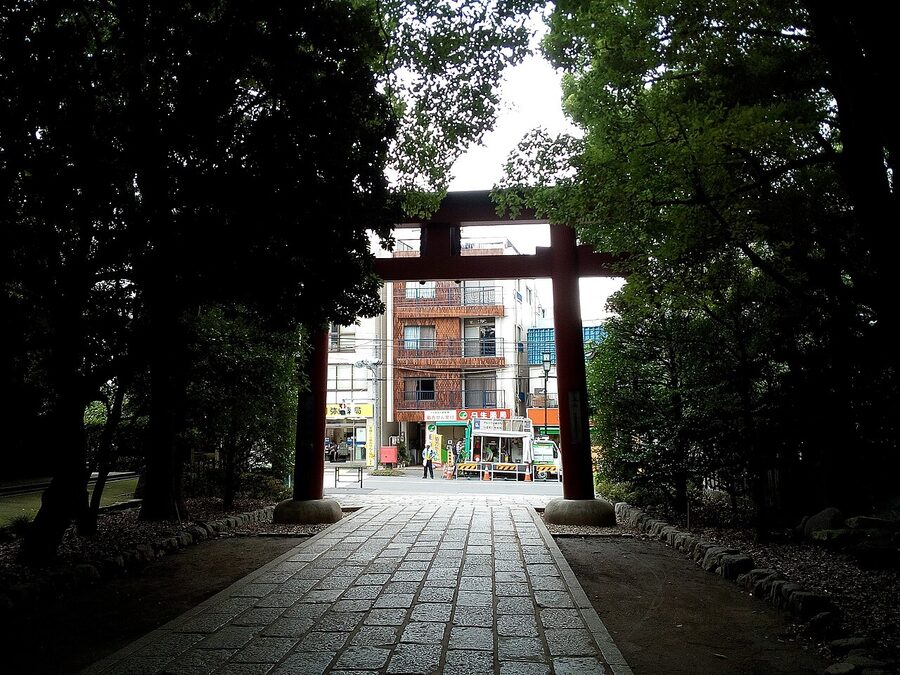

Second, the Tsutsuji Matsuri (azalea festival). The shrine’s back garden holds roughly 3,000 azalea bushes of around 100 varieties, some said to be 300 years old. They flower roughly from mid-April to early May depending on the year. Entry to the garden costs a few hundred yen during the festival. If you visit Tokyo at any time other than that window, the garden is fenced off and the shrine precinct is still lovely but you’ve missed the main event. Check the exact festival dates on the Go Tokyo page before you go.
SCAI the Bathhouse
If you like contemporary art, the one place to know about is SCAI the Bathhouse. It’s a contemporary art gallery housed in a 200-year-old former sento (public bathhouse). The architecture is the draw — tall ceilings, original tilework, lockers still in place — and the exhibitions rotate every couple of months. Entry is usually free; some exhibitions charge a small fee. It’s closed on Sundays and Mondays, which is enough of a gotcha to check before you show up. The gallery is a five-minute walk from Yanaka Ginza, on a quiet side street.
Worth it? If you’re someone who walks into an empty gallery and stays for 45 minutes, yes. If art galleries are not your thing, skip it and keep walking — the appeal here is partly the building, but if you don’t care about installation art, the building on its own isn’t quite enough.
Asakura Museum of Sculpture
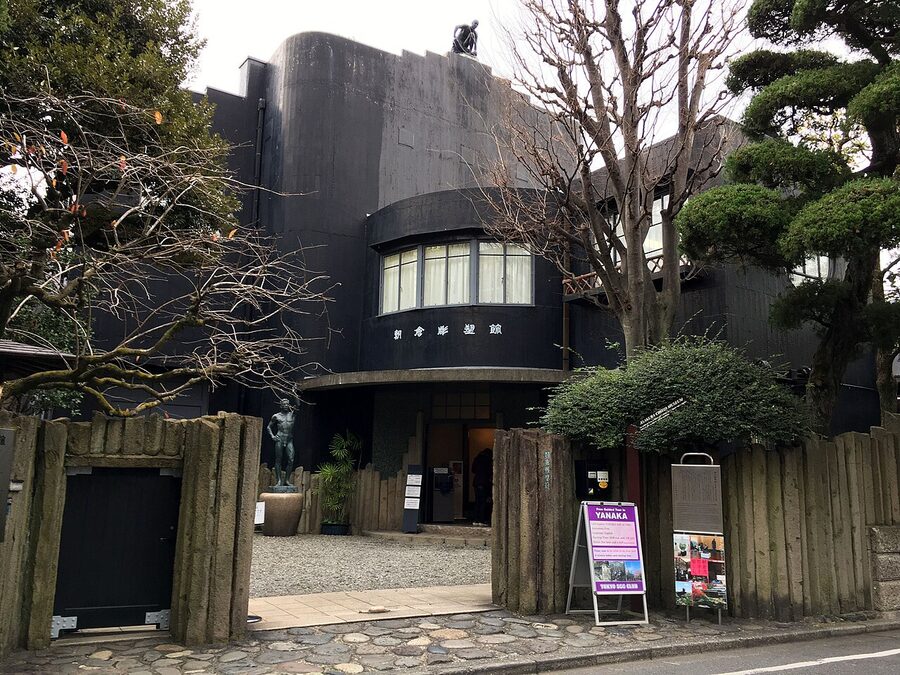
The Asakura Museum of Sculpture is the preserved house-and-studio of Fumio Asakura, a prominent early-20th-century Japanese sculptor who died in 1964. The building is as much the attraction as the art. Asakura designed the house himself — three floors, a central rooftop garden, a traditional Japanese section in the back, and a western-style studio in the front — and nearly every detail is intact. Admission is ¥500; students ¥250. Shoes off on entry (bring socks with no holes). Closed Mondays and Thursdays, last entry 4pm.
The bronze sculptures on display are good but not life-changing unless you’re specifically into early Showa-era sculpture. What is worth the ticket is walking through the actual rooms — the library, the study, the rooftop terrace. You can feel the weight of someone’s working life still in the building. For an hour of rainy-day Yanaka, this is where I’d go.
What to eat, in more detail
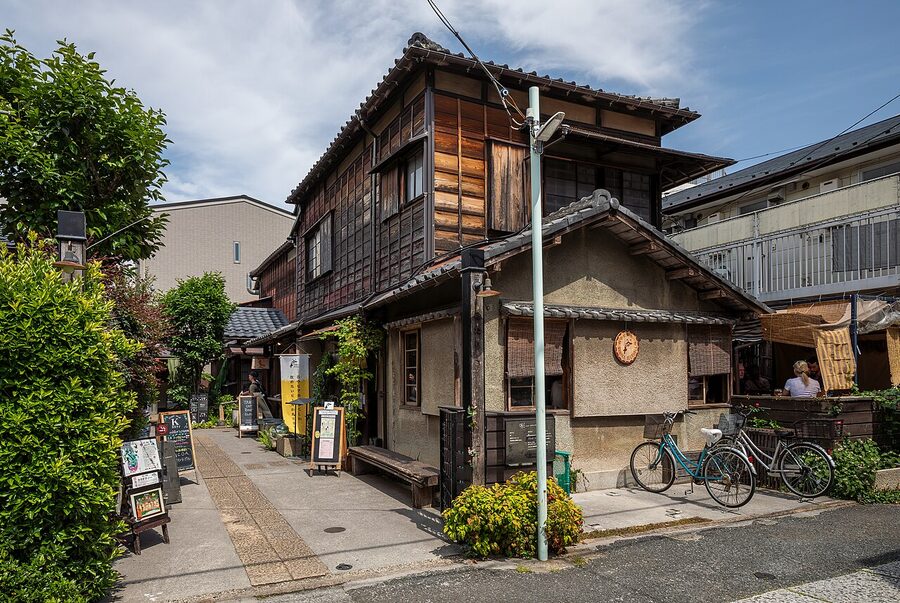

Beyond the shopping street snacks, here are the places worth planning for:
- Yanaka Beer Hall at Ueno Sakuragi Atari: craft beer from a local brewery in a restored 1938 wooden compound that houses a bakery and a salt-and-olive shop too. Good for a 30-minute stop on a warm afternoon. Closed Tuesdays.
- Hagi Café (Hagiso): a genuinely lovely café in a renovated wooden house. Set lunches, breakfast from 8am (rare in Japan), dinner until 9pm. Closed Mondays. Book ahead on weekends.
- Kayaba Coffee: an 80-year-old kissaten (traditional Japanese coffee shop), at the edge of Yanaka. The egg sandwich is famous enough that there’s usually a queue on weekends. Come midweek, not weekend.
- Habutae Dango: mochi shop operating since 1819. Order a mix of the sweet red-bean dango and the soy-sesame ones. They do takeout and in-shop seating.
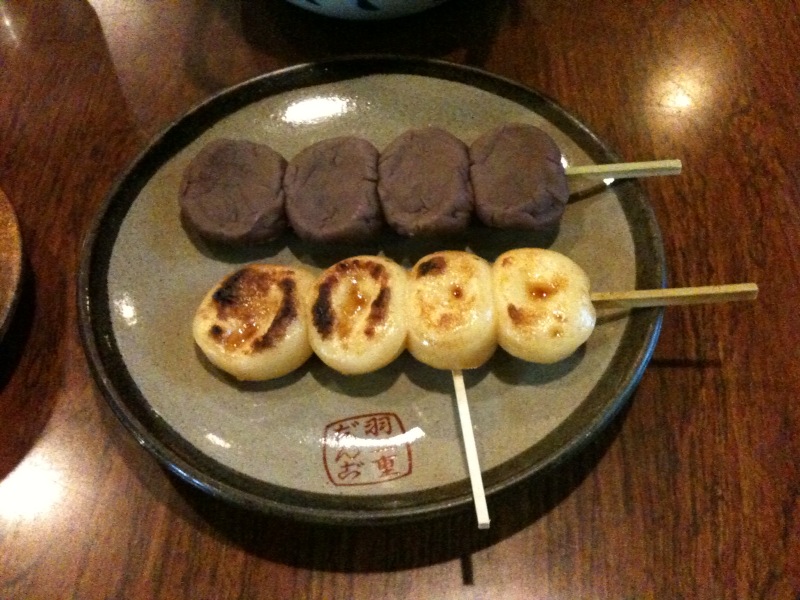

If you have dietary restrictions, Hagi Café is the most straightforward option — the staff speak enough English to help and the menu adapts. On the shopping street, most stalls are small, cash-only, and not geared up for English, so pointing and smiling is the order of the day.
Cherry blossom in Yanaka
Yanaka Cemetery is a good-to-great cherry blossom spot that most guidebooks don’t list. The Sakura-dori avenue through the cemetery has a canopy of blossoms for the ten or so days of peak bloom — usually last week of March to first week of April, earlier some years. I prefer it to Ueno Park, which is the cherry blossom spot nearest Yanaka: Ueno has more trees and bigger spectacle but it is also insanely crowded during bloom week, with blue-tarp picnic parties taking up most of the ground. Yanaka Cemetery has no tarp parties. It is quieter and more contemplative, which I think is closer to what hanami actually wants to be.
If you care about peak bloom dates, check the JMA’s cherry blossom forecast a week before your trip — the front moves north-east through Japan on a roughly predictable schedule. For a fuller breakdown of when and where to see blossoms in Tokyo, read my Tokyo cherry blossom guide.
Access and timing
- From central Tokyo to Yanaka: the easiest station is Nippori on the JR Yamanote Line, 4 stops from Tokyo Station, 6 stops from Shibuya. Use the north/west exit.
- Alternative stations: Nishi-Nippori (one stop further on the Yamanote), or Sendagi and Nezu on the Tokyo Metro Chiyoda Line if you want to enter Yanaka from the Nezu side.
- Best time of day: weekday afternoons, especially 3pm onwards when Yanaka Ginza closes to cars. Morning is quieter but a few stalls haven’t opened. Avoid Sunday lunchtime — that’s when domestic tourists fill the shopping street.
- Best season: late March to early April for blossom, mid-April to early May for Nezu’s azaleas. Autumn (November) is also pretty. Rainy-season June is my least favourite — Yanaka is an outdoor district and rain strips most of the charm out of it.
- Don’t combine with Asakusa + Ueno on the same day: plenty of itineraries squeeze all three into one afternoon. They fit geographically — Ueno is a 20-minute walk south of Yanaka, Asakusa 30 minutes east — but you will end up speed-walking Yanaka and it becomes the worst of the three. Give it its own half-day.
Practical info
- Cost: the district itself is free. Yanaka Cemetery is free. Tennoji Temple is free. SCAI the Bathhouse varies by exhibition (often free). Asakura Museum of Sculpture is ¥500. Nezu Shrine grounds are free; azalea garden charges roughly ¥500 during festival only.
- Opening times: the neighbourhood is always “open”. Yanaka Ginza shops mostly run 10am-6pm. Yanaka Ginza car-free window is weekdays 3pm-8pm. Asakura Museum 9:30am-4:30pm, closed Monday and Thursday. Nezu Shrine grounds 6am-5pm (summer) or 6:30am-5pm (winter).
- Payment: cash is king in the shopping street. A handful of places take IC cards (Suica/Pasmo) but don’t rely on it. ATMs at the 7-Eleven on Yomise-dori and at Nippori Station.
- Toilets: Nippori Station, Yanaka Cemetery admin office, inside Nezu Shrine grounds. There is no public toilet on Yanaka Ginza itself — plan ahead.
- Accessibility: Yuyake Dandan is a steep flight of stairs with no ramp or lift. If you’re in a wheelchair or have mobility issues, enter Yanaka Ginza from the opposite (western) end via Sendagi Station — it’s a flat approach. The cemetery is mostly flat paths.
Honest opinions on Yanaka
I’ll save you some reading.
- Yanaka needs good weather. On a sunny autumn day it is one of the best afternoons in Tokyo. In cold drizzle it is quiet, grey, and kind of sad — the street food stalls shutter, the cats vanish, and you spend ninety minutes wishing you’d gone to a museum. Check the forecast.
- Don’t combine it with Asakusa and Ueno on the same day. I said this above and I’ll say it again. Yanaka is a half-day at minimum. Treat it that way.
- Yanaka Ginza can be overrated in the morning. If you come at 10am on a Tuesday, you’ll find quite a few shutters still down and wonder what the fuss is about. Come from 2pm onwards.
- Nezu Shrine is genuinely underrated. The azalea garden in April is one of my favourite things in Tokyo, and yet most first-time Tokyo visitors don’t hear about it at all. If your trip overlaps with the festival, make space for it.
Where to stay nearby
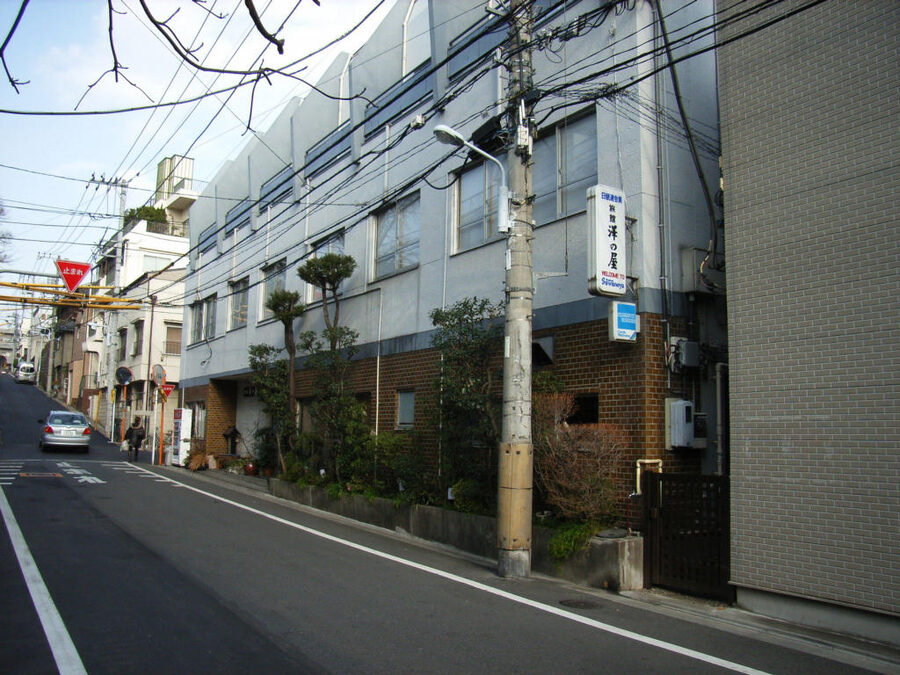
The closest hotels of any interest to most travellers are in Ueno, a stop south on the Yamanote Line. Ueno is a fine neighbourhood to base in and you’re 10 minutes on foot from the edge of Yanaka Cemetery. For broader Tokyo-base options read my budget-conscious Tokyo accommodation guide. A few small traditional ryokan exist inside Yanaka itself (Sawanoya is the famous one) if you want to sleep inside the old-town feel — book well ahead.

Pairing Yanaka with other districts
If you’re building a day around Yanaka, the two obvious pairings are:
- Ueno in the morning, Yanaka in the afternoon: start at the Tokyo National Museum or Ueno Park in the morning, walk 20 minutes north through the cemetery in the early afternoon, and spend the rest of the day in Yanaka. This is my preferred arrangement. Read my Ueno guide for the museum side of it.
- Yanaka in the afternoon, Asakusa in the evening: leave Yanaka around 5pm, take the Chiyoda or Yamanote line to Asakusa (roughly 20 minutes), and eat dinner there. See my Asakusa guide for options.
Do not try to do all three in one day. You will speed-walk all three and enjoy none of them.
External resources
- Go Tokyo — Yanaka and Nezu (official tourism board, good for festival dates and station maps)
- Yanaka Ginza Shopping Street official site (shop listings and opening hours)
- Taito City Culture Guide (for the museums and cultural sites in the ward)
My half-day Yanaka walk
If I were bringing a first-time visitor and we had four to five hours, this is exactly what I’d do. Leave central Tokyo around 1pm. Get off at Nippori Station, north exit. Stand at the top of Yuyake Dandan for a minute and look down the length of Yanaka Ginza. Descend the stairs. Buy one menchi-katsu at Niku-no-Suzuki and eat it walking. Get a senbei, eat that too. Wander to the end of the shopping street and turn left onto Yomise-dori. Poke into two or three craft shops. Cut across to the cemetery along one of the back lanes. Walk the length of Sakura-dori slowly. Stop at Tennoji for fifteen minutes — the Buddha, the inner courtyard, nothing more. Double back into Yanaka for Habutae Dango and a cup of tea. If there’s time, walk southwest to Nezu Shrine, do the torii tunnel, sit in the precinct for ten minutes. Take the Chiyoda Line home from Nezu Station.
That is the trip. Nothing fancy. No bookings. No queueing. The neighbourhood does the work for you — you just have to walk slowly enough to let it.