
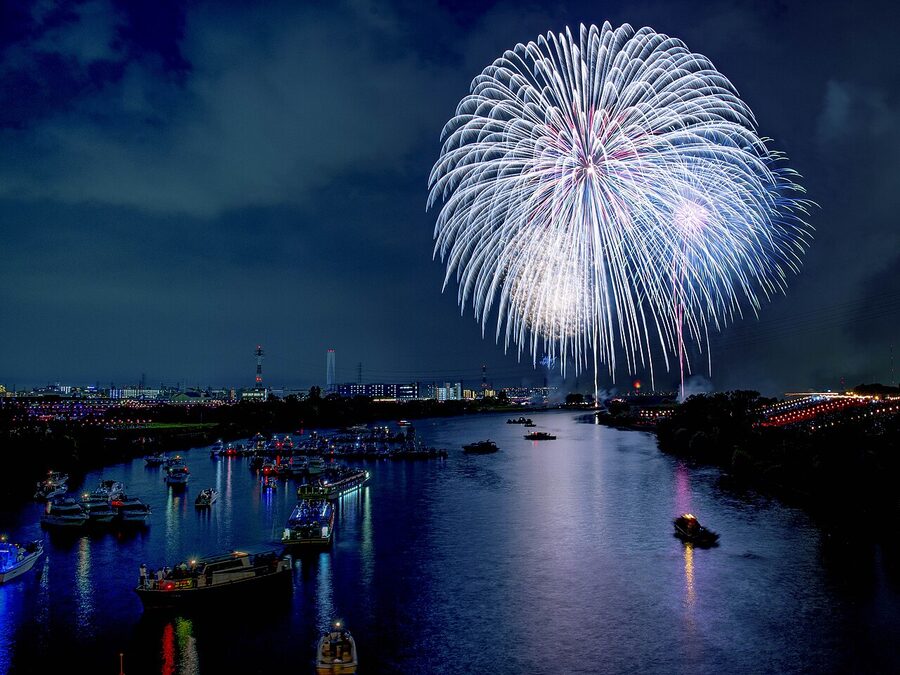
Itabashi’s fireworks festival and Edogawa’s fireworks festival happen on the same night. First Saturday of August, both starting around 7pm, both drawing massive crowds, both unmissable in their own way. It’s the one impossible night on the Tokyo hanabi calendar, and if you try to hit both you’ll end up seeing the ends of neither. So you pick.
The reason to pick Itabashi comes down to one thing that almost no other Tokyo fireworks festival does: a 700-metre wall of fireworks cascading down a wire strung along the Arakawa riverbank, in a finale called the Niagara Falls. It’s the festival’s signature and it’s been the festival’s signature for decades. Edogawa gives you scale and a killer opening. Sumida gives you history and the Skytree skyline. Itabashi gives you this waterfall of light that you’ll still be thinking about the next morning.
In This Article
- What Itabashi actually is
- The Niagara Falls finale
- Date and times for 2026
- Where it all happens
- Getting there on the Tokyo side
- Getting there on the Toda side
- Driving is not a plan
- Free viewing or paid seats
- Arrival: how to actually do it
- What to bring
- The food stalls
- History: how a 1951 local show became the Niagara Festival
- The exit is the hard part
- Edogawa vs Itabashi: which one to pick
- If you’re also doing Sumidagawa or Adachi
- Practical info
- How I’d pick between Itabashi, Edogawa and Sumidagawa
What Itabashi actually is
The festival’s full name is the Itabashi Hanabi Taikai (いたばし花火大会). It’s held on the first Saturday of August on the Tokyo side of the Arakawa River, in the Funado neighbourhood of Itabashi-ku, just upriver from the Todabashi Bridge. On the opposite bank, the city of Toda in Saitama prefecture runs its own festival at the exact same time, called the Todabashi Hanabi Taikai. Legally they’re two separate events, run by two separate organising committees. Practically they’re one show in the sky viewed from opposite sides of the river.
Between the two sides, roughly 15,000 shells go up over 90 minutes, with Itabashi contributing about 12,000 and Toda the rest. In recent years the combined attendance has pushed past 500,000 spectators, split roughly evenly. It’s one of the biggest fireworks events in Tokyo by volume, even though it’s never quite as famous as Sumida or Edogawa.
The Niagara Falls finale
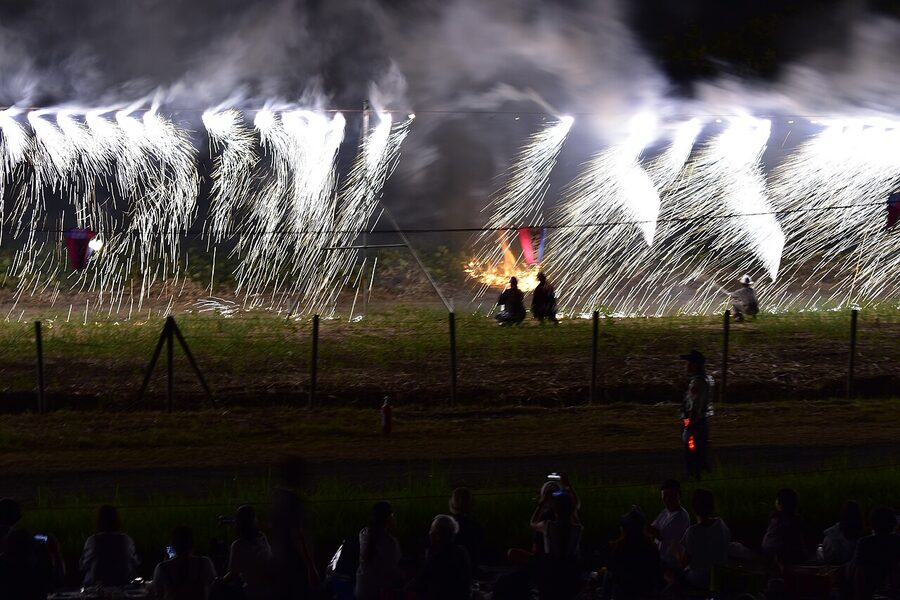
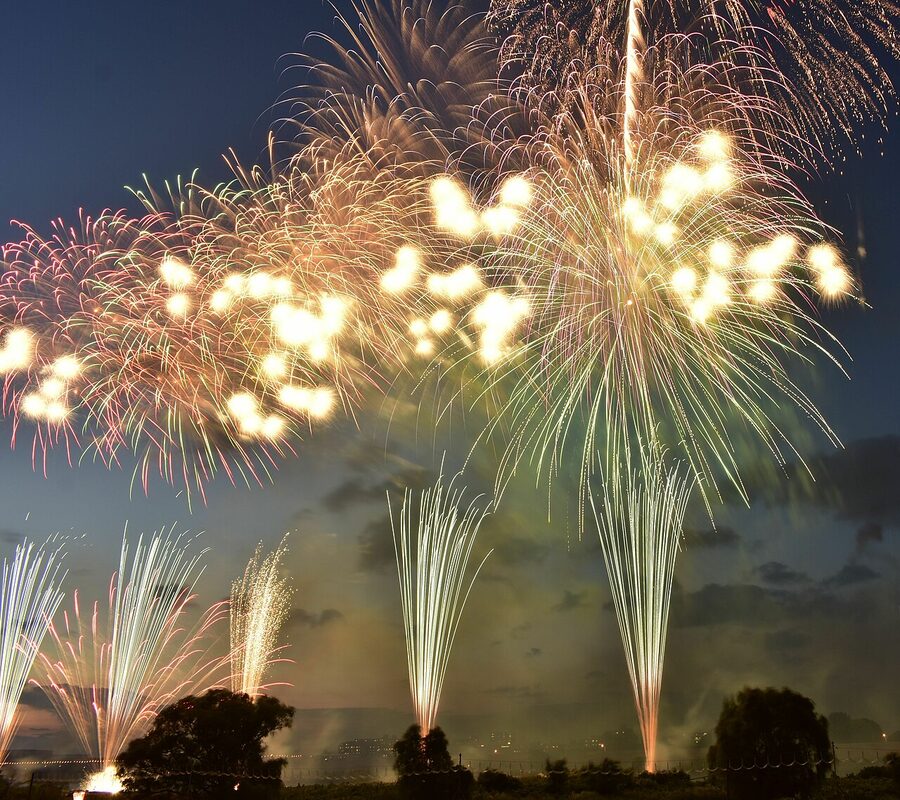
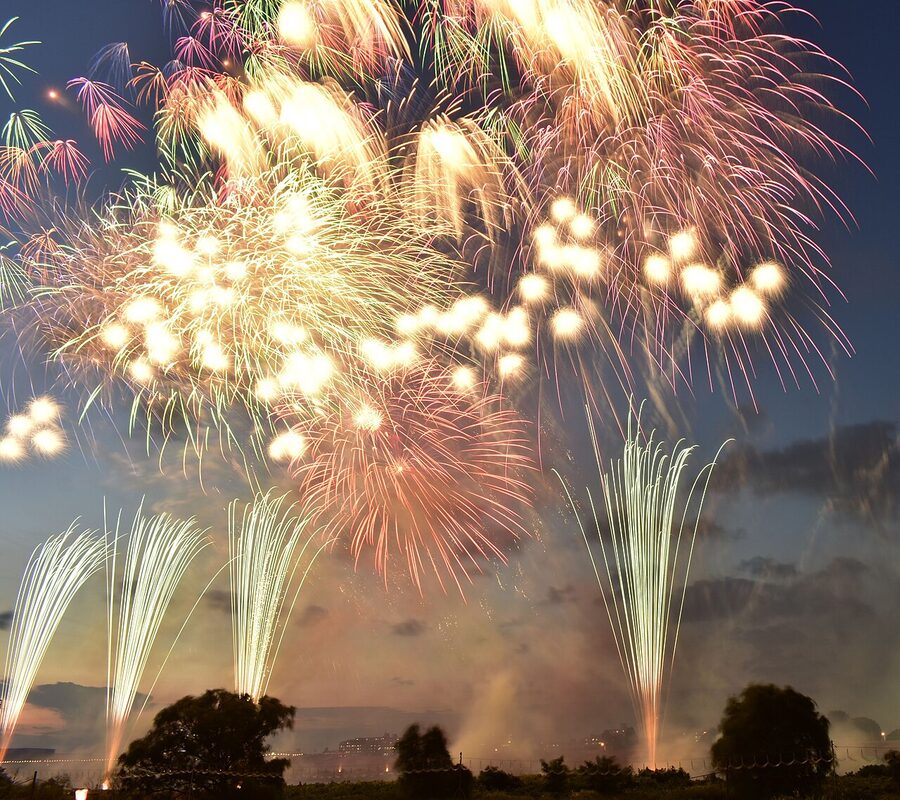
Here’s the thing that makes Itabashi worth the trip. About 45 minutes into the 90-minute programme, the regular shells stop for a breath, the crowd goes quiet, and a 700-metre wire strung across the riverbank lights up along its entire length at once. The fireworks ignited on the wire hang in place rather than shooting up — so what you see is a continuous, shimmering, gold-silver waterfall of sparks about a metre tall, running parallel to the river. It’s called the Dai-Naiagara no Taki, the Grand Niagara Falls, and the organisers claim it’s the longest of its kind in the Kanto region.
You get Niagara effects at other Japanese hanabi — it’s a standard technique — but they tend to be 100 or 200 metres long, and they’re usually a small transition piece tucked between the bigger shell sequences. At Itabashi it’s the centrepiece. You stand there for a long minute watching this thing drip fire, and then the regular shells come back in for the grand finale over the top of it, and that’s when the crowd finally loses its mind.
One detail worth knowing: in 2023, the Niagara finale set fire to dry leaves on the riverbank, burned across roughly 2,000 square metres, and forced an early end to the show. Nobody was hurt and the festival returned the next year with extra fire precautions, but it’s a reminder that you’re watching a controlled fire drawn across a real field, not a CGI animation.
Date and times for 2026
The 2026 festival falls on Saturday 1 August — the first Saturday of August, following the standard pattern. Fireworks start at 7pm and run until 8:30pm, weather permitting. In light rain the show goes ahead. In heavy rain, lightning, or strong wind, they cancel — and there’s no rain date. That last bit matters: if it pours on 1 August, the festival is over for the year.
The same date is also Edogawa’s fireworks festival — that’s not a coincidence, it’s been the Tokyo schedule for years, and it’s why I said up top that you have to pick. Sumidagawa, the most famous of the three, falls on a different night in late July, so it’s not in the same trap. If you’re in Tokyo the last weekend of July AND the first weekend of August, you can do both Sumidagawa and one of Itabashi/Edogawa, and feel like you’ve done your fireworks homework for the summer.
Where it all happens
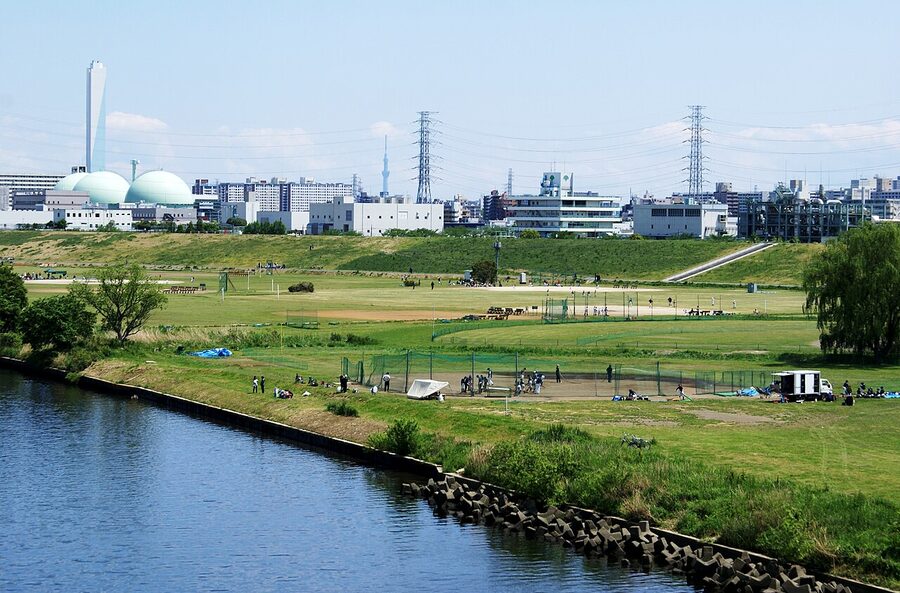
The launch site sits in the middle of the Arakawa River, just upstream from the Todabashi Bridge. You watch from either the Itabashi-ku (Tokyo) embankment to the south, or the Toda-shi (Saitama) embankment to the north. Either side gets a full, clear, almost-too-close view of the entire show. The Niagara Falls wire runs along the Tokyo side, so technically the Itabashi view is closer to that specific finale — but from Toda you see it laid out horizontally across the river, which is arguably the better frame.
Getting there on the Tokyo side
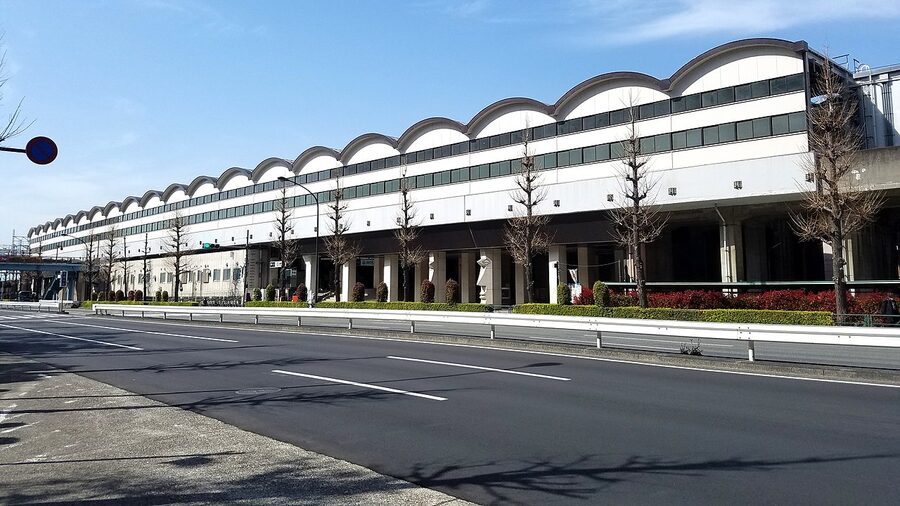
The nearest station for the Itabashi side is Takashimadaira (I-25) on the Toei Mita Line, about a 20-minute walk to the riverbank. Two other Mita Line stations — Nishidai (I-24) and Hasune (I-23) — are about the same distance and tend to be less crowded on the way in. There’s also Ukima-Funado on the JR Saikyo Line, same 20-minute walk, useful if you’re coming from Ikebukuro or Shinjuku.
None of these stations has a proper wide-mouth entrance like Shinjuku or Shinagawa. They’re suburban Mita Line stations with narrow gates and a single exit, and on festival night the crowd chokes through them slowly. On the way in, before about 5pm, it’s fine. On the way out, after 8:30pm, it’s a different story.
Getting there on the Toda side
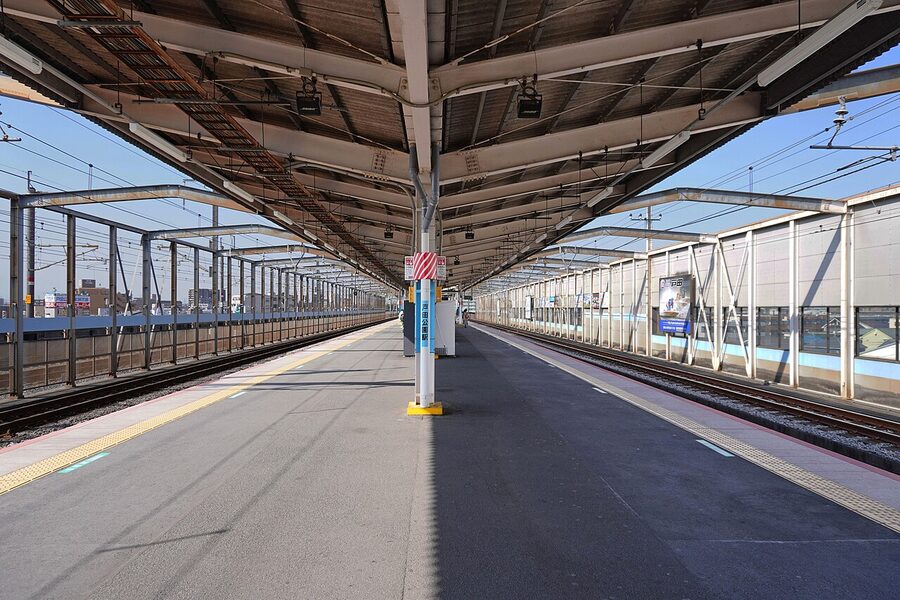
If you choose the Toda side, take the JR Saikyo Line to Toda-Koen Station (JA-18), then walk about 20 minutes north to the river. The Saikyo Line connects directly to Ikebukuro, Shinjuku, Shibuya and Ebisu, so from central Tokyo it’s often faster to reach Toda-Koen than Takashimadaira, despite Toda-Koen technically being in a different prefecture.
My honest take: the Toda side is less crowded, has an easier return route (only Saikyo Line traffic, not competing with the Itabashi-bound Mita Line squeeze), and gets roughly the same view of the fireworks for a bit less money if you’re buying reserved seats. The Niagara finale is framed across the water rather than above you, which some people prefer. The downside is that a late-night Saikyo Line round trip from Shinjuku takes longer than a Mita Line trip from Ikebukuro or Otemachi.
Driving is not a plan
Don’t even think about it. The entire Arakawa riverbank closes to traffic from late afternoon onwards, on both the Tokyo and Saitama sides. There is no festival parking. The surrounding residential streets have no available parking either, and most of them are one-way with heavy police controls on the night. The official organisers specifically ask everyone to use public transport, and for once that’s not just boilerplate advice — it’s the only option that actually works.
Free viewing or paid seats
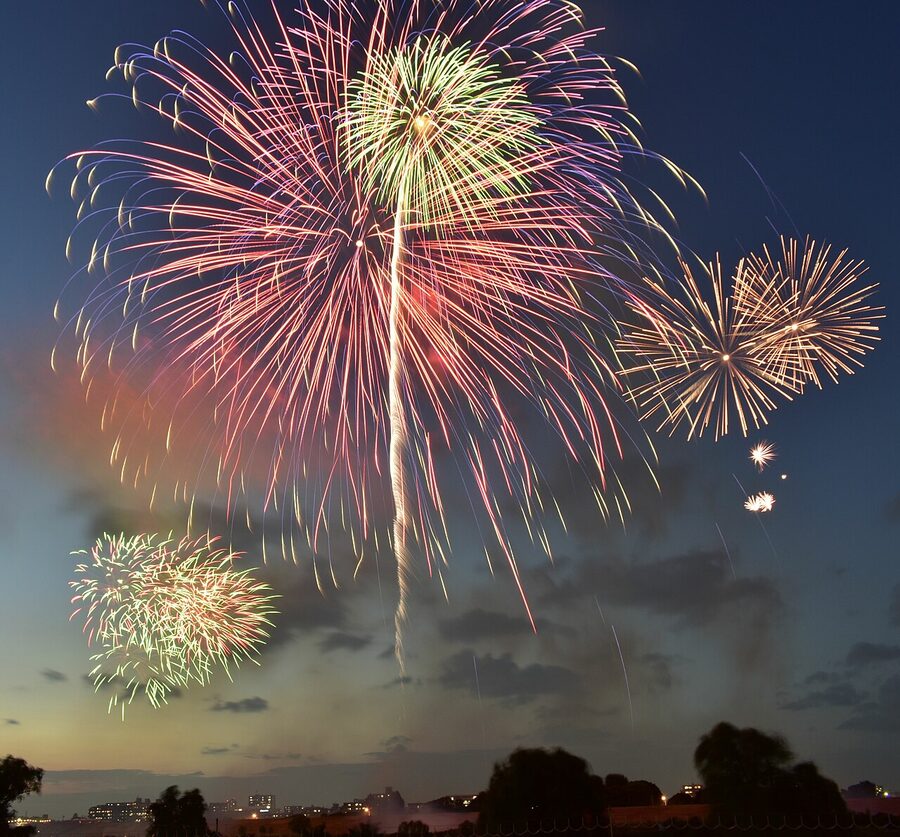
The organisers sell reserved seats on both sides. On the Itabashi side single seats start at about ¥4,500 and group plans run up to ¥48,000 for premium boxes of eight. On the Toda side the entry price is lower, with reserved tickets starting around ¥2,500. Tickets go on sale in mid-June through the official sites and via e-plus.
The free viewing areas are the grassy flats on either side of the paid zone on the Itabashi embankment, and the wider riverbank park on the Toda side. They fill up fast — the bigger-groups-with-tarps crowd start laying claim around 2pm, and by 5pm the prime spots are gone. A slightly left-field option: the rooftop of Aeon Itabashi Shopping Centre runs a viewing lottery each year, and if you win you get a genuinely great high view for free.
For Ukima Park, a little upriver on the JR Saikyo Line side, you get a clear angle at the show from about a kilometre away, without the Niagara finale visibility but also without the crush. It’s the quiet-picnic choice.
Arrival: how to actually do it
Here’s the sequence I’d work to on festival day:
- Arrive between 3pm and 5pm. Before 5pm the walks from any of the three Mita Line stations are calm and you can still pick your grass spot. After 6pm it’s a very slow shuffle.
- Bring a leisure sheet (rejaa shiito) if you’re going to the free zone. A small tarp or picnic blanket is essential — the embankment is hard gravel otherwise. You can buy one at any 100 yen shop on the way, but honestly most conbinis have them too for about ¥300.
- Stop at a conbini before you hit the riverbank. There are festival food stalls but the queues are brutal and the prices double. A Family Mart or 7-Eleven bento, a couple of drinks, and a pack of wet wipes will serve you better. Do not count on buying water at the stalls — they routinely sell out.
- Pick your spot and stake it out by 5:30pm. Sitting quietly on your sheet, waiting for 90 minutes, is an actual part of the Japanese fireworks experience. Don’t rush it.
- Keep your phone charged. The network around the launch site goes dead from roughly 7pm onwards — too many people on too few cells. If you’re meeting someone, set the exact spot before you arrive, and print a map on paper if you can.
What to bring
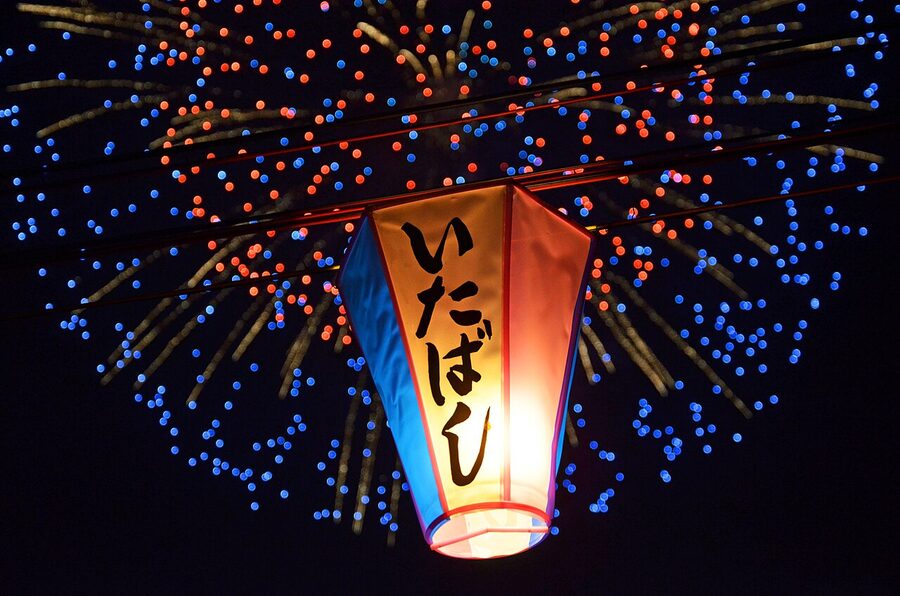
A yukata is fun but optional — plenty of people wear regular clothes. If you do wear one, bring a pair of socks for the train home because standing barefoot in geta on gravel after an hour gets old fast. A handheld uchiwa paper fan is worth buying at the station shop; early August nights around the Arakawa run 28 to 30 degrees even at 9pm.
Insect repellent is more important than anyone tells you. The Arakawa floodplain is effectively a giant damp meadow in August, and the mosquitoes find you within ten minutes of sitting down. Bug spray, or those stick-on patches from conbini, will save the evening.
A small torch is useful for the walk back. Most of the riverbank path isn’t lit, and once the fireworks end the whole crowd is groping their way back to the station in near darkness.
The food stalls
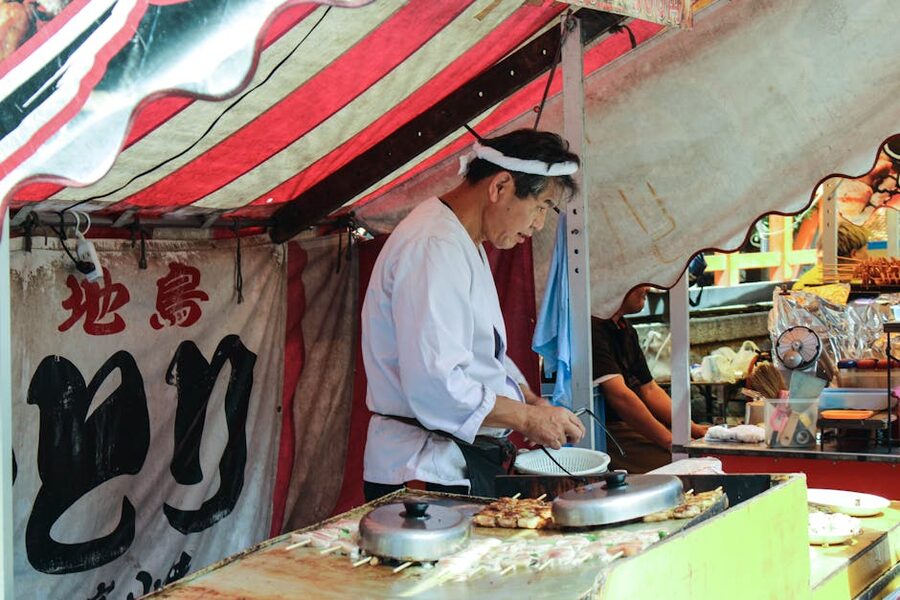
The Toda side has around 80 festival stalls set up along the embankment from late afternoon, which is more than most Tokyo-side stations have, and it’s one of the small reasons I usually nudge first-time visitors to the Saitama bank. Grilled corn, yakitori, yakisoba, takoyaki, karaage, kakigori shaved ice, Asahi on tap, and for some reason always a stall selling cucumber-on-a-stick are the core menu.
The Itabashi side is smaller on stalls — by 2024 the organisers had tightened up the street-food permits — but you’ll still find enough to piece a dinner together if you didn’t do the conbini run.
History: how a 1951 local show became the Niagara Festival
The first Itabashi Hanabi Taikai was held in 1951, in the era when Tokyo was still rebuilding from the war and the Arakawa floodplain was one of the few genuinely open spaces in the city. The local Itabashi-ku ward ran it as a postwar summer event, paired with Toda’s fireworks across the river — Toda had been running its own show since shortly before.
There’s actually older fireworks history in Itabashi than that. The Maeda clan, lords of the Kaga domain, had a lower residence in Itabashi during the Edo period, and diary entries from 1833 (Tempo 4) record a “great fireworks display” held at the residence for the lord Nariyasu Maeda and his family. It’s a small detail, but it means fireworks in Itabashi go back at least two centuries, even if the modern annual festival is from 1951.
The Niagara Falls technique was developed and refined at Itabashi over decades, and the 700-metre length is what distinguishes it. Smaller Niagara effects have been used at Japanese fireworks festivals for over a century, but the length and the fact that it’s treated as the main event — rather than a transition between shells — is specific to Itabashi.
The exit is the hard part
This is where people get caught. Fireworks end at 8:30pm. The crowd all stands up at once. Everyone on the Itabashi side walks back toward the same three stations. Takashimadaira in particular becomes a slow-moving human traffic jam that can take 60 to 90 minutes to clear.
Two exit strategies that actually work:
- Walk to Nishidai or Hasune instead of Takashimadaira. They’re the same distance from the river, but far fewer people head there because the signage on the day funnels the crowd to Takashimadaira. If you turn left where most people are turning right, you’ll be on a train 20 minutes earlier.
- Cross to the Toda side before the finale — well, don’t actually walk across the river during the show, that’s not possible. But if you’re watching from the Saitama bank to start with, you exit to Toda-Koen Station on the Saikyo Line, which handles the crowd much better than the Itabashi Mita Line stations. The Saikyo Line also runs longer into the night.
The authorities enforce a formal “no-exit period” (taijou kisei) for about 15 minutes after the show ends, on some parts of the Itabashi embankment. You physically can’t leave the seated area until they open the gates. This is by design — it lets the station crowd thin a little before the next wave arrives. Use those 15 minutes to pack up properly and drink your last conbini beer.
Edogawa vs Itabashi: which one to pick
If this is your first Tokyo summer and you can only do one of the two first-Saturday festivals, here’s my honest steer:
- Go to Edogawa if you want scale, Tokyo skyline backdrop, and the famous 5-second 1,000-shell opening. It’s the bigger and more crowded of the two, but also the more dramatic if you’ve never seen a major hanabi before. The downside is that the crowd is massive and the stations have a longer post-show queue.
- Go to Itabashi if you want the Niagara Falls finale, slightly smaller crowds, and a show that feels more like one long choreographed piece than a sequence of sections. The Toda side is the quieter option if you want a proper sit-down picnic. Itabashi also tends to be easier for families with kids because the crowd is less dense.
For travellers who plan to combine a fireworks night with something else, Itabashi pairs naturally with Ikebukuro for dinner afterwards — it’s the nearest major dining district, about 15 minutes by train from Takashimadaira via the Mita Line and Yurakucho Line transfer, or straight from the Saikyo Line if you went to the Toda side. If you’re staying in the area, the Ikebukuro cluster of budget hotels is the right base.
If you’re also doing Sumidagawa or Adachi
Tokyo’s main summer fireworks circuit is basically four events, spread across late July and early August:
- Sumidagawa Hanabi Taikai — late July, Asakusa/Skytree area, 20,000 shells, the oldest and most famous, the busiest
- Adachi Hanabi Taikai — late July, a week or so earlier, Kita-Senju area, 13,000 shells, compact and punchy
- Edogawa Hanabi Taikai — first Saturday of August, Koiwa/Ichikawa, 14,000 shells, epic opening
- Itabashi Hanabi Taikai — first Saturday of August (clashes with Edogawa), Takashimadaira/Toda-Koen, 12,000 shells on the Tokyo side plus 3,000 on the Saitama side, Niagara finale
If you’re in Tokyo for two weekends, you can realistically do Sumidagawa (late July) and then either Edogawa or Itabashi (first Saturday of August). Doing all four in one summer is the completist goal, but you need the calendar to cooperate. Worth checking the Go Tokyo events calendar before your trip.
Practical info
- Date (2026): Saturday 1 August 2026 (first Saturday of August)
- Time: 19:00–20:30 (90 minutes)
- Shells: ~12,000 on the Itabashi side, combined 15,000 with Toda
- Attendance: ~500,000+ combined across both sides
- Entry to free zones: Free
- Reserved seating (Itabashi): ¥4,500–¥48,000
- Reserved seating (Toda): from ¥2,500
- Nearest stations (Tokyo side): Takashimadaira, Nishidai, Hasune (all Toei Mita Line); Ukima-Funado (JR Saikyo Line)
- Nearest station (Saitama side): Toda-Koen (JR Saikyo Line)
- Official sites: itabashihanabi.jp (Japanese), city.toda.saitama.jp (Toda side), city.itabashi.tokyo.jp
- Weather cancellation: Light rain OK, heavy rain/lightning/wind cancels the event with no reschedule
How I’d pick between Itabashi, Edogawa and Sumidagawa
If you’re visiting Tokyo for the first time in summer and can only see one fireworks night, I’d send you to Sumidagawa for the setting — you get the Skytree and the Asakusa riverbank in the same frame as 20,000 shells, and it’s a very Tokyo postcard.
If you’re specifically a fireworks fan and want to see the technical best, Itabashi is the one. The Niagara finale alone is worth the trip, and the 12,000 shells of the main show are fired at a slower, more deliberate pace than Sumida or Edogawa, which lets each shell land properly before the next one goes up.
If you want the biggest opening minute in Japanese fireworks, Edogawa is hard to beat — the 1,000-shell five-second opener is a famous set piece that Itabashi doesn’t match. But Edogawa also has the bigger crowd and the longer return queue, and you miss out on the Niagara effect entirely.
On any given night there will be three things true at once: somewhere it’ll be raining, somewhere a station will be heaving, and somewhere a small group of people will have found a quiet spot with a perfect view. The last one is the goal. Walk further from the stations than you think you need to, bring enough water, and sit down an hour before you think you should. That’s all of it.