
Forty minutes on the Tokaido Shinkansen from Tokyo Station drops you in a small coastal town with hot springs recorded since the eighth century, a beach lined with palm trees, an art museum redesigned by Hiroshi Sugimoto in 2017, and a plum garden that blossoms in late January — two months before any cherry tree in Tokyo turns pink. That is the entire pitch for Atami. You can do it in a half-day if you push, a full day if you want to slow down, and an overnight if you want to use the onsen properly.
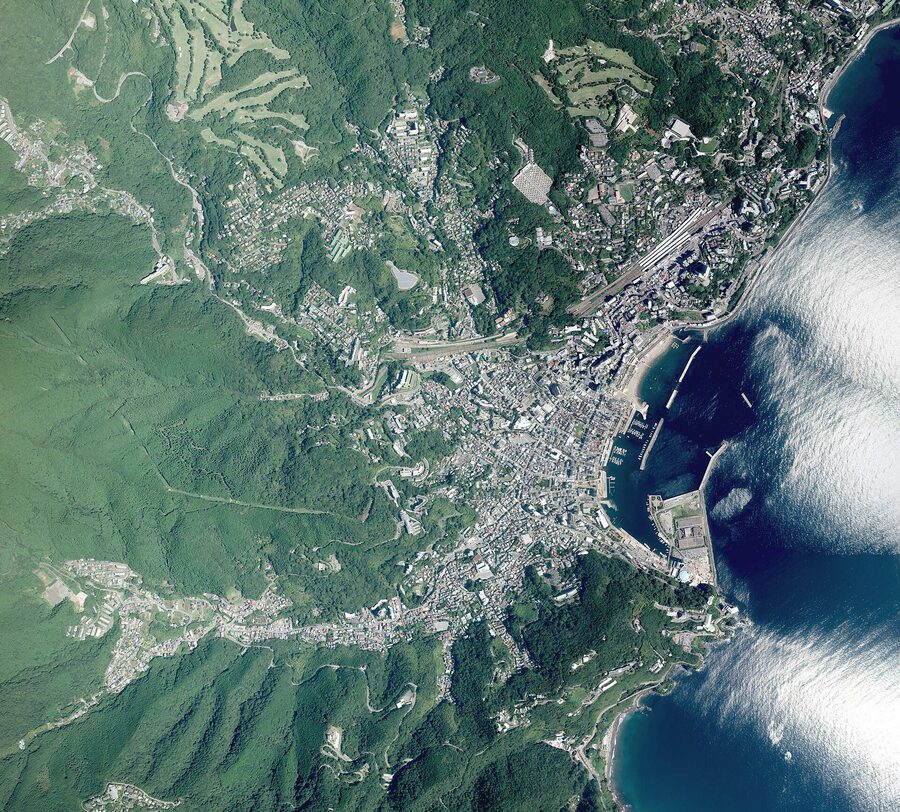
Atami sits at the northeastern base of the Izu Peninsula, in Shizuoka Prefecture, about 80km southwest of Tokyo on the western edge of Sagami Bay. The Kodama and Hikari Shinkansen both stop here, which is the single fact that has shaped the town — first as a 1960s honeymoon resort, then through a long bubble-economy decline, and now through an Instagram-fuelled second act as the closest Shinkansen-accessible onsen town to Tokyo.

In This Article
- Atami in thirty seconds
- Why you actually go
- Getting there
- Booking the Shinkansen ticket
- Getting around once you arrive
- The half-day Atami route
- MOA Museum of Art
- Atami Castle (and the honest opinion)
- Atami Plum Garden (Atami Baien)
- Kiunkaku
- Izusan Shrine
- Day-use onsen
- The Oyu Geyser
- Atami Sun Beach
- Atami Bay fireworks
- What to eat
- Atami versus Hakone
- When to come
- Practical info
- My Atami day-trip plan
Atami in thirty seconds
A small seaside city of about 31,000 people in eastern Shizuoka, on the western shore of Sagami Bay. Hot springs recorded since AD 749, designated one of the “Three Great Springs of Japan” in the Edo era. Peak honeymoon and corporate-retreat town through the 1960s and 80s, steep decline after the bubble burst in 1990, revival from around 2011 thanks to younger Tokyo travellers, the Shinkansen, and a long campaign by the local merchant association. Famous for hot baths, an early-blooming plum garden, the MOA Museum of Art on the hill, multiple fireworks displays through the year, and seafood off the boats from Atami Port.
Why you actually go
Three reasons. First, the train. Atami is the closest proper onsen town to Tokyo by Shinkansen — 40 minutes on a Kodama, sometimes 35 on a Hikari. Hakone is on roughly the same axis but takes longer because it’s not on the Shinkansen network proper. If you have one free day and want to soak without surrendering half of it to transit, this is the place.
Second, the season. Atami’s plum garden is the earliest-blooming in Japan; the trees start opening in early January and the official plum festival runs to early March. Cherry blossoms here come out in mid-March, two to three weeks before central Tokyo. If you’re in Japan in January or February and feeling cheated of any flowers, the train fare to Atami is the cheapest pink you’ll find.
Third, it’s an odd, faded, half-revived town in a way that Hakone isn’t. Hakone has been polished into a designed onsen experience; Atami is still half 1980s concrete bubble-resort and half twenty-something pop-up cafes, with a working fishing port underneath. I find it a more interesting place to walk for a day, even if the prettier postcard is in Hakone.
Getting there
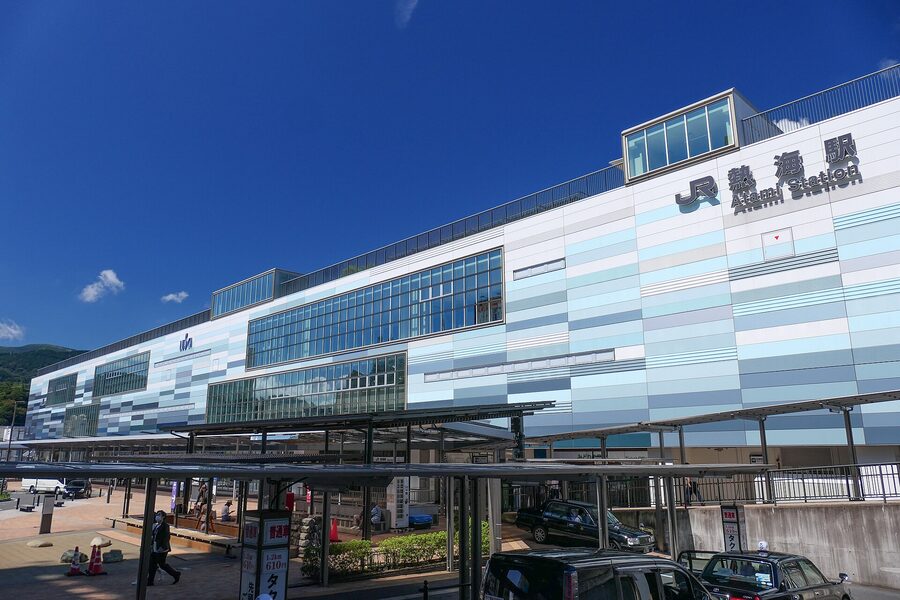

Three sensible options from Tokyo:
- Tokaido Shinkansen Kodama or Hikari: the one I’d take. Direct from Tokyo Station in 40-50 minutes, around ¥3,740 unreserved one-way (Kodama). One to three trains an hour. Nozomi trains do not stop at Atami.
- JR Tokaido Line local: direct from Tokyo Station, around 100-120 minutes, ¥1,980-2,090 one-way. Three trains an hour.
- From Shinjuku or Shibuya: Shonan-Shinjuku Line direct trains every 30-60 minutes, about 90-100 minutes. Same fare as the Tokaido Line local.
If you have a JR Pass, the Tokaido Shinkansen Kodama and Hikari are both covered. The JR Tokyo Wide Pass and JR East Pass do not cover Tokaido Shinkansen (it’s a JR Central line), so on those you’d need the slower JR Tokaido Line.
Booking the Shinkansen ticket
- Use a JR ticket window (Midori-no-madoguchi) at Tokyo Station or the green ticket machines, which now have an English mode.
- Specify Tokyo to Atami, Kodama or Hikari (not Nozomi), and unreserved seat (jiyuseki) unless you’re travelling on a weekend morning.
- You get a base fare ticket and a Shinkansen supplement ticket — insert both into the gate together at the Shinkansen entrance.
- If using a JR Pass, you do not need to buy any ticket; reserve at the window or walk straight to the unreserved carriages.
Getting around once you arrive
Atami is built into a steep slope. The town centre, the beach, the port and the shopping streets are all within a flat 15-minute walk of Atami Station. The MOA Museum, Atami Castle, Akao Herb & Rose Garden, Izusan Shrine and the Plum Garden are all up steep hills or on coastal cliffs — bus, taxi, or ropeway. The Atami 1-Day Pass (¥800) covers all Tokai Bus lines plus discounts on a handful of attractions; on sale at the Tokai Bus counter inside the station. For two or three sights in a day, taxis from the station rank are often cheaper and quicker — Atami Castle is around ¥1,500 one-way, the MOA Museum about ¥1,200.
The half-day Atami route
The sequence I would actually do for one day from Tokyo.
- 09:00. Kodama from Tokyo Station. Arrive Atami around 09:45.
- 10:00. Bus from station stop 8 to MOA Museum of Art (8 min, ¥160). Spend 90 minutes inside.
- 12:00. Bus or taxi back. Walk down to Atami Ginza shopping street for shirasu-don.
- 13:30. Taxi to Atami Castle (around ¥1,500). Pay for the rooftop deck only; pair with Akao Herb & Rose Garden if gardens are your thing.
- 15:30. Day-use onsen at Oasis Spa Fuua, Hotel Micuras, or Atami Taikanso. Budget 90 minutes.
- 17:30. Walk to the station via the Sun Beach promenade. Bento at Lascal Atami inside the station.
- 18:30. Kodama back. Arrive Tokyo around 19:15.
To add the Plum Garden (January-February) or Izusan Shrine, swap them in for the castle or the onsen — you cannot do everything in a single day at sensible pace.
MOA Museum of Art
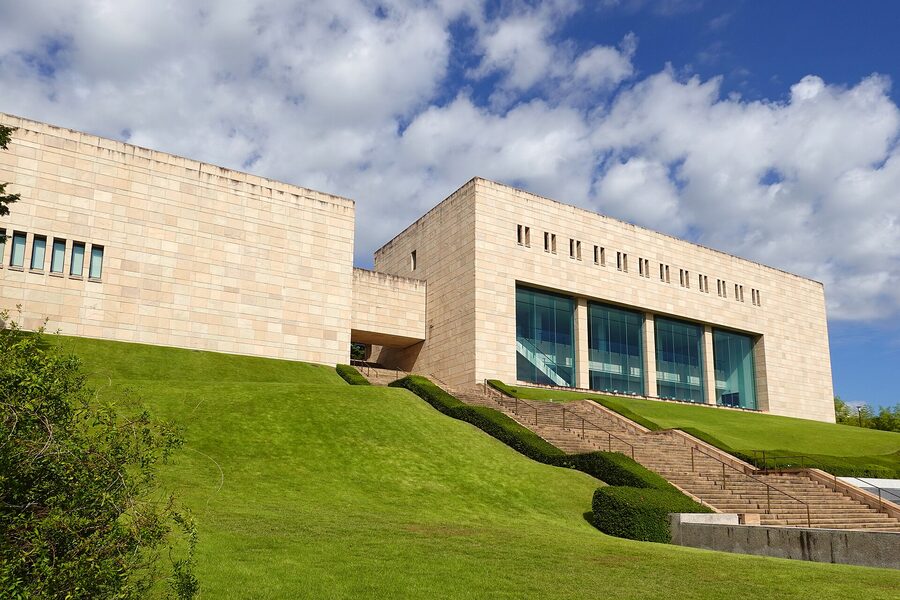

This is the one thing in Atami you should not skip. The MOA opened in 1982 on the hillside above the town, on the foundation of the smaller Atami Bijutsukan that had been there since 1957. In February 2017 the artist Hiroshi Sugimoto and the architect Tomoyuki Sakakida (of New Material Research Laboratory) reopened it after a renovation that replaced the gallery interiors with specially fabricated low-iron glass cases. The works sit in black-walled rooms with what feels like nothing between you and them. It became, quietly, one of the best-presented museums in Japan.
The collection is built on the personal holdings of the early-twentieth-century industrialist and religious leader Mokichi Okada (the museum’s name is the initialism of his English-style name, Mokichi Okada Association). It runs to about 3,500 pieces of Japanese and Chinese art, three of which are National Treasures and 67 Important Cultural Properties. The most famous is the “Red and White Plum Blossoms” folding screen by Ogata Korin, on display only briefly each February to coincide with plum-blossom season. The main lobby has a wall of windows giving a 180-degree panorama south over Hatsushima and the Izu, Boso and Miura Peninsulas; there’s also a Noh theatre on the grounds, a tea house, and a recreated golden tea room based on the portable golden room Toyotomi Hideyoshi had built for an Imperial tea ceremony in 1586.
Admission ¥2,000 for adults from 1 April 2025 (it was ¥1,600 before that price rise; older guides still quote the lower fee). Students ¥1,400. Open 09:30-16:30 (last entry 16:00), closed Thursdays unless a public holiday. About 8 minutes by taxi from Atami Station; by bus, the “MOA Bijutsukan” stop on the Tokai Bus from station bus stop 8 (around ¥360 one-way). Official site: moaart.or.jp.
Atami Castle (and the honest opinion)
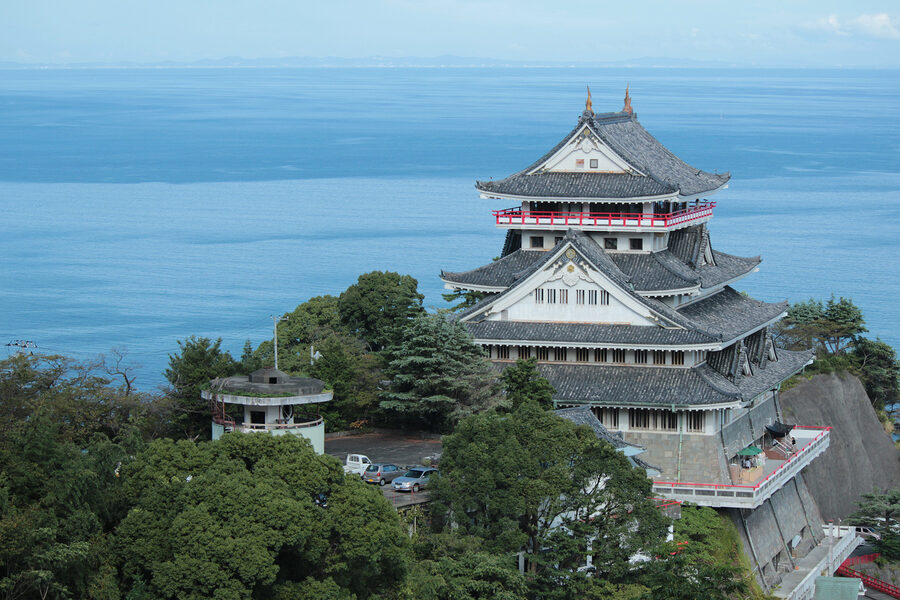

Honest opinion first, because this is the part of Atami where most guidebooks let you down. Atami Castle is not a historical castle. There is no original keep here; there has never been one. It was put up in 1959 as a tourist attraction in steel-reinforced concrete in the shape of a five-storey castle keep, with nine internal floors of fairly cheap exhibits. It is the sort of place that was charming in the 1960s and is now more interesting as a piece of Showa-era kitsch than as a museum.
What it is good for is the view. The sixth-floor observation deck sits 100 metres above sea level on Nishikigaura Hill; on a clear day you can see Hatsushima Island, Oshima Island, the whole sweep of Sagami Bay and, with the binoculars provided, Tokyo Skytree to the northeast and the Landmark Tower in Yokohama. There are 208 cherry trees on the grounds and a small Castle Cherry Festival from late March to early April. My recommendation: pay the ¥1,100, go straight to the sixth-floor deck, look at the view, then leave. Skip the interior floors unless the kitsch appeals. Open 09:00-17:00, no closing days.
Adjacent to the castle is the Akao Herb & Rose Garden, a cliffside garden with rose terraces and the much-shared Sea Bell viewpoint over Sagami Bay (entry ¥1,000-1,500 depending on season). If you have to pick one of the two big up-the-hill stops, pick the MOA. The Castle is a 1959 concrete folly with a great view; the MOA is one of the best-curated art museums in the country.
Atami Plum Garden (Atami Baien)
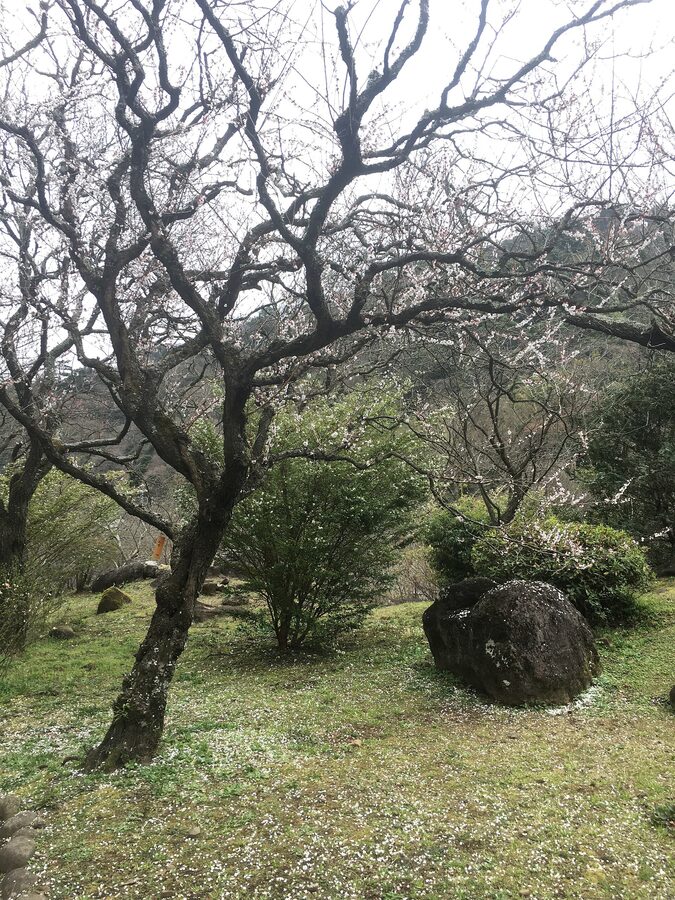

The Atami Plum Garden is officially the earliest-blooming plum garden in Japan and the latest-changing autumn maple garden in the country. The 4.4-hectare slope west of Kinomiya Station is planted with 469 plum trees of 59 cultivars, around 380 maples, and a scatter of pines and camphor. It was opened in 1886 on the suggestion of Sensai Nagayo, the Meiji-era public-health official who had also opened Japan’s first hot-spring therapy facility, the Kyukikan, next to Atami’s Oyu Geyser the year before. It became Imperial property in 1888 and was gifted to the city of Atami in 1960.
The Atami Baien Plum Festival runs from the second weekend of January to the first weekend of March; entry ¥300 for adults during festival hours (8:30-16:00), free outside festival season. The autumn Momiji Festival runs late November to early December, when the maples colour up about three weeks later than around Tokyo. Take the JR Ito Line one stop from Atami to Kinomiya Station (5 minutes, ¥200), then walk uphill 8-10 minutes; or a bus from Atami Station for around 15 minutes to the “Atami Baien” stop.
Kiunkaku
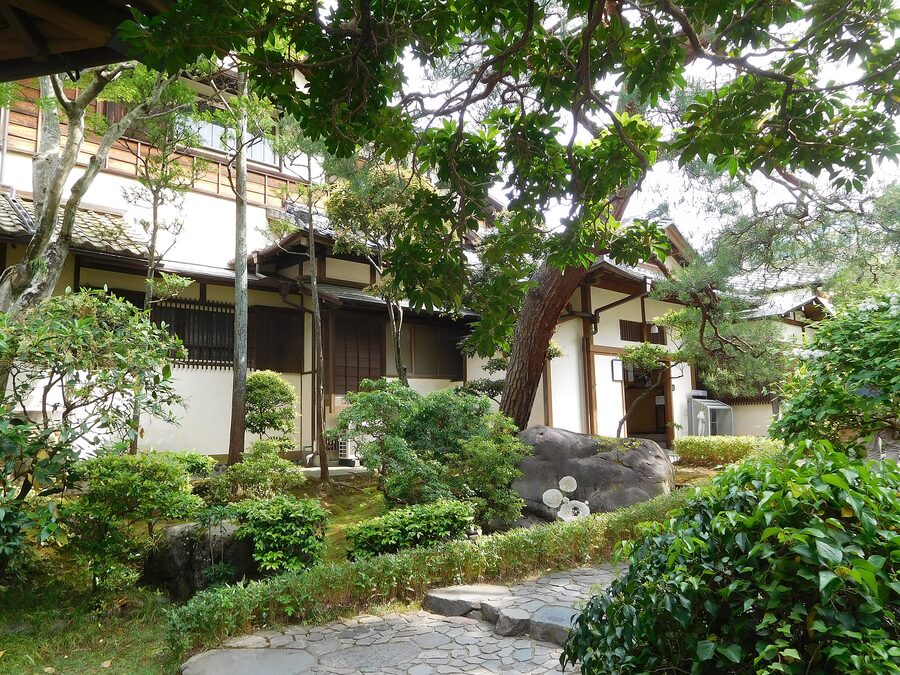

Kiunkaku is the most quietly satisfying single building in central Atami. It was built in 1919 by the politician and shipping magnate Nobuya Uchida as a holiday villa for his ailing mother, then sold in 1925 to the railway baron Kaichiro Nezu, who added the Western wing. From 1947 it ran as a luxury ryokan and became the Atami inn for postwar literary Japan: Yasunari Kawabata, Junichiro Tanizaki, Osamu Dazai, Naoya Shiga all stayed and wrote here. Yukio Mishima honeymooned in one of the rooms in 1958. The original Japanese Wing, Western Wing, Roman bath, Showa-era stained glass and inner garden are all preserved as they were.
It’s now an Atami City Designated Tangible Cultural Property and runs as a small public museum — you walk through the rooms in stocking feet and read about the writers who’ve passed through; most rooms have a short note in English. Admission ¥610 adults, open 09:00-17:00 (last entry 16:30), closed Wednesdays. A 5-minute taxi from Atami Station, or a 15-minute walk via Kasuga Town.
Izusan Shrine
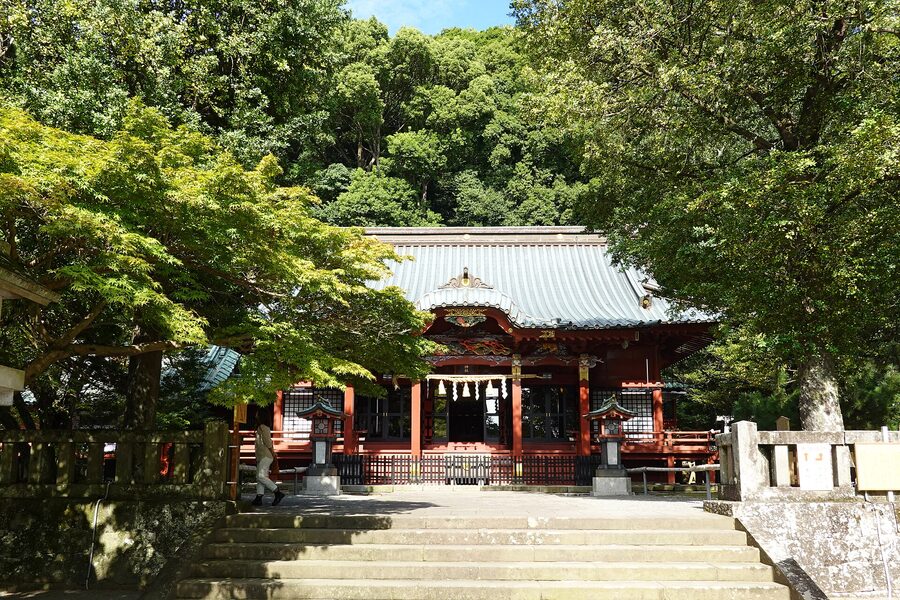

The single most historically significant site in Atami, and the one most day-trippers skip. Izusan Shrine sits on a forested hillside in the northern Izusan district, at the top of 170 stone steps (the original full pilgrimage staircase from the seafront is 837 steps; you do not have to do the whole thing). Records of the shrine date back to at least 836 AD.
The fame of the shrine is tied to Minamoto no Yoritomo. After the Heiji Rebellion in 1160, Yoritomo was sentenced to exile in Izu and spent the next twenty years here praying for the restoration of his Minamoto clan. According to local tradition, this was also where he met Hojo Masako, his future wife and one of the most politically formidable women in medieval Japanese history; the “Yoritomo and Masako resting stone” (Koshikake-ishi) is meant to be where they sat in secret. When Yoritomo founded the Kamakura shogunate in 1185, Izusan became one of the “Two Sacred Shrines” of the new regime, alongside Hakone Shrine. The chozuya has red and white dragon spouts — the “Sekibyaku Niryu” of local legend, said to live underneath Izusan and to power both the hot springs of Atami and Hakone. Admission free, dawn to dusk. Tokai Bus from Atami Station to Izusan-jinja-mae, then 170 steps; about 15-20 minutes by bus.
Day-use onsen
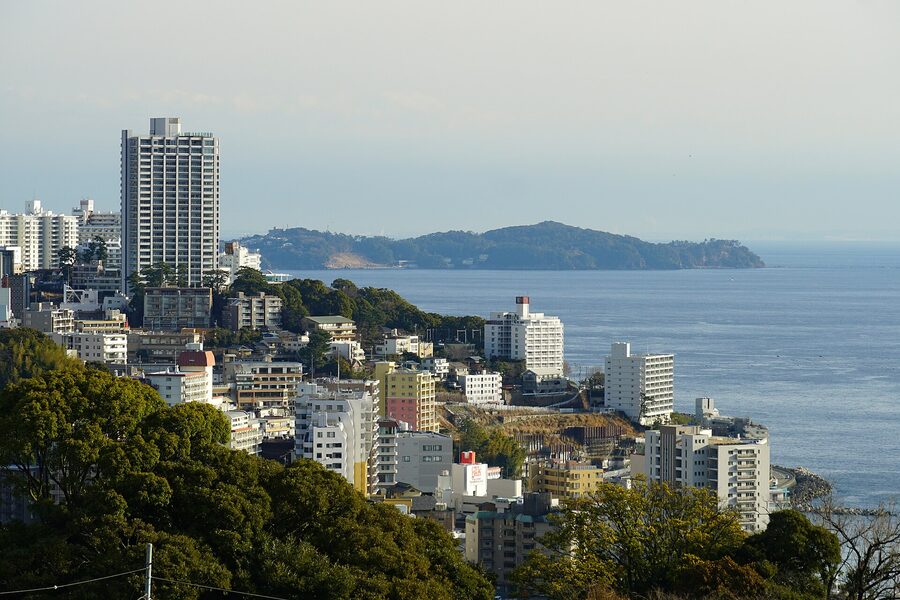

Atami runs on hot water. The town has more than 410 documented hot-spring sources of which roughly 250 are currently in production, gushing some 18,000 litres per minute, with source temperatures up to 98°C. The water is mostly sodium-calcium chloride; mildly alkaline; smooth on the skin without being slippery. The eighth-century legend says the springs were originally undersea vents causing problems for fishermen until a Buddhist priest named Mankan, on Hakone’s orders, prayed them inland onto the hillside — this is where the Yu-mae Shrine site is now.
For day-trippers, the easiest move is a hotel day-use bath (higaeri-yoku). Three solid options:
- Oasis Spa Fuua (Atami Korakuen Hotel) — ¥3,300 weekday / ¥3,850 weekend, large rooftop infinity bath over Sagami Bay. About 8 minutes by free shuttle from Atami Station.
- Hotel Micuras — rooftop sky bath with sea views, day-use around ¥1,500-2,500. 10 minutes’ walk from the station.
- Atami Taikanso — the historic ryokan-hotel, sweeping bay views; ¥1,500-2,000 bath only. 15 minutes by bus.
Free options exist if you want a taste rather than a soak. Ieyasu-no-Yu is a small free foot bath outside Atami Station’s south exit, named after Tokugawa Ieyasu’s 1604 visit. Fukufuku-no-Yu is a free hand bath halfway down Heiwa-dori. Both are open during daylight hours.
If you’ve never been to a Japanese onsen before, read up first — rinse before entering, no swimwear, towel folded on your head, no photos in changing rooms. My onsen etiquette guide covers the full sequence.
The Oyu Geyser
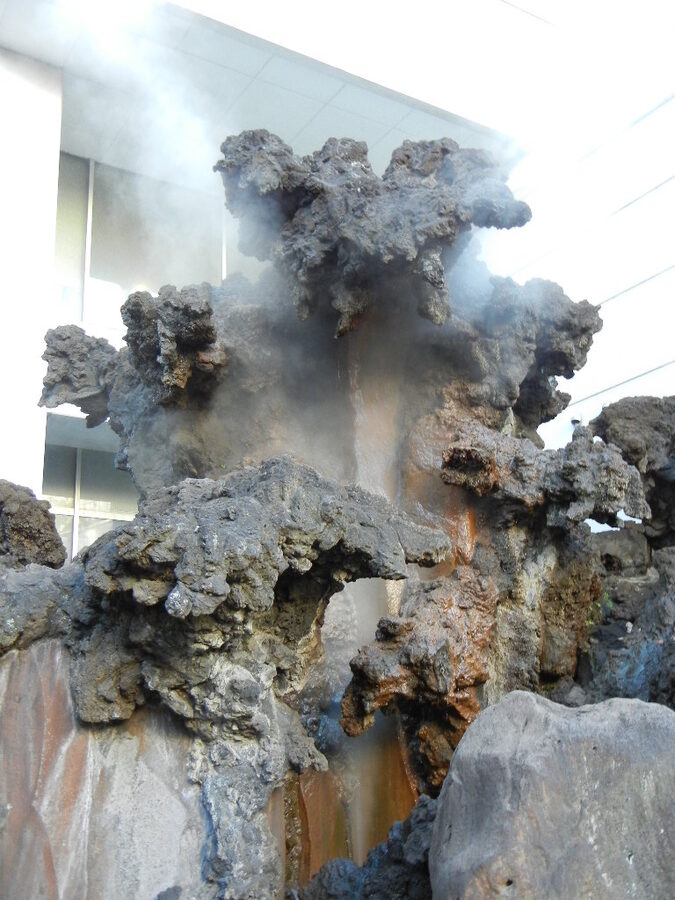

A 10-minute walk inland from Atami Station gets you to the Oyu Geyser, the historic centre of Atami’s onsen geology. In the late Edo era it was erupting eight times a day and was occasionally listed alongside Old Faithful as one of the world’s great geysers. Over-drilling in the late nineteenth century killed the natural eruptions; the geyser you see today is a recreated municipal vent installed in 1962. The surrounding park has a small monument to the British envoy Sir Rutherford Alcock and the grave of his Scottish terrier Toby, who was scalded here in the 1860s and is buried under a stone reading “poor Toby.”
Atami Sun Beach
.jpg)
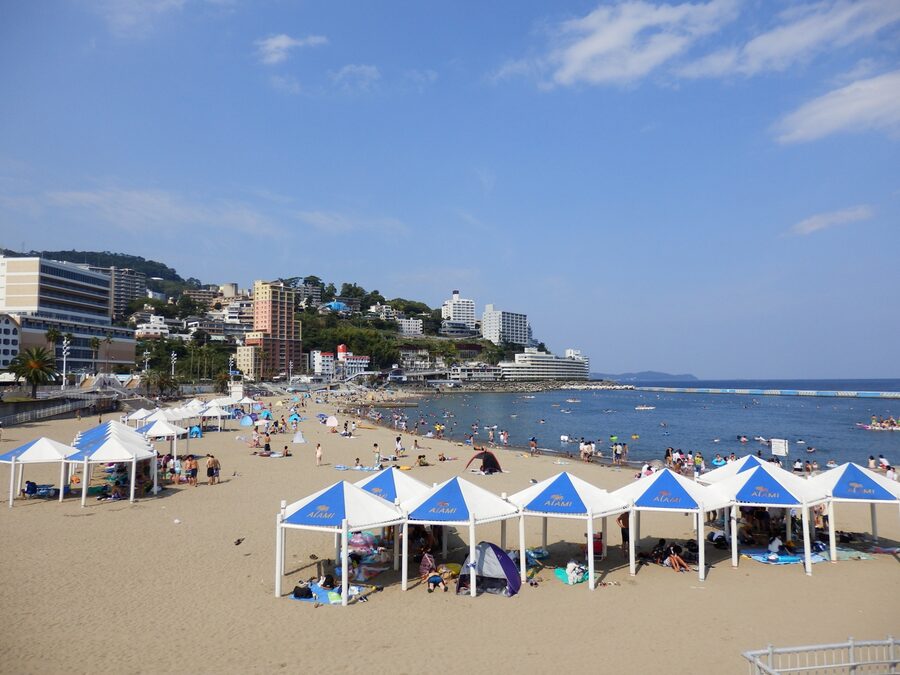
Atami Sun Beach is a 400-metre crescent of imported sand on the western edge of the harbour, lined with palm trees and finished in 1986. Official swimming season runs from mid-July to late August; outside of that the beach is closed for swimming but the promenade is a nice 20-minute walk between the station and the seafront onsen hotels. Honest take: skip the beach in winter unless you want the seafront walk — the wind comes in straight off Sagami Bay and the water is too cold. It’s also the best free seat for the Atami Bay Fireworks on display nights.
Atami Bay fireworks
The Atami Bay Fireworks (Atami Kaijo Hanabi Taikai) have run since 1952 and are unusual in happening multiple times a year — typically eight to ten dates spread between April and December, with the most concentrated run in summer and a smaller winter run in December. Each show lasts 25-30 minutes and is launched from boats in the bay, so the burst reflects on the water and the natural amphitheatre of hills throws the sound back across the harbour. Best free viewing spots are Sun Beach itself, the Shinsui Park promenade, and the Atami Castle rooftop (open late on display nights). Confirmed dates each year at ataminews.gr.jp.
What to eat
Atami’s food specialty is the local seafood from Atami Port and Ajiro Port. Catches you’ll see most often are amadai (tilefish, often grilled with salt or in a clear broth), aji (horse mackerel, as sashimi or aji-furai), sazae (turban shells, grilled in their shells with soy sauce as sazae no tsubo-yaki), and shirasu (whitebait), served either nama (raw) if the boats have run that morning or kama-age boiled. A shirasu-don is a bowl of rice covered in a generous fall of these tiny translucent fish; ask whether they have nama before you order — the raw is much better.
Three places near Atami Station: Asahi-ya Sushi on Heiwa-dori (unfussy local sushi counter, ¥2,500-4,000), Sakuraya (old-school amadai specialist, set lunches around ¥1,800), and Kinta (casual seafood market-style near the harbour, ¥2,000-3,000).
Atami versus Hakone
The single most-asked question about Atami is whether to do it instead of Hakone. Both are onsen day-trips of roughly the same length. Pick Atami if you want faster transit (Shinkansen 40 min vs Romance Car 90 min), urban onsen culture rather than nature, a beach, an art museum or a historic shrine, you have a JR Pass, or you’re visiting in January or February for the plum blossom. Pick Hakone if you want dramatic volcanic landscape, the Lake Ashi torii gate, the Hakone Open-Air Museum, the boiling Owakudani sulphur valley, classic mountain ryokan style, or the option to see Mt Fuji on a clear day. Hakone is the easier postcard; Atami is the more interesting walk.
When to come
- January-February. Plum blossom at Atami Baien (peak roughly second week of February). The single best winter outing on this side of Tokyo for blossom photographs.
- Mid-March. Cherry blossom on the Itogawa river path and at Atami Castle — 2-3 weeks earlier than central Tokyo.
- Mid-July to late August. Beach swimming season. Multiple fireworks dates. Crowded but lively.
- September-October. Quiet shoulder. Onsen weather is good. Fireworks dates continue.
- Late November-early December. Maple leaves at Atami Baien and the Momiji Festival.
Practical info
- Shinkansen: Tokyo to Atami, Tokaido Shinkansen Kodama or Hikari, 40-50 minutes, ¥3,740 unreserved one-way. Covered by JR Pass; not covered by JR Tokyo Wide Pass or JR East Pass.
- Local train: Tokyo to Atami, JR Tokaido Line, 100-120 minutes, ¥1,980-2,090. Covered by all JR passes.
- Local bus pass: Atami 1-Day Pass, ¥800, sold at the Tokai Bus counter inside Atami Station.
- MOA Museum of Art: ¥2,000 adult, 09:30-16:30, closed Thursdays.
- Atami Castle: ¥1,100 adult, 09:00-17:00, no closing days.
- Atami Plum Garden: ¥300 during festival (Jan-Mar), free other times. Open year-round.
- Kiunkaku: ¥610 adult, 09:00-17:00, closed Wednesdays and 26-30 December.
- Izusan Shrine: free. Daylight hours.
- Day-use onsen: ¥1,500-3,850 depending on hotel, mostly 13:00-16:00 entry windows.
- Atami Sun Beach: free. Swimming season mid-July to late August.
- Official tourism site: ataminews.gr.jp; city.atami.lg.jp for civic news.
Cash is widely accepted but most restaurants and shops now also take credit cards and IC cards (Suica, PASMO). The smaller seafood places off the main streets are still cash-preferred — carry a few thousand yen in notes.
My Atami day-trip plan
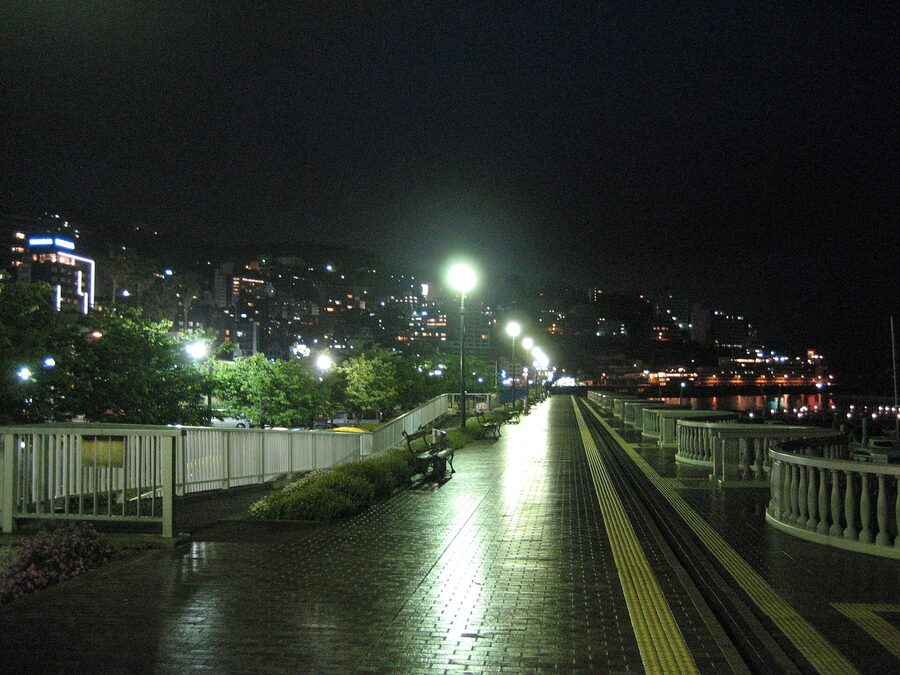

If I had one day to pitch Atami, I’d build it around the MOA, a long lunch, and an hour in a rooftop onsen. The 09:00 Kodama from Tokyo Station. MOA from 10:00 to 12:00 with a slow walk through the National Treasure rooms and a coffee on the lobby panorama deck. Shirasu-don for lunch on Heiwa-dori. A taxi to Atami Castle for the rooftop view at 14:00 and a hard skip on the interior. Back into town and across to the rooftop bath at Oasis Spa Fuua for an hour from 16:00. Walk the Sun Beach promenade at sunset. Bento and a Kodama back to Tokyo by 19:00.
If you’ve come in February, swap the castle for the Plum Garden. If the MOA is open, do not skip it for anything. If you’re also planning three days in Tokyo on the same trip and trying to budget your transit, do Atami on a day when you’d otherwise be doing a Shinkansen ride somewhere else — it’s the only way to make the ¥3,740 each way feel painless. And the train back at sunset, with the bay glowing pink to your left and the lights coming on along the coast, is one of those rides that genuinely is part of the trip, not just travel between bits of it.