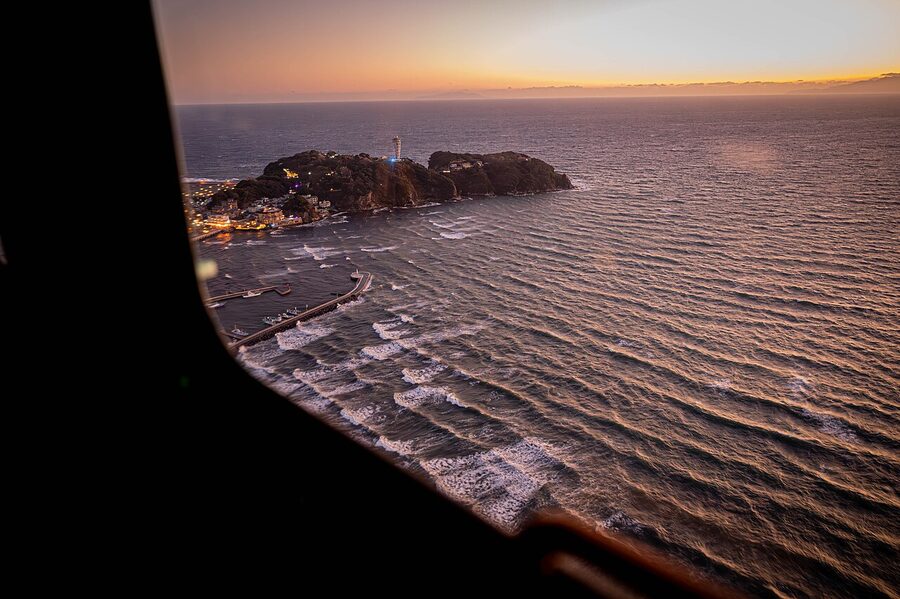
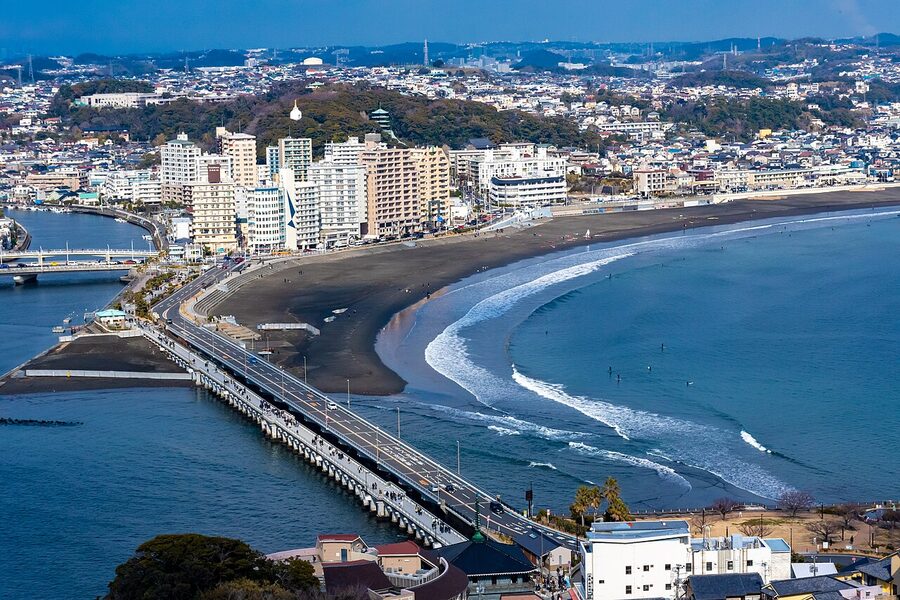
Enoshima is a tidal island. That’s the bit nobody tells you until you’re standing on the 389-metre Enoshima Ohashi bridge looking down at the water and realising the whole place was once cut off from the mainland at high tide. It still would be, if the 1923 Kanto earthquake hadn’t shoved the island roughly two metres higher out of the sea. The shrine at the top has been here since 552 AD by tradition, the Iwaya sea caves at the south-western tip have been a meditation spot since Kobo Daishi’s time in the 9th century, and the whole 4-kilometre-perimeter island sits about 60 minutes from Shinjuku on the Odakyu line. It’s one of the most efficient day trips you can do from Tokyo, and almost everyone pairs it with Kamakura on the same Enoden train line.
In This Article
- Enoshima in thirty seconds
- First, the confession
- Getting there
- Odakyu line from Shinjuku (the main route)
- Enoden from Kamakura (the scenic option)
- JR via Fujisawa
- The Enoshima-Kamakura Freepass
- Pairing with Kamakura
- The island walk
- The bridge and Benzaiten-Nakamise
- Enoshima Jinja (the three shrines)
- The Escar escalators (¥360)
- Samuel Cocking Garden and the Sea Candle
- The walk to Iwaya (and Oku-tsu-miya)
- The Iwaya sea caves
- What to eat
- The views (and Mt Fuji)
- When to come
- The beaches and Shichirigahama
- My one-day Enoshima-only plan
- My Kamakura plus Enoshima combined day plan
- Practical info at a glance
- Useful links
Enoshima in thirty seconds
A small wooded island just off Fujisawa in Kanagawa Prefecture, about an hour and a half from central Tokyo on the Odakyu line. Connected to the mainland by a long pedestrian bridge plus a separate vehicle bridge. Three linked Shinto shrines climbing up the spine of the island, a 59.8m observation tower called the Sea Candle at the highest point, and a set of sea caves at the far end. Pacific Ocean on one side, Sagami Bay on the other, and Mt Fuji on the horizon if the weather behaves.
It is touristy. It is also small, walkable, and unpretentious in the way Japanese tourist islands tend to be — old shops selling rice crackers, cats sleeping on stone steps, the smell of grilled squid drifting up the staircases. It pairs almost too neatly with Kamakura on the same trip, which is what most people do.
First, the confession
I tried to do Enoshima from the bottom up the first time. As in, I crossed the bridge, walked past the shrine entrance because it was uphill, and went straight to the Iwaya caves at the far end. By the time I’d climbed back out of the caves and started up towards the shrine, the temperature had hit 28 degrees, my legs had given up and I had to take the paid Escar escalators just to make it to the Sea Candle without sitting down on a bench and crying. Don’t be like me. Start at the shrine and work outwards, or take the Escar up first and walk down. Your knees will thank you.
Getting there
There are three sensible routes from Tokyo, and one of them is faster but more expensive. Pick by what you care about most.
Odakyu line from Shinjuku (the main route)
The Odakyu Enoshima line runs directly from Shinjuku to Katase-Enoshima Station, which sits about a five-minute walk from the bridge. There are two speeds:
- Romancecar (the comfortable option) — about 70 minutes. All seats reserved. Around ¥640 base fare plus a ¥1,280 limited-express seat reservation. The Romancecar trains have big windows and fold-out trays. Worth it if you’re starting your day at 8am and want to nap.
- Rapid Express + local (the cheaper option) — about 90 minutes. Around ¥640 total. Take a Rapid Express to Fujisawa Station, then change to the Odakyu Enoshima line local that goes 3 stops down to Katase-Enoshima. No seat guarantee.
From the gates at Shinjuku, follow the Odakyu signs near the Mylord department store at the South Exit. The platforms for Fujisawa-bound trains are usually 4 and 5. If the sign says “Rapid” in red or “Rapid Express” in orange, that’s the right train.
Enoden from Kamakura (the scenic option)
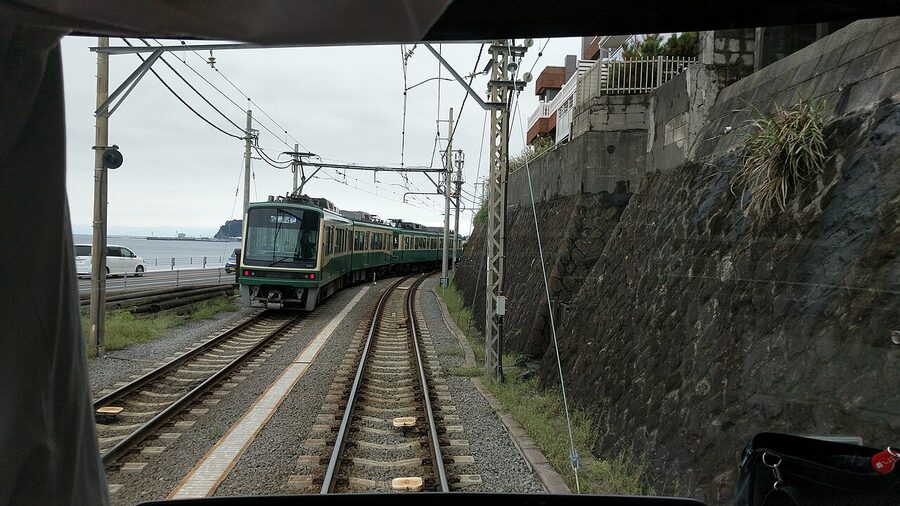
If you’re already in Kamakura, the Enoden tram is the obvious connection. It’s a single-track coastal railway that has been running since 1902, and the section between Inamuragasaki and Koshigoe runs along the seafront like something from a film. Trains every 12 minutes, around 25 minutes from Kamakura to Enoshima Station, ¥260 one way. Enoshima Station is about a 12-minute walk to the bridge — slightly further than Katase-Enoshima but you get the slow tram experience as part of the deal.
JR via Fujisawa
If you’ve got a JR Pass, take the JR Shonan-Shinjuku Line or Tokaido Line to Fujisawa Station, then transfer to the Odakyu local for three stops to Katase-Enoshima. About 50-55 minutes from Shinjuku/Shibuya. The JR Pass covers the JR portion; you’ll pay around ¥190 for the Odakyu hop.
The Enoshima-Kamakura Freepass
If you’re doing both Enoshima and Kamakura in one day from Tokyo (which is what most people do), this is the pass to buy. ¥1,640 for adults, sold at any Odakyu ticket machine in Shinjuku. It covers:
- Round-trip on the Odakyu line between Shinjuku and Fujisawa/Katase-Enoshima
- Unlimited use of the Odakyu line within the Fujisawa-Katase-Enoshima section all day
- Unlimited use of the Enoden between Fujisawa and Kamakura all day
- Small discounts on Iwaya cave entry, Sea Candle, and Samuel Cocking Garden
The maths: a one-way Shinjuku-Katase-Enoshima fare is around ¥640, an Enoden Enoshima-Kamakura return is around ¥520, and the regular fare back to Shinjuku is another ¥640. That’s already ¥1,800 before any attraction discounts, so the Freepass pays for itself almost immediately. The only catch: it doesn’t include the Romancecar reservation if you want one — that’s a separate ¥1,280 ticket.
Pairing with Kamakura
This is the classic combination. Kamakura is the bigger destination — the Great Buddha at Kotoku-in, Hasedera Temple’s ocean views, Tsurugaoka Hachimangu shrine — and Enoshima is the lighter, breezier add-on with sea air and fewer crowds. Both sit on the Enoden line so it’s literally a 25-minute tram between them.
The order I’d go in: Kamakura in the morning, Enoshima in the afternoon. The Great Buddha and the big temples are at their quietest before 10am, and Enoshima is at its prettiest in late-afternoon light when the Sea Candle catches the sun. If you want the full Kamakura day plan with timings, I’ve written it up in detail at my Kamakura day-trip guide.
The island walk
Once you’re on the bridge, the route up the island is essentially a single staircase climb with two side branches and a final descent into a sea cave. There are paid escalators (the Escar) for most of the climb if you want to skip the stairs, and you can walk down everything for free.
The bridge and Benzaiten-Nakamise
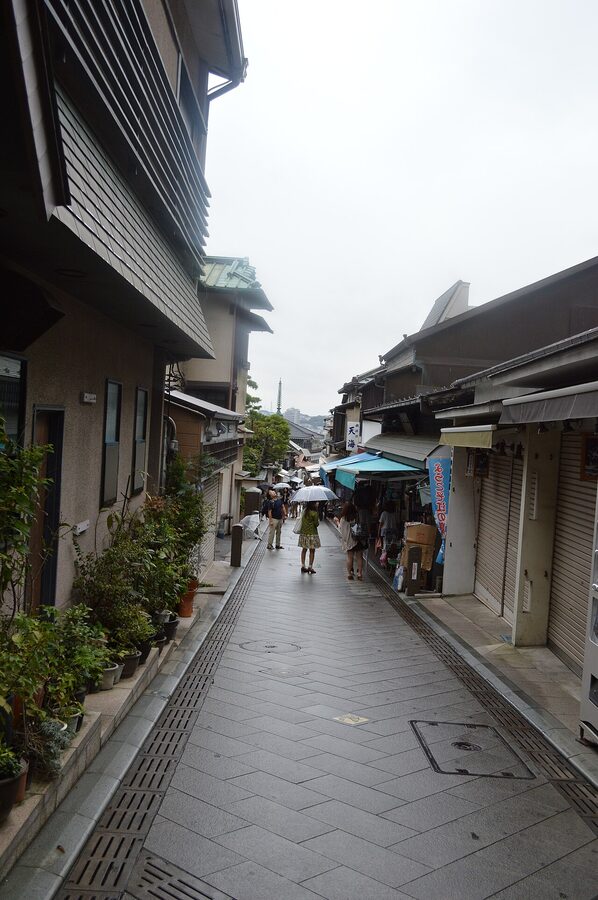
You cross the bridge — about 6 minutes at a normal pace — and on the other side you hit Benzaiten-Nakamise, the souvenir-and-snack street that runs uphill to the shrine. This is where you’ll find the famous tako-senbei: a whole baby octopus pressed flat between two hot iron plates into a paper-thin cracker the size of your face. You’ll see the queue before you see the shop. They cost around ¥500 each and they’re surprisingly good — salty, slightly chewy in the centre, crispy at the edges.
About a third of the way up the street, on the right, is the bronze torii (1747) that marks the entrance to the shrine. Through the torii is a second, more decorative gate called Zuishinmon, painted vermilion in the style of a Chinese palace.
Enoshima Jinja (the three shrines)
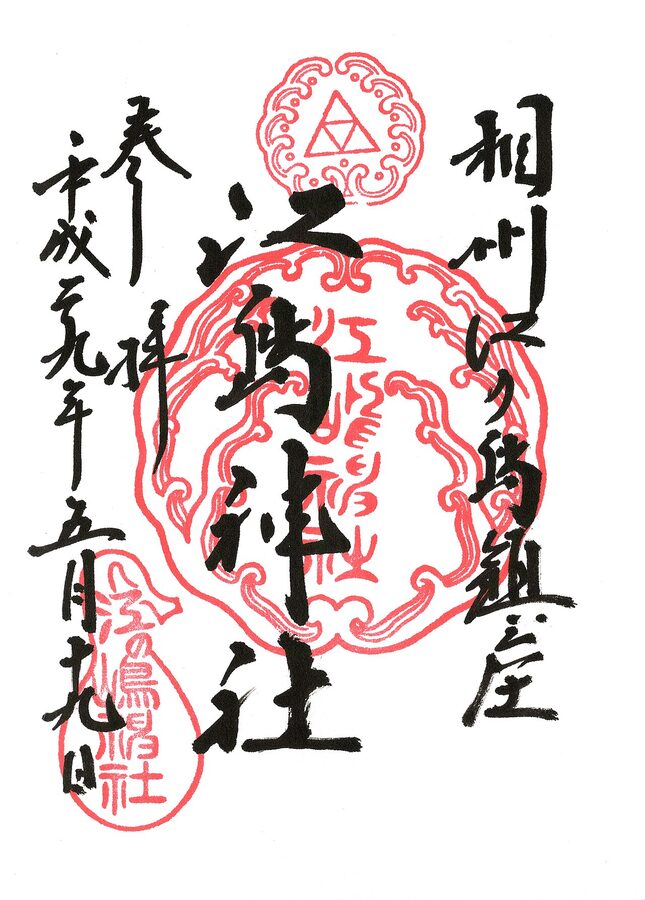
“Enoshima Shrine” is actually three separate shrines climbing up the island in order:
- Hetsu-miya (lower shrine) — first one you reach. Founded by Minamoto no Sanetomo in 1206 according to the temple records. There’s a money-washing pond next to the main hall; rinse your coins or a folded note in the bamboo basket and your wealth is supposed to multiply. I’m sceptical, I still do it every time.
- Naka-tsu-miya (middle shrine) — about a third of the way up. Said to be founded by the monk Ennin in 853. Quiet, rarely crowded, easy to walk straight past.
- Oku-tsu-miya (upper / inner shrine) — at the far end of the island near the Iwaya caves. Originally the most sacred of the three because it sat closest to the sea caves where the meditation traditions began.
The three goddesses worshipped here are Tagitsuhime, Ichikishimahime, and Tagirihime — daughters of the storm god Susanoo and patrons of seafarers and music. Benzaiten, the more famous local goddess, is honoured separately at the Hoanden hall on the Hetsu-miya grounds. You can pay ¥200 to go inside and see the wooden eight-armed Benzaiten statue, designated an Important Cultural Property in 2019.
The Escar escalators (¥360)
The Escar is a series of three outdoor escalators that climb the steepest 46 metres of the island. They opened in 1959 and were Japan’s first outdoor commercial escalators. The cost is ¥360 for all three sections together (¥210 if you only want the first one). Worth every yen if it’s hot, you’re tired, or you’ve got kids. The catch: there’s no down-escalator. You walk back down whatever way you go up.
My honest tip: take the Escar up, walk back down on the way out. It saves the worst of the climb but lets you do the descent at your own pace, and you’ll see the Sea Candle and shrines from totally different angles on the way down.
Samuel Cocking Garden and the Sea Candle
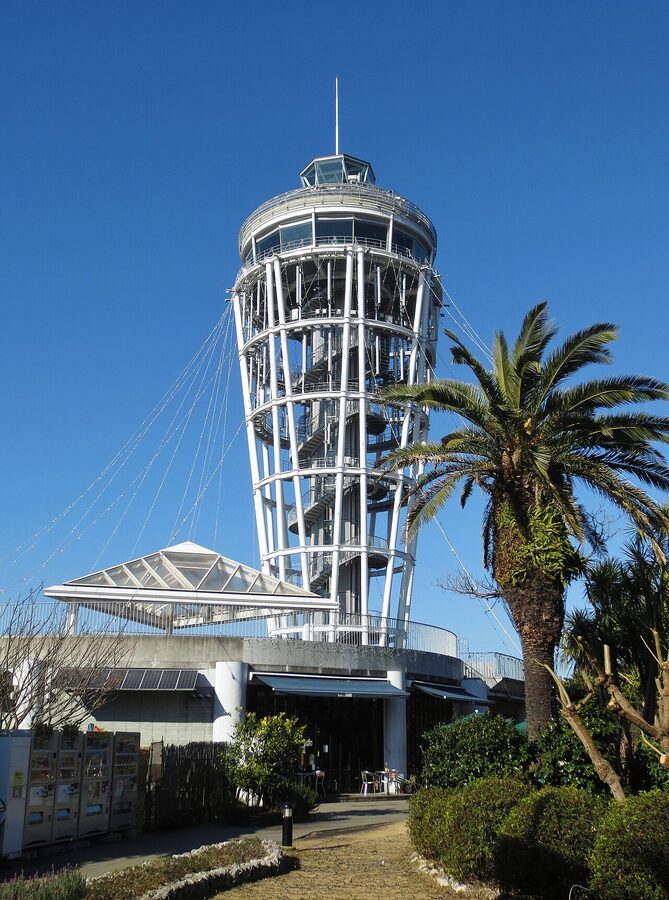
At the top of the Escar (or after a long staircase climb) you reach the Samuel Cocking Garden. This is the highest point of the island, and the patch of land was bought in 1880 by an Irish merchant called Samuel Cocking who built a botanical garden and tropical greenhouse here in 1882. The original greenhouse foundations were rediscovered during a 2002-2003 restoration and you can still see the brick remains in the garden. Camellias bloom from January to March and the ground is laid out in a slightly chaotic English-Japanese hybrid that I find more interesting than tidier Japanese gardens.
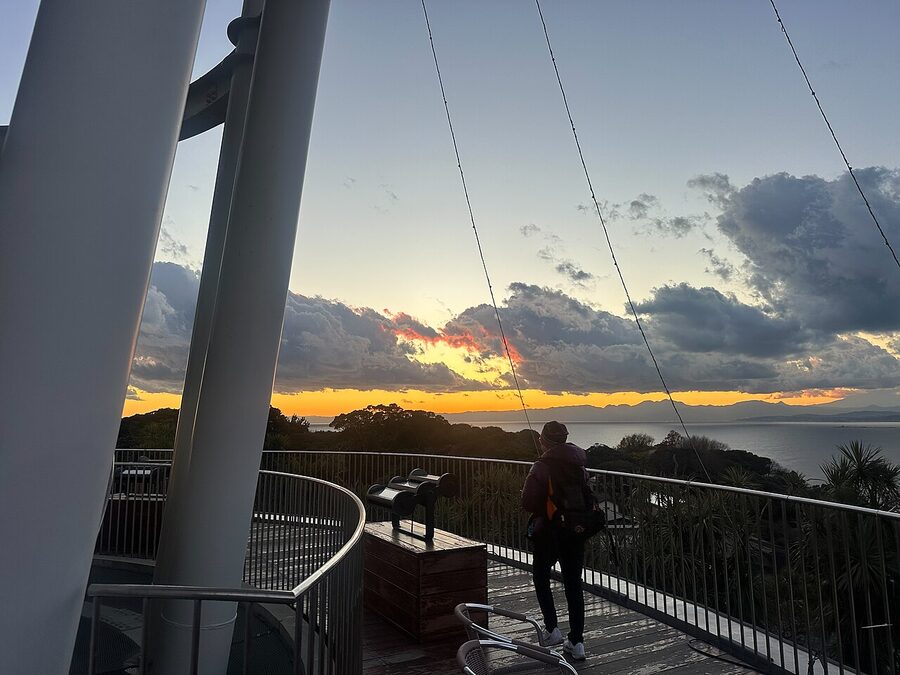
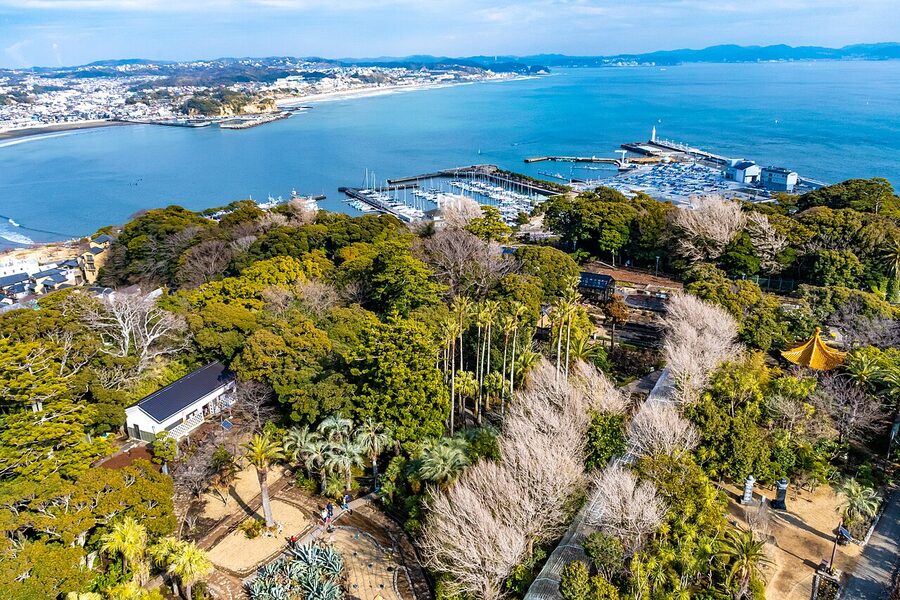
Inside the garden grounds is the Enoshima Sea Candle — the lighthouse-observation-tower hybrid that’s the island’s most recognisable landmark. The combined ticket for garden + tower is ¥500 (with the Freepass discount, less without). A glass elevator takes you up to the indoor observation room, then a spiral staircase climbs one more level to the open-air deck. On a clear day you see Mt Fuji to the west, the Pacific to the south, and the entire Shonan coast curving back towards Kamakura to the east. The views at sunset are the genuinely best thing on the island, but the deck closes at sundown plus 30 minutes most of the year, so check the time of year.
The walk to Iwaya (and Oku-tsu-miya)
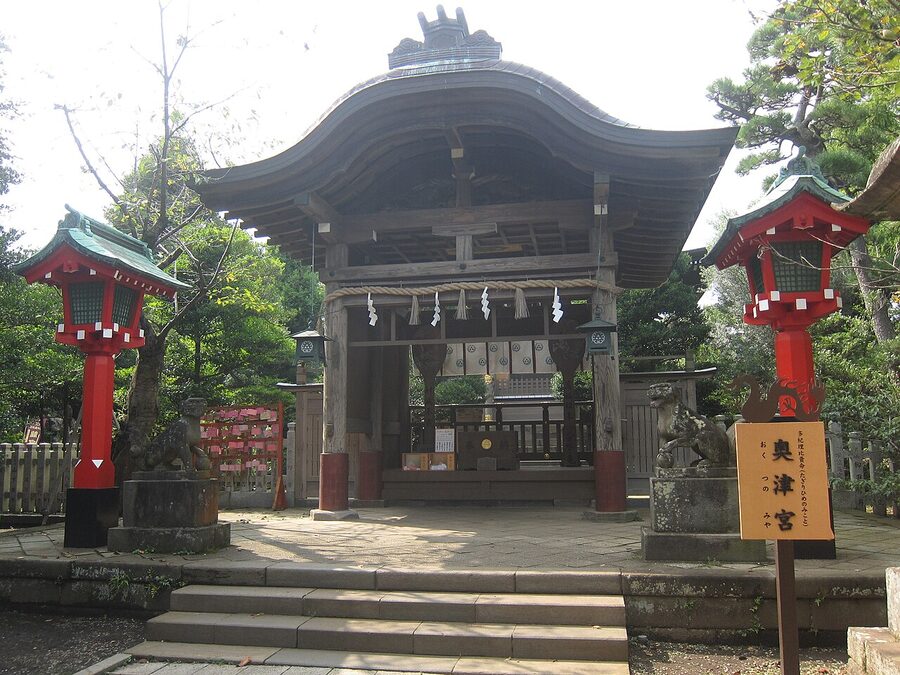
From the Sea Candle, the path drops down through trees to the Oku-tsu-miya, the innermost shrine. The walk takes about 10 minutes and the vibe shifts noticeably — the shopping crowds thin out, the trees get older, and you start hearing the surf below. There’s a famous painted ceiling inside the worship hall called the “eight-direction-staring turtle” (the eyes seem to follow you wherever you stand). Look up.
Past the Oku-tsu-miya, the path winds down to the Chigogafuchi plateau — a flat shelf of rock at the south-western tip of the island that the 1923 earthquake pushed up out of the sea. You can walk right out onto it if the tide is low enough. Anglers fish here. People sit and eat ice cream and watch the swell.
The Iwaya sea caves
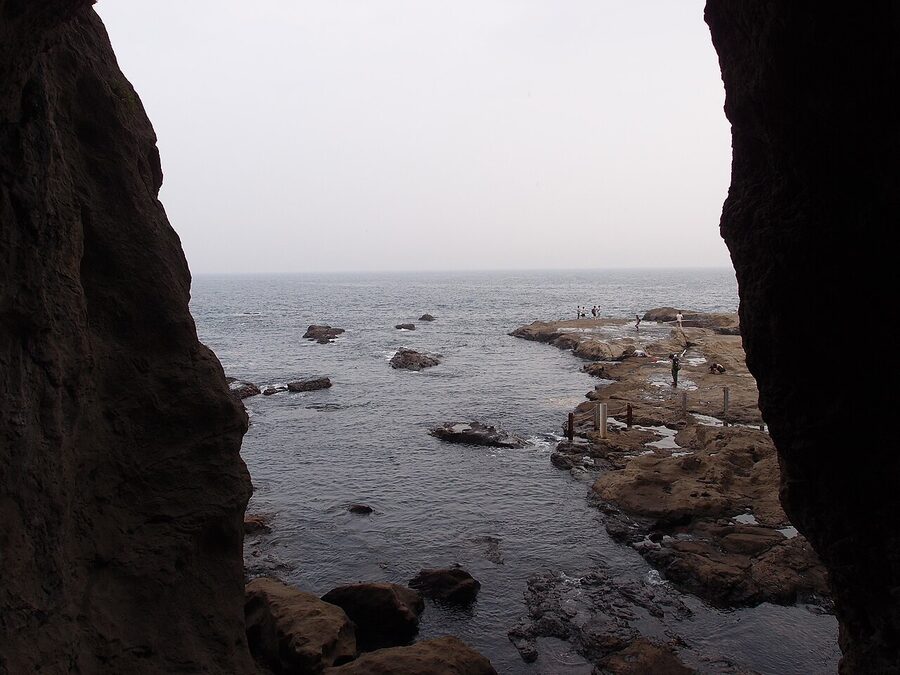
From Chigogafuchi, a 400-step staircase drops down to the Iwaya caves at the base of the cliffs. Two caves, both natural sea-cut chambers. Entry is ¥500 and you’re handed a candle lantern at the door (lit, on a wire handle), which you use for the back sections of the first cave where it goes properly dark. The first cave is the longer of the two and contains a series of stone Buddhist statues placed along the walls — these go back to the time when monks like Kobo Daishi (Kukai) were said to have meditated here in the early 9th century. The second cave is shorter and has a dragon shrine at the back that hisses when you approach (mechanical, but startling).
It’s genuinely worth the climb. I’ve been twice now and both times the caves were the bit that stuck with me afterwards more than the shrines or the tower. Wear shoes that grip — the cave floor stays damp.
What to eat
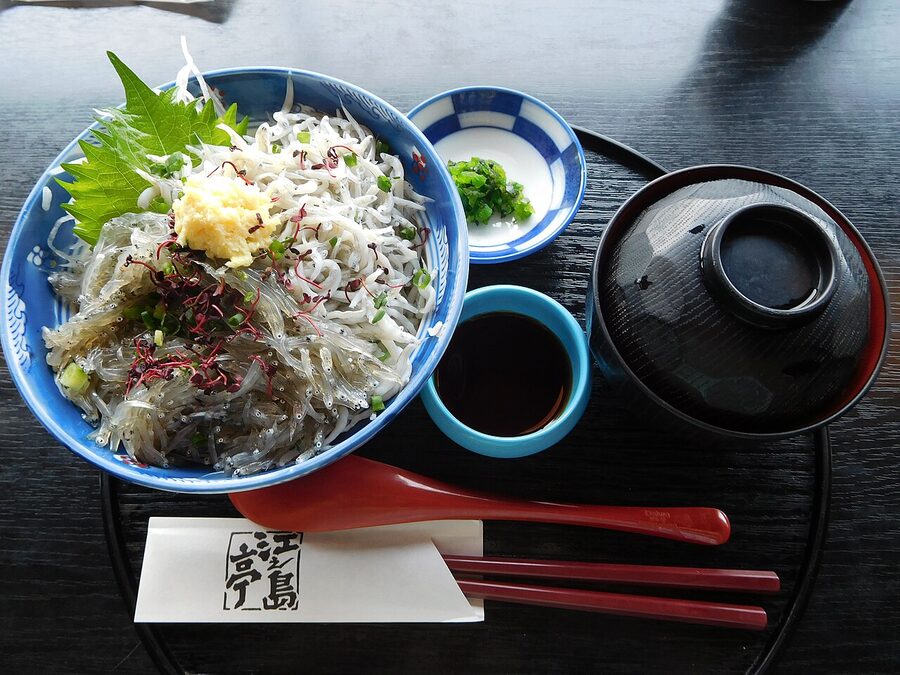
Two things you should eat on Enoshima, both connected to Sagami Bay just below the island.
Shirasu-don — a bowl of plain white rice topped with hundreds of tiny semi-translucent baby anchovies (whitebait). The shirasu fishing season runs March to December (closed January to mid-March for breeding) so if you visit then, you can have nama-shirasu (raw) which is the local treat. Outside that season it’s kama-age, briefly boiled. Most island restaurants do shirasu-don for ¥1,200-¥1,800. The bowl with both raw and boiled side by side is the one to order if you can.
Tako-senbei — the giant pressed-octopus rice cracker. Made by laying a whole baby octopus on a hot iron press and squashing it flat. ¥500ish. Look for the queue near the bottom of Benzaiten-Nakamise, you can’t miss it.
Beyond those two, look for grilled sazae (turban shells), Enoshima craft beer (the Cocking Garden has its own bar), and shirasu-pizza or shirasu-pasta if you want a less traditional spin.
The views (and Mt Fuji)
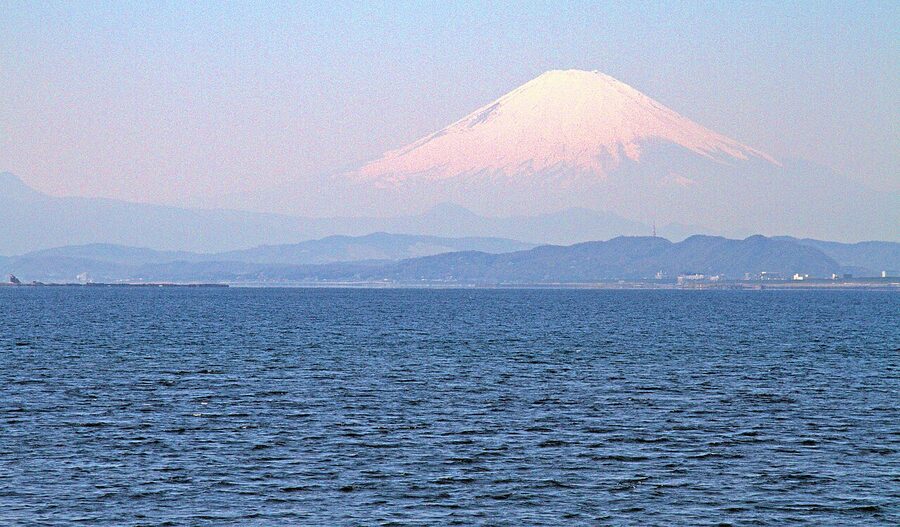
The Mt Fuji-from-Enoshima view is one of the most-painted scenes in Japanese art. Hokusai included it in his Thirty-Six Views of Mount Fuji in the early 1830s, and the angle from the island’s western edge is essentially unchanged. The catch is that Fuji is only visible on clear days — humidity in summer hides it almost completely, while winter mornings and late afternoons in the November-February window give the highest hit rate. I’ve been to Enoshima five times and seen Fuji clearly twice, hazily once, not at all the other two. So if you want it specifically for the view, plan for winter and check the morning forecast for visibility.
The best Fuji-and-Enoshima vantage points are: the Sea Candle deck (highest), the Oku-tsu-miya area (mid-island, framed by trees), and Chigogafuchi (sea-level, rocks-foreground composition). All three are free apart from the Sea Candle.
When to come
Honest seasonal ranking, best to worst:
- Late November to mid-February — coldest air, clearest Fuji, fewer visitors. The Sea Candle has a winter illumination event called Shonan no Hoseki (“Jewel of Shonan”) from late November to mid-February. Pack a coat for the deck.
- Late June — hydrangea season at the shrine. The shrine paths are lined with blue and pink hydrangea bushes for about three weeks around mid-to-late June.
- March-April — comfortable weather, possible cherry blossoms in the Cocking Garden, no crowds.
- October-early November — autumn weather, occasional clear Fuji days, manageable crowds.
- July-August — beach season, packed weekends, Fuji invisible, hot stair climbs. Avoid weekends in particular. Katase-Higashihama beach right by the bridge is one of the most popular swimming beaches in Kanto.
The beaches and Shichirigahama
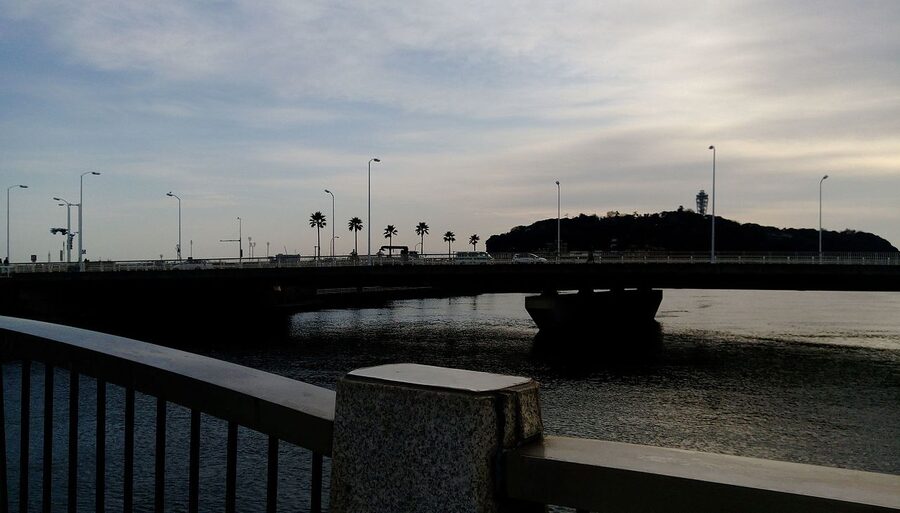
Two beaches sit either side of the bridge approach — Katase-Higashihama (east) and Katase-Nishihama (west). Both shallow, sandy, and crowded in July-August. The water is grey-green rather than tropical blue but the views back towards the island and out towards Fuji are worth the walk regardless of season.
Catch the Enoden one stop towards Kamakura and you’re at Shichirigahama, the long curved beach where Hokusai’s other classic Fuji scene was painted. It’s a surfing beach more than a swimming one, and there’s a windsurfing club at the western end. The Enoden traces the entire length of the beach so you can hop off for a quick look and hop back on to continue to Kamakura.
My one-day Enoshima-only plan
If you’ve got a clear day and only want Enoshima:
- 09:00 — Romancecar from Shinjuku to Katase-Enoshima (70 mins).
- 10:30 — Cross the bridge, walk Benzaiten-Nakamise, eat a tako-senbei.
- 11:00 — Hetsu-miya shrine and the Hoanden hall (¥200) for the wooden Benzaiten.
- 11:45 — Take the Escar up to the Sea Candle (¥360 + ¥500 garden/tower combined).
- 13:00 — Lunch at one of the restaurants near the Sea Candle. Shirasu-don.
- 14:00 — Walk down through Naka-tsu-miya and Oku-tsu-miya to Chigogafuchi.
- 15:00 — Iwaya caves (¥500). 400 steps down, 400 back up.
- 16:30 — Walk slowly back to the bridge along the east side of the island.
- 17:30 — Sunset at Katase-Nishihama beach if the weather is right.
- 18:30 — Train back to Shinjuku.
My Kamakura plus Enoshima combined day plan
The classic combo if you want both in one day:
- 08:00 — Buy the ¥1,640 Enoshima-Kamakura Freepass at Shinjuku Odakyu. Take the Rapid Express (or splurge on a Romancecar) to Fujisawa.
- 09:30 — Change to Enoden at Fujisawa, ride to Hase Station (Kamakura).
- 10:00 — Great Buddha at Kotoku-in, then Hasedera Temple. Both quietest before 11am.
- 12:00 — Enoden one stop to Kamakura Station. Lunch on Komachi-dori.
- 13:30 — Tsurugaoka Hachimangu shrine. Maybe Hokoku-ji bamboo garden if you’ve got energy.
- 15:00 — Enoden from Kamakura down to Enoshima Station (25 mins, sit on the ocean side).
- 15:30 — Cross the bridge, take the Escar straight up to the Sea Candle.
- 16:30 — Walk down via Oku-tsu-miya. Iwaya caves if you have time and energy.
- 17:45 — Sunset shirasu-don dinner near the bridge.
- 19:00 — Odakyu back to Shinjuku from Katase-Enoshima.
Practical info at a glance
- Getting to Enoshima from Shinjuku: Odakyu Romancecar 70 min ¥1,920 or Rapid Express + local 90 min ¥640.
- Best ticket: Enoshima-Kamakura Freepass ¥1,640 (covers Odakyu + Enoden all day).
- Bridge crossing: Free, about 6 minutes walk.
- Enoshima Jinja entry: Free for the shrines themselves. ¥200 for the Hoanden hall to see the Benzaiten statue.
- Escar escalators: ¥360 for all three (¥210 first section only). Up only.
- Samuel Cocking Garden + Sea Candle: ¥500 combined. Garden alone ¥200. Daytime hours until ~17:00, later in summer and during winter illumination.
- Iwaya caves: ¥500. Open 09:00-17:00 (16:00 in winter). 400 steps down and back up.
- Lunch budget: Shirasu-don ¥1,200-¥1,800. Tako-senbei ¥500.
- Best season: Late November-February for clearest Fuji and lightest crowds. Late June for hydrangeas.
- Worst season: Mid July-August weekends. Crowded beaches, hazy Fuji.
- Walking required: Lots. Wear flat, gripping shoes.
- Cash: Most stalls take cash only. Bring small notes and ¥100 coins.
Useful links
- Enoshima Jinja official site — shrine information in Japanese
- Fujisawa City — local government tourism resources
- Odakyu Railway (English) — for Romancecar reservations and the Freepass
- Enoden Railway (English) — Kamakura-Enoshima coastal tram
- Enoshima Sea Candle — observation tower and Cocking Garden hours
If you’ve enjoyed this and you’re planning more Tokyo escapes, see my Kamakura day trip guide for the natural pair, my Mt Fuji day trip for the bigger view, the Tokyo trains and IC card guide if you’re still working out the rail system, and my three days in Tokyo itinerary for fitting it all together. Take the Romancecar at least once. Eat the shirasu. Don’t skip the caves.