
You duck under a short blue-dyed cloth hanging across the doorway. The second the cloth brushes your head, somebody from inside the room shouts irasshaimase! and then a couple more voices pick it up from the kitchen, so now three people are yelling at you, welcoming you. A staff member in a checked headband waves you to a corner of a long wooden counter. You sit. You haven’t said anything yet. You’re handed a rolled-up hot wet towel in a little bamboo tray — that’s an oshibori, and it’s for your hands, not your face. Before you’ve even unrolled it, a small dish of pickled daikon and some edamame lands in front of you along with a glass of water. You haven’t opened a menu. You haven’t ordered. And you’ve just been charged ¥400 for food you didn’t ask for.
That’s an izakaya. This is how it works.
In This Article
- What an izakaya actually is
- The sequence when you walk in
- Otoshi — the charge that isn’t a mistake
- What everyone’s drinking
- The food, dish by dish
- Paying — the phrase and the process
- The three types of izakaya to know
- The Tokyo izakaya areas worth knowing
- The etiquette minimum
- What to skip
- What a night actually costs
- Timing — when to turn up
- One thing about smoking
- Practical info at a glance
- How I’d do a first izakaya night in Tokyo
What an izakaya actually is
The word breaks down to i (to stay, to remain) plus sakaya (sake shop), so literally “a sake shop to stay at.” For a couple of centuries that’s exactly what they were — liquor stores that started keeping a few stools inside for customers who wanted to drink their purchase on the spot, and then started frying up a few snacks to go with the drink. Somewhere around the Meiji era the snacks got more serious, the stools turned into tables, and the izakaya became a thing of its own.
It’s not a pub and it’s not a restaurant. The closest Western parallel is a Spanish tapas bar — small plates, lots of them, meant to be shared across the table, ordered a few at a time as you drink. You don’t come to an izakaya to eat a main course. You come to drink beer or chuhai or sake, and to graze on yakitori skewers and fried chicken and sashimi for two or three hours. Most izakayas only open in the evening — usually 17:00 until midnight or 01:00 — because that’s the entire point. This is a post-work place.
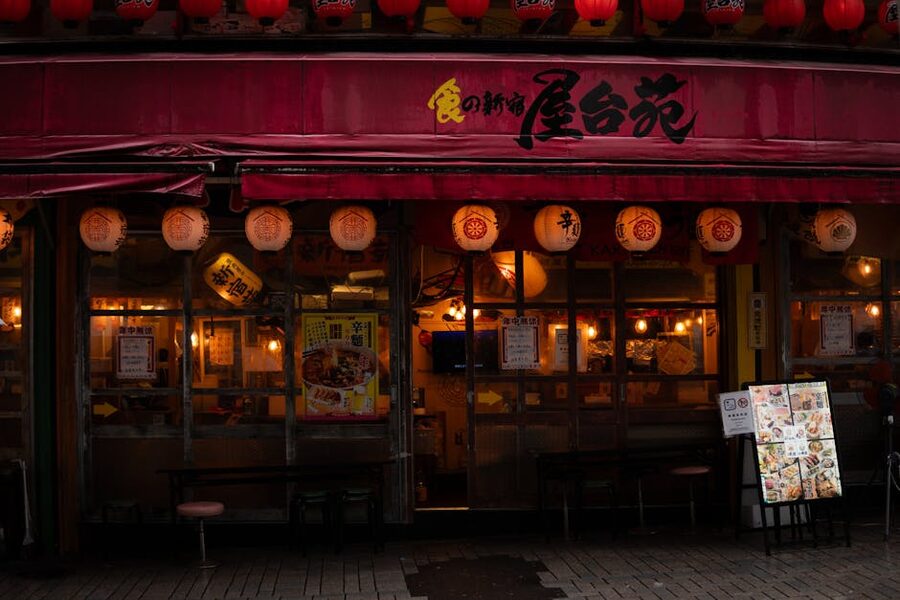
In Tokyo they are everywhere. Walk out of any major station and you’ll see the red paper lanterns within 30 seconds. The cluster is usually thickest directly next to the station — Shinjuku, Shibuya, Yurakucho, Ueno, Shimbashi, Ebisu — because the salaryman leaving the office at 19:00 is the core customer, and he is not walking far before his first beer.
The sequence when you walk in
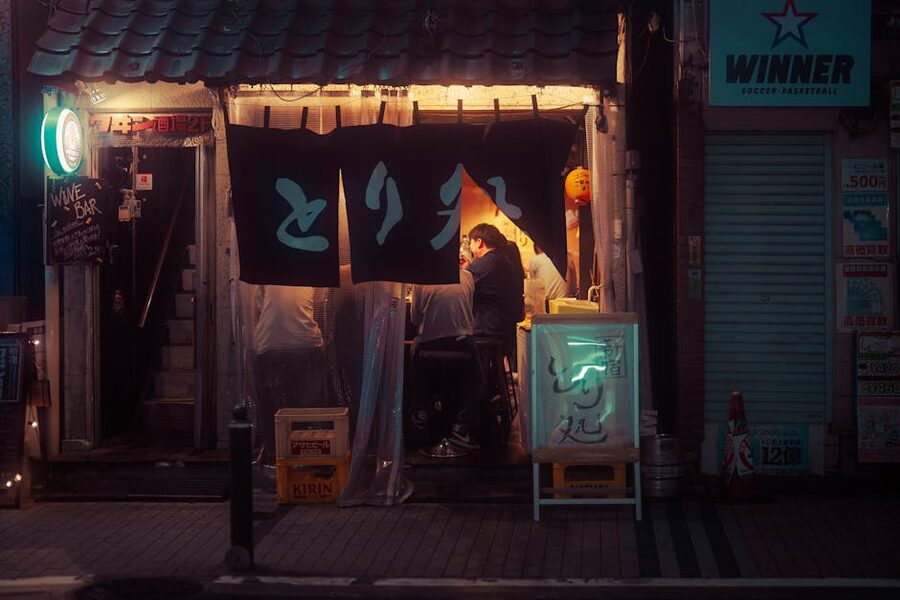
The entry ritual is the same basically everywhere — six-seat yokocho counter or five-storey chain, doesn’t matter. Learning it makes the whole thing feel a lot less chaotic. In order:
- The noren curtain at the door. A short fabric panel hanging in front of the entrance, usually indigo blue or dark red, split down the middle. If the noren is hung out, the shop is open. If they’ve taken it down, they’ve closed for the night — no ambiguity.
- The shout. You duck under the noren and the first person who sees you yells irasshaimase! (come on in). Don’t reply. You don’t bow. Nobody expects you to. Just walk in.
- How many are you? Staff will ask nanmei-sama? (how many people?). Hold up fingers. That’s fine.
- The oshibori. A rolled-up wet towel — hot in winter, cold in summer — arrives within about 20 seconds of sitting down. It’s for your hands. Not your face. Definitely not the back of your neck. Wipe your hands, fold it loosely, leave it on the tray.
- The otoshi lands. A small plate of something — could be simmered edamame, could be a cold pickled something, could be a tiny portion of cold tofu — appears on its own. This is not free and not a mistake. Keep reading.
- The drink order. Staff will come back and ask what you’re drinking. The overwhelming default is nama biru — draft beer — because everyone starts with beer.
- The food, whenever. Food is ordered in rounds as you drink. You don’t order everything at the start. You look at the menu, pick two or three things, and order more later.
That’s it. That’s the whole script. The thing most first-timers get wrong is trying to order the whole meal up front in one go — you can, but the kitchen will send everything at once and you’ll have five plates on a tiny table and a beer that’s already lukewarm. Order slowly.
Otoshi — the charge that isn’t a mistake
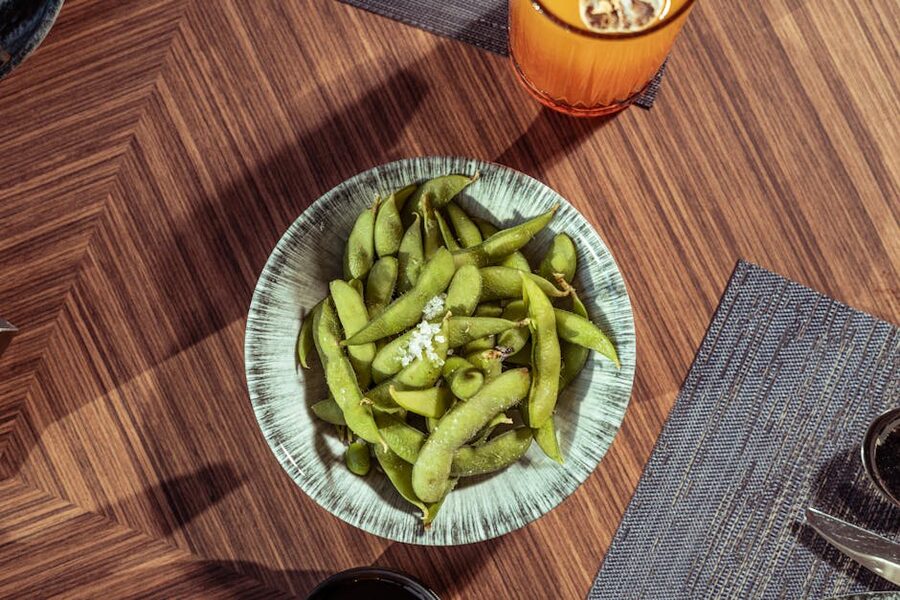
So. The otoshi. Also called tsukidashi depending on the region. You sit down, a small plate you didn’t order appears, and it ends up on your bill at roughly ¥300–600 per person. Nobody asked you if you wanted it. You can’t send it back.
This is the single thing that trips up every tourist. They see the charge on the bill and assume it’s a mistake, or a scam, or that they’ve been targeted as a tourist. None of that. This is a standard Japanese restaurant practice. It’s effectively a cover charge, dressed up as a small appetiser so it doesn’t look like one. Roughly three-quarters of all izakayas in Tokyo do it. Some signpost it with a sign at the entrance (ōtōshi-dai, usually alongside the price). Most don’t.
The right framing: think of it as the price of the seat. A normal izakaya is paying real Tokyo rent on real Tokyo ground and can’t survive on what you’d pay for two beers and a plate of edamame. The otoshi underwrites the space. You’re fine paying it. It’s also often quite good — I’ve had otoshi that was better than what I actually ordered.
The places that don’t charge otoshi are generally chains (Torikizoku doesn’t, Watami doesn’t) and tourist-facing bars. Which brings us to the next thing.
What everyone’s drinking
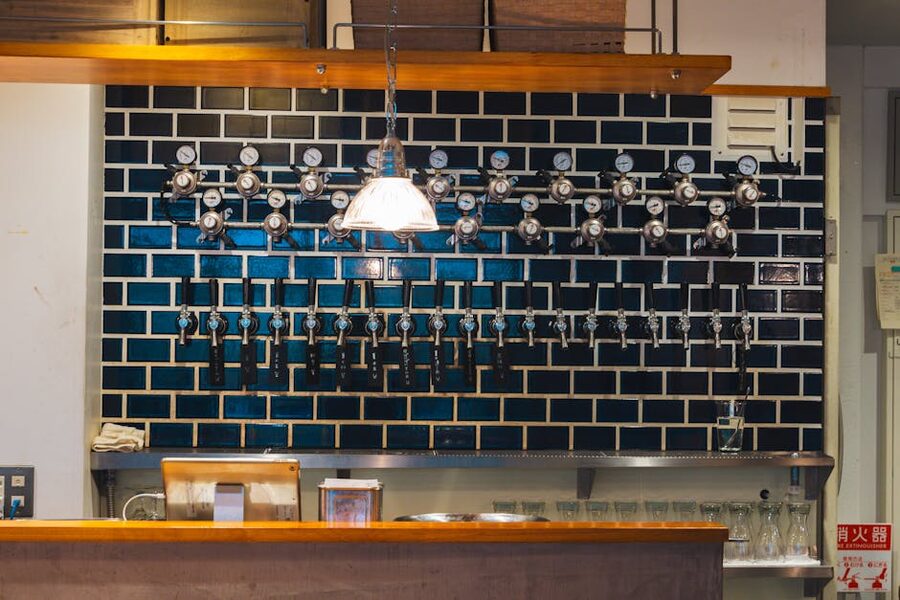
The drinks menu at a typical izakaya is narrower than you’d expect. This is not the place to be a craft beer enthusiast or a wine person. Know these five and you’re set:
- Nama biru (生ビール) — draft beer. The default. Almost always Asahi Super Dry, Kirin Ichiban, Sapporo, or Suntory Premium Malt’s, depending on which brewery the izakaya has a contract with. ¥500–700 for a medium. Say nama for draft, bin for a bottle. The first round at basically every izakaya in Japan is beer. Don’t fight it.
- Chuhai (酎ハイ). Shochu + soda water + a fruit flavour, served in a tall glass with ice. Lemon is the classic — so classic that plain chuhai is sometimes called “lemon sour” on menus. Grapefruit is equally popular. Also appears with yuzu, ume (plum), peach, lychee. ¥400–550. Very drinkable, deceptively strong. The budget izakaya’s second-round drink.
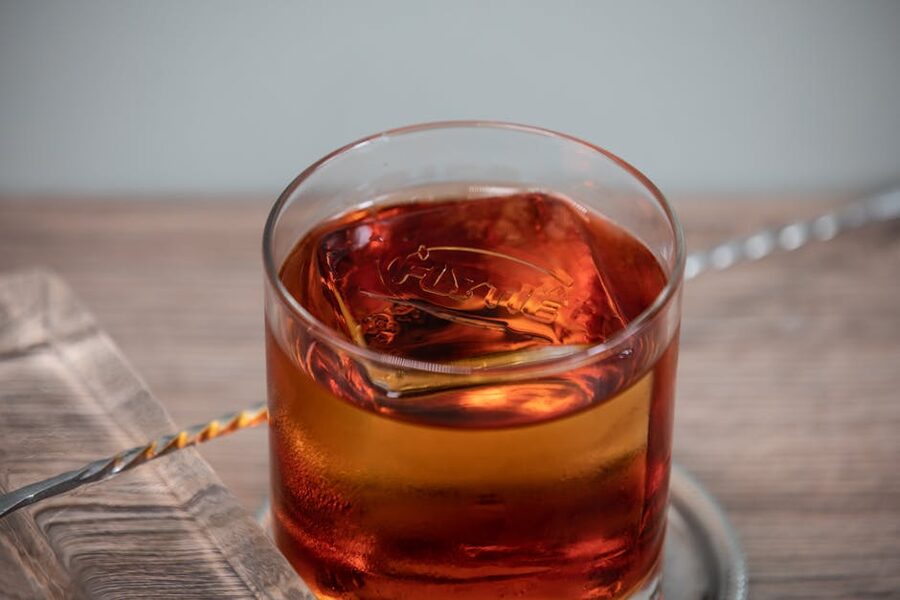
- Highball (ハイボール). Whisky + soda, almost always Suntory Kakubin over ice in a tall glass. Japan is collectively obsessed with highballs. Every chain has a machine that dispenses them; a lot of independents have a Kakubin bottle behind the bar and a soda gun. ¥500–700. Crisp, not sweet, pairs brilliantly with fried food.
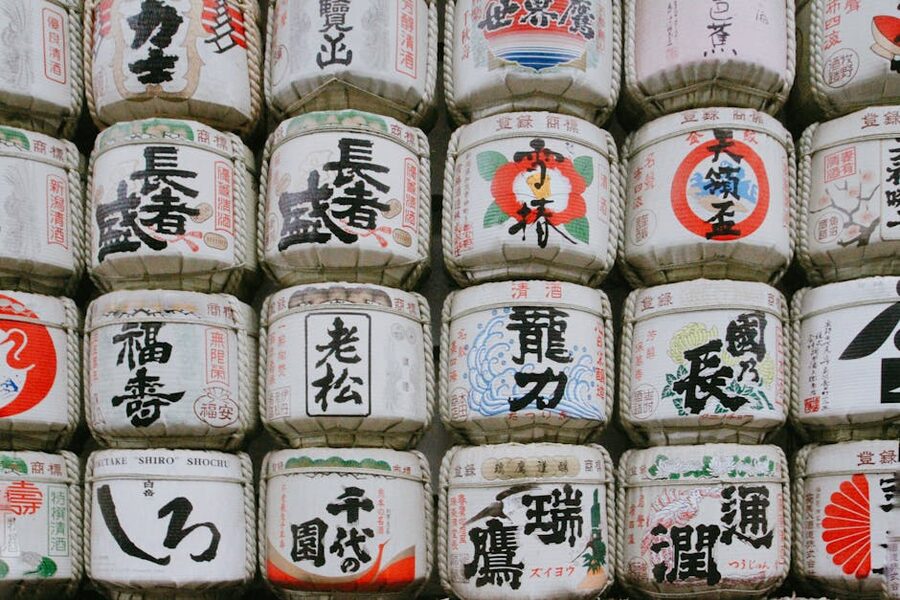
- Sake (日本酒). Nihonshu, to call it by the proper name in Japanese. Cold is hiya or reishu, warm is atsukan, lukewarm is nurukan. Poured into a small cup or a wooden box (masu) that sometimes sits on a saucer, which the staff overfill deliberately so it slops into the saucer — that’s the pour being generous. Cold in summer, warm in winter. If you don’t know what to order, just say osusume wa? (what do you recommend?).
- Oolong cha (烏龍茶). Oolong tea. The non-drinking option. Nobody will judge you.
One rule: you don’t drink before the kanpai. Once everyone has a glass, somebody raises theirs, says kanpai, and only then does the first sip happen. Pouring yourself a drink first is a small but noticeable faux pas. The related thing: you pour for the people around you and they pour for you. See the full dining etiquette piece for the unwritten bits.
The food, dish by dish
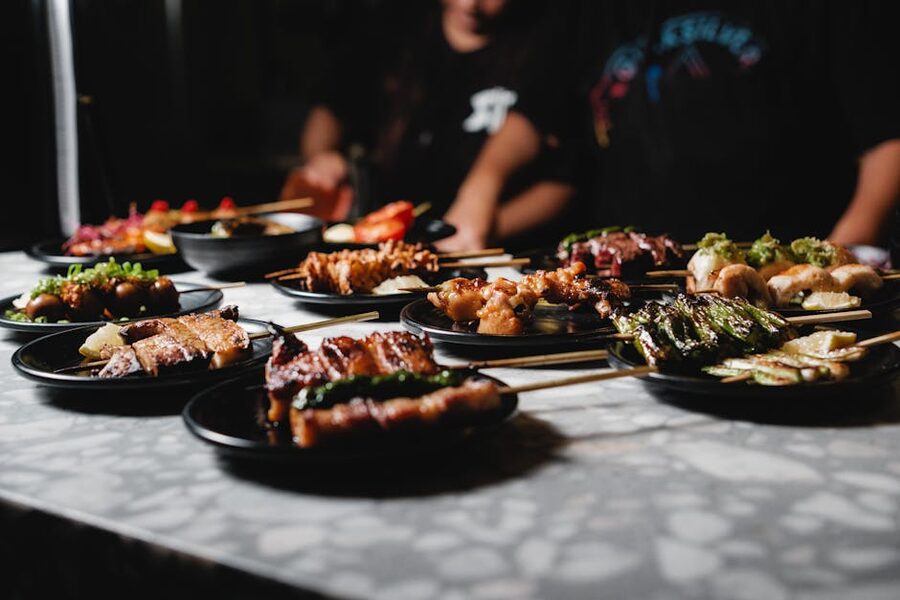
An izakaya menu can look overwhelming. It isn’t, once you know that about 70% of the menu is some version of the same core dishes in slightly different forms. Here’s the short list I actually order from when I want a good evening:
- Yakitori — grilled chicken skewers. The soul of the izakaya. Menus break down by cut: momo (thigh, juicy), negima (thigh alternated with leek), tsukune (minced chicken meatball on a skewer, sometimes with a raw egg yolk dip), nankotsu (cartilage, crunchy, surprisingly good), kawa (skin — fatty, crisp), reba (liver), hatsu (heart). ¥150–300 per skewer at an independent, ¥350 flat at Torikizoku. Order two or three cuts the first round.
- Karaage. Japanese fried chicken. Marinated in soy, ginger and sake, then double-fried. ¥500–700 a plate. If an izakaya has a sign in the window saying it’s famous for karaage, it probably is.
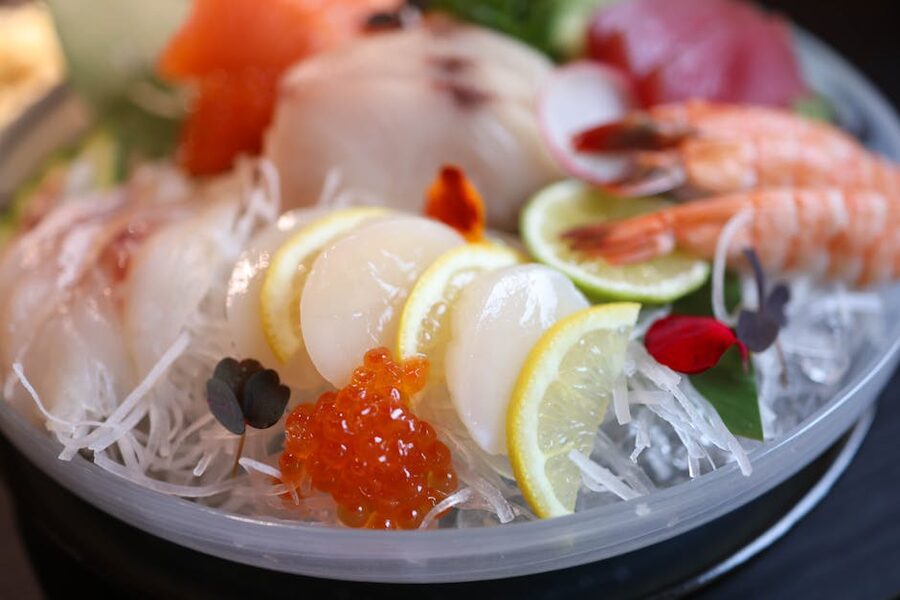
- Sashimi moriawase. A mixed plate of raw fish — usually tuna, salmon, white fish, maybe octopus. ¥1,200–2,000. The quality varies more than you’d think: a generic izakaya sashimi plate is fine but unremarkable; one that specifically says sakaba or describes itself as a fish izakaya will be much better.
- Agedashi-dofu. Deep-fried tofu in a dashi-based sauce. ¥450–600. Sounds unpromising. Is not. The tofu is crisp on the outside, liquid-soft inside, and the broth at the bottom of the bowl is worth drinking.
- Edamame. Salted boiled soybeans in the pod. ¥350–500. Sometimes this is the otoshi. When it’s not, order it anyway.
- Tamagoyaki. Sweet-savoury rolled omelette, served in thick slices. ¥450–700. Good with beer. Good with sake. Good with anything.
- Gyoza. Dumplings, usually pan-fried. Six to eight per order, ¥400–600.
- Nikujaga. Simmered beef and potato stew in a sweet soy broth. The classic winter dish. ¥600–900.
- Nabe (winter only). Hot pot for the table. Cold months, usually October through March. Shabu-shabu, sukiyaki, or chanko-nabe. Generally served to share between 2–4 people.
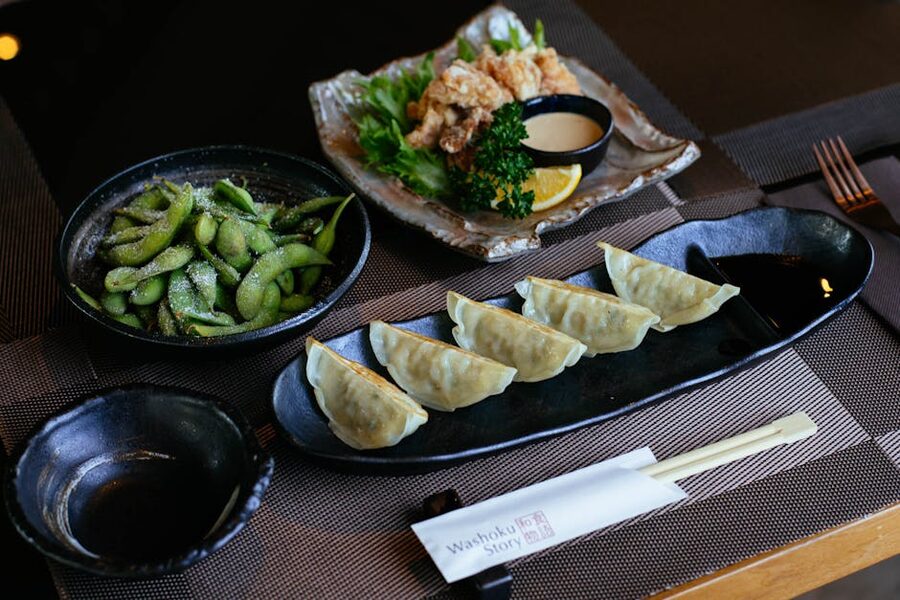
Ordering sequence matters. The way a Japanese table usually does it:
- Drinks first. Everyone picks a drink, the drinks arrive, kanpai.
- Round one of food — two or three shareable dishes. Usually something cold (edamame, sashimi), something grilled (yakitori), something deep-fried (karaage, agedashi-dofu).
- Eat, drink, talk. Order round two when the first drinks are about done — another round of drinks plus whatever looked good on the menu you haven’t tried.
- Optional round three. A “closer” like a bowl of rice or a small noodle dish — a lot of izakayas will sell ochazuke (rice with green tea poured over) or a small ramen to end on.
Paying — the phrase and the process
At an izakaya you almost always pay at the end, on your way out. You don’t pay per round. When you’re done, you catch the waiter’s eye and say:
Okaikei kudasai (お会計ください) — the bill, please.
They’ll either bring a printed bill to your table or gesture toward a register by the door. At the register you hand over the bill, they ring it up. Cash is still widely accepted and at older smaller places may be the only option. Cards and IC cards (Suica, Pasmo) work at most chain and mid-range izakayas in Tokyo now. If you’re going to a tiny yokocho-alley counter, bring a few thousand yen in cash — you’ll need it.
Tipping is not a thing. There’s no line on the bill for it. Don’t leave extra money on the table — staff will chase you down the street to return it. The otoshi is already the “service charge” baked in.
The three types of izakaya to know
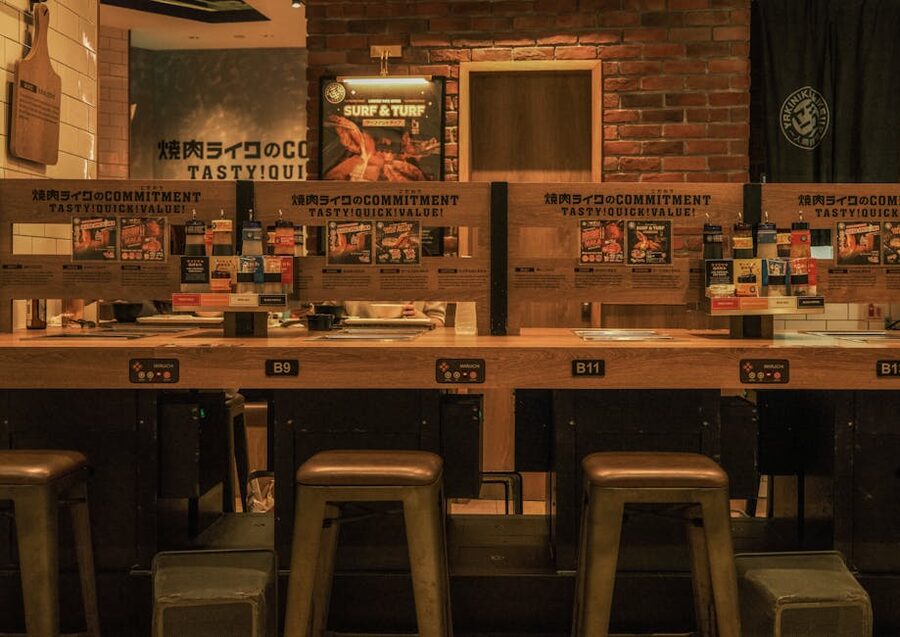
They’re not all the same. Three broad categories and knowing which one you’re in changes what you order and what to expect.
Chain izakayas. Torikizoku is the one to know — everything on the menu (yakitori, side dishes, drinks) is priced at a flat ¥360-ish, with the exact number printed on a banner at the door. It’s cheap, fast, the food is genuinely good for what you pay, and the beer is cold. Watami, Shoya, and Yakitori Totto are the other big names. Chains are fluorescent-lit, tablet-ordered, kid-friendly, English-menu-available, and a totally reasonable first izakaya if you’re nervous about the language barrier. They do not charge otoshi. Skip the atmosphere snobs who say chains aren’t “real” izakayas — they are the most real izakayas, statistically, because most of Japan eats at them.
Mid-range independents. A step up — still casual, still cheap-ish, but run by an actual owner-chef usually with a specialty. Might be a yakitori place (nothing but skewers), a seafood izakaya (fresh fish, sashimi, grilled items), an oden specialist (winter only, simmered stew bar). ¥3,500–5,500 per person. You’ll get an otoshi. The menu is usually only in Japanese, but pointing works and Google Translate on the menu photo works even better.
Yokocho micro-izakayas. The shoebox places. Six to ten seats at a single L-shaped counter. One or two staff. No menu card — either written on the wall in kanji or just whatever the cook feels like making tonight. These are in the alleys: Omoide Yokocho, Ebisu-yokocho, Nonbei Yokocho, the under-the-tracks rows in Yurakucho. Cash-only usually. Smoky. Often with a regular clientele who’ve been coming for 30 years. Sit down, order a beer, point at whatever your neighbour is eating, enjoy. This is the Tokyo people travel for.
The Tokyo izakaya areas worth knowing
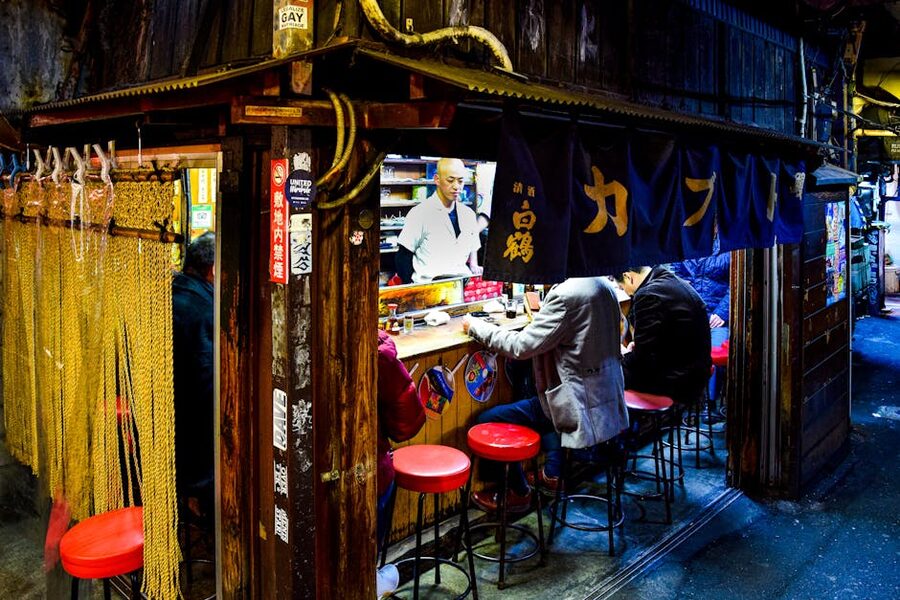
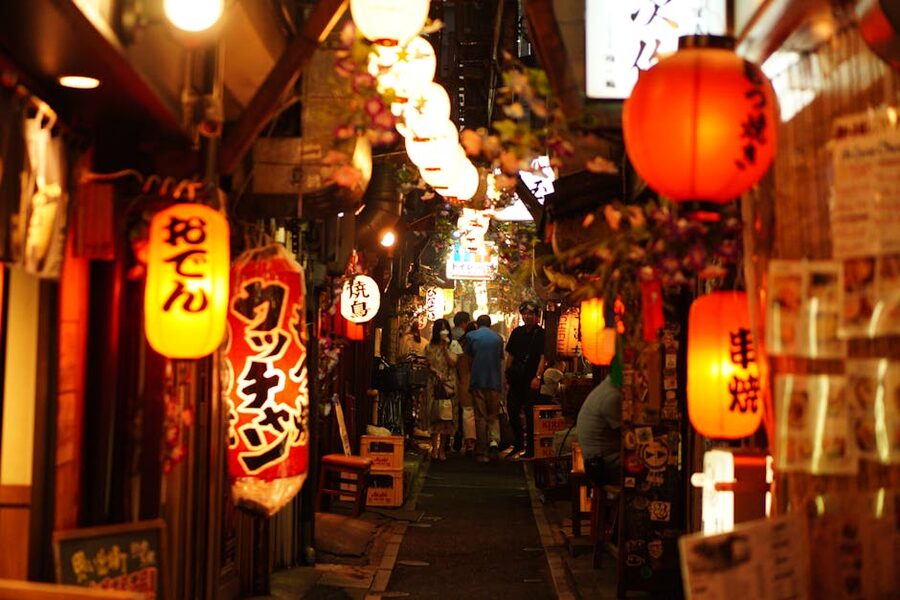
Omoide Yokocho (Shinjuku). “Memory Lane,” also known as Piss Alley from the post-war era. A single narrow pedestrian street just west of Shinjuku station with about 60 tiny yakitori and offal stalls in a row. Most have six to ten seats, all are open-front counters, smoke from charcoal grills pouring into the alley. Absolutely iconic. Also absolutely smoky — your clothes will smell like yakitori smoke for the next day. Go early (18:00–19:30 on a weekday), sit anywhere that has a free seat and looks busy but not heaving, and order yakitori, beer, chuhai. Cash. ¥2,500–3,500 per head for a proper session. Open until about 01:00.
Nonbei Yokocho (Shibuya). Two minutes from Shibuya Crossing. A two-storey huddle of 30-odd tiny bars built right up against the Yamanote line tracks, so close that a passing train rattles the glasses. Feels like 1955 wedged between the Shibuya scramble and the Hachiko statue. Many of these places are sunakku (snack bars) rather than pure izakayas — smaller, more regulars-only. Look for the ones with food photos outside and a written welcome sign. See the Shibuya guide for how to find it from the station.
Ebisu-yokocho. A covered indoor arcade just by Ebisu station with about 20 stalls running down both sides, everything from yakiniku to oden to a standing wine bar. Much more tourist-friendly than Omoide — wider aisles, some English menus — but still loud and fun. Good first-timer alley.
Yurakucho gado-shita. “Under the elevated tracks” — the strip of izakayas built into the arches under the JR Yamanote line between Yurakucho and Shimbashi stations. This is salaryman central on a weeknight. Open-front outdoor seating in summer, red lanterns everywhere, beer by the crate. No particular one is the “right” spot — walk along and pick whichever has a free seat and food smells you like.
Ameyoko (Ueno). South of Ueno station runs a market street that goes izakaya-dense in the evening — some of the best daytime-into-evening all-day drinking in Tokyo, because several of these places open at 10:00 or 11:00 and never really close. Cheaper than the Shinjuku yokocho. Good for an afternoon beer.
Nakameguro and Sangenjaya. Skip the yokocho format entirely — these two neighbourhoods are where Tokyo’s younger bar crowd go for the mid-range independents, often down side streets rather than clustered in one alley. Nakameguro along the canal is especially nice on a spring evening.
The etiquette minimum
Nothing complicated. The shortlist:
- Wait for kanpai before the first sip. Someone raises a glass, everyone clinks, then you drink.
- Pour for others, not yourself. If someone else’s glass is running low, top them up. They’ll do the same for you. This is the core social ritual of drinking in Japan.
- Oshibori for hands. Not face. Not neck. Hands. Fold it up afterwards, leave it on the tray.
- Don’t stand chopsticks upright in rice. It’s a funeral thing. Lay them flat on the rest.
- Keep the voice moderate. Izakayas can get properly loud, especially later in the evening, but at smaller counter-only places nobody wants to hear you.
- Don’t linger past a couple of hours at busy spots. Some places have an unwritten 90-minute soft limit when there’s a queue at the door. Watch the staff’s body language.
For the deeper version — chopstick rules, tipping, ordering niceties — see the full Japan dining etiquette guide.
What to skip
A few honest pieces of advice:
Skip the English-branded “izakaya restaurants” in Roppongi and Shinjuku’s tourist strips. If a place has a Western-style sandwich board outside, staff out front handing you flyers, and an English menu that lists “sake bomb” or “sushi platter” — walk on. These charge ¥1,500–2,500 for drinks that cost ¥500 two streets away, and the food is bad because tourists don’t come back to complain. The real izakayas don’t need flyers.
Don’t get hustled by touts in the yokocho alleys. At Omoide Yokocho especially, some of the English-speaking guys outside the most aggressively flagged stalls will try to pull you in. The stalls with nobody out front, just a smoky counter and locals on the stools, are the ones to sit at.
Don’t order sake at Torikizoku or Watami. Chain sake is fine for an emergency, but the price-to-quality at Torikizoku is genuinely not as good as the yakitori. Drink beer, chuhai, or highball at chains. Sake is what you order at a mid-range independent with a sake specialist behind the bar.
Don’t assume Golden Gai in Shinjuku is an izakaya scene. It isn’t. Golden Gai is a maze of five-seat cocktail bars, some of which charge a ¥1,500–2,000 seating fee (a much harsher version of the otoshi) and most of which are not inviting to non-Japanese-speaking first-timers. Go for the architecture; if you want a proper izakaya night, walk ten minutes to Omoide Yokocho instead.
Don’t worry about the otoshi. I said it already. Worth repeating. It’s ¥400 and it gets you a seat for three hours in a city where real-estate pressure defines the hospitality industry. Stop complaining online about it.
What a night actually costs
Actual ballpark costs for two people for a full evening of drinks and small plates in 2026 Tokyo:
- Chain (Torikizoku, Watami): ¥3,500–5,000 for two, including three rounds of drinks each
- Yokocho micro-izakaya (Omoide, Ebisu): ¥5,000–7,000 for two, with two rounds of drinks and proper grilled skewers
- Mid-range independent: ¥8,000–11,000 for two
- Higher-end independent (specialist sake bar, premium yakitori): ¥12,000–16,000+ for two
The ¥5,000–7,000 range is where most of the best Tokyo izakaya evenings happen. Under ¥4,000 a head you’re usually at a chain or a basic counter. Over ¥8,000 and you’re in restaurant territory where the distinction between an izakaya and a small proper restaurant starts to dissolve.
Timing — when to turn up
Izakayas open around 17:00, and the first hour (17:00–18:00) is quiet — happy-hour-ish at some chains, easy to walk in anywhere. 18:00–20:00 is peak work-leaver time, everywhere fills up fast, and at the popular yokocho spots there’s a queue at the door. 20:00 onwards thins out at chains but stays rowdy at the independents. The last order is usually 22:30–23:00 with the place clearing by midnight; Omoide Yokocho is the exception and runs until roughly 01:00, sometimes later at the weekend.
Weeknights (Mon–Thu) are the comfortable time — salarymen are there but you can walk in to almost any place without a wait. Friday and Saturday nights from 19:00 need a reservation for anywhere popular, particularly in the yokocho alleys. Sunday is quieter again, though some places close on Sundays entirely.
For the yokocho alleys, come at 18:00–18:30. Early enough to walk in, late enough that a few of the seats are already warmed up by locals which is what makes the atmosphere.
One thing about smoking
In 2020 Japan passed a law restricting indoor smoking in restaurants. But small places — under 100 square metres of floor area, with capital under ¥50 million — were allowed to keep smoking sections if they registered. In practice this means a lot of the small old-school izakayas and yokocho-alley counters are still smoking-permitted. The larger chains went fully non-smoking years ago. If smoke is a deal-breaker, stick to Torikizoku/Watami and the newer mid-range independents. If you’re walking into an unknown yokocho stall, expect smoke.
Practical info at a glance
- Hours: 17:00–midnight typical; 17:00–01:00 in yokocho districts; last order 22:30–23:00 at most places
- Cost per person: ¥1,800 (chain) to ¥8,000+ (premium independent); ¥3,500 is the comfortable mid-point
- Otoshi: ¥300–600 per person at most independents, none at Torikizoku/Watami
- Payment: Cards and Suica/Pasmo at chains and most mid-range; cash preferred at yokocho counters
- Reservations: Not needed weekdays; book ahead for Friday and Saturday 19:00–21:00 at popular spots; most chains walk-in only
- Tipping: Not a thing — don’t
- Smoking: Non-smoking at chains; often still permitted at small independents (under 100 sq m)
- Language: Tablet-ordering at chains has English; small independents are Japanese-only menu but pointing works and Google Translate on the menu photo is your friend
- Dress code: None. Rock up in whatever. You’ll be underdressed next to the suits and nobody cares
Official sources worth bookmarking: the Tokyo Tourism Bureau izakaya guide and the JNTO guide cover much of the same ground with official backing.
How I’d do a first izakaya night in Tokyo
If a friend landed in Tokyo and told me they’d never been to an izakaya, this is the sequence I’d do with them in one evening. It builds from easy to atmospheric to intimate:
- 18:00 — Torikizoku in Shinjuku-sanchome or Shibuya. Start at a chain for the first beer. It’s cheap (¥1,800 for a round and eight skewers between two), it’s fast, it’s English-menu-friendly. You get the rhythm of yakitori and beer without the stress of navigating a Japanese-only menu. Ninety minutes.
- 19:45 — Omoide Yokocho in Shinjuku. Walk to Shinjuku’s west exit, find the alley, pick any stall that has a free counter seat but is mostly full. Order two beers, a yakitori variety plate, and whatever your neighbour is eating. The smoke, the neon, the shouting cooks — this is the one people come to Tokyo for. An hour, maybe ninety minutes.
- 21:30 — A quieter mid-range independent somewhere residential. Get on the Yamanote line and go two stops — to Yoyogi, Shin-Okubo, or a small street off Nakano-sakaue. Find a regular neighbourhood izakaya. Sit at the counter. Order one last highball or a small warm sake and a bowl of ochazuke (rice with green tea) to close. This is where the Japanese office workers are winding down. The noise level drops. You talk.
If you want to keep going after that, you’re not on a first izakaya night anymore. You’re on an izakaya life.
If you liked this and want the full Tokyo context, start with dining etiquette in Japan and the neighbourhood guides for Shinjuku, Shibuya, and Ueno. And if you’re budgeting the rest of the trip, the budget Tokyo accommodation guide pairs with the izakaya math — a ¥5,000 hotel night plus a ¥3,500 izakaya evening is a properly good Tokyo day on a modest budget.