
The first time I came to Harajuku I was braced for an open-air cosplay convention. Pastel wigs, Gwen Stefani’s Harajuku Girls come to life, rainbow cotton candy in every third hand, teenagers doing the peace sign at every doorway. What I actually got was a seventeen-year-old girl eating a Totti Candy Factory rainbow cotton candy on her phone, looking more bored than any teenager I had ever seen, wedged into a crowd on Takeshita Street that was 80% middle-aged tourists and 20% her. She finished the cotton candy, rolled her eyes at something on TikTok, and walked into Daiso. That was my Harajuku moment.
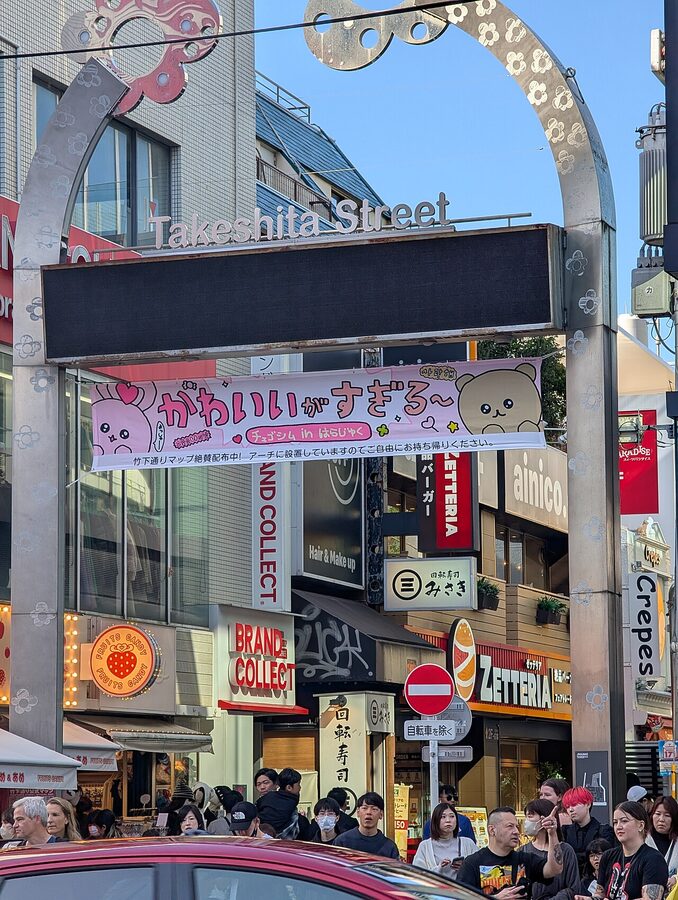
Here’s the thing nobody tells you about Harajuku. The “Harajuku Girls” era of extreme street fashion peaked about twenty years ago and has been winding down ever since. The city’s fashion photographer Shoichi Aoki, who built his whole career documenting Harajuku style, told Quartz back in 2017 that there weren’t enough genuinely fashionable people left in the neighbourhood to make his magazine FRUiTS viable. He shut it down. The cosplayers who used to gather on Jingu Bashi bridge at weekends are mostly a memory. What you’ll find instead is a neighbourhood with two very different halves stitched together: the touristy sugar-rush of Takeshita Street on one side, and the quietly stylish boulevards of Omotesando and Cat Street on the other. Both are worth your time. One of them is a lot more pleasant.
In This Article
- Getting there (which station to use)
- Takeshita Street, and why to come before 11am
- The rainbow cotton candy, and is it worth it
- Crepes, and which one is worth it
- Purikura, which you should do even if you feel silly
- Omotesando, the grown-up sibling
- Cat Street, the one everyone misses
- Kiddy Land and the other shops worth your time
- Cat cafes, themed cafes, and what to skip
- The food that isn’t a crepe
- Harajuku on a weekday vs a Sunday
- Yoyogi Park and Meiji Shrine, right next door
- Practical info at a glance
- How I’d spend a morning in Harajuku
- What I wish I’d known the first time
Getting there (which station to use)
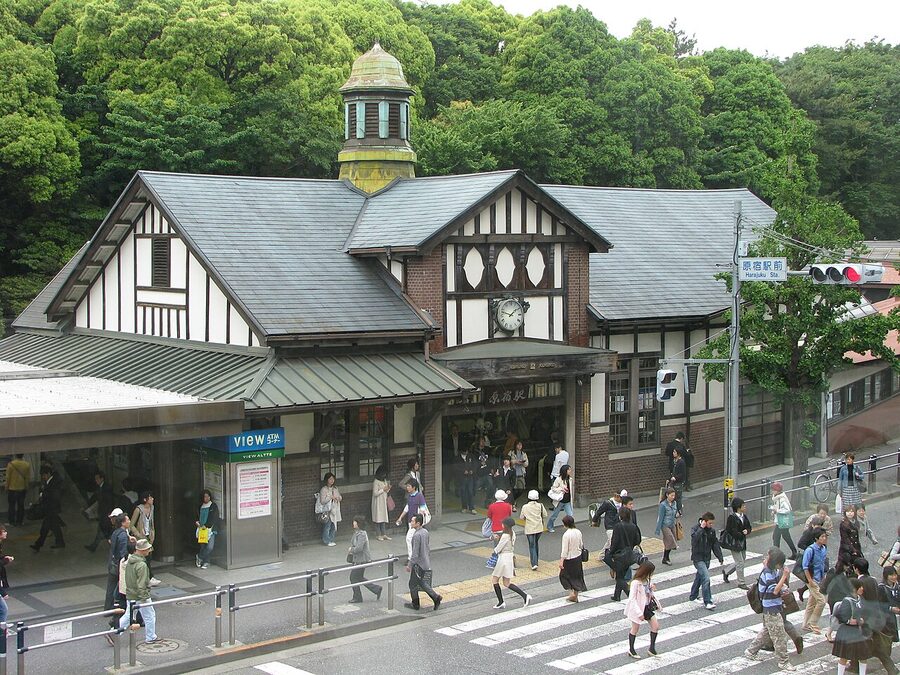
Harajuku is absurdly easy to reach. There are two stations within a two-minute walk of each other:
- Harajuku Station on the JR Yamanote Line — the loop line that every tourist in Tokyo eventually uses. You’re one stop from Shibuya and one stop from Shinjuku. From Tokyo Station it’s about 25 minutes. If you have a JR Pass, this is free.
- Meiji-Jingumae Station on the Tokyo Metro Chiyoda and Fukutoshin lines. This exits directly at the Takeshita Street intersection. Use this one if you’re coming from Ginza, Roppongi, or anywhere the Metro serves better than JR.
I normally use Meiji-Jingumae because it pops you up right at the start of Takeshita Street without the walk across. And the Metro runs until about 12.30am, while the Yamanote stops about an hour earlier. Single ride on the Yamanote is from ¥160. Tap in with a Suica or PASMO — don’t buy paper tickets, it’s 2026, nobody does that anymore.
A small geography point that confused me for about a month: everyone says “Harajuku” but half the time they mean Omotesando, which is technically its own district. The boundary is blurry. Takeshita Street and everything north of Omotesando Avenue is properly Harajuku. Everything south of Omotesando Avenue heading toward Aoyama is Omotesando, which is more of a mood than a map line. In practice you’ll walk across the boundary a dozen times in an afternoon and not notice.
Takeshita Street, and why to come before 11am
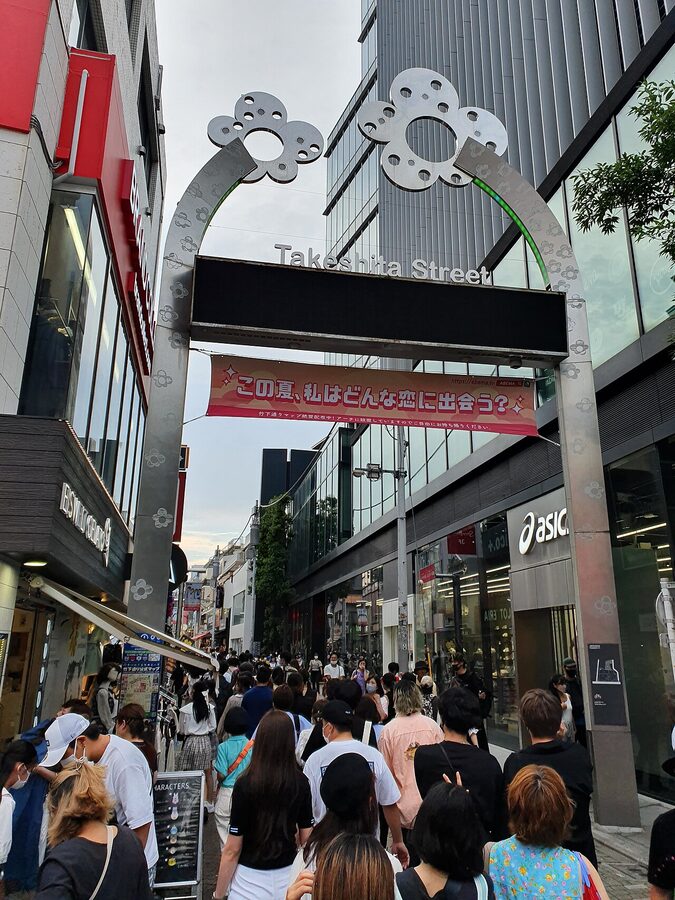
Takeshita Street is about 400 metres long and maybe four metres wide. It’s a pedestrian-only strip lined with maybe seventy small shops, cafes, and snack stalls, and on a sunny weekend afternoon the whole thing runs at the speed of a slow supermarket queue. I’ve done it on a Wednesday at 10am and it was pleasant. I’ve done it on a Sunday at 2pm and genuinely considered giving up and leaving.
Here’s what’s actually on it, in rough order if you enter from the Meiji Avenue arch and walk toward Harajuku Station:
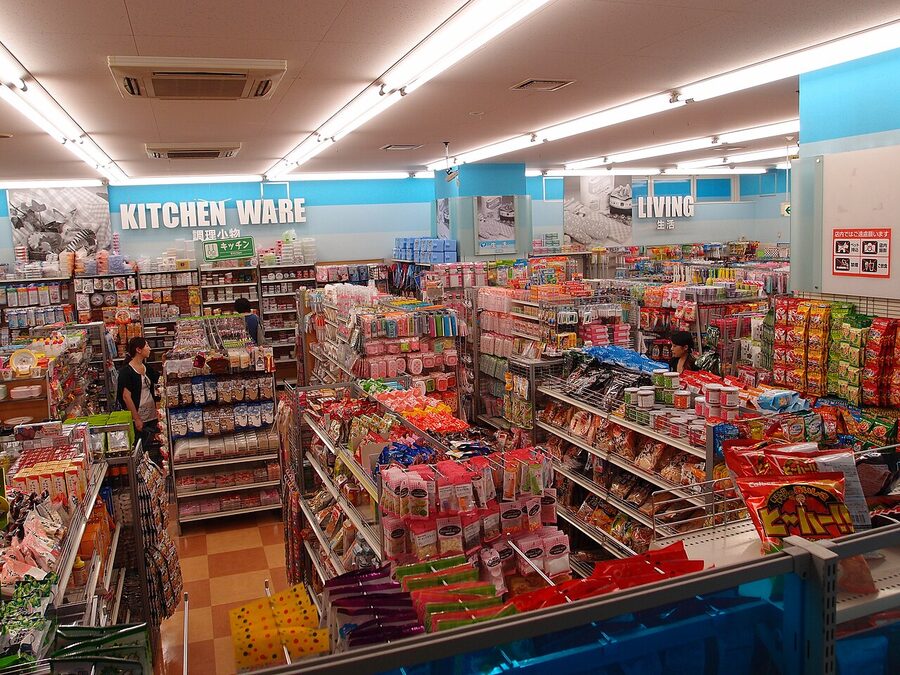
- Daiso Harajuku — Japan’s famous 100-yen shop. Most things are ¥110, some are ¥220, and it’s the best cheap-souvenir stop in Tokyo. I have left Daiso with chopsticks, novelty socks, miniature origami sets, and a frog-shaped shampoo bottle that I did not need. The Harajuku branch is three floors. The queue at the register moves fast.
- Don Quijote (Donki) Harajuku — the mad discount mega-store. Five floors of everything from snacks to cosplay costumes to Kit Kats in flavours you won’t believe. Open until very late; useful if you want to shop after dinner.
- Totti Candy Factory — the original rainbow cotton candy shop. ¥1,000 for one the size of a toddler’s head. More on this below.
- Long! Longer!! Longest!!! — tornado potato on a stick. A whole spud spiralised and deep-fried, about ¥600. Surprisingly good. You will smell of oil for the rest of the day.
- Marion Crepes — one of the originals, open since 1976. Bubblegum-pink storefront, huge menu, queue out the door on weekends.
- Le Shiner — rainbow cheese toasties. Pulls apart into strings of dyed cheese. I have not been able to bring myself to order one.
- Shop NOA — purikura photo booths, which I’ll come back to.
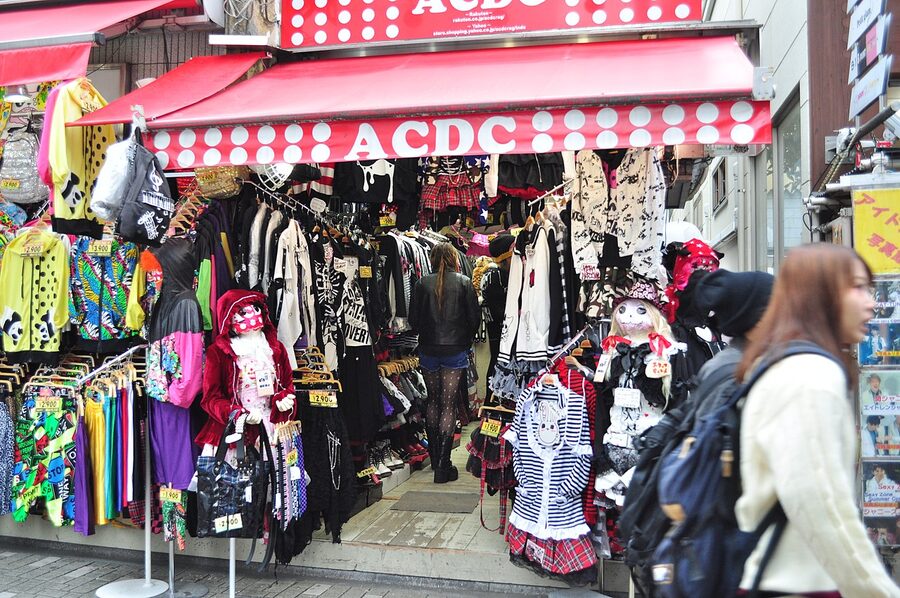
- Paris Kids — a tiny accessories shop packed with hair clips, scrunchies, earrings, mostly ¥330-550. The best cheap-gift shop for a teenager back home.
.jpg)
.jpg)
The honest Takeshita advice: go once, spend thirty to forty-five minutes, and then leave. The street is a series of photo ops more than a destination. After you’ve seen the cotton candy, bought something from Daiso, and taken a photo of the arch, you’re done. The real Harajuku experience is what happens when you step off it.
The rainbow cotton candy, and is it worth it
OK so. This is the image everyone has of Harajuku, so it’s worth addressing head-on. Yes, you can buy a rainbow cotton candy the size of a small child’s head. The main place is Totti Candy Factory on Takeshita Street — it’s the original and the biggest — but there’s also Candy Show Time nearby which does a similar product in a slightly different way. Totti is ¥900-1,000 depending on size; Candy Show Time is a touch cheaper and less queued.
Here’s the part nobody mentions in the Instagram posts:
- It’s spun sugar. That’s it. There’s no special ingredient. It tastes like every carnival cotton candy you’ve had since you were seven.
- It sheds. Within three minutes of stepping into the street with one, you will have sticky pink fluff stuck to your coat, your chin, your phone screen, the shopping bag of the stranger behind you, and any hair on your face.
- Eating it while walking is a doomed enterprise. Find a bench. Commit.
- Two people can comfortably split one. I have watched a family of four share one and still not finish.
If your goal is the photo, absolutely do it. If your goal is sugar, the crepes are better.
Crepes, and which one is worth it
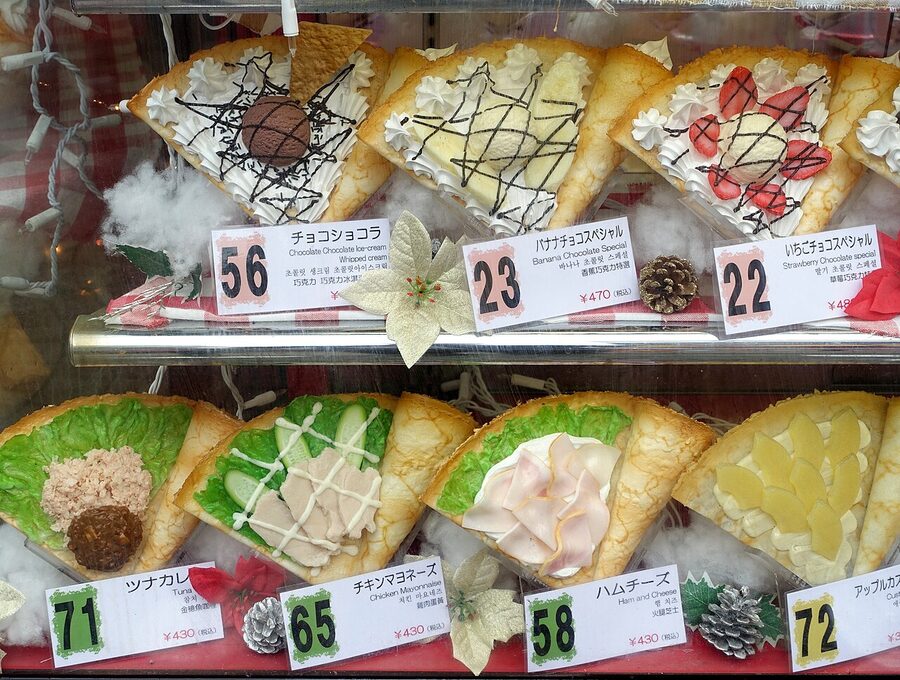
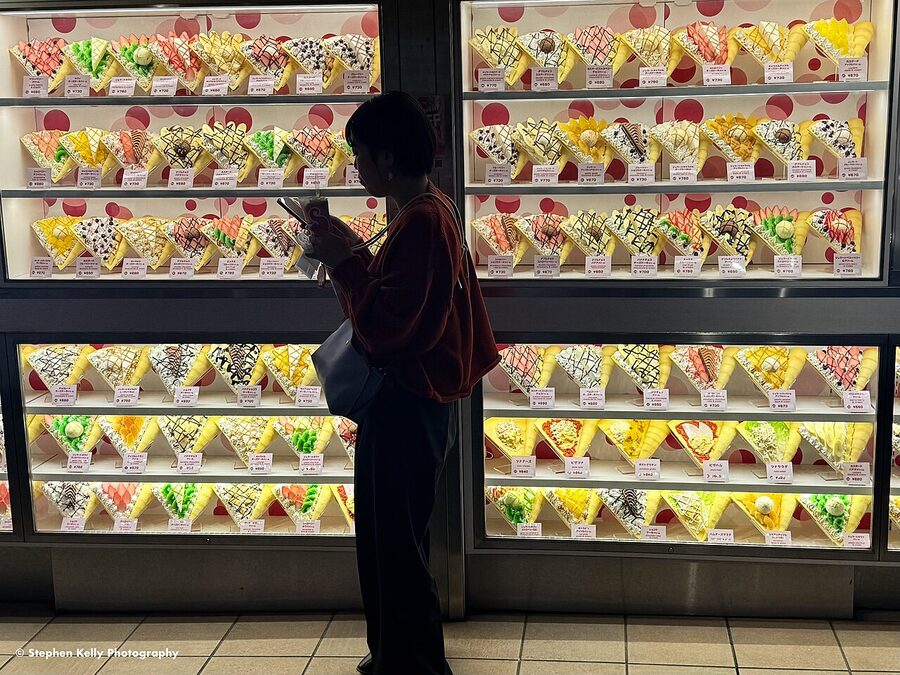
Crepes are the actual Harajuku food. There are probably fifteen crepe stands on or near Takeshita Street, each with a window full of plastic crepe models so you can point instead of speaking. The queue moves fast — about three minutes per person. Here’s the hierarchy as I understand it:
- Marion Crepes on Takeshita Street: the originators. Open since 1976 and still the best-known. The menu is enormous (I counted sixty-one options the last time) and the cream is genuinely good. Around ¥600-900.
- Santa Monica Crepes: the pink-fronted one halfway down Takeshita. Similar pricing, marginally smaller queue, slightly thicker batter that I prefer.
- Angel’s Heart: a step back from Takeshita, around the corner. This is where I’d actually send you. Shorter queue, lighter batter, and they don’t oversell. Ask for strawberry custard.
If you’ve never had a Harajuku crepe, the format is: a thin folded crepe held in a cone of wax paper, with whipped cream piled in, plus fruit, plus sometimes an entire slice of cheesecake or a brownie tucked inside. It is absurd. It works.
Purikura, which you should do even if you feel silly
Purikura comes from print club (プリクラ) and it’s the Japanese photo-booth craze that has somehow never died. You and up to five friends cram into a booth about the size of a shower cubicle, strike poses, and the machine takes a grid of photos while loudly coaching you in a cheerful female voice. Then you move to the editing station — a separate, smaller booth — and spend ten minutes making your eyes absurdly large, your skin glowy, and adding sparkle stickers. You walk out with a printed strip of stickers that looks nothing like you.
- Find Shop NOA on Takeshita Street, or Purikura no Mecca in the Harajuku/Shibuya area. Shop NOA has the newest machines.
- Cost is ¥400-500 per session for a group.
- You must remove your shoes before entering most booths. Nobody tells you this. Watch what everyone else is doing.
- The machine barks instructions in rapid Japanese. Ignore it. Just pose when the countdown hits zero.
- Make sure you pick the “foreign-looking eyes” filter if you want to keep any semblance of your actual face. The default skin-whitening and eye-enlarging filter is comically aggressive.
Is it silly? Very. Would I skip it? No. It costs less than a coffee and you’ll get a sticker sheet you’ll keep for years.
Omotesando, the grown-up sibling
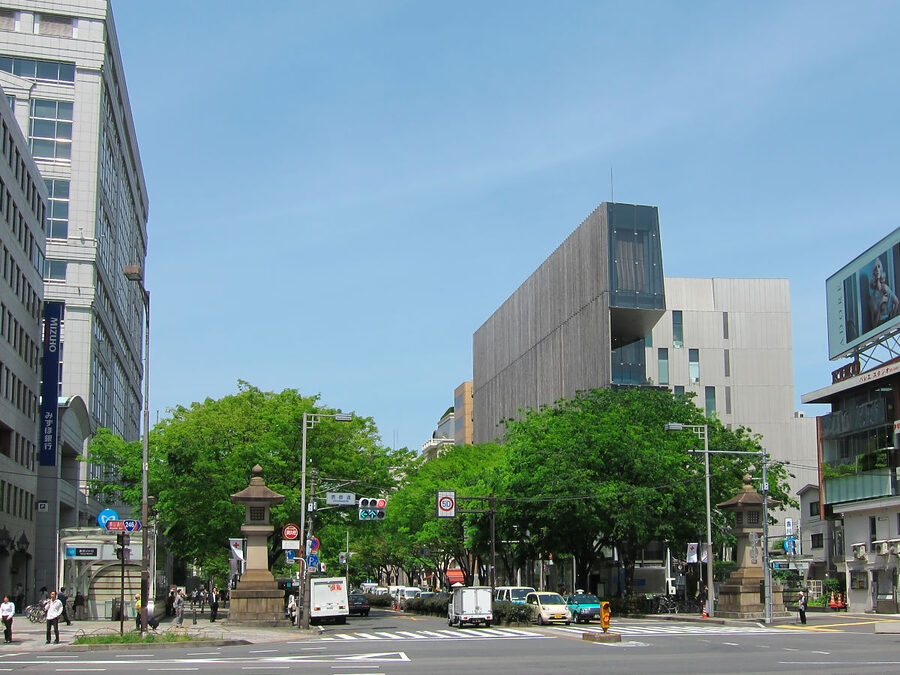
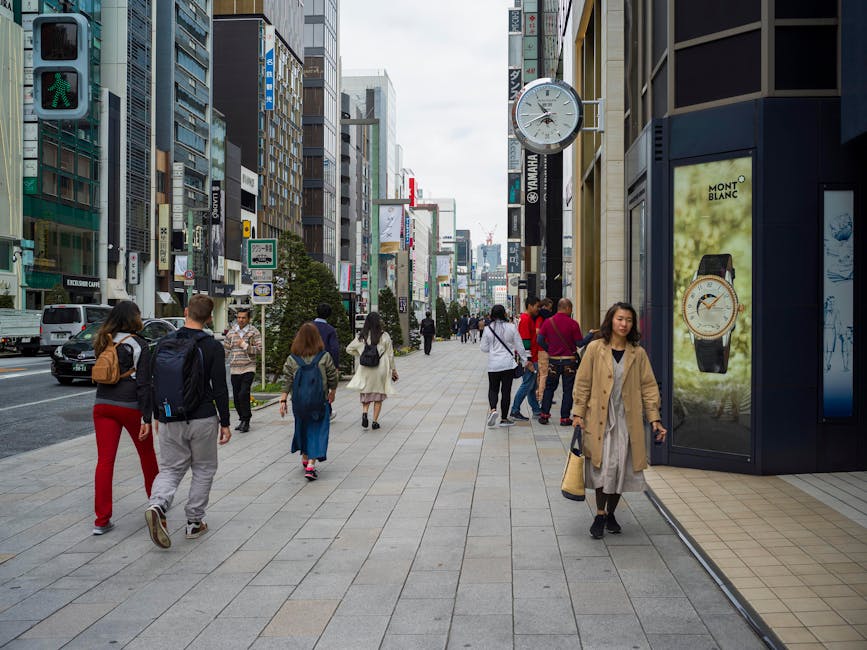
If Takeshita Street is what you expected Harajuku to be, Omotesando is what you didn’t know existed. It’s the wide, tree-lined boulevard that runs east from Meiji Shrine’s outer torii gate all the way to Aoyama, and it’s often compared to the Champs-Elysees, which is fair and also slightly underselling it. The zelkova trees form a proper canopy. The sidewalks are wide enough to actually walk on. And every other building is a flagship by a world-famous architect.
A short list of what’s on Omotesando worth looking at:
- Omotesando Hills — Tadao Ando’s shopping complex that runs underground for three floors, with a long central ramp instead of escalators. Even if you don’t want to shop, walk through it.
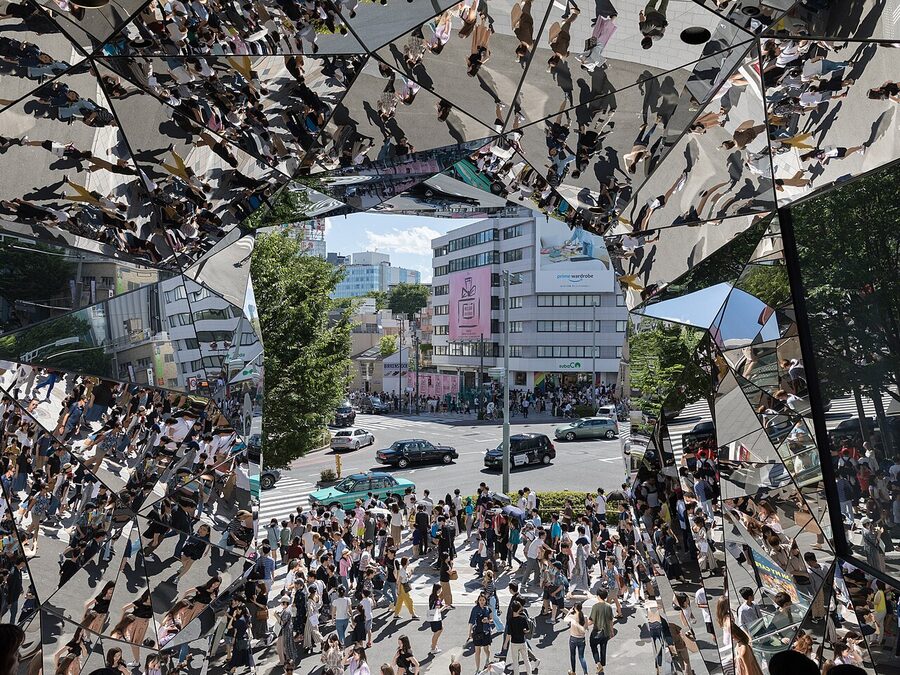
- Tokyu Plaza Omotesando (“Omokado”) — the building with the kaleidoscope mirror entrance that every visitor photographs.
- Harakado — the newer (2024) mall directly across from Omokado. A crystalline sort of building with a free rooftop garden where you can sit with a coffee and not pay for the view.
- Dior Omotesando — SANAA’s translucent fabric-looking building. Don’t need to go in. Just look.
- Prada Aoyama — Herzog & de Meuron’s diamond-glass building. Further down, over the Omotesando intersection.
I have done Omotesando as an architecture walk twice and not bought a single thing, and I don’t regret either trip. There’s a free architecture walking route on the Go Tokyo site if you want a more formal tour.

Cat Street, the one everyone misses
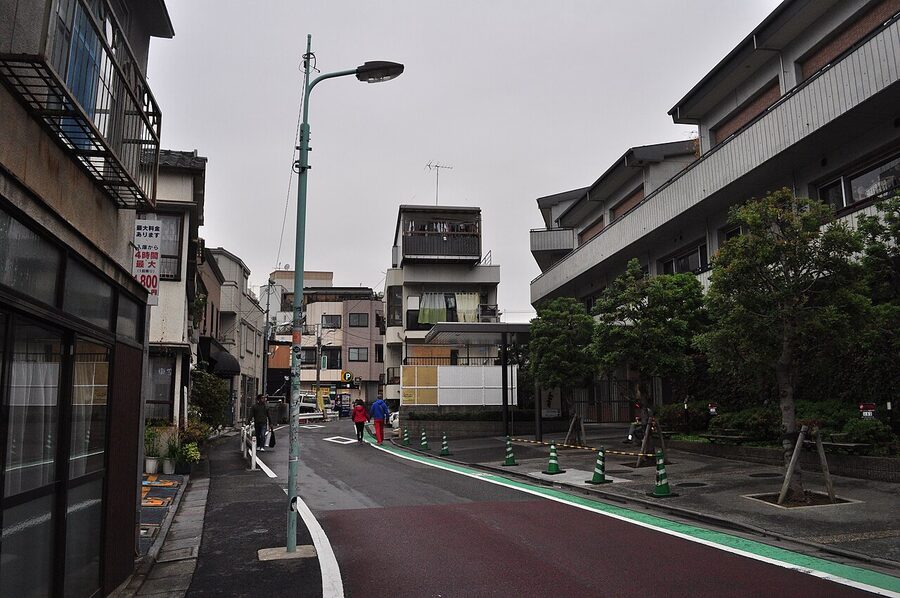
Cat Street is the narrow alley that runs roughly parallel to Meiji Dori, connecting Harajuku to Shibuya. It’s not called Cat Street because of any cats — the name comes from how narrow and meandering it is, apparently. Nobody I have asked can give me a definite origin. But it’s where Harajuku gets interesting again if the Takeshita crowds have worn you down.
What’s on Cat Street: small independent fashion boutiques, proper coffee shops (The Roastery by Nozy is the one coffee people talk about), vintage stores, a couple of record shops, and the kind of skate-and-streetwear places where the staff genuinely care about what they’re selling. It’s fifteen minutes’ wander from Takeshita to Shibuya if you don’t stop anywhere. If you stop in even three shops it’s two hours.
Good stops on Cat Street:
- Flamingo — vintage Americana and retro fashion in a cosy shop. Good for leather jackets and old band tees.
- Ragtag — second-hand designer, including A Bathing Ape, Vivienne Westwood, Marc Jacobs. Less Takeshita-tacky, more Tokyo-cool.
- Kinji — huge vintage selection, including upcycled kimono pieces and reworked denim.
- Chicago — American vintage plus the occasional traditional kimono at surprising prices.
- The Roastery by Nozy — single-origin pour-over coffee from ¥600. The one coffee stop that comes up in almost every Harajuku guide.
Kiddy Land and the other shops worth your time
If you’re travelling with children, or you’re a grown adult who has strong feelings about Studio Ghibli, Kiddy Land on Omotesando is the single best toy store I have ever been in. Five floors of character goods: Hello Kitty and the rest of the Sanrio family on one floor, Ghibli on another, Pokemon and Sanrio and Rilakkuma spread across the rest. Prices for a character plushie start around ¥2,500 and climb fast. The queue to pay moves quickly. Open until 9pm most days.
Beyond Kiddy Land:
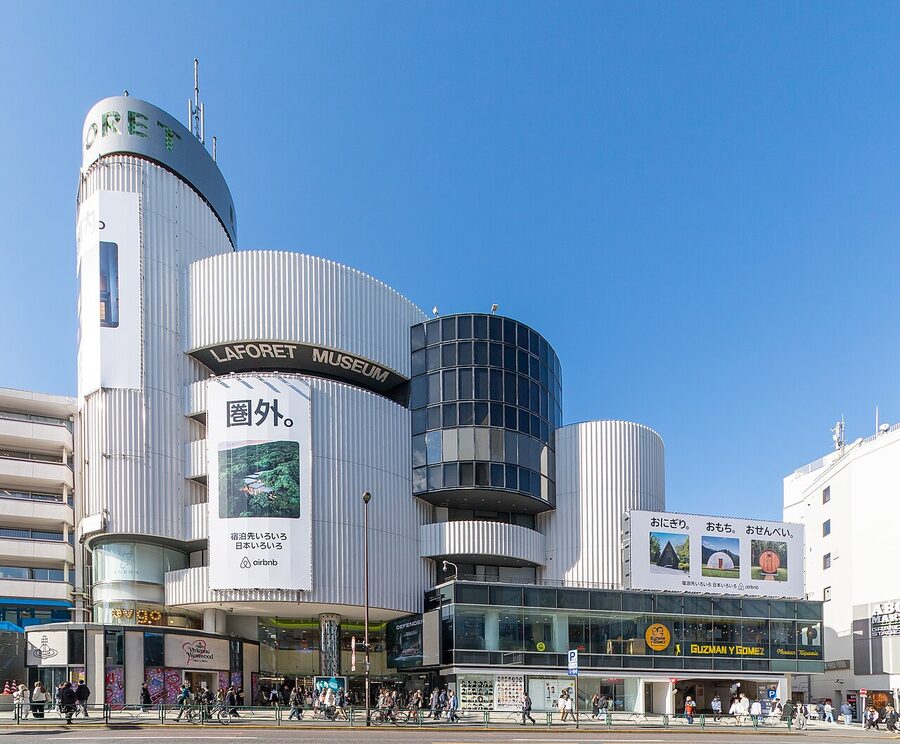
- LaForet Harajuku — a department store that works more like a collection of small brand spaces, heavily focused on Japanese streetwear and alternative fashion. Gothic Lolita, Visual Kei, and the more serious Tokyo subcultures all have shops here. Worth a wander for the mood even if you buy nothing. The basement floor (B1.5, yes that’s a real floor number here) is where the alternative brands live.
- Harakado — the 2024 mall on the corner of Meiji Dori and Omotesando, with a free rooftop garden and a basement traditional public bath (Kosugiyu Harajuku). Yes, a sento inside a mall.
- Oriental Bazaar — the kitsch-but-useful souvenir shop. Kimonos, chopsticks, ceramic cats, yukata. This is where people buy the gift-for-grandma that they forgot about.
.jpg)
Cat cafes, themed cafes, and what to skip
Right. The skip-this section. Harajuku is the animal-cafe capital of Tokyo, which is also to say it has more ethically dubious small-animal cafes per square kilometre than anywhere else in Japan. There are hedgehog cafes, otter cafes, owl cafes, micro-pig cafes, chinchilla cafes. Most of them are grim. The animals are kept in small spaces, handled by strangers for hours a day, and frequently look unhappy. I would skip all of them. If you genuinely want to interact with animals, go to a proper cat cafe in a different neighbourhood (Asakusa has a couple of decent ones) or, better, visit the Tokyo zoo.
Themed cafes are a different thing and mostly fine. The ones worth considering:
- Peanuts Cafe on Omotesando — Snoopy-shaped pancakes, Charlie Brown lattes, that sort of thing. Overpriced (¥1,500 for a pancake) but the food is actually good. The Snoopy pancake comes with a delicate tea syrup and proper whipped cream.
- Fender Cafe Tokyo in the basement of the Fender flagship — music nerd heaven. Guitars on the walls, live performances occasionally, decent espresso. If anyone in your group plays guitar, make them come here.
- Sanrio Cafe Harajuku — for Hello Kitty obsessives. I have been once; it was fine. The food looks better than it tastes, but the room itself is adorable.
Skip the Kawaii Monster Cafe — it closed in 2021 and hasn’t reopened, despite what out-of-date blog posts will tell you.
The food that isn’t a crepe
Harajuku has a reputation as a sugary-snacks-only neighbourhood, which is half right. Takeshita Street itself is 90% sweets, but step off it and there’s proper food in every direction. What I’d go back for:
- Harajuku Gyoza Lou — a scruffy, narrow dumpling place about a block off Takeshita. Two options: steamed or pan-fried, six for ¥330. Order a second round. Order a beer. This is the gyoza meal you’ll tell people about. Expect a 15-20 minute queue.
- Bills Omotesando — yes, the Australian brunch chain. Yes, it’s touristy. Yes, the ricotta hotcakes with honeycomb butter are worth the queue. Around ¥1,900 for the hotcakes. Come before 10am or after 2pm to skip the wait.
- Rainbow Pancake — fluffier, wobblier Japanese-style pancakes. Not the Bills version. Around ¥1,600. Queue forms at 10am sharp.
- Afuri Harajuku — a branch of the yuzu-ramen chain. Light, citrussy, not heavy. Around ¥1,100 a bowl. One of Tokyo’s best post-shopping meals.
- Commune 2nd — a food-truck collective tucked behind Omotesando. Tacos, Vietnamese, Turkish, Mexican, all in an outdoor seating area. Low-pressure, easy, good for lunch.
.jpg)
Harajuku on a weekday vs a Sunday
This deserves its own section because it really is a different neighbourhood depending on when you come.
Weekday morning (10am-12pm): the platonic ideal. Shops are open, Takeshita Street is walkable, crepe queues are five minutes, and you can actually see storefronts. Go now if you can.
Weekday afternoon (1-5pm): busier, especially around 3pm when school kids start appearing in their uniforms, but still navigable. Cafes on Omotesando start filling up. Good time to be wandering Cat Street.
Weekday evening (6-9pm): the neighbourhood starts to calm down. Takeshita Street stores close at 8pm. Omotesando and the side streets come alive with the after-work crowd. This is my favourite time for dinner in the area.
Saturday: busy but not as rough as Sunday. Arrive before 11am and you’ll be fine.
Sunday: absolutely heaving. Takeshita Street by 1pm is shoulder-to-shoulder for its whole length and you’ll move at about 1km per hour. This is also when Yoyogi Park next door comes alive with performers, cosplay groups, and market stalls, so it’s the day to see the old-school Harajuku subcultures if you can find them — but Takeshita itself becomes almost impossible. If you must do Sunday, go early, eat, and leave by noon.
Yoyogi Park and Meiji Shrine, right next door
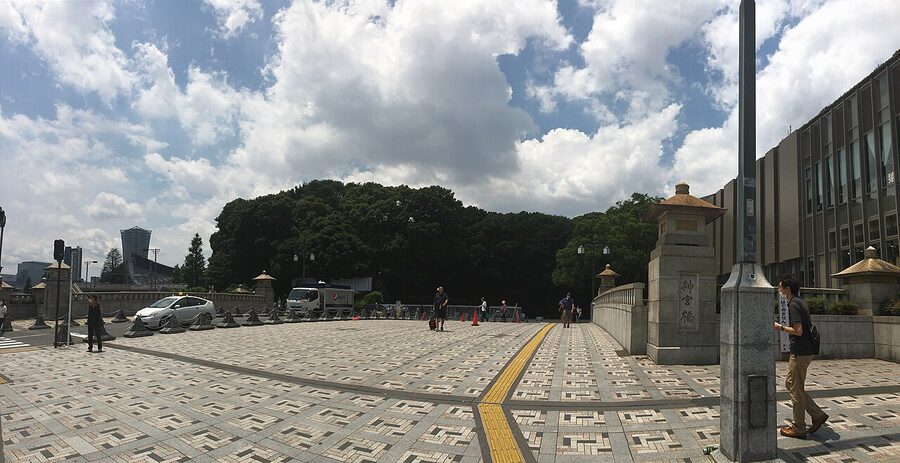

The easiest thing about Harajuku is that Meiji Shrine is literally across the bridge. You walk two minutes from Takeshita Street, cross Jingu Bashi, pass through the 12-metre torii gate, and you’re in a quiet forest. I’ve written a full guide to Meiji Shrine already so I won’t repeat it here, but if your plan is Takeshita in the morning then shrine in the afternoon, you’ll love it — it’s the single best contrast I know of in Tokyo. Chaos to calm in three minutes.
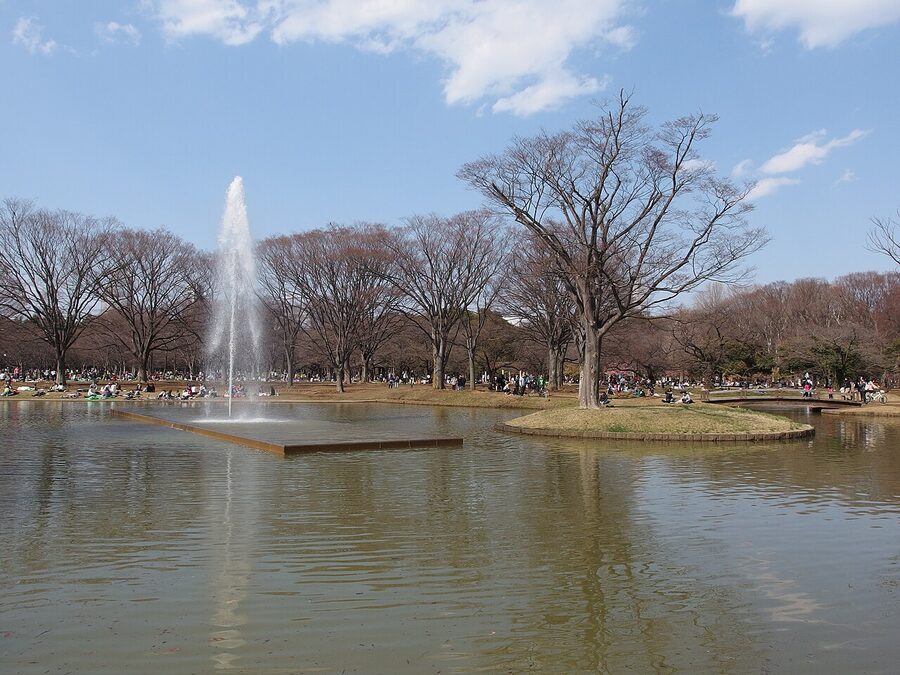
Yoyogi Park is the grassy area adjacent. On a sunny weekend it’s full of skaters, picnicking office workers, rockabilly dancers (a genuine local tribe, they’ve been coming for decades), and occasional cosplay gatherings. It’s free, open 24 hours, and has the best coffee stall in the neighbourhood at the west entrance (Little Nap Coffee Stand, ¥600 for pour-over).
.jpg)
Practical info at a glance
- Getting here: Harajuku Station (JR Yamanote Line) or Meiji-Jingumae Station (Tokyo Metro Chiyoda/Fukutoshin). One stop from Shibuya, one from Shinjuku.
- Cost to visit: free to walk around. Budget ¥1,500-3,000 for a crepe, a drink and one souvenir. Double that if you do purikura and a themed cafe.
- Opening hours: most shops open around 11am and close at 8pm. Daiso and Don Quijote are the late-night exceptions.
- Crowds: worst on Sunday afternoons. Best on weekday mornings.
- Accessibility: Takeshita Street is flat and pedestrianised, but the crowds make wheelchair and pushchair access difficult on weekends. Omotesando and Cat Street are easier. Meiji-Jingumae Station has lifts.
- Cash vs card: most shops now take cards and IC cards (Suica/PASMO). Smaller crepe stands and Takeshita stalls still sometimes need cash. ¥5,000 in a wallet covers most of an afternoon.
- Where to stay: Harajuku itself has almost no hotels. Stay in Shibuya (10 minutes’ walk) or Shinjuku (one stop) — see my budget-friendly Tokyo accommodation guide for options.
How I’d spend a morning in Harajuku
If you’re in Tokyo for a short stint and want to do Harajuku properly without wrecking yourself on the crowds, here’s the route I run with friends:
- 8.30am. Arrive at Meiji-Jingumae Station. Walk straight to Meiji Shrine via the southern torii — the shrine opens at sunrise and the forest path is blissfully empty at this hour. Allow an hour. (Full details in my Meiji Shrine guide.)
- 10am. Cross Jingu Bashi back to Harajuku Station. Walk straight onto Takeshita Street through the Meiji Avenue arch. Do the full length in twenty minutes — cotton candy photo if you must, Daiso for a gift, one crepe from Angel’s Heart around the corner. Don’t linger.
- 11am. Duck off Takeshita, head south to Omotesando. Walk up to Tokyu Plaza Omokado for the mirror entrance photo. Wander through Omotesando Hills if you want a quiet escape from the street.
- 12pm. Cat Street. Wander south toward Shibuya, stopping at a vintage shop or two and grabbing coffee at The Roastery by Nozy.
- 1pm. Lunch. Either Harajuku Gyoza Lou (back near Takeshita) or Afuri ramen (closer to the Shibuya end of Cat Street). Both are under ¥1,500 a head.
- 2pm. You are now within walking distance of Shibuya. If you have the energy, continue the day there. If not, Harajuku Station or Shibuya Station gets you home.
That’s a solid four-hour morning, gets you all the Harajuku photos, and doesn’t leave you wanting to cry in a convenience store. Add an hour if you want to do purikura, add two if you want to properly do Cat Street.
What I wish I’d known the first time
Three small things that would’ve saved me some frustration on my first visit.
First, the “eccentric street fashion” version of Harajuku mostly doesn’t exist anymore, at least not in the concentrated way it did in the late 90s and early 2000s. If you’re coming specifically to see it, you’ll be disappointed. Come for the shops, the crepes, the architecture, and the sheer density of small interesting places, and you’ll love it.
Second, the neighbourhood is much bigger than Takeshita Street. If your entire visit is one walk down that 400-metre strip, you’ve seen the smallest and most touristy slice. Omotesando, Cat Street, and the back alleys between them are where Harajuku lives now.
Third, weekend timing matters more than anywhere else in Tokyo. I have had lovely Wednesday afternoons in Harajuku and miserable Sunday ones, in the same weather, doing the same things. If you have any flexibility in your itinerary, come on a weekday.
And yes, the girl with the cotton candy is still there, scrolling her phone. She’s not the Harajuku you were promised. But she’s the one the neighbourhood has now.