
I’ve spent a lot of time in Japan with friends who’d just landed, and the list of things they apologise for and the list of things they should have apologised for barely overlap. Everyone worries about their chopstick grip. Nobody worries about the phone call they took on the Yamanote Line, or the sandwich they unwrapped on the train to Yokohama, or the moment they stepped onto a tatami mat still wearing their toilet slippers. Which is the opposite of what you read online before you fly out. So let me straighten this out before you land.
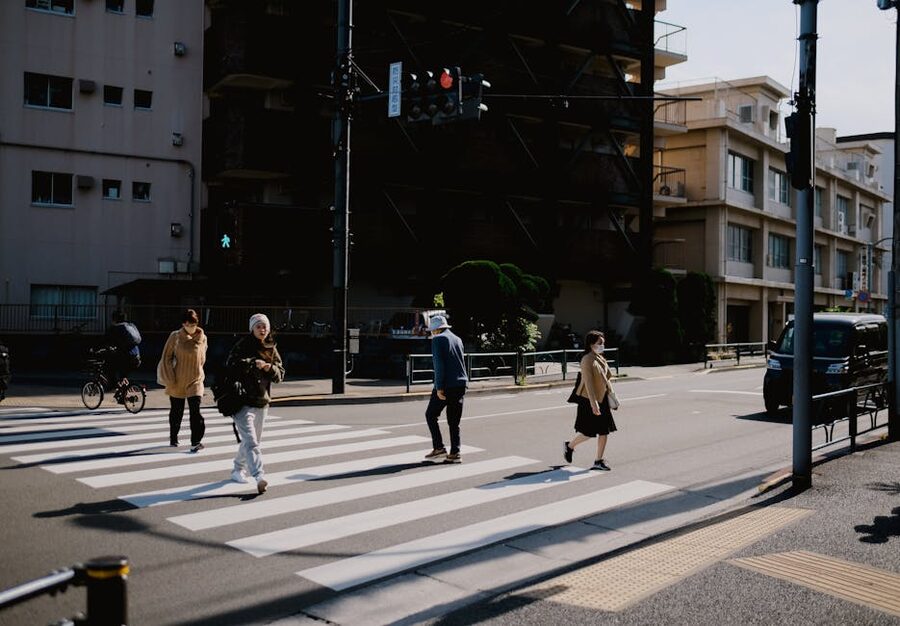
The real picture is simpler than the 31-point listicles suggest. Most of the classic do’s and don’ts you’ll see online are either overstated, outdated, or aimed at the kind of cultural misstep nobody’s going to call you out on anyway. The ones that actually earn you a LOOK from a Japanese commuter are mostly about noise, bins, shoes, and trains. If you get those four right, you’ve already cleared the bar.
In This Article
- What you’ve probably read that’s wrong or overstated
- What actually matters
- Trains and subways: be quiet, do not take calls
- Shoes on, shoes off
- Trash: you’re carrying it home
- Walking and eating, the neighbourhood version
- Onsen and sento rules
- Shoes-off transitions, the full tour
- Shrines and temples: a short version
- Money, cash, and “rude” payments
- Trains and the small courtesy moves
- Photography (where it gets awkward)
- Gifts and omiyage
- The small courtesy moves
- What I actually tell friends before they go
- A few useful outside links
What you’ve probably read that’s wrong or overstated
I want to lead with the reassurance nobody gives you. You have read a lot of things that aren’t really true, or aren’t true the way you’ve been told. Let’s clear some out.
Your chopstick grip is not going to offend anyone. Tourists have been handed grace on chopsticks since forever. Nobody at the ramen counter is silently grading your hand position. The two chopstick rules that do matter are: don’t stand your chopsticks upright in a bowl of rice (it looks like the funeral rite), and don’t pass food from your chopsticks to someone else’s. Both are linked to death rituals, and both genuinely read as bad luck. Everything else is forgivable. Drop them? Swap hands? Spear a dumpling? You’re fine.
You can slurp noodles. Please, actually, slurp them. Silence over a bowl of ramen is the thing that might read as weird. A good slurp is the polite version of telling the chef the food is good, and it cools the noodles on the way in. If you feel self-conscious, sit at a ramen counter at lunchtime and listen for about forty seconds. It sounds like a gentle wind tunnel. Join in.
Tipping is not “offensive” to Japanese people. That’s the internet version. The real reaction is confusion. Staff in a restaurant will often chase you out onto the street to return coins you left on the table, because they assume you forgot them. Cab drivers will count the note carefully and hand back the difference. In hotels, bellhops trained on foreign guests sometimes accept cash in an envelope, but the default across the country is “please pay the price on the bill and that’s it.” Leaving money on a table isn’t rude. It’s just a tiny logistics problem for the person who finds it.
Bowing angles are not a test. You will not be measured on how deep you bow. The small head-nod you naturally give when someone hands you something, or when you leave a restaurant, is enough for 98% of tourist interactions. The deeper bows are reserved for formal contexts that the average traveller simply isn’t in. The one time I actually used a proper bow was when I accidentally walked into a private office at a temple and needed to leave quietly. In every other situation, the nod handled it.
You don’t need to dress formally for shrines. This one gets quoted a lot and it’s nonsense. Meiji Shrine, Sensoji, Kyoto’s big names, the tiny neighbourhood shrines — all of them accept shorts, T-shirts, strap sandals in summer, whatever. You should be covered (no swimwear, obviously), and if you’re entering a specific hall you might need to remove your shoes. That’s the whole dress code. Nobody at the shrine office is judging your knees.
Walking and eating is more nuanced than “banned.” In Asakusa, around Sensoji, there are posted signs asking you not to walk while eating — the street food vendors want you to eat near their stall and throw the wrapper in their bin. In Harajuku, specifically Takeshita Street, walking with a crepe in hand is basically the local culture. On a Tokyo metro train: do not eat. At a conbini counter outside: fine. In the park: fine. The “rule” is neighbourhood-specific.
What actually matters
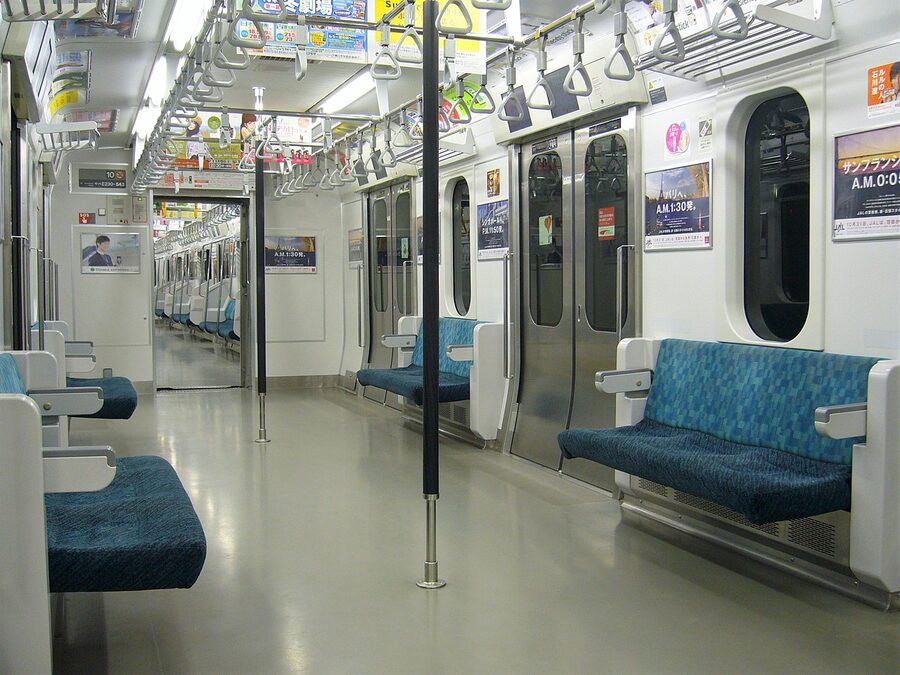

Now the actual rules. I’ve narrowed this to four areas because these are the ones that will separate you from the tourist flagged as “that one” in the group chat of a Japanese carriage.
Trains and subways: be quiet, do not take calls
Japanese trains are the quietest moving objects of their size you’ll ever be on. A full rush-hour Yamanote carriage makes less noise than a three-person corner at a London coffee shop. That’s not a figure of speech. Count it yourself. If you raise your voice above conversation-volume, every head in the carriage won’t turn — but about five will glance. That’s the LOOK. That’s what “reading the air” means in practice.
Three hard rules on trains:
- Phones on silent (“manner mode”). The signs say it in English on every train.
- No phone calls. Texting, reading, watching a video with headphones at low volume, all fine. A live call is a faux pas everyone notices.
- Don’t eat on a commuter train. Shinkansen (bullet trains) are different — bento is basically why people buy them — but the Yamanote, the Tokyo Metro, the Keihin-Tohoku, anything that’s treated like a London Tube line: do not open food.
And while I’m on trains: the priority seats (usually marked with little icons at the end of each carriage) are for pregnant women, elderly passengers, anyone with a walking aid, and anyone with a small child. You can sit in them if none of those people are around, but you stand up the moment one boards. Also, when the train is crowded, take your backpack off and hold it at your feet. This isn’t folk etiquette — it’s printed on signs at every station.
Shoes on, shoes off
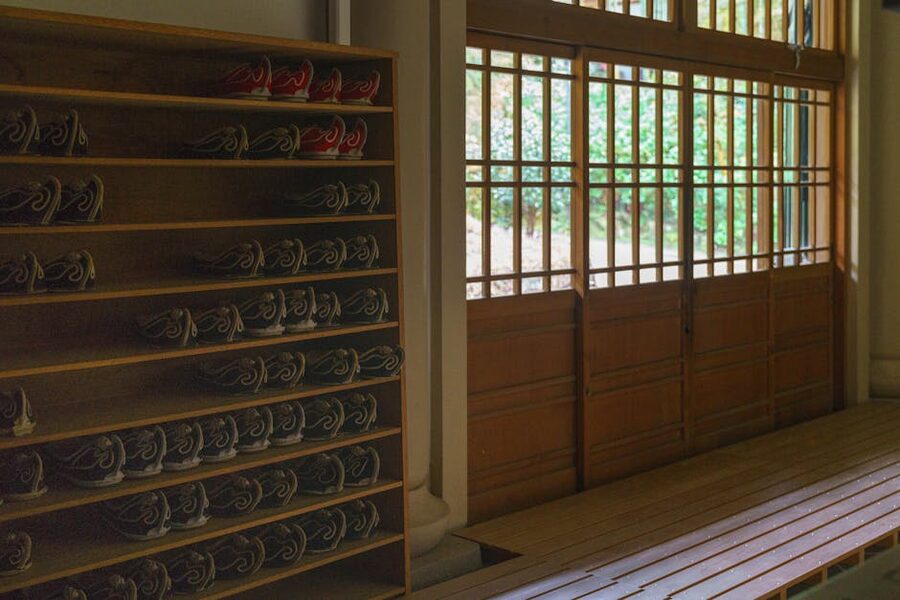
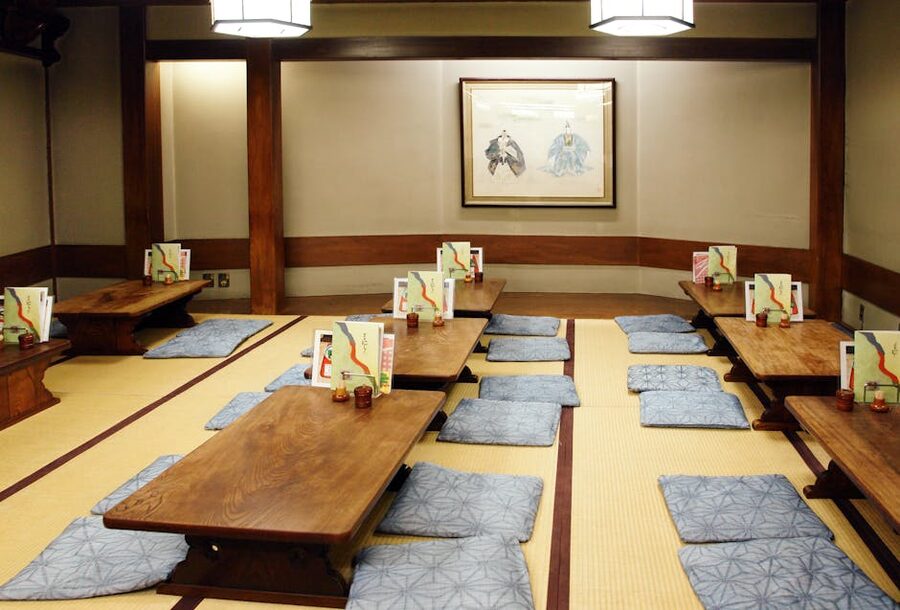
Shoes are the single most common tripwire for visitors. The rule is easier than it sounds: if you see a step-up, a rack of shoes, or a pile of slippers near an entrance, you take your shoes off. That covers ryokan entrances, tatami rooms, many traditional restaurants (especially ones with low tables), fitting rooms in some clothing stores, school buildings, and private homes. The ones you wouldn’t guess: some doctors’ offices, some museums, some archaeological sites.
When you enter a ryokan (a traditional inn), here’s the exact sequence:
- Stop at the genkan (the sunken entry area — the bit of floor lower than the main floor).
- Remove your shoes while still on the lower step, facing inward.
- Step up onto the higher floor level — now you’re on the “inside” floor.
- Turn around and rotate your shoes so they’re pointing back at the door (or staff will do this for you in a fancier place).
- Put on the slippers they hand you or that are waiting.
That’s it. If you trip the first couple of times, that’s also fine. I did.
Trash: you’re carrying it home
There are almost no public bins in Japan. This is one of the things that catches every tourist off guard. You buy a coffee, you drink the coffee, and now you’re walking around with a paper cup for forty minutes trying to figure out what to do with it. Options, in order of realism:
- Finish drinks before you leave the shop you bought them from — most have a bin inside.
- Conbinis (7-Eleven, Lawson, FamilyMart) have bins inside or just outside, usually labelled for burnable/cans/bottles/PET. This is the tourist’s best friend.
- Train stations have bins on the platform in some cases (less common since terrorism rules in the mid-2000s).
- Your hotel. Carry it back, drop it in your room bin.
Do not, under any circumstances, leave your trash on a bench, on the floor of a train, or tucked behind something. This is the fastest way to identify yourself as the kind of visitor locals complain about.
Walking and eating, the neighbourhood version
I mentioned this above but it’s worth a proper answer. Tabearuki (eating while walking) is officially discouraged everywhere but treated differently by neighbourhood. Asakusa has posted signs near Sensoji asking tourists not to walk with food because the street was getting covered in dropped skewers and wrappers. Harajuku’s Takeshita Street, on the other hand, is where you go to eat a crepe the size of your forearm while walking. Ueno Park is fine. Kichijoji is fine. Kyoto’s Nishiki Market recently put up signs asking shoppers to stop eating and walking because it was getting out of hand.
Default rule: eat near where you bought it. Stand to the side. Don’t be the person leaving the vendor covered in your drips. If in doubt, look at what Japanese customers are doing.
Onsen and sento rules
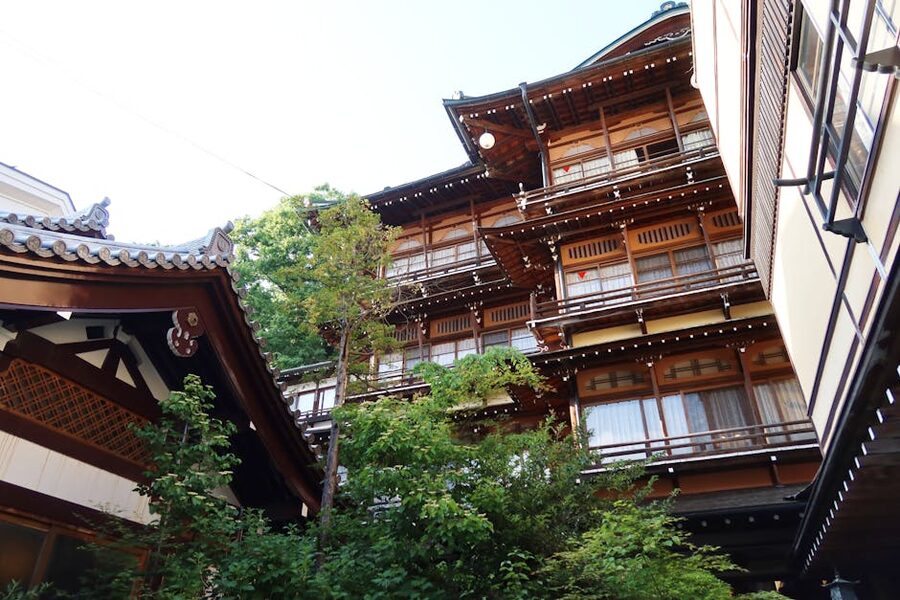
Onsen (natural hot spring) and sento (neighbourhood public bath) etiquette is the one area where the rules are non-negotiable. Mess this up and you’ll actually get asked to leave. The good news is the rules are simple and the same everywhere.
Seven steps, first-time onsen:
- Pay at the counter or the ticket machine, pick up a small and large towel if they’re not provided.
- Enter the correct changing room. Men is usually blue noren (the hanging cloth) and men’s kanji (男), women is red and (女). Memorise the kanji — the colours are not universal.
- Strip completely. Everything off, into a basket or locker. Swimsuits are a hard no.
- Take only the small towel into the bathing area. Leave the large one in the locker.
- Sit at one of the showers/taps. Wash thoroughly. This means soap, scrub, full rinse. Your body must be clean before any water touches the bath.
- Walk to the bath, small towel folded on top of your head or left on the edge — it doesn’t go into the water.
- Soak. Don’t splash, don’t swim, don’t put your head under. When you’re done, shower off again, dry off with the small towel before stepping back into the changing room.
If you have long hair, tie it up before you get in. If you have tattoos, this is where things get specific. Many traditional onsen still ban tattoos entirely — not because of you, but because they’re historically associated with organised crime. The trend is softening but uneven. Some places accept small tattoos covered with medical tape (the bigger conbini sell these — look for “hadairo tape”). Some have private baths (kashikiri-buro) you can book by the hour. And increasingly, ryokan rooms come with an ensuite rotenburo (private outdoor tub), which dodges the issue entirely. If the onsen matters to your trip and you have visible ink, book an ensuite room. That’s the compromise.
One more: no photography in the bathing area. Ever. Phones stay in the locker.
Shoes-off transitions, the full tour
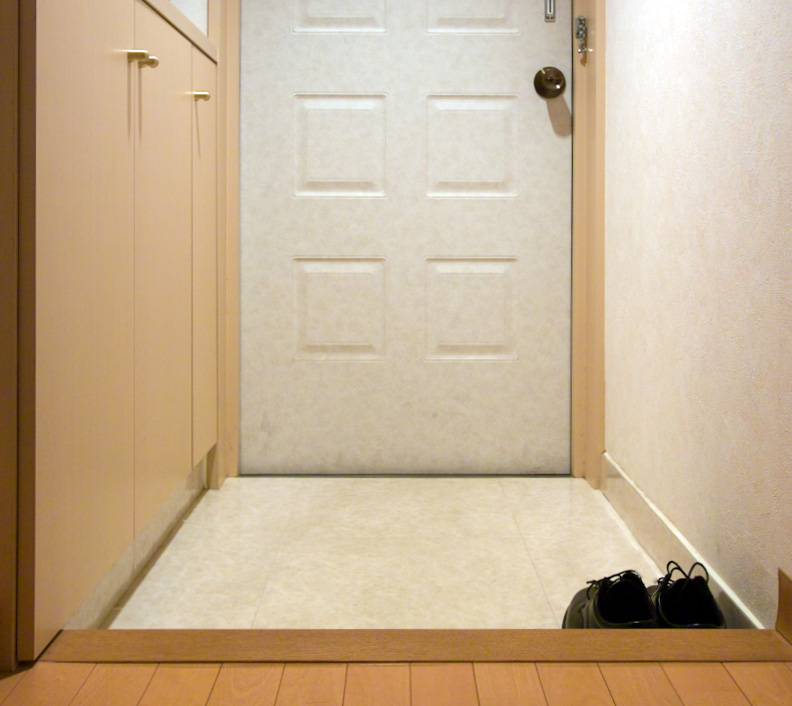
Once you understand the genkan logic, most of Japan’s shoe rules fall into place. The genkan is the transitional zone between outside and inside. Shoes live on the outside level; slippers or socks live on the inside level. The two never mix.
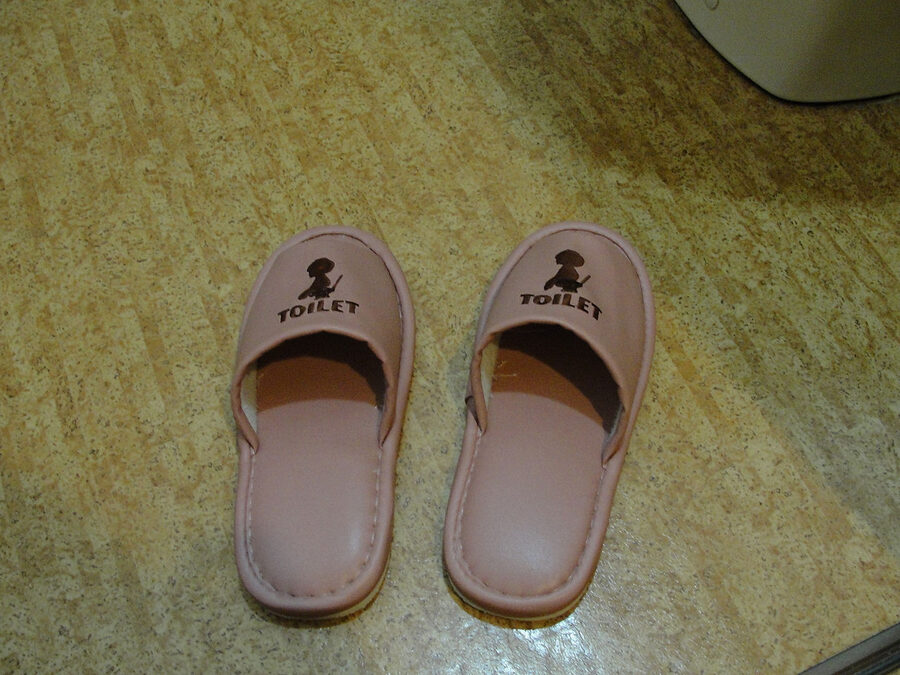
Inside most homes and traditional inns, you’ll get two pairs of slippers. The “house slippers” are for wooden floors and hallways. The “toilet slippers” are a separate pair sitting just inside the toilet room door. You swap into them when you go in, and swap back when you come out. The number-one tourist mistake is walking out of the toilet still wearing toilet slippers, which is the equivalent of tracking something through the rest of the house. If you see a different pair of slippers in the toilet, it’s not decoration — it’s a hand-off.
.jpg)
Tatami mats — the woven straw flooring in traditional rooms — follow their own rule: no slippers, no shoes, socks only. If you step off the wooden floor onto a tatami mat with slippers on, you will get politely corrected. Leave the slippers on the wooden edge and walk on the tatami in socks.
Shrines and temples: a short version
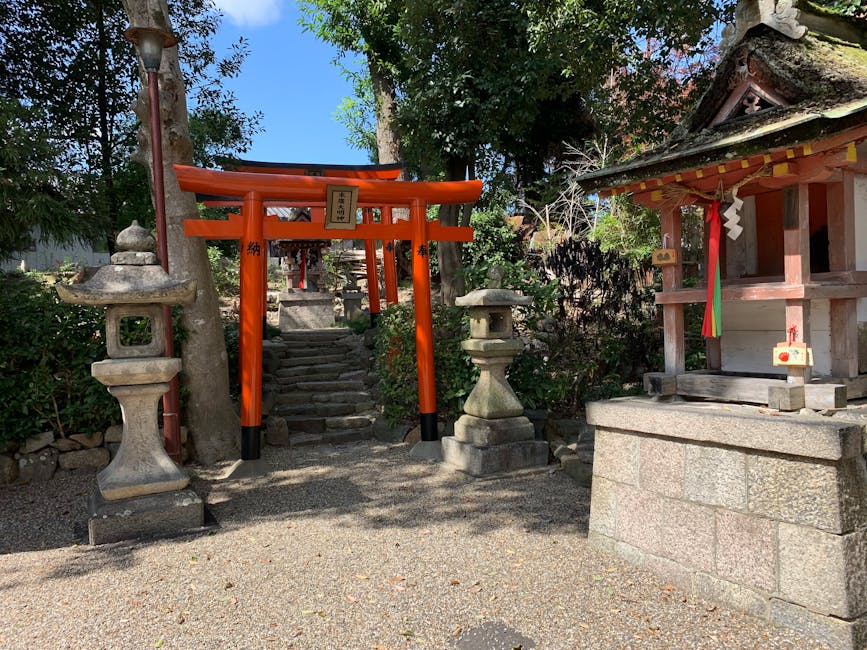
Shrine (jinja, Shinto) and temple (tera, Buddhist) etiquette is short and forgiving. I’ve written more on this for specific sites in my Meiji Shrine guide and Sensoji guide, but the essentials for any visit:
- At the torii (gate), a small head-bow before walking through is traditional. Walk slightly to the side — the centre of the path is for the kami (the spirit).
- Use the temizuya (the water pavilion). Fill the ladle, rinse left hand, then right, then cup water in your left hand and rinse your mouth (spit to the side), then tilt the ladle so the remaining water runs down the handle. One ladle for the whole sequence.
- At a shrine offering hall, it’s two bows, two claps, one bow (“ni-rei, ni-hakushu, ippai”). At a temple offering hall, no clap — put your hands together in front of your chest and bow silently.
- Drop a coin in the box first. ¥5 is traditional because “go-en” puns with the word for a good connection, but anything works.
- Photography: outdoors is fine, inside main halls is usually not. If there’s a sign you can’t read, assume no.
That’s the whole thing. You’re not going to upset anyone by doing this in the wrong order.
Money, cash, and “rude” payments
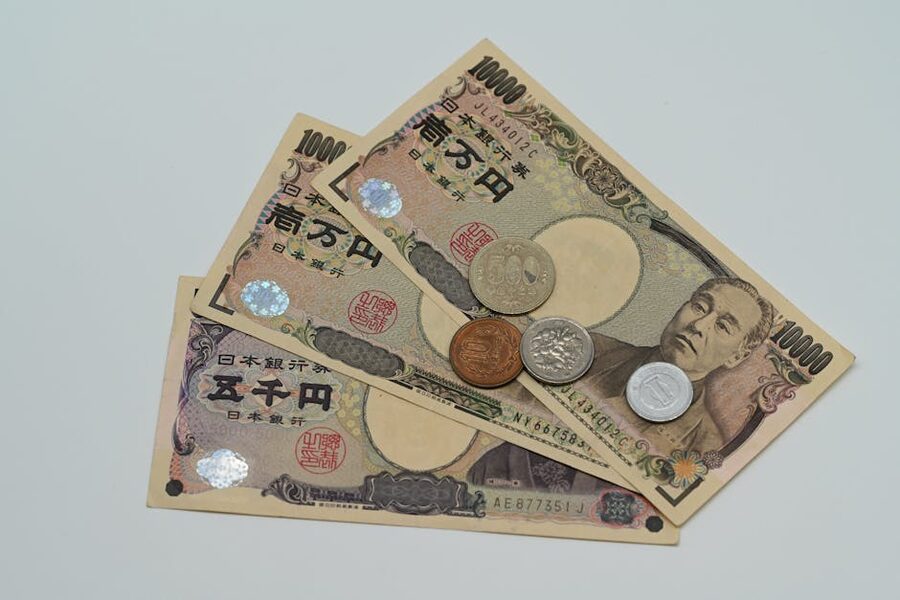
Japan is the most cash-heavy modern country I’ve ever travelled in. This is the second-biggest thing that catches people out. Not because cards are never accepted — they are, everywhere big and chain — but because the small place you want to eat at is much more likely to be cash-only than you expect, and because some of the most memorable experiences (tiny izakaya, offering boxes at shrines, small rural ryokan) are entirely cash-only.
A few specifics:
- Paying a ¥600 coffee with a ¥10,000 note is fine. Everyone has change. In fact, conbinis actively prefer this at certain times because small cash shortages build up when tourists hoard coins.
- Get an IC card (Suica or Pasmo) on day one. You tap in and out of all of Tokyo’s trains, the metro, the buses, and you can pay at conbinis with it. It also works in Osaka, Kyoto, Fukuoka, and most of the country.
- 7-Eleven ATMs accept foreign cards reliably. Most Japanese ATMs don’t. If you’re travelling rurally, hit a 7-Eleven before you get on the train.
- Tipping is not done. Full stop. Confirmed at every context: restaurants, cabs, hotels, ryokan staff, tour guides. If you want to thank someone specifically, a small omiyage (boxed sweets from your country) works better than money.
Use the little tray on the counter. When you hand cash over, it goes in the tray, not directly in the staff’s hand. Your change comes back in the tray. This is one of the ritual details that’ll make you look like you’ve done this before.
Trains and the small courtesy moves
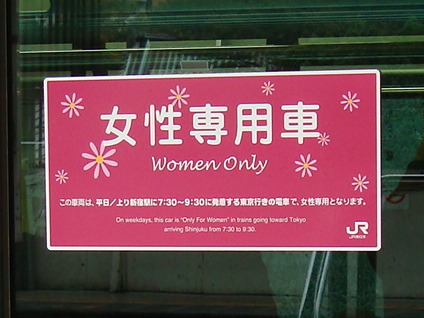
A few more train things I wish someone had told me before I landed:
Women-only carriages run on most major Tokyo lines during weekday rush hours — usually the morning peak (around 07:30-09:30), sometimes evening too. Look for the pink floor markings at the boarding spot on the platform and pink stickers on the carriage windows. Outside those hours, the carriage is normal. Getting this wrong as a man is one of the rare times a Japanese commuter will actually say something directly.
Queuing at the platform happens in neat lines behind painted marks on the floor that show where the train doors will open. People form two files either side of each mark, and when the train arrives, you let passengers off before you board. Do not push through the doors as they open. You’ll be noticed.
Escalator sides differ by city. Tokyo: stand on the left, walk on the right. Osaka: stand on the right, walk on the left. Don’t ask me why — I’ve been corrected in both directions in different cities.
On the Shinkansen, you can eat and drink freely, there are bins at the end of each carriage, and you can pre-book large luggage space on certain routes (Tokyo-Osaka now requires reservations for big suitcases on the back row). If your case is over 160 cm total (height + width + depth), book ahead via the JR reservation page.
Photography (where it gets awkward)
Japan is an easy country to photograph and a surprisingly restrictive one in small ways. The two mistakes I see constantly:
- Geisha and maiko in Kyoto’s Gion district. There’s been a full-on crackdown — Gion now has some private alleys that are closed to tourists entirely after too many incidents of people grabbing at sleeves for selfies. The same goes for the Kagurazaka area in Tokyo on a smaller scale. You don’t chase. You don’t stop them. You certainly don’t pose them.
- People inside restaurants or small shops. Always ask first. A shot of your ramen is fine; a shot that includes the counter staff at work or the table of four next to you isn’t.
Shrine interiors, temple main halls, and most museum collections have photography rules posted in English. A red camera with a slash through it is universal. No flash in the Tokyo National Museum, no video at certain kabuki theatre performances, and no photography inside the offering halls at either Meiji or Sensoji.
Gifts and omiyage
If you stay in a Japanese person’s home, bring a small gift. Not a big gift. Something consumable, wrapped nicely, ideally from your country. This is called “temiyage” on the way in and “omiyage” when you bring something back from a trip. Boxed sweets, a bottle of something, small cakes — all standard. If you’re not staying in a private home, you don’t need to bring anything for anyone. Tourists are not expected to do omiyage in any other context.
If someone gives you a gift, the convention is not to open it in front of them. Take it, thank them, open it later. This one surprises a lot of Western visitors used to the opposite — the idea of opening a present straight away is slightly embarrassing for the giver, because it turns a private generosity into a public reaction you’re being watched for.
The small courtesy moves
These are the quiet moves that make a visible difference. None of them are mandatory; all of them are noticed:
- Head-nod on entry/exit. Walking into a small shop or restaurant, give the staff a small head-bow with “konnichiwa”. Walking out, “gochisousama deshita” at a restaurant or “arigatou gozaimashita” anywhere else. A tiny nod goes with both. Takes a second and it transforms the interaction.
- Let people off the train first. Stand to the side of the doors, let the carriage empty, then board.
- Line up at the platform marks. If you’re near the edge of the queue, stay there, don’t drift in.
- Don’t blow your nose at the table. Blowing your nose in public, in front of people, is the one body-sound Japan finds genuinely impolite. Sniffing quietly is fine. A full trumpet into a tissue at dinner is not. If you have to clear your nose, step into the bathroom.
- Walk on the left indoors. Most corridors and staircases default to left-lane, same as the trains. It’s not strict, but if you’re dodging people in a department store, left is safe.
- Business cards (meishi), if it comes up. Take with both hands, read it, don’t stuff it in your pocket, and don’t write on it. This almost never applies to tourists, but if you end up in a slightly professional context (a guided tour, a shop owner introducing themselves) you’ll be glad you knew.
What I actually tell friends before they go
Here’s the short list I send to every friend the week before their Japan trip:
- Volume on trains, calls go to voicemail until you get off. This is the big one.
- Carry a small plastic bag in your daypack for your trash, because the bin you want is not there.
- Slip-on shoes. Trust me.
- Get a Suica/Pasmo the moment you land — the Welcome Suica is fine.
- Keep at least ¥10,000 on you. ¥20,000 if you’re eating at small places.
- Tipping is not a thing. Stop thinking about it.
- Cross on the green, even at 6 am with no car in sight.
- Onsen: wash first. Tattoos: check the policy of the specific place, or book a ryokan with a private rotenburo.
- On the Shinkansen, eat the bento. On the Yamanote, don’t.
- Your chopstick grip is fine.
That’s the list. Everything else is a nice-to-know.
A few useful outside links
The official tourism sources are genuinely useful for this stuff — they’ll back up what I’ve written and add the government-level specifics like public smoking rules:
- JNTO’s manners overview — official Japan National Tourism Organization, the baseline etiquette guide.
- Go Tokyo’s travel basics — Tokyo’s metropolitan government tourism site, good for train and payment specifics.
- JR East — the train operator whose lines cover most of Tokyo and much of north-east Japan. Their English site has the live timetables and reservation links for the Shinkansen large-luggage rule.
And if you want to go deeper on specific scenarios, my guides to dining etiquette in Japan (chopsticks, paying, sharing dishes) and making restaurant reservations (the “Japanese phone number” barrier, how to get around it) cover the food side with the kind of detail I couldn’t squeeze in here. They’re a natural pair with this article.
The last thing I’ll say: most of Japan’s social rules are quiet invitations, not traps. You step on the train, you lower your voice, and the country gets easier. You trip a couple, and nobody’s going to shout at you. The worst thing that’ll happen is you’ll catch the LOOK from a tired salaryman on the Hibiya Line, and then you won’t do it again. That’s honestly the whole system.